

Ismene

Encyclopedia

Greek mythology
Greek mythology is the body of myths and legends belonging to the ancient Greeks, concerning their gods and heroes, the nature of the world, and the origins and significance of their own cult and ritual practices. They were a part of religion in ancient Greece...
. The more famous is a daughter and half-sister of Oedipus
Oedipus
Oedipus was a mythical Greek king of Thebes. He fulfilled a prophecy that said he would kill his father and marry his mother, and thus brought disaster on his city and family...
, daughter and granddaughter of Jocasta
Jocasta
In Greek mythology, Jocasta, also known as Jocaste , Epikastê, or Iokastê was a daughter of Menoeceus and Queen consort of Thebes, Greece. She was the wife of Laius. Wife and mother of Oedipus by Laius, and both mother and grandmother of Antigone, Eteocles, Polynices and Ismene by Oedipus...
, and sister of Antigone
Antigone
In Greek mythology, Antigone is the daughter of Oedipus and Jocasta, Oedipus' mother. The name may be taken to mean "unbending", coming from "anti-" and "-gon / -gony" , but has also been suggested to mean "opposed to motherhood", "in place of a mother", or "anti-generative", based from the root...
, Eteocles
Eteocles
In Greek mythology, Eteocles was a king of Thebes, the son of Oedipus and either Jocasta or Euryganeia. The name is from earlier *Etewoklewes , meaning "truly glorious". Tawaglawas is thought to be the Hittite rendition of the name. Oedipus killed his father Laius and married his mother without...
, and Polynices
Polynices
In Greek mythology, Polynices or Polyneices was the son of Oedipus and Jocasta. His wife was Argea. His father, Oedipus, was discovered to have killed his father and married his mother, and was expelled from Thebes, leaving his sons Eteocles and Polynices to rule...
. She appears in several plays of Sophocles
Sophocles
Sophocles is one of three ancient Greek tragedians whose plays have survived. His first plays were written later than those of Aeschylus, and earlier than or contemporary with those of Euripides...
: at the end of Oedipus the King
Oedipus the King
Oedipus the King , also known by the Latin title Oedipus Rex, is an Athenian tragedy by Sophocles that was first performed c. 429 BCE. It was the second of Sophocles's three Theban plays to be produced, but it comes first in the internal chronology, followed by Oedipus at Colonus and then Antigone...
, in Oedipus at Colonus
Oedipus at Colonus
Oedipus at Colonus is one of the three Theban plays of the Athenian tragedian Sophocles...
and in Antigone
Antigone (Sophocles)
Antigone is a tragedy by Sophocles written in or before 442 BC. Chronologically, it is the third of the three Theban plays but was written first...
. She also appears at the end of Aeschylus
Aeschylus
Aeschylus was the first of the three ancient Greek tragedians whose work has survived, the others being Sophocles and Euripides, and is often described as the father of tragedy. His name derives from the Greek word aiskhos , meaning "shame"...
' Seven Against Thebes
Seven Against Thebes
The Seven against Thebes is the third play in an Oedipus-themed trilogy produced by Aeschylus in 467 BC. The trilogy is sometimes referred to as the Oedipodea. It concerns the battle between an Argive army led by Polynices and the army of Thebes led by Eteocles and his supporters. The trilogy won...
.
When Oedipus
Oedipus
Oedipus was a mythical Greek king of Thebes. He fulfilled a prophecy that said he would kill his father and marry his mother, and thus brought disaster on his city and family...
stepped down as King of Thebes, he gave the kingdom to Eteocles
Eteocles
In Greek mythology, Eteocles was a king of Thebes, the son of Oedipus and either Jocasta or Euryganeia. The name is from earlier *Etewoklewes , meaning "truly glorious". Tawaglawas is thought to be the Hittite rendition of the name. Oedipus killed his father Laius and married his mother without...
and Polynices
Polynices
In Greek mythology, Polynices or Polyneices was the son of Oedipus and Jocasta. His wife was Argea. His father, Oedipus, was discovered to have killed his father and married his mother, and was expelled from Thebes, leaving his sons Eteocles and Polynices to rule...
, who both agreed to alternate the throne every year. However, after the first year, Eteocles refused to step down and Polynices attacked Thebes with his supporters (the Seven Against Thebes). Both brothers died in the battle. King Creon
Creon
Creon is a figure in Greek mythology best known as the ruler of Thebes in the legend of Oedipus. He had two children with his wife, Eurydice: Megareus and Haemon...
, who ascended to the throne of Thebes, decreed that Polynices was not to be buried, but left to rot on pain of death.
However, Antigone defied the order and was caught. In the opening scene of the play when Antigone is about to perform the burial rituals on Polynices, Ismene serves as the compassionate but rational and prudent counterpart to Antigone's headstrong style of decision-making with no regard for consequence. While Antigone resolves to honor her brother at all costs, Ismene laments that while she too loves her brother, her disposition does not allow her to defy the state and become an outlaw. Once Antigone was caught, in spite of her betrothal to his son Haemon
Haemon
According to Sophocles' play Antigone, Haemon or Haimon , was the son of Creon and Eurydice.When Oedipus stepped down as King of Thebes, he gave the kingdom to his two sons, Eteocles and Polynices, who both agreed to alternate the throne every year. However, they showed no concern for their...
, Creon decreed that she was to be buried alive. Ismene then declared she had aided Antigone and wanted the same fate, though she did not participate in the crime. Antigone refused to let her be martyred for a cause she did not stand up for. She even seems to forget her sister exists, calling herself the 'last descendant of Oedipus.'
Thus, it is apparent that Ismene serves as a foil for Antigone; she is the “compliant citizen” to her sister’s “conscientious objector.” While she is loyal and willing to die at her sister’s side, she does not make the same bold, defiant stand that Antigone does. Like Haemon, she is a reasonable, sympathetic person whose fate is tied to the far more fanatical Antigone and Creon.
However, in Aeschylus' play, Seven Against Thebes, Ismene and Antigone sing a funeral dirge together for both of their brothers.
The 7th century poet Mimnermus
Mimnermus
Mimnermus was a Greek elegiac poet from either Colophon or Smyrna in Ionia, who flourished about 630-600 BC. He was strongly influenced by the example of Homer yet he wrote short poems suitable for performance at drinking parties and was remembered by ancient authorities chiefly as a love poet...
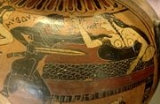
accounts that Ismene was murdered by Tydeus
Tydeus
In Greek mythology, Tydeus was an Aeolian hero of the generation before the Trojan War. He was one of the Seven Against Thebes and was mortally wounded by Melanippus before the walls of the city. The goddess Athena had planned to make him immortal but refused after Tydeus in a rage devoured the...
. No other Classical writer mentions the story, but the scene is represented on a 6th century Corinthian black-figure
Black-figure pottery
Black-figure pottery painting, also known as the black-figure style or black-figure ceramic is one of the most modern styles for adorning antique Greek vases. It was especially common between the 7th and 5th centuries BC, although there are specimens dating as late as the 2nd century BC...
amphora
Amphora
An amphora is a type of vase-shaped, usually ceramic container with two handles and a long neck narrower than the body...
now housed in the Louvre
Louvre
The Musée du Louvre – in English, the Louvre Museum or simply the Louvre – is one of the world's largest museums, the most visited art museum in the world and a historic monument. A central landmark of Paris, it is located on the Right Bank of the Seine in the 1st arrondissement...
.
Daughter of Asopus
Ismene was also a daughter of the river-god AsopusAsopus
Asopus or Asôpos is the name of four different rivers in Greece and one in Turkey. In Greek mythology, it was the name of the gods of those rivers.-The rivers in Greece:...
by Metope
Metope (mythology)
In Greek mythology, Metope was a river nymph, the daughter of the river Ladon. Her waters were near the town of Stymphalus in the Peloponnesus...
. The blue berries, near Thebes, was named for her, or for her brother.