


Eteocles

Encyclopedia
Greek mythology
Greek mythology is the body of myths and legends belonging to the ancient Greeks, concerning their gods and heroes, the nature of the world, and the origins and significance of their own cult and ritual practices. They were a part of religion in ancient Greece...
, Eteocles was a king of Thebes
Ancient Thebes (Boeotia)
See Thebes, Greece for the modern city built on the ancient ruins.Ancient Thebes was a Boeotian city-state , situated to the north of the Cithaeron range, which divides Boeotia from Attica, and on the southern edge of the Boeotian plain...
, the son of Oedipus
Oedipus
Oedipus was a mythical Greek king of Thebes. He fulfilled a prophecy that said he would kill his father and marry his mother, and thus brought disaster on his city and family...
and either Jocasta
Jocasta
In Greek mythology, Jocasta, also known as Jocaste , Epikastê, or Iokastê was a daughter of Menoeceus and Queen consort of Thebes, Greece. She was the wife of Laius. Wife and mother of Oedipus by Laius, and both mother and grandmother of Antigone, Eteocles, Polynices and Ismene by Oedipus...
or Euryganeia. The name is from earlier *Etewoklewes , meaning "truly glorious". Tawaglawas is thought to be the Hittite
Hittite language
Hittite is the extinct language once spoken by the Hittites, a people who created an empire centred on Hattusa in north-central Anatolia...
rendition of the name. Oedipus killed his father Laius
Laius
In Greek mythology, King Laius, or Laios of Thebes was a divine hero and key personage in the Theban founding myth. Son of Labdacus, he was raised by the regent Lycus after the death of his father.-Abduction of Chrysippus:...
and married his mother without knowing his relationship to either. When the relationship was revealed, he was expelled from Thebes. The rule passed to his sons Eteocles and Polynices
Polynices
In Greek mythology, Polynices or Polyneices was the son of Oedipus and Jocasta. His wife was Argea. His father, Oedipus, was discovered to have killed his father and married his mother, and was expelled from Thebes, leaving his sons Eteocles and Polynices to rule...
. However, because of a curse from their father, the two brothers did not share the rule peacefully. Eteocles was succeeded by his uncle, Creon
Creon
Creon is a figure in Greek mythology best known as the ruler of Thebes in the legend of Oedipus. He had two children with his wife, Eurydice: Megareus and Haemon...
.
Oedipus's curse
In the ThebaidThebaid (Greek poem)
The Thebaid or Thebais is an Ancient Greek epic poem of uncertain authorship sometimes attributed by early writers to Homer. It told the story of the war between the brothers Eteocles and Polynices, and was regarded as forming part of a Theban Cycle. Only fragments of the text...
, the brothers were cursed by their father for their disrespect towards him on two occasions. The first of these occurred when they served him using the silver table of Cadmus
Cadmus
Cadmus or Kadmos , in Greek mythology was a Phoenician prince, the son of king Agenor and queen Telephassa of Tyre and the brother of Phoenix, Cilix and Europa. He was originally sent by his royal parents to seek out and escort his sister Europa back to Tyre after she was abducted from the shores...
and a golden cup, which he had forbidden. The brothers then sent him the haunch of a sacrificed animal, rather than the shoulder, which he deserved. Enraged, Oedipus prayed to Zeus
Zeus
In the ancient Greek religion, Zeus was the "Father of Gods and men" who ruled the Olympians of Mount Olympus as a father ruled the family. He was the god of sky and thunder in Greek mythology. His Roman counterpart is Jupiter and his Etruscan counterpart is Tinia.Zeus was the child of Cronus...
that the brothers would die by each other's hands. However, in Sophocles
Sophocles
Sophocles is one of three ancient Greek tragedians whose plays have survived. His first plays were written later than those of Aeschylus, and earlier than or contemporary with those of Euripides...
's Oedipus at Colonus
Oedipus at Colonus
Oedipus at Colonus is one of the three Theban plays of the Athenian tragedian Sophocles...
, Oedipus desired to stay in Thebes but was expelled by Creon. His sons argued over the throne, but Eteocles gained the support of the Thebans and expelled Polynices, who went to Oedipus to ask for his blessing to retake the city, but instead was cursed to die by his brother's hand.
Quarrel over the rule of Thebes
There are several accounts of how Eteocles and Polynices shared the rule after Oedipus's departure from the city. In Hellanikos's account, Eteocles offers his brother his choice of either the rule of the city or a share of the property. In PherekydesPherecydes of Leros
Pherecydes of Leros was a Greek mythographer and logographer. He came from the island of Leros. Pherecydes spent the greater part of his working life in Athens, and so he was also called Pherecydes of Athens: the encyclopedic Byzantine Suda consider Pherecydes of Athens and of Leros...
, however, Eteocles expels Polynices by force, and keeps the rule of Thebes and the inheritance. Apollodorus
Apollodorus
Apollodorus of Athens son of Asclepiades, was a Greek scholar and grammarian. He was a pupil of Diogenes of Babylon, Panaetius the Stoic, and the grammarian Aristarchus of Samothrace...
and Diodorus state that the brothers agree to divide the kingship between them, switching each year. Eteocles, however, was allotted the first year, and refused to surrender the crown.
In all of these versions, Polynices gathered the support of the Argives and attacked Thebes. This battle is the subject of Aeschylus
Aeschylus
Aeschylus was the first of the three ancient Greek tragedians whose work has survived, the others being Sophocles and Euripides, and is often described as the father of tragedy. His name derives from the Greek word aiskhos , meaning "shame"...
' tragedy Seven Against Thebes
Seven Against Thebes
The Seven against Thebes is the third play in an Oedipus-themed trilogy produced by Aeschylus in 467 BC. The trilogy is sometimes referred to as the Oedipodea. It concerns the battle between an Argive army led by Polynices and the army of Thebes led by Eteocles and his supporters. The trilogy won...
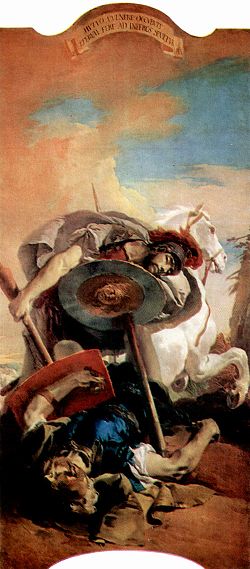
. Although Eteocles's forces were victorious, the brothers killed each other.
Sources
- Gantz, Timothy. Early Greek Myth. Baltimore: Johns Hopkins University Press, 1993.