

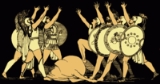
Seven Against Thebes

Encyclopedia
The Seven against Thebes is the third play in an Oedipus-themed trilogy produced by Aeschylus
in 467 BC. The trilogy is sometimes referred to as the Oedipodea. It concerns the battle between an Argive army led by Polynices
and the army of Thebes
led by Eteocles
and his supporters. The trilogy won the first prize at the City Dionysia. Its first two plays, Laius and Oedipus as well as the satyr play
Sphinx are no longer extant.
, The king of Thebes, realized he had married his own mother and had four children with her, he blinded himself and cursed his sons to divide their inheritance (the kingdom) by the sword. The two sons, Eteocles
and Polynices
, in order to avoid bloodshed, agreed to rule Thebes in alternate years. After the first year, Eteocles refused to step down and as a result, Polynices raised an army (captained by the eponymous Seven) to take Thebes by force. This is where Aeschylus
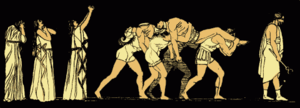
' tragedy starts. There is little plot as such; instead, the bulk of the play consists of rich dialogues that show how the citizens of Thebes feel about the threat of the hostile army before their gates, and also how their king Eteocles feels and thinks about it. Dialogues also show aspects of Eteocles character. There is also a lengthy description of each of the seven captains that lead the Argive army against the seven gates of the city of Thebes as well as the devices on their respective shields. Eteocles, in turn, announces which Theban commander he will send against each Argive attacker. Finally, the commander of the troops before the seventh gate is revealed to be Polynices, the brother of the king. Then Eteocles remembers and refers to the curse of their father Oedipus King Eteocles resolves to meet and fight his brother in person before the seventh gate and exits. Following a choral ode, a messenger enters, announcing that the attackers have been repelled but that Eteocles and Polynices have killed each other in battle. Their bodies are brought on stage, and the chorus mourns them.
The seven attackers and defenders in the play are:
Due to the popularity of Sophocles's Antigone
, the ending of Seven against Thebes was rewritten about fifty years after Aeschylus' death. Where the play was meant to end with somber mourning for the dead brothers, it instead contains an ending that serves as a lead-in of sorts to Sophocles' play: a messenger appears, announcing a prohibition against burying Polynices; Antigone, however, announces her intention to defy this edict.
of the "outlandish" and "savage" Seven who threatened the city has traditionally seemed to be based on Bronze Age history in the generation before the Trojan War
, when in the Iliad
s Catalogue of Ships
only the remnant Hypothebai subsists on the ruins. Yet archaeologists have been hard put to locate seven gates in "seven-gated Thebes": In 1891 Ulrich von Wilamowitz-Moellendorff
declared that the seven gates existed only for symmetry with the seven assailants, whose very names vary: some have their own identity, like Amphiaraus
the seer, "who had his sanctuary
and his cult afterwards... Others appear as stock figures to fill out the list," Burkert remarks. "To call one of them Eteoklos, vis-à-vis Eteokles the brother of Polyneikes, appears to be the almost desperate invention of a faltering poet" Burkert follows a suggestion made by Ernest Howald in 1939 that the Seven are pure myth led by Adrastos (the "inescapable") on his magic horse, seven demons of the Underworld
; Burkert draws parallels in an Akkadian epic text, the story of Erra the plague god, and the Seven (Sibitti), called upon to destroy mankind, but who withdraw from Babylon at the last. The city is saved when the brothers simultaneously run each other through. Burkert adduces a ninth-century relief from Tell Halaf
which would exactly illustrate a text from II Samuel 7: "But each seized his opponent by the forelock and thrust his sword into his side so that all fell together".
The mythic theme passed into Etruscan culture: a fifth-century bronze mirrorback
is inscribed with Fulnice (Polynices) and Evtucle (Eteocles) running at one another with drawn swords. A particularly gruesome detail from the battle, in which Tydeus gnawed on the living brain of Melanippos in the course of the siege, also appears, in a sculpted terracotta relief from a temple at Pyrgi
, ca. 470-460 BC.
 The Seven Against Thebes were
Allies:
The defenders of Thebes included
See also Epigoni
, the mythic theme of the Second War of Thebes
The Sphinx, few fragments have survived. The only fragment definitively assigned to Oedipus is a line translated by Herbert Weir Smyth
as "We were coming on our journey to the place from which three highways part in the branching roads, where we crossed the junction of the triple roads at Potniae." The only two fragments definitively assigned to The Sphinx were translated by Smyth as "For the stranger a garland, an ancient crown, the best of bonds, as Prometheus
said," and "The Sphinx, the Watch-dog that presideth over evil days."
Aeschylus
Aeschylus was the first of the three ancient Greek tragedians whose work has survived, the others being Sophocles and Euripides, and is often described as the father of tragedy. His name derives from the Greek word aiskhos , meaning "shame"...
in 467 BC. The trilogy is sometimes referred to as the Oedipodea. It concerns the battle between an Argive army led by Polynices
Polynices
In Greek mythology, Polynices or Polyneices was the son of Oedipus and Jocasta. His wife was Argea. His father, Oedipus, was discovered to have killed his father and married his mother, and was expelled from Thebes, leaving his sons Eteocles and Polynices to rule...
and the army of Thebes
Ancient Thebes (Boeotia)
See Thebes, Greece for the modern city built on the ancient ruins.Ancient Thebes was a Boeotian city-state , situated to the north of the Cithaeron range, which divides Boeotia from Attica, and on the southern edge of the Boeotian plain...
led by Eteocles
Eteocles
In Greek mythology, Eteocles was a king of Thebes, the son of Oedipus and either Jocasta or Euryganeia. The name is from earlier *Etewoklewes , meaning "truly glorious". Tawaglawas is thought to be the Hittite rendition of the name. Oedipus killed his father Laius and married his mother without...
and his supporters. The trilogy won the first prize at the City Dionysia. Its first two plays, Laius and Oedipus as well as the satyr play
Satyr play
Satyr plays were an ancient Greek form of tragicomedy, similar in spirit to burlesque. They featured choruses of satyrs, were based on Greek mythology, and were rife with mock drunkenness, brazen sexuality , pranks, sight gags, and general merriment.Satyric drama was one of the three varieties of...
Sphinx are no longer extant.
Plot summary
When OedipusOedipus
Oedipus was a mythical Greek king of Thebes. He fulfilled a prophecy that said he would kill his father and marry his mother, and thus brought disaster on his city and family...
, The king of Thebes, realized he had married his own mother and had four children with her, he blinded himself and cursed his sons to divide their inheritance (the kingdom) by the sword. The two sons, Eteocles
Eteocles
In Greek mythology, Eteocles was a king of Thebes, the son of Oedipus and either Jocasta or Euryganeia. The name is from earlier *Etewoklewes , meaning "truly glorious". Tawaglawas is thought to be the Hittite rendition of the name. Oedipus killed his father Laius and married his mother without...
and Polynices
Polynices
In Greek mythology, Polynices or Polyneices was the son of Oedipus and Jocasta. His wife was Argea. His father, Oedipus, was discovered to have killed his father and married his mother, and was expelled from Thebes, leaving his sons Eteocles and Polynices to rule...
, in order to avoid bloodshed, agreed to rule Thebes in alternate years. After the first year, Eteocles refused to step down and as a result, Polynices raised an army (captained by the eponymous Seven) to take Thebes by force. This is where Aeschylus
Aeschylus
Aeschylus was the first of the three ancient Greek tragedians whose work has survived, the others being Sophocles and Euripides, and is often described as the father of tragedy. His name derives from the Greek word aiskhos , meaning "shame"...
' tragedy starts. There is little plot as such; instead, the bulk of the play consists of rich dialogues that show how the citizens of Thebes feel about the threat of the hostile army before their gates, and also how their king Eteocles feels and thinks about it. Dialogues also show aspects of Eteocles character. There is also a lengthy description of each of the seven captains that lead the Argive army against the seven gates of the city of Thebes as well as the devices on their respective shields. Eteocles, in turn, announces which Theban commander he will send against each Argive attacker. Finally, the commander of the troops before the seventh gate is revealed to be Polynices, the brother of the king. Then Eteocles remembers and refers to the curse of their father Oedipus King Eteocles resolves to meet and fight his brother in person before the seventh gate and exits. Following a choral ode, a messenger enters, announcing that the attackers have been repelled but that Eteocles and Polynices have killed each other in battle. Their bodies are brought on stage, and the chorus mourns them.
The seven attackers and defenders in the play are:
| # | Attacker | Defender |
|---|---|---|
| 1 | Tydeus Tydeus In Greek mythology, Tydeus was an Aeolian hero of the generation before the Trojan War. He was one of the Seven Against Thebes and was mortally wounded by Melanippus before the walls of the city. The goddess Athena had planned to make him immortal but refused after Tydeus in a rage devoured the... |
Melanippus Melanippus In Greek mythology, there were nine people named Melanippus :#One of the sons of Agrius, killed by Diomedes.#Son of Perigune and Theseus, the father of Ioxus who, together with Ornytus, led a colony to Caria and became the ancestor of the family Ioxides.#Son of Astacus, defended Thebes in Seven... |
| 2 | Capaneus Capaneus In Greek mythology, Capaneus was a son of Hipponous and either Astynome or Laodice , and husband of Evadne, with whom he fathered Sthenelus. Some call his wife Ianeira.... |
Polyphontes Polyphontes In Greek mythology, Polyphontes was the son of Autophonus. In the Iliad, when the Argives attack Thebes in an attempt to regain the throne for Polynices that his brother, Eteocles, holds, Tydeus, a leader of the Thebans, enters Thebes as an embassy, and finding all the Theban leaders together... |
| 3 | Eteoclus Eteoclus In Greek mythology, Eteoclus was the son of Iphis. He participated in the attack on Thebes by the Seven Against Thebes.In Aeschylus' play Seven Against Thebes, Eteoclus is one of the seven champions who attack Thebes' seven gates... |
Megareus Megareus of Thebes Megareus of Thebes was the son of Eurydice of Thebes and Creon, a king of Thebes, who appears in Antigone, a play by Sophocles.... |
| 4 | Hippomedon Hippomedon In Greek mythology, Hippomedon was one of the Seven Against Thebes and father of Polydorus.His father was either Talaus, the father of Adrastus, or Aristomachus , or Mnesimachus. If he is the son of Mnesimachus, then his mother is Metidice, daughter of Talaus, which makes him Adrastus's sister's... |
Hyperbius |
| 5 | Parthenopeus Parthenopeus For the hero of mediaeval romance, see Partonopeus de BloisIn Greek mythology, Parthenopeus was one of the Seven Against Thebes and the son of Atalanta and Hippomenes, Meleager, or Ares, or perhaps the son of Talaus. Promachus was his son... |
Actor Actor (mythology) Actor is a very common name in Greek mythology. Here is a selection of characters that share this name :... |
| 6 | Amphiaraus Amphiaraus In Greek mythology, Amphiaraus was the son of Oecles and Hypermnestra, and husband of Eriphyle. Amphiaraus was the King of Argos along with Adrastus— the brother of Amphiaraus' wife, Eriphyle— and Iphis. Amphiaraus was a seer, and greatly honored in his time... |
Lasthenes |
| 7 | Polynices Polynices In Greek mythology, Polynices or Polyneices was the son of Oedipus and Jocasta. His wife was Argea. His father, Oedipus, was discovered to have killed his father and married his mother, and was expelled from Thebes, leaving his sons Eteocles and Polynices to rule... |
Eteocles Eteocles In Greek mythology, Eteocles was a king of Thebes, the son of Oedipus and either Jocasta or Euryganeia. The name is from earlier *Etewoklewes , meaning "truly glorious". Tawaglawas is thought to be the Hittite rendition of the name. Oedipus killed his father Laius and married his mother without... |
Due to the popularity of Sophocles's Antigone
Antigone (Sophocles)
Antigone is a tragedy by Sophocles written in or before 442 BC. Chronologically, it is the third of the three Theban plays but was written first...
, the ending of Seven against Thebes was rewritten about fifty years after Aeschylus' death. Where the play was meant to end with somber mourning for the dead brothers, it instead contains an ending that serves as a lead-in of sorts to Sophocles' play: a messenger appears, announcing a prohibition against burying Polynices; Antigone, however, announces her intention to defy this edict.
The mythic content
The mythemeMytheme
In the study of mythology, a mytheme is the essential kernel of a myth—an irreducible, unchanging element, a minimal unit that is always found shared with other, related mythemes and reassembled in various ways—"bundled" was Claude Lévi-Strauss's image— or linked in more...
of the "outlandish" and "savage" Seven who threatened the city has traditionally seemed to be based on Bronze Age history in the generation before the Trojan War
Trojan War
In Greek mythology, the Trojan War was waged against the city of Troy by the Achaeans after Paris of Troy took Helen from her husband Menelaus, the king of Sparta. The war is among the most important events in Greek mythology and was narrated in many works of Greek literature, including the Iliad...
, when in the Iliad
Iliad
The Iliad is an epic poem in dactylic hexameters, traditionally attributed to Homer. Set during the Trojan War, the ten-year siege of the city of Troy by a coalition of Greek states, it tells of the battles and events during the weeks of a quarrel between King Agamemnon and the warrior Achilles...
s Catalogue of Ships
Catalogue of Ships
The Catalogue of Ships is a passage in Book 2 of Homer's Iliad , which lists the contingents of the Achaean army that sailed to Troy...
only the remnant Hypothebai subsists on the ruins. Yet archaeologists have been hard put to locate seven gates in "seven-gated Thebes": In 1891 Ulrich von Wilamowitz-Moellendorff
Ulrich von Wilamowitz-Moellendorff
Enno Friedrich Wichard Ulrich von Wilamowitz-Moellendorff was a German Classical Philologist. Wilamowitz, as he is known in scholarly circles, was a renowned authority on Ancient Greece and its literature.- Youth :...
declared that the seven gates existed only for symmetry with the seven assailants, whose very names vary: some have their own identity, like Amphiaraus
Amphiaraus
In Greek mythology, Amphiaraus was the son of Oecles and Hypermnestra, and husband of Eriphyle. Amphiaraus was the King of Argos along with Adrastus— the brother of Amphiaraus' wife, Eriphyle— and Iphis. Amphiaraus was a seer, and greatly honored in his time...
the seer, "who had his sanctuary
Amphiareion of Oropos
The Amphiareion of Oropos , situated in the hills 6 km southeast of the fortified port of Oropos, was a sanctuary dedicated in the late 5th century BCE to the hero Amphiaraos, where pilgrims went to seek oracular responses and healing. It became particularly successful during the 4th century...
and his cult afterwards... Others appear as stock figures to fill out the list," Burkert remarks. "To call one of them Eteoklos, vis-à-vis Eteokles the brother of Polyneikes, appears to be the almost desperate invention of a faltering poet" Burkert follows a suggestion made by Ernest Howald in 1939 that the Seven are pure myth led by Adrastos (the "inescapable") on his magic horse, seven demons of the Underworld
Greek underworld
The Greek underworld was made up of various realms believed to lie beneath the earth or at its farthest reaches.This includes:* The great pit of Tartarus, originally the exclusive prison of the old Titan gods, it later came to be the dungeon home of damned souls.* The land of the dead ruled by the...
; Burkert draws parallels in an Akkadian epic text, the story of Erra the plague god, and the Seven (Sibitti), called upon to destroy mankind, but who withdraw from Babylon at the last. The city is saved when the brothers simultaneously run each other through. Burkert adduces a ninth-century relief from Tell Halaf
Tell Halaf
Tell Halaf is an archaeological site in the Al Hasakah governorate of northeastern Syria, near the Turkish border, just opposite Ceylanpınar. It was the first find of a Neolithic culture, subsequently dubbed the Halaf culture, characterized by glazed pottery painted with geometric and animal designs...
which would exactly illustrate a text from II Samuel 7: "But each seized his opponent by the forelock and thrust his sword into his side so that all fell together".
The mythic theme passed into Etruscan culture: a fifth-century bronze mirrorback
Corpus Speculorum Etruscorum
Corpus Speculorum Etruscorum is an international project with the goal to publish all existing Etruscan bronze mirrors. The first volumes were published in 1981 and since then over 25 fascicles have been produced.-Background:...
is inscribed with Fulnice (Polynices) and Evtucle (Eteocles) running at one another with drawn swords. A particularly gruesome detail from the battle, in which Tydeus gnawed on the living brain of Melanippos in the course of the siege, also appears, in a sculpted terracotta relief from a temple at Pyrgi
Pyrgi
Pyrgi was an ancient Etruscan port in Latium, central Italy, to the north-west of Caere. Its location is now occupied by the burgh of Santa Severa....
, ca. 470-460 BC.
- AdrastusAdrastusAdrastus or Adrestus , traditionally translated as "nonparticipant" or "uncooperative", was a legendary king of Argos during the war of the Seven Against Thebes.-Mythological tradition:...
- AmphiarausAmphiarausIn Greek mythology, Amphiaraus was the son of Oecles and Hypermnestra, and husband of Eriphyle. Amphiaraus was the King of Argos along with Adrastus— the brother of Amphiaraus' wife, Eriphyle— and Iphis. Amphiaraus was a seer, and greatly honored in his time...
- CapaneusCapaneusIn Greek mythology, Capaneus was a son of Hipponous and either Astynome or Laodice , and husband of Evadne, with whom he fathered Sthenelus. Some call his wife Ianeira....
- HippomedonHippomedonIn Greek mythology, Hippomedon was one of the Seven Against Thebes and father of Polydorus.His father was either Talaus, the father of Adrastus, or Aristomachus , or Mnesimachus. If he is the son of Mnesimachus, then his mother is Metidice, daughter of Talaus, which makes him Adrastus's sister's...
- ParthenopeusParthenopeusFor the hero of mediaeval romance, see Partonopeus de BloisIn Greek mythology, Parthenopeus was one of the Seven Against Thebes and the son of Atalanta and Hippomenes, Meleager, or Ares, or perhaps the son of Talaus. Promachus was his son...
- PolynicesPolynicesIn Greek mythology, Polynices or Polyneices was the son of Oedipus and Jocasta. His wife was Argea. His father, Oedipus, was discovered to have killed his father and married his mother, and was expelled from Thebes, leaving his sons Eteocles and Polynices to rule...
- TydeusTydeusIn Greek mythology, Tydeus was an Aeolian hero of the generation before the Trojan War. He was one of the Seven Against Thebes and was mortally wounded by Melanippus before the walls of the city. The goddess Athena had planned to make him immortal but refused after Tydeus in a rage devoured the...
Allies:
- EteoclusEteoclusIn Greek mythology, Eteoclus was the son of Iphis. He participated in the attack on Thebes by the Seven Against Thebes.In Aeschylus' play Seven Against Thebes, Eteoclus is one of the seven champions who attack Thebes' seven gates...
and MecisteusMecisteusIn Greek mythology, Mecisteus was the son of Talaus and Lysimache. He participated in the attack on the city of Thebes with the Seven Against Thebes, along with his brother Adrastus. In Aeschylus' tragedy Seven Against Thebes, Mecisteus is not among the seven champions who attack the seven gates...
. Some sources, however, state that Eteoclus and Mecisteus were in fact two of the seven, and that Tydeus and Polynices were allies. This is because both Tydeus and Polynices were foreigners. However, Polynices was the cause of the entire conflict, and Tydeus performed acts of valour far surpassing Eteoclus and Mecisteus. Either way, all nine men were present (and killed) in the battle, save Adrastus.
The defenders of Thebes included
- MelanippusMelanippusIn Greek mythology, there were nine people named Melanippus :#One of the sons of Agrius, killed by Diomedes.#Son of Perigune and Theseus, the father of Ioxus who, together with Ornytus, led a colony to Caria and became the ancestor of the family Ioxides.#Son of Astacus, defended Thebes in Seven...
- PolyphontesPolyphontesIn Greek mythology, Polyphontes was the son of Autophonus. In the Iliad, when the Argives attack Thebes in an attempt to regain the throne for Polynices that his brother, Eteocles, holds, Tydeus, a leader of the Thebans, enters Thebes as an embassy, and finding all the Theban leaders together...
- MegareusMegareus of ThebesMegareus of Thebes was the son of Eurydice of Thebes and Creon, a king of Thebes, who appears in Antigone, a play by Sophocles....
- MelanippusMelanippusIn Greek mythology, there were nine people named Melanippus :#One of the sons of Agrius, killed by Diomedes.#Son of Perigune and Theseus, the father of Ioxus who, together with Ornytus, led a colony to Caria and became the ancestor of the family Ioxides.#Son of Astacus, defended Thebes in Seven...
- Hyperbius
- ActorActor (mythology)Actor is a very common name in Greek mythology. Here is a selection of characters that share this name :...
- Lasthenes
- EteoclesEteoclesIn Greek mythology, Eteocles was a king of Thebes, the son of Oedipus and either Jocasta or Euryganeia. The name is from earlier *Etewoklewes , meaning "truly glorious". Tawaglawas is thought to be the Hittite rendition of the name. Oedipus killed his father Laius and married his mother without...
See also Epigoni
Epigoni
In Greek mythology, Epigoni are the sons of the Argive heroes who had fought and been killed in the first Theban war, the subject of the Greek Thebaid, in which Polynices and six allies attacked Thebes because Polynices' brother, Eteocles, refused to give up the throne as promised...
, the mythic theme of the Second War of Thebes
Laius, Oedipus and The Sphinx
Of the other two plays that made up the trilogy that included Seven Against Thebes, Laius and Oedipus, or of its satyr playSatyr play
Satyr plays were an ancient Greek form of tragicomedy, similar in spirit to burlesque. They featured choruses of satyrs, were based on Greek mythology, and were rife with mock drunkenness, brazen sexuality , pranks, sight gags, and general merriment.Satyric drama was one of the three varieties of...
The Sphinx, few fragments have survived. The only fragment definitively assigned to Oedipus is a line translated by Herbert Weir Smyth
Herbert Weir Smyth
Herbert Weir Smyth was an American classical scholar. His comprehensive grammar of ancient Greek has become a standard reference on the subject in English, comparable to William Watson Goodwin's, whom he succeeded as Eliott Professor of Greek Literature at Harvard University.He was educated at...
as "We were coming on our journey to the place from which three highways part in the branching roads, where we crossed the junction of the triple roads at Potniae." The only two fragments definitively assigned to The Sphinx were translated by Smyth as "For the stranger a garland, an ancient crown, the best of bonds, as Prometheus
Prometheus
In Greek mythology, Prometheus is a Titan, the son of Iapetus and Themis, and brother to Atlas, Epimetheus and Menoetius. He was a champion of mankind, known for his wily intelligence, who stole fire from Zeus and gave it to mortals...
said," and "The Sphinx, the Watch-dog that presideth over evil days."
Translations
- A. S. Way, 1906 - verse
- E. D. A. Morshead, 1908 - verse: on-line text
- G. M. Cookson, 1922 - verse
- Herbert Weir Smyth, 1922 - prose: full text
- David Grene, 1956 - verse
- Philip Vellacott, 1961 - verse
- Will Power, 2001 - verse, lyric
- George Theodoridis,2010, prose. full text:http://bacchicstage.wordpress.com/