

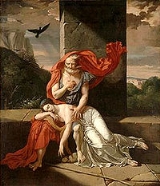
Oedipus at Colonus

Encyclopedia
Oedipus at Colonus is one of the three Theban plays of the Athenian tragedian Sophocles
. It was written shortly before Sophocles' death in 406 BC
and produced by his grandson (also called Sophocles) at the Festival of Dionysus in 401 BC
.
In the timeline of the plays, the events of Oedipus at Colonus occur after Oedipus the King
and before Antigone
; however, it was chronologically the last of Sophocles' three Theban plays to be written. The play describes the end of Oedipus
' tragic life. Legends differ as to the site of Oedipus' death; Sophocles set the place at Colonus
, a village near Athens
and also Sophocles' own birthplace, where the blinded Oedipus has come with his daughters Antigone
and Ismene
as suppliants of the Erinyes
and of Theseus
, the king of Athens
.
. Oedipus recognizes this as a sign, for when he received the prophecy
that he would kill his father and marry his mother, Apollo
also revealed to him that at the end of his life he would die at a place sacred to the Furies, and be a blessing for the land in which he is buried.
The chorus of old men from the village enters, and persuades Oedipus to leave the holy ground. They then question him about his identity, and are horrified to learn that he is the son of Laius
. Although they promised not to harm Oedipus, they wish to expel him from their city, fearing that he will curse it. Oedipus answers by explaining that he is not morally responsible for his crimes, since he killed his father in self-defence. Furthermore, he asks to see their king, Theseus
, saying, "I come as someone sacred, someone filled with piety and power, bearing a great gift for all your people." The chorus is amazed, and decides to reserve their judgment of Oedipus until Theseus, king of Athens, arrives.
Ismene arrives on horse, rejoicing to see her father and sister. She brings the news that Eteocles
has seized the throne of Thebes from his elder brother, Polyneices, while Polyneices is gathering support from the Argives to attack the city. Both sons have heard from an oracle that the outcome of the conflict will depend on where their father is buried. Ismene tells her father that it is Creon
's plan to come for him and bury him at the border of Thebes, without proper burial rites, so that the power which the oracle says his grave will have will not be granted to any other land. Hearing this, Oedipus curses both of his sons for not treating him well, contrasting them with his devoted daughters. He pledges allegiance with neither of his feuding sons, but with the people of Colonus, who thus far have treated him well, and further asks them for protection from Creon.
Because Oedipus trespassed on the holy ground of the Euminides, the villagers tell him that he must perform certain rites to appease them. Ismene volunteers to go perform them for him and departs, while Antigone remains with Oedipus. Meanwhile, the chorus questions Oedipus once more, desiring to know the details of his incest and patricide. After he relates his sorrowful story to them, Theseus enters, and in contrast to the prying chorus states, "I know all about you, son of Laius." He sympathizes with Oedipus, and offers him unconditional aid, causing Oedipus to praise Theseus and offer him the gift of his burial site, which will ensure victory in a future conflict with Thebes. Theseus protests, saying that the two cities are friendly, and Oedipus responds with what is perhaps the most famous speech in the play. "Oh Theseus, dear friend, only the gods can never age, the gods can never die. All else in the world almighty Time obliterates, crushes all to nothing..." Theseus makes Oedipus a citizen of Athens, and leaves the chorus to guard him as he departs. The chorus sings about the glory and beauty of Athens.
Creon, who is the representative of Thebes, comes to Oedipus and feigns pity for him and his children, telling him that he should return to Thebes. Oedipus is horrified, and recounts all of the harms Creon has inflicted on him. Creon becomes angry and reveals that he has already captured Ismene; he then instructs his guards to forcibly seize Antigone. His men begin to carry them off toward Thebes, perhaps planning to use them as blackmail to get Oedipus to follow, out of a desire to return Thebans to Thebes, or simply out of anger. The chorus attempts to stop him, but Creon threatens to use force to bring Oedipus back to Thebes. The chorus then calls for Theseus, who comes from sacrificing to Poseidon
to condemn Creon, telling him, "You have come to a city that practices justice, that sanctions nothing without law." Creon replies by condemning Oedipus, saying "I knew [your city] would never harbor a father-killer...worse, a creature so corrupt, exposed as the mate, the unholy husband of his own mother." Oedipus, infuriated, declares once more that he is not morally responsible for what he did. Theseus leads Creon away to retake the two girls. The Athenians overpower the Thebans and return both girls to Oedipus. Oedipus moves to kiss Theseus in gratitude, then draws back, acknowledging that he is still polluted.
Theseus then informs Oedipus that a suppliant has come to the temple of Poseidon
and wishes to speak with him; it is Oedipus' son Polynices
, who has been banished from Thebes by his brother Eteocles
. Oedipus does not want to talk to him, saying that he loathes the sound of his voice, but Antigone persuades him to listen, saying, "Many other men have rebellious children, quick tempers too...but they listen to reason, they relent." Oedipus gives in to her, and Polynices enters, lamenting Oedipus' miserable condition and begging his father to speak to him. He tells Oedipus that he has been driven out of the Thebes unjustly by his brother, and that he is preparing to attack the city. He knows that this is the result of Oedipus' curse on his sons, and begs his father to relent, even going so far as to say "We share the same fate" to his father. Oedipus tells him that he deserves his fate, for he cast his father out. He foretells that his two sons will kill each other in the coming battle. "Die! Die by your own blood brother's hand-die!-killing the very man who drove you out! So I curse your life out!" Antigone tries to restrain her brother, telling him that he should not attack Thebes and avoid dying at his brother's hand. Polyneices refuses to be dissuaded, and exits.
Following their conversation there is a fierce thunderstorm, which Oedipus interprets as a sign from Zeus
of his impending death. Calling for Theseus, he tells him that it is time for him to give the gift he promised to Athens. Filled with strength, the blind Oedipus stands and walks, calling for his children and Theseus to follow him.
A messenger enters and tells the chorus that Oedipus is dead. He led his children and Theseus away, then bathed himself and poured libations, while his daughters grieved. He told them that their burden of caring for him was gone, and asked Theseus to swear not to forsake his daughters. Then he sent his children away, for only Theseus could know the place of his death, and pass it on to his heir. When the messenger turned back to look at the spot where Oedipus last stood, he says that "We couldn't see the man- he was gone- nowhere! And the king, alone, shielding his eyes, both hands spread out against his face as if- some terrible wonder flashed before his eyes and he, he could not bear to look." Theseus enters with Antigone and Ismene, who are weeping and mourning their father. Antigone longs to see her father's tomb, even to be buried there with him rather than live without him. The girls beg Theseus to take them, but he reminds them that the place is a secret, and that no one may go there. "And he said that if I kept my pledge, I'd keep my country free of harm forever." Antigone agrees, and asks for passage back to Thebes, where she hopes to stop the Seven Against Thebes
from marching. Everyone exits toward Athens.
ns, the city was placed under the rule of the Thirty Tyrants
, and the citizens who opposed their rule were exiled or executed. This certainly affected the way that early audiences reacted to the play, just as the invasion of Athens and its diminished power surely affected Sophocles as he wrote it.
The play contrasts the cities of Athens and Thebes quite sharply. Thebes is often used in Athenian dramas as a city in which proper boundaries and identities are not maintained, allowing the playwright to explore themes like incest, murder, and hubris in a safe setting.
Nevertheless, determination of guilt is far more complex than this, as illustrated by the dichotomy between the blessing and the curse upon Oedipus. He has committed two crimes which render him a sort of monster and outcast among men: incest and patricide. His physical suffering, including his self-inflicted blindness, and lonely wandering, are his punishment. However, in death, he will be favored; the place in which he dies will be blessed. This suggests that willful action is in some part of guilt; the fact that Oedipus is “rationally innocent” – that he sinned unknowingly – decreases his guilt, allowing his earthly sufferings to serve as sufficient expiation for his sins.
Sophocles
Sophocles is one of three ancient Greek tragedians whose plays have survived. His first plays were written later than those of Aeschylus, and earlier than or contemporary with those of Euripides...
. It was written shortly before Sophocles' death in 406 BC
406 BC
Year 406 BC was a year of the pre-Julian Roman calendar. At the time, it was known as the Year of the Tribunate of Cossus, Ambustus, Cossus and Potitus...
and produced by his grandson (also called Sophocles) at the Festival of Dionysus in 401 BC
401 BC
Year 401 BC was a year of the pre-Julian Roman calendar. At the time, it was known as the Year of the Tribunate of Potitus, Cossus, Camillus, Ambustus, Mamercinus and Iullus...
.
In the timeline of the plays, the events of Oedipus at Colonus occur after Oedipus the King
Oedipus the King
Oedipus the King , also known by the Latin title Oedipus Rex, is an Athenian tragedy by Sophocles that was first performed c. 429 BCE. It was the second of Sophocles's three Theban plays to be produced, but it comes first in the internal chronology, followed by Oedipus at Colonus and then Antigone...
and before Antigone
Antigone (Sophocles)
Antigone is a tragedy by Sophocles written in or before 442 BC. Chronologically, it is the third of the three Theban plays but was written first...
; however, it was chronologically the last of Sophocles' three Theban plays to be written. The play describes the end of Oedipus
Oedipus
Oedipus was a mythical Greek king of Thebes. He fulfilled a prophecy that said he would kill his father and marry his mother, and thus brought disaster on his city and family...
' tragic life. Legends differ as to the site of Oedipus' death; Sophocles set the place at Colonus
Colonus
In classical Greece Hippeios Colonus was a deme about to the northwest of Athens, near Plato's Academy. There is also the Agoraios Kolonos , a hillock by the Athens Agora on which the temple of Hephaestus still stands.Hippeios Colonus held a temple of Poseidon and a sacred grove to the...
, a village near Athens
Athens
Athens , is the capital and largest city of Greece. Athens dominates the Attica region and is one of the world's oldest cities, as its recorded history spans around 3,400 years. Classical Athens was a powerful city-state...
and also Sophocles' own birthplace, where the blinded Oedipus has come with his daughters Antigone
Antigone
In Greek mythology, Antigone is the daughter of Oedipus and Jocasta, Oedipus' mother. The name may be taken to mean "unbending", coming from "anti-" and "-gon / -gony" , but has also been suggested to mean "opposed to motherhood", "in place of a mother", or "anti-generative", based from the root...
and Ismene
Ismene
Ismene is the name of two women of Greek mythology. The more famous is a daughter and half-sister of Oedipus, daughter and granddaughter of Jocasta, and sister of Antigone, Eteocles, and Polynices. She appears in several plays of Sophocles: at the end of Oedipus the King, in Oedipus at Colonus and...
as suppliants of the Erinyes
Erinyes
In Greek mythology the Erinyes from Greek ἐρίνειν " pursue, persecute"--sometimes referred to as "infernal goddesses" -- were female chthonic deities of vengeance. A formulaic oath in the Iliad invokes them as "those who beneath the earth punish whosoever has sworn a false oath"...
and of Theseus
Theseus
For other uses, see Theseus Theseus was the mythical founder-king of Athens, son of Aethra, and fathered by Aegeus and Poseidon, both of whom Aethra had slept with in one night. Theseus was a founder-hero, like Perseus, Cadmus, or Heracles, all of whom battled and overcame foes that were...
, the king of Athens
King of Athens
Before the Athenian democracy, the tyrants, and the Archons, the city-state of Athens was ruled by kings. Most of these are probably mythical or only semi-historical...
.
Plot
Led by Antigone, Oedipus enters the village of Colonus and sits down on a stone. They are approached by a villager, who demands that they leave, because that ground is sacred to the Furies, or ErinyesErinyes
In Greek mythology the Erinyes from Greek ἐρίνειν " pursue, persecute"--sometimes referred to as "infernal goddesses" -- were female chthonic deities of vengeance. A formulaic oath in the Iliad invokes them as "those who beneath the earth punish whosoever has sworn a false oath"...
. Oedipus recognizes this as a sign, for when he received the prophecy
Prophecy
Prophecy is a process in which one or more messages that have been communicated to a prophet are then communicated to others. Such messages typically involve divine inspiration, interpretation, or revelation of conditioned events to come as well as testimonies or repeated revelations that the...
that he would kill his father and marry his mother, Apollo
Apollo
Apollo is one of the most important and complex of the Olympian deities in Greek and Roman mythology...
also revealed to him that at the end of his life he would die at a place sacred to the Furies, and be a blessing for the land in which he is buried.
The chorus of old men from the village enters, and persuades Oedipus to leave the holy ground. They then question him about his identity, and are horrified to learn that he is the son of Laius
Laius
In Greek mythology, King Laius, or Laios of Thebes was a divine hero and key personage in the Theban founding myth. Son of Labdacus, he was raised by the regent Lycus after the death of his father.-Abduction of Chrysippus:...
. Although they promised not to harm Oedipus, they wish to expel him from their city, fearing that he will curse it. Oedipus answers by explaining that he is not morally responsible for his crimes, since he killed his father in self-defence. Furthermore, he asks to see their king, Theseus
Theseus
For other uses, see Theseus Theseus was the mythical founder-king of Athens, son of Aethra, and fathered by Aegeus and Poseidon, both of whom Aethra had slept with in one night. Theseus was a founder-hero, like Perseus, Cadmus, or Heracles, all of whom battled and overcame foes that were...
, saying, "I come as someone sacred, someone filled with piety and power, bearing a great gift for all your people." The chorus is amazed, and decides to reserve their judgment of Oedipus until Theseus, king of Athens, arrives.
Ismene arrives on horse, rejoicing to see her father and sister. She brings the news that Eteocles
Eteocles
In Greek mythology, Eteocles was a king of Thebes, the son of Oedipus and either Jocasta or Euryganeia. The name is from earlier *Etewoklewes , meaning "truly glorious". Tawaglawas is thought to be the Hittite rendition of the name. Oedipus killed his father Laius and married his mother without...
has seized the throne of Thebes from his elder brother, Polyneices, while Polyneices is gathering support from the Argives to attack the city. Both sons have heard from an oracle that the outcome of the conflict will depend on where their father is buried. Ismene tells her father that it is Creon
Creon
Creon is a figure in Greek mythology best known as the ruler of Thebes in the legend of Oedipus. He had two children with his wife, Eurydice: Megareus and Haemon...
's plan to come for him and bury him at the border of Thebes, without proper burial rites, so that the power which the oracle says his grave will have will not be granted to any other land. Hearing this, Oedipus curses both of his sons for not treating him well, contrasting them with his devoted daughters. He pledges allegiance with neither of his feuding sons, but with the people of Colonus, who thus far have treated him well, and further asks them for protection from Creon.
Because Oedipus trespassed on the holy ground of the Euminides, the villagers tell him that he must perform certain rites to appease them. Ismene volunteers to go perform them for him and departs, while Antigone remains with Oedipus. Meanwhile, the chorus questions Oedipus once more, desiring to know the details of his incest and patricide. After he relates his sorrowful story to them, Theseus enters, and in contrast to the prying chorus states, "I know all about you, son of Laius." He sympathizes with Oedipus, and offers him unconditional aid, causing Oedipus to praise Theseus and offer him the gift of his burial site, which will ensure victory in a future conflict with Thebes. Theseus protests, saying that the two cities are friendly, and Oedipus responds with what is perhaps the most famous speech in the play. "Oh Theseus, dear friend, only the gods can never age, the gods can never die. All else in the world almighty Time obliterates, crushes all to nothing..." Theseus makes Oedipus a citizen of Athens, and leaves the chorus to guard him as he departs. The chorus sings about the glory and beauty of Athens.
Creon, who is the representative of Thebes, comes to Oedipus and feigns pity for him and his children, telling him that he should return to Thebes. Oedipus is horrified, and recounts all of the harms Creon has inflicted on him. Creon becomes angry and reveals that he has already captured Ismene; he then instructs his guards to forcibly seize Antigone. His men begin to carry them off toward Thebes, perhaps planning to use them as blackmail to get Oedipus to follow, out of a desire to return Thebans to Thebes, or simply out of anger. The chorus attempts to stop him, but Creon threatens to use force to bring Oedipus back to Thebes. The chorus then calls for Theseus, who comes from sacrificing to Poseidon
Poseidon
Poseidon was the god of the sea, and, as "Earth-Shaker," of the earthquakes in Greek mythology. The name of the sea-god Nethuns in Etruscan was adopted in Latin for Neptune in Roman mythology: both were sea gods analogous to Poseidon...
to condemn Creon, telling him, "You have come to a city that practices justice, that sanctions nothing without law." Creon replies by condemning Oedipus, saying "I knew [your city] would never harbor a father-killer...worse, a creature so corrupt, exposed as the mate, the unholy husband of his own mother." Oedipus, infuriated, declares once more that he is not morally responsible for what he did. Theseus leads Creon away to retake the two girls. The Athenians overpower the Thebans and return both girls to Oedipus. Oedipus moves to kiss Theseus in gratitude, then draws back, acknowledging that he is still polluted.
Theseus then informs Oedipus that a suppliant has come to the temple of Poseidon
Poseidon
Poseidon was the god of the sea, and, as "Earth-Shaker," of the earthquakes in Greek mythology. The name of the sea-god Nethuns in Etruscan was adopted in Latin for Neptune in Roman mythology: both were sea gods analogous to Poseidon...
and wishes to speak with him; it is Oedipus' son Polynices
Polynices
In Greek mythology, Polynices or Polyneices was the son of Oedipus and Jocasta. His wife was Argea. His father, Oedipus, was discovered to have killed his father and married his mother, and was expelled from Thebes, leaving his sons Eteocles and Polynices to rule...
, who has been banished from Thebes by his brother Eteocles
Eteocles
In Greek mythology, Eteocles was a king of Thebes, the son of Oedipus and either Jocasta or Euryganeia. The name is from earlier *Etewoklewes , meaning "truly glorious". Tawaglawas is thought to be the Hittite rendition of the name. Oedipus killed his father Laius and married his mother without...
. Oedipus does not want to talk to him, saying that he loathes the sound of his voice, but Antigone persuades him to listen, saying, "Many other men have rebellious children, quick tempers too...but they listen to reason, they relent." Oedipus gives in to her, and Polynices enters, lamenting Oedipus' miserable condition and begging his father to speak to him. He tells Oedipus that he has been driven out of the Thebes unjustly by his brother, and that he is preparing to attack the city. He knows that this is the result of Oedipus' curse on his sons, and begs his father to relent, even going so far as to say "We share the same fate" to his father. Oedipus tells him that he deserves his fate, for he cast his father out. He foretells that his two sons will kill each other in the coming battle. "Die! Die by your own blood brother's hand-die!-killing the very man who drove you out! So I curse your life out!" Antigone tries to restrain her brother, telling him that he should not attack Thebes and avoid dying at his brother's hand. Polyneices refuses to be dissuaded, and exits.
Following their conversation there is a fierce thunderstorm, which Oedipus interprets as a sign from Zeus
Zeus
In the ancient Greek religion, Zeus was the "Father of Gods and men" who ruled the Olympians of Mount Olympus as a father ruled the family. He was the god of sky and thunder in Greek mythology. His Roman counterpart is Jupiter and his Etruscan counterpart is Tinia.Zeus was the child of Cronus...
of his impending death. Calling for Theseus, he tells him that it is time for him to give the gift he promised to Athens. Filled with strength, the blind Oedipus stands and walks, calling for his children and Theseus to follow him.
A messenger enters and tells the chorus that Oedipus is dead. He led his children and Theseus away, then bathed himself and poured libations, while his daughters grieved. He told them that their burden of caring for him was gone, and asked Theseus to swear not to forsake his daughters. Then he sent his children away, for only Theseus could know the place of his death, and pass it on to his heir. When the messenger turned back to look at the spot where Oedipus last stood, he says that "We couldn't see the man- he was gone- nowhere! And the king, alone, shielding his eyes, both hands spread out against his face as if- some terrible wonder flashed before his eyes and he, he could not bear to look." Theseus enters with Antigone and Ismene, who are weeping and mourning their father. Antigone longs to see her father's tomb, even to be buried there with him rather than live without him. The girls beg Theseus to take them, but he reminds them that the place is a secret, and that no one may go there. "And he said that if I kept my pledge, I'd keep my country free of harm forever." Antigone agrees, and asks for passage back to Thebes, where she hopes to stop the Seven Against Thebes
Seven Against Thebes
The Seven against Thebes is the third play in an Oedipus-themed trilogy produced by Aeschylus in 467 BC. The trilogy is sometimes referred to as the Oedipodea. It concerns the battle between an Argive army led by Polynices and the army of Thebes led by Eteocles and his supporters. The trilogy won...
from marching. Everyone exits toward Athens.
Analysis and themes
There is less action in this play than in Oedipus the King, and more philosophical discussion. Here, Oedipus discusses his fate as related by the oracle, and claims that he is not fully guilty because his crimes of murder and incest were committed in ignorance. Despite being blinded and exiled and facing violence from Creon and his sons, in the end Oedipus is accepted and absolved by Zeus.Historical context
In the years between the play's composition and its first performance, Athens underwent many changes. Defeated by the SpartaSparta
Sparta or Lacedaemon, was a prominent city-state in ancient Greece, situated on the banks of the River Eurotas in Laconia, in south-eastern Peloponnese. It emerged as a political entity around the 10th century BC, when the invading Dorians subjugated the local, non-Dorian population. From c...
ns, the city was placed under the rule of the Thirty Tyrants
Thirty Tyrants
The Thirty Tyrants were a pro-Spartan oligarchy installed in Athens after its defeat in the Peloponnesian War in 404 BC. Contemporary Athenians referred to them simply as "the oligarchy" or "the Thirty" ; the expression "Thirty Tyrants" is due to later historians...
, and the citizens who opposed their rule were exiled or executed. This certainly affected the way that early audiences reacted to the play, just as the invasion of Athens and its diminished power surely affected Sophocles as he wrote it.
The play contrasts the cities of Athens and Thebes quite sharply. Thebes is often used in Athenian dramas as a city in which proper boundaries and identities are not maintained, allowing the playwright to explore themes like incest, murder, and hubris in a safe setting.
Fate
While the two other plays about Oedipus often bring up the theme of a person's moral responsibility for their destiny, and whether it is possible to rebel against destiny, Oedipus at Colonus is the only one to address it explicitly. Oedipus vehemently states that he is not responsible for the actions he was fated to commit.Guilt
‘Oedipus at Colonus’ suggests that, in breaking divine law, a ruler’s limited understanding may lead him to believe himself fully innocent; however, his lack of awareness does not change the objective fact of his guilt.Nevertheless, determination of guilt is far more complex than this, as illustrated by the dichotomy between the blessing and the curse upon Oedipus. He has committed two crimes which render him a sort of monster and outcast among men: incest and patricide. His physical suffering, including his self-inflicted blindness, and lonely wandering, are his punishment. However, in death, he will be favored; the place in which he dies will be blessed. This suggests that willful action is in some part of guilt; the fact that Oedipus is “rationally innocent” – that he sinned unknowingly – decreases his guilt, allowing his earthly sufferings to serve as sufficient expiation for his sins.
Heroization of Oedipus
Darice Birge argues that Oedipus at Colonus is a story of Oedipus' heroization. It is a transition piece from the Oedipus of Oedipus Rex whose acts were abominable to the Oedipus we see at the end of Oedipus at Colonus who is so powerful that he is sought after by two separate major cities. The major image used to show this transition from beggar to hero is Oedipus' relationship with the sacred grove of the Erinyes. At the beginning of the play, Oedipus has to be led through the grove by Antigone and is only allowed to go through it because as a holy place it is an asylum for beggars. He recognizes the grove as the location once described to him in a prophecy as his final resting place. When Elders come looking for him, Oedipus enters the grove. This act, according to Birge, is his first act as a hero. He has given up his habit of trying to fight divine will (as was his wont in Oedipus Rex) and now is no longer fighting prophecies, but is rather accepting this grove as the place of his death. Oedipus then hints at his supernatural power, an ability to bring success to those who accept him and suffering to those who turned him away. Oedipus' daughter Ismene then arrives, bringing news that Thebes, the city that once exiled Oedipus for his sins, wants him back for his hero status. Ismene furthers Oedipus' status as a hero when she performs a libation to the Erinyes, but his status is cemented when he chooses his final resting place as a hidden part of the sacred grove, which even his daughters can't know.English-language translations
- Thomas FrancklinThomas Francklin-Life:Francklin was the son of Richard Francklin, bookseller near the Piazza in Covent Garden, London, who printed William Pulteney's paper ‘The Craftsman.’ He was admitted to Westminster School in 1735. On the advice of Pulteney he was educated for the church: but Pulteney gave him no subsequent...
, 1759 - verse - Richard C. Jebb, 1904 - prose: full text
- Francis Storr, 1912 - verse: full text
- E. F. Watling, 1947 - verse
- Theodore Howard Banks, 1953 - verse
- Robert FitzgeraldRobert FitzgeraldRobert Stuart Fitzgerald was a poet, critic and translator whose renderings of the Greek classics "became standard works for a generation of scholars and students." He was best known as a translator of ancient Greek and Latin...
, 1940 - verse - Paul Roche, 1958 - verse
- Robert FaglesRobert FaglesRobert Fagles was an American professor, poet, and academic, best known for his many translations of ancient Greek classics, especially his acclaimed translations of the epic poems of Homer...
, 1984 - verse - Ruby Blondell, 2002 - verse
- Eamon GrennanEamon GrennanEamon Grennan is an Irish poet born in Dublin. He has lived in the United States, except for brief periods, since 1964. He was the Dexter M. Ferry, Jr. Professor of English at Vassar College until his retirement in 2004....
and Rachel Kitzinger, 2004 - verse - David R. Slavitt, 2007 - verse
- George Theodoridis, 2009- prose full text http://bacchicstage.wordpress.com/
- Carl R. Mueller & Anna Krajewska Wieczorek, 2000 - verse
Adaptations
- Ioannis Gryparis Broadway adaptation, 1976, with Alexis MinotisAlexis MinotisAlexis Minotakis, known as Alexis Minotis , was born 8 August 1898 or 1899 in Deliana , Chania, Crete and died on 11 November 1990 in Athens, Greece....
as Oedipus - Don TaylorDon Taylor (director)Donald Victor Taylor was an English writer, director and producer, active across theatre, radio and television for over forty years...
's 1984 television adaptation starring Anthony QuayleAnthony QuayleSir John Anthony Quayle, CBE was an English actor and director.-Early life:Quayle was born in Ainsdale, Southport, in Lancashire to a Manx family.... - Lee BreuerLee BreuerLee Breuer is an American academic, educator, film maker, poet, lyricist, writer and stage director.-Work with Mabou Mines:Lee Breuer is a founding artistic director of Mabou Mines Theater Company in New York City, which he began in 1970 with colleagues Philip Glass, Ruth Maleczech, JoAnne...
and Bob TelsonBob TelsonRobert "Bob" Eria Telson is an American composer, songwriter, and pianist best known for his work in musical theater and film, for which he has received Tony, Pulitzer, and Academy Award nominations. He is currently living and working in Argentina.-Biography:Robert Eria Telson was born in Cannes,...
, The Gospel at ColonusThe Gospel at ColonusThe Gospel at Colonus is a gospel version of Sophocles's tragedy, Oedipus at Colonus. The show was created in New York City in 1985 by the experimental-theatre director Lee Breuer, one of the founders of the seminal American avant-garde theatre company Mabou Mines, and composer Bob Telson. The...
, 1986 - Patrick StewartPatrick StewartSir Patrick Hewes Stewart, OBE is an English film, television and stage actor, who has had a distinguished career in theatre and television for around half a century...
and Tim Philip-Smith, BBC radio 4 play