

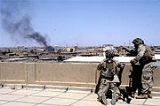
Iraq spring fighting of 2004

Encyclopedia
The Iraq Spring Fighting of 2004 (April 4, 2004 - June 24, 2004) was a series of operational
offensives and various major engagements during the Iraq War. It was a turning point in the war: before, the conflict was simply US/Coalition versus insurgents, but the Spring Fighting marked the entrance of militia
s and religiously based (Shi'a and Sunni) militant Iraqi groups, such as the Mahdi Army
into the arena of conflict.
The first was the rise of a hard-line Shiite cleric called Muqtada al-Sadr
and his militia, the Mahdi Army, in the south of the country. Muqtada al-Sadr also has great influence in the Sadr City section of Baghdad (Sadr City, which was Saddam City, was renamed after the invasion, in honor of Sadr's father, Grand Ayatollah Mohammad Mohammad Sadeq al-Sadr
). With the fall of Saddam Hussein, Muqtada al-Sadr
emerged as a Shia leader by zealously rejecting the US-led occupation of Iraq. Al-Sadr created the Mahdi Army in June 2003.
The second cause, probably the flashpoint for the conflict, was the highly-publicized killing and mutilation of four Blackwater
private military contractors on March 31, 2004. Five days before American troops withdrew from Fallujah after intense fighting on March 26, 2004 (at which point Fallujah had already been declared insurgent-occupied) killed one Marine. The troops retreated to the city's outskirts. The four independent contractors were guarding food shipments for a U.S. base on the outskirts of Fallujah
, Iraq, when they took a wrong turn and entered the city. They were killed in a grenade attack by suspected insurgents, and their corpses were mutilated by cheering crowds.
On April 3, Bremer sent troops to al-Sadr’s home and arrested Mustafa Yaqoubi, a top lieutenant, sparking further protests.
On April 4, Spanish troops clashed with demonstrators in Najaf demanding Yaqubi’s release, resulting in the death of one Salvadoran soldier and at least 20 Iraqis. It is unclear which side fired first.
The same day al-Sadr issued a statement calling on his supporters to stop staging demonstrations “because your enemy prefers terrorism,” reported the Toronto Globe and Mail.
“America has unsheathed its fangs and its despicable intentions, and the conscientious Iraqi people cannot remain silent at all. They must defend their rights in the ways they see fit,” the statement said, according to the Washington Post.
A day after the statement given by Sadr, violent protests occurred throughout the Shiite south, soon spilling over into a violent uprising by Mahdi Army militiamen, which was fully underway by April 6, 2004.
, Kufa
, Kut
, and Sadr City
on April 4, 2004. They began by taking control of public buildings and police stations. In Sadr City in Baghdad, Iraqi police were expelled from three stations. Members of the newly arrived 1st Cavalry Division were sent out to retake them. Militiamen ambushed the U.S. forces and eight U.S. troops were killed, and 51 more wounded in the bloody battle. U.S. forces subsequently regained control of the police stations after running firefights with Mahdi rebels that killed 35 Mahdi Army militiamen. Mahdi Army members still maintained some influence over many of the slum areas of Sadr City, however. The fighting was not only in Sadr City, instead, it spread to other parts of Baghdad throughout the month. The highway linking Baghdad with the western province of Anbar
was cut by the insurgents and resupplies for Marines in the province could only be delivered by helicopter.
The militants gained partial control of Karbala
after fighting there. Other coalition forces came under attack: in Nasiriyah
two Italian armored vehicles were destroyed, and British forces came under fire in Amarah
and Basra
. Najaf and Kufa were seized by militiamen on April 6, 2004 after a few firefights with Spanish and Salvadoran troops. Kut
was seized on the next day after clashes with Ukrainian troops, mainly on the Tigris River bridge. On the same day, Karbala came under full Mahdi Army control.
By April 9, 2004, exactly a year to the day after the statue of Saddam Hussein was symbolically torn down, the US-led forces lost control of all the parts of Iraq that had been gained in the year since that event.
One notable battle during the fighting in Baghdad was on April 9, 2004. An American fuel convoy of the 13th Corps Support Command came under attack
near the Baghdad International Airport
. In what was described as a 5-mile long ambush, the 26-vehicle serial was pummeled by gunfire, mortar rounds and RPGs, disabling many of the civilian fuel tankers and Army vehicles. A total of 12 people from the convoy were killed: 2 American soldiers, 7 American private truck drivers and 3 Iraqi truck drivers. One American soldier, PFC Keith Matthew Maupin
, and an American truck driver, Thomas Hamill, were captured. Hamill managed to escape from his captors on May 2, 2004, while Maupin was executed and his remains recovered four years later.
After sporadic clashes, Coalition forces temporarily suppressed most militia activity in Nasiriyah
, Amarah
, and Basra. On April 16, Kut was retaken by US forces, and several dozen Mahdi Army members were killed in the battle. However, the area around Najaf and Kufa, as well as Karbala remained under the control of Sadr's forces. Sadr himself was believed to be in hiding in Najaf. Coalition troops put a cordon of 2,500 troops around Najaf, but reduced the number of forces to pursue negotiations with the Mahdi Army. At the beginning of May, coalition forces estimated that there were 200-500 militants still present in Karbala, 300-400 in Diwaniyah, an unknown number still left in Amarah and Basra, and 1,000-2,000 still holed up in the Najaf-Kufa region.
. They surrounded the city with the intent of capturing the individuals responsible for the killings, as well as others in the region who might have been involved in the insurgency or terrorist activities. It was planned that the Iraqi National Guard would fight alongside the U.S. Marines in the operation, but on the dawn of the invasion they discarded their uniforms and deserted. Heavy fighting lasted until April 9, 2004, when, again under enormous public pressure, the offensive was called off because of great civilian losses. At that point, the Marines had only managed to gain control of about 25 percent of the city.
there was another insurgent attack on the town of Husaybah on the Syria
n border on April 17, 2004. Like in Ramadi
, insurgents attacked the Marine garrison
and were repulsed; 5 Marines and 150 insurgents were killed.
On April 10, the U.S. military declared a unilateral truce to allow for humanitarian supplies to enter Fallujah, and pulled troops back to the outskirts of the city. Local sheikhs and imams refused to honor the cease-fire agreement, and repeatedly sent mujahideen
fighters to attack the Marines. The city's main hospital was occupied by Coalition Forces to protect its patients, and a sniper was placed on top of the hospital's water tower
. There were also numerous reports of the use of Close Air Support by Coalition Forces in Fallujah during this time, in actions against insurgents.
The U.S. forces sought to negotiate a settlement, but promised to restart the offensive to retake the city if one was not reached. Military commanders said their goal in the siege was to capture those responsible for the numerous deaths of American and Iraqi security personnel. As the siege continued, insurgents continued to conduct hit-and-run attacks on U.S. Marine positions, despite the fact that U.S. Marines were under a unilateral ceasefire
. It was also reported that the Marines wanted a cease-fire because they were not being resupplied, due to the insurgent capture of the main highway from Baghdad
to Anbar.
On May 1, 2004 U.S. forces withdrew completely from the city, and control of the city was turned over to the Fallujah Brigade (which was under control of a general who had served under Saddam Hussein
). The brigade soon allied itself with the insurgents and the city was effectively under insurgent control. Between 731 and 800 Iraqis were killed during the siege of the city, at least 184 of them insurgents, and at least 27 American Marines also died. Soon afterwards, many towns in Anbar province - such as Karabilah, Sada
, Romania, Ubaydi, Haqlaniyah
, Hit, Baghdadi, Haditha
, as well as numerous smaller villages - came under insurgent control.
of the government of the hostage's nation and gave a time limit for the demand to be carried out, often 72 hour
s. Beheading was often threatened if the government fails to heed the wishes of the hostage takers. Several individuals, including an American civilian (Nicholas Berg) and a South Korean (Kim Sun-il
), among others, were beheaded during this period.
It was followed by a second wave on May 5 in Karbala, and more attacks which seized the governor's office in Najaf on May 6. Four U.S. soldiers and an estimated 86 militiamen were killed in the fighting. Several high ranking militia commanders were also killed in a separate raid by US Army
Special Operations
units.
On May 8, U.S. forces launched a follow-up offensive into Karbala, launching a two-pronged attack into the city. U.S tanks also launched an incursion
into Sadr City. At the same time, perhaps as a diversionary tactic, hundreds of Mahdi Army insurgents swept through Basra, firing on British patrols and seizing parts of the city. Two militants were killed and several British troops were wounded.
On May 24, after suffering heavy losses in weeks of fighting, Mahdi Army forces withdrew from the city of Karbala. This left the Najaf-Kufa region the only area still under firm Mahdi control, though it was also under sustained American assault. Several hundred Mahdi Army rebels in total were killed in clashes with American forces. Unfazed by the fighting, Muqtada al-Sadr regularly gave Friday sermons in Kufa throughout the uprising.
On May 30, American forces withdrew from the interior of the city of Samarra
, and encircled it. Insurgents took full control of the city. On the same day, insurgents also took control of Latifiya
and Yusufiyah
south of Baghdad, effectively cutting Highway One between Baghdad and Karbala, and the Americans responded by rerouting traffic onto Highway Eight to maintain contact with the south of the country.
Twenty-one members of the Iraqi security forces, two American soldiers and thirteen civilians were killed during the street fighting in Baquba. The only gain by the insurgents on this day was in Ramadi
, where insurgent forces managed to take control and laid siege to Marine bunker
positions. The city was under insurgent control by the end of the day. Some additional fighting was also reported around Fallujah, where nine civilians were said to have been killed. During the insurgent
offensive on June 24, 2004 one hundred twenty-nine Iraqis and four Americans were killed. The number of insurgent casualties is unknown.
and Fallujah) as well as some Sunni territory north and south of Baghdad, including Samarra
, were effectively left under insurgent control. The United States forces managed to maintain control of Baghdad and other major cities in the Shi'a south as well as some in the north. Another uprising of the Mahdi Army occurred a month and a half later, and a bloodier battle for the city of Najaf
unfolded. Also in November the Second Battle of Fallujah
occurred, Operation Phantom Fury
, which left ninety-five percent of the city in ruins. Four days after the end of the Spring Fighting on June 28, 2004, the Coalition Provisional Authority transferred control to a new Iraqi government. With this, the occupation was officially over, but coalition forces remained in large numbers in the country. On the day that the transfer of authority occurred, three American Marines were killed in Baghdad and one British soldier was killed in Basra.
Operational warfare
Operational mobility, beginning as a military theory concept during the period of mechanisation of armed forces, became a method of managing movement of forces by strategic commanders from the staging area to their Tactical Area of Responsibility....
offensives and various major engagements during the Iraq War. It was a turning point in the war: before, the conflict was simply US/Coalition versus insurgents, but the Spring Fighting marked the entrance of militia
Militia
The term militia is commonly used today to refer to a military force composed of ordinary citizens to provide defense, emergency law enforcement, or paramilitary service, in times of emergency without being paid a regular salary or committed to a fixed term of service. It is a polyseme with...
s and religiously based (Shi'a and Sunni) militant Iraqi groups, such as the Mahdi Army
Mahdi Army
The Mahdi Army, also known as the Mahdi Militia or Jaish al-Mahdi , was an Iraqi paramilitary force created by the Iraqi Shia cleric Muqtada al-Sadr in June 2003....
into the arena of conflict.
Prelude
The start of 2004 was marked by a relative lull in violence. Guerrilla attacks lessened in intensity while insurgent forces reorganized, studying the multinational forces' tactics and planning a renewed offensive.Causes
There were two main causes for the start of the Spring Fighting.The first was the rise of a hard-line Shiite cleric called Muqtada al-Sadr
Muqtada al-Sadr
Sayyid Muqtadā al-Ṣadr is an Iraqi Islamic political leader.Along with Ali al-Sistani and Ammar al-Hakim of the Islamic Supreme Council of Iraq, Sadr is one of the most influential religious and political figures in the country not holding any official title in the Iraqi government.-Titles:He is...
and his militia, the Mahdi Army, in the south of the country. Muqtada al-Sadr also has great influence in the Sadr City section of Baghdad (Sadr City, which was Saddam City, was renamed after the invasion, in honor of Sadr's father, Grand Ayatollah Mohammad Mohammad Sadeq al-Sadr
Mohammad Mohammad Sadeq al-Sadr
Grand Ayatollah Mohammad Mohammad Sadeq al-Sadr , often referred to as Muhammad Sadiq as-Sadr which is his father's name, was a prominent Iraqi Twelver Shi'a cleric of the rank of Grand Ayatollah. He called for government reform and the release of detained Shi'a leaders...
). With the fall of Saddam Hussein, Muqtada al-Sadr
Muqtada al-Sadr
Sayyid Muqtadā al-Ṣadr is an Iraqi Islamic political leader.Along with Ali al-Sistani and Ammar al-Hakim of the Islamic Supreme Council of Iraq, Sadr is one of the most influential religious and political figures in the country not holding any official title in the Iraqi government.-Titles:He is...
emerged as a Shia leader by zealously rejecting the US-led occupation of Iraq. Al-Sadr created the Mahdi Army in June 2003.
The second cause, probably the flashpoint for the conflict, was the highly-publicized killing and mutilation of four Blackwater
Blackwater USA
Xe Services LLC, better known by its former names, Blackwater USA and Blackwater Worldwide, is a private military company founded in 1997 by Erik Prince and Al Clark.. Xe is currently the largest of the U.S. State Department's three private security contractors...
private military contractors on March 31, 2004. Five days before American troops withdrew from Fallujah after intense fighting on March 26, 2004 (at which point Fallujah had already been declared insurgent-occupied) killed one Marine. The troops retreated to the city's outskirts. The four independent contractors were guarding food shipments for a U.S. base on the outskirts of Fallujah
Fallujah
Fallujah is a city in the Iraqi province of Al Anbar, located roughly west of Baghdad on the Euphrates. Fallujah dates from Babylonian times and was host to important Jewish academies for many centuries....
, Iraq, when they took a wrong turn and entered the city. They were killed in a grenade attack by suspected insurgents, and their corpses were mutilated by cheering crowds.
Provocation and the start of the offensive
On March 28, the U.S. overseer of Iraq, Paul Bremer, ordered the 60-day closure of Al-Hawza, a newspaper published by Muqtada al-Sadr’s group, on the charges of inciting violence against the occupation. The next day thousands of Iraqis rallied outside the offices of Al-Hawza in support of the newspaper.On April 3, Bremer sent troops to al-Sadr’s home and arrested Mustafa Yaqoubi, a top lieutenant, sparking further protests.
On April 4, Spanish troops clashed with demonstrators in Najaf demanding Yaqubi’s release, resulting in the death of one Salvadoran soldier and at least 20 Iraqis. It is unclear which side fired first.
The same day al-Sadr issued a statement calling on his supporters to stop staging demonstrations “because your enemy prefers terrorism,” reported the Toronto Globe and Mail.
“America has unsheathed its fangs and its despicable intentions, and the conscientious Iraqi people cannot remain silent at all. They must defend their rights in the ways they see fit,” the statement said, according to the Washington Post.
A day after the statement given by Sadr, violent protests occurred throughout the Shiite south, soon spilling over into a violent uprising by Mahdi Army militiamen, which was fully underway by April 6, 2004.
Baghdad and the Shia south
The Mahdi Army forces began an offensive in NajafNajaf
Najaf is a city in Iraq about 160 km south of Baghdad. Its estimated population in 2008 is 560,000 people. It is the capital of Najaf Governorate...
, Kufa
Kufa
Kufa is a city in Iraq, about south of Baghdad, and northeast of Najaf. It is located on the banks of the Euphrates River. The estimated population in 2003 was 110,000....
, Kut
Kut
Al-Kūt is a city in eastern Iraq, on the left bank of the Tigris River, about 160 kilometres south east of Baghdad. the estimated population is about 374,000 people...
, and Sadr City
Sadr City
Sadr City is a suburb district of the city of Baghdad, Iraq. It was built in 1959 by Prime Minister Abdul Karim Qassim and later unofficially renamed Sadr City after deceased Shia leader Mohammad Mohammad Sadeq al-Sadr....
on April 4, 2004. They began by taking control of public buildings and police stations. In Sadr City in Baghdad, Iraqi police were expelled from three stations. Members of the newly arrived 1st Cavalry Division were sent out to retake them. Militiamen ambushed the U.S. forces and eight U.S. troops were killed, and 51 more wounded in the bloody battle. U.S. forces subsequently regained control of the police stations after running firefights with Mahdi rebels that killed 35 Mahdi Army militiamen. Mahdi Army members still maintained some influence over many of the slum areas of Sadr City, however. The fighting was not only in Sadr City, instead, it spread to other parts of Baghdad throughout the month. The highway linking Baghdad with the western province of Anbar
Anbar
Anbar was a town in Iraq, at lat. 33 deg. 22' N., long. 43 deg. 49' E, on the east bank of the Euphrates, just south of the Nahr 'Isa, or Sakhlawieh canal, the northernmost of the canals connecting that river with the Tigris.-History:...
was cut by the insurgents and resupplies for Marines in the province could only be delivered by helicopter.
The militants gained partial control of Karbala
Karbala
Karbala is a city in Iraq, located about southwest of Baghdad. Karbala is the capital of Karbala Governorate, and has an estimated population of 572,300 people ....
after fighting there. Other coalition forces came under attack: in Nasiriyah
Nasiriyah
Nasiriyah is a city in Iraq. It is on the Euphrates about 225 miles southeast of Baghdad, near the ruins of the ancient city of Ur. It is the capital of the province of Dhi Qar...
two Italian armored vehicles were destroyed, and British forces came under fire in Amarah
Amarah
Amarah , is a city in southeastern Iraq, located on a low ridge next to the Tigris River waterway south of Baghdad about 50 km from the border with Iran. It lies at the northern tip of the marshlands between the Tigris and Euphrates....
and Basra
Basra
Basra is the capital of Basra Governorate, in southern Iraq near Kuwait and Iran. It had an estimated population of two million as of 2009...
. Najaf and Kufa were seized by militiamen on April 6, 2004 after a few firefights with Spanish and Salvadoran troops. Kut
Kut
Al-Kūt is a city in eastern Iraq, on the left bank of the Tigris River, about 160 kilometres south east of Baghdad. the estimated population is about 374,000 people...
was seized on the next day after clashes with Ukrainian troops, mainly on the Tigris River bridge. On the same day, Karbala came under full Mahdi Army control.
By April 9, 2004, exactly a year to the day after the statue of Saddam Hussein was symbolically torn down, the US-led forces lost control of all the parts of Iraq that had been gained in the year since that event.
One notable battle during the fighting in Baghdad was on April 9, 2004. An American fuel convoy of the 13th Corps Support Command came under attack
2004 Iraq KBR convoy ambush
The 2004 Iraq KBR convoy ambush was an attack by Iraqi insurgents on April 9, 2004 during the Iraq War on a convoy of United States supply trucks near the Baghdad International Airport...
near the Baghdad International Airport
Baghdad International Airport
Baghdad International Airport, originally Saddam International Airport, , BIAP is Iraq's largest airport, located in a suburb about west of downtown Baghdad in the Baghdad Governorate...
. In what was described as a 5-mile long ambush, the 26-vehicle serial was pummeled by gunfire, mortar rounds and RPGs, disabling many of the civilian fuel tankers and Army vehicles. A total of 12 people from the convoy were killed: 2 American soldiers, 7 American private truck drivers and 3 Iraqi truck drivers. One American soldier, PFC Keith Matthew Maupin
Matt Maupin
Keith Matthew "Matt" Maupin was a United States Army Private First Class captured by Iraqi insurgents on April 9, 2004, while serving in the Iraq War, after his convoy came under attack by rocket-propelled grenades and small arms fire near Baghdad, Iraq .On June 28, 2004, Arabic-language...
, and an American truck driver, Thomas Hamill, were captured. Hamill managed to escape from his captors on May 2, 2004, while Maupin was executed and his remains recovered four years later.
After sporadic clashes, Coalition forces temporarily suppressed most militia activity in Nasiriyah
Nasiriyah
Nasiriyah is a city in Iraq. It is on the Euphrates about 225 miles southeast of Baghdad, near the ruins of the ancient city of Ur. It is the capital of the province of Dhi Qar...
, Amarah
Amarah
Amarah , is a city in southeastern Iraq, located on a low ridge next to the Tigris River waterway south of Baghdad about 50 km from the border with Iran. It lies at the northern tip of the marshlands between the Tigris and Euphrates....
, and Basra. On April 16, Kut was retaken by US forces, and several dozen Mahdi Army members were killed in the battle. However, the area around Najaf and Kufa, as well as Karbala remained under the control of Sadr's forces. Sadr himself was believed to be in hiding in Najaf. Coalition troops put a cordon of 2,500 troops around Najaf, but reduced the number of forces to pursue negotiations with the Mahdi Army. At the beginning of May, coalition forces estimated that there were 200-500 militants still present in Karbala, 300-400 in Diwaniyah, an unknown number still left in Amarah and Basra, and 1,000-2,000 still holed up in the Najaf-Kufa region.
First Battle of Fallujah
Coincidentally, the offensive against Fallujah started on the same day that the Shia uprising began. In response to the killing of the four Americans on March 31 and intense political pressure, the U.S. Marines commenced Operation Vigilant ResolveOperation Vigilant Resolve
As part of the occupation of Iraq, the First Battle of Fallujah, codenamed Operation Vigilant Resolve, was an unsuccessful attempt by the United States Military to capture the city of Fallujah in April 2004....
. They surrounded the city with the intent of capturing the individuals responsible for the killings, as well as others in the region who might have been involved in the insurgency or terrorist activities. It was planned that the Iraqi National Guard would fight alongside the U.S. Marines in the operation, but on the dawn of the invasion they discarded their uniforms and deserted. Heavy fighting lasted until April 9, 2004, when, again under enormous public pressure, the offensive was called off because of great civilian losses. At that point, the Marines had only managed to gain control of about 25 percent of the city.
Battle of Ramadi
During the fighting in Anbar there was also a major insurgent attack on the city of Ramadi on April 6, 2004, which began when a force of 300 insurgents attacked Marine patrols throughout the city in an attempt to relieve pressure on Fallujah. In heavy street fighting over four days 16 U.S. Marines and an estimated 250 insurgents were killed.Battle of Husaybah
Immediately following the Battle of RamadiBattle of Ramadi (2004)
The Battle of Ramadi was fought in the spring of 2004 during the same time as the First Battle of Fallujah. In April 2004, Fallujah was under siege by Coalition Forces and insurgents were looking to relieve pressure on the city by attempting an offensive of their own...
there was another insurgent attack on the town of Husaybah on the Syria
Syria
Syria , officially the Syrian Arab Republic , is a country in Western Asia, bordering Lebanon and the Mediterranean Sea to the West, Turkey to the north, Iraq to the east, Jordan to the south, and Israel to the southwest....
n border on April 17, 2004. Like in Ramadi
Ramadi
Ramadi is a city in central Iraq, about west of Baghdad. It is the capital of Al Anbar Governorate.-History:Ramadi is located in a fertile, irrigated, alluvial plain.The Ottoman Empire founded Ramadi in 1869...
, insurgents attacked the Marine garrison
Garrison
Garrison is the collective term for a body of troops stationed in a particular location, originally to guard it, but now often simply using it as a home base....
and were repulsed; 5 Marines and 150 insurgents were killed.
Fallujah peace attempts
The occupying force in Fallujah on April 9 allowed more than 70,000 women, children and elderly residents to leave the besieged city, reportedly also allowing males of military age to leave.On April 10, the U.S. military declared a unilateral truce to allow for humanitarian supplies to enter Fallujah, and pulled troops back to the outskirts of the city. Local sheikhs and imams refused to honor the cease-fire agreement, and repeatedly sent mujahideen
Mujahideen
Mujahideen are Muslims who struggle in the path of God. The word is from the same Arabic triliteral as jihad .Mujahideen is also transliterated from Arabic as mujahedin, mujahedeen, mudžahedin, mudžahidin, mujahidīn, mujaheddīn and more.-Origin of the concept:The beginnings of Jihad are traced...
fighters to attack the Marines. The city's main hospital was occupied by Coalition Forces to protect its patients, and a sniper was placed on top of the hospital's water tower
Water tower
A water tower or elevated water tower is a large elevated drinking water storage container constructed to hold a water supply at a height sufficient to pressurize a water distribution system....
. There were also numerous reports of the use of Close Air Support by Coalition Forces in Fallujah during this time, in actions against insurgents.
The U.S. forces sought to negotiate a settlement, but promised to restart the offensive to retake the city if one was not reached. Military commanders said their goal in the siege was to capture those responsible for the numerous deaths of American and Iraqi security personnel. As the siege continued, insurgents continued to conduct hit-and-run attacks on U.S. Marine positions, despite the fact that U.S. Marines were under a unilateral ceasefire
Ceasefire
A ceasefire is a temporary stoppage of a war in which each side agrees with the other to suspend aggressive actions. Ceasefires may be declared as part of a formal treaty, but they have also been called as part of an informal understanding between opposing forces...
. It was also reported that the Marines wanted a cease-fire because they were not being resupplied, due to the insurgent capture of the main highway from Baghdad
Baghdad
Baghdad is the capital of Iraq, as well as the coterminous Baghdad Governorate. The population of Baghdad in 2011 is approximately 7,216,040...
to Anbar.
On May 1, 2004 U.S. forces withdrew completely from the city, and control of the city was turned over to the Fallujah Brigade (which was under control of a general who had served under Saddam Hussein
Saddam Hussein
Saddam Hussein Abd al-Majid al-Tikriti was the fifth President of Iraq, serving in this capacity from 16 July 1979 until 9 April 2003...
). The brigade soon allied itself with the insurgents and the city was effectively under insurgent control. Between 731 and 800 Iraqis were killed during the siege of the city, at least 184 of them insurgents, and at least 27 American Marines also died. Soon afterwards, many towns in Anbar province - such as Karabilah, Sada
Sada
Sada as a surname may refer to:*Daniel Sada , Mexican writer*Eugenio Garza Sada , Mexican businessman and philanthropist*Georges Sada , Iraqi author and statesman*Masashi Sada , Japanese folk singer...
, Romania, Ubaydi, Haqlaniyah
Haqlaniyah
Al-Haqlaniyah is an Iraqi town on the Euphrates River in Al-Anbar province....
, Hit, Baghdadi, Haditha
Haditha
Haditha is a city in the western Iraqi Al Anbar Governorate, about 240 km northwest of Baghdad. It is a farming town situated on the Euphrates River at . Its population of around 100,000 people is predominantly Sunni Muslim Arabs...
, as well as numerous smaller villages - came under insurgent control.
Hostage tactics
It is at this time during the war that kidnapping, and in some cases beheadings, emerged as another insurgent tactic. Foreign civilians bore the brunt of the kidnappings, although some U.S. military personnel were also targeted. After kidnapping the victim, the insurgents typically made some sort of demandRansom
Ransom is the practice of holding a prisoner or item to extort money or property to secure their release, or it can refer to the sum of money involved.In an early German law, a similar concept was called bad influence...
of the government of the hostage's nation and gave a time limit for the demand to be carried out, often 72 hour
Hour
The hour is a unit of measurement of time. In modern usage, an hour comprises 60 minutes, or 3,600 seconds...
s. Beheading was often threatened if the government fails to heed the wishes of the hostage takers. Several individuals, including an American civilian (Nicholas Berg) and a South Korean (Kim Sun-il
Kim Sun-il
Kim Sun-il was a South Korean translator and Christian missionary who was kidnapped and beheaded in Iraq.- Kidnapping :...
), among others, were beheaded during this period.
Operations in May
On May 4, following a breakdown in negotiations, coalition forces began a counter-offensive to eliminate the Mahdi Army in southern Iraq. The first wave began with simultaneous raids in Karbala and Diwaniyah on militia forces.It was followed by a second wave on May 5 in Karbala, and more attacks which seized the governor's office in Najaf on May 6. Four U.S. soldiers and an estimated 86 militiamen were killed in the fighting. Several high ranking militia commanders were also killed in a separate raid by US Army
Army
An army An army An army (from Latin arma "arms, weapons" via Old French armée, "armed" (feminine), in the broadest sense, is the land-based military of a nation or state. It may also include other branches of the military such as the air force via means of aviation corps...
Special Operations
Special operations
Special operations are military operations that are considered "special" .Special operations are typically performed independently or in conjunction with conventional military operations. The primary goal is to achieve a political or military objective where a conventional force requirement does...
units.
On May 8, U.S. forces launched a follow-up offensive into Karbala, launching a two-pronged attack into the city. U.S tanks also launched an incursion
Incursion
Incursion is a science fiction role playing game created by Richard Tucholka and published by Tri Tac Games in 1992.-Overview:The player characters are humans abducted by alien slave traders...
into Sadr City. At the same time, perhaps as a diversionary tactic, hundreds of Mahdi Army insurgents swept through Basra, firing on British patrols and seizing parts of the city. Two militants were killed and several British troops were wounded.
On May 24, after suffering heavy losses in weeks of fighting, Mahdi Army forces withdrew from the city of Karbala. This left the Najaf-Kufa region the only area still under firm Mahdi control, though it was also under sustained American assault. Several hundred Mahdi Army rebels in total were killed in clashes with American forces. Unfazed by the fighting, Muqtada al-Sadr regularly gave Friday sermons in Kufa throughout the uprising.
On May 30, American forces withdrew from the interior of the city of Samarra
Samarra
Sāmarrā is a city in Iraq. It stands on the east bank of the Tigris in the Salah ad-Din Governorate, north of Baghdad and, in 2003, had an estimated population of 348,700....
, and encircled it. Insurgents took full control of the city. On the same day, insurgents also took control of Latifiya
Latifiya
Latifiya is an Iraqi city south of Baghdad, inhabited by 250 thousand people.It is home to the 1/4/6 Iraqi Army Battalion and US Patrol Base Latifiya....
and Yusufiyah
Yusufiyah
Yusufiyah is a regional township in the country of Iraq, located in Baghdad Province, approximately 25 km southwest of the capital, Baghdad...
south of Baghdad, effectively cutting Highway One between Baghdad and Karbala, and the Americans responded by rerouting traffic onto Highway Eight to maintain contact with the south of the country.
Close of operations
On June 6, 2004, Muqtada al-Sadr issued an announcement directing the Mahdi Army to cease operations in Najaf and Kufa, but the fighting in the south continued until June 24, 2004. Coincidentally, just as the Shi'a and Sunni offensives started together on the same day, they ended on the same day. On the day that the fighting ceased in the south, a massive coordinated attack by insurgents was underway in the Sunni territories. In five cities - Ramadi, Baghdad, Mahmudiya, Baquba and Mosul - attacks were underway. In Baghdad a suicide bomber killed four Iraqi soldiers, but the attacks in Mosul were the bloodiest. Four suicide bombers killed fifty-six civilians, eight Iraqi policemen and two American soldiers. The most intense fighting was in Baquba, where, with precise and strategic attack, the insurgents attacked and took control of the main police station and city hall, and burned down the home of the police chief. American and Iraqi troops withdrew from the city, but after a few hours American bomber planes hit insurgent positions in the city at city hall, the police station and at the football stadium. After the air strikes, the American forces entered the city without resistance.Twenty-one members of the Iraqi security forces, two American soldiers and thirteen civilians were killed during the street fighting in Baquba. The only gain by the insurgents on this day was in Ramadi
Ramadi
Ramadi is a city in central Iraq, about west of Baghdad. It is the capital of Al Anbar Governorate.-History:Ramadi is located in a fertile, irrigated, alluvial plain.The Ottoman Empire founded Ramadi in 1869...
, where insurgent forces managed to take control and laid siege to Marine bunker
Bunker
A military bunker is a hardened shelter, often buried partly or fully underground, designed to protect the inhabitants from falling bombs or other attacks...
positions. The city was under insurgent control by the end of the day. Some additional fighting was also reported around Fallujah, where nine civilians were said to have been killed. During the insurgent
Iraqi insurgency
The Iraqi Resistance is composed of a diverse mix of militias, foreign fighters, all-Iraqi units or mixtures opposing the United States-led multinational force in Iraq and the post-2003 Iraqi government...
offensive on June 24, 2004 one hundred twenty-nine Iraqis and four Americans were killed. The number of insurgent casualties is unknown.
Aftermath
In total, the United States estimated that around 1,342 Sunni and Shi'a fighters were killed, and approximately 430 insurgents were captured. The USA, Iraq, and other allied forces suffered 383 killed. Approximately 2,500 American soldiers were wounded during this period. The results were indecisive. Most of Al-Anbar province (including RamadiRamadi
Ramadi is a city in central Iraq, about west of Baghdad. It is the capital of Al Anbar Governorate.-History:Ramadi is located in a fertile, irrigated, alluvial plain.The Ottoman Empire founded Ramadi in 1869...
and Fallujah) as well as some Sunni territory north and south of Baghdad, including Samarra
Samarra
Sāmarrā is a city in Iraq. It stands on the east bank of the Tigris in the Salah ad-Din Governorate, north of Baghdad and, in 2003, had an estimated population of 348,700....
, were effectively left under insurgent control. The United States forces managed to maintain control of Baghdad and other major cities in the Shi'a south as well as some in the north. Another uprising of the Mahdi Army occurred a month and a half later, and a bloodier battle for the city of Najaf
Battle of Najaf (2004)
The Battle of Najaf was fought between United States and Iraqi forces on one side and the Islamist Mahdi Army of Muqtada al-Sadr on the other in the Iraqi city of Najaf in August 2004.-Background:...
unfolded. Also in November the Second Battle of Fallujah
Operation Phantom Fury
The Second Battle of Fallujah was a joint U.S., Iraqi, and British offensive in November and December 2004, considered the highest point of conflict in Fallujah during the Iraq War. It was led by the U.S...
occurred, Operation Phantom Fury
Operation Phantom Fury
The Second Battle of Fallujah was a joint U.S., Iraqi, and British offensive in November and December 2004, considered the highest point of conflict in Fallujah during the Iraq War. It was led by the U.S...
, which left ninety-five percent of the city in ruins. Four days after the end of the Spring Fighting on June 28, 2004, the Coalition Provisional Authority transferred control to a new Iraqi government. With this, the occupation was officially over, but coalition forces remained in large numbers in the country. On the day that the transfer of authority occurred, three American Marines were killed in Baghdad and one British soldier was killed in Basra.