


Iraqi insurgency

Encyclopedia
The Iraqi Resistance is composed of a diverse mix of militia
s, foreign fighters, all-Iraqi units or mixtures opposing the United States
-led multinational force in Iraq
and the post-2003 Iraqi government. During the height of the war the fighting was appearing both as armed conflict with the United States-led military coalition, as well as sectarian violence
among the different ethnic groups within the population. The insurgents were involved in asymmetric warfare
and a war of attrition
against the US-supported Iraqi government and US forces, while conducting coercive tactics against rivals or other militias.
The insurgency began
shortly after the 2003 invasion of Iraq
and before the establishment of the new Iraqi government. From at least 2004, and as of May 2007, the insurgency primarily targeted Coalition armies and latterly, Iraqi security forces
seen as collaborator
s with the coalition. During this period, only 10% of significant attacks have targeted Iraqi civilians. These have, however, caused the largest number of victims (see Tactics of the Iraqi insurgency
).
Many militant attacks have been directed at the Iraqi police
and military forces of the Iraqi government
. They have continued during the transitional reconstruction of Iraq
, as the Iraqi government tries to establish itself. As in most guerrilla warfare
, civilians on all sides bear the brunt of the violence. According to a February–March 2007 poll, 51% of the Iraqi population approve of the attacks on Coalition forces. The same poll indicated that over 90% of Arab
Sunnis in Iraq approve of the attacks.
Iraq's deep sectarian divides have been a major dynamic in the insurgency, with support for the insurgents varying amongst different segments of the population. However as of August 2011, the insurgency went from about 130,000 size-force in 2003 after the U.S. government disbanded the original Iraqi Army, into only a few thousand fighters since the vast majority of the insurgent groups have been either defeated or switched to the Iraqi Government during and after the U.S. troop surge of 2007.
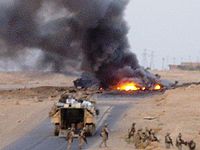 Because of its clandestine nature, the exact composition of the Iraqi insurgency is difficult to determine, but the main groupings are:
 The Ba'athists include former Ba’ath Party
officials, the Fedayeen Saddam
, and some former agents of the Iraqi intelligence elements and security services, such as the Mukhabarat
and the Special Security Organization. Their goal, at least before the capture of Saddam Hussein, was the restoration of the former Ba'athist regime to power. The pre-war organization of the Ba'ath Party and its militias as a cellular structure aided the continued pro-Saddam resistance after the fall of Baghdad, and Iraqi intelligence operatives may have developed a plan for guerrilla war
following the toppling of Saddam Hussein from power.
Following Saddam's capture, the Ba'athist movement largely faded; its surviving factions were increasingly shifting to either nationalist factions (Iraqi, though not Pan-Arab, such as the ideology of the pre-Ba'athist regime), or Islamist (Sunni or Shia, depending on the actual faith of the individual, though Ba'ath Party policy had been secular, and many of its members were atheist).
As the goal of restoring the Ba'ath Party to power was seemingly out of reach, the alternative solution appeared to be to join forces with organisations who opposed the US-led invasion. Many former Ba'athists had adopted an Islamist façade in order to attract more credibility within the country, and perhaps gain support from outside Iraq. Others, especially following the January 2005 elections, became more interested in politics.
The fall of Baghdad effectively ended the existence of the Fedayeen Saddam
as an organized paramilitary. Several of its members died during the war. A large number survived, however, and were willing to carry on the fight even after the fall of Saddam Hussein from power. Many former members joined guerrilla organizations that began to form to resist the U.S-led coalition in Iraq. By June, an insurgency was underway in the central and northern Iraq, especially in an area known as the Sunni Triangle. Some units of the Fedayeen also continued to operate independently of other insurgent organizations in the Sunni areas of Iraq. On November 30, 2003, a U.S. convoy traveling through the town of Samarra
in the Sunni Triangle was ambushed by over 100 Iraqi guerillas, reportedly wearing trademark Fedayeen Saddam uniforms.
Following the execution of Saddam Hussein
, Deputy Leader of the Iraqi Ba'ath Party and former Vice President of Iraq Izzat Ibrahim ad-Douri became a leading candidate to succeed him as Leader of the Iraqi Ba'ath Party. Ad-Douri had taken over the running of the Iraqi Ba'ath Party following Saddam Hussein's capture in 2003 and had been endorsed by a previously unknown group calling itself Baghdad Citizens Gathering
. On 3 January 2007 the website of the banned Iraqi Ba'ath Party confirmed that he was new leader of the party.
Increasing Syrian influence in the Iraqi Ba'ath Party may well have a major effect on result in a fragmentation of Ba'athist parts of the insugency.
and to quickly restore complete sovereignty
.
One notable leader of the insurgency among nationalist Sunni is former aide to Saddam Hussein and a former regional Ba'ath Party
Organiser Mohammed Younis al-Ahmed al-Muwali
who has been crossing the border between Iraq and Syria disbursing funds, smuggling weaponry and organising much of the fighting in the central area of Iraq.
One former minister in the interim government, Ayham al-Samarai, announced the launch in 2005 of "a new political movement, saying he aimed to give a voice to figures from the legitimate Iraqi resistance. 'The birth of this political bloc is to silence the skeptics who say there is no legitimate Iraqi resistance and that they cannot reveal their political face,' he told a news conference." It is unclear what became of this movement.
followers of the Ikhwan movement
, the Wahabi movement, or, in particular, the latter's offshoot the Salafi
movement. Salafis advocate a return to the strict "uncorrupted" understanding of Islam exemplified by the first three generations of Islam after Muhammad
. They oppose any non-Muslim groups and influences, and regularly attack the Christian
, Mandean and Yazidi
communities of Iraq. Many also engage in attacks on Shia Muslims, considered apostates and therefore held in even lower regard than non-believers. These groups, especially the Salafis, are distinct from the normative and more spiritual mainstream Sunni Muslim population.
Examples of Sunni Islamist groups include Mujahideen Shura Council (Iraq), the Islamic Army in Iraq
, al-Qaeda in Iraq
, the United Jihad Factions Council
and Jaish al-Rashideen
.
Hard-line clerics and remaining underground cells of the Muslim Brotherhood
in Iraq have helped provide support for the indigenous militant
Islamist movement. Supportive of this strand is the founder of the ultra-conservative and Wahabi Association of Muslim Scholars
, Sheikh Hareth Al-Dhari.
with perhaps the greatest conundrum of his administration given the capture of Amarah
. American officials have pressed him hard to disarm the militias and rid the state security forces of their influence. Yet Mr. Maliki has hesitated to move against them, particularly the Mahdi Army and Badr Organization, for fear of alienating fundamentalist Shia leaders inside his fractious coalition.
A 2008 report by the Combating Terrorism Center
at West Point based on reports from the interrogations of dozens of captured Shia fighters described an Iranian-run network smuggling Shia fighters into Iran where they received training and weapons before returning to Iraq.
, the military wing of the Supreme Islamic Council of Iraq. The group is currently based in Karbala, Iraq, and is also active in areas throughout southern Iraq. The group was formed by the Iranian Government to fight the Saddam Hussein-controlled Iraq during the Iraq-Iran War. Originally, the group consisted of Iraqi exiles who were banished from Iraq during the reign of Saddam Hussein. After the war ended in 1988, the organization remained in Iran until Saddam Hussein was overthrown during the 2003 invasion of Iraq
. Following the invasion, the brigade then moved into Iraq, became members of the new Iraq Army, and aided coalition forces in fighting other Iraqi insurgents.
In December 2005, the group and their leaders in the Supreme Islamic Council of Iraq participated in parliament elections
, under the pro-Shiite coalition known as the United Iraqi Alliance
, and managed to get 36 members into the Iraqi Parliament.
The Badr organization supports the government of Nouri al-Maliki.
are largely impoverished men from the Shi'a urban areas and slums in Baghdad and the southern Shi'a cities. The Mahdi Army
area of operation stretches from Basra
in the south to the Sadr City
section of Baghdad
in central Iraq (some scattered Shi'a militia activity has also been reported in Baquba and Kirkuk
, where Shi'a minorities exist).
Sadr was suspected by U.S. and Iraqi authorities of ordering the assassination of a returning moderate Shia cleric, Imam
Abdul Majid al-Khoei
, in Najaf on April 12, 2003. On April 5, 2004, a warrant was issued for Sadr's arrest in connection with this killing; this, in addition to the closing of his newspaper al-Hawza on March 29, the arrest of one of his aides and other actions to suppress his movement, led to an armed attack by the Mahdi Army in April 2004. This initial attack in southern Iraq was suppressed by June. A second attack by his militia, centered in a mosque in Najaf
, began in August; this was resolved in an agreement brokered by Grand Ayatollah Ali al-Sistani
. Since that point, Sadr's opposition to the multinational occupation has been mainly in the realm of politics. Since the handover of sovereignty, the Mahdi Army has been maintained as an organized force. Sadr supporters also continue to engage in peaceful resistance such as the large protests in Baghdad on April 9, 2005.
During his group's active militant phase, Al-Sadr enjoyed wide support from the Iraqi people. A poll by the Iraq Center for Research and Studies found that 32% of Iraqis "strongly supported" him and another 36% "somewhat supported" him, making him the second most popular man in Iraq, behind only Ayatollah Ali al-Sistani. The Mahdi Army is believed to have around 60,000 members.
After the December 2005 elections in Iraq, al-Sadr's party got 32 new seats giving him substantial political power in the divided Iraqi Parliament. In January 2006, he used these seats to swing the vote for prime minister to Ibrahim al-Jaafari
, giving al-Sadr a legitimate stake in the new Iraqi government and allying al-Jaafari with the controversial cleric.
On November 27, 2006, a senior American intelligence official told reporters that the Iranian-backed group Hezbollah had been training members of the Mahdi Army
. The official said that 1,000 to 2,000 fighters from the Mahdi Army and other Shia militias had been trained by Hezbollah in Lebanon
, and a small number of Hezbollah operatives have also visited Iraq to help with training. Iran
has facilitated the link between Hezbollah and the Shia militias in Iraq, the official said. "There seems to have been a strategic decision taken sometime over late winter or early spring by Damascus
, Tehran
, along with their partners in ait Lebanese Hezbollah, to provide more support to Sadr to increase pressure on the U.S.," the American intelligence official said.
in December 2003, several documents were found in his possession. One particular document, which was apparently written after he lost power, appeared to be a directive to his Ba'athist loyalists warning them to be wary of Islamist mujahideen
and other foreign Arabs entering the country to join the insurgency. The directive supposedly shows Saddam having concerns that foreign fighters would not share the same objectives as Ba'ath loyalists (i.e. the eventual return of Saddam to power and the restoration of his regime). A US official commenting on the document stressed that while Saddam urged his followers to be cautious in their dealings with other Arab fighters, he did not order them to avoid contact or rule out co-operation. Bruce Hoffman
, a Washington counter-terrorism expert stated that the existence of the document underscores the fact that "this is an insurgency cut of many different cloths...[and] everybody's jockeying for their position of power in the future Iraq." Many experts believe that fighters from other countries who have flocked to Iraq to join the insurgents are motivated by animosity toward the United States and the desire to install an Islamic state in place of the Ba'ath Party
's secular regime
.
Foreign fighters are mostly of Arab fighters from neighboring countries, who have entered Iraq, primarily through the porous desert borders of Syria and Saudi Arabia, to assist the Iraqi insurgency. Many of these fighters are Wahhabi
fundamentalists who see Iraq as the new "field of jihad
" in the battle against U.S. forces. It is generally believed that most are freelance fighters, but a few members of Al-Qaeda
and the related group Ansar al-Islam
are suspected of infiltrating into the Sunni areas of Iraq through the mountainous northeastern border with Iran
. The U.S. and its allies point to Jordan
ian-born Al-Qaeda in Iraq leader Abu Musab al-Zarqawi as the key player in this group. Zarqawi was considered the head of an insurgent group called Al-Tawhid Wal-Jihad ("Monotheism and Holy War") until his death on June 7, 2006, which according to U.S. estimates numbers in the low hundreds.
Usage of the term "foreign fighters" has received criticism as being Western-centric because, taken literally, the term would encompass all non-Iraqi forces, including Coalition forces. Zarqawi has taken to taunting the American occupiers about the irony of the term: "Who is the foreigner, O cross worshippers? You are the ones who came to the land of the Muslims from your distant corrupt land." (Communiqué of 10 May 2005). Zarqawi's group has since announced the formation of the Ansar platoon, a squad of Iraqi suicide bombers, which an AP writer called "an apparent bid to deflect criticism that most suicide bombers in Iraq are foreigners."
While it is not known how many of those fighting the U.S. in Iraq are from outside the country, it is generally agreed that foreign fighters make up a very small percentage of the insurgency. Major General
Joseph Taluto, head of the 42nd Infantry Division, said that "99.9 per cent" of captured Insurgents are Iraqi. The estimate has been confirmed by the Pentagon's own figures; in one analysis of over 1000 insurgents captured in Fallujah, only 15 were non-Iraqi. According to the Daily Telegraph, information from military commanders engaging in battles around Ramadi exposed the fact that out of 1300 suspected insurgents arrested in five months of 2005, none were foreign, although Colonel
John Gronski stated that foreigners provided money and logistical support: "The foreign fighters are staying north of the [Euphrates] river, training and advising, like the Soviets were doing in Vietnam
"
In September 2006, the Christian Science Monitor reported, "It's true that foreign fighters are in Iraq, such as the late Abu Musab al-Zarqawi
. But they are a small minority of the insurgents, say administration critics. Most Iraqi mujahideen are Sunnis who fear their interests will be ignored under Iraq's Shia-dominated government. They are fighting for concrete, local political goals - not the destruction of America." The paper quoted University of Michigan history professor Juan Cole
: "If the Iraqi Sunni nationalists could take over their own territory, they would not put up with the few hundred foreign volunteers blowing things up, and would send them away or slit their throats." In 2005, the Washington-based Centre for Strategic and International Studies (CSIS) concluded that foreign fighters accounted for less than 10% of the estimated 30,000 insurgents and argued that the US and Iraqi Governments were "feeding the myth" that they comprised the backbone of the insurgency.
Despite the low numbers of foreign fighters their presence has been confirmed in several ways and Coalition forces believe the majority of suicide bombings are believed to be carried out by non-Iraqi foreigners. Kenneth Katzman, a Middle East expert with the Congressional Research Service
, stated in June 2005: "I still think 80 percent of the Insurgents, the day to day activity, is Iraqi - the roadside bombings, mortars, direct weapons fire, rifle fire, automatic weapons fire...[but] the foreign fighters attract the headlines with the suicide bombings, no question."
In September 2005, Iraqi and US forces conducted a counter-insurgency operation in the predominantly Turkmen
town of Tal Afar
. According to an AP
, report, an Iraqi Army Captain claimed that Iraqi forces arrested 150 non-Iraqi Arabs (Syria, Sudan, Yemen and Jordan) in the operation; the American army claimed 20% of arrests were foreign combatants, while Donald Rumsfeld
on PBS
confirmed that foreign combatants were present. However, not all accounts of the battle mention these arrests, and U.S. Army commander Colonel H. R. McMaster
said the "vast majority" of Insurgents captured there were "Iraqis and not foreigners." Iraqi journalist Nasir Ali claimed that there were "very few foreign combatants" in Tal Afar and charged "Every time the US army and the Iraqi government want to destroy a specific city, they claim it hosts Arab fighters and Abu Musab al-Zarqawi."
There are allegations that the U.S. government has attempted to inflate the number of foreign fighters in order to advance the theory that the insurgency is not a local movement. U.S. Army Specialist Tony Lagouranis spoke about his job identifying many of the bodies after the assault on Fallujah:
reported that 45% of all foreign militants targeting U.S. troops and Iraqi civilians and security forces are from Saudi Arabia; 15% are from Syria and Lebanon; and 10% are from North Africa. 50% of all Saudi fighters in Iraq come as suicide bombers. In the six months preceding that article, such bombings have killed or injured 4,000 Iraqis.
According to a U.S. military press briefing on October 20, 2005, 312 foreign nationals from 27 different countries had been captured in Iraq from April to October 2005. This represents a component of the Iraqi insurgent movement, which also includes a nationalist movement encompassing over 30 Shia and Sunni militias.
Foreign Insurgents captured in Iraq in the 7-month period April–October 2005:
Involvement of Zarqawi in significant terrorist incidents was not usually proven, although his group often claimed it perpetrated bombings. As al-Qaeda is an "opt-in" group (meaning everyone who agrees to some basic Wahhabi moral tenets and the fundamental goals may consider himself a member), it is most likely that "Al-Qaeda in Iraq" is a loose association of largely independent cells united by a common strategy and vision, rather than a unified organization with a firm internal structure.
On June 8, 2006, Iraqi officials confirmed Zarqawi was killed by two 500 lb laser guided bombs dropped from an F-16 the previous evening. Abu Ayyub al-Masri
, an Egyptian who was trained in Al-Qaeda camps in Afghanistan has taken his place.
A document found in Zarqawi's safe house indicates that the guerrilla group was trying to provoke the U.S. to attack Iran in order to reinvigorate the resistance in Iraq and to weaken American forces in Iraq. "The question remains, how to draw the Americans into fighting a war against Iran? It is not known whether American is serious in its animosity towards Iraq, because of the big support Iran is offering to America in its war in Afghanistan and in Iraq. Hence, it is necessary first to exaggerate the Iranian danger and to convince America and the west in general, of the real danger coming from Iran...". The document then outlines 6 ways to incite war between the two nations. Iraqi national security adviser Mowaffak al-Rubaie said the document, shows al-Qaeda in Iraq
is in "pretty bad shape." He added that "we believe that this is the beginning of the end of al-Qaeda in Iraq."
Journalist Jill Carroll
, detailing her captivity in Iraq, described how one of her captors, who identified himself as Abdullah Rashid and leader of the Mujahideen Shura Council in Iraq. He told her that "The Americans were constantly saying that the mujahideen in Iraq were led by foreigners... So, the Iraqi insurgents went to Zarqawi and insisted that an Iraqi be put in charge." She continued by stating: "But as I saw in coming weeks, Zarqawi remained the insurgents' hero, and the most influential member of their council, whatever Nour
/Rashid's position... At various times, I heard my captors discussing changes in their plans because of directives from the council and Zarqawi."
Opinions differ on how broad this schism is. Terrorism expert Jessica Stern
warned that "in the run-up to the war, most Iraqis viewed the foreign volunteers who were rushing in to fight against America as troublemakers, and Saddam Hussein's forces reportedly killed many of them." This opinion contradicts Iraqi scholar Mustapha Alani, who says that these foreigners are increasingly welcomed by the public, especially in the former Ba'athist strongholds north of Baghdad.
While some have noted an alliance of convenience that existed between the foreign fighters and the native Sunni insurgents, there are signs that the foreign militants, especially those who follow Zarqawi, are increasingly unpopular among the native fighters. In the run-up to the December 2005 elections, Sunni fighters were warning al Qaeda members and foreign fighters not to attack polling stations. One former Ba'athist told Reuters, "Sunnis should vote to make political gains. We have sent leaflets telling al Qaeda that they will face us if they attack voters." And an unnamed Sunni leader was quoted commenting on Zarqawi: "Zarqawi is an American, Israeli and Iranian agent who is trying to keep our country unstable so that the Sunnis will keep facing occupation."
By early 2006, the split between the Sunni groups and the Zarqawi-led foreign fighters had grown dramatically, and Sunni forces began targeting al Qaeda forces for assassination. One senior intelligence official told the Telegraph that Zarqawi had fled to Iran as a result of the attacks. In response to al Qaeda killings in Iraq, Sunni insurgents in al-Anbar province led by former Ba'athist intelligence officer Ahmed Ftaikhan formed an anti-al-Qaeda militia called the Anbar Revolutionaries. All of the militia's core members have relatives who have been killed by al-Qaeda in Iraq, and they have sought to prevent foreign jihadis from entering the country. The group "claims to have killed 20 foreign fighters and 33 Iraqi sympathizers.". The schism became all the more apparent in when a tape claiming to be from the Mujahedeen Shura Council urged Osama Bin Laden to replace Al Qaida in Iraq's current head with an Iraqi national. The Mujahedeen Shura Council, however, issued a statement shortly afterwards denying the authenticity of this tape.
On July 19, 2007 seven domestic insurgent groups informed journalists in Damascus
that they were forming a united front independent of Al-Qaeda.
Interrogation of members from the Qazali terror network revealed that the group had received substantial Iran-based training in explosives technology; arms and munitions; and some cases of advice. All this is alleged by the U.S. military to have taken place through the Quds force of the Iranian Revolutionary Guards Corps. It is also alleged that Iran supports Muqtada al-Sadr
's Mahdi Army
.
Although the CPA
enforced a 1987 law banning unions in public enterprises, trade union
s such as the Iraqi Federation of Trade Unions
(IFTU) and Iraq's Union of the Unemployed have also mounted effective opposition to the Coalition. However, no trades unions support the armed insurgents, and unions have themselves been subject to attacks from the insurgents. Hadi Saleh
of the IFTU was assassinated under circumstances that pointed to a Ba'athist insurgent group on 3 January 2005. . Another union federation, the General Union of Oil Employees (GUOE) opposes the Coalition forces in Iraq and calls for immediate withdrawal but was neutral on participation in the election. Whereas the GUOE wants all Coalition troops out immediately, both the IFTU and the Workers Councils'
call for replacement of U.S. and British forces with neutral forces from the UN, the Arab League and other nations as a transition.
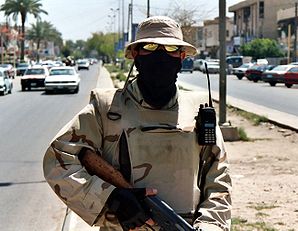
Polls conducted in June 2005 suggest that there is some sentiment towards Coalition armies being in Iraq. According to the Boston Globe (10 June 2005): "a recent internal poll conducted for the U.S.-led Coalition found that nearly 85 percent of the population supported the terrorist attacks, making accurate intelligence difficult to obtain. Only 15 percent of those polled said they strongly supported the U.S.-led coalition." A later 2005 poll by British intelligence said that 45% of Iraqis support attacks against Coalition forces, rising to 65% in some areas, and that 82% are "strongly opposed" to the presence of Coalition troops. Demands for U.S. withdrawal have also been signed on by one third of Iraq's Parliament. These results are consistent with a January 2006 poll that found an overall 47% approval for attacks on US-led forces. That figure climbed to 88% among Sunnis. Attacks on Iraqi security forces and civilians, however, were approved of by only 7% and 12% of respondents respectively. 87% favored a U.S. withdrawal, but only 23% believe the U.S. would actually withdraw if asked. 80% believed the U.S. plans permanent bases in Iraq.
A September 2006 poll of both Sunnis and Shias found that 71% of Iraqis wanted the U.S. to leave within a year, with 65% favoring an immediate pullout and 77% voicing suspicion that the U.S. wanted to keep permanent bases in Iraq. 61% approved of attacks on U.S. forces. A later poll in march 2007 suggests the percentage of Iraqis who approve of attacks on Coalition forces has dropped to 51%.
U.S. and British forces tend to suffer fewer casualties in the Shia and Kurdish areas outside the "Sunni triangle." Many, however, especially in the Shia community, although supportive of the overthrow of Saddam Hussein, are very unhappy with the coalition staying in Iraq. Farther north in the Kurdish areas, there is some pro-U.S. sentiment and a strong opposition to the insurgency.
Support for the insurgency is less strong in the Shi'a areas of the country than in the Sunni areas since the Shi'as, like the Kurds, did not dominate the ruling factions of the old regime. Shi'as have also been influenced by a moderate clerical establishment under Ayatollah Ali al-Sistani that has advocated a political solution. However, Muqtada al-Sadr has drawn support from a portion of the Shi'a community, mainly young and unemployed men in urban areas. Sadr's support varies region by region; while likely not drawing considerable support in Najaf (a stronghold of the clerical establishment which was occupied by Sadr's militia and has been the scene of some of the heaviest fighting), some polls have indicated Sadr's support among the Shi'as of Baghdad may be as high as 50%. However, this support did not translate into direct electoral winnings for Sadr supporters during the January 2005 elections.
Spontaneous peaceful protests against the coalition forces have appeared in Shi'a areas. The Shi'a intellectuals and the upper classes, as well as the inhabitants of rural regions in the south and followers of more moderate clerics such as al-Sistani, tend to cooperate with the Coalition and the Iraqi interim government and eschew militant protest. Sistani's political pressure is largely credited with enabling the elections of January 2005.
The Shi'a and Kurdish populations of Iraq have had long histories of strained relations with past Iraqi regimes, which have long been dominated by the Sunni. Their favored status in Iraq since the 2003 U.S.-led invasion is also a factor attributed to the fewer instances of attacks against Coalition forces in Shi'a and Kurdish regions of the country. This is in contrast to the more radical al-Sadr, who draws his support from the lower classes and much of the Shia urban population. Both united, however, on the United Iraqi Alliance ticket that brought in the largest share of the votes in the January 2005 elections.
n border town of al-Qaim
through Ramadi
and Fallujah
to Baghdad
, as well as along the Tigris river from Baghdad north to Tikrit
. Heavy guerilla activity also takes place around the cities of Mosul and Tal Afar
in the north, as well as the "Triangle of Death" south of Baghdad, which includes the "-iya" cities of Iskandariya, Mahmudiya, Latifiya, and Yusufiya. Lesser activity takes place in several other areas of the country. The insurgents are believed to maintain a key supply line stretching from Syria through al-Qaim and along the Euphrates to Baghdad and central Iraq, the Iraqi equivalent of the Ho Chi Minh trail
. A second "ratline" runs from the Syrian border through Tal Afar to Mosul.
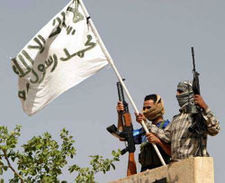
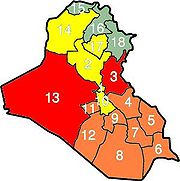 Although estimates of the total number of Iraqi guerrillas varies by group and fluctuates under changing political climate, the latest assessments put the present number at between 3,000 and 7,000 fighters along with numerous supporters and facilitators throughout the Sunni Arab community. At various points U.S. forces provided estimates on the number of fighters in specific regions. A few are provided here (although these numbers almost certainly have fluctuated):
Guerilla forces operate in many of the cities and towns of al-Anbar province, due to mostly ineffective Iraqi security forces in this area. There was extensive guerilla activity in Ramadi
, the capital of the province, as well as al-Qa'im
, the first stop on an insurgent movement route between Iraq and Syria. In 2006, reports suggested that the Anbar capital Ramadi had largely fallen under insurgent control along with most of the Anbar region, as a result the US
is sending an extra 3,500 marines to reestablish control of the region. In the early part of 2007 the insurgency suffered serious setbacks in Ramadi after they were defeated in the Second Battle of Ramadi in the fall of 2006. With the help of the Anbar Salvation Council
, incidents fell from an average of 30 attacks per day in December 2006 to an average of fewer than four in April 2007.
Baghdad is still one of the most violent regions of the country, even after the 2007 troop surge more than two thirds of the violence that takes place in Iraq happens in Baghdad even though the Iraqi Government is in firm control of the entire city. Suicide attacks and car bombs are near daily occurrences in Baghdad. The road from Baghdad to the city airport is the most dangerous in the country, if not the world. Iraqi security and police forces had also been significantly built up in the capital and, despite being constantly targeted, had enjoyed some successes such as the pacification of Haifa Street
, which however subsequently saw a massive surge of insurgent activity. and after the failed Coalition Operation Together Forward fell under Sunni insurgent control. The U.S. and Iraqi Forces scored many decisive victories in 2007 during the U.S. troops surge when they lauched Operation Law and Order and Operation Phantam Thunder which broke the back of the insurgency and has since the saw a mass reduction in violence by 80 percent since then.
As time passed the insurgent grasp on Mosul has strengthened and by mid-2007 insurgents had control of most neighborhoods on the west bank of the Tigris, with the exception of the few Coalition bases scattered throughout the city and their immediate surroundings. Kurdish peshmerga-forces are in control of the East bank neighborhoods, mostly populated by fellow Kurds.
Recent intelligence suggests that the base of foreign paramilitary operations has moved from Anbar to the religiously- and ethnically-mixed Diyala province. By July 2007 Diyala had fallen under almost total Insurgent control, and had become the headquarters for the Sunni-dominated Islamic State of Iraq
, which has issued a proclamation declaring the regional capital Baqubah its capital.
In response to a law allowing for the partitioning of Iraq into autonomous regions, members of the Mutayibeen Coalition (Khalf al-Mutayibeen), one of Iraq's largest Sunni insurgent groups, allegedly claimed the creation of an Islamic state encompassing parts of 6 of Iraq's 18 provinces on October 15. Yet another show of defiance came on October 18 when Sunni fighters brazenly paraded in Ramadi. Similar parades were held two days later in several towns across western Iraq, two of which occurred within two miles of US military bases.
By October 2006, small radicalized militias had seemed to overshadow the larger and more organized Sunni groups which had composed the insurgency previously. As disagreements emerged in pre-existing groups for reasons ranging from the rift in the Sunni forces between foreign and Iraqi fighters, competition between Mahdi Army and Badr Brigade, and anger over various decisions such as Muqtada al Sadr's agreement to join the political process, dozens of insurgency groups sprung up across the country, though particularly in Baghdad where the US army has listed 23 active militias. Residents have described the capital as being a patchwork of militia run fiefs. As a result of the insurgency’s splintering nature, many established leaders seemed to lose influence. This was particularly illustrated on October 19, when members of the Mahdi army briefly seized control of Amarah. The attack, while demonstrating the influence of the Madhi army, is believed to have originated as a result of contention between local units of the Madhi army and the allegedly Badr brigade run security forces, and the timing suggested that neither Al Sadr nor his top commanders had known or orchestrated the offensive.
At the height of the war, insurgents launched hundreds of attacks each month against Coalition forces. Overtime, insurgency groups moved to more sophisticated methods of attack such as Explosively formed penetrator
s, and infrared lasers, which cannot be easily jammed. These attacks contributed to the rate of civilian casualties which in turn reduced Iraq's public safety as well as the reliability of infrastructure.
As of January 29, 2009 4,235 U.S. soldiers, 178 British soldiers and 139 soldiers from other nations (allied with the coalition) have died in Iraq. 31,834 U.S. soldiers had been wounded. Coalition forces do not usually release death counts. As such, the exact number of insurgents killed by the Coalition or Iraqi forces is unknown. Through September 2007 more than 19,000 insurgents were reported to have been killed in fighting with Coalition forces and tens of thousands were captured (including 25,000 detainees in U.S. military custody at the time), according to military statistics released for the first time.
. According to the analysts, this raises the possibility that Western agent provocateur
s may be using the untraceable pistols even as the U.S. government uses insurgent attacks against Iraqi civilians in an effort to discredit the Iraqi groups.
operations have been undertaken by the US-led Coalition or the Iraqi government. These include Operation Option North and Operation Bayonet Lightning
in Kirkuk
, Operation Desert Thrust
, Operation Abilene and Operation All American Tiger throughout Iraq, Operation Iron Hammer
in Baghdad
and Operation Ivy Blizzard
in Samarra
- all in 2003; Operation Market Sweep
, Operation Vigilant Resolve
and Operation Phantom Fury
in Fallujah
in 2004; Operation Matador in Anbar, Operation Squeeze Play
and Operation Lightning in Baghdad, Operation New Market
near Haditha
, Operation Spear
in Karabillah and the Battle of Tal Afar
- all in 2005; Operation Swarmer
in Samarra and Operation Together Forward in Baghdad in 2006; and Operation Law and Order in Baghdad, Operation Arrowhead Ripper in Baqouba and Operation Phantom Strike
throughout Iraq - all in 2007.
Chronology:
Militia
The term militia is commonly used today to refer to a military force composed of ordinary citizens to provide defense, emergency law enforcement, or paramilitary service, in times of emergency without being paid a regular salary or committed to a fixed term of service. It is a polyseme with...
s, foreign fighters, all-Iraqi units or mixtures opposing the United States
United States
The United States of America is a federal constitutional republic comprising fifty states and a federal district...
-led multinational force in Iraq
Multinational force in Iraq
The Multi-National Force – Iraq was a military command, led by the United States, which was responsible for Operation Iraqi Freedom. Multi-National Force – Iraq replaced the previous force, Combined Joint Task Force 7, on 15 May 2004, and was later itself reorganized into its successor, United...
and the post-2003 Iraqi government. During the height of the war the fighting was appearing both as armed conflict with the United States-led military coalition, as well as sectarian violence
Sectarian violence
Sectarian violence and/or sectarian strife is violence inspired by sectarianism, that is, between different sects of one particular mode of ideology or religion within a nation/community...
among the different ethnic groups within the population. The insurgents were involved in asymmetric warfare
Asymmetric warfare
Asymmetric warfare is war between belligerents whose relative military power differs significantly, or whose strategy or tactics differ significantly....
and a war of attrition
Attrition warfare
Attrition warfare is a military strategy in which a belligerent side attempts to win a war by wearing down its enemy to the point of collapse through continuous losses in personnel and matériel....
against the US-supported Iraqi government and US forces, while conducting coercive tactics against rivals or other militias.
The insurgency began
History of Iraqi insurgency
This is a history of the Iraqi insurgency, the armed opposition to the United States-led multinational force in Iraq in Iraq and the post-2003 Iraqi government.-Build up to insurgency:...
shortly after the 2003 invasion of Iraq
2003 invasion of Iraq
The 2003 invasion of Iraq , was the start of the conflict known as the Iraq War, or Operation Iraqi Freedom, in which a combined force of troops from the United States, the United Kingdom, Australia and Poland invaded Iraq and toppled the regime of Saddam Hussein in 21 days of major combat operations...
and before the establishment of the new Iraqi government. From at least 2004, and as of May 2007, the insurgency primarily targeted Coalition armies and latterly, Iraqi security forces
Iraqi security forces
Iraqi security forces is a U.S. Department of Defense term for all security forces of the Federal government of Iraq. They consist of the following organizations:*Ministry of Defence **Iraqi Armed Forces:*** Iraqi Army*** Iraqi Air Force...
seen as collaborator
Collaborationism
Collaborationism is cooperation with enemy forces against one's country. Legally, it may be considered as a form of treason. Collaborationism may be associated with criminal deeds in the service of the occupying power, which may include complicity with the occupying power in murder, persecutions,...
s with the coalition. During this period, only 10% of significant attacks have targeted Iraqi civilians. These have, however, caused the largest number of victims (see Tactics of the Iraqi insurgency
Tactics of the Iraqi insurgency
The tactics of the Iraqi insurgency vary widely. Minority Jihadist elements use car bombs, kidnappings, hostage-taking, shootings and other types of attacks to target Iraqi collaborators and U.S. forces with little regard for civilian casualties...
).
Many militant attacks have been directed at the Iraqi police
Iraqi Police
The Iraqi Police Service are the uniformed Territorial police force responsible for the enforcement of civil law within Iraq.The current organisation, structure and recruitment practice was guided by the Coalition Provisional Authority following the 2003 invasion of Iraq...
and military forces of the Iraqi government
Government of Iraq from 2006
The current government of Iraq took office on May 20, 2006 following approval by the members of the Iraqi National Assembly. This followed the general election in December 2005...
. They have continued during the transitional reconstruction of Iraq
Reconstruction of Iraq
Investment in post-2003 Iraq refers to international efforts to rebuild the infrastructure of Iraq since the Iraq War in 2003.Along with the economic reform of Iraq, international projects have been implemented to repair and upgrade Iraqi water and sewage treatment plants, electricity production,...
, as the Iraqi government tries to establish itself. As in most guerrilla warfare
Guerrilla warfare
Guerrilla warfare is a form of irregular warfare and refers to conflicts in which a small group of combatants including, but not limited to, armed civilians use military tactics, such as ambushes, sabotage, raids, the element of surprise, and extraordinary mobility to harass a larger and...
, civilians on all sides bear the brunt of the violence. According to a February–March 2007 poll, 51% of the Iraqi population approve of the attacks on Coalition forces. The same poll indicated that over 90% of Arab
Arab
Arab people, also known as Arabs , are a panethnicity primarily living in the Arab world, which is located in Western Asia and North Africa. They are identified as such on one or more of genealogical, linguistic, or cultural grounds, with tribal affiliations, and intra-tribal relationships playing...
Sunnis in Iraq approve of the attacks.
Iraq's deep sectarian divides have been a major dynamic in the insurgency, with support for the insurgents varying amongst different segments of the population. However as of August 2011, the insurgency went from about 130,000 size-force in 2003 after the U.S. government disbanded the original Iraqi Army, into only a few thousand fighters since the vast majority of the insurgent groups have been either defeated or switched to the Iraqi Government during and after the U.S. troop surge of 2007.
Composition
The Iraqi insurgency is composed of at least a dozen major organizations and perhaps as many as 40 distinct groups. These groups are subdivided into countless smaller cells. The Washington-based Centre for Strategic and International Studies (CSIS) estimates that less than 10% of insurgents are non-Iraqi foreign fighters. According to the Chief of the British General Staff, General Sir Richard Dannatt, speaking in September 2007,- Ba'athists, the supporters of Saddam HusseinSaddam HusseinSaddam Hussein Abd al-Majid al-Tikriti was the fifth President of Iraq, serving in this capacity from 16 July 1979 until 9 April 2003...
's former administration including army or intelligence officers, whose ideology is a variant of Pan-ArabismPan-ArabismPan-Arabism is an ideology espousing the unification--or, sometimes, close cooperation and solidarity against perceived enemies of the Arabs--of the countries of the Arab world, from the Atlantic Ocean to the Arabian Sea. It is closely connected to Arab nationalism, which asserts that the Arabs...
. - Iraqi nationalistIraqi nationalismIraqi nationalism refers to a nationalism based on Iraqi identity. Iraqi nationalism in history was influential in Iraq's movement to independence from Ottoman and British occupation. Iraqi nationalism was an important aspect in the 1920 Revolution against British occupation, and the 1958...
s, Iraqis who believe in a strong version of Iraqi self-determinationSelf-determinationSelf-determination is the principle in international law that nations have the right to freely choose their sovereignty and international political status with no external compulsion or external interference...
. These policies may not necessarily espouse a Pan-Arab ideology, but rather advocate the country's territorial integrityTerritorial integrityTerritorial integrity is the principle under international law that nation-states should not attempt to promote secessionist movements or to promote border changes in other nation-states...
including KuwaitKuwaitThe State of Kuwait is a sovereign Arab state situated in the north-east of the Arabian Peninsula in Western Asia. It is bordered by Saudi Arabia to the south at Khafji, and Iraq to the north at Basra. It lies on the north-western shore of the Persian Gulf. The name Kuwait is derived from the...
and KhuzestanKhuzestan ProvinceKhuzestan Province is one of the 31 provinces of Iran. It is in the southwest of the country, bordering Iraq's Basra Province and the Persian Gulf. Its capital is Ahwaz and covers an area of 63,238 km²...
. Historical figures of this movement include the pre-Ba'athist leader of Iraq Abd al-Karim Qasim and his government. - Iraqi SalafiSalafiA Salafi come from Sunni Islam is a follower of an Islamic movement, Salafiyyah, that is supposed to take the Salaf who lived during the patristic period of early Islam as model examples...
IslamistsIslamismIslamism also , lit., "Political Islam" is set of ideologies holding that Islam is not only a religion but also a political system. Islamism is a controversial term, and definitions of it sometimes vary...
, the indigenous armed followers of the Salafi movement, as well as any remnants of the KurdishKurdish peopleThe Kurdish people, or Kurds , are an Iranian people native to the Middle East, mostly inhabiting a region known as Kurdistan, which includes adjacent parts of Iran, Iraq, Syria, and Turkey...
Ansar al-IslamAnsar al-IslamAnsar al-Islam is a Sunni Islamist group of Iraqis, promoting a radical interpretation of Islam, close to the official Saudi ideology of Wahhabism with strict application of Sharia. The group was formed in the northern provinces of Iraq near the Iranian border, and previously had established...
: individuals with a Salafi-only policy opposed to non-Salafis though not aligned to one specific ethnic group. Though opposed to the US-led invasion, these groups are not wholly sympathetic towards the former Ba'ath Party as its members included non-Salafis. - Shi'a militias, including the southern, IranIranIran , officially the Islamic Republic of Iran , is a country in Southern and Western Asia. The name "Iran" has been in use natively since the Sassanian era and came into use internationally in 1935, before which the country was known to the Western world as Persia...
-linked Badr OrganizationBadr OrganizationThe Badr Organization previously known as the Badr Brigades or Badr Corps is an Iraqi political party headed by Hadi al-Amiri...
, the Mahdi ArmyMahdi ArmyThe Mahdi Army, also known as the Mahdi Militia or Jaish al-Mahdi , was an Iraqi paramilitary force created by the Iraqi Shia cleric Muqtada al-Sadr in June 2003....
, and the central-Iraq followers of Muqtada al-SadrMuqtada al-SadrSayyid Muqtadā al-Ṣadr is an Iraqi Islamic political leader.Along with Ali al-Sistani and Ammar al-Hakim of the Islamic Supreme Council of Iraq, Sadr is one of the most influential religious and political figures in the country not holding any official title in the Iraqi government.-Titles:He is...
. These groups neither advocate the dominance of a single ethnic group, nor the traditional ideologies behind the Iraqi state (e.g. these particular Shi'as do not support the capture of Khuzestan or other border areas with Iran, but rather promote warm relations with Iran's Shi'a government). - Foreign Islamist volunteers, including those often linked to al Qaeda and largely driven by the Salafi/Wahhabi doctrine (the two preceding categories are often lumped as "jihadJihadJihad , an Islamic term, is a religious duty of Muslims. In Arabic, the word jihād translates as a noun meaning "struggle". Jihad appears 41 times in the Quran and frequently in the idiomatic expression "striving in the way of God ". A person engaged in jihad is called a mujahid; the plural is...
ists"); - Possibly some socialist revolutionaries (such as the Iraqi Armed Revolutionary ResistanceIraqi Armed Revolutionary ResistanceThe Iraqi Armed Revolutionary Resistance is a Marxist insurgent group alleged to be operating in Iraq in 2007.-History:According to two reports by Zeeyad Khan in the now inactive blog IraqSlogger, the IARR's existence was made public in mid-May 2007, when a group of insurgents distributed leaflets...
, which claimed one attack in 2007). - Non-violent resistance groups and political parties (not part of the armed insurgency).
Ba'athists
Arab Socialist Ba'ath Party – Iraq Region
The Arab Socialist Ba'ath Party – Iraq Region is a ba'athist regional organisation founded in 1951 by Fuad al-Rikabi...
officials, the Fedayeen Saddam
Fedayeen Saddam
Fedayeen Saddam was a paramilitary organization loyal to the former Ba'athist government of Saddam Hussein. The name was chosen to mean "Saddam's Men of Sacrifice". At its height, the group had 30,000-40,000 members.-Irregular forces:...
, and some former agents of the Iraqi intelligence elements and security services, such as the Mukhabarat
Iraqi Intelligence Service
The Iraqi Intelligence Service , also known as the Mukhabarat, General Directorate of Intelligence, or Party Intelligence, was the main state intelligence organization in Iraq under Saddam Hussein...
and the Special Security Organization. Their goal, at least before the capture of Saddam Hussein, was the restoration of the former Ba'athist regime to power. The pre-war organization of the Ba'ath Party and its militias as a cellular structure aided the continued pro-Saddam resistance after the fall of Baghdad, and Iraqi intelligence operatives may have developed a plan for guerrilla war
Guerrilla warfare
Guerrilla warfare is a form of irregular warfare and refers to conflicts in which a small group of combatants including, but not limited to, armed civilians use military tactics, such as ambushes, sabotage, raids, the element of surprise, and extraordinary mobility to harass a larger and...
following the toppling of Saddam Hussein from power.
Following Saddam's capture, the Ba'athist movement largely faded; its surviving factions were increasingly shifting to either nationalist factions (Iraqi, though not Pan-Arab, such as the ideology of the pre-Ba'athist regime), or Islamist (Sunni or Shia, depending on the actual faith of the individual, though Ba'ath Party policy had been secular, and many of its members were atheist).
As the goal of restoring the Ba'ath Party to power was seemingly out of reach, the alternative solution appeared to be to join forces with organisations who opposed the US-led invasion. Many former Ba'athists had adopted an Islamist façade in order to attract more credibility within the country, and perhaps gain support from outside Iraq. Others, especially following the January 2005 elections, became more interested in politics.
The fall of Baghdad effectively ended the existence of the Fedayeen Saddam
Fedayeen Saddam
Fedayeen Saddam was a paramilitary organization loyal to the former Ba'athist government of Saddam Hussein. The name was chosen to mean "Saddam's Men of Sacrifice". At its height, the group had 30,000-40,000 members.-Irregular forces:...
as an organized paramilitary. Several of its members died during the war. A large number survived, however, and were willing to carry on the fight even after the fall of Saddam Hussein from power. Many former members joined guerrilla organizations that began to form to resist the U.S-led coalition in Iraq. By June, an insurgency was underway in the central and northern Iraq, especially in an area known as the Sunni Triangle. Some units of the Fedayeen also continued to operate independently of other insurgent organizations in the Sunni areas of Iraq. On November 30, 2003, a U.S. convoy traveling through the town of Samarra
Samarra
Sāmarrā is a city in Iraq. It stands on the east bank of the Tigris in the Salah ad-Din Governorate, north of Baghdad and, in 2003, had an estimated population of 348,700....
in the Sunni Triangle was ambushed by over 100 Iraqi guerillas, reportedly wearing trademark Fedayeen Saddam uniforms.
Following the execution of Saddam Hussein
Saddam Hussein
Saddam Hussein Abd al-Majid al-Tikriti was the fifth President of Iraq, serving in this capacity from 16 July 1979 until 9 April 2003...
, Deputy Leader of the Iraqi Ba'ath Party and former Vice President of Iraq Izzat Ibrahim ad-Douri became a leading candidate to succeed him as Leader of the Iraqi Ba'ath Party. Ad-Douri had taken over the running of the Iraqi Ba'ath Party following Saddam Hussein's capture in 2003 and had been endorsed by a previously unknown group calling itself Baghdad Citizens Gathering
Baghdad Citizens Gathering
On 31 December 2006, a previously unknown Baathist group which, following the execution of Saddam Hussein, the former ruler of Iraq and leader of Iraq's Baath Party, very publicly issued a statement in Amman in Jordan at the Jordanian branch of the Iraqi Baath Party endorsing Izzat Ibrahim...
. On 3 January 2007 the website of the banned Iraqi Ba'ath Party confirmed that he was new leader of the party.
Increasing Syrian influence in the Iraqi Ba'ath Party may well have a major effect on result in a fragmentation of Ba'athist parts of the insugency.
Iraqi Nationalists
Iraqi nationalists are mostly drawn from the Arab regions. Their reasons for opposing the Coalition vary from a rejection of the Coalition presence as a matter of principle to the failure of the multinational forces to fully restore public servicesPublic services
Public services is a term usually used to mean services provided by government to its citizens, either directly or by financing private provision of services. The term is associated with a social consensus that certain services should be available to all, regardless of income...
and to quickly restore complete sovereignty
Sovereignty
Sovereignty is the quality of having supreme, independent authority over a geographic area, such as a territory. It can be found in a power to rule and make law that rests on a political fact for which no purely legal explanation can be provided...
.
One notable leader of the insurgency among nationalist Sunni is former aide to Saddam Hussein and a former regional Ba'ath Party
Arab Socialist Ba'ath Party – Iraq Region
The Arab Socialist Ba'ath Party – Iraq Region is a ba'athist regional organisation founded in 1951 by Fuad al-Rikabi...
Organiser Mohammed Younis al-Ahmed al-Muwali
Mohammed Younis al-Ahmed al-Muwali
Mohammed Younis al-Ahmed al-Muwali aka "Khadr al-Sabahi" is a former senior member of the Ba'ath Party in Iraq with a Million Dollar Bounty on his head as one of Iraq's most wanted men accused of funding and leading terrorist operations....
who has been crossing the border between Iraq and Syria disbursing funds, smuggling weaponry and organising much of the fighting in the central area of Iraq.
One former minister in the interim government, Ayham al-Samarai, announced the launch in 2005 of "a new political movement, saying he aimed to give a voice to figures from the legitimate Iraqi resistance. 'The birth of this political bloc is to silence the skeptics who say there is no legitimate Iraqi resistance and that they cannot reveal their political face,' he told a news conference." It is unclear what became of this movement.
Sunni Islamist
Sunni IslamistsIslamism
Islamism also , lit., "Political Islam" is set of ideologies holding that Islam is not only a religion but also a political system. Islamism is a controversial term, and definitions of it sometimes vary...
followers of the Ikhwan movement
Muslim Brotherhood
The Society of the Muslim Brothers is the world's oldest and one of the largest Islamist parties, and is the largest political opposition organization in many Arab states. It was founded in 1928 in Egypt by the Islamic scholar and schoolteacher Hassan al-Banna and by the late 1940s had an...
, the Wahabi movement, or, in particular, the latter's offshoot the Salafi
Salafi
A Salafi come from Sunni Islam is a follower of an Islamic movement, Salafiyyah, that is supposed to take the Salaf who lived during the patristic period of early Islam as model examples...
movement. Salafis advocate a return to the strict "uncorrupted" understanding of Islam exemplified by the first three generations of Islam after Muhammad
Muhammad
Muhammad |ligature]] at U+FDF4 ;Arabic pronunciation varies regionally; the first vowel ranges from ~~; the second and the last vowel: ~~~. There are dialects which have no stress. In Egypt, it is pronounced not in religious contexts...
. They oppose any non-Muslim groups and influences, and regularly attack the Christian
Christian
A Christian is a person who adheres to Christianity, an Abrahamic, monotheistic religion based on the life and teachings of Jesus of Nazareth as recorded in the Canonical gospels and the letters of the New Testament...
, Mandean and Yazidi
Yazidi
The Yazidi are members of a Kurdish religion with ancient Indo-Iranian roots. They are primarily a Kurdish-speaking people living in the Mosul region of northern Iraq, with additional communities in Transcaucasia, Armenia, Turkey, and Syria in decline since the 1990s – their members emigrating to...
communities of Iraq. Many also engage in attacks on Shia Muslims, considered apostates and therefore held in even lower regard than non-believers. These groups, especially the Salafis, are distinct from the normative and more spiritual mainstream Sunni Muslim population.
Examples of Sunni Islamist groups include Mujahideen Shura Council (Iraq), the Islamic Army in Iraq
Islamic Army in Iraq
The Islamic Army in Iraq is one of a number of underground Baathist and Islamist militant organizations formed in Iraq following the 2003 invasion of Iraq by United States and coalition military forces, and the subsequent collapse of the Baathist government headed by Saddam Hussein.Although it...
, al-Qaeda in Iraq
Al-Qaeda in Iraq
Al-Qaeda in Iraq is a popular name for the Iraqi division of the international Salafi jihadi militant organization al-Qaeda. It is recognized as a part of the greater Iraqi insurgency....
, the United Jihad Factions Council
United Jihad Factions Council
The United Jihad Factions Council is a confederation of Iraqi Sunni insurgent groups, including the Islamic Army and Hamas of Iraq, that now cooperate with the U.S. Army and the Iraqi Army.-Sources:...
and Jaish al-Rashideen
Jaish al-Rashideen
The Jaish al-Rashideen group is a Sunni Iraqi insurgent group resisting against the American occupation of Iraq, taking part in many guerrilla attacks against coalition forces. The group has been operating in Iraq since the middle of 2003...
.
Hard-line clerics and remaining underground cells of the Muslim Brotherhood
Muslim Brotherhood
The Society of the Muslim Brothers is the world's oldest and one of the largest Islamist parties, and is the largest political opposition organization in many Arab states. It was founded in 1928 in Egypt by the Islamic scholar and schoolteacher Hassan al-Banna and by the late 1940s had an...
in Iraq have helped provide support for the indigenous militant
Militant
The word militant, which is both an adjective and a noun, usually is used to mean vigorously active, combative and aggressive, especially in support of a cause, as in 'militant reformers'. It comes from the 15th century Latin "militare" meaning "to serve as a soldier"...
Islamist movement. Supportive of this strand is the founder of the ultra-conservative and Wahabi Association of Muslim Scholars
Association of Muslim Scholars
The Association of Muslim Scholars is a group of religious leaders in Iraq. It was formed on the April 14, 2003, four days after the U.S.-led invasion demolished the Ba'athist regime of Saddam Hussein, by a group of scholars who aimed to represent Sunnis in Iraq...
, Sheikh Hareth Al-Dhari.
Shia Islamist
The Shia militias have presented Nouri al-MalikiNouri al-Maliki
Nouri Kamil Mohammed Hasan al-Maliki , also known as Jawad al-Maliki or Abu Esraa, is the Prime Minister of Iraq and the secretary-general of the Islamic Dawa Party. Al-Maliki and his government succeeded the Iraqi Transitional Government. He is currently in his second term as Prime Minister...
with perhaps the greatest conundrum of his administration given the capture of Amarah
Amarah
Amarah , is a city in southeastern Iraq, located on a low ridge next to the Tigris River waterway south of Baghdad about 50 km from the border with Iran. It lies at the northern tip of the marshlands between the Tigris and Euphrates....
. American officials have pressed him hard to disarm the militias and rid the state security forces of their influence. Yet Mr. Maliki has hesitated to move against them, particularly the Mahdi Army and Badr Organization, for fear of alienating fundamentalist Shia leaders inside his fractious coalition.
A 2008 report by the Combating Terrorism Center
Combating Terrorism Center
The Combating Terrorism Center is an academic institution at the United States Military Academy in West Point, New York that provides education, research and policy analysis in the specialty areas of terrorism, counterterrorism, homeland security and weapons of mass destruction...
at West Point based on reports from the interrogations of dozens of captured Shia fighters described an Iranian-run network smuggling Shia fighters into Iran where they received training and weapons before returning to Iraq.
Badr Organization
One major Shiite militia in Iraq is the Badr OrganizationBadr Organization
The Badr Organization previously known as the Badr Brigades or Badr Corps is an Iraqi political party headed by Hadi al-Amiri...
, the military wing of the Supreme Islamic Council of Iraq. The group is currently based in Karbala, Iraq, and is also active in areas throughout southern Iraq. The group was formed by the Iranian Government to fight the Saddam Hussein-controlled Iraq during the Iraq-Iran War. Originally, the group consisted of Iraqi exiles who were banished from Iraq during the reign of Saddam Hussein. After the war ended in 1988, the organization remained in Iran until Saddam Hussein was overthrown during the 2003 invasion of Iraq
2003 invasion of Iraq
The 2003 invasion of Iraq , was the start of the conflict known as the Iraq War, or Operation Iraqi Freedom, in which a combined force of troops from the United States, the United Kingdom, Australia and Poland invaded Iraq and toppled the regime of Saddam Hussein in 21 days of major combat operations...
. Following the invasion, the brigade then moved into Iraq, became members of the new Iraq Army, and aided coalition forces in fighting other Iraqi insurgents.
In December 2005, the group and their leaders in the Supreme Islamic Council of Iraq participated in parliament elections
Iraqi legislative election, December 2005
Following the ratification of the Constitution of Iraq on 15 October 2005, a general election was held on 15 December to elect a permanent 275-member Iraqi Council of Representatives....
, under the pro-Shiite coalition known as the United Iraqi Alliance
United Iraqi Alliance
The National Iraqi Alliance , also known as the Watani List, is an Iraqi electoral coalition that contested the Iraqi legislative election, 2010. The Alliance is mainly composed of Shi'a Islamist parties...
, and managed to get 36 members into the Iraqi Parliament.
The Badr organization supports the government of Nouri al-Maliki.
Muqtada al-Sadr
Supporters of the young Shi'a Islamist cleric Muqtada al-SadrMuqtada al-Sadr
Sayyid Muqtadā al-Ṣadr is an Iraqi Islamic political leader.Along with Ali al-Sistani and Ammar al-Hakim of the Islamic Supreme Council of Iraq, Sadr is one of the most influential religious and political figures in the country not holding any official title in the Iraqi government.-Titles:He is...
are largely impoverished men from the Shi'a urban areas and slums in Baghdad and the southern Shi'a cities. The Mahdi Army
Mahdi Army
The Mahdi Army, also known as the Mahdi Militia or Jaish al-Mahdi , was an Iraqi paramilitary force created by the Iraqi Shia cleric Muqtada al-Sadr in June 2003....
area of operation stretches from Basra
Basra
Basra is the capital of Basra Governorate, in southern Iraq near Kuwait and Iran. It had an estimated population of two million as of 2009...
in the south to the Sadr City
Sadr City
Sadr City is a suburb district of the city of Baghdad, Iraq. It was built in 1959 by Prime Minister Abdul Karim Qassim and later unofficially renamed Sadr City after deceased Shia leader Mohammad Mohammad Sadeq al-Sadr....
section of Baghdad
Baghdad
Baghdad is the capital of Iraq, as well as the coterminous Baghdad Governorate. The population of Baghdad in 2011 is approximately 7,216,040...
in central Iraq (some scattered Shi'a militia activity has also been reported in Baquba and Kirkuk
Kirkuk
Kirkuk is a city in Iraq and the capital of Kirkuk Governorate.It is located in the Iraqi governorate of Kirkuk, north of the capital, Baghdad...
, where Shi'a minorities exist).
Sadr was suspected by U.S. and Iraqi authorities of ordering the assassination of a returning moderate Shia cleric, Imam
Imam
An imam is an Islamic leadership position, often the worship leader of a mosque and the Muslim community. Similar to spiritual leaders, the imam is the one who leads Islamic worship services. More often, the community turns to the mosque imam if they have a religious question...
Abdul Majid al-Khoei
Abdul Majid al-Khoei
Sayyid Abdul Majid al-Khoei , 16 August 1962 – 10 April 2003) was a Twelver Shia cleric and the son of Ayatollah Al-Udhma Sayyid Abul Qasim al-Khoei. He was born in the holy city of Najaf.-Life:...
, in Najaf on April 12, 2003. On April 5, 2004, a warrant was issued for Sadr's arrest in connection with this killing; this, in addition to the closing of his newspaper al-Hawza on March 29, the arrest of one of his aides and other actions to suppress his movement, led to an armed attack by the Mahdi Army in April 2004. This initial attack in southern Iraq was suppressed by June. A second attack by his militia, centered in a mosque in Najaf
Najaf
Najaf is a city in Iraq about 160 km south of Baghdad. Its estimated population in 2008 is 560,000 people. It is the capital of Najaf Governorate...
, began in August; this was resolved in an agreement brokered by Grand Ayatollah Ali al-Sistani
Grand Ayatollah Ali al-Sistani
Grand Ayatollah Sayyid Ali al-Husayni al-Sistani is the highest-ranking Twelver Shia marja in Iraq and the leader of the Hawza of Najaf.-Early life:Sistani was born in Mashhad, Iran, to a family of religious scholars who traced their roots to Isfahan...
. Since that point, Sadr's opposition to the multinational occupation has been mainly in the realm of politics. Since the handover of sovereignty, the Mahdi Army has been maintained as an organized force. Sadr supporters also continue to engage in peaceful resistance such as the large protests in Baghdad on April 9, 2005.
During his group's active militant phase, Al-Sadr enjoyed wide support from the Iraqi people. A poll by the Iraq Center for Research and Studies found that 32% of Iraqis "strongly supported" him and another 36% "somewhat supported" him, making him the second most popular man in Iraq, behind only Ayatollah Ali al-Sistani. The Mahdi Army is believed to have around 60,000 members.
After the December 2005 elections in Iraq, al-Sadr's party got 32 new seats giving him substantial political power in the divided Iraqi Parliament. In January 2006, he used these seats to swing the vote for prime minister to Ibrahim al-Jaafari
Ibrahim al-Jaafari
Ibrahim abd al-Karim Hamzah al-Eshaiker al-Jafari is an Iraqi politician who was Prime Minister of Iraq in the Iraqi Transitional Government from 2005 to 2006, following the January 2005 election. He was previously one of the two Vice-Presidents of Iraq under the Iraqi Interim Government from 2004...
, giving al-Sadr a legitimate stake in the new Iraqi government and allying al-Jaafari with the controversial cleric.
On November 27, 2006, a senior American intelligence official told reporters that the Iranian-backed group Hezbollah had been training members of the Mahdi Army
Mahdi Army
The Mahdi Army, also known as the Mahdi Militia or Jaish al-Mahdi , was an Iraqi paramilitary force created by the Iraqi Shia cleric Muqtada al-Sadr in June 2003....
. The official said that 1,000 to 2,000 fighters from the Mahdi Army and other Shia militias had been trained by Hezbollah in Lebanon
Lebanon
Lebanon , officially the Republic of LebanonRepublic of Lebanon is the most common term used by Lebanese government agencies. The term Lebanese Republic, a literal translation of the official Arabic and French names that is not used in today's world. Arabic is the most common language spoken among...
, and a small number of Hezbollah operatives have also visited Iraq to help with training. Iran
Iran
Iran , officially the Islamic Republic of Iran , is a country in Southern and Western Asia. The name "Iran" has been in use natively since the Sassanian era and came into use internationally in 1935, before which the country was known to the Western world as Persia...
has facilitated the link between Hezbollah and the Shia militias in Iraq, the official said. "There seems to have been a strategic decision taken sometime over late winter or early spring by Damascus
Damascus
Damascus , commonly known in Syria as Al Sham , and as the City of Jasmine , is the capital and the second largest city of Syria after Aleppo, both are part of the country's 14 governorates. In addition to being one of the oldest continuously inhabited cities in the world, Damascus is a major...
, Tehran
Tehran
Tehran , sometimes spelled Teheran, is the capital of Iran and Tehran Province. With an estimated population of 8,429,807; it is also Iran's largest urban area and city, one of the largest cities in Western Asia, and is the world's 19th largest city.In the 20th century, Tehran was subject to...
, along with their partners in ait Lebanese Hezbollah, to provide more support to Sadr to increase pressure on the U.S.," the American intelligence official said.
Foreign participants
When Saddam Hussein was capturedOperation Red Dawn
Operation Red Dawn was the U.S. military operation conducted on 13 December 2003 in the town of ad-Dawr, Iraq, near Tikrit, that captured Iraq President Saddam Hussein, ending rumours of his death. The operation was named after the 1984 film Red Dawn. The mission was assigned to the 1st Brigade...
in December 2003, several documents were found in his possession. One particular document, which was apparently written after he lost power, appeared to be a directive to his Ba'athist loyalists warning them to be wary of Islamist mujahideen
Mujahideen
Mujahideen are Muslims who struggle in the path of God. The word is from the same Arabic triliteral as jihad .Mujahideen is also transliterated from Arabic as mujahedin, mujahedeen, mudžahedin, mudžahidin, mujahidīn, mujaheddīn and more.-Origin of the concept:The beginnings of Jihad are traced...
and other foreign Arabs entering the country to join the insurgency. The directive supposedly shows Saddam having concerns that foreign fighters would not share the same objectives as Ba'ath loyalists (i.e. the eventual return of Saddam to power and the restoration of his regime). A US official commenting on the document stressed that while Saddam urged his followers to be cautious in their dealings with other Arab fighters, he did not order them to avoid contact or rule out co-operation. Bruce Hoffman
Bruce Hoffman
Bruce Hoffman is the Director of the Center for Peace and Security Studies at Georgetown University's Walsh School of Foreign Service and a specialist in the study of terrorism and counter-insurgency...
, a Washington counter-terrorism expert stated that the existence of the document underscores the fact that "this is an insurgency cut of many different cloths...[and] everybody's jockeying for their position of power in the future Iraq." Many experts believe that fighters from other countries who have flocked to Iraq to join the insurgents are motivated by animosity toward the United States and the desire to install an Islamic state in place of the Ba'ath Party
Arab Socialist Ba'ath Party – Iraq Region
The Arab Socialist Ba'ath Party – Iraq Region is a ba'athist regional organisation founded in 1951 by Fuad al-Rikabi...
's secular regime
Regime
The word regime refers to a set of conditions, most often of a political nature.-Politics:...
.
Foreign fighters are mostly of Arab fighters from neighboring countries, who have entered Iraq, primarily through the porous desert borders of Syria and Saudi Arabia, to assist the Iraqi insurgency. Many of these fighters are Wahhabi
Wahhabism
Wahhabism is a religious movement or a branch of Islam. It was developed by an 18th century Muslim theologian from Najd, Saudi Arabia. Ibn Abdul Al-Wahhab advocated purging Islam of what he considered to be impurities and innovations...
fundamentalists who see Iraq as the new "field of jihad
Jihad
Jihad , an Islamic term, is a religious duty of Muslims. In Arabic, the word jihād translates as a noun meaning "struggle". Jihad appears 41 times in the Quran and frequently in the idiomatic expression "striving in the way of God ". A person engaged in jihad is called a mujahid; the plural is...
" in the battle against U.S. forces. It is generally believed that most are freelance fighters, but a few members of Al-Qaeda
Al-Qaeda
Al-Qaeda is a global broad-based militant Islamist terrorist organization founded by Osama bin Laden sometime between August 1988 and late 1989. It operates as a network comprising both a multinational, stateless army and a radical Sunni Muslim movement calling for global Jihad...
and the related group Ansar al-Islam
Ansar al-Islam
Ansar al-Islam is a Sunni Islamist group of Iraqis, promoting a radical interpretation of Islam, close to the official Saudi ideology of Wahhabism with strict application of Sharia. The group was formed in the northern provinces of Iraq near the Iranian border, and previously had established...
are suspected of infiltrating into the Sunni areas of Iraq through the mountainous northeastern border with Iran
Iran
Iran , officially the Islamic Republic of Iran , is a country in Southern and Western Asia. The name "Iran" has been in use natively since the Sassanian era and came into use internationally in 1935, before which the country was known to the Western world as Persia...
. The U.S. and its allies point to Jordan
Jordan
Jordan , officially the Hashemite Kingdom of Jordan , Al-Mamlaka al-Urduniyya al-Hashemiyya) is a kingdom on the East Bank of the River Jordan. The country borders Saudi Arabia to the east and south-east, Iraq to the north-east, Syria to the north and the West Bank and Israel to the west, sharing...
ian-born Al-Qaeda in Iraq leader Abu Musab al-Zarqawi as the key player in this group. Zarqawi was considered the head of an insurgent group called Al-Tawhid Wal-Jihad ("Monotheism and Holy War") until his death on June 7, 2006, which according to U.S. estimates numbers in the low hundreds.
Usage of the term "foreign fighters" has received criticism as being Western-centric because, taken literally, the term would encompass all non-Iraqi forces, including Coalition forces. Zarqawi has taken to taunting the American occupiers about the irony of the term: "Who is the foreigner, O cross worshippers? You are the ones who came to the land of the Muslims from your distant corrupt land." (Communiqué of 10 May 2005). Zarqawi's group has since announced the formation of the Ansar platoon, a squad of Iraqi suicide bombers, which an AP writer called "an apparent bid to deflect criticism that most suicide bombers in Iraq are foreigners."
While it is not known how many of those fighting the U.S. in Iraq are from outside the country, it is generally agreed that foreign fighters make up a very small percentage of the insurgency. Major General
Major General
Major general or major-general is a military rank used in many countries. It is derived from the older rank of sergeant major general. A major general is a high-ranking officer, normally subordinate to the rank of lieutenant general and senior to the ranks of brigadier and brigadier general...
Joseph Taluto, head of the 42nd Infantry Division, said that "99.9 per cent" of captured Insurgents are Iraqi. The estimate has been confirmed by the Pentagon's own figures; in one analysis of over 1000 insurgents captured in Fallujah, only 15 were non-Iraqi. According to the Daily Telegraph, information from military commanders engaging in battles around Ramadi exposed the fact that out of 1300 suspected insurgents arrested in five months of 2005, none were foreign, although Colonel
Colonel
Colonel , abbreviated Col or COL, is a military rank of a senior commissioned officer. It or a corresponding rank exists in most armies and in many air forces; the naval equivalent rank is generally "Captain". It is also used in some police forces and other paramilitary rank structures...
John Gronski stated that foreigners provided money and logistical support: "The foreign fighters are staying north of the [Euphrates] river, training and advising, like the Soviets were doing in Vietnam
Vietnam War
The Vietnam War was a Cold War-era military conflict that occurred in Vietnam, Laos, and Cambodia from 1 November 1955 to the fall of Saigon on 30 April 1975. This war followed the First Indochina War and was fought between North Vietnam, supported by its communist allies, and the government of...
"
In September 2006, the Christian Science Monitor reported, "It's true that foreign fighters are in Iraq, such as the late Abu Musab al-Zarqawi
Abu Musab al-Zarqawi
Abu Musab al-Zarqawi ; October 30, 1966 – June 7, 2006), born Ahmad Fadeel al-Nazal al-Khalayleh was a Jordanian militant Islamist who ran a paramilitary training camp in Afghanistan...
. But they are a small minority of the insurgents, say administration critics. Most Iraqi mujahideen are Sunnis who fear their interests will be ignored under Iraq's Shia-dominated government. They are fighting for concrete, local political goals - not the destruction of America." The paper quoted University of Michigan history professor Juan Cole
Juan Cole
John Ricardo I. "Juan" Cole is an American scholar, public intellectual, and historian of the modern Middle East and South Asia. He is Richard P. Mitchell Collegiate Professor of History at the University of Michigan. As a commentator on Middle Eastern affairs, he has appeared in print and on...
: "If the Iraqi Sunni nationalists could take over their own territory, they would not put up with the few hundred foreign volunteers blowing things up, and would send them away or slit their throats." In 2005, the Washington-based Centre for Strategic and International Studies (CSIS) concluded that foreign fighters accounted for less than 10% of the estimated 30,000 insurgents and argued that the US and Iraqi Governments were "feeding the myth" that they comprised the backbone of the insurgency.
Despite the low numbers of foreign fighters their presence has been confirmed in several ways and Coalition forces believe the majority of suicide bombings are believed to be carried out by non-Iraqi foreigners. Kenneth Katzman, a Middle East expert with the Congressional Research Service
Congressional Research Service
The Congressional Research Service , known as "Congress's think tank", is the public policy research arm of the United States Congress. As a legislative branch agency within the Library of Congress, CRS works exclusively and directly for Members of Congress, their Committees and staff on a...
, stated in June 2005: "I still think 80 percent of the Insurgents, the day to day activity, is Iraqi - the roadside bombings, mortars, direct weapons fire, rifle fire, automatic weapons fire...[but] the foreign fighters attract the headlines with the suicide bombings, no question."
In September 2005, Iraqi and US forces conducted a counter-insurgency operation in the predominantly Turkmen
Iraqi Turkmen
The Iraqi Turkmen are an ethnic group who mainly reside in northern Iraq. Estimates of their numbers vary dramatically, in accordance with Iraq's assimilation policies no realistic and independent census results have been revealed regarding the Iraqi Turkmen population...
town of Tal Afar
Tal Afar
Tal Afar is a city and district in northwestern Iraq in the Ninawa Governorate located approximately 30 miles west of Mosul and 120 miles north west of Kirkuk.While no official census data exists, the city which had been...
. According to an AP
Associated Press
The Associated Press is an American news agency. The AP is a cooperative owned by its contributing newspapers, radio and television stations in the United States, which both contribute stories to the AP and use material written by its staff journalists...
, report, an Iraqi Army Captain claimed that Iraqi forces arrested 150 non-Iraqi Arabs (Syria, Sudan, Yemen and Jordan) in the operation; the American army claimed 20% of arrests were foreign combatants, while Donald Rumsfeld
Donald Rumsfeld
Donald Henry Rumsfeld is an American politician and businessman. Rumsfeld served as the 13th Secretary of Defense from 1975 to 1977 under President Gerald Ford, and as the 21st Secretary of Defense from 2001 to 2006 under President George W. Bush. He is both the youngest and the oldest person to...
on PBS
Public Broadcasting Service
The Public Broadcasting Service is an American non-profit public broadcasting television network with 354 member TV stations in the United States which hold collective ownership. Its headquarters is in Arlington, Virginia....
confirmed that foreign combatants were present. However, not all accounts of the battle mention these arrests, and U.S. Army commander Colonel H. R. McMaster
H. R. McMaster
Herbert Raymond McMaster is an American soldier, and a career officer in the U.S. Army. McMaster is currently the Director of CJIATF-Shafafiyat at ISAF Headquarters in Kabul, Afghanistan. He is known for his role in the Gulf War, the Iraq War, and his reputation for questioning U.S...
said the "vast majority" of Insurgents captured there were "Iraqis and not foreigners." Iraqi journalist Nasir Ali claimed that there were "very few foreign combatants" in Tal Afar and charged "Every time the US army and the Iraqi government want to destroy a specific city, they claim it hosts Arab fighters and Abu Musab al-Zarqawi."
There are allegations that the U.S. government has attempted to inflate the number of foreign fighters in order to advance the theory that the insurgency is not a local movement. U.S. Army Specialist Tony Lagouranis spoke about his job identifying many of the bodies after the assault on Fallujah:
Foreign fighter nationality distribution
In July 2007, the Los Angeles TimesLos Angeles Times
The Los Angeles Times is a daily newspaper published in Los Angeles, California, since 1881. It was the second-largest metropolitan newspaper in circulation in the United States in 2008 and the fourth most widely distributed newspaper in the country....
reported that 45% of all foreign militants targeting U.S. troops and Iraqi civilians and security forces are from Saudi Arabia; 15% are from Syria and Lebanon; and 10% are from North Africa. 50% of all Saudi fighters in Iraq come as suicide bombers. In the six months preceding that article, such bombings have killed or injured 4,000 Iraqis.
According to a U.S. military press briefing on October 20, 2005, 312 foreign nationals from 27 different countries had been captured in Iraq from April to October 2005. This represents a component of the Iraqi insurgent movement, which also includes a nationalist movement encompassing over 30 Shia and Sunni militias.
Foreign Insurgents captured in Iraq in the 7-month period April–October 2005:
| Nationality | Number |
|---|---|
 Egypt Egypt |
78 |
 Syria Syria |
66 |
 Sudan Sudan |
41 |
 Saudi Arabia Saudi Arabia |
32 |
 Jordan Jordan |
17 |
 United States United States |
15 |
 Iran Iran |
13 |
 Palestinian territories Palestinian territories |
12 |
 Tunisia Tunisia |
10 |
 Algeria Algeria |
8 |
 Libya Libya |
7 |
 Turkey Turkey |
6 |
 Lebanon Lebanon |
3 |
 India India |
2 |
 Qatar Qatar |
2 |
 United Arab Emirates United Arab Emirates |
2 |
 United Kingdom United Kingdom |
2 |
 Denmark Denmark |
1 |
 Early Modern France Early Modern France |
1 |
 Indonesia Indonesia |
1 |
| 1 | |
 Israel Israel |
1 |
 Kuwait Kuwait |
1 |
 Republic of Macedonia Republic of Macedonia |
1 |
 Morocco Morocco |
1 |
 Somalia Somalia |
1 |
 Yemen Yemen |
1 |
| Total | 619 |
Abu Musab al-Zarqawi
The extent of Zarqawi's influence is a source of much controversy. Zarqawi was reported killed in action in March 2004 in "a statement signed by a dozen alleged insurgent groups". His Jordanian family then held a funeral service on his behalf, although no body was recovered and positively identified. Iraqi leaders denied the presence of Zarqawi in Fallujah prior to the US attack on that city in November 2004. Zarqawi's existence was even questioned.Involvement of Zarqawi in significant terrorist incidents was not usually proven, although his group often claimed it perpetrated bombings. As al-Qaeda is an "opt-in" group (meaning everyone who agrees to some basic Wahhabi moral tenets and the fundamental goals may consider himself a member), it is most likely that "Al-Qaeda in Iraq" is a loose association of largely independent cells united by a common strategy and vision, rather than a unified organization with a firm internal structure.
On June 8, 2006, Iraqi officials confirmed Zarqawi was killed by two 500 lb laser guided bombs dropped from an F-16 the previous evening. Abu Ayyub al-Masri
Abu Ayyub al-Masri
Abu Ayyub al-Masri , also known as Abu Hamza al-Muhajir and other aliases , was an active combattant of al-Qaeda and at least a senior aide to former leader of Al-Qaeda in Iraq, Abu Musab al-Zarqawi. When Zarqawi was killed in a U.S. airstrike on 7 June 2006, U.S...
, an Egyptian who was trained in Al-Qaeda camps in Afghanistan has taken his place.
A document found in Zarqawi's safe house indicates that the guerrilla group was trying to provoke the U.S. to attack Iran in order to reinvigorate the resistance in Iraq and to weaken American forces in Iraq. "The question remains, how to draw the Americans into fighting a war against Iran? It is not known whether American is serious in its animosity towards Iraq, because of the big support Iran is offering to America in its war in Afghanistan and in Iraq. Hence, it is necessary first to exaggerate the Iranian danger and to convince America and the west in general, of the real danger coming from Iran...". The document then outlines 6 ways to incite war between the two nations. Iraqi national security adviser Mowaffak al-Rubaie said the document, shows al-Qaeda in Iraq
Al-Qaeda in Iraq
Al-Qaeda in Iraq is a popular name for the Iraqi division of the international Salafi jihadi militant organization al-Qaeda. It is recognized as a part of the greater Iraqi insurgency....
is in "pretty bad shape." He added that "we believe that this is the beginning of the end of al-Qaeda in Iraq."
Journalist Jill Carroll
Jill Carroll
Jill Carroll is an American former journalist who was kidnapped and ultimately released in Iraq. Carroll was a reporter for the Christian Science Monitor at the time of her kidnapping...
, detailing her captivity in Iraq, described how one of her captors, who identified himself as Abdullah Rashid and leader of the Mujahideen Shura Council in Iraq. He told her that "The Americans were constantly saying that the mujahideen in Iraq were led by foreigners... So, the Iraqi insurgents went to Zarqawi and insisted that an Iraqi be put in charge." She continued by stating: "But as I saw in coming weeks, Zarqawi remained the insurgents' hero, and the most influential member of their council, whatever Nour
Abu Nour
Abu Nour was a Berber king of Ronda . He built the most important sites in the town ....
/Rashid's position... At various times, I heard my captors discussing changes in their plans because of directives from the council and Zarqawi."
Schism between foreign fighters and native insurgency
Large-scale terrorist attacks against civilians carried out by foreign fighters, as well as the interpretation of Islam that they attempt to impose on the local population in areas under their control, have increasingly turned Iraqis against them, in some cases breaking out into open fighting between different groups in the insurgency. There are signs that local Islamist insurgent groups have also increasingly caused the population to turn against themOpinions differ on how broad this schism is. Terrorism expert Jessica Stern
Jessica Stern
Jessica Stern is an American policy consultant on terrorism. Stern is a lecturer at Harvard University and a faculty affiliate of the Belfer Center for Science and International Affairs. She serves on the Hoover Institution Task Force on National Security and Law. In 2001, she was featured in Time...
warned that "in the run-up to the war, most Iraqis viewed the foreign volunteers who were rushing in to fight against America as troublemakers, and Saddam Hussein's forces reportedly killed many of them." This opinion contradicts Iraqi scholar Mustapha Alani, who says that these foreigners are increasingly welcomed by the public, especially in the former Ba'athist strongholds north of Baghdad.
While some have noted an alliance of convenience that existed between the foreign fighters and the native Sunni insurgents, there are signs that the foreign militants, especially those who follow Zarqawi, are increasingly unpopular among the native fighters. In the run-up to the December 2005 elections, Sunni fighters were warning al Qaeda members and foreign fighters not to attack polling stations. One former Ba'athist told Reuters, "Sunnis should vote to make political gains. We have sent leaflets telling al Qaeda that they will face us if they attack voters." And an unnamed Sunni leader was quoted commenting on Zarqawi: "Zarqawi is an American, Israeli and Iranian agent who is trying to keep our country unstable so that the Sunnis will keep facing occupation."
By early 2006, the split between the Sunni groups and the Zarqawi-led foreign fighters had grown dramatically, and Sunni forces began targeting al Qaeda forces for assassination. One senior intelligence official told the Telegraph that Zarqawi had fled to Iran as a result of the attacks. In response to al Qaeda killings in Iraq, Sunni insurgents in al-Anbar province led by former Ba'athist intelligence officer Ahmed Ftaikhan formed an anti-al-Qaeda militia called the Anbar Revolutionaries. All of the militia's core members have relatives who have been killed by al-Qaeda in Iraq, and they have sought to prevent foreign jihadis from entering the country. The group "claims to have killed 20 foreign fighters and 33 Iraqi sympathizers.". The schism became all the more apparent in when a tape claiming to be from the Mujahedeen Shura Council urged Osama Bin Laden to replace Al Qaida in Iraq's current head with an Iraqi national. The Mujahedeen Shura Council, however, issued a statement shortly afterwards denying the authenticity of this tape.
On July 19, 2007 seven domestic insurgent groups informed journalists in Damascus
Damascus
Damascus , commonly known in Syria as Al Sham , and as the City of Jasmine , is the capital and the second largest city of Syria after Aleppo, both are part of the country's 14 governorates. In addition to being one of the oldest continuously inhabited cities in the world, Damascus is a major...
that they were forming a united front independent of Al-Qaeda.
Iranian influence
An estimated 150 Iranian intelligence officers, plus members of Iran's Iranian Revolutionary Guard Corps, are believed to be active inside Iraq at any given time. For more than a year, US troops have detained and recorded fingerprints, photographs, and DNA samples from dozens of suspected Iranian agents in a catch and release program designed to intimidate the Iranian leadership. Iranian influence is felt most heavily within the Iraqi Government, the ISF, and Shiite militias.Interrogation of members from the Qazali terror network revealed that the group had received substantial Iran-based training in explosives technology; arms and munitions; and some cases of advice. All this is alleged by the U.S. military to have taken place through the Quds force of the Iranian Revolutionary Guards Corps. It is also alleged that Iran supports Muqtada al-Sadr
Muqtada al-Sadr
Sayyid Muqtadā al-Ṣadr is an Iraqi Islamic political leader.Along with Ali al-Sistani and Ammar al-Hakim of the Islamic Supreme Council of Iraq, Sadr is one of the most influential religious and political figures in the country not holding any official title in the Iraqi government.-Titles:He is...
's Mahdi Army
Mahdi Army
The Mahdi Army, also known as the Mahdi Militia or Jaish al-Mahdi , was an Iraqi paramilitary force created by the Iraqi Shia cleric Muqtada al-Sadr in June 2003....
.
Although the CPA
Coalition Provisional Authority
The Coalition Provisional Authority was established as a transitional government following the invasion of Iraq by the United States and its allies, members of the Multi-National Force – Iraq which was formed to oust the government of Saddam Hussein in 2003...
enforced a 1987 law banning unions in public enterprises, trade union
Trade union
A trade union, trades union or labor union is an organization of workers that have banded together to achieve common goals such as better working conditions. The trade union, through its leadership, bargains with the employer on behalf of union members and negotiates labour contracts with...
s such as the Iraqi Federation of Trade Unions
Iraqi Federation of Trade Unions
The Iraqi Federation of Trade Unions is the largest union federation in Iraq and the only officially recognized trade union body. It was formed in the aftermath of the Iraq War by several groups, most prominently the Iraqi Communist Party, which wished to disassociate itself from the National...
(IFTU) and Iraq's Union of the Unemployed have also mounted effective opposition to the Coalition. However, no trades unions support the armed insurgents, and unions have themselves been subject to attacks from the insurgents. Hadi Saleh
Hadi Saleh
Hadi Saleh was an Iraqi trade unionist and was International Secretary of the Iraqi Federation of Trade Unions.Saleh had been involved in Iraqi trade unions for much of his adult life, and was sentenced to death in 1969 because of his involvement in independent unions after the 1968 Ba'ath coup...
of the IFTU was assassinated under circumstances that pointed to a Ba'athist insurgent group on 3 January 2005. . Another union federation, the General Union of Oil Employees (GUOE) opposes the Coalition forces in Iraq and calls for immediate withdrawal but was neutral on participation in the election. Whereas the GUOE wants all Coalition troops out immediately, both the IFTU and the Workers Councils'
Federation of Workers Councils and Unions in Iraq
The Federation of Workers Councils and Unions in Iraq is the second largest union federation in Iraq.The federation was formed by members of the Union of the Unemployed of Iraq, which is connected to the Worker Communist Party of Iraq as a left-wing alternative to the Iraqi Federation of Trade...
call for replacement of U.S. and British forces with neutral forces from the UN, the Arab League and other nations as a transition.
Tactics
The tactics of the Iraqi insurgency vary widely. The majority of Jihadist elements use car bombs, kidnappings, hostage-taking, shootings and other types of attacks to target Iraqis and U.S. forces with little regard for civilian casualties.Awareness of US public opinion
A single study has compared the number of insurgent attacks in Iraq to supposedly negative statements in the US media, release of public opinion polls, and geographic variations in access to international media by Iraqis. The purpose was to determine if there was a link between insurgent activity and media reports. The researchers' study suggested it may be possible that insurgent attacks spiked by 5 to 10% after increases in the number of negative reports of the war in the media. The authors believe this may possibly be an "emboldenment effect" and speculated that "insurgent groups respond rationally to expected probability of US withdrawal."Iraqi public opinion
A series of several polls have been conducted to ascertain the position of the Iraqi public further on Al Qaeda in Iraq and the U.S. presence. Some polls have found the following:- Polls suggest the majority of Iraqis disapprove of the presence of Coalition forces.
- A majority of both Sunnis and Shi'as want an end to the U.S. presence as soon as possible, although Sunnis are opposed to the Coalition soldiers being there by greater margins.
Polls conducted in June 2005 suggest that there is some sentiment towards Coalition armies being in Iraq. According to the Boston Globe (10 June 2005): "a recent internal poll conducted for the U.S.-led Coalition found that nearly 85 percent of the population supported the terrorist attacks, making accurate intelligence difficult to obtain. Only 15 percent of those polled said they strongly supported the U.S.-led coalition." A later 2005 poll by British intelligence said that 45% of Iraqis support attacks against Coalition forces, rising to 65% in some areas, and that 82% are "strongly opposed" to the presence of Coalition troops. Demands for U.S. withdrawal have also been signed on by one third of Iraq's Parliament. These results are consistent with a January 2006 poll that found an overall 47% approval for attacks on US-led forces. That figure climbed to 88% among Sunnis. Attacks on Iraqi security forces and civilians, however, were approved of by only 7% and 12% of respondents respectively. 87% favored a U.S. withdrawal, but only 23% believe the U.S. would actually withdraw if asked. 80% believed the U.S. plans permanent bases in Iraq.
A September 2006 poll of both Sunnis and Shias found that 71% of Iraqis wanted the U.S. to leave within a year, with 65% favoring an immediate pullout and 77% voicing suspicion that the U.S. wanted to keep permanent bases in Iraq. 61% approved of attacks on U.S. forces. A later poll in march 2007 suggests the percentage of Iraqis who approve of attacks on Coalition forces has dropped to 51%.
U.S. and British forces tend to suffer fewer casualties in the Shia and Kurdish areas outside the "Sunni triangle." Many, however, especially in the Shia community, although supportive of the overthrow of Saddam Hussein, are very unhappy with the coalition staying in Iraq. Farther north in the Kurdish areas, there is some pro-U.S. sentiment and a strong opposition to the insurgency.
Support for the insurgency is less strong in the Shi'a areas of the country than in the Sunni areas since the Shi'as, like the Kurds, did not dominate the ruling factions of the old regime. Shi'as have also been influenced by a moderate clerical establishment under Ayatollah Ali al-Sistani that has advocated a political solution. However, Muqtada al-Sadr has drawn support from a portion of the Shi'a community, mainly young and unemployed men in urban areas. Sadr's support varies region by region; while likely not drawing considerable support in Najaf (a stronghold of the clerical establishment which was occupied by Sadr's militia and has been the scene of some of the heaviest fighting), some polls have indicated Sadr's support among the Shi'as of Baghdad may be as high as 50%. However, this support did not translate into direct electoral winnings for Sadr supporters during the January 2005 elections.
Spontaneous peaceful protests against the coalition forces have appeared in Shi'a areas. The Shi'a intellectuals and the upper classes, as well as the inhabitants of rural regions in the south and followers of more moderate clerics such as al-Sistani, tend to cooperate with the Coalition and the Iraqi interim government and eschew militant protest. Sistani's political pressure is largely credited with enabling the elections of January 2005.
The Shi'a and Kurdish populations of Iraq have had long histories of strained relations with past Iraqi regimes, which have long been dominated by the Sunni. Their favored status in Iraq since the 2003 U.S.-led invasion is also a factor attributed to the fewer instances of attacks against Coalition forces in Shi'a and Kurdish regions of the country. This is in contrast to the more radical al-Sadr, who draws his support from the lower classes and much of the Shia urban population. Both united, however, on the United Iraqi Alliance ticket that brought in the largest share of the votes in the January 2005 elections.
Scope and size of the Insurgency
The most intense Sunni insurgent activity takes place in the cities and countryside along the Euphrates River from the SyriaSyria
Syria , officially the Syrian Arab Republic , is a country in Western Asia, bordering Lebanon and the Mediterranean Sea to the West, Turkey to the north, Iraq to the east, Jordan to the south, and Israel to the southwest....
n border town of al-Qaim
Al-Qa'im (town)
Al-Qa'im is an Iraqi town on the Euphrates River in Al-Anbar province, close to the Syrian border....
through Ramadi
Ramadi
Ramadi is a city in central Iraq, about west of Baghdad. It is the capital of Al Anbar Governorate.-History:Ramadi is located in a fertile, irrigated, alluvial plain.The Ottoman Empire founded Ramadi in 1869...
and Fallujah
Fallujah
Fallujah is a city in the Iraqi province of Al Anbar, located roughly west of Baghdad on the Euphrates. Fallujah dates from Babylonian times and was host to important Jewish academies for many centuries....
to Baghdad
Baghdad
Baghdad is the capital of Iraq, as well as the coterminous Baghdad Governorate. The population of Baghdad in 2011 is approximately 7,216,040...
, as well as along the Tigris river from Baghdad north to Tikrit
Tikrit
Tikrit is a town in Iraq, located 140 km northwest of Baghdad on the Tigris river . The town, with an estimated population in 2002 of about 260,000 is the administrative center of the Salah ad Din Governorate.-Ancient times:...
. Heavy guerilla activity also takes place around the cities of Mosul and Tal Afar
Tal Afar
Tal Afar is a city and district in northwestern Iraq in the Ninawa Governorate located approximately 30 miles west of Mosul and 120 miles north west of Kirkuk.While no official census data exists, the city which had been...
in the north, as well as the "Triangle of Death" south of Baghdad, which includes the "-iya" cities of Iskandariya, Mahmudiya, Latifiya, and Yusufiya. Lesser activity takes place in several other areas of the country. The insurgents are believed to maintain a key supply line stretching from Syria through al-Qaim and along the Euphrates to Baghdad and central Iraq, the Iraqi equivalent of the Ho Chi Minh trail
Ho Chi Minh trail
The Ho Chi Minh trail was a logistical system that ran from the Democratic Republic of Vietnam to the Republic of Vietnam through the neighboring kingdoms of Laos and Cambodia...
. A second "ratline" runs from the Syrian border through Tal Afar to Mosul.
- Fallujah (mid-2004): 2,000-5,000 (in a November 2004 operation, the Fallujah insurgency has been destroyed or dispersed, but had staged a comeback in 2005, albeit not to former strength, in the course of 2005-2008 the remainder of the insurgency was defeated in Fallujah and the rest of Al-Anbar province.
- SamarraSamarraSāmarrā is a city in Iraq. It stands on the east bank of the Tigris in the Salah ad-Din Governorate, north of Baghdad and, in 2003, had an estimated population of 348,700....
(August 2011): 1,000+ - Baquba (August 2011 ): 1,000+
- Baghdad (August 2011): 2,000+
Guerilla forces operate in many of the cities and towns of al-Anbar province, due to mostly ineffective Iraqi security forces in this area. There was extensive guerilla activity in Ramadi
Ramadi
Ramadi is a city in central Iraq, about west of Baghdad. It is the capital of Al Anbar Governorate.-History:Ramadi is located in a fertile, irrigated, alluvial plain.The Ottoman Empire founded Ramadi in 1869...
, the capital of the province, as well as al-Qa'im
Al-Qa'im (town)
Al-Qa'im is an Iraqi town on the Euphrates River in Al-Anbar province, close to the Syrian border....
, the first stop on an insurgent movement route between Iraq and Syria. In 2006, reports suggested that the Anbar capital Ramadi had largely fallen under insurgent control along with most of the Anbar region, as a result the US
United States
The United States of America is a federal constitutional republic comprising fifty states and a federal district...
is sending an extra 3,500 marines to reestablish control of the region. In the early part of 2007 the insurgency suffered serious setbacks in Ramadi after they were defeated in the Second Battle of Ramadi in the fall of 2006. With the help of the Anbar Salvation Council
Anbar Salvation Council
Anbar Salvation Council is a collection of tribal militias in the Al Anbar province of Iraq, formed by former Baathists and nationalists to fight al-Qaeda in Iraq and other associated terrorist groups. In Arabic the council is known as Sahawa Al Anbar, abbreviated SAA when referred to by the US Army...
, incidents fell from an average of 30 attacks per day in December 2006 to an average of fewer than four in April 2007.
Baghdad is still one of the most violent regions of the country, even after the 2007 troop surge more than two thirds of the violence that takes place in Iraq happens in Baghdad even though the Iraqi Government is in firm control of the entire city. Suicide attacks and car bombs are near daily occurrences in Baghdad. The road from Baghdad to the city airport is the most dangerous in the country, if not the world. Iraqi security and police forces had also been significantly built up in the capital and, despite being constantly targeted, had enjoyed some successes such as the pacification of Haifa Street
Haifa Street
Haifa Street is a two mile long street in Baghdad, Iraq. Along with Yafa Street , it runs southeast to the Assassin's Gate, an archway that served as the main entrance to the American-run Green Zone during the 2003 invasion of Iraq, paralleling the Tigris river...
, which however subsequently saw a massive surge of insurgent activity. and after the failed Coalition Operation Together Forward fell under Sunni insurgent control. The U.S. and Iraqi Forces scored many decisive victories in 2007 during the U.S. troops surge when they lauched Operation Law and Order and Operation Phantam Thunder which broke the back of the insurgency and has since the saw a mass reduction in violence by 80 percent since then.
As time passed the insurgent grasp on Mosul has strengthened and by mid-2007 insurgents had control of most neighborhoods on the west bank of the Tigris, with the exception of the few Coalition bases scattered throughout the city and their immediate surroundings. Kurdish peshmerga-forces are in control of the East bank neighborhoods, mostly populated by fellow Kurds.
Recent intelligence suggests that the base of foreign paramilitary operations has moved from Anbar to the religiously- and ethnically-mixed Diyala province. By July 2007 Diyala had fallen under almost total Insurgent control, and had become the headquarters for the Sunni-dominated Islamic State of Iraq
Islamic State of Iraq
The Islamic State of Iraq , is an umbrella organization of a number Iraqi insurgency groups established on October 15 2006.The group is composed of and supported by a variety of insurgency groups, including its predecessor, the Mujahideen Shura Council, Al-Qaeda, Jeish al-Fatiheen, Jund al-Sahaba,...
, which has issued a proclamation declaring the regional capital Baqubah its capital.
In response to a law allowing for the partitioning of Iraq into autonomous regions, members of the Mutayibeen Coalition (Khalf al-Mutayibeen), one of Iraq's largest Sunni insurgent groups, allegedly claimed the creation of an Islamic state encompassing parts of 6 of Iraq's 18 provinces on October 15. Yet another show of defiance came on October 18 when Sunni fighters brazenly paraded in Ramadi. Similar parades were held two days later in several towns across western Iraq, two of which occurred within two miles of US military bases.
By October 2006, small radicalized militias had seemed to overshadow the larger and more organized Sunni groups which had composed the insurgency previously. As disagreements emerged in pre-existing groups for reasons ranging from the rift in the Sunni forces between foreign and Iraqi fighters, competition between Mahdi Army and Badr Brigade, and anger over various decisions such as Muqtada al Sadr's agreement to join the political process, dozens of insurgency groups sprung up across the country, though particularly in Baghdad where the US army has listed 23 active militias. Residents have described the capital as being a patchwork of militia run fiefs. As a result of the insurgency’s splintering nature, many established leaders seemed to lose influence. This was particularly illustrated on October 19, when members of the Mahdi army briefly seized control of Amarah. The attack, while demonstrating the influence of the Madhi army, is believed to have originated as a result of contention between local units of the Madhi army and the allegedly Badr brigade run security forces, and the timing suggested that neither Al Sadr nor his top commanders had known or orchestrated the offensive.
At the height of the war, insurgents launched hundreds of attacks each month against Coalition forces. Overtime, insurgency groups moved to more sophisticated methods of attack such as Explosively formed penetrator
Explosively Formed Penetrator
An explosively formed penetrator , also known as an explosively formed projectile, a self-forging warhead, or a self-forging fragment, is a special type of shaped charge designed to penetrate armour effectively at standoff distances...
s, and infrared lasers, which cannot be easily jammed. These attacks contributed to the rate of civilian casualties which in turn reduced Iraq's public safety as well as the reliability of infrastructure.
As of January 29, 2009 4,235 U.S. soldiers, 178 British soldiers and 139 soldiers from other nations (allied with the coalition) have died in Iraq. 31,834 U.S. soldiers had been wounded. Coalition forces do not usually release death counts. As such, the exact number of insurgents killed by the Coalition or Iraqi forces is unknown. Through September 2007 more than 19,000 insurgents were reported to have been killed in fighting with Coalition forces and tens of thousands were captured (including 25,000 detainees in U.S. military custody at the time), according to military statistics released for the first time.
Evidence of Western intelligence armaments
Some Iraqi insurgents were using recent-model Italian-made pistols with missing serial numbers, according to U.S. intelligence officers. The pistols appear to have been manufactured without any serial numbers; the serial numbers do not appear merely to have been physically removed. Analysts suggest that the fact that the weapons were manufactured without serial numbers to make them untraceable indicates that the weapons were intended for use in intelligence operations or by terrorists with substantial government backing. Analysts therefore speculate that these Iraqi insurgents' pistols are probably from either the CIA or the Israeli MossadMossad
The Mossad , short for HaMossad leModi'in uleTafkidim Meyuchadim , is the national intelligence agency of Israel....
. According to the analysts, this raises the possibility that Western agent provocateur
Agent provocateur
Traditionally, an agent provocateur is a person employed by the police or other entity to act undercover to entice or provoke another person to commit an illegal act...
s may be using the untraceable pistols even as the U.S. government uses insurgent attacks against Iraqi civilians in an effort to discredit the Iraqi groups.
Iraqi Coalition counter-insurgency operations
Over 500 counter-insurgencyCounter-insurgency
A counter-insurgency or counterinsurgency involves actions taken by the recognized government of a nation to contain or quell an insurgency taken up against it...
operations have been undertaken by the US-led Coalition or the Iraqi government. These include Operation Option North and Operation Bayonet Lightning
Operation Bayonet Lightning
Operation Bayonet Lightning was a military operation in Iraq designed to capture weapons, materials, and people that posed a threat against Coalition Forces. The joint operation, lasting about 16 hours, was conducted on December 2, 2003 by 1200 troops from the 173rd Airborne Brigade, the 4th...
in Kirkuk
Kirkuk
Kirkuk is a city in Iraq and the capital of Kirkuk Governorate.It is located in the Iraqi governorate of Kirkuk, north of the capital, Baghdad...
, Operation Desert Thrust
Operation Desert Thrust
In post-invasion Iraq, Operation Desert Thrust was the name given by the First Brigade 1st Infantry Division to their operations in Iraq beginning on their arrival in October 2003. The name seems to have applied to their entire campaign plan for their yearlong deployment.Followed Operation Iron...
, Operation Abilene and Operation All American Tiger throughout Iraq, Operation Iron Hammer
Operation Iron Hammer (Iraq 2003)
Operation Iron Hammer was a joint operation between the US Army, US Air Force and Iraqi Civil Defense Corps with the objective of preventing the staging of weapons by anti-coalition forces, and preemptively destroy enemy operating bases and fighters in Baghdad.The operation was launched on the...
in Baghdad
Baghdad
Baghdad is the capital of Iraq, as well as the coterminous Baghdad Governorate. The population of Baghdad in 2011 is approximately 7,216,040...
and Operation Ivy Blizzard
Operation Ivy Blizzard
Operation Ivy Blizzard, occurred on December 17, 2003, during the 2003 invasion of Iraq was a counterinsurgent sweep of the Iraqi town of Samarra . The operation involved elements of the U.S. 4th Infantry Division and began before dawn, lasting to about mid-morning...
in Samarra
Samarra
Sāmarrā is a city in Iraq. It stands on the east bank of the Tigris in the Salah ad-Din Governorate, north of Baghdad and, in 2003, had an estimated population of 348,700....
- all in 2003; Operation Market Sweep
Operation Market Sweep
During the 2003 Invasion of Iraq, or Iraq War, Operation Market Sweep was a successful raid into the downtown Fallujah arms market by troops from the 505th Parachute Infantry Regiment of the U.S. 82nd Airborne Division on January 13, 2004....
, Operation Vigilant Resolve
Operation Vigilant Resolve
As part of the occupation of Iraq, the First Battle of Fallujah, codenamed Operation Vigilant Resolve, was an unsuccessful attempt by the United States Military to capture the city of Fallujah in April 2004....
and Operation Phantom Fury
Operation Phantom Fury
The Second Battle of Fallujah was a joint U.S., Iraqi, and British offensive in November and December 2004, considered the highest point of conflict in Fallujah during the Iraq War. It was led by the U.S...
in Fallujah
Fallujah
Fallujah is a city in the Iraqi province of Al Anbar, located roughly west of Baghdad on the Euphrates. Fallujah dates from Babylonian times and was host to important Jewish academies for many centuries....
in 2004; Operation Matador in Anbar, Operation Squeeze Play
Operation Squeeze Play
After the handover of sovereignty, Operation Squeeze Play was a combined U.S./Iraqi sweep of the western suburbs of Baghdad launched on 22 May 2005. Almost 300 suspects were detained in the first day of the operation....
and Operation Lightning in Baghdad, Operation New Market
Operation New Market
After the handover of sovereignty, Operation New Market was a sweep of an area near Haditha in western Iraq conducted by one thousand coalition and Iraqi Security Forces to rid the Euphrates river bank of anti-coalition forces. It was launched on 24 May 2005 and followed Operation Squeeze Play. New...
near Haditha
Haditha
Haditha is a city in the western Iraqi Al Anbar Governorate, about 240 km northwest of Baghdad. It is a farming town situated on the Euphrates River at . Its population of around 100,000 people is predominantly Sunni Muslim Arabs...
, Operation Spear
Operation Spear
Operation Spear was a United States operation, conducted by U.S. Marines, in Karabillah, Iraq, announced in June 2005. The main objective was to provide proof of foreign fighters, mainly Syrian, passing through the borders between Iraq and Syria...
in Karabillah and the Battle of Tal Afar
Battle of Tal Afar
The Battle of Tal Afar was a military offensive conducted by the United States Army and supported by Iraqi forces, against Al Qaeda insurgents in the city of Tal Afar, Iraq in response to the growing increase of insurgent attacks against U.S. and Iraqi positions in the area...
- all in 2005; Operation Swarmer
Operation Swarmer
Operation Swarmer was a joint U.S-Iraqi air assault offensive targeting insurgents in Salahuddin province, near the central city of Samarra, Iraq....
in Samarra and Operation Together Forward in Baghdad in 2006; and Operation Law and Order in Baghdad, Operation Arrowhead Ripper in Baqouba and Operation Phantom Strike
Operation Phantom Strike
Operation Phantom Strike was a major offensive launched by the Multi-National Corps - Iraq on August 15, 2007 in a crackdown to disrupt Al-Qaeda in Iraq and Shia extremist operations in Iraq. It consisted of a number of simultaneous operations throughout Iraq focused on pursuing remaining AQI...
throughout Iraq - all in 2007.
See also
- Challenge ProjectChallenge ProjectThe Challenge Project was an insurgency plan orchestrated by Directorate 14. Special Operations, a branch of Iraqi Intelligence Service. The Challenge Project was Saddam Hussein's pre-US invasion backup plan for establishing a long-term insurgency designed to inhibit the American occupation of...
- Civil war in Iraq
- Consolation paymentConsolation paymentConsolation payments is payment given to relatives of civilians who have died accidentally.US Representative John Murtha has said that the United States has paid $5 million in consolation payments to the Iraqis in 2004 and $20 million in 2005 ....
- Fallujah during the Iraq War
- Juba (sniper)Juba (sniper)Juba is the pseudonym of an alleged sniper involved in the Iraqi Insurgency featured in several propaganda videos. The second of these videos shows Juba claiming to have shot 37 American soldiers...
- List of revolutions and rebellions
- United States military in IraqUnited States military in IraqThe United States military has played a major role in the 2003 invasion of Iraq and the subsequent Iraq War. Its missions and activities there have brought a range of new challenges, and various impacts on military personnel, equipment and procedures...
Chronology:
- Post-invasion Iraq, 2003–present
- 2003 in Iraq2003 in IraqEvents in the year 2003 in Iraq.-Incumbents:* President - Saddam Hussein until April 9* Prime Minister – Saddam Hussein until April 9Transitional government:* Head of State -** Government Administrator – Jay Montgomery Garner , L...
- 2004 in Iraq2004 in Iraq-Incumbents:* Head of State -*# Government Administrator – L. Paul Bremer III *# President - Ghazi Mashal Ajil al-Yawer * Head of Government -*# President of the Governing Council of Iraq - Adnan Pachachi...
- 2005 in Iraq2005 in Iraq-Incumbents:* President -*# Ghazi Mashal Ajil al-Yawer *# Jalal Talabani * Prime Minister -*# Ayad Allawi *# Ibrahim al-Jaafari * Iraqi Kurdistan Regional Government...
- 2006 in Iraq2006 in Iraq-Incumbents:* President - Jalal Talabani* Prime Minister - Nouri al-Maliki* Iraqi Kurdistan Regional Government ** President - Massoud Barzani** Prime Minister - Nechervan Idris Barzani -January:...
- 2007 in Iraq2007 in Iraq-Incumbents:* President - Jalal Talabani* Prime Minister - Nouri al-Maliki* Iraqi Kurdistan Regional Government ** President - Massoud Barzani** Prime Minister - Nechervan Idris Barzani-January:...
- 2008 in Iraq2008 in Iraq-Incumbents:* President - Jalal Talabani* Prime Minister - Nouri al-Maliki* Iraqi Kurdistan Regional Government ** President - Massoud Barzani** Prime Minister - Nechervan Idris Barzani-January:...
- 2008 Mosul offensive
- 2009 in Iraq2009 in Iraq-Incumbents:* President - Jalal Talabani* Prime Minister - Nouri al-Maliki* Iraqi Kurdistan Regional Government ** President - Massoud Barzani** Prime Minister - Nechervan Idris Barzani until August 31, Barham Salih-January:...
- 2010 in Iraq2010 in Iraq-Incumbents:* President - Jalal Talabani* Prime Minister - Nouri al-Maliki* Iraqi Kurdistan Regional Government * President - Massoud Barzani* Prime Minister - Barham Salih-Events:...
- 2011 in Iraq2011 in Iraq-Incumbents:* President - Jalal Talabani* Prime Minister - Nouri al-Maliki* Iraqi Kurdistan Regional Government * President - Massoud Barzani* Prime Minister - Barham Salih-Events:* January 15 - An Iraqi soldier opens fire on U.S...
- 2003 in Iraq
Further reading
- Chehab, Zaki. Iraq Ablaze: Inside the Insurgency, I. B. Tauris & Co Ltd. ISBN 1845111109.
- Who Are the Insurgents? Sunni Arab Rebels in Iraq US Institute of Peace Special Report, April 2005
- Rogers, Paul. Iraq and the War on Terror: Twelve Months of Insurgency. I.B. Tauris. ISBN 1845112059.
- Hashim, Ahmed S. Insurgency and Counter-Insurgency in Iraq. I.B. TaurisI.B. TaurisI. B. Tauris is an independent publishing house with offices in London and New York.-History:I.B.Tauris was founded in 1983. Its declared strategy was to fill the perceived gap between trade publishing houses and university presses—that is, to publish serious but accessible works on international...
. ISBN 0801444527. - Enders, David. Baghdad Bulletin: Dispatches on the American Occupation University of Michigan Press (April 4, 2005) ISBN 0-472-11469-7
- O'Connell, Edward. Bruce R. Pirnie. Counterinsurgency in Iraq: 2003-2006/ RAND ISBN 978-0-8330-4297-2.
- Jürgen TodenhöferJürgen TodenhöferJürgen Todenhöfer is a German executive, author and former politician.Todenhöfer studied law at the universities of Munich, Paris, Bonn and Freiburg. He graduated as a doctor of law in 1969 and worked as a judge from 1972 on...
Why do you kill? The untold story of the Iraqi resistance.
Analysis
- "The Sunni Insurgency in Iraq" by Dr. Ahmed S. Hashim, Middle East Institute (MEI) - August 15, 2003
- Christopher Alexander, Charles Kyle and William McCallister The Iraqi Insurgent Movement, Commonwealth InstituteCommonwealth InstituteThe Commonwealth Institute was an educational charity connected with the Commonwealth of Nations, and the name of a building in West London formerly owned by the Institute...
November 14, 2003 - Robert R. Tomes, "Relearning Counterinsurgency Warfare", Parameters Spring 2004
- Carl Conetta "400 Days and Out: A Strategy for Solving the Iraq Impasse". Project on Defense Alternatives, 19 July 2005.
- Frontline: The Insurgency PBSPublic Broadcasting ServiceThe Public Broadcasting Service is an American non-profit public broadcasting television network with 354 member TV stations in the United States which hold collective ownership. Its headquarters is in Arlington, Virginia....
Frontline February 21, 2006 - Insurgent Iraq: Links to full-text online articles and reports about the Iraqi Insurgency. Compiled by Project on Defense Alternatives, March 2006. Updated 22 August 2006.
- "Electronic Propaganda in Iraq". wadinet.de (PDF)
News articles
- Biedermann, Ferry. "Portrait of an Iraqi Rebel." Salon. August 16, 2003, via globalpolicy.
- "Crushing Iraq's insurgency may take up to 10 years." Middle East Online (UK). August 23, 2004.
- Fisk, RobertRobert FiskRobert Fisk is an English writer and journalist from Maidstone, Kent. As Middle East correspondent of The Independent, he has primarily been based in Beirut for more than 30 years. He has published a number of books and has reported on the United States's war in Afghanistan and the same country's...
. "Iraq on the brink of anarchy." The IndependentThe IndependentThe Independent is a British national morning newspaper published in London by Independent Print Limited, owned by Alexander Lebedev since 2010. It is nicknamed the Indy, while the Sunday edition, The Independent on Sunday, is the Sindy. Launched in 1986, it is one of the youngest UK national daily...
(Fallujah). April 6, 2004. - "Why the insurgency won't go away." Boston Review. October, 2004.
- "Secrets of Terror", Interview with Ryan Mauro, the author of the book Death to America: The Unreported Battle of Iraq ISBN 1-4137-7473-3
- multimedia article by Australian Journalist Paul McGeogh of the Sydney Morning Herald
Supportive of the Insurgents
- Iraqi Resistance Reports from albasrah.net.
- Eurolefties fund Iraq insurgency, U.S. News & World ReportU.S. News & World ReportU.S. News & World Report is an American news magazine published from Washington, D.C. Along with Time and Newsweek it was for many years a leading news weekly, focusing more than its counterparts on political, economic, health and education stories...
, June 23, 2005
Profiles of insurgent groups
- "Iraq's Insurgents: Who's Who". Washington Post, 19 March 2006.
- "Iraqi Insurgent Groups". GlobalSecurity.orgGlobalSecurity.orgGlobalSecurity.org, launched in 2000, is a public policy organization focusing on the fields of defense, space exploration, intelligence, weapons of mass destruction and homeland security...
, 2005. - Global Security: Saddam's Martyrs "Men of Sacrifice" Fedayeen Saddam
- BBC: Abu Musab al-Zarqawi
- Global Security: Jaish Ansar al-Sunna