


Inversion (geometry)

Encyclopedia
In geometry
, inversive geometry is the study of those properties of figures that are preserved by a generalization of a type of transformation of the Euclidean plane
, called inversion. These transformations preserve angles and map
generalized circle
s into generalized circles, where a generalized circle means either a circle or a line
(loosely speaking, a circle with infinite
radius
). Many difficult problems in geometry become much more tractable when an inversion is applied.
The concept of inversion can be generalized to higher dimensional spaces.

The inversion taking any point P (other than O) to its image P also takes P back to P, so the result of applying the same inversion twice is the identity transformation on all the points of the plane other than O. To make inversion an involution it is necessary to introduce a point at infinity, a single point placed on all the lines through the center, and extend the inversion, by definition, to interchange the center O and this point at infinity.
It follows from the definition that the inversion of any point inside the reference circle must lie outside it, and vice-versa, with the center and the point at infinity changing positions, whilst any point on the circle is unaffected. In summary, the nearer a point to the center, the further away its transformation, and vice versa.
Additional properties include:
Invert with respect to the incircle of triangle ABC. The medial triangle
of the intouch triangle is inverted into triangle ABC, meaning the circumcenter of the medial triangle, that is, the nine-point center of the intouch triangle, the incenter and circumcenter of triangle ABC are collinear.
Any two non-intersecting circles may be inverted into concentric
circles. Then the inversive distance
(usually denoted δ) is defined as the natural logarithm
of the ratio of the radii of the two concentric circles.
In addition, any two non-intersecting circles may be inverted into congruent
circles, using circle of inversion centered at a point on the circle of antisimilitude
.
The Peaucellier linkage is a mechanical implementation of inversion in a circle. It provides an exact solution to the important problem of converting between linear and circular motion.
 in 3D with respect to a reference sphere centered at a point
  with radius
  is a point P' such that
  and the points
  and P' are on the same ray going from
  . As with the 2D version, a sphere inverts to a sphere, except that if a sphere passes through the center
  of the reference sphere, then it inverts to a plane. Any plane not passing through
  , inverts to a sphere touching at
  .
.
Stereographic projection
is a special case of sphere inversion. Consider a sphere of radius 1 and a plane
  touching
  at the South Pole
  of
of  . Then
  is the stereographic projection of
  with respect to the North Pole
  of
of  . Consider a sphere
  of radius 2 centered at
  . The inversion with respect to
  transforms
  into its stereographic projection
  .
.
.
in 1831. Since then this mapping has become an avenue to higher mathematics. Through some steps of application of the circle inversion map, a student of transformation geometry
soon appreciates the significance of Felix Klein
’s Erlangen program
, an outgrowth of certain models of hyperbolic geometry
, homothetic transformation, or dilation
characterized by the ratio of the circle radii.
 , with complex conjugate
 , then the reciprocal
of z is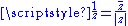 . Consequently, the algebraic form of the inversion in a unit circle is given by
  where:
Reciprocation is key in transformation theory as a generator
of the Mobius group. The other generators are translation and rotation, both familiar through physical manipulations in the ambient 3-space. Introduction of reciprocation (dependent upon circle inversion) is what produces the peculiar nature of Mobius geometry, which is sometimes identified with inversive geometry (of the Euclidean plane). However, inversive geometry is the larger study since it includes the raw inversion in a circle (not yet made, with conjugation, into reciprocation). Inversive geometry also includes the conjugation mapping. Neither conjugation nor inversion-in-a-circle are in the Mobius group since they are non-conformal (see below). Mobius group elements are analytic function
s of the whole plane and so are necessarily conformal
.
subspaces and subgroups of this space and group of mappings that were applied to produce early models of hyperbolic geometry by Felix Klein
and Henri Poincaré
. Thus inversive geometry includes the ideas originated by Lobachevsky and Bolyai in their plane geometry. Furthermore, Felix Klein was so overcome by this facility of mappings to identify geometrical phenomena that he delivered a manifesto, the Erlangen program
, in 1872. Since then many mathematicians reserve the term geometry for a space together with a group of mappings of that space; the significant properties of figures in the geometry are those which are invariant under this group.
For example, Smogorzhevsky develops several theorems of inversive geometry before beginning Lobachevskian geometry.

where r is the radius
of the inversion.
In 2 dimensions, with r = 1, this is circle inversion with respect to the unit circle
.
As said, in inversive geometry there is no distinction made between a straight line and a circle
(or hyperplane
and hypersphere
): a line is simply a circle in its particular embedding
in a Euclidean geometry
(with a point added at infinity) and one can always be transformed into another.
A remarkable fact about higher-dimensional conformal map
s is that they arise strictly from inversions in n-spheres or hyperplanes and Euclidean motions: see Liouville's theorem (conformal mappings).
if it preserves oriented angles) . Algebraically, a map is anticonformal if at every point the Jacobian is a scalar times an orthogonal matrix
with negative determinant: in two dimensions the Jacobian must be a scalar times a reflection at every point. This means that if J is the Jacobian, then

and
Computing the Jacobian in the case zi = xi/||x||2, where ||x||2 = x12 + ... + xn2 gives JJT = kI, with k = 1/||x||4, and additionally det(J) is negative; hence the inversive map is anticonformal.
In the complex plane, the most obvious circle inversion map (i.e., using the unit circle centered at the origin) is the complex conjugate of the complex inverse map taking z to 1/z. The complex analytic inverse map is conformal and its conjugate, circle inversion, is anticonformal.
with equation
will have a positive radius so long as a12 + ... + an2 is greater than c, and on inversion gives the sphere
Hence, it will be invariant under inversion if and only if c = 1. But this is the condition of being orthogonal to the unit sphere. Hence we are led to consider the (n − 1)-spheres with equation
which are invariant under inversion, orthogonal to the unit sphere, and have centers outside of the sphere. These together with the subspace hyperplanes separating hemispheres are the hypersurfaces of the Poincaré disc model of hyperbolic geometry.
Since inversion in the unit sphere leaves the spheres orthogonal to it invariant, the inversion maps the points inside the unit sphere to the outside and vice-versa. This is therefore true in general of orthogonal spheres, and in particular inversion in one of the spheres orthogonal to the unit sphere maps the unit sphere to itself. It also maps the interior of the unit sphere to itself, with points outside the orthogonal sphere mapping inside, and vice-versa; this defines the reflections of the Poincaré disc model if we also include with them the reflections through the diameters separating hemispheres of the unit sphere. These reflections generate the group of isometries of the
model, which tells us that the isometries are conformal. Hence, the angle between two curves in the model is the same as the angle between two curves in the hyperbolic space.
Geometry
Geometry arose as the field of knowledge dealing with spatial relationships. Geometry was one of the two fields of pre-modern mathematics, the other being the study of numbers ....
, inversive geometry is the study of those properties of figures that are preserved by a generalization of a type of transformation of the Euclidean plane
Plane (mathematics)
In mathematics, a plane is a flat, two-dimensional surface. A plane is the two dimensional analogue of a point , a line and a space...
, called inversion. These transformations preserve angles and map
Function (mathematics)
In mathematics, a function associates one quantity, the argument of the function, also known as the input, with another quantity, the value of the function, also known as the output. A function assigns exactly one output to each input. The argument and the value may be real numbers, but they can...
generalized circle
Circle
A circle is a simple shape of Euclidean geometry consisting of those points in a plane that are a given distance from a given point, the centre. The distance between any of the points and the centre is called the radius....
s into generalized circles, where a generalized circle means either a circle or a line
Line (mathematics)
The notion of line or straight line was introduced by the ancient mathematicians to represent straight objects with negligible width and depth. Lines are an idealization of such objects...
(loosely speaking, a circle with infinite
Infinity
Infinity is a concept in many fields, most predominantly mathematics and physics, that refers to a quantity without bound or end. People have developed various ideas throughout history about the nature of infinity...
radius
Radius
In classical geometry, a radius of a circle or sphere is any line segment from its center to its perimeter. By extension, the radius of a circle or sphere is the length of any such segment, which is half the diameter. If the object does not have an obvious center, the term may refer to its...
). Many difficult problems in geometry become much more tractable when an inversion is applied.
The concept of inversion can be generalized to higher dimensional spaces.
Inverse of a point
In the plane, the inverse of a point P with respect to a reference circle of center O and radius r is a point P, lying on the ray from O through P such thatThe inversion taking any point P (other than O) to its image P also takes P back to P, so the result of applying the same inversion twice is the identity transformation on all the points of the plane other than O. To make inversion an involution it is necessary to introduce a point at infinity, a single point placed on all the lines through the center, and extend the inversion, by definition, to interchange the center O and this point at infinity.
It follows from the definition that the inversion of any point inside the reference circle must lie outside it, and vice-versa, with the center and the point at infinity changing positions, whilst any point on the circle is unaffected. In summary, the nearer a point to the center, the further away its transformation, and vice versa.
Properties
The inversion of a set of points in the plane is the set of the inverse of each separate element with respect to the circle. The following properties are what make circle inversion important.- A circle which passes through the center of the reference circle inverts to a line not passing through the center, and vice versa; whereas a line passing through the center of the reference circle is inverted into itself.
- A circle not passing through the center of the reference circle inverts to a circle meeting it at the same points whilst not passing through the center. A circle (or line) is unchanged by inversion if and only if it is orthogonal to the reference circle at the points of intersection.
Additional properties include:
- If a circle q passes through two distinct points A and A', inverses with respect to a circle k, then the circles k and q are orthogonal.
- If the circles k and q are orthogonal, then a straight line passing through the center O of k and intersecting q, does so at inverse points with respect to k.
- Given a triangle OAB in which O is the center of a circle k, and points A' and B' inverses of A and B with respect to k, then
-
-

- The points of intersection of two circles p and q orthogonal to a circle k, are inverses with respect to k.
- If M and M' are inverse points with respect to a circle k on two curves m and m', also inverses with respect to k, then the tangents to m and m' at the points M and M' are either perpendicular to the straight line MM' or form with this line an isosceles triangle with base MM'.
- Inversion leaves angles unaltered, but reverses the orientation of oriented angles.
-
Application
Note that the center of a circle being inverted and the center of the circle as result of inversion are collinear with the center of the reference circle. This fact could be useful in proving the Euler line of the intouch triangle of a triangle coincides with its OI line. The proof roughly goes as below:Invert with respect to the incircle of triangle ABC. The medial triangle
Medial triangle
The medial triangle of a triangle ABC is the triangle with vertices at the midpoints of the triangle's sides AB, AC and BC....
of the intouch triangle is inverted into triangle ABC, meaning the circumcenter of the medial triangle, that is, the nine-point center of the intouch triangle, the incenter and circumcenter of triangle ABC are collinear.
Any two non-intersecting circles may be inverted into concentric
Concentric
Concentric objects share the same center, axis or origin with one inside the other. Circles, tubes, cylindrical shafts, disks, and spheres may be concentric to one another...
circles. Then the inversive distance
Inversive distance
Inversive distance is a way of measuring the "distance" between two non-intersecting circles α and β. If α and β are inverted with respect to a circle centered at one of the limiting points of the pencil of α and β, then α and β will invert into concentric circles...
(usually denoted δ) is defined as the natural logarithm
Natural logarithm
The natural logarithm is the logarithm to the base e, where e is an irrational and transcendental constant approximately equal to 2.718281828...
of the ratio of the radii of the two concentric circles.
In addition, any two non-intersecting circles may be inverted into congruent
Congruence (geometry)
In geometry, two figures are congruent if they have the same shape and size. This means that either object can be repositioned so as to coincide precisely with the other object...
circles, using circle of inversion centered at a point on the circle of antisimilitude
Circle of antisimilitude
In geometry, the circle of antisimilitude of two circles α and β is a circle for which α and β are inverses of each other. If α and β are non-intersecting or tangent, there exists one circle of antisimilitude; if α and β intersect at two points, there exist two circles of antisimilitude...
.
The Peaucellier linkage is a mechanical implementation of inversion in a circle. It provides an exact solution to the important problem of converting between linear and circular motion.
Inversions in three dimensions
Circle inversion is generalizable to sphere inversion in three dimensions. The inversion of a point in 3D with respect to a reference sphere centered at a point with radius is a point P' such that and the points and P' are on the same ray going from . As with the 2D version, a sphere inverts to a sphere, except that if a sphere passes through the center of the reference sphere, then it inverts to a plane. Any plane not passing through , inverts to a sphere touching at .Stereographic projection
Stereographic projection
The stereographic projection, in geometry, is a particular mapping that projects a sphere onto a plane. The projection is defined on the entire sphere, except at one point — the projection point. Where it is defined, the mapping is smooth and bijective. It is conformal, meaning that it...
is a special case of sphere inversion. Consider a sphere
of radius 1 and a plane touching at the South Pole of . Then is the stereographic projection of with respect to the North Pole of . Consider a sphere of radius 2 centered at . The inversion with respect to transforms into its stereographic projection .Axiomatics and generalization
The axiomatic foundation and generalization of inversive plane geometry is the Möbius planeMöbius plane
A Möbius plane or inversive plane is a particular kind of plane geometry, built upon some affine planes by adding one point, called the ideal point or point at infinity. In a Möbius plane straight lines are a special case of circles; they are the circles that pass through the ideal point. Möbius...
.
Relation to Erlangen program
According to Coxeter, the transformation by inversion in circle was invented by L. I. MagnusLudwig Immanuel Magnus
Ludwig Immanuel Magnus was a German Jewish mathematician who, in 1831, published a paper about the inversion transformation, which leads to inversive geometry....
in 1831. Since then this mapping has become an avenue to higher mathematics. Through some steps of application of the circle inversion map, a student of transformation geometry
Transformation geometry
In mathematics, transformation geometry is a name for a pedagogic theory for teaching Euclidean geometry, based on the Erlangen programme. Felix Klein, who pioneered this point of view, was himself interested in mathematical education. It took many years, though, for his "modern" point of view to...
soon appreciates the significance of Felix Klein
Felix Klein
Christian Felix Klein was a German mathematician, known for his work in group theory, function theory, non-Euclidean geometry, and on the connections between geometry and group theory...
’s Erlangen program
Erlangen program
An influential research program and manifesto was published in 1872 by Felix Klein, under the title Vergleichende Betrachtungen über neuere geometrische Forschungen...
, an outgrowth of certain models of hyperbolic geometry
Hyperbolic geometry
In mathematics, hyperbolic geometry is a non-Euclidean geometry, meaning that the parallel postulate of Euclidean geometry is replaced...
Dilations
The combination of two inversions in concentric circles results in a similaritySimilarity (geometry)
Two geometrical objects are called similar if they both have the same shape. More precisely, either one is congruent to the result of a uniform scaling of the other...
, homothetic transformation, or dilation
Dilation (mathematics)
In mathematics, a dilation is a function f from a metric space into itself that satisfies the identityd=rd \,for all points where d is the distance from x to y and r is some positive real number....
characterized by the ratio of the circle radii.
Reciprocation
When a point in the plane is interpreted as a complex numberComplex number
A complex number is a number consisting of a real part and an imaginary part. Complex numbers extend the idea of the one-dimensional number line to the two-dimensional complex plane by using the number line for the real part and adding a vertical axis to plot the imaginary part...
, with complex conjugateComplex conjugate
In mathematics, complex conjugates are a pair of complex numbers, both having the same real part, but with imaginary parts of equal magnitude and opposite signs...
, then the reciprocalMultiplicative inverse
In mathematics, a multiplicative inverse or reciprocal for a number x, denoted by 1/x or x−1, is a number which when multiplied by x yields the multiplicative identity, 1. The multiplicative inverse of a fraction a/b is b/a. For the multiplicative inverse of a real number, divide 1 by the...
of z is
. Consequently, the algebraic form of the inversion in a unit circle is given by where:
-
 .
.
Reciprocation is key in transformation theory as a generator
Generating set of a group
In abstract algebra, a generating set of a group is a subset that is not contained in any proper subgroup of the group. Equivalently, a generating set of a group is a subset such that every element of the group can be expressed as the combination of finitely many elements of the subset and their...
of the Mobius group. The other generators are translation and rotation, both familiar through physical manipulations in the ambient 3-space. Introduction of reciprocation (dependent upon circle inversion) is what produces the peculiar nature of Mobius geometry, which is sometimes identified with inversive geometry (of the Euclidean plane). However, inversive geometry is the larger study since it includes the raw inversion in a circle (not yet made, with conjugation, into reciprocation). Inversive geometry also includes the conjugation mapping. Neither conjugation nor inversion-in-a-circle are in the Mobius group since they are non-conformal (see below). Mobius group elements are analytic function
Analytic function
In mathematics, an analytic function is a function that is locally given by a convergent power series. There exist both real analytic functions and complex analytic functions, categories that are similar in some ways, but different in others...
s of the whole plane and so are necessarily conformal
Conformal map
In mathematics, a conformal map is a function which preserves angles. In the most common case the function is between domains in the complex plane.More formally, a map,...
.
Higher geometry
As mentioned above, zero, the origin, requires special consideration in the circle inversion mapping. The approach is to adjoin a point at infinity designated ∞ or 1/0 . In the complex number approach, where reciprocation is the apparent operation, this procedure leads to the complex projective line, often called the Riemann sphere. It wassubspaces and subgroups of this space and group of mappings that were applied to produce early models of hyperbolic geometry by Felix Klein
Felix Klein
Christian Felix Klein was a German mathematician, known for his work in group theory, function theory, non-Euclidean geometry, and on the connections between geometry and group theory...
and Henri Poincaré
Henri Poincaré
Jules Henri Poincaré was a French mathematician, theoretical physicist, engineer, and a philosopher of science...
. Thus inversive geometry includes the ideas originated by Lobachevsky and Bolyai in their plane geometry. Furthermore, Felix Klein was so overcome by this facility of mappings to identify geometrical phenomena that he delivered a manifesto, the Erlangen program
Erlangen program
An influential research program and manifesto was published in 1872 by Felix Klein, under the title Vergleichende Betrachtungen über neuere geometrische Forschungen...
, in 1872. Since then many mathematicians reserve the term geometry for a space together with a group of mappings of that space; the significant properties of figures in the geometry are those which are invariant under this group.
For example, Smogorzhevsky develops several theorems of inversive geometry before beginning Lobachevskian geometry.
Inversion in higher dimensions
In the spirit of generalization to higher dimensions, inversive geometry is the study of transformations generated by the Euclidean transformations together with inversion in an n-sphere:where r is the radius
Radius
In classical geometry, a radius of a circle or sphere is any line segment from its center to its perimeter. By extension, the radius of a circle or sphere is the length of any such segment, which is half the diameter. If the object does not have an obvious center, the term may refer to its...
of the inversion.
In 2 dimensions, with r = 1, this is circle inversion with respect to the unit circle
Unit circle
In mathematics, a unit circle is a circle with a radius of one. Frequently, especially in trigonometry, "the" unit circle is the circle of radius one centered at the origin in the Cartesian coordinate system in the Euclidean plane...
.
As said, in inversive geometry there is no distinction made between a straight line and a circle
Circle
A circle is a simple shape of Euclidean geometry consisting of those points in a plane that are a given distance from a given point, the centre. The distance between any of the points and the centre is called the radius....
(or hyperplane
Hyperplane
A hyperplane is a concept in geometry. It is a generalization of the plane into a different number of dimensions.A hyperplane of an n-dimensional space is a flat subset with dimension n − 1...
and hypersphere
Hypersphere
In mathematics, an n-sphere is a generalization of the surface of an ordinary sphere to arbitrary dimension. For any natural number n, an n-sphere of radius r is defined as the set of points in -dimensional Euclidean space which are at distance r from a central point, where the radius r may be any...
): a line is simply a circle in its particular embedding
Embedding
In mathematics, an embedding is one instance of some mathematical structure contained within another instance, such as a group that is a subgroup....
in a Euclidean geometry
Euclidean geometry
Euclidean geometry is a mathematical system attributed to the Alexandrian Greek mathematician Euclid, which he described in his textbook on geometry: the Elements. Euclid's method consists in assuming a small set of intuitively appealing axioms, and deducing many other propositions from these...
(with a point added at infinity) and one can always be transformed into another.
A remarkable fact about higher-dimensional conformal map
Conformal map
In mathematics, a conformal map is a function which preserves angles. In the most common case the function is between domains in the complex plane.More formally, a map,...
s is that they arise strictly from inversions in n-spheres or hyperplanes and Euclidean motions: see Liouville's theorem (conformal mappings).
Anticonformal mapping property
The circle inversion map is anticonformal, which means that at every point it preserves angles and reverses orientation (a map is called conformalConformal map
In mathematics, a conformal map is a function which preserves angles. In the most common case the function is between domains in the complex plane.More formally, a map,...
if it preserves oriented angles) . Algebraically, a map is anticonformal if at every point the Jacobian is a scalar times an orthogonal matrix
Orthogonal matrix
In linear algebra, an orthogonal matrix , is a square matrix with real entries whose columns and rows are orthogonal unit vectors ....
with negative determinant: in two dimensions the Jacobian must be a scalar times a reflection at every point. This means that if J is the Jacobian, then
and
Computing the Jacobian in the case zi = xi/||x||2, where ||x||2 = x12 + ... + xn2 gives JJT = kI, with k = 1/||x||4, and additionally det(J) is negative; hence the inversive map is anticonformal.
In the complex plane, the most obvious circle inversion map (i.e., using the unit circle centered at the origin) is the complex conjugate of the complex inverse map taking z to 1/z. The complex analytic inverse map is conformal and its conjugate, circle inversion, is anticonformal.
Inversive geometry and hyperbolic geometry
The (n − 1)-sphereHypersphere
In mathematics, an n-sphere is a generalization of the surface of an ordinary sphere to arbitrary dimension. For any natural number n, an n-sphere of radius r is defined as the set of points in -dimensional Euclidean space which are at distance r from a central point, where the radius r may be any...
with equation
will have a positive radius so long as a12 + ... + an2 is greater than c, and on inversion gives the sphere
Hence, it will be invariant under inversion if and only if c = 1. But this is the condition of being orthogonal to the unit sphere. Hence we are led to consider the (n − 1)-spheres with equation
which are invariant under inversion, orthogonal to the unit sphere, and have centers outside of the sphere. These together with the subspace hyperplanes separating hemispheres are the hypersurfaces of the Poincaré disc model of hyperbolic geometry.
Since inversion in the unit sphere leaves the spheres orthogonal to it invariant, the inversion maps the points inside the unit sphere to the outside and vice-versa. This is therefore true in general of orthogonal spheres, and in particular inversion in one of the spheres orthogonal to the unit sphere maps the unit sphere to itself. It also maps the interior of the unit sphere to itself, with points outside the orthogonal sphere mapping inside, and vice-versa; this defines the reflections of the Poincaré disc model if we also include with them the reflections through the diameters separating hemispheres of the unit sphere. These reflections generate the group of isometries of the
model, which tells us that the isometries are conformal. Hence, the angle between two curves in the model is the same as the angle between two curves in the hyperbolic space.
See also
- Inverse curveInverse curveIn geometry, an inverse curve of a given curve C is the result of applying an inverse operation to C. Specifically, with respect to a fixed circle with center O and radius k the inverse of a point Q is the point P for which P lies on the ray OQ and OP·PQ = k2...
- Circle of antisimilitudeCircle of antisimilitudeIn geometry, the circle of antisimilitude of two circles α and β is a circle for which α and β are inverses of each other. If α and β are non-intersecting or tangent, there exists one circle of antisimilitude; if α and β intersect at two points, there exist two circles of antisimilitude...
- Duality (projective geometry)Duality (projective geometry)A striking feature of projective planes is the "symmetry" of the roles played by points and lines in the definitions and theorems, and duality is the formalization of this metamathematical concept. There are two approaches to the subject of duality, one through language and the other a more...
- Möbius planeMöbius planeA Möbius plane or inversive plane is a particular kind of plane geometry, built upon some affine planes by adding one point, called the ideal point or point at infinity. In a Möbius plane straight lines are a special case of circles; they are the circles that pass through the ideal point. Möbius...
- Möbius transformation
- Projective geometryProjective geometryIn mathematics, projective geometry is the study of geometric properties that are invariant under projective transformations. This means that, compared to elementary geometry, projective geometry has a different setting, projective space, and a selective set of basic geometric concepts...
External links
- Inversion: Reflection in a Circle at cut-the-knotCut-the-knotCut-the-knot is a free, advertisement-funded educational website maintained by Alexander Bogomolny and devoted to popular exposition of many topics in mathematics. The site has won more than 20 awards from scientific and educational publications, including a Scientific American Web Award in 2003,...
- Wilson Stother's inversive geometry page
- IMO Compendium Training Materials practice problems on how to use inversion for math olympiad problems
- Visual Dictionary of Special Plane Curves Xah Lee