

Hudibras

Encyclopedia
Hudibras is an English mock heroic narrative poem from the 17th century written by Samuel Butler.
upon Roundhead
s, Puritan
s, Presbyterians and many of the other factions involved in the English Civil War
. The work was begun, according to the title page, during the civil war and published in three parts in 1663, 1664 and 1678, with the first edition encompassing all three parts in 1684 (see 1684 in poetry
). The Mercurius Aulicus
(an early newspaper of the time) reported an unauthorised edition of the first part was already in print in early 1662.
Published only four years after Charles II
had been restored
to the throne
and the Protectorate
of Oliver Cromwell
being completely over, the poem found an appreciative audience. The satire is not balanced as Butler was fiercely royalist
and only the parliamentarian
side are singled out for ridicule. Butler also uses the work to parody some of the dreadful poetry of the time.
The epic tells the story of Sir Hudibras, a knight errant who is described dramatically and with laudatory praise that is so thickly applied as to be absurd, and the conceited and arrogant person is visible beneath. He is praised for his knowledge of logic despite appearing stupid throughout, but it is his religious fervour which is mainly attacked:
His squire
, Ralpho, is of a similar stamp but makes no claim to great learning, knowing all there is to know from his religion or “new-light”, as he calls it. Butler satirises the competing factions at the time of the protectorship by the constant bickering of these two principal characters whose religious opinions should unite them.
These are fawning but barbed portraits and are thought to represent personalities of the times but the actual analogues are, now as then, debatable. "A Key to Hudibras" printed with one of the work's editions (1709) and ascribed to Roger L'Estrange
names Sir Samuel Luke
as the model for Hudibras. Certainly, the mention of Mamaluke in the poem makes this possible although Butler suggests Hudibras is from the West Country making Henry Rosewell
a candidate. The witchfinder
, Matthew Hopkins
, John Desborough
, parliamentarian
general, and William Prynne
, lawyer, all make appearances, and the character of Sidrophel is variously seen as either William Lilly
or Paul Neale.
' Don Quixote. But whereas in Cervantes, the noble knight although being mocked is supposed to draw readers' sympathies, Hudibras is offered nothing but derision.
The title comes from the name of a knight in Edmund Spenser
's Faerie Queene who is described as "not so good of deeds as great of name" and "more huge in strength than wise in work". Spenser in turn probably got the name from the legendary English king Rud Hud Hudibras
.
Hudibras was written in an iambic tetrameter
in closed couplet
s, with surprising feminine rhyme
s. The dramatic meter portends tales of dramatic deeds, but the subject matter and the unusual rhymes undercut its importance. This verse form is now referred to as Hudibrastic
. Consider the following from the opening of the poem, where the English Civil War
is described thus:
The work was published in three parts, each divided into three canto
s with some additional heroic epistles. It is possible that a fourth part was planned, which would have given the work twelve parts in imitation of Virgil
's Aeneid
.
 The knight and his squire sally forth and come upon some people bear-baiting
. After deciding that this is anti-Christian they attack the baiters and capture one after defeating the bear. The defeated group of bear-baiters then rallies and renews the attack, capturing the knight and his squire. While in the stock the pair argue on religion.
Part two describes how the knight's imprisoned condition is reported by Fame
to a widow Hudibras has been wooing and she comes to see him. With a captive audience, she complains that he does not really love her and he ends up promising to flagellate
himself if she frees him. Once free he regrets his promise and debates with Ralpho how to avoid his fate with Ralpho suggesting that oath breaking is next to saintliness:
Hudibras then tries to convince Ralpho of the nobility of accepting the beating in his stead but he declines the offer. They are interrupted by a skimmington
, a procession where women are celebrated and men made fools. After haranguing the crowd for their lewdness, the knight is pelted with rotten eggs and chased away.
He decides to visit an astrologer
, Sidrophel, to ask him how he should woo the widow but they get into an argument and after a fight the knight and squire run off in different directions believing they have killed Sidrophel.
The third part was published 14 years after the first two and is considerably different from the first parts. It picks up from where the second left off with Hudibras going to the widow's house to explain the details of the whipping he had promised to give himself but Ralpho had got there first and told her what had actually happened. Suddenly a group rushes in and gives him a beating and supposing them to be spirits from Sidrophel, rather than hired by the widow, confesses his sins and by extension the sins of the Puritan
s. Hudibras then visits a lawyer—the profession Butler trained in and one he is well able to satirise—who convinces him to write a letter to the widow. The poem ends with their exchange of letters in which the knight's arguments are rebuffed by the widow.
Before the visit to the lawyer there is a digression of an entire canto in which much fun is had at the events after Oliver Cromwell
's death. The succession of his son Richard Cromwell
and the squabbles of factions such as the Fifth Monarchists
are told with no veil of fiction and no mention of Sir Hudibras.
in his Letters on the English
saying "I never found so much wit in one single book". One reader though was distinctly unimpressed. On 26 December 1662 Samuel Pepys
recorded in his diary that he bought Hudibras, but, despite its being extremely popular at the time, he admitted finding no humour in it and selling it the same day. Two months later he bought it again to try to find what he was missing. He still found nothing funny about it, due to his finding its treatment of Puritans too vicious and being insensitive to the humour of the rhymes.
The mock heroic epic and its jaunty verse form known as Hudibrastic became the standard of satire for some time after that with at least twenty-seven direct imitations being produced. Of the most famous was Ned Ward
and his Hudibras Redivivus with Samuel Wesley
father of John Wesley
emulating the work.
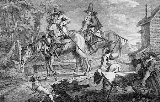
Fifty years after the last part was written a new edition was published, with illustrations by William Hogarth
, who later became one of the foremost artists of the day. The work remained popular for several centuries as a warning against the zealotry during the Civil War
period of English history although it has lately gone out of fashion.
In his poem, Butler originated the phrase "Spare the rod and spoil the child," and although the phrase is often taken to be a Biblical injunction about child-rearing, (probably as a corruption of Book of Proverbs
13:24), it is in the context of Hudibras a bawdy metaphor suggesting the best way to curtail amorous passions or, through double entendre, to prevent conception:
Purpose
The work is a satirical polemicPolemic
A polemic is a variety of arguments or controversies made against one opinion, doctrine, or person. Other variations of argument are debate and discussion...
upon Roundhead
Roundhead
"Roundhead" was the nickname given to the supporters of the Parliament during the English Civil War. Also known as Parliamentarians, they fought against King Charles I and his supporters, the Cavaliers , who claimed absolute power and the divine right of kings...
s, Puritan
Puritan
The Puritans were a significant grouping of English Protestants in the 16th and 17th centuries. Puritanism in this sense was founded by some Marian exiles from the clergy shortly after the accession of Elizabeth I of England in 1558, as an activist movement within the Church of England...
s, Presbyterians and many of the other factions involved in the English Civil War
English Civil War
The English Civil War was a series of armed conflicts and political machinations between Parliamentarians and Royalists...
. The work was begun, according to the title page, during the civil war and published in three parts in 1663, 1664 and 1678, with the first edition encompassing all three parts in 1684 (see 1684 in poetry
1684 in poetry
Nationality words link to articles with information on the nation's poetry or literature .-Events:* April 15 – Nicolas Boileau-Despréaux, a France poet, critic and scholar, was admitted to the Académie française, and then only by the king's wish-Works published:* Aphra Behn, Poems Upon...
). The Mercurius Aulicus
Mercurius Aulicus
Mercurius Aulicus was one of the "most important early newspapers" in England, famous during the English Civil War for its role in Royalist propaganda.-Creation:...
(an early newspaper of the time) reported an unauthorised edition of the first part was already in print in early 1662.
Published only four years after Charles II
Charles II of England
Charles II was monarch of the three kingdoms of England, Scotland, and Ireland.Charles II's father, King Charles I, was executed at Whitehall on 30 January 1649, at the climax of the English Civil War...
had been restored
English Restoration
The Restoration of the English monarchy began in 1660 when the English, Scottish and Irish monarchies were all restored under Charles II after the Interregnum that followed the Wars of the Three Kingdoms...
to the throne
Throne of England
The Throne of England is the English term used to identify the throne of the King of England. The term can refer to very specific seating, as in King Edward's Chair, which has been used in the coronations of British kings for eight centuries...
and the Protectorate
The Protectorate
In British history, the Protectorate was the period 1653–1659 during which the Commonwealth of England was governed by a Lord Protector.-Background:...
of Oliver Cromwell
Oliver Cromwell
Oliver Cromwell was an English military and political leader who overthrew the English monarchy and temporarily turned England into a republican Commonwealth, and served as Lord Protector of England, Scotland, and Ireland....
being completely over, the poem found an appreciative audience. The satire is not balanced as Butler was fiercely royalist
Cavalier
Cavalier was the name used by Parliamentarians for a Royalist supporter of King Charles I and son Charles II during the English Civil War, the Interregnum, and the Restoration...
and only the parliamentarian
Roundhead
"Roundhead" was the nickname given to the supporters of the Parliament during the English Civil War. Also known as Parliamentarians, they fought against King Charles I and his supporters, the Cavaliers , who claimed absolute power and the divine right of kings...
side are singled out for ridicule. Butler also uses the work to parody some of the dreadful poetry of the time.
The epic tells the story of Sir Hudibras, a knight errant who is described dramatically and with laudatory praise that is so thickly applied as to be absurd, and the conceited and arrogant person is visible beneath. He is praised for his knowledge of logic despite appearing stupid throughout, but it is his religious fervour which is mainly attacked:
- For his Religion, it was fit
- To match his learning and his wit;
- 'Twas Presbyterian true blue;
- For he was of that stubborn crew
- Of errant saints, whom all men grant
- To be the true Church Militant;
- Such as do build their faith upon
- The holy text of pike and gun;
- Decide all controversies by
- Infallible artillery;
- And prove their doctrine orthodox
- By apostolic blows and knocks;
- Call fire and sword and desolation,
- A godly thorough reformation,
- Which always must be carried on,
- And still be doing, never done;
- As if religion were intended
- For nothing else but to be mended.
His squire
Squire
The English word squire is a shortened version of the word Esquire, from the Old French , itself derived from the Late Latin , in medieval or Old English a scutifer. The Classical Latin equivalent was , "arms bearer"...
, Ralpho, is of a similar stamp but makes no claim to great learning, knowing all there is to know from his religion or “new-light”, as he calls it. Butler satirises the competing factions at the time of the protectorship by the constant bickering of these two principal characters whose religious opinions should unite them.
These are fawning but barbed portraits and are thought to represent personalities of the times but the actual analogues are, now as then, debatable. "A Key to Hudibras" printed with one of the work's editions (1709) and ascribed to Roger L'Estrange
Roger L'Estrange
Sir Roger L'Estrange was an English pamphleteer and author, and staunch defender of royalist claims. L'Estrange was involved in political controversy throughout his life...
names Sir Samuel Luke
Samuel Luke
Sir Samuel Luke was an English politician who sat in the House of Commons of England from 1640 to 1653 and in 1660.Luke was born in Southill, Bedfordshire, England to Sir Oliver Luke Member of Parliament and his wife Elizabeth Knightley...
as the model for Hudibras. Certainly, the mention of Mamaluke in the poem makes this possible although Butler suggests Hudibras is from the West Country making Henry Rosewell
Henry Rosewell
Sir Henry Rosewell of Forde Abbey, Devon, was a puritan and supporter of the New World colonies.-Early years and education:Henry Rosewell was born on 1 November 1590 at Forde Abbey in Devon...
a candidate. The witchfinder
Witch-hunt
A witch-hunt is a search for witches or evidence of witchcraft, often involving moral panic, mass hysteria and lynching, but in historical instances also legally sanctioned and involving official witchcraft trials...
, Matthew Hopkins
Matthew Hopkins
Matthew Hopkins was an English witchhunter whose career flourished during the time of the English Civil War. He claimed to hold the office of Witchfinder General, although that title was never bestowed by Parliament...
, John Desborough
John Desborough
John Desborough was an English soldier and politician who supported the parliamentary cause during the English Civil War.-Life:He was the son of James Desborough of Eltisley, Cambridgeshire, and of Elizabeth Hatley of Over in the same county, was baptized on 13 November 1608. He was educated for...
, parliamentarian
Parliament of England
The Parliament of England was the legislature of the Kingdom of England. In 1066, William of Normandy introduced a feudal system, by which he sought the advice of a council of tenants-in-chief and ecclesiastics before making laws...
general, and William Prynne
William Prynne
William Prynne was an English lawyer, author, polemicist, and political figure. He was a prominent Puritan opponent of the church policy of the Archbishop of Canterbury, William Laud. Although his views on church polity were presbyterian, he became known in the 1640s as an Erastian, arguing for...
, lawyer, all make appearances, and the character of Sidrophel is variously seen as either William Lilly
William Lilly
William Lilly , was an English astrologer famed during his time. Lilly was particularly adept at interpreting the astrological charts drawn up for horary questions, as this was his speciality....
or Paul Neale.
Structure
Butler is clearly influenced by Rabelais and particularly CervantesCervantes
-People:*Alfonso J. Cervantes , mayor of St. Louis, Missouri*Francisco Cervantes de Salazar, 16th-century man of letters*Ignacio Cervantes, Cuban composer*Jorge Cervantes, a world-renowned expert on indoor, outdoor, and greenhouse cannabis cultivation...
' Don Quixote. But whereas in Cervantes, the noble knight although being mocked is supposed to draw readers' sympathies, Hudibras is offered nothing but derision.
The title comes from the name of a knight in Edmund Spenser
Edmund Spenser
Edmund Spenser was an English poet best known for The Faerie Queene, an epic poem and fantastical allegory celebrating the Tudor dynasty and Elizabeth I. He is recognised as one of the premier craftsmen of Modern English verse in its infancy, and one of the greatest poets in the English...
's Faerie Queene who is described as "not so good of deeds as great of name" and "more huge in strength than wise in work". Spenser in turn probably got the name from the legendary English king Rud Hud Hudibras
Rud Hud Hudibras
Rud Hud Hudibras was a legendary king of the Britons as recounted by Geoffrey of Monmouth. He was the son of King Leil and ruled during a civil war....
.
Hudibras was written in an iambic tetrameter
Iambic tetrameter
Iambic tetrameter is a meter in poetry. It refers to a line consisting of four iambic feet. The word "tetrameter" simply means that there are four feet in the line; iambic tetrameter is a line comprising four iambs...
in closed couplet
Closed couplet
In poetics, closed couplets are two line units of verse that do not extend their sense beyond the line's end. Furthermore, the lines are usually rhymed. When the lines are in iambic pentameter, they are referred to as heroic verse. However, Samuel Butler also used closed couplets in his iambic...
s, with surprising feminine rhyme
Feminine rhyme
A feminine rhyme is a rhyme that matches two or more syllables, usually at the end of respective lines, in which the final syllable or syllables are unstressed.-English:...
s. The dramatic meter portends tales of dramatic deeds, but the subject matter and the unusual rhymes undercut its importance. This verse form is now referred to as Hudibrastic
Hudibrastic
Hudibrastic is a type of English verse named for Samuel Butler's Hudibras, published in parts from 1663 to 1678. For the poem, Butler invented a mock-heroic verse structure. Instead of pentameter, the lines were written in iambic tetrameter...
. Consider the following from the opening of the poem, where the English Civil War
English Civil War
The English Civil War was a series of armed conflicts and political machinations between Parliamentarians and Royalists...
is described thus:
When civil dudgeon first grew high,
And men fell out they knew not why;
When hard words, jealousies, and fears,
Set folks together by the ears,
And made them fight, like mad or drunk,
For Dame Religion, as for punk;
Whose honesty they all durst swear for,
Though not a man of them knew wherefore....
The work was published in three parts, each divided into three canto
Canto
The canto is a principal form of division in a long poem, especially the epic. The word comes from Italian, meaning "song" or singing. Famous examples of epic poetry which employ the canto division are Lord Byron's Don Juan, Valmiki's Ramayana , Dante's The Divine Comedy , and Ezra Pound's The...
s with some additional heroic epistles. It is possible that a fourth part was planned, which would have given the work twelve parts in imitation of Virgil
Virgil
Publius Vergilius Maro, usually called Virgil or Vergil in English , was an ancient Roman poet of the Augustan period. He is known for three major works of Latin literature, the Eclogues , the Georgics, and the epic Aeneid...
's Aeneid
Aeneid
The Aeneid is a Latin epic poem, written by Virgil between 29 and 19 BC, that tells the legendary story of Aeneas, a Trojan who travelled to Italy, where he became the ancestor of the Romans. It is composed of roughly 10,000 lines in dactylic hexameter...
.
Plot
Bear-baiting
Bear-baiting is a blood sport involving the worrying or tormenting of bears.-Bear-baiting in England:Bear-baiting was popular in England until the nineteenth century. From the sixteenth century, many herds of bears were maintained for baiting...
. After deciding that this is anti-Christian they attack the baiters and capture one after defeating the bear. The defeated group of bear-baiters then rallies and renews the attack, capturing the knight and his squire. While in the stock the pair argue on religion.
Part two describes how the knight's imprisoned condition is reported by Fame
Pheme
In Greek mythology, Pheme was the personification of fame and renown, her favour being notability, her wrath being scandalous rumors. She was a daughter either of Gaia or of Hope, was described as "she who initiates and furthers communication" and had an altar at Athens...
to a widow Hudibras has been wooing and she comes to see him. With a captive audience, she complains that he does not really love her and he ends up promising to flagellate
Flagellate
Flagellates are organisms with one or more whip-like organelles called flagella. Some cells in animals may be flagellate, for instance the spermatozoa of most phyla. Flowering plants do not produce flagellate cells, but ferns, mosses, green algae, some gymnosperms and other closely related plants...
himself if she frees him. Once free he regrets his promise and debates with Ralpho how to avoid his fate with Ralpho suggesting that oath breaking is next to saintliness:
- For breaking of an oath, and lying,
- Is but a kind of self-denying;
- A Saint-like virtue: and from hence
- Some have broke oaths by Providence
- Some, to the glory of the Lord,
- Perjur'd themselves, and broke their word;
Hudibras then tries to convince Ralpho of the nobility of accepting the beating in his stead but he declines the offer. They are interrupted by a skimmington
Skimmington
A skimmington, or skimmington ride, is a traditional custom comprising a public demonstration of moral disapproval of an individual or individuals. The form of the demonstration, and the reasons for it, varied between different places, but the general intent was public humiliation of the victim...
, a procession where women are celebrated and men made fools. After haranguing the crowd for their lewdness, the knight is pelted with rotten eggs and chased away.
He decides to visit an astrologer
Astrologer
An astrologer practices one or more forms of astrology. Typically an astrologer draws a horoscope for the time of an event, such as a person's birth, and interprets celestial points and their placements at the time of the event to better understand someone, determine the auspiciousness of an...
, Sidrophel, to ask him how he should woo the widow but they get into an argument and after a fight the knight and squire run off in different directions believing they have killed Sidrophel.
The third part was published 14 years after the first two and is considerably different from the first parts. It picks up from where the second left off with Hudibras going to the widow's house to explain the details of the whipping he had promised to give himself but Ralpho had got there first and told her what had actually happened. Suddenly a group rushes in and gives him a beating and supposing them to be spirits from Sidrophel, rather than hired by the widow, confesses his sins and by extension the sins of the Puritan
Puritan
The Puritans were a significant grouping of English Protestants in the 16th and 17th centuries. Puritanism in this sense was founded by some Marian exiles from the clergy shortly after the accession of Elizabeth I of England in 1558, as an activist movement within the Church of England...
s. Hudibras then visits a lawyer—the profession Butler trained in and one he is well able to satirise—who convinces him to write a letter to the widow. The poem ends with their exchange of letters in which the knight's arguments are rebuffed by the widow.
Before the visit to the lawyer there is a digression of an entire canto in which much fun is had at the events after Oliver Cromwell
Oliver Cromwell
Oliver Cromwell was an English military and political leader who overthrew the English monarchy and temporarily turned England into a republican Commonwealth, and served as Lord Protector of England, Scotland, and Ireland....
's death. The succession of his son Richard Cromwell
Richard Cromwell
At the same time, the officers of the New Model Army became increasingly wary about the government's commitment to the military cause. The fact that Richard Cromwell lacked military credentials grated with men who had fought on the battlefields of the English Civil War to secure their nation's...
and the squabbles of factions such as the Fifth Monarchists
Fifth Monarchists
The Fifth Monarchists or Fifth Monarchy Men were active from 1649 to 1661 during the Interregnum, following the English Civil Wars of the 17th century. They took their name from a prophecy in the Book of Daniel that four ancient monarchies would precede Christ's return...
are told with no veil of fiction and no mention of Sir Hudibras.
Significance
Hudibras was an extremely popular work with pirate copies and a spurious second part being issued before Butler could produce his genuine second part in 1664. It was highly praised with VoltaireVoltaire
François-Marie Arouet , better known by the pen name Voltaire , was a French Enlightenment writer, historian and philosopher famous for his wit and for his advocacy of civil liberties, including freedom of religion, free trade and separation of church and state...
in his Letters on the English
Letters on the English
Lettres philosophiques or ) is a series of essays written by Voltaire based on his experiences living in England between 1722 and 1734. It was published in both French and English in 1734...
saying "I never found so much wit in one single book". One reader though was distinctly unimpressed. On 26 December 1662 Samuel Pepys
Samuel Pepys
Samuel Pepys FRS, MP, JP, was an English naval administrator and Member of Parliament who is now most famous for the diary he kept for a decade while still a relatively young man...
recorded in his diary that he bought Hudibras, but, despite its being extremely popular at the time, he admitted finding no humour in it and selling it the same day. Two months later he bought it again to try to find what he was missing. He still found nothing funny about it, due to his finding its treatment of Puritans too vicious and being insensitive to the humour of the rhymes.
The mock heroic epic and its jaunty verse form known as Hudibrastic became the standard of satire for some time after that with at least twenty-seven direct imitations being produced. Of the most famous was Ned Ward
Ned Ward
Ned Ward , also known as Edward Ward, was a satirical writer and publican in the late seventeenth and early eighteenth century based in London, England. His most famous work is The London Spy. Published in 18 monthly instalments starting in November 1698 it was described as a "complete survey" of...
and his Hudibras Redivivus with Samuel Wesley
Samuel Wesley (poet)
Samuel Wesley was a poet and a writer of controversial prose. He was also the father of John Wesley and Charles Wesley, founders of the Methodist Church.-Family and early life:...
father of John Wesley
John Wesley
John Wesley was a Church of England cleric and Christian theologian. Wesley is largely credited, along with his brother Charles Wesley, as founding the Methodist movement which began when he took to open-air preaching in a similar manner to George Whitefield...
emulating the work.
Fifty years after the last part was written a new edition was published, with illustrations by William Hogarth
William Hogarth
William Hogarth was an English painter, printmaker, pictorial satirist, social critic and editorial cartoonist who has been credited with pioneering western sequential art. His work ranged from realistic portraiture to comic strip-like series of pictures called "modern moral subjects"...
, who later became one of the foremost artists of the day. The work remained popular for several centuries as a warning against the zealotry during the Civil War
English Civil War
The English Civil War was a series of armed conflicts and political machinations between Parliamentarians and Royalists...
period of English history although it has lately gone out of fashion.
In his poem, Butler originated the phrase "Spare the rod and spoil the child," and although the phrase is often taken to be a Biblical injunction about child-rearing, (probably as a corruption of Book of Proverbs
Book of Proverbs
The Book of Proverbs , commonly referred to simply as Proverbs, is a book of the Hebrew Bible.The original Hebrew title of the book of Proverbs is "Míshlê Shlomoh" . When translated into Greek and Latin, the title took on different forms. In the Greek Septuagint the title became "paroimai paroimiae"...
13:24), it is in the context of Hudibras a bawdy metaphor suggesting the best way to curtail amorous passions or, through double entendre, to prevent conception:
- If matrimony and hanging go
- By dest'ny, why not whipping too?
- What med'cine else can cure the fits
- Of lovers when they lose their wits?
- Love is a boy by poets stil'd
- Then spare the rod and spoil the child (Part II, Canto I, ll. 839-44).