

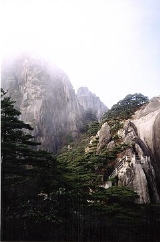
Huangshan Pine

Encyclopedia
The Huangshan Pine is a pine
native to the mountain
s of eastern China
, in the provinces of Anhui
, Fujian
, Guizhou
, Hubei
, Hunan
, Jiangxi
, and Zhejiang
; it is named after the Huangshan Mountains
in Anhui, from where it was first described.
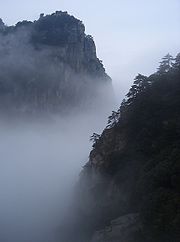 It is an evergreen
tree
reaching 15-25 m in height, with a very broad, flat-topped crown of long, level branches. The bark
is thick, greyish, and scaly plated. The leaves
are needle-like, dark green, 2 per fascicle, 5-8 cm long and 0.8-1 mm wide, the persistent fascicle sheath 1 cm long. The cones
are broad squat ovoid, 4-6.5 cm long, yellow-brown, opening when mature in late winter to 5-7 cm broad. The seed
s are winged, 5-6 mm long with a 1.5-2.5 cm wing. Pollination is in mid spring, with the cones maturing 18-20 months after. It is closely related to Japanese Black Pine (P. thunbergii), differing from it in the slenderer leaves, brown (not white) buds and broader cones.
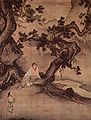
Huangshan Pines typically grow at moderate to high altitudes on steep, rocky crags, and are a major vegetation component in the exceptional landscapes of eastern China. Many specimens are venerated for their unique rugged shapes, and are frequently portrayed in traditional Chinese painting
s.
Pine
Pines are trees in the genus Pinus ,in the family Pinaceae. They make up the monotypic subfamily Pinoideae. There are about 115 species of pine, although different authorities accept between 105 and 125 species.-Etymology:...
native to the mountain
Mountain
Image:Himalaya_annotated.jpg|thumb|right|The Himalayan mountain range with Mount Everestrect 58 14 160 49 Chomo Lonzorect 200 28 335 52 Makalurect 378 24 566 45 Mount Everestrect 188 581 920 656 Tibetan Plateaurect 250 406 340 427 Rong River...
s of eastern China
China
Chinese civilization may refer to:* China for more general discussion of the country.* Chinese culture* Greater China, the transnational community of ethnic Chinese.* History of China* Sinosphere, the area historically affected by Chinese culture...
, in the provinces of Anhui
Anhui
Anhui is a province in the People's Republic of China. Located in eastern China across the basins of the Yangtze River and the Huai River, it borders Jiangsu to the east, Zhejiang to the southeast, Jiangxi to the south, Hubei to the southwest, Henan to the northwest, and Shandong for a tiny...
, Fujian
Fujian
' , formerly romanised as Fukien or Huguing or Foukien, is a province on the southeast coast of mainland China. Fujian is bordered by Zhejiang to the north, Jiangxi to the west, and Guangdong to the south. Taiwan lies to the east, across the Taiwan Strait...
, Guizhou
Guizhou
' is a province of the People's Republic of China located in the southwestern part of the country. Its provincial capital city is Guiyang.- History :...
, Hubei
Hubei
' Hupeh) is a province in Central China. The name of the province means "north of the lake", referring to its position north of Lake Dongting...
, Hunan
Hunan
' is a province of South-Central China, located to the south of the middle reaches of the Yangtze River and south of Lake Dongting...
, Jiangxi
Jiangxi
' is a southern province in the People's Republic of China. Spanning from the banks of the Yangtze River in the north into hillier areas in the south, it shares a border with Anhui to the north, Zhejiang to the northeast, Fujian to the east, Guangdong to the south, Hunan to the west, and Hubei to...
, and Zhejiang
Zhejiang
Zhejiang is an eastern coastal province of the People's Republic of China. The word Zhejiang was the old name of the Qiantang River, which passes through Hangzhou, the provincial capital...
; it is named after the Huangshan Mountains
Huangshan Mountains
Huangshan , is a mountain range in southern Anhui province in eastern China. The range composed of material that was uplifted from an ancient sea during the Mesozoic era, 100 million years ago. The mountains themselves were carved by glaciers during the Quaternary...
in Anhui, from where it was first described.
Evergreen
In botany, an evergreen plant is a plant that has leaves in all seasons. This contrasts with deciduous plants, which completely lose their foliage during the winter or dry season.There are many different kinds of evergreen plants, both trees and shrubs...
tree
Tree
A tree is a perennial woody plant. It is most often defined as a woody plant that has many secondary branches supported clear of the ground on a single main stem or trunk with clear apical dominance. A minimum height specification at maturity is cited by some authors, varying from 3 m to...
reaching 15-25 m in height, with a very broad, flat-topped crown of long, level branches. The bark
Bark
Bark is the outermost layers of stems and roots of woody plants. Plants with bark include trees, woody vines and shrubs. Bark refers to all the tissues outside of the vascular cambium and is a nontechnical term. It overlays the wood and consists of the inner bark and the outer bark. The inner...
is thick, greyish, and scaly plated. The leaves
Leaf
A leaf is an organ of a vascular plant, as defined in botanical terms, and in particular in plant morphology. Foliage is a mass noun that refers to leaves as a feature of plants....
are needle-like, dark green, 2 per fascicle, 5-8 cm long and 0.8-1 mm wide, the persistent fascicle sheath 1 cm long. The cones
Conifer cone
A cone is an organ on plants in the division Pinophyta that contains the reproductive structures. The familiar woody cone is the female cone, which produces seeds. The male cones, which produce pollen, are usually herbaceous and much less conspicuous even at full maturity...
are broad squat ovoid, 4-6.5 cm long, yellow-brown, opening when mature in late winter to 5-7 cm broad. The seed
Seed
A seed is a small embryonic plant enclosed in a covering called the seed coat, usually with some stored food. It is the product of the ripened ovule of gymnosperm and angiosperm plants which occurs after fertilization and some growth within the mother plant...
s are winged, 5-6 mm long with a 1.5-2.5 cm wing. Pollination is in mid spring, with the cones maturing 18-20 months after. It is closely related to Japanese Black Pine (P. thunbergii), differing from it in the slenderer leaves, brown (not white) buds and broader cones.
Huangshan Pines typically grow at moderate to high altitudes on steep, rocky crags, and are a major vegetation component in the exceptional landscapes of eastern China. Many specimens are venerated for their unique rugged shapes, and are frequently portrayed in traditional Chinese painting
Chinese painting
Chinese painting is one of the oldest continuous artistic traditions in the world. The earliest paintings were not representational but ornamental; they consisted of patterns or designs rather than pictures. Early pottery was painted with spirals, zigzags, dots, or animals...
s.