

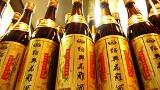
Huangjiu

Encyclopedia
Huangjiu is a type of Chinese
beverage brewed directly from grains such as rice
, millet
, or wheat
. Unlike baijiu
, such liquors are not distilled, and contain less than 20% alcohol, due to the inhibition of fermentation by ethanol at that concentration. These wines are traditionally pasteurized, aged, and filtered before their final bottling for sale to consumers. The various styles of huangjiu may vary in color from clear to beige, yellowish-brown, or reddish-brown.
Huangjiu is either drunk directly after being cooled or warmed, or used in Chinese cooking
. Major producers of huangjiu include mainland China
and Taiwan
.
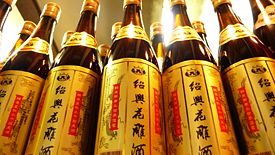
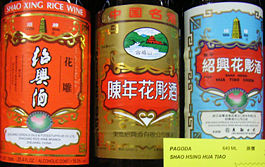 Some of the most popular yellow liquors include:
China
Chinese civilization may refer to:* China for more general discussion of the country.* Chinese culture* Greater China, the transnational community of ethnic Chinese.* History of China* Sinosphere, the area historically affected by Chinese culture...
beverage brewed directly from grains such as rice
Rice
Rice is the seed of the monocot plants Oryza sativa or Oryza glaberrima . As a cereal grain, it is the most important staple food for a large part of the world's human population, especially in East Asia, Southeast Asia, South Asia, the Middle East, and the West Indies...
, millet
Millet
The millets are a group of small-seeded species of cereal crops or grains, widely grown around the world for food and fodder. They do not form a taxonomic group, but rather a functional or agronomic one. Their essential similarities are that they are small-seeded grasses grown in difficult...
, or wheat
Wheat
Wheat is a cereal grain, originally from the Levant region of the Near East, but now cultivated worldwide. In 2007 world production of wheat was 607 million tons, making it the third most-produced cereal after maize and rice...
. Unlike baijiu
Baijiu
Baijiu , or shaojiu is a Chinese distilled alcoholic beverage. The name baijiu literally means "white liquor," "white alcohol" or "white spirits". Baijiu is often translated as "wine" or "white wine"...
, such liquors are not distilled, and contain less than 20% alcohol, due to the inhibition of fermentation by ethanol at that concentration. These wines are traditionally pasteurized, aged, and filtered before their final bottling for sale to consumers. The various styles of huangjiu may vary in color from clear to beige, yellowish-brown, or reddish-brown.
Huangjiu is either drunk directly after being cooled or warmed, or used in Chinese cooking
Chinese cuisine
Chinese cuisine is any of several styles originating in the regions of China, some of which have become highly popular in other parts of the world – from Asia to the Americas, Australia, Western Europe and Southern Africa...
. Major producers of huangjiu include mainland China
Mainland China
Mainland China, the Chinese mainland or simply the mainland, is a geopolitical term that refers to the area under the jurisdiction of the People's Republic of China . According to the Taipei-based Mainland Affairs Council, the term excludes the PRC Special Administrative Regions of Hong Kong and...
and Taiwan
Taiwan
Taiwan , also known, especially in the past, as Formosa , is the largest island of the same-named island group of East Asia in the western Pacific Ocean and located off the southeastern coast of mainland China. The island forms over 99% of the current territory of the Republic of China following...
.
Classifications
Chinese "yellow liquors" (fermented wines) are classified based on several factors. Among them are the liquor's dryness, the starter used in its production, and its production method.Dryness/Sweetness
This is the formal classification for all Chinese wines. There are five categories: dry, semi-dry, semi-sweet, sweet, and extra-sweet.- Dry (Gan, 乾, 干): with sugar content no greater than 1%. This type of yellow wine has the lowest fermentation temperature. An example of this kind is Yuanhongjiu (元红酒, literally "ChampionImperial examinationThe Imperial examination was an examination system in Imperial China designed to select the best administrative officials for the state's bureaucracy. This system had a huge influence on both society and culture in Imperial China and was directly responsible for the creation of a class of...
's Red Wine"), a specialty of ShaoxingShaoxingShaoxing is a prefecture-level city in northeastern Zhejiang province, People's Republic of China. Located on the south bank of the Qiantang River estuary, it borders Ningbo to the east, Taizhou to the southeast, Jinhua to the southwest, and Hangzhou to the west. It was once known as "越"...
, so-named because traditionally the wine jars are painted red. - Semi-dry (Ban Gan, 半乾, 半干): with sugar content between 1% and 3%. This type of huangjiu can be stored for a long period of time and encompasses most of the varieties of huangjiu that are exported from China. An example of this variety is Jiafanjiu (加饭酒, literally "Added Rice Wine"), a variation on the Yuanhongjiu that involves adding more rice in fermentation. The jiafanjiu is traditionally used for ceremonies, such as child birth, engagement, and funerals.
- Semi-sweet (Ban Tian, 半甜): with sugar content between 3% and 10%. The longer the semi-sweet huangjiu is stored, the darker its color becomes. This variety of huangjiu cannot be stored for long periods of time. An example of this kind is Shanniangjiu (善酿酒, literally "Best Made Wine"), a specialty of ShaoxingShaoxingShaoxing is a prefecture-level city in northeastern Zhejiang province, People's Republic of China. Located on the south bank of the Qiantang River estuary, it borders Ningbo to the east, Taizhou to the southeast, Jinhua to the southwest, and Hangzhou to the west. It was once known as "越"...
which partly uses vintage Yuanhongjiu instead of water. - Sweet (Tian, 甜): with sugar content between 10% and 20%. An example of this variety is Feng Gang Jiu (封缸酒, literally "Conceal Earth Jar Wine"). In comparison to previous types of huangjiu, sweet huangjiu can be manufactured all year round when using traditional production methods.
- Extra-sweet (Nong Tian, 浓甜): with sugar content equal or greater than 20%. An example of this variety is Xiang Xue Jiu (香雪酒, literally "Fragrant Snow Wine").
Starter/Inoculant
- Small starter (小麴, 小曲; pinyinPinyinPinyin is the official system to transcribe Chinese characters into the Roman alphabet in China, Malaysia, Singapore and Taiwan. It is also often used to teach Mandarin Chinese and spell Chinese names in foreign publications and used as an input method to enter Chinese characters into...
: xiǎo qū): Wines inoculated using rice cultured with RhizopusRhizopusRhizopus is a genus of common saprobic fungi on plants and specialized parasites on animals. They are found on a wide variety of organic substrates, including "mature fruits and vegetables", faeces, jellies, syrups, leather, bread, peanuts and tobacco. Some Rhizopus species are opportunistic agents...
, yeast, and other microorganisms. The mixture generates less heat, so they are mostly used in the tropical South of China. - Large starter (酒麴, 酒曲; pinyinPinyinPinyin is the official system to transcribe Chinese characters into the Roman alphabet in China, Malaysia, Singapore and Taiwan. It is also often used to teach Mandarin Chinese and spell Chinese names in foreign publications and used as an input method to enter Chinese characters into...
: jiǔ qū): Wines inoculated using rice cultured with Aspergillus oryzaeAspergillus oryzaeAspergillus oryzae is a filamentous fungus . It is used in Chinese and Japanese cuisine to ferment soybeans. It is also used to saccharify rice, other grains, and potatoes in the making of alcoholic beverages such as huangjiu, sake, and shōchū...
and yeast. Almost all popular alcoholic drinks in China belong to this type. - Red starter (紅麴, 红曲; pinyinPinyinPinyin is the official system to transcribe Chinese characters into the Roman alphabet in China, Malaysia, Singapore and Taiwan. It is also often used to teach Mandarin Chinese and spell Chinese names in foreign publications and used as an input method to enter Chinese characters into...
: hóng qū): Wines that are flavoured and coloured with Monascus purpureusMonascus purpureusMonascus purpureus is a species of mold that is purplish-red in color...
or other red rice molds of the MonascusMonascusMonascus is a genus of mold. Among the 24 known species of this genus, the red-pigmented Monascus purpureus is among the most important because of its use in the production of certain fermented foods in East Asia, particularly China and Japan....
genus.
Production methods
- Hot rice (燙飯; pinyinPinyinPinyin is the official system to transcribe Chinese characters into the Roman alphabet in China, Malaysia, Singapore and Taiwan. It is also often used to teach Mandarin Chinese and spell Chinese names in foreign publications and used as an input method to enter Chinese characters into...
: tàng fàn): The steamed rice used to make the wine is cooled in the open air until it is still relatively warm before processing. - Cool rice (凉飯; pinyinPinyinPinyin is the official system to transcribe Chinese characters into the Roman alphabet in China, Malaysia, Singapore and Taiwan. It is also often used to teach Mandarin Chinese and spell Chinese names in foreign publications and used as an input method to enter Chinese characters into...
: liáng fàn): The steamed rice used to make the wine is quenched with cold water before further processing. The unfiltered mash for this wine is sometimes eaten as a dessert or used as an inoculant for other Chinese wines. - Feeding rice (加飯 or 餵飯; pinyinPinyinPinyin is the official system to transcribe Chinese characters into the Roman alphabet in China, Malaysia, Singapore and Taiwan. It is also often used to teach Mandarin Chinese and spell Chinese names in foreign publications and used as an input method to enter Chinese characters into...
: jiā fàn or wèi fàn): Steamed rice is continuously fed into a fermenting mixture (up to three times), which produces a sweeter wine. - Fortified: Distilled Chinese wines are added to the fermenting mash, which increases the concentration of alcohol in the mash and halts the fermentation process. This leaves a significant quantity of unfermented sugars, thus producing an especially sweet tasting wine.
Types
- Mijiu (米酒; pinyin: mǐjiǔ) is the generic name for Chinese fermented rice wineRice wineRice wine is an alcoholic beverage made from rice. Unlike wine, which is made by fermentation of naturally sweet grapes and other fruit, rice "wine" results from the fermentation of rice starch converted to sugars...
, similar to Japanese sake. It is generally clear, and is used for both drinking and cooking. Mijiu intended for cooking often contains 1.5% saltSaltIn chemistry, salts are ionic compounds that result from the neutralization reaction of an acid and a base. They are composed of cations and anions so that the product is electrically neutral...
. Alcohol content by volume: 12-19.5%. - FujianFujian' , formerly romanised as Fukien or Huguing or Foukien, is a province on the southeast coast of mainland China. Fujian is bordered by Zhejiang to the north, Jiangxi to the west, and Guangdong to the south. Taiwan lies to the east, across the Taiwan Strait...
glutinous rice wine (福建糯米酒; pinyin: Fújiàn nuòmǐ jiǔ): made by adding a long list of expensive Chinese medicinal herbs to glutinous riceGlutinous riceGlutinous rice is a type of short-grained Asian rice that is especially sticky when cooked. It is called glutinous Glutinous rice (Oryza sativa var. glutinosa or Oryza glutinosa; also called sticky rice, sweet rice, waxy rice, botan rice, biroin chal, mochi rice, and pearl rice, and pulut) is a...
and a low alcohol distilled rice wine. The unique brewing technique uses another wine as raw material, instead of starting with water. The wine has an orange-red color. Alcohol content by volume: 18%. - Huadiao jiu (花雕酒; pinyin: huādiāo jiǔ; lit. "flowery carving wine"), also known as nu'er hong (女儿红; pinyin: nǚ'ér hóng, lit. "daughter red"): a variety of huangjiu that originates from ShaoxingShaoxingShaoxing is a prefecture-level city in northeastern Zhejiang province, People's Republic of China. Located on the south bank of the Qiantang River estuary, it borders Ningbo to the east, Taizhou to the southeast, Jinhua to the southwest, and Hangzhou to the west. It was once known as "越"...
, in the eastern coastal province of ZhejiangZhejiangZhejiang is an eastern coastal province of the People's Republic of China. The word Zhejiang was the old name of the Qiantang River, which passes through Hangzhou, the provincial capital...
. It is made of glutinous riceGlutinous riceGlutinous rice is a type of short-grained Asian rice that is especially sticky when cooked. It is called glutinous Glutinous rice (Oryza sativa var. glutinosa or Oryza glutinosa; also called sticky rice, sweet rice, waxy rice, botan rice, biroin chal, mochi rice, and pearl rice, and pulut) is a...
and wheat. This wine evolved from the Shaoxing tradition of burying nu'er hong underground when a daughter was born, and digging it up for the wedding banquet when the daughter was to be married. The containers would be decorated with bright colors as a wedding gift. To make the gift more appealing, people began to use pottery with flowery carvings and patterns. Huadiao jiu' s alcohol content is 16% by volume.
- Shaoxing wineShaoxing wineShaoxing wine is one of the most famous varieties of huangjiu, or traditional Chinese wines, fermented from rice. It originates from the region of Shaoxing, in the Zhejiang province of eastern China. It is both drunk as a beverage as well as widely used in Chinese cuisine...
(绍兴酒 or 紹興酒; pinyin: Shàoxīng jiǔ) is the more internationally known high grade version. It is commonly used in Chinese cooking as well as for drinking. The reddish color of these wines is imparted by red yeast rice. One prominent producer of Shaoxing wine is Zhejiang Gu Yue Long Shan Shaoxing Wine Co., Ltd. (古越龍山) of Shaoxing, Zhejiang. It is not uncommon for some varieties of Shaoxing wine to be aged for 50 years or more.
- Hong lu jiu (红露酒 or 紅露酒; pinyin: hóng lù jiǔ; lit. "red wine")photo are basically made of the same wine except they are of lower grade than Shaoxing wine. It is named differently depending on the age, the container, and how they are used.

- Liaojiu (料酒; pinyin: liàojiǔ; lit. "ingredient wine")photo is a lower grade of huangjiu widely used in Chinese cuisineChinese cuisineChinese cuisine is any of several styles originating in the regions of China, some of which have become highly popular in other parts of the world – from Asia to the Americas, Australia, Western Europe and Southern Africa...
as a cooking wine. Often it is sold with various seasonings added, such as cloveCloveCloves are the aromatic dried flower buds of a tree in the family Myrtaceae. Cloves are native to the Maluku islands in Indonesia and used as a spice in cuisines all over the world...
s, star aniseStar aniseIllicium verum, commonly called Star anise, star aniseed, or Chinese star anise, is a spice that closely resembles anise in flavor, obtained from the star-shaped pericarp of Illicium verum, a small native evergreen tree of northeast Vietnam and southwest China...
, cassia, black cardamomBlack cardamomBlack cardamom, also known as hill cardamom, Bengal cardamom, greater cardamom, Indian cardamom, Nepal cardamom, or winged cardamom, brown cardamom, thảo quả and tsao-ko) comes from either of two species in the family Zingiberaceae...
, Sichuan pepperSichuan PepperSichuan pepper is the outer pod of the tiny fruit of a number of species in the genus Zanthoxylum , widely grown and consumed in Asia as a spice. Despite the name, it is not related to black pepper or to chili peppers...
, gingerGingerGinger is the rhizome of the plant Zingiber officinale, consumed as a delicacy, medicine, or spice. It lends its name to its genus and family . Other notable members of this plant family are turmeric, cardamom, and galangal....
, nutmegNutmegThe nutmeg tree is any of several species of trees in genus Myristica. The most important commercial species is Myristica fragrans, an evergreen tree indigenous to the Banda Islands in the Moluccas of Indonesia...
, and salt.
