

Historic center of Mexico City

Encyclopedia
The historic center of Mexico City
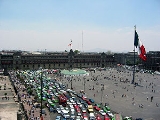
is also known as the "Centro" or "Centro Histórico." This neighborhood is focused on the Zócalo
or main plaza in Mexico City
and extends in all directions for a number of blocks with its farthest extent being west to the Alameda Central
The Zocalo is the largest plaza in Latin America and the second largest in the world after Moscow's Red Square
. It can hold up to nearly 100,000 people.
This is where the Spaniards began to build what is now modern Mexico City
in the 16th century on the ruins of the conquered Tenochtitlan, capital of the Aztec Empire. As the center of the ancient Aztec Empire and the seat of power for the Spanish colony of New Spain
, the Centro Historico contains most of the city's historic sites from both eras as well as a large number of museums. This has made it a World Heritage Site.
 What is now the historic downtown of Mexico City roughly correlates with the ancient Aztec city of Tenochtitlan, which was founded around 1325. During the prehispanic era, the city developed in a planned fashion, with streets and canals aligned with the cardinal directions, leading to orderly square blocks. The island that the city was founded on was divided into four calpullis or neighborhoods that were divided by the main north-south roads leading to Tepeyac
and Iztapalapa
respectively and the west-east road that lead to Tacuba
and to a dike into the lake, respectively. The calpullis were named Cuepopan, Atzacualco, Moyotla and Zoquipan, which had subdivisions and a "tecpan" or district council each. The intersection of these roads was the center of the city and of the Aztec world. Here were the Templo Mayor, the palaces of the tlatoani
or emperors, palaces of nobles such as the "House of the Demons" and the "House of the Flowers". Also located here were the two most renowned Aztec schools: the Telpuchcalli for secular studies and the Calmecac for priestly training. When the Spaniards arrived, the city had aqueducts built by Montezuma Ilhuicamina and Ahuizotl as well as a large dike constructed to the east of the city.
After the Spanish conquest, this design remained largely intact, mostly due to the efforts of Alonso Garcia Bravo, who supervised much of the rebuilding of the city. This reconstruction conserved many of the main thoroughfares such as Tenayuca, renamed Vallejo; Tlacopan, renamed México Tacuba, and Tepeyac, now called the Calzada de los Misterios. They also kept major divisions of the city adding Christian prefixes to the names such as San Juan Moyotla, Santa María Tlaquechiuacan, San Sebastián Atzacualco and San Pedro Teopan. In fact, most of the centro historicos is built with the rubble of the destroyed Aztec city.
A number of people during this time, all Spaniards, accumulated vast wealth mostly through mining and commerce in the 17th and 18th centuries. This wealth is reflected in the various mansions scattered in the centro such as the Palace of Iturbide
and Casa de Azulejos
(House of Tiles). This house was built in the 16th century in Arab style but its namesake tiles were added in 1747 when the Count of the Valley of Orizaba ordered the Talavera
tiles from Puebla
.
In the early part of the 20th century, as a result of the Latin American posture of then-Minister of Public Education José Vasconcelos
, many of the streets to the north and west of the Zocalo were renamed after Latin American countries.
's photo shoot, the Ashes and Snow
Nomadic museum and a skateboarding/BMX event that drew 50,000 young people on 24 August 2008. The Festival de México is an annual event with programs dedicated to art (popular and high) and academia. In 2008, was the 24th Festival with 254 performances and shows from over 20 countries.in 65 plazas and other locations in this section of the city.
It is central to national level protests such as those staged by Lopez Obrador after the 2006 Presidential Elections and the nationwide protest against crime held on August 30, 2008.
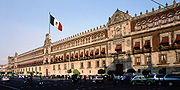 Just off the Zócalo are the Palacio Nacional, the Cathedral Metropolitana, the Templo Mayor with its adjoining museum, and Nacional Monte de Piedad
building. The Palacio Nacional borders the entire east side of the Zocalo and contains the offices of the President of Mexico
, the Federal Treasury, the National Archives as wells as murals depicting pre-Hispanic life and a large mural filling the central stairway depicting the entire history of the Mexican nation from the Conquest on. This palace was built on the ruins of Moctezuma II's palace beginning in 1521, using the same tezontle
stone used to build the Aztec palace. It was originally in the Hernan Cortes
family until the king of Spain bought it to house the viceroys of New Spain and remained so (despite being destroyed and rebuilt again in 1692) until Mexican independence. Facing the Zocalo above a central balcony is the Campana (Bell) of Dolores, which is rung by the president each 15th of Sept to celebrate Independence.
 The Metropolitan Cathedral occupies the north end of the Zócalo and was built between 1573 and 1813. The site originally was part of the Aztec Sacred Precinct (called the Teocalli) and contained the main tzompantli, or rack for the skulls of sacrifice victims. The inside of the cathedral is somewhat disfigured by work designed to halt the cathedral's slow descent into the soft ground, made worse by dropping water tables.
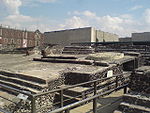 The Templo Mayor archeological site and museum, is the center of the ancient teocalli, located now just northwest of the Zócalo. It was demolished by Hernán Cortés in the 1520s and its location forgotten. The exact site was determined in the beginning of the 20th century, but the decision to excavate was not made until 1978, when electrical workers chanced upon an eight-ton stone disk depicting the Aztec goddess Coyolxauhqui
. Excavation unearthed a pyramid built in multiple layers. This is the spot where, according to legend, the Aztecs saw their sign to settle from their wanderings, an eagle perched on a nopal
cactus with a snake in its beak, which is still the symbol of Mexico today.
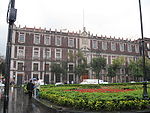 The Nacional Monte de Piedad
building is the national pawn shop, founded in 1775 and one of the largest second-hand shops in the world. On this site were houses that belonged to the last Aztec ruler, Moctezuma II, which Hernán Cortes took for his own after the Conquest. These houses originally stretched from modern-day Isabel la Catolica, Madero, Tacuba and Monte de Piedad streets, prompting one chronicler, Cervantes de Salazar to comment that the residence was not a palace but rather another city.
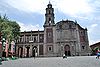 Santo Domingo
refers to the Church of Santo Domingo and the adjoining plaza. Both are located three blocks north of the Mexico City Metropolitan Cathedral
following Republica de Brasil Street with Belisario Dominguez Street separating the two. Officially known as the Señor de la Expiación Chapel, the church is located on the north side of Belisario Dominguez and faces the plaza. It is all that is left from the first convent
to be established in New Spain
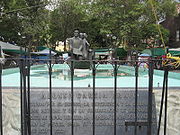
. To the south of the church is Plaza San Domingo. It is flanked to the west by the Portal de Evangelistas, which is a Tuscan colonnade with round arches. Scribes with typewriters and antique printing machines work in this Portal. Scribes offer their services to illiterate clients, often offering services similar to that of lawyers, counselors, and financial consultants. A statue of Josefa Ortiz de Dominguez
, a heroine of the Mexican War of Independence
stands in a fountain in the middle of the plaza.
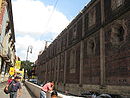 The San Ildefonso College
currently is a museum and cultural center considered to be the birthplace of the Mexican muralism
movement. San Ildefonso began as a prestigious Jesuit boarding school, and after the Reform War
, it gained educational prestige again as National Preparatory School. This school and the building closed completely in 1978, then reopened as a museum and cultural center in 1994. The museum has permanent and temporary art and archeological exhibitions in addition to the many murals painted on its walls by José Clemente Orozco
, Diego Rivera
and others. The complex is located between San Ildefonso Street and Justo Sierra Street in the historic center of Mexico City
.
Secretaría de Educación Pública
at Calle Argentina
Centro Cultural de España (Cultural Center of Spain), located on Republica de Guatemala street just north of the Mexico City Cathedral.
Museum Archive of Photography, located at the corner of Republica de Guatemala and Republica de Argentina Street
Lirico Theatre, located on Republica de Cuba street
Antigua Escuela de Economía (Old School of Economics), located on Republica de Cuba Street
Colegio Nacional
, located on The Colegio Nacional Building, located on Luis Gonzalez Obregon Street
Old Customs building
, on Republica de Brasil just off the Plaza Santo Domingo
Palace of the Inquisition (Museum of Mexican Medicine)
located on Republica de Brasil
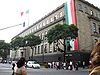
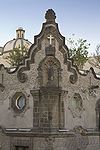 The Supreme Court of Justice of the Nation
is located just off the main plaza
of Mexico City on the corners of Pino Suárez and Carranza Streets. It was built between 1935 and 1941 by Antonio Muñoz Garcia. Prior to the Conquest, this site was reserved for the ritual known as "Dance of the Flyers
" which is still practice today in Papantla
. Its ownership was in dispute during much of the colonial period, eventually becoming the site of a very large market known as El Volador. The interior of the building contains four panels painted in 1941 by José Clemente Orozco
, two of which are named "The Social Labor Movement" and "National Wealth." There is also one mural done by American artist George Biddle
entitled "War and Peace" at the entrance to the library.
Temple of Saint Augustine Located on Avenida Republica de El Salvador
The original El Palacio de Hierro
store located on Carranza and 20 de noviembre streets
The original Liverpool
department store on Carranza and 20 de noviembre streets
Saint Augustine House
Located on Republica de Uruguay and 5 de Febrero streets
The Chapel of the Most Holy Conception of Tlaxcoaque
, one of the oldest churches in Mexico City on Fray Servando de Mier
Church of San Bernardo
off the Zocalo
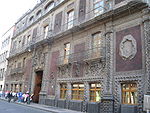 The Palace of Iturbide
- this large palatial home, located in the historic center of Mexico City
on Madero Street #17 was built by the Count of San Mateo Valparaíso in the 18th century as a wedding gift for his daughter. It gained the name "Palace of Iturbide" because Agustín de Iturbide
lived and accepted the crown as Mexico's first emperor there after independence
from Spain. Today, the restored building houses the Fomento Cultural Banamex and has been renamed the Palacio de Cultura Banamex.
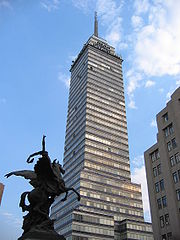 The Torre Latinoamericana
This is one of the best-known skyscrapers in Latin America. It was begun in 1948 and completed in 1956 and is 182 meters tall, antennae included. It is located on the corner of Eje Central and Juarez Streets. It was the tallest tower in Mexico prior to the construction of Torre Pemex. The building has survived two major earthquakes since it was built, one in 1957 and the other in 1985.
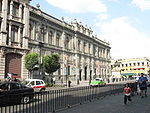 The Museo Nacional de Arte
(MUNAL) is the Mexican National Art Museum, located in the historical center of Mexico City
. The museum is housed in a neoclassical building at No. 8 Tacuba, Col. Centro, Mexico City. It houses a collection representing the history of Mexican art
from the late pre-Hispanic era to the early 20th century. It is recognizable by Manuel Tolsá
's large equestrian statue of Charles IV of Spain who was the monarch just before Mexico gained its Independence. It was originally in the Zocalo
but it was moved to several locations, not out of deference to the king but rather to conserve a piece of art, according to the plaque at the base. It arrived to its final location in 1979.
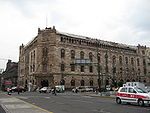 The Palacio de Correos de Mexico
(Postal Palace of Mexico City) also known as the "Correo Mayor" (Main Post Office) is located in the historic center of Mexico City, on the Eje Central (Lazaro Cardenas) near the Palacio de Bellas Artes. It is an early 20th century building built in the style of an Italian Renaissance palace. It was designed by Italian Adamo Boari, who also designed part of the Palacio de Bellas Artes across the street.
Casa de Azulejos
a former mansion completely covered in blue and white Puebla tile between Avenida Madero and Avenida Cinco de Mayo
Colegio de Minería (College of Mining) on Tacuba Street
Mexican Army Museum originally Bethlemites Hospital, located at Tacuba and Mata
Garden of the Triple Alliance
on corner of Tacuba and Mata
Cámara de Senadores
on Xicoténcatl Street
Museo de Estanquillo (cartoons and magazines) on corner of Isabel la Catolica and Madero
Temple of San Felipe Neri "La Profesa"
with collection of artwork from the 17th to 20th centuries, and guided tours on Saturdays from 1200 to 1400 hrs
Interactive Museum of Economics
on Tacuba Street
Santa Clara church - Library of Congress on corner of Tacuba and Mata
Senate of Mexico
Chambers on corner of Donceles and Xicotencatl streets
Chamber of Deputies on Donceles Street
Teatro de la Ciudad
on Donceles Street
Academia Mexicana
on Donceles 66
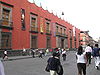 The Museo de la Secretaría de Hacienda y Crédito Público
is an art museum located at Moneda Street #4. It is housed in what was the Palacio del Arzobispado (Palace of the Archbishopric), built in 1530 under Friar Juan de Zumárraga
on the base of the destroyed pyramid dedicated to the Aztec god Tezcatlipoca
. It remained the archbishphoric until 1867 when the Finance Ministry Accountancy Department was established there. The modern museum houses an exhibit dedicated to this god as well as a large art collection.
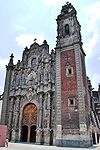 La Santisima Church
is located the cornoer of La Santisima and Emiliano Zapata streets. Its full name is Temple and Hospital of the Most Holy Trinity (Templo y Antiguo Hospital de la Santisíma Trinidad). The church was built between 1755 and 1783 as a temple for the adjoining hospital/hospice for priests. The church still retains its original function but the adjoining hospital and office sites have since moved into private hands with only parts of the original structures still intact and preserved. The church is also noted for the fact that it has sunk almost three meters since it was built.
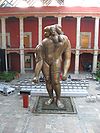 The José Luis Cuevas Museum
is located just off the main plaza, or Zocalo
of Mexico City
in a building that was the convent for the neighboring Church of Santa Ines (Agnes of Rome). This convent was founded in 1600 by Don Diego Caballero and his wife Doña Inés de Velasco. The convent existed until 1861, when, due to the Nationalization of Church Property Act, all covents and monasteries in the country were disbanded. The convent's church and residence hall where separated and the Church of Santa Inés still maintains its original function. The residence hall became private property, functioning mostly as tenements until artist José Luis Cuevas bought the property with the intention to restoring it and establishing the current museum dedicated to his art and art of contemporary Latin America.
The House of the First Print Shop in the Americas
at the corner of Moneda and Licenciado Primo Verdad streets was the home of the first printing press/print shop in the New World
. The house was originally constructed by Gerónimo de Aguilar
in 1524 and is located on the outer edge of what was the sacred precinct of the Templo Mayor prior to the Conquest.
Cathedral Nuestra Señora de Balvanera and Sanctuary of San Charbel, built in the 17th century located at Rep Uruguay and Correo Mayor.
Palacio de la Autonomia de UNAM, (Palace of UNAM's Autonomy) located off of Moneda Street.
Departamento de Estadistica Nacional (Dept. of National Statistics) building on Correo Mayor
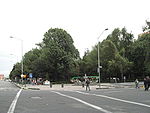 Alameda Central
is a public park in downtown Mexico City
, adjacent to the Palacio de Bellas Artes
, between Juarez Avenue and Hidalgo Avenue. It is a green garden with paved paths and decorative fountains and statues, and is frequently the center of civic events. The area used to be an Aztec marketplace and after the Conquest, the Catholic Church used the area for the burning of heretics and witches. The park was created in 1592, when Viceroy Luis de Velasco
decided to create green space here as a public park. The name comes from the Spanish word álamo, which means poplar
tree, which were planted here. By the late 19th century, the park included a bandstand and gas (now electric) lamps. On the south side of the park, facing toward the street is the Hemiciclo a Juárez, which is a large white semi-circular monument to Benito Juárez
, who is one of Mexico's most beloved presidents.
Palacio de Bellas Artes
on Juárez Street
Teatro Hidalgo on Hidalgo Street north of the Alameda Central
Parish of Santa Cruz, Mexico City on Hidalgo Street
Museo Nacional de la Estampa (National Print Museum) located on Hidalgo Street
Franz Mayer Museum
on Hidalgo Street
Parish of La Santa Vera Cruz de San Juan de Dios on Hidalgo Street
Ex Temple of Corpus Christi on Juarez Street
 Mexico City's Chinatown
, known locally as "Barrio Chino", is located on two blocks of Dolores Street, just south of the Palacio de Bellas Artes
. It is very small, consisting only of a number of restaurants and businesses that import goods. Its diminished size is because most descendants of Chinese immigrants to Mexico
in the late 19th and early 20th centuries either intermarried with the local Mexican population and/or were expelled from the country in the 1930s. Despite this, it is considered the nucleus of the approximately 3,000 families with Chinese heritage in Mexico City.
, Colonia Cuauhtémoc, Colonia Roma
and Colonia Condesa
. The Centro remained the commercial, political and intellectual center through the mid 20th century although it was around this time that UNAM
moved most of its facilities to the new Ciudad Universitaria
. The reason for the decline of the city center was partly man-made and partly natural. In the 1940s, the city government froze rents so that until 1998 when the government repealed the law, tenants were still paying 1950's-level rents. With no financial incentive to keep up their properties, landlords let their buildings disintegrate. The 1985 earthquake
took its toll on a number of these structures, which were never fixed or rebuilt, leading to slums and garbage-strewn vacant lots. The result was the loss of about 100,000 residents of the "Colonia Centro", leaving the area almost deserted at night.
By the 1980s, so many had fled the Centro that many of its former mansions were either abandoned or turned into tenements for the poor, and its sidewalks and streets taken over by pickpockets and milling vendors. For many people, especially international visitors, Mexico City's reputation for pollution, traffic and crime has made the city someplace to "get into and out of as fast as you can", seeing it as little more than an airport through which to make their connecting flights to resort areas like Cozumel
. Until recently, many of the restaurants in the area, even the best, would close early to allow employees time to get home because the area was not particularly safe at night.
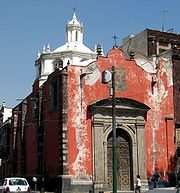 Many of historic churches in the oldest parts of the city are in serious disrepair and are in danger of being lost. Efforts to save these churches are hampered by disagreements between the Church and the federal government
. Because these churches are both active religious institutions and historical landmarks, their legal situation is complicated. By law, religious institutions cannot appeal to the government for financial help, but agencies like the National Council for Culture and Arts do have say in how these places are maintained because of their historic value.
Some of the disagreement is over the extent of the deterioration. Conaculta does not believe that any of the 68 religious buildings in the oldest part of city are in imminent danger of collapse. However the Archdiocese of Mexico believes that the structural problems noted constitute a grave danger to both people and to the "incalculable artistic and historic value of the buildings." One of the churches in imminent danger is called San Lorenzo Diácono y Mártir
, with Our Lady of Loreto
, La Santísima Trinidad
and La Santa Cruz also requiring prompt attention to avoid collapse. The San Lorenzo and Loreto churches both have had incidences where large pieces of the building, a stone and a window respectively, have fallen, causing damage but no injuries. Despite efforts by the archdiocese to demonstrate the extent of the damage of many of the churches, Conaculta still maintains that none of the buildings are in danger of coming down. Another problem is that the depopulation of the historic center, which leaves these churches fairly empty and the diocese unable to fund restoration work.
 Starting in the early 2000s, the government has infused 500 million Mexican pesos (55 million USD) into the Historic Center Trust and entered into a partnership with the Fundación Centro Histórico, an organization established by Carlos Slim, to buy dozens of centuries-old buildings for rehabilitation. The significance of this effort was recognized when, in 2006, the Historic Center was included in the 2006 World Monuments Watch by the World Monuments Fund
. Work began with the renovation of 34 blocks just north of the Zocalo, digging up the antiquated drainage system and improving water supply. An architect was put in charge of each of the thirteen main streets to restore the facades of more than 500 buildings. The latest infrastructure projects of this type have focused on the southwest portions of the area, on República de El Salvador, Talavera, Correo Mayor, Mesones and Pino Suárez streets, mostly focusing on repaving and improving the outdated drainage systems. In the process, artifacts dating from as early as the pre-Hispanic period have been unearthed.
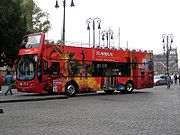
All over the historic center, streets have been pedestrianized, buildings have been remodeled and restored, and new museums opened. In the 1990s, after many years of controversy, protests and even riots, most street vendors were evicted to other parts of the city. The impetus to bring things back to the city center included the construction of the new mayoral residence just off the Zocalo. The government has buried electric and telephone cables in the area, and replaced old asphalt with paving stones. It has also installed nearly 100 security cameras to help with crime issues. This paved the way for the opening of upscale eateries, bars and fashionable stores. Also, young people are moving into downtown lofts. To attract more tourists, there are new red double-decker buses.
As of 2004, investment in the city center has climbed to over 5 billion pesos or 438 million U.S. dollars. According to the Historic Center of Mexico City Trust, this has led to the creation of 15,000 jobs and property owners in the area are showing interest in improving on their investments here. It has also attracted outside investment into the area.
Mexico City
Mexico City is the Federal District , capital of Mexico and seat of the federal powers of the Mexican Union. It is a federal entity within Mexico which is not part of any one of the 31 Mexican states but belongs to the federation as a whole...
is also known as the "Centro" or "Centro Histórico." This neighborhood is focused on the Zócalo
Zócalo
The Zócalo is the main plaza or square in the heart of the historic center of Mexico City. The plaza used to be known simply as the "Main Square" or "Arms Square," and today its formal name is Plaza de la Constitución...
or main plaza in Mexico City
Mexico City
Mexico City is the Federal District , capital of Mexico and seat of the federal powers of the Mexican Union. It is a federal entity within Mexico which is not part of any one of the 31 Mexican states but belongs to the federation as a whole...
and extends in all directions for a number of blocks with its farthest extent being west to the Alameda Central
Mexico City Alameda Central
Alameda Central is a public municipal park in downtown Mexico City, adjacent to the Palacio de Bellas Artes, between Juarez Avenue and Hidalgo Avenue.-Description:...
The Zocalo is the largest plaza in Latin America and the second largest in the world after Moscow's Red Square
Red Square
Red Square is a city square in Moscow, Russia. The square separates the Kremlin, the former royal citadel and currently the official residence of the President of Russia, from a historic merchant quarter known as Kitai-gorod...
. It can hold up to nearly 100,000 people.
Overview
This section of the city has just over nine square km and occupies 668 blocks. It contains 9,000 buildings, 1,550 of which have been declared of historical importance. Most of these historic buildings were constructed between the 16th and 20th centuries. It is divided into two zones for preservation purposes. Zone A encompasses the pre-Hispanic city and its expansion from the Viceroy period until Independence. Zone B covers the areas all other constructions to the end of the 19th century that are considered indispensable to the preservation of the area's architectural and cultural heritage.This is where the Spaniards began to build what is now modern Mexico City
Mexico City
Mexico City is the Federal District , capital of Mexico and seat of the federal powers of the Mexican Union. It is a federal entity within Mexico which is not part of any one of the 31 Mexican states but belongs to the federation as a whole...
in the 16th century on the ruins of the conquered Tenochtitlan, capital of the Aztec Empire. As the center of the ancient Aztec Empire and the seat of power for the Spanish colony of New Spain
New Spain
New Spain, formally called the Viceroyalty of New Spain , was a viceroyalty of the Spanish colonial empire, comprising primarily territories in what was known then as 'América Septentrional' or North America. Its capital was Mexico City, formerly Tenochtitlan, capital of the Aztec Empire...
, the Centro Historico contains most of the city's historic sites from both eras as well as a large number of museums. This has made it a World Heritage Site.
History
Tepeyac
Tepeyac or the Hill of Tepeyac, historically known by the names "Tepeyacac" and "Tepeaquilla", is located inside Gustavo A. Madero, the northernmost delegación or borough of the Mexican Federal District. It is the site where Saint Juan Diego met the Virgin of Guadalupe in December of 1531, and...
and Iztapalapa
Iztapalapa
Iztapalapa is one of the Federal District of Mexico City’s 16 boroughs, located on the east side of the entity. The borough is named after and centered on the formerly independent municipality of Iztapalapa, which is officially called Iztapalapa de Cuitláhuac for disambiguation purposes...
respectively and the west-east road that lead to Tacuba
Tacuba
Tacuba is a municipality in the Ahuachapán department of El Salvador.-Church Of Tacuba:It is located in Villa of Tacuba. It is head of the municipality of the same name in the department of Ahuachapán, at about 14 Kilometers of the city of Ahuachapán and at 700 meters over the sea level...
and to a dike into the lake, respectively. The calpullis were named Cuepopan, Atzacualco, Moyotla and Zoquipan, which had subdivisions and a "tecpan" or district council each. The intersection of these roads was the center of the city and of the Aztec world. Here were the Templo Mayor, the palaces of the tlatoani
Tlatoani
Tlatoani is the Nahuatl term for the ruler of an altepetl, a pre-Hispanic state. The word literally means "speaker", but may be translated into English as "king". A is a female ruler, or queen regnant....
or emperors, palaces of nobles such as the "House of the Demons" and the "House of the Flowers". Also located here were the two most renowned Aztec schools: the Telpuchcalli for secular studies and the Calmecac for priestly training. When the Spaniards arrived, the city had aqueducts built by Montezuma Ilhuicamina and Ahuizotl as well as a large dike constructed to the east of the city.
After the Spanish conquest, this design remained largely intact, mostly due to the efforts of Alonso Garcia Bravo, who supervised much of the rebuilding of the city. This reconstruction conserved many of the main thoroughfares such as Tenayuca, renamed Vallejo; Tlacopan, renamed México Tacuba, and Tepeyac, now called the Calzada de los Misterios. They also kept major divisions of the city adding Christian prefixes to the names such as San Juan Moyotla, Santa María Tlaquechiuacan, San Sebastián Atzacualco and San Pedro Teopan. In fact, most of the centro historicos is built with the rubble of the destroyed Aztec city.
A number of people during this time, all Spaniards, accumulated vast wealth mostly through mining and commerce in the 17th and 18th centuries. This wealth is reflected in the various mansions scattered in the centro such as the Palace of Iturbide
Palace of Iturbide
The Palace of Iturbide is a large palatial home located in the historic center of Mexico City on Madero Street #17. It was built by the Count of San Mateo Valparaíso as a wedding gift for his daughter. It gained the name “Palace of Iturbide” because Agustín de Iturbide lived and accepted the crown...
and Casa de Azulejos
Casa de los Azulejos, Mexico City
The Casa de los Azulejos or "House of Tiles" is an 18th century palace in Mexico City, built by the Count del Valle de Orizaba family. What makes this palace, in the City of Palaces, distinctive is that its facade on three sides is completely covered in the expensive blue and white tile of Puebla...
(House of Tiles). This house was built in the 16th century in Arab style but its namesake tiles were added in 1747 when the Count of the Valley of Orizaba ordered the Talavera
Talavera (pottery)
Talavera pottery of Puebla, Mexico is a type of majolica pottery, which is distinguished by a milky-white glaze. Authentic Talavera pottery only comes from the city of Puebla and the nearby communities of Atlixco, Cholula, and Tecali, because of the quality of the natural clay found there and the...
tiles from Puebla
Puebla
Puebla officially Estado Libre y Soberano de Puebla is one of the 31 states which, with the Federal District, comprise the 32 Federal Entities of Mexico. It is divided in 217 municipalities and its capital city is Puebla....
.
In the early part of the 20th century, as a result of the Latin American posture of then-Minister of Public Education José Vasconcelos
José Vasconcelos
José Vasconcelos Calderón was a Mexican writer, philosopher and politician. He is one of the most influential and controversial personalities in the development of modern Mexico. His philosophy of "indigenismo" affected all aspects of Mexican sociocultural, political, and economic...
, many of the streets to the north and west of the Zocalo were renamed after Latin American countries.
The Zócalo and surrounding sites
Historically, the Zócalo, or main plaza, has been a venue for fine and popular cultural events. Some example of events held here recently are Spencer TunickSpencer Tunick
Spencer Tunick is an American photographer. Tunick is best known for organizing large-scale nude shoots. Since 1994 he has photographed over 75 human installations around the world.-Biography:...
's photo shoot, the Ashes and Snow
Ashes and Snow
Ashes and Snow by Canadian artist Gregory Colbert is an installation of photographic artworks, films, and a novel in letters that travels in the Nomadic Museum, a temporary structure built exclusively to house the exhibition. The work explores the shared poetic sensibilities of human beings and...
Nomadic museum and a skateboarding/BMX event that drew 50,000 young people on 24 August 2008. The Festival de México is an annual event with programs dedicated to art (popular and high) and academia. In 2008, was the 24th Festival with 254 performances and shows from over 20 countries.in 65 plazas and other locations in this section of the city.
It is central to national level protests such as those staged by Lopez Obrador after the 2006 Presidential Elections and the nationwide protest against crime held on August 30, 2008.
Nacional Monte de Piedad
The Nacional Monte de Piedad is a not-for-profit- institution and pawnshop whose main office is located just off the Zócalo, or main plaza of Mexico City. It was established between 1774 and 1777 by Pedro Romero de Terreros as part of a movement to provide interest-free or low-interest loans to...
building. The Palacio Nacional borders the entire east side of the Zocalo and contains the offices of the President of Mexico
President of Mexico
The President of the United Mexican States is the head of state and government of Mexico. Under the Constitution, the president is also the Supreme Commander of the Mexican armed forces...
, the Federal Treasury, the National Archives as wells as murals depicting pre-Hispanic life and a large mural filling the central stairway depicting the entire history of the Mexican nation from the Conquest on. This palace was built on the ruins of Moctezuma II's palace beginning in 1521, using the same tezontle
Tezontle
Tezontle is a porous, extrusive, igneous, volcanic rock used extensively in construction in Mexico. It is usually reddish in color.-Uses:Tezontle can be mixed with concrete to form lightweight concrete blocks, or mixed with cement to create stucco finishes. Tezontle is often used as the top...
stone used to build the Aztec palace. It was originally in the Hernan Cortes
Hernán Cortés
Hernán Cortés de Monroy y Pizarro, 1st Marquis of the Valley of Oaxaca was a Spanish Conquistador who led an expedition that caused the fall of the Aztec Empire and brought large portions of mainland Mexico under the rule of the King of Castile in the early 16th century...
family until the king of Spain bought it to house the viceroys of New Spain and remained so (despite being destroyed and rebuilt again in 1692) until Mexican independence. Facing the Zocalo above a central balcony is the Campana (Bell) of Dolores, which is rung by the president each 15th of Sept to celebrate Independence.
Coyolxauhqui
In Aztec mythology, Coyolxauhqui was a daughter of Coatlicue and Mixcoatl and is the leader of the Centzon Huitznahuas, the star gods. Coyolxauhqui was a powerful magician and led her siblings in an attack on their mother, Coatlicue, because Coatlicue had become pregnant.- Attack on Coatlicue :The...
. Excavation unearthed a pyramid built in multiple layers. This is the spot where, according to legend, the Aztecs saw their sign to settle from their wanderings, an eagle perched on a nopal
Nopal
Nopales are a vegetable made from the young cladode segments of prickly pear, carefully peeled to remove the spines. These fleshy pads are flat and about hand-sized. They can be purple or green...
cactus with a snake in its beak, which is still the symbol of Mexico today.
Nacional Monte de Piedad
The Nacional Monte de Piedad is a not-for-profit- institution and pawnshop whose main office is located just off the Zócalo, or main plaza of Mexico City. It was established between 1774 and 1777 by Pedro Romero de Terreros as part of a movement to provide interest-free or low-interest loans to...
building is the national pawn shop, founded in 1775 and one of the largest second-hand shops in the world. On this site were houses that belonged to the last Aztec ruler, Moctezuma II, which Hernán Cortes took for his own after the Conquest. These houses originally stretched from modern-day Isabel la Catolica, Madero, Tacuba and Monte de Piedad streets, prompting one chronicler, Cervantes de Salazar to comment that the residence was not a palace but rather another city.
Notable sites north of the Zócalo
Santo Domingo (Mexico City)
Santo Domingo in Mexico City refers to the Church of Santo Domingo and its Plaza, also called Santo Domingo. Both are located three blocks north of the Mexico City Metropolitan Cathedral following Republica de Brasil Street with Belisario Dominguez Street separating the two.-The Church:Officially...
refers to the Church of Santo Domingo and the adjoining plaza. Both are located three blocks north of the Mexico City Metropolitan Cathedral
Mexico City Metropolitan Cathedral
The Metropolitan Cathedral of the Assumption of Mary of Mexico City is the largest and oldest cathedral in the Americas and seat of the Roman Catholic Archdiocese of Mexico. It is situated atop the former Aztec sacred precinct near the Templo Mayor on the northern side of the Plaza de la...
following Republica de Brasil Street with Belisario Dominguez Street separating the two. Officially known as the Señor de la Expiación Chapel, the church is located on the north side of Belisario Dominguez and faces the plaza. It is all that is left from the first convent
Convent
A convent is either a community of priests, religious brothers, religious sisters, or nuns, or the building used by the community, particularly in the Roman Catholic Church and in the Anglican Communion...
to be established in New Spain
New Spain
New Spain, formally called the Viceroyalty of New Spain , was a viceroyalty of the Spanish colonial empire, comprising primarily territories in what was known then as 'América Septentrional' or North America. Its capital was Mexico City, formerly Tenochtitlan, capital of the Aztec Empire...
. To the south of the church is Plaza San Domingo. It is flanked to the west by the Portal de Evangelistas, which is a Tuscan colonnade with round arches. Scribes with typewriters and antique printing machines work in this Portal. Scribes offer their services to illiterate clients, often offering services similar to that of lawyers, counselors, and financial consultants. A statue of Josefa Ortiz de Dominguez
Josefa Ortiz de Domínguez
María Josefa Cresencia Ortiz y Girón, popularly known as Doña Josefa Ortiz de Domínguez or La Corregidora was an insurgent and supporter of the Mexican War of Independence, which fought for independence against Spain, in the early 19th century...
, a heroine of the Mexican War of Independence
Mexican War of Independence
The Mexican War of Independence was an armed conflict between the people of Mexico and the Spanish colonial authorities which started on 16 September 1810. The movement, which became known as the Mexican War of Independence, was led by Mexican-born Spaniards, Mestizos and Amerindians who sought...
stands in a fountain in the middle of the plaza.
San Ildefonso College
The San Ildefonso College currently is a museum and cultural center in Mexico City, considered to be the birthplace of the Mexican muralism movement. San Ildefonso began as a prestigious Jesuit boarding school, and after the Reform War, it gained educational prestige again as National Preparatory...
currently is a museum and cultural center considered to be the birthplace of the Mexican muralism
Mexican Muralism
Mexican muralism is a Mexican art movement. The most important period of this movement took place primarily from the 1920s to the 1960s, though it exerted an influence on later generations of Mexican artists...
movement. San Ildefonso began as a prestigious Jesuit boarding school, and after the Reform War
Reform War
The Reform War in Mexico is one of the episodes of the long struggle between Liberal and Conservative forces that dominated the country’s history in the 19th century. The Liberals wanted a federalist government, limiting traditional Catholic Church and military influence in the country...
, it gained educational prestige again as National Preparatory School. This school and the building closed completely in 1978, then reopened as a museum and cultural center in 1994. The museum has permanent and temporary art and archeological exhibitions in addition to the many murals painted on its walls by José Clemente Orozco
José Clemente Orozco
José Clemente Orozco was a Mexican social realist painter, who specialized in bold murals that established the Mexican Mural Renaissance together with murals by Diego Rivera, David Alfaro Siqueiros, and others...
, Diego Rivera
Diego Rivera
Diego María de la Concepción Juan Nepomuceno Estanislao de la Rivera y Barrientos Acosta y Rodríguez was a prominent Mexican painter born in Guanajuato, Guanajuato, an active communist, and husband of Frida Kahlo . His large wall works in fresco helped establish the Mexican Mural Movement in...
and others. The complex is located between San Ildefonso Street and Justo Sierra Street in the historic center of Mexico City
Mexico City
Mexico City is the Federal District , capital of Mexico and seat of the federal powers of the Mexican Union. It is a federal entity within Mexico which is not part of any one of the 31 Mexican states but belongs to the federation as a whole...
.
Secretaría de Educación Pública
Secretaría de Educación Pública
The Secretaría de Educación Pública is a Mexican federal government authority with Cabinet representation and responsibility for overseeing the development and implementation of national educational policy and school standards in Mexico.Additionally, it has the following responsibilities:*Creation...
at Calle Argentina
Centro Cultural de España (Cultural Center of Spain), located on Republica de Guatemala street just north of the Mexico City Cathedral.
Museum Archive of Photography, located at the corner of Republica de Guatemala and Republica de Argentina Street
Lirico Theatre, located on Republica de Cuba street
Antigua Escuela de Economía (Old School of Economics), located on Republica de Cuba Street
Colegio Nacional
Colegio Nacional
The National College is a Mexican honorary academy with a strictly limited membership created by presidential decree in 1943 in order to bring together the country's foremost artists and scientists, who are periodically invited to deliver lectures and seminars in their respective area of speciality...
, located on The Colegio Nacional Building, located on Luis Gonzalez Obregon Street
Old Customs building
Old Customs Buildings, Mexico City
The Old Customs Building is located on the east side of Santo Domingo Plaza between Republica de Venezuela and Luis Gonzalez Obregon Streets just to the north of the main plaza of Mexico City. The land here originally belonged to several nobles, including the Marquis of Villamayor...
, on Republica de Brasil just off the Plaza Santo Domingo
Palace of the Inquisition (Museum of Mexican Medicine)
Palace of the Inquisition (Museum of Mexican Medicine)
The Palace of the Inquisition stands on the corner of Republica de Brasil and Republica de Venezuela streets in Mexico City, Mexico. While neither side of the building faces the Santo Domingo Plaza, the entrance does, as it is placed at the corner, which is canted to allow it to face in that...
located on Republica de Brasil
Notable sites south of the Zócalo
Supreme Court of Justice of the Nation
The Supreme Court of Justice of the Nation is the highest federal court in the United Mexican States. It consists of a President of the Supreme Court and ten Ministers who are confirmed by the Senate from a list proposed by the President of the Republic.Justices of the SCJN serve for fifteen...
is located just off the main plaza
Zócalo
The Zócalo is the main plaza or square in the heart of the historic center of Mexico City. The plaza used to be known simply as the "Main Square" or "Arms Square," and today its formal name is Plaza de la Constitución...
of Mexico City on the corners of Pino Suárez and Carranza Streets. It was built between 1935 and 1941 by Antonio Muñoz Garcia. Prior to the Conquest, this site was reserved for the ritual known as "Dance of the Flyers
Danza de los Voladores de Papantla
The Danza de los Voladores is a ceremony/ritual which has its roots in the pre-Hispanic period and presently best known as associated with the town of Papantla, Veracruz. It is believed to have originated with the Nahua, Huastec and Otomi peoples in central Mexico, and then spread throughout most...
" which is still practice today in Papantla
Papantla
Papantla is a city and municipality located in the north of the state of Veracruz, Mexico, in the Sierra Papanteca range and on the Gulf of Mexico. The city was founded in the 13th century by the Totonacs and has dominated the Totonacapan region of the state since then...
. Its ownership was in dispute during much of the colonial period, eventually becoming the site of a very large market known as El Volador. The interior of the building contains four panels painted in 1941 by José Clemente Orozco
José Clemente Orozco
José Clemente Orozco was a Mexican social realist painter, who specialized in bold murals that established the Mexican Mural Renaissance together with murals by Diego Rivera, David Alfaro Siqueiros, and others...
, two of which are named "The Social Labor Movement" and "National Wealth." There is also one mural done by American artist George Biddle
George Biddle
George Biddle was an American artist best known for his social realism, combat art, and his strong advocacy of government-sponsored art projects...
entitled "War and Peace" at the entrance to the library.
Temple of Saint Augustine Located on Avenida Republica de El Salvador
The original El Palacio de Hierro
El Palacio de Hierro
El Palacio de Hierro is an upscale chain of department stores in Mexico.-History:In the 1850s, a clothing store opened in Mexico City called "Las Fábricas de Francia" which was owned by Victor Gassier, a Frenchman...
store located on Carranza and 20 de noviembre streets
The original Liverpool
Liverpool (store)
Liverpool is mid-to-high biggest chain of department stores in Mexico, operating 79 stores and one luxury shopping center Galerías Insurgentes, throughout Mexico and continuing to grow...
department store on Carranza and 20 de noviembre streets
Saint Augustine House
Saint Augustine House
It is a monument located in the Historic center of Mexico City, on the corner of the streets Republic of Uruguay and 5 of February, , it got its name because it was property of the order of the Augustinians, whose convent was located next to this building.The order of the Augustinians owned several...
Located on Republica de Uruguay and 5 de Febrero streets
The Chapel of the Most Holy Conception of Tlaxcoaque
Tlaxcoaque
Tlaxcoaque is a plaza located in the historic center of Mexico City which has given its name to both the 17th century church that is on it and the blocks that surround it. Historically this plaza and the church that sits on it have marked the southern edge of Mexico City, and today it is on the...
, one of the oldest churches in Mexico City on Fray Servando de Mier
Church of San Bernardo
Church of San Bernardo, Mexico City
The Church of San Bernardo stands at the corner of Avenida 20 de Noviembre and Venustiano Carranza Street just south of the Zocalo or main plaza of Mexico City. It was part of a convent of the same name that was founded in 1636, but was closed along with all convents and monasteries during the La...
off the Zocalo
Notable sites west of the Zocalo
Palace of Iturbide
The Palace of Iturbide is a large palatial home located in the historic center of Mexico City on Madero Street #17. It was built by the Count of San Mateo Valparaíso as a wedding gift for his daughter. It gained the name “Palace of Iturbide” because Agustín de Iturbide lived and accepted the crown...
- this large palatial home, located in the historic center of Mexico City
Mexico City
Mexico City is the Federal District , capital of Mexico and seat of the federal powers of the Mexican Union. It is a federal entity within Mexico which is not part of any one of the 31 Mexican states but belongs to the federation as a whole...
on Madero Street #17 was built by the Count of San Mateo Valparaíso in the 18th century as a wedding gift for his daughter. It gained the name "Palace of Iturbide" because Agustín de Iturbide
Agustín de Iturbide
Agustín Cosme Damián de Iturbide y Aramburu , also known as Augustine I of Mexico, was a Mexican army general who built a successful political and military coalition that was able to march into Mexico City on 27 September 1821, decisively ending the Mexican War of Independence...
lived and accepted the crown as Mexico's first emperor there after independence
Mexican War of Independence
The Mexican War of Independence was an armed conflict between the people of Mexico and the Spanish colonial authorities which started on 16 September 1810. The movement, which became known as the Mexican War of Independence, was led by Mexican-born Spaniards, Mestizos and Amerindians who sought...
from Spain. Today, the restored building houses the Fomento Cultural Banamex and has been renamed the Palacio de Cultura Banamex.
Torre Latinoamericana
The Torre Latinoamericana is a building in downtown Mexico City, Mexico. Its central location, height and history make it one of the city's most important landmarks...
This is one of the best-known skyscrapers in Latin America. It was begun in 1948 and completed in 1956 and is 182 meters tall, antennae included. It is located on the corner of Eje Central and Juarez Streets. It was the tallest tower in Mexico prior to the construction of Torre Pemex. The building has survived two major earthquakes since it was built, one in 1957 and the other in 1985.
Museo Nacional de Arte
The Museo Nacional de Arte is the Mexican national art museum, located in the historical center of Mexico City. The museum is housed in a neoclassical building at No. 8 Tacuba, Col. Centro, Mexico City. It includes a large collection representing the history of Mexican art from the mid-sixteenth...
(MUNAL) is the Mexican National Art Museum, located in the historical center of Mexico City
Mexico City
Mexico City is the Federal District , capital of Mexico and seat of the federal powers of the Mexican Union. It is a federal entity within Mexico which is not part of any one of the 31 Mexican states but belongs to the federation as a whole...
. The museum is housed in a neoclassical building at No. 8 Tacuba, Col. Centro, Mexico City. It houses a collection representing the history of Mexican art
Mexican art
Mexican art consists of the various visual and plastic arts which developed over the geographical area now known as Mexico. The development of these arts roughly follow the history of Mexico, divided into the Mesoamerican era, the colonial period, with the period after the gaining of Independence...
from the late pre-Hispanic era to the early 20th century. It is recognizable by Manuel Tolsá
Manuel Tolsá
Manuel Tolsá was a prolific Neoclassical architect and sculptor in Spain and Mexico.-Biography:...
's large equestrian statue of Charles IV of Spain who was the monarch just before Mexico gained its Independence. It was originally in the Zocalo
Zócalo
The Zócalo is the main plaza or square in the heart of the historic center of Mexico City. The plaza used to be known simply as the "Main Square" or "Arms Square," and today its formal name is Plaza de la Constitución...
but it was moved to several locations, not out of deference to the king but rather to conserve a piece of art, according to the plaque at the base. It arrived to its final location in 1979.
Palacio de Correos de Mexico
The Palacio de Correos de Mexico also known as the "Correo Mayor" is located in the historic center of Mexico City, on the Eje Central near the Palacio de Bellas Artes. It was built at the very beginning of the 20th century, when the Post Office here became a separate government entity...
(Postal Palace of Mexico City) also known as the "Correo Mayor" (Main Post Office) is located in the historic center of Mexico City, on the Eje Central (Lazaro Cardenas) near the Palacio de Bellas Artes. It is an early 20th century building built in the style of an Italian Renaissance palace. It was designed by Italian Adamo Boari, who also designed part of the Palacio de Bellas Artes across the street.
Casa de Azulejos
Casa de los Azulejos, Mexico City
The Casa de los Azulejos or "House of Tiles" is an 18th century palace in Mexico City, built by the Count del Valle de Orizaba family. What makes this palace, in the City of Palaces, distinctive is that its facade on three sides is completely covered in the expensive blue and white tile of Puebla...
a former mansion completely covered in blue and white Puebla tile between Avenida Madero and Avenida Cinco de Mayo
Colegio de Minería (College of Mining) on Tacuba Street
Mexican Army Museum originally Bethlemites Hospital, located at Tacuba and Mata
Garden of the Triple Alliance
Garden of the Triple Alliance
The Garden of the Triple Alliance is a very small garden and monument composed of three bronze castings representing the three tlatoani of the Aztec Triple Alliance, and made by the artist Jesús F. Contreras between 1888 and 1889. It is located on Filomeno Mata street , west of the Zocalo in the...
on corner of Tacuba and Mata
Cámara de Senadores
Senate of Mexico
The Senate of the Republic, constitutionally Chamber of Senators of the Honorable Congress of the Union After a series of reforms during the 1990s, it is now made up of 128 senators:...
on Xicoténcatl Street
Museo de Estanquillo (cartoons and magazines) on corner of Isabel la Catolica and Madero
Temple of San Felipe Neri "La Profesa"
Temple of San Felipe Neri "La Profesa"
The Temple of San Felipe Neri, commonly known as "La Profesa" , is a Roman Catholic parish church that was established by the Society of Jesus late in the 16th century as the church of a community of professed Jesuits...
with collection of artwork from the 17th to 20th centuries, and guided tours on Saturdays from 1200 to 1400 hrs
Interactive Museum of Economics
Interactive Museum of Economics
The Interactive Museum of Economics or MIDE is the first museum in the world dedicated exclusively to economics. The museum was opened in 2006 and is located on Tacuba Street in the historic center of Mexico City. The museum is open to the public and features hands-on exhibits meant to make the...
on Tacuba Street
Santa Clara church - Library of Congress on corner of Tacuba and Mata
Senate of Mexico
Senate of Mexico
The Senate of the Republic, constitutionally Chamber of Senators of the Honorable Congress of the Union After a series of reforms during the 1990s, it is now made up of 128 senators:...
Chambers on corner of Donceles and Xicotencatl streets
Chamber of Deputies on Donceles Street
Teatro de la Ciudad
Teatro de la Ciudad
The Teatro de la Ciudad was built as the "Teatro Esperanza Iris" in 1918 and is now one of Mexico City’s public venues for cultural events...
on Donceles Street
Academia Mexicana
Academia Mexicana de la Lengua
The Academia Mexicana de la Lengua is the correspondent academy in Mexico of the Royal Spanish Academy...
on Donceles 66
Notable sites east of the Zocalo
Museo de la Secretaría de Hacienda y Crédito Público
The Museo de la Secretaría de Hacienda y Crédito Público is an art museum located in the historic center of Mexico City. It is housed in what was the Palacio del Arzobispado , built in 1530 under Friar Juan de Zumárraga on the base of the destroyed pyramid dedicated to the Aztec god Tezcatlipoca...
is an art museum located at Moneda Street #4. It is housed in what was the Palacio del Arzobispado (Palace of the Archbishopric), built in 1530 under Friar Juan de Zumárraga
Juan de Zumárraga
Juan de Zumárraga was a Spanish Basque Franciscan prelate and first bishop of Mexico.-Origins and arrival in New Spain:...
on the base of the destroyed pyramid dedicated to the Aztec god Tezcatlipoca
Tezcatlipoca
Tezcatlipoca was a central deity in Aztec religion. One of the four sons of Ometeotl, he is associated with a wide range of concepts, including the night sky, the night winds, hurricanes, the north, the earth, obsidian, enmity, discord, rulership, divination, temptation, jaguars, sorcery, beauty,...
. It remained the archbishphoric until 1867 when the Finance Ministry Accountancy Department was established there. The modern museum houses an exhibit dedicated to this god as well as a large art collection.
La Santisima Church
La Santísima Church is located 12 La Santísima Street at corner of Emiliano Zapata Street in the historic center of Mexico City. Its full name is Temple and Hospital of the Most Holy Trinity . The church was built between 1755 and 1783 as a temple for the adjoining hospital/hospice for priests...
is located the cornoer of La Santisima and Emiliano Zapata streets. Its full name is Temple and Hospital of the Most Holy Trinity (Templo y Antiguo Hospital de la Santisíma Trinidad). The church was built between 1755 and 1783 as a temple for the adjoining hospital/hospice for priests. The church still retains its original function but the adjoining hospital and office sites have since moved into private hands with only parts of the original structures still intact and preserved. The church is also noted for the fact that it has sunk almost three meters since it was built.
José Luis Cuevas Museum
The José Luis Cuevas Museum and Church of Santa Inés are located just off the main plaza, or Zocalo of Mexico City and started out as parts of the same convent complex. The museum was founded in what in colonial times was the residential portion of the convent of Santa Inés . This convent was...
is located just off the main plaza, or Zocalo
Zócalo
The Zócalo is the main plaza or square in the heart of the historic center of Mexico City. The plaza used to be known simply as the "Main Square" or "Arms Square," and today its formal name is Plaza de la Constitución...
of Mexico City
Mexico City
Mexico City is the Federal District , capital of Mexico and seat of the federal powers of the Mexican Union. It is a federal entity within Mexico which is not part of any one of the 31 Mexican states but belongs to the federation as a whole...
in a building that was the convent for the neighboring Church of Santa Ines (Agnes of Rome). This convent was founded in 1600 by Don Diego Caballero and his wife Doña Inés de Velasco. The convent existed until 1861, when, due to the Nationalization of Church Property Act, all covents and monasteries in the country were disbanded. The convent's church and residence hall where separated and the Church of Santa Inés still maintains its original function. The residence hall became private property, functioning mostly as tenements until artist José Luis Cuevas bought the property with the intention to restoring it and establishing the current museum dedicated to his art and art of contemporary Latin America.
The House of the First Print Shop in the Americas
House of the First Print Shop in the Americas
The House of the First Print Shop in the Americas at the corner of Moneda and Licenciado Primo Verdad streets in Mexico City was the home of the first printing press/print shop in the New World....
at the corner of Moneda and Licenciado Primo Verdad streets was the home of the first printing press/print shop in the New World
New World
The New World is one of the names used for the Western Hemisphere, specifically America and sometimes Oceania . The term originated in the late 15th century, when America had been recently discovered by European explorers, expanding the geographical horizon of the people of the European middle...
. The house was originally constructed by Gerónimo de Aguilar
Gerónimo de Aguilar
Gerónimo de Aguilar O.F.M. was a Franciscan friar born in Écija, Spain. Aguilar was later involved with the 1519 Spanish conquest of Mexico, and with La Malinche he assisted Hernán Cortés in translating indigenous language to Spanish....
in 1524 and is located on the outer edge of what was the sacred precinct of the Templo Mayor prior to the Conquest.
Cathedral Nuestra Señora de Balvanera and Sanctuary of San Charbel, built in the 17th century located at Rep Uruguay and Correo Mayor.
Palacio de la Autonomia de UNAM, (Palace of UNAM's Autonomy) located off of Moneda Street.
Departamento de Estadistica Nacional (Dept. of National Statistics) building on Correo Mayor
Around the Alameda Central
Mexico City Alameda Central
Alameda Central is a public municipal park in downtown Mexico City, adjacent to the Palacio de Bellas Artes, between Juarez Avenue and Hidalgo Avenue.-Description:...
is a public park in downtown Mexico City
Mexico City
Mexico City is the Federal District , capital of Mexico and seat of the federal powers of the Mexican Union. It is a federal entity within Mexico which is not part of any one of the 31 Mexican states but belongs to the federation as a whole...
, adjacent to the Palacio de Bellas Artes
Palacio de Bellas Artes
The Palacio de Bellas Artes is the most important cultural center in Mexico City as well as the rest of the country of Mexico...
, between Juarez Avenue and Hidalgo Avenue. It is a green garden with paved paths and decorative fountains and statues, and is frequently the center of civic events. The area used to be an Aztec marketplace and after the Conquest, the Catholic Church used the area for the burning of heretics and witches. The park was created in 1592, when Viceroy Luis de Velasco
Luis de Velasco
Luís de Velasco was the second viceroy of New Spain during the Spanish colonization of the Americas in the mid-sixteenth century....
decided to create green space here as a public park. The name comes from the Spanish word álamo, which means poplar
Poplar
Populus is a genus of 25–35 species of deciduous flowering plants in the family Salicaceae, native to most of the Northern Hemisphere. English names variously applied to different species include poplar , aspen, and cottonwood....
tree, which were planted here. By the late 19th century, the park included a bandstand and gas (now electric) lamps. On the south side of the park, facing toward the street is the Hemiciclo a Juárez, which is a large white semi-circular monument to Benito Juárez
Benito Juárez
Benito Juárez born Benito Pablo Juárez García, was a Mexican lawyer and politician of Zapotec origin from Oaxaca who served five terms as president of Mexico: 1858–1861 as interim, 1861–1865, 1865–1867, 1867–1871 and 1871–1872...
, who is one of Mexico's most beloved presidents.
Palacio de Bellas Artes
Palacio de Bellas Artes
The Palacio de Bellas Artes is the most important cultural center in Mexico City as well as the rest of the country of Mexico...
on Juárez Street
Teatro Hidalgo on Hidalgo Street north of the Alameda Central
Parish of Santa Cruz, Mexico City on Hidalgo Street
Museo Nacional de la Estampa (National Print Museum) located on Hidalgo Street
Franz Mayer Museum
Franz Mayer Museum
The Franz Mayer Museum , in Mexico City opened in 1986 to house, display and maintain Latin America’s largest collection of decorative arts. The collection was amassed by stockbroker and financial professional Franz Mayer, who collected fine artworks, books, furniture, ceramics, textiles and many...
on Hidalgo Street
Parish of La Santa Vera Cruz de San Juan de Dios on Hidalgo Street
Ex Temple of Corpus Christi on Juarez Street
Barrio Chino
Chinatown, Mexico City
Mexico City’s Chinatown, known locally as Barrio Chino, is located in the downtown area of Mexico City, near the Palacio de Bellas Artes. It is very small, encompassing only two blocks on Dolores Street and consists of a number of restaurants and businesses that import goods...
, known locally as "Barrio Chino", is located on two blocks of Dolores Street, just south of the Palacio de Bellas Artes
Palacio de Bellas Artes
The Palacio de Bellas Artes is the most important cultural center in Mexico City as well as the rest of the country of Mexico...
. It is very small, consisting only of a number of restaurants and businesses that import goods. Its diminished size is because most descendants of Chinese immigrants to Mexico
Chinese immigration to Mexico
The history of Chinese immigration to Mexico spans the decades between the 1880s and the 1980s. Between the years 1880 and 1910, during the term of President Porfirio Díaz, the Mexican government was trying to modernize the country, especially in building railroads and developing the sparsely...
in the late 19th and early 20th centuries either intermarried with the local Mexican population and/or were expelled from the country in the 1930s. Despite this, it is considered the nucleus of the approximately 3,000 families with Chinese heritage in Mexico City.
Architecture
Even though Spanish colonial buildings make up most of Centro histórico there are examples of different architectural styles- BaroqueBaroque architectureBaroque architecture is a term used to describe the building style of the Baroque era, begun in late sixteenth century Italy, that took the Roman vocabulary of Renaissance architecture and used it in a new rhetorical and theatrical fashion, often to express the triumph of the Catholic Church and...
: Palacio de Iturbide, Casa de los Azulejos, Palacio Nacional and Palacio de los Condes de Valparaíso - NeoclassicalNeoclassical architectureNeoclassical architecture was an architectural style produced by the neoclassical movement that began in the mid-18th century, manifested both in its details as a reaction against the Rococo style of naturalistic ornament, and in its architectural formulas as an outgrowth of some classicizing...
: Palacio de Mineria - Italiante styleItalianate architectureThe Italianate style of architecture was a distinct 19th-century phase in the history of Classical architecture. In the Italianate style, the models and architectural vocabulary of 16th-century Italian Renaissance architecture, which had served as inspiration for both Palladianism and...
: Palacio de Correos - Art NouveauArt NouveauArt Nouveau is an international philosophy and style of art, architecture and applied art—especially the decorative arts—that were most popular during 1890–1910. The name "Art Nouveau" is French for "new art"...
Palacio de Bellas Artes - Beaux-Arts: Museo Nacional de Arte, Banco de México
- Art DecoArt DecoArt deco , or deco, is an eclectic artistic and design style that began in Paris in the 1920s and flourished internationally throughout the 1930s, into the World War II era. The style influenced all areas of design, including architecture and interior design, industrial design, fashion and...
Banco de Mexico, Interior of Palacio de Bellas Artes - FunctionalistFunctionalism (architecture)Functionalism, in architecture, is the principle that architects should design a building based on the purpose of that building. This statement is less self-evident than it first appears, and is a matter of confusion and controversy within the profession, particularly in regard to modern...
: Torre Latinoamericana
Deterioration of the area
From Aztec times, the Centro Historico used to be where the wealthy and elite lived. However, in the early 20th century, these classes began to move to areas west and southwest of the Centro, to neighbourhoods such as Colonia JuárezColonia Juárez (Mexico City)
Colonia Juarez is one of the better–known neighborhoods or colonias in the Cuauhtémoc borough of Mexico City. Its boundaries are: the corner of Paseo de la Reforma and Eje Bucareli to the north, Avenida Chapultepec to the south, Eje 1 Poniente to the east and Circuito Interior José Vasconcelos to...
, Colonia Cuauhtémoc, Colonia Roma
Colonia Roma
Colonia Roma is a colonia or neighborhood located in the Cuauhtémoc borough of Mexico City just west of the city’s historic center. The area was a very shallow part of Lake Texcoco, dotted with tiny islands and one small island village of Aztacalco during the pre-Hispanic period...
and Colonia Condesa
Condesa
Officially, Colonia Condesa is an administrative division or “colonia” located west of the historic center of Mexico City, just south of Avenida Chapultepec. Popularly, the name “La Condesa” is named after the second, the María Magdalena Dávalos de Bracamontes y Orozco, the Countess of Miravalle,...
. The Centro remained the commercial, political and intellectual center through the mid 20th century although it was around this time that UNAM
Unam
UNAM or UNaM may refer to:* National University of Misiones, a National University in Posadas, Argentina*National Autonomous University of Mexico , the large public autonomous university based in Mexico City...
moved most of its facilities to the new Ciudad Universitaria
Ciudad Universitaria
Ciudad Universitaria , Mexico, is UNAM's main campus, located in Coyoacán borough in the southern part of Mexico City. Designed by architects Mario Pani and Enrique del Moral, it encloses the Olympic Stadium, about 40 faculties and institutes, the Cultural Center, an ecological reserve, the Central...
. The reason for the decline of the city center was partly man-made and partly natural. In the 1940s, the city government froze rents so that until 1998 when the government repealed the law, tenants were still paying 1950's-level rents. With no financial incentive to keep up their properties, landlords let their buildings disintegrate. The 1985 earthquake
1985 Mexico City earthquake
The 1985 Mexico City earthquake, a magnitude 8.0 earthquake that struck Mexico City on the early morning of 19 September 1985 at around 7:19 AM , caused the deaths of at least 10,000 people and serious damage to the greater Mexico City Area. The complete seismic event...
took its toll on a number of these structures, which were never fixed or rebuilt, leading to slums and garbage-strewn vacant lots. The result was the loss of about 100,000 residents of the "Colonia Centro", leaving the area almost deserted at night.
By the 1980s, so many had fled the Centro that many of its former mansions were either abandoned or turned into tenements for the poor, and its sidewalks and streets taken over by pickpockets and milling vendors. For many people, especially international visitors, Mexico City's reputation for pollution, traffic and crime has made the city someplace to "get into and out of as fast as you can", seeing it as little more than an airport through which to make their connecting flights to resort areas like Cozumel
Cozumel
Cozumel is an island in the Caribbean Sea off the eastern coast of Mexico's Yucatan Peninsula, opposite Playa del Carmen, and close to the Yucatan Channel. Cozumel is one of the ten municipalities of the state of Quintana Roo...
. Until recently, many of the restaurants in the area, even the best, would close early to allow employees time to get home because the area was not particularly safe at night.
Deterioration of religious buildings
Politics of Mexico
The politics of Mexico take place in a framework of a federal presidential representative democratic republic whose government is based on a congressional system, whereby the president of Mexico is both head of state and head of government, and of a multi-party system...
. Because these churches are both active religious institutions and historical landmarks, their legal situation is complicated. By law, religious institutions cannot appeal to the government for financial help, but agencies like the National Council for Culture and Arts do have say in how these places are maintained because of their historic value.
Some of the disagreement is over the extent of the deterioration. Conaculta does not believe that any of the 68 religious buildings in the oldest part of city are in imminent danger of collapse. However the Archdiocese of Mexico believes that the structural problems noted constitute a grave danger to both people and to the "incalculable artistic and historic value of the buildings." One of the churches in imminent danger is called San Lorenzo Diácono y Mártir
Santo Domingo (Mexico City)
Santo Domingo in Mexico City refers to the Church of Santo Domingo and its Plaza, also called Santo Domingo. Both are located three blocks north of the Mexico City Metropolitan Cathedral following Republica de Brasil Street with Belisario Dominguez Street separating the two.-The Church:Officially...
, with Our Lady of Loreto
Nuestra Señora de Loreto Church
The Nuestra Señora de Loreto Church in the historic center of Mexico City was the last major church constructed during the colonial period. Constructed between 1806 and 1819, the church tilts significantly to one side due to being constructed of stone of two different weights...
, La Santísima Trinidad
La Santisima Church
La Santísima Church is located 12 La Santísima Street at corner of Emiliano Zapata Street in the historic center of Mexico City. Its full name is Temple and Hospital of the Most Holy Trinity . The church was built between 1755 and 1783 as a temple for the adjoining hospital/hospice for priests...
and La Santa Cruz also requiring prompt attention to avoid collapse. The San Lorenzo and Loreto churches both have had incidences where large pieces of the building, a stone and a window respectively, have fallen, causing damage but no injuries. Despite efforts by the archdiocese to demonstrate the extent of the damage of many of the churches, Conaculta still maintains that none of the buildings are in danger of coming down. Another problem is that the depopulation of the historic center, which leaves these churches fairly empty and the diocese unable to fund restoration work.
Revitalization
World Monuments Fund
World Monuments Fund is a private, international, non-profit organization dedicated to the preservation of historic architecture and cultural heritage sites around the world through fieldwork, advocacy, grantmaking, education, and training....
. Work began with the renovation of 34 blocks just north of the Zocalo, digging up the antiquated drainage system and improving water supply. An architect was put in charge of each of the thirteen main streets to restore the facades of more than 500 buildings. The latest infrastructure projects of this type have focused on the southwest portions of the area, on República de El Salvador, Talavera, Correo Mayor, Mesones and Pino Suárez streets, mostly focusing on repaving and improving the outdated drainage systems. In the process, artifacts dating from as early as the pre-Hispanic period have been unearthed.
All over the historic center, streets have been pedestrianized, buildings have been remodeled and restored, and new museums opened. In the 1990s, after many years of controversy, protests and even riots, most street vendors were evicted to other parts of the city. The impetus to bring things back to the city center included the construction of the new mayoral residence just off the Zocalo. The government has buried electric and telephone cables in the area, and replaced old asphalt with paving stones. It has also installed nearly 100 security cameras to help with crime issues. This paved the way for the opening of upscale eateries, bars and fashionable stores. Also, young people are moving into downtown lofts. To attract more tourists, there are new red double-decker buses.
As of 2004, investment in the city center has climbed to over 5 billion pesos or 438 million U.S. dollars. According to the Historic Center of Mexico City Trust, this has led to the creation of 15,000 jobs and property owners in the area are showing interest in improving on their investments here. It has also attracted outside investment into the area.