


Hindenburgdamm

Encyclopedia


Causeway
In modern usage, a causeway is a road or railway elevated, usually across a broad body of water or wetland.- Etymology :When first used, the word appeared in a form such as “causey way” making clear its derivation from the earlier form “causey”. This word seems to have come from the same source by...
joining the North Frisian island
North Frisian Islands
The North Frisian Islands are a group of islands in the Wadden Sea, a part of the North Sea, off the western coast of Schleswig-Holstein, Germany. The German islands are in the traditional region of North Frisia and are part of the Schleswig-Holstein Wadden Sea National Park and the Kreis of...
of Sylt
Sylt
Sylt is an island in northern Germany, part of Nordfriesland district, Schleswig-Holstein, and well known for the distinctive shape of its shoreline. It belongs to the North Frisian Islands and is the largest island in North Frisia...
to mainland Schleswig-Holstein
Schleswig-Holstein
Schleswig-Holstein is the northernmost of the sixteen states of Germany, comprising most of the historical duchy of Holstein and the southern part of the former Duchy of Schleswig...
. Its coordinates are 54°53′N 8°33′E. It was opened on 1 June 1927 and is exclusively a railway corridor. The companies that built the Hindenburgdamm, a job that took four years, were Philipp Holzmann AG of Frankfurt
Frankfurt
Frankfurt am Main , commonly known simply as Frankfurt, is the largest city in the German state of Hesse and the fifth-largest city in Germany, with a 2010 population of 688,249. The urban area had an estimated population of 2,300,000 in 2010...
, working from the mainland, and Peter Fix Söhne of Duisburg
Duisburg
- History :A legend recorded by Johannes Aventinus holds that Duisburg, was built by the eponymous Tuisto, mythical progenitor of Germans, ca. 2395 BC...
working from Sylt. A train trip along the causeway takes about 10 minutes, and the time between the auto terminals at Niebüll
Niebüll
Niebüll is a town in the district of Nordfriesland, in Schleswig-Holstein, Germany. It is situated near the North Sea coast and the border with Denmark, approx. 35 km northwest of Husum.-International relations:...
on the mainland and Westerland
Westerland (Schleswig)
Westerland lies on the North Sea island of Sylt and is Germany's northernmost town and a former municipality. Only the smaller communities of List, Wenningstedt and Kampen – none an incorporated town – lie farther north in Germany. Since 1 January 2009, it has been part of the municipality Sylt....
on Sylt is about 30 minutes. The Hindenburgdamm is part of the railway line known as the Marschbahn ("Marsh Railway"), which is double-tracked
Double track
A double track railway usually involves running one track in each direction, compared to a single track railway where trains in both directions share the same track.- Overview :...
along much of the route, although there as yet exists a single-tracked
Single track (rail)
A single track railway is where trains in both directions share the same track. Single track is normally used on lesser used rail lines, often branch lines, where the traffic density is not high enough to justify the cost of building double tracks....
stretch. On the causeway is a signal box
Signal box
On a rail transport system, signalling control is the process by which control is exercised over train movements by way of railway signals and block systems to ensure that trains operate safely, over the correct route and to the proper timetable...
.
Every day, more than 100 trains pass over the causeway, 50 of those ferrying cars (there is no road link to Sylt). Each year, the railway ferries more than 450,000 vehicles over the causeway.
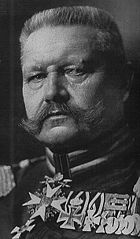
The causeway, which bears the Weimar Republic
Weimar Republic
The Weimar Republic is the name given by historians to the parliamentary republic established in 1919 in Germany to replace the imperial form of government...
Reichspräsident Paul von Hindenburg
Paul von Hindenburg
Paul Ludwig Hans Anton von Beneckendorff und von Hindenburg , known universally as Paul von Hindenburg was a Prussian-German field marshal, statesman, and politician, and served as the second President of Germany from 1925 to 1934....
's name, has interrupted the tidal flow
Tide
Tides are the rise and fall of sea levels caused by the combined effects of the gravitational forces exerted by the moon and the sun and the rotation of the Earth....
, which until the causeway's appearance had flowed freely between Sylt and the mainland. This change in tides, it is believed, is part of what has led to the loss of a certain amount of land at Sylt's southern end.
The causeway lies in the specially protected Zone I of the Schleswig-Holsteinisches Wattenmeer National Park
Wadden Sea National Parks
The Wadden Sea National Parks, part of a UNESCO World Heritage Site, are located along the German coast of the North Sea. Named after the Wadden Sea, they consist of three national parks:...
. Walks on the tidal flats are not allowed here, although they are quite popular elsewhere.
Situation before the causeway was built
After the Second War of SchleswigSecond War of Schleswig
The Second Schleswig War was the second military conflict as a result of the Schleswig-Holstein Question. It began on 1 February 1864, when Prussian forces crossed the border into Schleswig.Denmark fought Prussia and Austria...
in 1864, when Prussia
Prussia
Prussia was a German kingdom and historic state originating out of the Duchy of Prussia and the Margraviate of Brandenburg. For centuries, the House of Hohenzollern ruled Prussia, successfully expanding its size by way of an unusually well-organized and effective army. Prussia shaped the history...
took over Schleswig
Schleswig
Schleswig or South Jutland is a region covering the area about 60 km north and 70 km south of the border between Germany and Denmark; the territory has been divided between the two countries since 1920, with Northern Schleswig in Denmark and Southern Schleswig in Germany...
from Denmark
Denmark
Denmark is a Scandinavian country in Northern Europe. The countries of Denmark and Greenland, as well as the Faroe Islands, constitute the Kingdom of Denmark . It is the southernmost of the Nordic countries, southwest of Sweden and south of Norway, and bordered to the south by Germany. Denmark...
, Sylt and Westerland belonged to the new Tondern district. The seaside bathing town of Westerland gradually grew in popularity. The west coast railway already ran from Altona
Altona, Hamburg
Altona is the westernmost urban borough of the German city state of Hamburg, on the right bank of the Elbe river. From 1640 to 1864 Altona was under the administration of the Danish monarchy. Altona was an independent city until 1937...
by way of Husum and Niebüll to Tønder
Tønder
Tønder is a municipality in Region of Southern Denmark on the Jutland peninsula in south Denmark. The municipality covers an area of 1,278 km², and has a total population of 40,367...
(then also in Germany and called Tondern). From here, the tracks were extended to the port at the Hoyerschleuse, whence paddlesteamers ran to Munkmarsch harbour on Sylt.
The connection was at the tide's mercy, and in winter, the ice in the Wadden Sea
Wadden Sea
The Wadden Sea is an intertidal zone in the southeastern part of the North Sea. It lies between the coast of northwestern continental Europe and the range of Frisian Islands, forming a shallow body of water with tidal flats and wetlands. It is rich in biological diversity...
formed an impenetrable barrier. Already being planned at that time was a rail causeway from the mainland to Nösse on Sylt. The horrendous cost of such a project kept it shelved for quite a while, until Westerland was raised to town in 1905. Westerland's growing popularity as a seaside resort led in 1910 to serious official planning for the rail causeway.
World War I
World War I
World War I , which was predominantly called the World War or the Great War from its occurrence until 1939, and the First World War or World War I thereafter, was a major war centred in Europe that began on 28 July 1914 and lasted until 11 November 1918...
brought all planning to a stop. After the war, Germany was obliged to cede Tønder and the Hoyerschleuse to Denmark. Sylt remained part of Germany, but owing to the new border, the old route to Sylt was now cut off, except if travellers wanted to go to the trouble of obtaining a Danish visa
Visa (document)
A visa is a document showing that a person is authorized to enter the territory for which it was issued, subject to permission of an immigration official at the time of actual entry. The authorization may be a document, but more commonly it is a stamp endorsed in the applicant's passport...
to make a short trip through Danish territory.
Construction

Cofferdam
A cofferdam is a temporary enclosure built within, or in pairs across, a body of water and constructed to allow the enclosed area to be pumped out, creating a dry work environment for the major work to proceed...
was built to facilitate construction. One thousand to 1,500 workers were employed on the project. In the four years that it took to build the causeway, more than 3 million cubic metres of sand and clay were moved, and 120,000 tonnes of stones used.
Rail traffic
The auto-train terminal in NiebüllNiebüll
Niebüll is a town in the district of Nordfriesland, in Schleswig-Holstein, Germany. It is situated near the North Sea coast and the border with Denmark, approx. 35 km northwest of Husum.-International relations:...
is connected to the Autobahnen in Schleswig-Holstein by Federal Highways (Bundesstraße
Bundesstraße
Bundesstraße , abbreviated B, is the denotation for German and Austrian national highways.-Germany:...
n) B5 and B199.
On 3 September 2009, there was a fatal accident on the Hindenburgdamm when a squall
Squall
A squall is a sudden, sharp increase in wind speed which is usually associated with active weather, such as rain showers, thunderstorms, or heavy snow. Squalls refer to an increase in the sustained winds over a short time interval, as there may be higher gusts during a squall event...
blew a truck off a flatcar
Flatcar
A flatcar is a piece of railroad or railway rolling stock that consists of an open, flat deck on four or six wheels or a pair of trucks or bogies . The deck of the car can be wood or steel, and the sides of the deck can include pockets for stakes or tie-down points to secure loads...
in one of the auto-trains. The driver was thrown out of the truck and died at the accident scene.
Namesake
Future
Even though a few on Sylt may call for a road causeway instead of a railway link, it seems unlikely that Deutsche BahnDeutsche Bahn
Deutsche Bahn AG is the German national railway company, a private joint stock company . Headquartered in Berlin, it came into existence in 1994 as the successor to the former state railways of Germany, the Deutsche Bundesbahn of West Germany and the Deutsche Reichsbahn of East Germany...
will be willing to give this profitable line up.
A plan is under way to double-track the single-tracked stretch of the line. The work began in 2008 at the Lehnshallig crossover, and is expected to cost €100,000,000.