

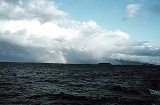
Squall

Encyclopedia
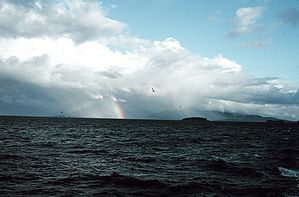
A squall is a sudden, sharp increase in wind speed which is usually associated with active weather, such as rain showers, thunderstorms, or heavy snow. Squalls refer to an increase in the sustained winds over a short time interval, as there may be higher gusts during a squall event. They usually occur in a region of strong mid-level height falls, or mid-level tropospheric cooling, which force strong localized upward motions at the leading edge of the region of cooling, which then enhances local downward motions just in its wake.
is considered obscure. It probably has its roots in the word skvala an Old Norse word meaning literally, to squeal.
(WMO) defined that to be classified as a squall, the wind must increase at least 8 m/s and must attain a top speed of at least 11 m/s, lasting at least one minute in duration. In Australia
, a squall is defined to last for several minutes before the wind returns to the long term mean value. In either case, a squall is defined to last about half as long as the definition of sustained wind in its respective country. Usually, this sudden violent wind is associated with briefly heavy precipitation.
.
, the term gully squall is used to describe strong increases of the wind forced through sharp mountain valleys on the Pacific Ocean
side of the isthmus.
of Bayamo.
, a squall is a short but furious rainstorm with strong winds, often small in area and moving at high speed, especially as a maritime term. Such a strong outflow occurring in fjords and inlets is referred to by mariners as a squamish
.
.
"Sumatra" squall is a term used in Singapore
and Peninsular Malaysia for squall line
s that form over the island of Sumatra
and move east across the Straits of Malacca. Gusts can reach up to 28 m/s (100 km/h)
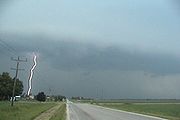
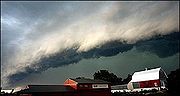 A squall line is an organized line of thunderstorm
s. It is classified as a multi-cell cluster, meaning a thunderstorm complex comprising many individual updrafts. They are also called multi-cell lines. Squalls are sometimes associated with hurricanes or other cyclone
s, but they can also occur independently. Most commonly, independent squalls occur along front lines
, and may contain heavy precipitation
, hail
, frequent lightning
, dangerous straight line winds, and possibly funnel cloud
s, tornado
es and waterspout
s. Squall lines require significant low-level warmth and humidity, a nearby frontal zone, and vertical wind shear
from an angle behind the frontal boundary. The strong winds at the surface are usually a reflection of dry air intruding into the line of storms, which when saturated, falls quickly to ground level due to its much higher density before it spreads out downwind. Significant squall lines with multiple bow echoes are known as derecho
s.
, including simplistic isolated thunderstorms unrelated to advancing cold fronts, to the more complex daytime/nocturnal Mesoscale Convective System
(MCS) and Mesoscale Convective Complex
(MCC), to squall line
thunderstorms.
.
Pressure perturbations within an extent of a thunderstorm are noteworthy. With buoyancy
rapid within the lower and mid-levels of a mature thunderstorm, one might believe that low pressure dominates in the mesoscale environment. However, this is not the case. With downdrafts ushering colder air from mid-levels, hitting ground and propagating away in all directions, high pressure is to be found widely at surface levels, usually indicative of strong (potentially damaging) winds.
 Wind shear
is an important aspect to measuring the potential of squall line severity and duration. In low to medium shear environments, mature thunderstorms will contribute modest amounts of downdrafts, enough to turn will aid in create a leading edge lifting mechanism - the gust front. In high shear environments created by opposing low level jet winds and synoptic winds, updrafts and consequential downdrafts can be much more intense (common in supercell mesocyclones). The cold air outflow
leaves the trailing area of the squall line to the mid-level jet, which aids in downdraft processes.
The leading area of a squall line is composed primarily of multiple updrafts, or singular regions of an updraft, rising from ground level to the highest extensions of the troposphere
, condensing water and building a dark, ominous cloud to one with a noticeable overshooting top and anvil (thanks to synoptic scale
winds). Because of the chaotic nature of updrafts and downdrafts, pressure perturbations are important.
As thunderstorms fill into a distinct line, strong leading-edge updrafts - occasionally visible to a ground observer in the form of a shelf cloud - may appear as an ominous sign of potential severe weather.
Beyond the strong winds because of updraft/downdraft behavior, heavy rain (and hail
) is another sign of a squall line. In the winter, squall lines can occur albeit less frequently - bringing heavy snow
and/or thunder
and lightning - usually over inland lakes (i.e. Great Lakes
region).
Following the initial passage of a squall line, light to moderate stratiform precipitation is also common. A Bow echo
is frequently seen on the northern and southern most reaches of squall line thunderstorms (via satellite imagery). This is where the northern and southern ends curl backwards towards the middle portions of the squall line
, making a "bow" shape. Bow echoes are frequently featured within supercell
mesoscale systems.
The northern end of the squall line is commonly referred to as the cyclonic end, with the southern side rotating anticyclonically. Because of the coriolis force, the northern end may evolve further, creating a "comma shaped" mesolow, or may continue in a squall-like pattern.
or lack of daytime heating) the squall line
or gust front associated with them may outrun the squall line itself and the synoptic scale area of low pressure may then infill, leading to a weakening of the cold front; essentially, the thunderstorm has exhausted its updrafts, becoming purely a downdraft dominated system. The areas of dissipating squall line thunderstorms may be regions of low CAPE
, low humidity
, insufficient wind shear, or poor synoptic dynamics (e.g. an upper level low filling) leading to frontolysis
.
From here, a general thinning of a squall line will occur: with winds decaying over time, outflow boundaries weakening updrafts substantially and clouds losing their thickness.
's gust front. From the time these low cloud features appear in the sky, one can expect a sudden increase in the wind in less than 15 minutes.
s normally have squalls coincident with spiral bands of greater curvature than many mid-latitude systems due to their smaller size. These squalls can harbor waterspouts and tornadoes due to the significant vertical wind shear
which exists in the vicinity of a tropical cyclone's outer bands.
s can be in the form of a snow squall.
Origin of the term
The word appears to be Nordic in origin, but its etymologyEtymology
Etymology is the study of the history of words, their origins, and how their form and meaning have changed over time.For languages with a long written history, etymologists make use of texts in these languages and texts about the languages to gather knowledge about how words were used during...
is considered obscure. It probably has its roots in the word skvala an Old Norse word meaning literally, to squeal.
Character of the wind
The term "squall" is universally used to refer to a sudden wind-speed increase, both historically and in the present day. In 1962 the World Meteorological OrganizationWorld Meteorological Organization
The World Meteorological Organization is an intergovernmental organization with a membership of 189 Member States and Territories. It originated from the International Meteorological Organization , which was founded in 1873...
(WMO) defined that to be classified as a squall, the wind must increase at least 8 m/s and must attain a top speed of at least 11 m/s, lasting at least one minute in duration. In Australia
Australia
Australia , officially the Commonwealth of Australia, is a country in the Southern Hemisphere comprising the mainland of the Australian continent, the island of Tasmania, and numerous smaller islands in the Indian and Pacific Oceans. It is the world's sixth-largest country by total area...
, a squall is defined to last for several minutes before the wind returns to the long term mean value. In either case, a squall is defined to last about half as long as the definition of sustained wind in its respective country. Usually, this sudden violent wind is associated with briefly heavy precipitation.
Argentina
Known locally as pamperos, they are used to describe strong downsloped winds that move across the pampas, eventually making it to the Atlantic OceanAtlantic Ocean
The Atlantic Ocean is the second-largest of the world's oceanic divisions. With a total area of about , it covers approximately 20% of the Earth's surface and about 26% of its water surface area...
.
Central America
Offshore Central AmericaCentral America
Central America is the central geographic region of the Americas. It is the southernmost, isthmian portion of the North American continent, which connects with South America on the southeast. When considered part of the unified continental model, it is considered a subcontinent...
, the term gully squall is used to describe strong increases of the wind forced through sharp mountain valleys on the Pacific Ocean
Pacific Ocean
The Pacific Ocean is the largest of the Earth's oceanic divisions. It extends from the Arctic in the north to the Southern Ocean in the south, bounded by Asia and Australia in the west, and the Americas in the east.At 165.2 million square kilometres in area, this largest division of the World...
side of the isthmus.
Cuba
Bayamo is a term used to describe squalls emanating from tropical thunderstorms near the BightBight (geography)
In geography, bight has two meanings. A bight can be simply a bend or curve in any geographical feature—usually a bend or curve in the line between land and water....
of Bayamo.
Pacific North-West (North America)
In the Pacific NorthwestPacific Northwest
The Pacific Northwest is a region in northwestern North America, bounded by the Pacific Ocean to the west and, loosely, by the Rocky Mountains on the east. Definitions of the region vary and there is no commonly agreed upon boundary, even among Pacific Northwesterners. A common concept of the...
, a squall is a short but furious rainstorm with strong winds, often small in area and moving at high speed, especially as a maritime term. Such a strong outflow occurring in fjords and inlets is referred to by mariners as a squamish
Squamish (wind)
A squamish is a strong and often violent wind occurring in many of the fjords, inlets and valleys of British Columbia. Squamishes occur in those fjords oriented in a northeast-southwest or east-west direction where cold polar air can be funneled westward, the opposite of how the wind generally...
.
South Africa
Bull's Eye Squall is a term used offshore South Africa, describing a squall forming in fair weather. It is named for the appearance of the small isolated cloud marking the top of the squall.Philippines (West Pacific)
In most parts of the country, squalls are called subasko characterized by heavy rains driven by blustery winds. Local fishermen at sea are often on the lookout for signs of impending squalls on the open water and rush to shore at its early hints.South-East Asia
Barat is a term for a northwest squall in Manado Bay in SulawesiSulawesi
Sulawesi is one of the four larger Sunda Islands of Indonesia and is situated between Borneo and the Maluku Islands. In Indonesia, only Sumatra, Borneo, and Papua are larger in territory, and only Java and Sumatra have larger Indonesian populations.- Etymology :The Portuguese were the first to...
.
"Sumatra" squall is a term used in Singapore
Singapore
Singapore , officially the Republic of Singapore, is a Southeast Asian city-state off the southern tip of the Malay Peninsula, north of the equator. An island country made up of 63 islands, it is separated from Malaysia by the Straits of Johor to its north and from Indonesia's Riau Islands by the...
and Peninsular Malaysia for squall line
Squall line
A squall line is a line of severe thunderstorms that can form along or ahead of a cold front. In the early 20th century, the term was used as a synonym for cold front. It contains heavy precipitation, hail, frequent lightning, strong straight-line winds, and possibly tornadoes and waterspouts....
s that form over the island of Sumatra
Sumatra
Sumatra is an island in western Indonesia, westernmost of the Sunda Islands. It is the largest island entirely in Indonesia , and the sixth largest island in the world at 473,481 km2 with a population of 50,365,538...
and move east across the Straits of Malacca. Gusts can reach up to 28 m/s (100 km/h)
Severe weather
Thunderstorm
A thunderstorm, also known as an electrical storm, a lightning storm, thundershower or simply a storm is a form of weather characterized by the presence of lightning and its acoustic effect on the Earth's atmosphere known as thunder. The meteorologically assigned cloud type associated with the...
s. It is classified as a multi-cell cluster, meaning a thunderstorm complex comprising many individual updrafts. They are also called multi-cell lines. Squalls are sometimes associated with hurricanes or other cyclone
Cyclone
In meteorology, a cyclone is an area of closed, circular fluid motion rotating in the same direction as the Earth. This is usually characterized by inward spiraling winds that rotate anticlockwise in the Northern Hemisphere and clockwise in the Southern Hemisphere of the Earth. Most large-scale...
s, but they can also occur independently. Most commonly, independent squalls occur along front lines
Weather front
A weather front is a boundary separating two masses of air of different densities, and is the principal cause of meteorological phenomena. In surface weather analyses, fronts are depicted using various colored lines and symbols, depending on the type of front...
, and may contain heavy precipitation
Precipitation (meteorology)
In meteorology, precipitation In meteorology, precipitation In meteorology, precipitation (also known as one of the classes of hydrometeors, which are atmospheric water phenomena is any product of the condensation of atmospheric water vapor that falls under gravity. The main forms of precipitation...
, hail
Hail
Hail is a form of solid precipitation. It consists of balls or irregular lumps of ice, each of which is referred to as a hail stone. Hail stones on Earth consist mostly of water ice and measure between and in diameter, with the larger stones coming from severe thunderstorms...
, frequent lightning
Lightning
Lightning is an atmospheric electrostatic discharge accompanied by thunder, which typically occurs during thunderstorms, and sometimes during volcanic eruptions or dust storms...
, dangerous straight line winds, and possibly funnel cloud
Funnel cloud
A funnel cloud is a funnel-shaped cloud of condensed water droplets, associated with a rotating column of wind and extending from the base of a cloud but not reaching the ground or a water surface. A funnel cloud is usually visible as a cone-shaped or needle like protuberance from the main cloud...
s, tornado
Tornado
A tornado is a violent, dangerous, rotating column of air that is in contact with both the surface of the earth and a cumulonimbus cloud or, in rare cases, the base of a cumulus cloud. They are often referred to as a twister or a cyclone, although the word cyclone is used in meteorology in a wider...
es and waterspout
Waterspout
A waterspout is an intense columnar vortex that occurs over a body of water and is connected to a cumuliform cloud. In the common form, it is a non-supercell tornado over water. While it is often weaker than most of its land counterparts, stronger versions spawned by mesocyclones do occur...
s. Squall lines require significant low-level warmth and humidity, a nearby frontal zone, and vertical wind shear
Wind shear
Wind shear, sometimes referred to as windshear or wind gradient, is a difference in wind speed and direction over a relatively short distance in the atmosphere...
from an angle behind the frontal boundary. The strong winds at the surface are usually a reflection of dry air intruding into the line of storms, which when saturated, falls quickly to ground level due to its much higher density before it spreads out downwind. Significant squall lines with multiple bow echoes are known as derecho
Derecho
A derecho is a widespread and long-lived, violent convectively induced straight-line windstorm that is associated with a fast-moving band of severe thunderstorms in the form of a squall line usually taking the form of a bow echo...
s.
Squall line life cycle
There are several forms of mesoscale meteorologyMesoscale meteorology
Mesoscale meteorology is the study of weather systems smaller than synoptic scale systems but larger than microscale and storm-scale cumulus systems. Horizontal dimensions generally range from around 5 kilometers to several hundred kilometers...
, including simplistic isolated thunderstorms unrelated to advancing cold fronts, to the more complex daytime/nocturnal Mesoscale Convective System
Mesoscale Convective System
A mesoscale convective system is a complex of thunderstorms that becomes organized on a scale larger than the individual thunderstorms but smaller than extratropical cyclones, and normally persists for several hours or more...
(MCS) and Mesoscale Convective Complex
Mesoscale Convective Complex
A mesoscale convective complex is a unique kind of mesoscale convective system which is defined by characteristics observed in infrared satellite imagery. They are long-lived, nocturnal in formation and commonly contain heavy rainfall, wind, hail, lightning and possibly tornadoes.-Size:A...
(MCC), to squall line
Squall line
A squall line is a line of severe thunderstorms that can form along or ahead of a cold front. In the early 20th century, the term was used as a synonym for cold front. It contains heavy precipitation, hail, frequent lightning, strong straight-line winds, and possibly tornadoes and waterspouts....
thunderstorms.
Formation
The main driving force behind squall line creation is attributed to the process of in-filling of multiple thunderstorms and/or a single area of thunderstorms expanding outward within the leading space of an advancing cold frontCold front
A cold front is defined as the leading edge of a cooler mass of air, replacing a warmer mass of air.-Development of cold front:The cooler and denser air wedges under the less-dense warmer air, lifting it...
.
Pressure perturbations
Pressure perturbations within an extent of a thunderstorm are noteworthy. With buoyancy
Buoyancy
In physics, buoyancy is a force exerted by a fluid that opposes an object's weight. In a column of fluid, pressure increases with depth as a result of the weight of the overlying fluid. Thus a column of fluid, or an object submerged in the fluid, experiences greater pressure at the bottom of the...
rapid within the lower and mid-levels of a mature thunderstorm, one might believe that low pressure dominates in the mesoscale environment. However, this is not the case. With downdrafts ushering colder air from mid-levels, hitting ground and propagating away in all directions, high pressure is to be found widely at surface levels, usually indicative of strong (potentially damaging) winds.
Wind shear
Wind shear
Wind shear, sometimes referred to as windshear or wind gradient, is a difference in wind speed and direction over a relatively short distance in the atmosphere...
is an important aspect to measuring the potential of squall line severity and duration. In low to medium shear environments, mature thunderstorms will contribute modest amounts of downdrafts, enough to turn will aid in create a leading edge lifting mechanism - the gust front. In high shear environments created by opposing low level jet winds and synoptic winds, updrafts and consequential downdrafts can be much more intense (common in supercell mesocyclones). The cold air outflow
Outflow (meteorology)
Outflow, in meteorology, is air that flows outwards from a storm system. It is associated with ridging, or anticyclonic flow. In the low levels of the troposphere, outflow radiates from thunderstorms in the form of a wedge of rain-cooled air, which is visible as a thin rope-like cloud on weather...
leaves the trailing area of the squall line to the mid-level jet, which aids in downdraft processes.
Updrafts
The leading area of a squall line is composed primarily of multiple updrafts, or singular regions of an updraft, rising from ground level to the highest extensions of the troposphere
Troposphere
The troposphere is the lowest portion of Earth's atmosphere. It contains approximately 80% of the atmosphere's mass and 99% of its water vapor and aerosols....
, condensing water and building a dark, ominous cloud to one with a noticeable overshooting top and anvil (thanks to synoptic scale
Synoptic scale meteorology
The synoptic scale in meteorology is a horizontal length scale of the order of 1000 kilometres or more. This corresponds to a horizontal scale typical of mid-latitude depressions...
winds). Because of the chaotic nature of updrafts and downdrafts, pressure perturbations are important.
As thunderstorms fill into a distinct line, strong leading-edge updrafts - occasionally visible to a ground observer in the form of a shelf cloud - may appear as an ominous sign of potential severe weather.
Beyond the strong winds because of updraft/downdraft behavior, heavy rain (and hail
Hail
Hail is a form of solid precipitation. It consists of balls or irregular lumps of ice, each of which is referred to as a hail stone. Hail stones on Earth consist mostly of water ice and measure between and in diameter, with the larger stones coming from severe thunderstorms...
) is another sign of a squall line. In the winter, squall lines can occur albeit less frequently - bringing heavy snow
Snow
Snow is a form of precipitation within the Earth's atmosphere in the form of crystalline water ice, consisting of a multitude of snowflakes that fall from clouds. Since snow is composed of small ice particles, it is a granular material. It has an open and therefore soft structure, unless packed by...
and/or thunder
Thunder
Thunder is the sound made by lightning. Depending on the nature of the lightning and distance of the listener, thunder can range from a sharp, loud crack to a long, low rumble . The sudden increase in pressure and temperature from lightning produces rapid expansion of the air surrounding and within...
and lightning - usually over inland lakes (i.e. Great Lakes
Great Lakes
The Great Lakes are a collection of freshwater lakes located in northeastern North America, on the Canada – United States border. Consisting of Lakes Superior, Michigan, Huron, Erie, and Ontario, they form the largest group of freshwater lakes on Earth by total surface, coming in second by volume...
region).
Bow echoes
Following the initial passage of a squall line, light to moderate stratiform precipitation is also common. A Bow echo
Bow echo
A bow echo is a term describing the characteristic radar return from a mesoscale convective system that is shaped like an archer’s bow. These systems can produce severe straight-line winds and occasionally tornadoes, causing major damage.-Research:...
is frequently seen on the northern and southern most reaches of squall line thunderstorms (via satellite imagery). This is where the northern and southern ends curl backwards towards the middle portions of the squall line
Squall line
A squall line is a line of severe thunderstorms that can form along or ahead of a cold front. In the early 20th century, the term was used as a synonym for cold front. It contains heavy precipitation, hail, frequent lightning, strong straight-line winds, and possibly tornadoes and waterspouts....
, making a "bow" shape. Bow echoes are frequently featured within supercell
Supercell
A supercell is a thunderstorm that is characterized by the presence of a mesocyclone: a deep, continuously-rotating updraft. For this reason, these storms are sometimes referred to as rotating thunderstorms...
mesoscale systems.
Mesolow
The northern end of the squall line is commonly referred to as the cyclonic end, with the southern side rotating anticyclonically. Because of the coriolis force, the northern end may evolve further, creating a "comma shaped" mesolow, or may continue in a squall-like pattern.
Dissipation
As supercells and multi-cell thunderstorms dissipate due to a weak shear force or poor lifting mechanisms, (e.g. considerable terrainTerrain
Terrain, or land relief, is the vertical and horizontal dimension of land surface. When relief is described underwater, the term bathymetry is used...
or lack of daytime heating) the squall line
Squall line
A squall line is a line of severe thunderstorms that can form along or ahead of a cold front. In the early 20th century, the term was used as a synonym for cold front. It contains heavy precipitation, hail, frequent lightning, strong straight-line winds, and possibly tornadoes and waterspouts....
or gust front associated with them may outrun the squall line itself and the synoptic scale area of low pressure may then infill, leading to a weakening of the cold front; essentially, the thunderstorm has exhausted its updrafts, becoming purely a downdraft dominated system. The areas of dissipating squall line thunderstorms may be regions of low CAPE
Convective available potential energy
In meteorology, convective available potential energy , sometimes, simply, available potential energy , is the amount of energy a parcel of air would have if lifted a certain distance vertically through the atmosphere...
, low humidity
Humidity
Humidity is a term for the amount of water vapor in the air, and can refer to any one of several measurements of humidity. Formally, humid air is not "moist air" but a mixture of water vapor and other constituents of air, and humidity is defined in terms of the water content of this mixture,...
, insufficient wind shear, or poor synoptic dynamics (e.g. an upper level low filling) leading to frontolysis
Frontolysis
Frontolysis - in meteorology, is the dissipation or weakening of an atmospheric front.In contrary to areas of "Frontogenesis", the areas where air masses diverge are called areas of frontolysis. Siberia and Canada are examples of areas of frontolysis...
.
From here, a general thinning of a squall line will occur: with winds decaying over time, outflow boundaries weakening updrafts substantially and clouds losing their thickness.
Signs in the sky
Shelf clouds and roll clouds are usually seen above the leading edge of a squall, also known as a thunderstormThunderstorm
A thunderstorm, also known as an electrical storm, a lightning storm, thundershower or simply a storm is a form of weather characterized by the presence of lightning and its acoustic effect on the Earth's atmosphere known as thunder. The meteorologically assigned cloud type associated with the...
's gust front. From the time these low cloud features appear in the sky, one can expect a sudden increase in the wind in less than 15 minutes.
Tropical cyclones
Tropical cycloneTropical cyclone
A tropical cyclone is a storm system characterized by a large low-pressure center and numerous thunderstorms that produce strong winds and heavy rain. Tropical cyclones strengthen when water evaporated from the ocean is released as the saturated air rises, resulting in condensation of water vapor...
s normally have squalls coincident with spiral bands of greater curvature than many mid-latitude systems due to their smaller size. These squalls can harbor waterspouts and tornadoes due to the significant vertical wind shear
Wind shear
Wind shear, sometimes referred to as windshear or wind gradient, is a difference in wind speed and direction over a relatively short distance in the atmosphere...
which exists in the vicinity of a tropical cyclone's outer bands.
Winter weather
Snow squalls can be spawned by an intrusion of cold air aloft over a relatively warm surface layer. Lake effect snowLake effect snow
Lake-effect snow is produced during cooler atmospheric conditions when cold winds move across long expanses of warmer lake water, providing energy and picking up water vapor which freezes and is deposited on the leeward shores...
s can be in the form of a snow squall.