

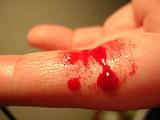
Bleeding

Encyclopedia
Bleeding, technically known as hemorrhaging or haemorrhaging (see American and British spelling differences) is the loss of blood
or blood escape from the circulatory system
. Bleeding can occur internally, where blood leaks from blood vessel
s inside the body or externally, either through a natural opening such as the vagina
, mouth, nose
, ear
or anus
, or through a break in the skin
.
Desanguination is a massive blood loss, and the complete loss of blood is referred to as exsanguination
. Typically, a healthy person can endure a loss of 10–15% of the total blood volume without serious medical difficulties
, and blood donation
typically takes 8–10% of the donor's blood volume.

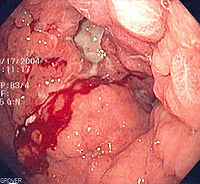
(ATLS).
This system is basically the same as used in the staging of hypovolemic shock
.
Individuals in excellent physical and cardiovascular shape may have more effective compensatory mechanisms before experiencing cardiovascular collapse. These patients may look deceptively stable, with minimal derangements in vital signs, while having poor peripheral perfusion. Elderly patients or those with chronic medical conditions may have less tolerance to blood loss, less ability to compensate, and may take medications such as betablockers that can potentially blunt the cardiovascular response. Care must be taken in the assessment of these patients.
made a standardized grading scale to measure the severity of bleeding.
s which may cause traumatic bleeding. These include:
The pattern of injury, evaluation and treatment will vary with the mechanism of the injury. Blunt trauma causes injury via a shock effect; delivering energy over an area. Wounds are often not straight and unbroken skin may hide significant injury. Penetrating trauma follows the course of the injurious device. As the energy is applied in a more focused fashion, it requires less energy to cause significant injury. Any body organ, including bone and brain, can be injured and bleed. Bleeding may not be readily apparent; internal organs such as the liver, kidney and spleen may bleed into the abdominal cavity. The only apparent signs may come with blood loss. Bleeding from a bodily orifice, such as the rectum, nose, ears may signal internal bleeding, but cannot be relied upon. Bleeding from a medical procedure
also falls into this category.
s as a result of 3 basic patterns of injury:
The underlying scientific basis for blood clotting and hemostasis is discussed in detail in the articles, Coagulation, hemostasis
and related articles. The discussion here is limited to the common practical aspects of blood clot formation which manifest as bleeding.
Certain medical conditions can also make patients susceptible to bleeding. These are conditions that affect the normal "hemostatic" functions of the body. Hemostasis
involves several components. The main components of the hemostatic system include platelets and the coagulation system.
Platelets are small blood components that form a plug in the blood vessel wall that stops bleeding. Platelets also produce a variety of substances that stimulate the production of a blood clot. One of the most common causes of increased bleeding risk is exposure to non-steroidal anti-inflammatory drugs (or "NSAIDs"). The prototype for these drugs is aspirin, which inhibits the production of thromboxane. NSAIDs inhibit the activation of platelets, and thereby increase the risk of bleeding. The effect of aspirin is irreversible; therefore, the inhibitory effect of aspirin is present until the platelets have been replaced (about ten days). Other NSAIDs, such as "ibuprofen" (Motrin) and related drugs, are reversible and therefore, the effect on platelets is not as long-lived.
There are several named coagulation factors that interact in a complex way to form blood clots, as discussed in the article on coagulation
. Deficiencies of coagulation factors are associated with clinical bleeding. For instance, deficiency of Factor VIII causes classic Hemophilia A while deficiencies of Factor IX cause "Christmas disease"(hemophilia B). Antibodies to Factor VIII can also inactivate the Factor VII and precipitate bleeding that is very difficult to control. This is a rare condition that is most likely to occur in older patients and in those with autoimmune diseases. von Willebrand disease
is another common bleeding disorder. It is caused by a deficiency of or abnormal function of the "von Willebrand" factor, which is involved in platelet activation. Deficiencies in other factors, such as factor XIII or factor VII are occasionally seen, but may not be associated with severe bleeding and are not as commonly diagnosed.
In addition to NSAID-related bleeding, another common cause of bleeding is that related to the medication, warfarin
("Coumadin" and others). This medication needs to be closely monitored as the bleeding risk can be markedly increased by interactions with other medications. Warfarin acts by inhibiting the production of Vitamin K
in the gut. Vitamin K is required for the production of the clotting factors, II, VII, IX, and X in the liver. One of the most common causes of warfarin-related bleeding is taking antibiotics. The gut bacteria make vitamin K and are killed by antibiotics. This decreases vitamin K levels and therefore the production of these clotting factors.
Deficiencies of platelet function may require platelet transfusion while deficiencies of clotting factors may require transfusion of either fresh frozen plasma
or specific clotting factors, such as Factor VIII
for patients with hemophilia.
Blood
Blood is a specialized bodily fluid in animals that delivers necessary substances such as nutrients and oxygen to the cells and transports metabolic waste products away from those same cells....
or blood escape from the circulatory system
Circulatory system
The circulatory system is an organ system that passes nutrients , gases, hormones, blood cells, etc...
. Bleeding can occur internally, where blood leaks from blood vessel
Blood vessel
The blood vessels are the part of the circulatory system that transports blood throughout the body. There are three major types of blood vessels: the arteries, which carry the blood away from the heart; the capillaries, which enable the actual exchange of water and chemicals between the blood and...
s inside the body or externally, either through a natural opening such as the vagina
Vagina
The vagina is a fibromuscular tubular tract leading from the uterus to the exterior of the body in female placental mammals and marsupials, or to the cloaca in female birds, monotremes, and some reptiles. Female insects and other invertebrates also have a vagina, which is the terminal part of the...
, mouth, nose
Human nose
The visible part of the human nose is the protruding part of the face that bears the nostrils. The shape of the nose is determined by the ethmoid bone and the nasal septum, which consists mostly of cartilage and which separates the nostrils...
, ear
Ear
The ear is the organ that detects sound. It not only receives sound, but also aids in balance and body position. The ear is part of the auditory system....
or anus
Anus
The anus is an opening at the opposite end of an animal's digestive tract from the mouth. Its function is to control the expulsion of feces, unwanted semi-solid matter produced during digestion, which, depending on the type of animal, may be one or more of: matter which the animal cannot digest,...
, or through a break in the skin
Human skin
The human skin is the outer covering of the body. In humans, it is the largest organ of the integumentary system. The skin has multiple layers of ectodermal tissue and guards the underlying muscles, bones, ligaments and internal organs. Human skin is similar to that of most other mammals,...
.
Desanguination is a massive blood loss, and the complete loss of blood is referred to as exsanguination
Exsanguination
Exsanguination is the fatal process of hypovolemia , to a degree sufficient enough to cause death. One does not have to lose literally all of one's blood to cause death...
. Typically, a healthy person can endure a loss of 10–15% of the total blood volume without serious medical difficulties
Sequela
A sequela) is a pathological condition resulting from a disease, injury, or other trauma.Chronic kidney disease, for example, is sometimes a sequela of diabetes, and neck pain is a common sequela of whiplash or other trauma to the cervical vertebrae. Post-traumatic stress disorder may be a...
, and blood donation
Blood donation
A blood donation occurs when a person voluntarily has blood drawn and used for transfusions or made into medications by a process called fractionation....
typically takes 8–10% of the donor's blood volume.
Classification
Blood loss
Hemorrhaging is broken down into four classes by the American College of Surgeons' Advanced Trauma Life SupportAdvanced Trauma Life Support
Advanced Trauma Life Support is a training program for medical doctors in the management of acute trauma cases, developed by the American College of Surgeons. Similar programs exist for nurses and paramedics...
(ATLS).
- Class I Hemorrhage involves up to 15% of blood volume. There is typically no change in vital signs and fluid resuscitation is not usually necessary.
- Class II Hemorrhage involves 15-30% of total blood volume. A patient is often tachycardic (rapid heart beat) with a narrowing of the difference between the systolic and diastolic blood pressures. The body attempts to compensate with peripheral vasoconstriction. Skin may start to look pale and be cool to the touch. The patient may exhibit slight changes in behavior. Volume resuscitation with crystalloids (Saline solutionSaline (medicine)In medicine, saline is a general term referring to a sterile solution of sodium chloride in water but is only sterile when it is to be placed intravenously, otherwise, a saline solution is a salt water solution...
or Lactated Ringer's solutionLactated Ringer's solutionLactated Ringer's solution is a solution that is isotonic with blood and intended for intravenous administration. It may also be given subcutaneously....
) is all that is typically required. Blood transfusionBlood transfusionBlood transfusion is the process of receiving blood products into one's circulation intravenously. Transfusions are used in a variety of medical conditions to replace lost components of the blood...
is not typically required. - Class III Hemorrhage involves loss of 30-40% of circulating blood volume. The patient's blood pressureBlood pressureBlood pressure is the pressure exerted by circulating blood upon the walls of blood vessels, and is one of the principal vital signs. When used without further specification, "blood pressure" usually refers to the arterial pressure of the systemic circulation. During each heartbeat, BP varies...
drops, the heart rateHeart rateHeart rate is the number of heartbeats per unit of time, typically expressed as beats per minute . Heart rate can vary as the body's need to absorb oxygen and excrete carbon dioxide changes, such as during exercise or sleep....
increases, peripheral hypoperfusion (shock), such as capillary refillCapillary refillCapillary refill is the rate at which blood refills empty capillaries. It can be measured by holding a hand higher than heart-level , pressing the soft pad of a finger or toe until it turns white, and taking note of the time needed for the color to return once pressure is released. Normal refill...
worsens, and the mental status worsens. Fluid resuscitation with crystalloid and blood transfusion are usually necessary. - Class IV Hemorrhage involves loss of >40% of circulating blood volume. The limit of the body's compensation is reached and aggressive resuscitation is required to prevent death.
This system is basically the same as used in the staging of hypovolemic shock
Hypovolemia
In physiology and medicine, hypovolemia is a state of decreased blood volume; more specifically, decrease in volume of blood plasma...
.
Individuals in excellent physical and cardiovascular shape may have more effective compensatory mechanisms before experiencing cardiovascular collapse. These patients may look deceptively stable, with minimal derangements in vital signs, while having poor peripheral perfusion. Elderly patients or those with chronic medical conditions may have less tolerance to blood loss, less ability to compensate, and may take medications such as betablockers that can potentially blunt the cardiovascular response. Care must be taken in the assessment of these patients.
World Health Organization
The World Health OrganizationWorld Health Organization
The World Health Organization is a specialized agency of the United Nations that acts as a coordinating authority on international public health. Established on 7 April 1948, with headquarters in Geneva, Switzerland, the agency inherited the mandate and resources of its predecessor, the Health...
made a standardized grading scale to measure the severity of bleeding.
| Grade 0 | no bleeding |
| Grade 1 | petechial bleeding; |
| Grade 2 | mild blood loss (clinically significant); |
| Grade 3 | gross blood loss, requires transfusion (severe); |
| Grade 4 | debilitating blood loss, retinal or cerebral associated with fatality |
Origin
- Mouth
- HematemesisHematemesisHematemesis or haematemesis is the vomiting of blood. The source is generally the upper gastrointestinal tract. Patients can easily confuse it with hemoptysis , although the latter is more common.-Signs:...
- vomiting fresh blood - HemoptysisHemoptysisHemoptysis or haemoptysis is the expectoration of blood or of blood-stained sputum from the bronchi, larynx, trachea, or lungs Hemoptysis or haemoptysis is the expectoration (coughing up) of blood or of blood-stained sputum from the bronchi, larynx, trachea, or lungs Hemoptysis or haemoptysis ...
- coughing up blood from the lungs
- Hematemesis
- HematocheziaHematocheziaHematochezia is the passage of fresh blood per anus, usually in or with stools . Hematochezia is commonly associated with lower gastrointestinal bleeding, but may also occur from a brisk upper GI bleed...
- rectal blood - HematuriaHematuriaIn medicine, hematuria, or haematuria, is the presence of red blood cells in the urine. It may be idiopathic and/or benign, or it can be a sign that there is a kidney stone or a tumor in the urinary tract , ranging from trivial to lethal...
- blood in the urine from urinary bleeding - Upper head
- Intracranial hemorrhageIntracranial hemorrhageAn intracranial hemorrhage is a hemorrhage, or bleeding, within the skull.-Causes:Intracranial bleeding occurs when a blood vessel within the skull is ruptured or leaks. It can result from physical trauma or nontraumatic causes such as a ruptured aneurysm...
- bleeding in the skull. - Cerebral hemorrhage - a type of intracranial hemorrhage, bleeding within the brain tissue itself.
- Intracerebral hemorrhage - bleeding in the brain caused by the rupture of a blood vessel within the head. See also hemorrhagic stroke.
- Subarachnoid hemorrhageSubarachnoid hemorrhageA subarachnoid hemorrhage , or subarachnoid haemorrhage in British English, is bleeding into the subarachnoid space—the area between the arachnoid membrane and the pia mater surrounding the brain...
(SAH) implies the presence of blood within the subarachnoid spaceSubarachnoid spaceIn the central nervous system, the subarachnoid cavity is the interval between the arachnoid membrane and pia mater....
from some pathologic process. The common medical use of the term SAH refers to the nontraumatic types of hemorrhages, usually from rupture of a berry aneurysm or arteriovenous malformationArteriovenous malformationArteriovenous malformation or AVM is an abnormal connection between veins and arteries, usually congenital. This pathology is widely known because of its occurrence in the central nervous system, but can appear in any location. An arteriovenous malformation is a vascular anomaly. It is a...
(AVM). The scope of this article is limited to these nontraumatic hemorrhages.
- Intracranial hemorrhage
- Lung
- Pulmonary hemorrhagePulmonary hemorrhagePulmonary hemorrhage is an acute bleeding from the lung, especially in the upper respiratory tract and the endotracheal tube. When evident clinically, the condition is usually massive, associated with bleeding in other sites as well as more than one third of the lungs...
- Pulmonary hemorrhage
- Gynecologic
- Vaginal bleedingVaginal bleedingVaginal bleeding refers to bleeding in females that is either a physiologic response during the non-conceptional menstrual cycle or caused by hormonal or organic problems of the reproductive system. Vaginal bleeding may occur at any age, but always needs investigation when encountered in female...
- Postpartum hemorrhagePostpartum hemorrhageHemorrhage after delivery, or postpartum hemorrhage, is the loss of greater than 500 ml of blood following vaginal delivery, or 1000 ml of blood following cesarean section...
- Breakthrough bleedingBreakthrough bleedingBreakthrough bleeding is an abnormal uterine bleeding that occurs between menstrual periods, especially due to irregular sloughing of the endometrium in women on combined oral contraceptives...
- Postpartum hemorrhage
- Ovarian bleeding. This is a potentially catastrophic and not so rare complication among lean patients with polycystic ovary syndromePolycystic ovary syndromePolycystic ovary syndrome is one of the most common female endocrine disorders. PCOS is a complex, heterogeneous disorder of uncertain aetiology, but there is strong evidence that it can to a large degree be classified as a genetic disease....
undergoing transvaginal oocyte retrievalTransvaginal oocyte retrievalTransvaginal oocyte retrieval , also referred to as oocyte retrieval or even simply egg collection, is a technique used in in vitro fertilization in order to remove oocytes from the ovary of the female, enabling fertilization outside the body...
.
- Vaginal bleeding
- Upper gastrointestinal bleed
Causes
Bleeding arises due to either traumatic injury, underlying medical condition, or a combination.Traumatic Injury
Traumatic bleeding is caused by some type of injury. There are different types of woundWound
A wound is a type of injury in which skin is torn, cut or punctured , or where blunt force trauma causes a contusion . In pathology, it specifically refers to a sharp injury which damages the dermis of the skin.-Open:...
s which may cause traumatic bleeding. These include:
- Abrasion - Also called a graze, this is caused by transverse action of a foreign object against the skin, and usually does not penetrate below the epidermis
- Excoriation - In common with Abrasion, this is caused by mechanical destruction of the skin, although it usually has an underlying medical cause
- HematomaHematomaA hematoma, or haematoma, is a localized collection of blood outside the blood vessels, usually in liquid form within the tissue. This distinguishes it from an ecchymosis, which is the spread of blood under the skin in a thin layer, commonly called a bruise...
- Caused by damage to a blood vessel that in turn causes blood to collect under the skin. - Laceration - Irregular wound caused by blunt impact to soft tissue overlying hard tissue or tearing such as in childbirth. In some instances, this can also be used to describe an incision.
- Incision - A cut into a body tissue or organ, such as by a scalpelScalpelA scalpel, or lancet, is a small and extremely sharp bladed instrument used for surgery, anatomical dissection, and various arts and crafts . Scalpels may be single-use disposable or re-usable. Re-usable scalpels can have attached, resharpenable blades or, more commonly, non-attached, replaceable...
, made during surgery. - Puncture WoundWoundA wound is a type of injury in which skin is torn, cut or punctured , or where blunt force trauma causes a contusion . In pathology, it specifically refers to a sharp injury which damages the dermis of the skin.-Open:...
- Caused by an object that penetrated the skin and underlying layers, such as a nail, needle or knife - ContusionBruiseA bruise, also called a contusion, is a type of relatively minor hematoma of tissue in which capillaries and sometimes venules are damaged by trauma, allowing blood to seep into the surrounding interstitial tissues. Bruises can involve capillaries at the level of skin, subcutaneous tissue, muscle,...
- Also known as a bruise, this is a blunt trauma damaging tissue under the surface of the skin - Crushing Injuries - Caused by a great or extreme amount of force applied over a period of time. The extent of a crushing injury may not immediately present itself.
- Ballistic TraumaBallistic traumaThe term ballistic trauma refers to a form of physical trauma sustained from the discharge of arms or munitions. The most common forms of ballistic trauma stem from firearms used in armed conflicts, civilian sporting and recreational pursuits, and criminal activity.-Destructive effects:The degree...
- Caused by a projectile weapon, this may include two external wounds (entry and exit) and a contiguous wound between the two
The pattern of injury, evaluation and treatment will vary with the mechanism of the injury. Blunt trauma causes injury via a shock effect; delivering energy over an area. Wounds are often not straight and unbroken skin may hide significant injury. Penetrating trauma follows the course of the injurious device. As the energy is applied in a more focused fashion, it requires less energy to cause significant injury. Any body organ, including bone and brain, can be injured and bleed. Bleeding may not be readily apparent; internal organs such as the liver, kidney and spleen may bleed into the abdominal cavity. The only apparent signs may come with blood loss. Bleeding from a bodily orifice, such as the rectum, nose, ears may signal internal bleeding, but cannot be relied upon. Bleeding from a medical procedure
Medical procedure
A medical procedure is a course of action intended to achieve a result in the care of persons with health problems.A medical procedure with the intention of determining, measuring or diagnosing a patient condition or parameter is also called a medical test...
also falls into this category.
Medical Condition
'Medical bleeding' denotes hemorrhage as a result of an underlying medical condition (i.e. causes of bleeding that are not directly due to trauma). Blood can escape from blood vesselBlood vessel
The blood vessels are the part of the circulatory system that transports blood throughout the body. There are three major types of blood vessels: the arteries, which carry the blood away from the heart; the capillaries, which enable the actual exchange of water and chemicals between the blood and...
s as a result of 3 basic patterns of injury:
- Intravascular changesBloodBlood is a specialized bodily fluid in animals that delivers necessary substances such as nutrients and oxygen to the cells and transports metabolic waste products away from those same cells....
- changes of the blood within vessels (e.g. ↑ blood pressureBlood pressureBlood pressure is the pressure exerted by circulating blood upon the walls of blood vessels, and is one of the principal vital signs. When used without further specification, "blood pressure" usually refers to the arterial pressure of the systemic circulation. During each heartbeat, BP varies...
, ↓ clotting factors) - Intramural changesBlood vesselThe blood vessels are the part of the circulatory system that transports blood throughout the body. There are three major types of blood vessels: the arteries, which carry the blood away from the heart; the capillaries, which enable the actual exchange of water and chemicals between the blood and...
- changes arising within the walls of blood vessels (e.g. aneurysms, dissectionsAortic dissectionAortic dissection occurs when a tear in the inner wall of the aorta causes blood to flow between the layers of the wall of the aorta and force the layers apart. The dissection typically extends anterograde, but can extend retrograde from the site of the intimal tear. Aortic dissection is a medical...
, AVMsArteriovenous malformationArteriovenous malformation or AVM is an abnormal connection between veins and arteries, usually congenital. This pathology is widely known because of its occurrence in the central nervous system, but can appear in any location. An arteriovenous malformation is a vascular anomaly. It is a...
, vasculitides) - Extravascular changes - changes arising outside blood vessels (e.g. H pyloriHelicobacter pyloriHelicobacter pylori , previously named Campylobacter pyloridis, is a Gram-negative, microaerophilic bacterium found in the stomach. It was identified in 1982 by Barry Marshall and Robin Warren, who found that it was present in patients with chronic gastritis and gastric ulcers, conditions that were...
infection, brain abscessBrain abscessBrain abscess is an abscess caused by inflammation and collection of infected material, coming from local or remote infectious sources, within the brain tissue...
, brain tumorBrain tumorA brain tumor is an intracranial solid neoplasm, a tumor within the brain or the central spinal canal.Brain tumors include all tumors inside the cranium or in the central spinal canal...
)
The underlying scientific basis for blood clotting and hemostasis is discussed in detail in the articles, Coagulation, hemostasis
Hemostasis
Hemostasis or haemostasis is a process which causes bleeding to stop, meaning to keep blood within a damaged blood vessel . Most of the time this includes blood changing from a liquid to a solid state. Intact blood vessels are central to moderating blood's tendency to clot...
and related articles. The discussion here is limited to the common practical aspects of blood clot formation which manifest as bleeding.
Certain medical conditions can also make patients susceptible to bleeding. These are conditions that affect the normal "hemostatic" functions of the body. Hemostasis
Hemostasis
Hemostasis or haemostasis is a process which causes bleeding to stop, meaning to keep blood within a damaged blood vessel . Most of the time this includes blood changing from a liquid to a solid state. Intact blood vessels are central to moderating blood's tendency to clot...
involves several components. The main components of the hemostatic system include platelets and the coagulation system.
Platelets are small blood components that form a plug in the blood vessel wall that stops bleeding. Platelets also produce a variety of substances that stimulate the production of a blood clot. One of the most common causes of increased bleeding risk is exposure to non-steroidal anti-inflammatory drugs (or "NSAIDs"). The prototype for these drugs is aspirin, which inhibits the production of thromboxane. NSAIDs inhibit the activation of platelets, and thereby increase the risk of bleeding. The effect of aspirin is irreversible; therefore, the inhibitory effect of aspirin is present until the platelets have been replaced (about ten days). Other NSAIDs, such as "ibuprofen" (Motrin) and related drugs, are reversible and therefore, the effect on platelets is not as long-lived.
There are several named coagulation factors that interact in a complex way to form blood clots, as discussed in the article on coagulation
Coagulation
Coagulation is a complex process by which blood forms clots. It is an important part of hemostasis, the cessation of blood loss from a damaged vessel, wherein a damaged blood vessel wall is covered by a platelet and fibrin-containing clot to stop bleeding and begin repair of the damaged vessel...
. Deficiencies of coagulation factors are associated with clinical bleeding. For instance, deficiency of Factor VIII causes classic Hemophilia A while deficiencies of Factor IX cause "Christmas disease"(hemophilia B). Antibodies to Factor VIII can also inactivate the Factor VII and precipitate bleeding that is very difficult to control. This is a rare condition that is most likely to occur in older patients and in those with autoimmune diseases. von Willebrand disease
Von Willebrand disease
von Willebrand disease is the most common hereditary coagulation abnormality described in humans, although it can also be acquired as a result of other medical conditions. It arises from a qualitative or quantitative deficiency of von Willebrand factor , a multimeric protein that is required for...
is another common bleeding disorder. It is caused by a deficiency of or abnormal function of the "von Willebrand" factor, which is involved in platelet activation. Deficiencies in other factors, such as factor XIII or factor VII are occasionally seen, but may not be associated with severe bleeding and are not as commonly diagnosed.
In addition to NSAID-related bleeding, another common cause of bleeding is that related to the medication, warfarin
Warfarin
Warfarin is an anticoagulant. It is most likely to be the drug popularly referred to as a "blood thinner," yet this is a misnomer, since it does not affect the thickness or viscosity of blood...
("Coumadin" and others). This medication needs to be closely monitored as the bleeding risk can be markedly increased by interactions with other medications. Warfarin acts by inhibiting the production of Vitamin K
Vitamin K
Vitamin K is a group of structurally similar, fat soluble vitamins that are needed for the posttranslational modification of certain proteins required for blood coagulation and in metabolic pathways in bone and other tissue. They are 2-methyl-1,4-naphthoquinone derivatives...
in the gut. Vitamin K is required for the production of the clotting factors, II, VII, IX, and X in the liver. One of the most common causes of warfarin-related bleeding is taking antibiotics. The gut bacteria make vitamin K and are killed by antibiotics. This decreases vitamin K levels and therefore the production of these clotting factors.
Deficiencies of platelet function may require platelet transfusion while deficiencies of clotting factors may require transfusion of either fresh frozen plasma
Fresh frozen plasma
The term fresh frozen plasma refers to the liquid portion of human blood that has been frozen and preserved after a blood donation and will be used for blood transfusion...
or specific clotting factors, such as Factor VIII
Factor VIII
Factor VIII is an essential blood clotting factor also known as anti-hemophilic factor . In humans, Factor VIII is encoded by the F8 gene...
for patients with hemophilia.
See also
- Anaesthesia Trauma and Critical Care
- AneurysmAneurysmAn aneurysm or aneurism is a localized, blood-filled balloon-like bulge in the wall of a blood vessel. Aneurysms can commonly occur in arteries at the base of the brain and an aortic aneurysm occurs in the main artery carrying blood from the left ventricle of the heart...
- AutohemorrhagingAutohaemorrhagingAutohaemorrhaging or reflex bleeding is the action of animals deliberately ejecting haemolymph or blood from themselves. If the animal has toxic compounds in its blood then it may be an effective chemical defence mechanism....
- CoagulationCoagulationCoagulation is a complex process by which blood forms clots. It is an important part of hemostasis, the cessation of blood loss from a damaged vessel, wherein a damaged blood vessel wall is covered by a platelet and fibrin-containing clot to stop bleeding and begin repair of the damaged vessel...
- ExsanguinationExsanguinationExsanguination is the fatal process of hypovolemia , to a degree sufficient enough to cause death. One does not have to lose literally all of one's blood to cause death...
- death by bleeding - Hemophage
- Hemophilia