


Herodian architecture

Encyclopedia

Classical architecture
Classical architecture is a mode of architecture employing vocabulary derived in part from the Greek and Roman architecture of classical antiquity, enriched by classicizing architectural practice in Europe since the Renaissance...
characteristic of the numerous building projects undertaken during the reign (37 BC - 4 BC) of Herod the Great
Herod the Great
Herod , also known as Herod the Great , was a Roman client king of Judea. His epithet of "the Great" is widely disputed as he is described as "a madman who murdered his own family and a great many rabbis." He is also known for his colossal building projects in Jerusalem and elsewhere, including his...
, the Roman
Ancient Rome
Ancient Rome was a thriving civilization that grew on the Italian Peninsula as early as the 8th century BC. Located along the Mediterranean Sea and centered on the city of Rome, it expanded to one of the largest empires in the ancient world....
client king of Judea. Herod undertook many colossal building projects, most famously his reconstruction of the Temple in Jerusalem
Temple in Jerusalem
The Temple in Jerusalem or Holy Temple , refers to one of a series of structures which were historically located on the Temple Mount in the Old City of Jerusalem, the current site of the Dome of the Rock. Historically, these successive temples stood at this location and functioned as the centre of...
(ca. 19 BC).
Innovations
Herod introduced numerous architectural innovations and construction techniques in his buildings, such as the domes inside the Double GateHuldah Gates
The Huldah Gates are the two sets of now-blocked gates in the Southern Wall of the Temple Mount, situated in Jerusalem's Old City. The western set is a double arched gate , and the eastern is a triple arched gate...
to the Temple Mount
Temple Mount
The Temple Mount, known in Hebrew as , and in Arabic as the Haram Ash-Sharif , is one of the most important religious sites in the Old City of Jerusalem. It has been used as a religious site for thousands of years...
. He adapted the mikveh — a Jewish ritual bath — for use as the frigidarium
Frigidarium
A frigidarium is a large cold pool of Roman baths. It would be entered after the Caldarium and the Tepidarium, which were used to open the pores of the skin. The cold water would close the pores. There would be a small pool of cold water or sometimes a large Swimming pool...
in the Roman-style bathhouses in his many palaces. Herod also developed an innovative combination of palace and fortress; examples include the Antonia Fortress
Antonia Fortress
The Antonia Fortress was a military barracks built by Herod the Great in Jerusalem on the site of earlier Ptolemaic and Hasmonean strongholds, named after Herod's patron Mark Antony...
in Jerusalem and the Herodium
Herodium
Herodium or Herodion is a volcano-like hill with a truncated cone located south of Jerusalem, near the city of Bethlehem in the West Bank. Herod the Great built a fortress and palace on the top of Herodium, and may have been buried there...
in the Judean Desert
Judean desert
The Judaean Desert is a desert in Israel and the West Bank that lies east of Jerusalem and descends to the Dead Sea. It stretches from the northeastern Negev to the east of Beit El, and is marked by terraces with escarpments. It ends in a steep escarpment dropping to the Dead Sea and the Jordan...
about 2 miles south of Bethlehem
Bethlehem
Bethlehem is a Palestinian city in the central West Bank of the Jordan River, near Israel and approximately south of Jerusalem, with a population of about 30,000 people. It is the capital of the Bethlehem Governorate of the Palestinian National Authority and a hub of Palestinian culture and tourism...
. Characteristically, they have (or had) one tower higher and stronger than the others. Herod’s fortification innovations strongly influenced the military architecture of subsequent generations.
In line with contemporary Jewish customs, Herod generally avoided the representation of human and animal figures, even in the closed and private parts of his palaces.
Herod's Temple
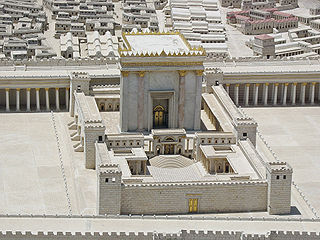
In the eighteenth year of his reign (20–19 BC), Herod rebuilt the Second TempleSecond Temple
The Jewish Second Temple was an important shrine which stood on the Temple Mount in Jerusalem between 516 BCE and 70 CE. It replaced the First Temple which was destroyed in 586 BCE, when the Jewish nation was exiled to Babylon...
in Jerusalem on "a more magnificent scale". The new Temple was finished in a year and a half, although work on out-buildings and courts continued another eighty years. To comply with religious law, Herod employed a thousand priests as masons and carpenters for the rebuilding. The finished temple, which was destroyed by the Romans
Roman Empire
The Roman Empire was the post-Republican period of the ancient Roman civilization, characterised by an autocratic form of government and large territorial holdings in Europe and around the Mediterranean....
in 70 AD, is often referred to as Herod's Temple. The Wailing Wall (Western Wall) in Jerusalem was for many years the only section visible of the four retaining walls built by Herod to create a flat platform (the Temple Mount
Temple Mount
The Temple Mount, known in Hebrew as , and in Arabic as the Haram Ash-Sharif , is one of the most important religious sites in the Old City of Jerusalem. It has been used as a religious site for thousands of years...
) upon which his Temple was constructed.
Major Herodian building projects
- Herod's PalaceHerod's PalaceHerod's Palace was a fortified palace, built by Herod the Great to protect the Old City of Jerusalem. Part of Herodian architecture, the palace consisted of two principal buildings, each with its banquet halls, baths and accommodations for hundreds of guests....
in Jerusalem - The Palace-fortress at MasadaMasadaMasada is the name for a site of ancient palaces and fortifications in the South District of Israel, on top of an isolated rock plateau, or horst, on the eastern edge of the Judean Desert, overlooking the Dead Sea. Masada is best known for the violence that occurred there in the first century CE...
(37-31 BC) - The Palace-fortress at HerodiumHerodiumHerodium or Herodion is a volcano-like hill with a truncated cone located south of Jerusalem, near the city of Bethlehem in the West Bank. Herod the Great built a fortress and palace on the top of Herodium, and may have been buried there...
(first century BC) - Roman public facilities, Jerusalem (first century BC)
- Theater, amphitheater, hippodrome (Remains have not been found)
- The Royal Complex at Lower Herodium (Palace, Herod's Tomb, etc.) (?? BC)
- Three Winter Palaces, JerichoJerichoJericho ; is a city located near the Jordan River in the West Bank of the Palestinian territories. It is the capital of the Jericho Governorate and has a population of more than 20,000. Situated well below sea level on an east-west route north of the Dead Sea, Jericho is the lowest permanently...
(?? BC) - Caesarea Maritima and its harbor (25–13 BC)
- Three temples dedicated to AugustusAugustusAugustus ;23 September 63 BC – 19 August AD 14) is considered the first emperor of the Roman Empire, which he ruled alone from 27 BC until his death in 14 AD.The dates of his rule are contemporary dates; Augustus lived under two calendars, the Roman Republican until 45 BC, and the Julian...
(at SebasteSebastia, NablusSebastia is a Palestinian village of over 4,500 inhabitants, located in the Nablus Governorate of the West Bank some 12 kilometers northwest of the city of Nablus. The village's total area is 4,810 dunums, the built up area of which comprises 150 dunums...
, Caesarea, and Panias) - The Temple MountTemple MountThe Temple Mount, known in Hebrew as , and in Arabic as the Haram Ash-Sharif , is one of the most important religious sites in the Old City of Jerusalem. It has been used as a religious site for thousands of years...
(with Herod's Temple and Antonia FortressAntonia FortressThe Antonia Fortress was a military barracks built by Herod the Great in Jerusalem on the site of earlier Ptolemaic and Hasmonean strongholds, named after Herod's patron Mark Antony...
), Jerusalem (ca 19 BC) - Renovation of the Pool of SiloamPool of SiloamPool of Siloam is a rock-cut pool on the southern slope of the City of David, the original site of Jerusalem, located outside the walls of the Old City to the southeast. The pool was fed by the waters of the Gihon Spring, carried there by two aqueducts.-History:The Pool of Siloam is mentioned...
- Jerusalem water channelJerusalem Water ChannelThe Jerusalem water channel is an archaeological site in Jerusalem, Israel. It is a large, ancient drainage tunnel or sewer that runs down the Tyropoeon Valley and once drained runoff and storm water from the city of Jerusalem....
- Jerusalem pilgrim roadJerusalem pilgrim roadThe Jerusalem pilgrim road is an ancient road used by ritual processions ascending from the Pool of Siloam to the Temple Mount via the Hulda Gates in the Southern Wall.-History:...