

Herero

Encyclopedia
The Herero are a Bantu
-speaking ethnic group inhabiting parts of Southern Africa
. The majority reside in Namibia
, with the remainder found in Botswana
and Angola
. About 240,000 members are alive today.
, the Herero are traditionally pastoralists
and make a living tending livestock. As cattle terminology in use amongst the few modern Bantu pastoralist groups testifies, Bantu herders originally acquired cattle
from Cushitic
pastoralists inhabiting Eastern Africa prior to the Bantu expansion
from West Africa
. Linguistic evidence also indicates that Bantus likely borrowed the custom of milking cattle directly from Cushitic peoples in the area. Later interactions between Bantu and Cushitic peoples resulted in Bantu groups with significant Cushitic admixture and culturo-linguistic influences, such as the Herero herdsmen of southern Africa. The notably lighter skin color, finer facial features, greater stature and warrior ethos found amongst some Herero members relative to other Bantu peoples are believed to be physical and cultural traits inherited from these exchanges.
The Herero claim to comprise several subgroups, including the Himba, the Tjimba (Cimba), the Mbanderu and the Kwandu. Groups in Angola include the Kuvale, Zemba, Hakawona, Tjavikwa, Tjimba and Himba, who regularly cross the Namibia/Angola border when migrating with their herds. However, the Tjimba
, though they speak Herero, are physically distinct indigenous hunter-gatherer
s; it may be in the Herero's interest to portray indigenous peoples as impoverished (cattleless) Herero.
. In the beginning of the 19th century, the Nama
from South Africa
, who already possessed some firearms, entered the land and were followed, in turn, by white merchants and German
missionaries. At first, the Nama began displacing the Herero, leading to bitter warfare between the two groups which lasted the greater part of the 19th century. Later the two peoples entered into a period of cultural exchange.
During the late 19th century, the first Europeans began entering to permanently settle the land. Primarily in Damaraland
, German settlers acquired land from the Herero in order to establish farm
s. In 1883, the merchant Franz Adolf Eduard Lüderitz entered into a contract with the native elders. The exchange later became the basis of German colonial
rule. The territory became a German colony under the name of German South-West Africa
.
Soon after, conflicts between the German colonists and the Herero herdsmen began. Controversies frequently arose because of disputes about access to land and water, but also the legal discrimination
against the native population by the white immigrants.
and racism ruled, they were considered as subhuman.
Between 1893 and 1903, the Herero and Nama peoples land as well as their cattle were progressively making their way into the hands of the German colonists. The Herero and Nama resisted expropriation over the years, but they were unorganized and the Germans defeated them with ease. In 1903, the Herero people learnt that they were to be placed in reservations, leaving more room for colonists to own land and prosper. In 1904, the Herero and Nama began a great rebellion that lasted until 1907, ending with the utter destruction of the Herero people. “The war against the Herero and Nama was the first in which German imperialism resorted to methods of genocide…” It has been determined by experts that roughly 80,000 Herero lived in German South-West Africa at the beginning of Germany’s colonial rule over the area, while after their revolt was defeated, they numbered approximately 15,000. In a period of four years approximately 65,000 Herero people perished.
Samuel Maharero, the Supreme Chief of the Herero, led his people in a great uprising on January 12, 1904 against the Germans. The Herero, surprising the Germans with their uprising, had initial success.
German General von Trotha took over as leader in May 1904. In August 1904, he devised a plan to annihilate the Herero nation. The plan was to surround the area where the Herero were, leaving but one route for them to escape, into the desert. The Herero battled the Germans, and the losses were minor. It was when they had escaped through the only passage made available by the Germans, and had been chased away from the last watering hole into complete desertion, that casualties grew to insufferable amounts. It was then that the Herero uprising changed from war, to genocide.
At the 100th anniversary of the massacre, German Minister for Economic Development and Cooperation Heidemarie Wieczorek-Zeul
commemorated the dead on site and apologized for the crimes on behalf of all Germans. Some Africans demand financial reparations, however in 2004 there was only minor media attention in Germany on this matter.
The Herero language
(Otjiherero) is the main unifying link amongst the Herero peoples. It is a Bantu language, part of the Niger–Congo
family. Within the Otjiherero umbrella, there are many dialects, including Oluthimba or Otjizemba- which is the most common dialect in Angola-, Otjihimba, and Otjikuvale. These differ mainly in phonology, and are largely mutually intelligible, though Kuvale, Zemba
, and Hakaona
have been classified as separate languages. Standard Herero is used in the Namibian media and is taught in schools throughout the country.
The Herero are traditionally cattle-herding pastoralists who rate status on the number of cattle owned. Cattle raids occurred between Herero groups, but Herero land (Ehi Rovaherero) belongs to the community and has no fixed boundaries.
The Herero have a bilateral descent
system. A person traces their heritage through both their father's lineage, or oruzo (plural: otuzo), and their mother's lineage, or eanda (plural: omaanda). In the 1920s, Kurt Falk recorded in the Archiv für Menschenkunde that the Ovahimba retained a "medicine-man" or "wizard" status for homosexual men. He wrote, "When I asked him if he was married, he winked at me slyly and the other natives laughed heartily and declared to me subsequently that he does not love women, but only men. He nonetheless enjoyed no low status in his tribe."
The Holy Fire (OtjikaTjamuaha) of the Herero is located at Okahandja
. From 1923 to 2011 it was situated at the Red Flag Commando. On Herero Day
2011, a group around Paramount Chief Kuaima Riruako
claimed that this fire was facing eastwards for the past 88 years, while it should be facing towards the sunset. They removed it and placed it at an undisclosed location, a move that has stirred controversy.
novel Gravity's Rainbow
. The genocide under von Trotha plays a major role in another novel by the same author, V.
.
German author Uwe Timm
's novel Morenga, set in German South-West Africa
, also includes several Herero characters.
Bantu languages
The Bantu languages constitute a traditional sub-branch of the Niger–Congo languages. There are about 250 Bantu languages by the criterion of mutual intelligibility, though the distinction between language and dialect is often unclear, and Ethnologue counts 535 languages...
-speaking ethnic group inhabiting parts of Southern Africa
Southern Africa
Southern Africa is the southernmost region of the African continent, variably defined by geography or geopolitics. Within the region are numerous territories, including the Republic of South Africa ; nowadays, the simpler term South Africa is generally reserved for the country in English.-UN...
. The majority reside in Namibia
Namibia
Namibia, officially the Republic of Namibia , is a country in southern Africa whose western border is the Atlantic Ocean. It shares land borders with Angola and Zambia to the north, Botswana to the east and South Africa to the south and east. It gained independence from South Africa on 21 March...
, with the remainder found in Botswana
Botswana
Botswana, officially the Republic of Botswana , is a landlocked country located in Southern Africa. The citizens are referred to as "Batswana" . Formerly the British protectorate of Bechuanaland, Botswana adopted its new name after becoming independent within the Commonwealth on 30 September 1966...
and Angola
Angola
Angola, officially the Republic of Angola , is a country in south-central Africa bordered by Namibia on the south, the Democratic Republic of the Congo on the north, and Zambia on the east; its west coast is on the Atlantic Ocean with Luanda as its capital city...
. About 240,000 members are alive today.
General
Unlike most Bantus, who are overwhelmingly subsistence farmersSubsistence agriculture
Subsistence agriculture is self-sufficiency farming in which the farmers focus on growing enough food to feed their families. The typical subsistence farm has a range of crops and animals needed by the family to eat and clothe themselves during the year. Planting decisions are made with an eye...
, the Herero are traditionally pastoralists
Pastoralism
Pastoralism or pastoral farming is the branch of agriculture concerned with the raising of livestock. It is animal husbandry: the care, tending and use of animals such as camels, goats, cattle, yaks, llamas, and sheep. It may have a mobile aspect, moving the herds in search of fresh pasture and...
and make a living tending livestock. As cattle terminology in use amongst the few modern Bantu pastoralist groups testifies, Bantu herders originally acquired cattle
Cattle
Cattle are the most common type of large domesticated ungulates. They are a prominent modern member of the subfamily Bovinae, are the most widespread species of the genus Bos, and are most commonly classified collectively as Bos primigenius...
from Cushitic
Cushitic languages
The Cushitic languages are a branch of the Afroasiatic language family spoken in the Horn of Africa, Tanzania, Kenya, Sudan and Egypt. They are named after the Biblical character Cush, who was identified as an ancestor of the speakers of these specific languages as early as AD 947...
pastoralists inhabiting Eastern Africa prior to the Bantu expansion
Bantu expansion
The Bantu expansion or the Bantu Migration was a millennia-long series of migrations of speakers of the original proto-Bantu language group...
from West Africa
West Africa
West Africa or Western Africa is the westernmost region of the African continent. Geopolitically, the UN definition of Western Africa includes the following 16 countries and an area of approximately 5 million square km:-Flags of West Africa:...
. Linguistic evidence also indicates that Bantus likely borrowed the custom of milking cattle directly from Cushitic peoples in the area. Later interactions between Bantu and Cushitic peoples resulted in Bantu groups with significant Cushitic admixture and culturo-linguistic influences, such as the Herero herdsmen of southern Africa. The notably lighter skin color, finer facial features, greater stature and warrior ethos found amongst some Herero members relative to other Bantu peoples are believed to be physical and cultural traits inherited from these exchanges.
The Herero claim to comprise several subgroups, including the Himba, the Tjimba (Cimba), the Mbanderu and the Kwandu. Groups in Angola include the Kuvale, Zemba, Hakawona, Tjavikwa, Tjimba and Himba, who regularly cross the Namibia/Angola border when migrating with their herds. However, the Tjimba
Tjimba people
The Cimba , also spelled Tjimba, are a remote, Herero-speaking hunter-gatherer people of the Kaokoveld desert in northwest Namibia and southwest Angola, in the mountain ranges bordering the Kunene River...
, though they speak Herero, are physically distinct indigenous hunter-gatherer
Hunter-gatherer
A hunter-gatherer or forage society is one in which most or all food is obtained from wild plants and animals, in contrast to agricultural societies which rely mainly on domesticated species. Hunting and gathering was the ancestral subsistence mode of Homo, and all modern humans were...
s; it may be in the Herero's interest to portray indigenous peoples as impoverished (cattleless) Herero.
History
During the 17th and 18th centuries, the Herero migrated to what is today Namibia from the east and established themselves as herdsmenHerding
Herding is the act of bringing individual animals together into a group , maintaining the group and moving the group from place to place—or any combination of those. While the layperson uses the term "herding", most individuals involved in the process term it mustering, "working stock" or...
. In the beginning of the 19th century, the Nama
Namaqua
Nama are an African ethnic group of South Africa, Namibia and Botswana. They traditionally speak the Nama language of the Khoe-Kwadi language family, although many Nama now speak Afrikaans. The Nama are the largest group of the Khoikhoi people, most of whom have largely disappeared as a group,...
from South Africa
South Africa
The Republic of South Africa is a country in southern Africa. Located at the southern tip of Africa, it is divided into nine provinces, with of coastline on the Atlantic and Indian oceans...
, who already possessed some firearms, entered the land and were followed, in turn, by white merchants and German
Germany
Germany , officially the Federal Republic of Germany , is a federal parliamentary republic in Europe. The country consists of 16 states while the capital and largest city is Berlin. Germany covers an area of 357,021 km2 and has a largely temperate seasonal climate...
missionaries. At first, the Nama began displacing the Herero, leading to bitter warfare between the two groups which lasted the greater part of the 19th century. Later the two peoples entered into a period of cultural exchange.
During the late 19th century, the first Europeans began entering to permanently settle the land. Primarily in Damaraland
Damaraland
Damaraland was a name given to the north-central part of what later became Namibia, inhabited by the Damaras. It was bounded roughly by Ovamboland in the north, the Namib Desert in the west, the Kalahari Desert in the east, and Windhoek in the south....
, German settlers acquired land from the Herero in order to establish farm
Farm
A farm is an area of land, or, for aquaculture, lake, river or sea, including various structures, devoted primarily to the practice of producing and managing food , fibres and, increasingly, fuel. It is the basic production facility in food production. Farms may be owned and operated by a single...
s. In 1883, the merchant Franz Adolf Eduard Lüderitz entered into a contract with the native elders. The exchange later became the basis of German colonial
Colonialism
Colonialism is the establishment, maintenance, acquisition and expansion of colonies in one territory by people from another territory. It is a process whereby the metropole claims sovereignty over the colony and the social structure, government, and economics of the colony are changed by...
rule. The territory became a German colony under the name of German South-West Africa
German South-West Africa
German South West Africa was a colony of Germany from 1884 until 1915, when it was taken over by South Africa and administered as South West Africa, finally becoming Namibia in 1990...
.
Soon after, conflicts between the German colonists and the Herero herdsmen began. Controversies frequently arose because of disputes about access to land and water, but also the legal discrimination
Discrimination
Discrimination is the prejudicial treatment of an individual based on their membership in a certain group or category. It involves the actual behaviors towards groups such as excluding or restricting members of one group from opportunities that are available to another group. The term began to be...
against the native population by the white immigrants.
Genocide
In the late 19th and early 20th century, imperialism and colonialism in Africa peaked. European power houses were hungry for railways and trade routes, as well as more colonies to call their own. Germany officially claimed their stake in a South African colony in 1884, calling it, German South-West Africa until it was taken over in 1915. The first German colonists arrived in 1892, and conflict with the indigenous Herero and Nama people began. As in many cases of colonization, the indigenous people were not treated fairly. They were assumed to be savages and in a time where Social DarwinismSocial Darwinism
Social Darwinism is a term commonly used for theories of society that emerged in England and the United States in the 1870s, seeking to apply the principles of Darwinian evolution to sociology and politics...
and racism ruled, they were considered as subhuman.
Between 1893 and 1903, the Herero and Nama peoples land as well as their cattle were progressively making their way into the hands of the German colonists. The Herero and Nama resisted expropriation over the years, but they were unorganized and the Germans defeated them with ease. In 1903, the Herero people learnt that they were to be placed in reservations, leaving more room for colonists to own land and prosper. In 1904, the Herero and Nama began a great rebellion that lasted until 1907, ending with the utter destruction of the Herero people. “The war against the Herero and Nama was the first in which German imperialism resorted to methods of genocide…” It has been determined by experts that roughly 80,000 Herero lived in German South-West Africa at the beginning of Germany’s colonial rule over the area, while after their revolt was defeated, they numbered approximately 15,000. In a period of four years approximately 65,000 Herero people perished.
Samuel Maharero, the Supreme Chief of the Herero, led his people in a great uprising on January 12, 1904 against the Germans. The Herero, surprising the Germans with their uprising, had initial success.
German General von Trotha took over as leader in May 1904. In August 1904, he devised a plan to annihilate the Herero nation. The plan was to surround the area where the Herero were, leaving but one route for them to escape, into the desert. The Herero battled the Germans, and the losses were minor. It was when they had escaped through the only passage made available by the Germans, and had been chased away from the last watering hole into complete desertion, that casualties grew to insufferable amounts. It was then that the Herero uprising changed from war, to genocide.
At the 100th anniversary of the massacre, German Minister for Economic Development and Cooperation Heidemarie Wieczorek-Zeul
Heidemarie Wieczorek-Zeul
Heidemarie Wieczorek-Zeul is a German politician and a member of the Social Democratic Party since 1965.-Career:...
commemorated the dead on site and apologized for the crimes on behalf of all Germans. Some Africans demand financial reparations, however in 2004 there was only minor media attention in Germany on this matter.
Herero culture and language
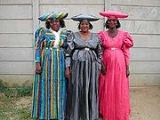
Despite sharing a language and pastoral traditions, the Herero are not a homogeneous people. The main Herero group in central Namibia (sometimes called Herero proper) was heavily influenced by Western culture during the colonial period, creating a whole new identity. The Herero proper and their southern counterparts the Mbanderu, for instance, wear garments similar to those worn by colonial Europeans (see photo at top of article). Traditional leather garments are worn by northwestern groups, such as the Himba, Kuvale, and Tjimba, who are also more conservative in other aspects. The Kaokoland Herero and those in Angola have remained isolated and are still pastoral nomads, practicing limited horticulture.The Herero language
Herero language
The Herero language is a language of the Bantu family . It is spoken by the Herero people in Namibia and Botswana...
(Otjiherero) is the main unifying link amongst the Herero peoples. It is a Bantu language, part of the Niger–Congo
Niger–Congo languages
The Niger–Congo languages constitute one of the world's major language families, and Africa's largest in terms of geographical area, number of speakers, and number of distinct languages. They may constitute the world's largest language family in terms of distinct languages, although this question...
family. Within the Otjiherero umbrella, there are many dialects, including Oluthimba or Otjizemba- which is the most common dialect in Angola-, Otjihimba, and Otjikuvale. These differ mainly in phonology, and are largely mutually intelligible, though Kuvale, Zemba
Zemba language
Zemba is a Bantu language spoken mainly in Angola where the language has about 18,000 speakers, and also in Namibia with some 4,000. It is closely related to Herero, and is often considered a dialect of that language, especially as the Zemba are ethnically Herero.There are various spellings and...
, and Hakaona
Hakaona language
Hakaona is a Bantu language of Angola and Namibia. Until perhaps Anita Pfouts , it was considered a dialect of Herero....
have been classified as separate languages. Standard Herero is used in the Namibian media and is taught in schools throughout the country.
The Herero are traditionally cattle-herding pastoralists who rate status on the number of cattle owned. Cattle raids occurred between Herero groups, but Herero land (Ehi Rovaherero) belongs to the community and has no fixed boundaries.
The Herero have a bilateral descent
Bilateral descent
Bilateral descent is a system of family lineage in which the relatives on the mother's side and father's side are equally important for emotional ties or for transfer of property or wealth. It is a family arrangement where descent and inheritance are passed equally through both parents...
system. A person traces their heritage through both their father's lineage, or oruzo (plural: otuzo), and their mother's lineage, or eanda (plural: omaanda). In the 1920s, Kurt Falk recorded in the Archiv für Menschenkunde that the Ovahimba retained a "medicine-man" or "wizard" status for homosexual men. He wrote, "When I asked him if he was married, he winked at me slyly and the other natives laughed heartily and declared to me subsequently that he does not love women, but only men. He nonetheless enjoyed no low status in his tribe."
The Holy Fire (OtjikaTjamuaha) of the Herero is located at Okahandja
Okahandja
Okahandja is a town of 14,000 inhabitants in Otjozondjupa Region, central Namibia, and the district capital of the Okahandja electoral constituency. It is known as the Garden Town of Namibia. It is located 70km north of Windhoek on the B1 road...
. From 1923 to 2011 it was situated at the Red Flag Commando. On Herero Day
Herero Day
Herero Day is a gathering of the Herero people of Namibia to commemorate their deceased chieftains. It is held annually on the Sunday closest to August 23, the day on which Herero chief Samuel Maharero's body was returned to Okahandja in 1923. Maharero was eventually reburied in Okahandja...
2011, a group around Paramount Chief Kuaima Riruako
Kuaima Riruako
Kuaima Riruako is a politician in Namibia. Riruako is also the paramount chief of the Herero and a National Unity Democratic Organisation representative in Parliament, also called "Okahandja Herero" by some...
claimed that this fire was facing eastwards for the past 88 years, while it should be facing towards the sunset. They removed it and placed it at an undisclosed location, a move that has stirred controversy.
Herero in fiction
A group of Herero living in Germany who were inducted into the German military during the Second World War play a major part in Thomas Pynchon'sThomas Pynchon
Thomas Ruggles Pynchon, Jr. is an American novelist. For his most praised novel, Gravity's Rainbow, Pynchon received the National Book Award, and is regularly cited as a contender for the Nobel Prize in Literature...
novel Gravity's Rainbow
Gravity's Rainbow
Gravity's Rainbow is a postmodern novel written by Thomas Pynchon and first published on February 28, 1973.The narrative is set primarily in Europe at the end of World War II and centers on the design, production and dispatch of V-2 rockets by the German military, and, in particular, the quest...
. The genocide under von Trotha plays a major role in another novel by the same author, V.
V.
V. is the debut novel of Thomas Pynchon, published in 1963. It describes the exploits of a discharged U.S. Navy sailor named Benny Profane, his reconnection in New York with a group of pseudo-bohemian artists and hangers-on known as the Whole Sick Crew, and the quest of an aging traveller named...
.
German author Uwe Timm
Uwe Timm
-Life and work:Uwe Timm was the youngest son in his family. His brother, 16 years his senior, was a soldier in the Waffen SS and died in Ukraine in 1943...
's novel Morenga, set in German South-West Africa
German South-West Africa
German South West Africa was a colony of Germany from 1884 until 1915, when it was taken over by South Africa and administered as South West Africa, finally becoming Namibia in 1990...
, also includes several Herero characters.
See also
- History of NamibiaHistory of NamibiaThe history of Namibia has passed through several distinct stages from being colonised in the late nineteenth century to Namibia's independence on 21 March 1990....
- Herero Wars
- Herero massacre
- Herero languageHerero languageThe Herero language is a language of the Bantu family . It is spoken by the Herero people in Namibia and Botswana...
- Herero DayHerero DayHerero Day is a gathering of the Herero people of Namibia to commemorate their deceased chieftains. It is held annually on the Sunday closest to August 23, the day on which Herero chief Samuel Maharero's body was returned to Okahandja in 1923. Maharero was eventually reburied in Okahandja...
Publications
- Rachel Anderson, Redressing Colonial Genocide Under International Law: The Hereros' Cause of Action Against Germany, 93 California Law Review 1155 (2005).
- Hans Schinz, Deutsch Südwest-Afrika, (Oldenburg and Leipzig, 1891)
- S. Passarge, Südafrika, (Oldenburg and Leipzig, 1908)
External links
- The following links were last verified 24 June 2007.
Photographs
- Africa on the Matrix: Herero People of Namibia — Photographs and information.