

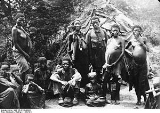
Namaqua

Encyclopedia
Nama are an African ethnic group
of South Africa, Namibia and Botswana
. They traditionally speak the Nama language
of the Khoe-Kwadi
(Central Khoisan) language family, although many Nama now speak Afrikaans
. The Nama are the largest group of the Khoikhoi
people, most of whom have largely disappeared as a group, except for the Namas. Many of the Nama clans live in Central Namibia and the other smaller groups lives Namaqualand
, which today straddles the Namibian border with South Africa.
 For thousands of years, the Khoisan peoples of South Africa and southern Namibia maintained a nomad
ic way of life.
From 1904 to 1907, the Germans, who had colonised present-day Namibia
waged war against the Nama and the Herero, leading to the Herero and Namaqua Genocide
in which 50–70% of the total Nama and Herero populations perished. This was motivated by the German desire to establish a prosperous colony and this entailed the displacement of the indigenous people from their agricultural land. Large herds of cattle were confiscated and Nama and Herero people were driven into the desert and in some cases interred in concentration camps on the coast, for example at Shark Island. Additionally, the Nama and Herero people were forced into slave labour to build railway lines and to hunt for diamonds during the diamond rush.
Following the discovery of diamonds at the mouth of the Orange River
in the 1920s, however, prospectors began moving into the region, establishing towns at Alexander Bay and Port Nolloth
, a process that accelerated the appropriation of traditional lands that had begun early in the colonial period. Under apartheid, remaining pastoralists were encouraged to abandon their traditional lifestyle in favour of village life.
The Nama people originally lived around the Orange River in southern Namibia and northern South Africa. The early colonialists referred to them as Hottentots
. Their alternative historical name, "Namaqua", simply stems from the addition of the Khoekhoe language suffix "-qua/khwa", meaning "people" (found in the names of other Southern African nations like the Griqua)
In 1991, a portion of Namaqualand
(home of the Nama and one of the last true wilderness areas of South Africa) became the Richtersveld National Park. In December 2002, ancestral lands, including the park, were returned to community ownership and the governments of South Africa and Namibia embarked on the development of a transfrontier park from the west coast of southern Africa to the desert interior, absorbing the Richtersveld National Park. Today, the Richtersveld National Park is one of the few places where the original Nama traditions survive. Here, the Nama still move with the seasons and speak their language. The traditional Nama dwelling – the |haru oms, or portable rush-mat covered domed hut – is a reflection of a nomadic way of life, offering a cool haven against the blistering heat of the sun, yet easy to pack and move if grazing lands become scarce.
At the dawn of the 19th century, Oorlam people encroached Namaqualand and Damaraland
. They likewise descended from indigenous
Khoikhoi
but are a group who mixed with slaves from Madagascar
, India, and Indonesia
. After two centuries of assimilation into the Nama culture, many Oorlams today regard Khoikhoigowab (Damara/Nama) as their mother tongue. The distinction between Namas and Oorlams has gradually disappeared over time to an extent where they are today regarded as one ethnic group, despite their different backgrounds.
 In general the Nama practice a policy of communal land ownership. Music, poetry and story telling are very important in Nama culture and many stories have been passed down orally through the generations.
The Nama have a culture that is rich in the musical and literary abilities of its people. Traditional music, folk tales, proverbs, and praise poetry have been handed down for generations and form the base for much of their culture. They are known for crafts which include leatherwork, skin kaross
es and mats, musical instruments (such as reed flutes), jewellery, clay pots, and tortoiseshell powder containers.
The traditional dress of Nama women consists of long, formal dresses that resemble Victorian traditional fashion. The long, flowing dresses were developed from the style of the missionaries in the 1800s, and this traditional clothing is today an integral part of the Nama nation's culture.
They have largely abandoned their traditional religion through the sustained efforts of Christian (and now Muslim) proselytizers. The majority of the Nama people in Namibia
today are therefore Christian with a small Muslim
minority.
The groom's family ask for the gate to be opened. If this is granted, the groom is interrogated about details of the bride, including the circumstances of their first meeting and how to identify her body marks to make sure both know each other well. If the bride is pregnant or already has children from her future husband or someone else, the bride is subjected to the "door cleansing" ceremony (slaughtering and consuming a snow-white goat). After several days the wedding ritual continues in reverse; the bride's family visits the clan of the groom. If all is to the satisfaction of the two clans, an engagement day is announced.
At the engagement, the groom's family brings live animals to the woman's family home. The animals are slaughtered, hung on three sticks, and each part is offered to the bride's family. Other items like bags of sugar or flour are only offered in quantities of two or four to indicate that there will always be abundance of food. This process is also celebrated in reverse at the man's family home. White flags are mounted on both family's houses which may not be taken off but wither or are blown off by the wind one day.
The wedding preparations can take up to one year. The family of the groom makes a gift to the bride's mother, traditionally a cow and a calf, for she has raised the bride at her breast. A bargaining process accompanies the gift that can take weeks in itself. On wedding day, both families provide animals and other food and bring it to the bride's home. The wedding itself takes place in a church. Festivities afterward go on for several days. The first night after the wedding the couple spends separately. On the next morning, they set off for their own home.
Ethnic group
An ethnic group is a group of people whose members identify with each other, through a common heritage, often consisting of a common language, a common culture and/or an ideology that stresses common ancestry or endogamy...
of South Africa, Namibia and Botswana
Botswana
Botswana, officially the Republic of Botswana , is a landlocked country located in Southern Africa. The citizens are referred to as "Batswana" . Formerly the British protectorate of Bechuanaland, Botswana adopted its new name after becoming independent within the Commonwealth on 30 September 1966...
. They traditionally speak the Nama language
Nama language
The Khoekhoe language, or Khoekhoegowab, also known by the ethnic term Nàmá and previously the now-discouraged term Hottentot, is the most widespread of the Khoisan languages. It belongs to the Khoe language family, and is spoken in Namibia, Botswana, and South Africa by three ethnic groups, the...
of the Khoe-Kwadi
Khoe languages
The Khoe languages are the largest of the non-Bantu language families indigenous to southern Africa. They are often considered to be a branch of a suspected Khoisan language family, and are known as Central Khoisan in that scenario. The nearest relative of the Khoe family is the extinct and poorly...
(Central Khoisan) language family, although many Nama now speak Afrikaans
Afrikaans
Afrikaans is a West Germanic language, spoken natively in South Africa and Namibia. It is a daughter language of Dutch, originating in its 17th century dialects, collectively referred to as Cape Dutch .Afrikaans is a daughter language of Dutch; see , , , , , .Afrikaans was historically called Cape...
. The Nama are the largest group of the Khoikhoi
Khoikhoi
The Khoikhoi or Khoi, in standardised Khoekhoe/Nama orthography spelled Khoekhoe, are a historical division of the Khoisan ethnic group, the native people of southwestern Africa, closely related to the Bushmen . They had lived in southern Africa since the 5th century AD...
people, most of whom have largely disappeared as a group, except for the Namas. Many of the Nama clans live in Central Namibia and the other smaller groups lives Namaqualand
Namaqualand
Namaqualand is an arid region of Namibia and South Africa, extending along the west coast over and covering a total area of 170,000 square miles/440,000 km². It is divided by the lower course of the Orange River into two portions - Little Namaqualand to the south and Great Namaqualand to the...
, which today straddles the Namibian border with South Africa.
History
Nomad
Nomadic people , commonly known as itinerants in modern-day contexts, are communities of people who move from one place to another, rather than settling permanently in one location. There are an estimated 30-40 million nomads in the world. Many cultures have traditionally been nomadic, but...
ic way of life.
From 1904 to 1907, the Germans, who had colonised present-day Namibia
Namibia
Namibia, officially the Republic of Namibia , is a country in southern Africa whose western border is the Atlantic Ocean. It shares land borders with Angola and Zambia to the north, Botswana to the east and South Africa to the south and east. It gained independence from South Africa on 21 March...
waged war against the Nama and the Herero, leading to the Herero and Namaqua Genocide
Herero and Namaqua Genocide
The Herero and Namaqua Genocide is considered to have been the first genocide of the 20th century. It took place between 1904 and 1907 in German South-West Africa , during the scramble for Africa...
in which 50–70% of the total Nama and Herero populations perished. This was motivated by the German desire to establish a prosperous colony and this entailed the displacement of the indigenous people from their agricultural land. Large herds of cattle were confiscated and Nama and Herero people were driven into the desert and in some cases interred in concentration camps on the coast, for example at Shark Island. Additionally, the Nama and Herero people were forced into slave labour to build railway lines and to hunt for diamonds during the diamond rush.
Following the discovery of diamonds at the mouth of the Orange River
Orange River
The Orange River , Gariep River, Groote River or Senqu River is the longest river in South Africa. It rises in the Drakensberg mountains in Lesotho, flowing westwards through South Africa to the Atlantic Ocean...
in the 1920s, however, prospectors began moving into the region, establishing towns at Alexander Bay and Port Nolloth
Port Nolloth
Port Nolloth is a town and domestic seaport in the Namaqualand region on the northwestern coast of South Africa, 89 miles northwest of Springbok....
, a process that accelerated the appropriation of traditional lands that had begun early in the colonial period. Under apartheid, remaining pastoralists were encouraged to abandon their traditional lifestyle in favour of village life.
The Nama people originally lived around the Orange River in southern Namibia and northern South Africa. The early colonialists referred to them as Hottentots
Khoikhoi
The Khoikhoi or Khoi, in standardised Khoekhoe/Nama orthography spelled Khoekhoe, are a historical division of the Khoisan ethnic group, the native people of southwestern Africa, closely related to the Bushmen . They had lived in southern Africa since the 5th century AD...
. Their alternative historical name, "Namaqua", simply stems from the addition of the Khoekhoe language suffix "-qua/khwa", meaning "people" (found in the names of other Southern African nations like the Griqua)
In 1991, a portion of Namaqualand
Namaqualand
Namaqualand is an arid region of Namibia and South Africa, extending along the west coast over and covering a total area of 170,000 square miles/440,000 km². It is divided by the lower course of the Orange River into two portions - Little Namaqualand to the south and Great Namaqualand to the...
(home of the Nama and one of the last true wilderness areas of South Africa) became the Richtersveld National Park. In December 2002, ancestral lands, including the park, were returned to community ownership and the governments of South Africa and Namibia embarked on the development of a transfrontier park from the west coast of southern Africa to the desert interior, absorbing the Richtersveld National Park. Today, the Richtersveld National Park is one of the few places where the original Nama traditions survive. Here, the Nama still move with the seasons and speak their language. The traditional Nama dwelling – the |haru oms, or portable rush-mat covered domed hut – is a reflection of a nomadic way of life, offering a cool haven against the blistering heat of the sun, yet easy to pack and move if grazing lands become scarce.
At the dawn of the 19th century, Oorlam people encroached Namaqualand and Damaraland
Damaraland
Damaraland was a name given to the north-central part of what later became Namibia, inhabited by the Damaras. It was bounded roughly by Ovamboland in the north, the Namib Desert in the west, the Kalahari Desert in the east, and Windhoek in the south....
. They likewise descended from indigenous
Indigenous peoples
Indigenous peoples are ethnic groups that are defined as indigenous according to one of the various definitions of the term, there is no universally accepted definition but most of which carry connotations of being the "original inhabitants" of a territory....
Khoikhoi
Khoikhoi
The Khoikhoi or Khoi, in standardised Khoekhoe/Nama orthography spelled Khoekhoe, are a historical division of the Khoisan ethnic group, the native people of southwestern Africa, closely related to the Bushmen . They had lived in southern Africa since the 5th century AD...
but are a group who mixed with slaves from Madagascar
Madagascar
The Republic of Madagascar is an island country located in the Indian Ocean off the southeastern coast of Africa...
, India, and Indonesia
Indonesia
Indonesia , officially the Republic of Indonesia , is a country in Southeast Asia and Oceania. Indonesia is an archipelago comprising approximately 13,000 islands. It has 33 provinces with over 238 million people, and is the world's fourth most populous country. Indonesia is a republic, with an...
. After two centuries of assimilation into the Nama culture, many Oorlams today regard Khoikhoigowab (Damara/Nama) as their mother tongue. The distinction between Namas and Oorlams has gradually disappeared over time to an extent where they are today regarded as one ethnic group, despite their different backgrounds.
Nama clans
Apart from Oorlam clans there are nine known sub-tribes, or clans, of Nama. Their names and tribal centres are:- Khaiǁkhaun (Red Nation) at HoachanasHoachanasHoachanas is a settlement of 3,000 inhabitants in the Hardap Region of southern central Namibia, located northeast of Kalkrand. It is situated at the junction of the main road C21 from Kalkrand, and C15 from Dordabis to Stampriet and belongs to the Mariental Rural electoral constituency.Inhabited...
, the main group and the oldest Nama clan in Namibia - ǃGamiǂnun (Bondelswarts) at WarmbadWarmbad, NamibiaWarmbad is a settlement located in the Karas Region of southern Namibia. It is situated south of Karasburg at the Homs River, close to the border with South Africa, and belongs to the Karasburg electoral constituency.First occupied by traders, hunters, and missionaries of different congregations,...
- ǂAonin (Southern Topnaars) at Roobiank
- ǃGomen (Northern Topnaars) at SesfonteinSesfonteinSesfontein is a settlement in the Kunene Region of Namibia. It is the district capital of the Sesfontein electoral constituency, its population is 7,358. Sesfontein derives its name from the six fountains which have their source in the vicinity....
- ǃKharakhoen (Fransman Nama) at GochasGochasGochas is a village in Hardap Region, Namibia. It is located southeast of Mariental on the way to the Mata Mata border post to the Kgalagadi Transfrontier Park. The village has been the main settlement of the ǃKharakhoen , a subtribe of the Nama people, since 1889.-References:...
. After being defeated by Imperial GermanyGerman EmpireThe German Empire refers to Germany during the "Second Reich" period from the unification of Germany and proclamation of Wilhelm I as German Emperor on 18 January 1871, to 1918, when it became a federal republic after defeat in World War I and the abdication of the Emperor, Wilhelm II.The German...
SchutztruppeSchutztruppeSchutztruppe was the African colonial armed force of Imperial Germany from the late 19th century to 1918, when Germany lost its colonies. Similar to other colonial forces, the Schutztruppe consisted of volunteer European commissioned and non-commissioned officers, medical and veterinary officers. ...
in the Battle of Swartfontein on 15 January 1905, this Nama group split into two. Part of the ǃKharakhoen fled to LokgwabeLokgwabeLokgwabe is a village in Kgalagadi District of Botswana. It is located in the Kalahari Desert and the village has a primary school. The population was 1,304 in 2001 census....
, Botswana, and stayed there permanently. - ǁHawoben (Veldschoendragers) at KoësKoësKoës is a village in the Karas Region of south-eastern Namibia. It belongs to the Keetmanshoop Rural electoral constituency.-References:...
- ǁOgain (Groot Doden) at SchlipSchlipSchlip is a settlement in the Rehoboth Rural constituency in the Hardap Region of central Namibia. It is situated on the unpaved road D1290 and has two primary schools and a junior secondary school. Schlip is the main settlement of the ǁOgain clan of the Nama people.-References:...
- ǁKhauǀgoan (Swartbooi Nama) at RehobothRehoboth, NamibiaRehoboth is a town of 21,000 inhabitants in central Namibia just north of the Tropic of Capricorn. Located on the B1 road, 90 kilometres south of the Namibian capital Windhoek, Rehoboth lies on a high elevation plateau with several natural hot-water springs. It receives sparse mean annual rainfall...
, later at Salem, Ameib, and Franzfontein - The Kharoǃoan (Keetmanshoop Nama) split from the Red Nation in February 1850 and settled at KeetmanshoopKeetmanshoopKeetmanshoop is a city in Karas Region, southern Namibia, lying on the Trans-Namib Railway from Windhoek to Upington in South Africa. It is named after Johann Keetman, a German industrialist and founder of the city....
.
Culture
The Nama have a culture that is rich in the musical and literary abilities of its people. Traditional music, folk tales, proverbs, and praise poetry have been handed down for generations and form the base for much of their culture. They are known for crafts which include leatherwork, skin kaross
Kaross
Bushmen's A Kaross is a cloak made of sheepskin, or the hide of other animals, with the hair left on. It is properly confined to the coat of skin without sleeves and used to be worn by the Khoikhoi and Bushmen / San peoples of South Africa. These karosses became replaced by a blanket. Their chiefs...
es and mats, musical instruments (such as reed flutes), jewellery, clay pots, and tortoiseshell powder containers.
The traditional dress of Nama women consists of long, formal dresses that resemble Victorian traditional fashion. The long, flowing dresses were developed from the style of the missionaries in the 1800s, and this traditional clothing is today an integral part of the Nama nation's culture.
They have largely abandoned their traditional religion through the sustained efforts of Christian (and now Muslim) proselytizers. The majority of the Nama people in Namibia
Namibia
Namibia, officially the Republic of Namibia , is a country in southern Africa whose western border is the Atlantic Ocean. It shares land borders with Angola and Zambia to the north, Botswana to the east and South Africa to the south and east. It gained independence from South Africa on 21 March...
today are therefore Christian with a small Muslim
Islam in Namibia
Islam is the third largest religion in Namibia after Christianity and indigenous beliefs.-Number of Muslims:In 1999, a Namibian Muslim leader estimated that there were approximately 1,500 Muslims in the country. In 2009, leaders estimated that there were between 3,000 and 5,000 Namibian Muslims...
minority.
Wedding ritual
Namas have a complicated wedding ritual. First the man has to discuss his intentions with his family. If they agree they will advise him of the customs to ask the bride's family and then accompany him to the place she lives. The yard at the bride's living place is prepared prior to the future husband's family's arrival, animal hides are laid out in the corners for the different groups to sit down and discuss.The groom's family ask for the gate to be opened. If this is granted, the groom is interrogated about details of the bride, including the circumstances of their first meeting and how to identify her body marks to make sure both know each other well. If the bride is pregnant or already has children from her future husband or someone else, the bride is subjected to the "door cleansing" ceremony (slaughtering and consuming a snow-white goat). After several days the wedding ritual continues in reverse; the bride's family visits the clan of the groom. If all is to the satisfaction of the two clans, an engagement day is announced.
At the engagement, the groom's family brings live animals to the woman's family home. The animals are slaughtered, hung on three sticks, and each part is offered to the bride's family. Other items like bags of sugar or flour are only offered in quantities of two or four to indicate that there will always be abundance of food. This process is also celebrated in reverse at the man's family home. White flags are mounted on both family's houses which may not be taken off but wither or are blown off by the wind one day.
The wedding preparations can take up to one year. The family of the groom makes a gift to the bride's mother, traditionally a cow and a calf, for she has raised the bride at her breast. A bargaining process accompanies the gift that can take weeks in itself. On wedding day, both families provide animals and other food and bring it to the bride's home. The wedding itself takes place in a church. Festivities afterward go on for several days. The first night after the wedding the couple spends separately. On the next morning, they set off for their own home.
Literature
- Hoernl‚, A. W. 1925. The Social Organization of the Nama Hottentots. American Anthropologist, n.s., 27: 1–24. JSTOR
- Hoernl‚, A. W. 1918. Certain Rites of Transition and the Conception of !Nau among the Hottentots. Harvard African Studies 2:65–82. JSTOR
- Schultze, L. 1907. Aus Namaland und Kalahari. Jena.
External links
- South African National Parks website
- Aerial Richtersveld Images Taken during the filming of "flying the fish"