

Heacham

Encyclopedia
Heacham is a village of 4,707 inhabitants, located in north-west Norfolk
, England
, between King's Lynn
, 14 miles (22.5 km) to the south and Hunstanton
, about 3 miles (4.8 km) to the north, on The Wash
.
and latter Bronze Age
finds throughout the parish. This is presumably due to the fact the local geology consists of primarily cretaceous
sands and underlying chalk meaning that there is very little surface water for miles in any direction. This can also be seen along the banks of the Caudle Carr located just outside Dersingham where numerous archaeological sites have been found. Running water in conjunction with the fertile surrounding lands, made it an ideal settling location for early man. Evidence of habitation continues through the Iron age
into the Romano-British
era. But the beginnings of the present village most probably did not occur until around the 5th century with the Anglo-Saxon
invasion and the beginnings of present-day East Anglia
.
The name of the village purportedly derives from a 12th-century Norman lord, Geoffrey de Hecham. Although this is possible, it is unlikely as the name ‘de Hecham' literally means ‘of Hecham' implying the place name was already in existence. The name Hecham was in use at the time of the Little Domesday Book
as part of the Smithdon hundred (Smetheduna) which was written around 1086. Prior to the Norman Conquest, Heacham was controlled by two Saxons, Alnoth, and Toki the king's thegn
whose estates were based around his hall in Castle Acre
. After the conquest the lands passed to William de Warenne
and his brother-in-law Frederick de Warenne who was later killed by Hereward the Wake
.
The name itself however is more likely to have derived from the name of the river, The Hitch, in conjunction with the Old English word ham or hamm which meant either homestead, village, manor, estate or enclosure, land hemmed by water or marsh or higher ground, land in a river bend, river meadow, promontory.
In 1085 the manor of Heacham was given by William de Warenne to a cell of Cluniac
monks from the Priory of St Pancras of Lewes
to pray for the soul of his late wife Gundreda. After the dissolution
, around 1541, the manor passed to Thomas Howard, 3rd Duke of Norfolk
.
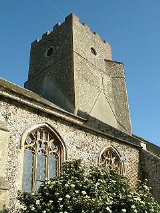
in design.
In the cupola on the tower hangs a bell (circa 1100), the oldest in East Anglia, and the seventh-oldest in the country. The transepts have been lost as well as 12 feet (3.7 m) from the east end, and the roof has been lowered.
The Oxford historian of science Robert Gunther
is buried in the village.
, who married John Rolfe
in 1614. Pocahontas died prior to her husband and is buried at Gravesend, England in the St George's Parish churchyard. Rolfe returned to Virginia and was killed in the 1622 Indian massacre near Jamestown. His remains are missing. It may be possible his remains were returned to Heacham and possibly buried there at a later date but no records indicate this happened. No records indicate either was buried at the Rolfe homeplace of Heacham Hall, England, that burned in the early 1900's. However, John Rolfe took his wife, Pocahontas, and their infant son, Thomas
, to visit his family at Heacham Hall in 1616. She died on this return trip when the ship they were on docked in Kent County to get care for the ailing Native American princess.
The singer, Wayne Newton
, who is a distant relative of Pocahontas has tried to have her remains returned to America and buried in Virginia, but her grave is unknown. The Church Records note her death and burial, but not the exact location. Reverend David Willey, rector of Saint George's, told Newton in 2000 that the church burned down on August 24, 1727 when a great fire that also destroyed about 110 houses and the parish church. Services were transferred to the town hall until the church (restored in the Georgian style and part-funded by the Commission for Building Fifty New Churches) was completed in 1731.
John Rolfe, whose family estate was Heacham Hall, England and his wife Pocahontas have long been known in America to be the couple who united two nationalities and two worlds in America to create the beginning of a new peaceful nation. After Rolfe, Pocahontas and her father died, problems began to arise as the Native Americans were being pushed out of their homes due to the influx of many new immigrants from Europe.
 Heacham started to become popular as a seaside resort
with the Victorians due to the opening of the railway line between King's Lynn
and Hunstanton
in the early 1860s. This culminated in the building of the Jubilee Bridge in 1887 to replace an old wooden bridge as a result of oversubscriptions from parishioners in celebration of Queen Victoria's Diamond Jubilee. Heacham is still popular today as a seaside resort with both the North Beach (Jubilee) Road and South Beach Road being lined with caravan parks.
The beach at Heacham is situated on the east banks of The Wash
; this means it is one of the few beaches in eastern England where the sun sets over the sea instead of over land. As such, with the right weather conditions, beautiful sunsets can be viewed.
On 29 July 1929 Miss Mercedes Gleitze became the first woman to swim the Wash
. Originally aiming for Hunstanton she finally came ashore at Heacham after battling treacherous tides for over 13 hours.
Heacham was severely affected by the North Sea flood of 1953
, where nine people died in the village, as a result of the sea breaking through its defences.
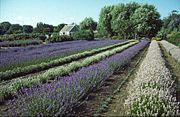
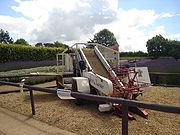 Norfolk Lavender Ltd was founded in 1932. Linn Chilvers supplied the plants and the labour. Francis Dusgate of Fring Hall provided the land. The first lavender
field was planted on Dusgate's land at Fring and in 1936 Dusgate acquired Caley Mill on the River Heacham
and the ground around it, not for the building but for the land. Lavender has been grown there ever since. A kiosk was erected from which bunches of lavender were sold to passing pre-war
traffic. By 1936 Caley Mill was already disused and no significant repairs were carried out until 1953/4 after the new road (the A149
) had been put through cutting the lavender field in half. It was at that time that the new lay-by and kiosk were constructed. Further repairs and restoration work were carried out at the Mill in 1977-78 and in the late 1980s. From the early 1990s onwards it has broadened its range to include other typical English
floral fragrances. These are sold all over Britain and exported all over the world.
Norfolk
Norfolk is a low-lying county in the East of England. It has borders with Lincolnshire to the west, Cambridgeshire to the west and southwest and Suffolk to the south. Its northern and eastern boundaries are the North Sea coast and to the north-west the county is bordered by The Wash. The county...
, England
England
England is a country that is part of the United Kingdom. It shares land borders with Scotland to the north and Wales to the west; the Irish Sea is to the north west, the Celtic Sea to the south west, with the North Sea to the east and the English Channel to the south separating it from continental...
, between King's Lynn
King's Lynn
King's Lynn is a sea port and market town in the ceremonial county of Norfolk in the East of England. It is situated north of London and west of Norwich. The population of the town is 42,800....
, 14 miles (22.5 km) to the south and Hunstanton
Hunstanton
Hunstanton, often pronounced by locals as and known colloquially as 'Sunny Hunny', is a seaside town in Norfolk, England, facing The Wash....
, about 3 miles (4.8 km) to the north, on The Wash
The Wash
The Wash is the square-mouthed bay and estuary on the northwest margin of East Anglia on the east coast of England, where Norfolk meets Lincolnshire. It is among the largest estuaries in the United Kingdom...
.
History
There is evidence of settlement in the Heacham area, for around the last 5,000 years, with numerous NeolithicNeolithic
The Neolithic Age, Era, or Period, or New Stone Age, was a period in the development of human technology, beginning about 9500 BC in some parts of the Middle East, and later in other parts of the world. It is traditionally considered as the last part of the Stone Age...
and latter Bronze Age
Bronze Age
The Bronze Age is a period characterized by the use of copper and its alloy bronze as the chief hard materials in the manufacture of some implements and weapons. Chronologically, it stands between the Stone Age and Iron Age...
finds throughout the parish. This is presumably due to the fact the local geology consists of primarily cretaceous
Cretaceous
The Cretaceous , derived from the Latin "creta" , usually abbreviated K for its German translation Kreide , is a geologic period and system from circa to million years ago. In the geologic timescale, the Cretaceous follows the Jurassic period and is followed by the Paleogene period of the...
sands and underlying chalk meaning that there is very little surface water for miles in any direction. This can also be seen along the banks of the Caudle Carr located just outside Dersingham where numerous archaeological sites have been found. Running water in conjunction with the fertile surrounding lands, made it an ideal settling location for early man. Evidence of habitation continues through the Iron age
Iron Age
The Iron Age is the archaeological period generally occurring after the Bronze Age, marked by the prevalent use of iron. The early period of the age is characterized by the widespread use of iron or steel. The adoption of such material coincided with other changes in society, including differing...
into the Romano-British
Romano-British
Romano-British culture describes the culture that arose in Britain under the Roman Empire following the Roman conquest of AD 43 and the creation of the province of Britannia. It arose as a fusion of the imported Roman culture with that of the indigenous Britons, a people of Celtic language and...
era. But the beginnings of the present village most probably did not occur until around the 5th century with the Anglo-Saxon
Anglo-Saxons
Anglo-Saxon is a term used by historians to designate the Germanic tribes who invaded and settled the south and east of Great Britain beginning in the early 5th century AD, and the period from their creation of the English nation to the Norman conquest. The Anglo-Saxon Era denotes the period of...
invasion and the beginnings of present-day East Anglia
East Anglia
East Anglia is a traditional name for a region of eastern England, named after an ancient Anglo-Saxon kingdom, the Kingdom of the East Angles. The Angles took their name from their homeland Angeln, in northern Germany. East Anglia initially consisted of Norfolk and Suffolk, but upon the marriage of...
.
The name of the village purportedly derives from a 12th-century Norman lord, Geoffrey de Hecham. Although this is possible, it is unlikely as the name ‘de Hecham' literally means ‘of Hecham' implying the place name was already in existence. The name Hecham was in use at the time of the Little Domesday Book
Domesday Book
Domesday Book , now held at The National Archives, Kew, Richmond upon Thames in South West London, is the record of the great survey of much of England and parts of Wales completed in 1086...
as part of the Smithdon hundred (Smetheduna) which was written around 1086. Prior to the Norman Conquest, Heacham was controlled by two Saxons, Alnoth, and Toki the king's thegn
Thegn
The term thegn , from OE þegn, ðegn "servant, attendant, retainer", is commonly used to describe either an aristocratic retainer of a king or nobleman in Anglo-Saxon England, or as a class term, the majority of the aristocracy below the ranks of ealdormen and high-reeves...
whose estates were based around his hall in Castle Acre
Castle Acre
Castle Acre is a village and civil parish in the English county of Norfolk. The village is situated on the River Nar some north of the town of Swaffham...
. After the conquest the lands passed to William de Warenne
William de Warenne, 1st Earl of Surrey
William de Warenne, 1st Earl of Surrey, Seigneur de Varennes is one of the very few proven Companions of William the Conqueror known to have fought at the Battle of Hastings in 1066...
and his brother-in-law Frederick de Warenne who was later killed by Hereward the Wake
Hereward the Wake
Hereward the Wake , known in his own times as Hereward the Outlaw or Hereward the Exile, was an 11th-century leader of local resistance to the Norman conquest of England....
.
The name itself however is more likely to have derived from the name of the river, The Hitch, in conjunction with the Old English word ham or hamm which meant either homestead, village, manor, estate or enclosure, land hemmed by water or marsh or higher ground, land in a river bend, river meadow, promontory.
In 1085 the manor of Heacham was given by William de Warenne to a cell of Cluniac
Cluny Abbey
Cluny Abbey is a Benedictine monastery in Cluny, Saône-et-Loire, France. It was built in the Romanesque style, with three churches built in succession from the 10th to the early 12th centuries....
monks from the Priory of St Pancras of Lewes
Lewes
Lewes is the county town of East Sussex, England and historically of all of Sussex. It is a civil parish and is the centre of the Lewes local government district. The settlement has a history as a bridging point and as a market town, and today as a communications hub and tourist-oriented town...
to pray for the soul of his late wife Gundreda. After the dissolution
Dissolution of the Monasteries
The Dissolution of the Monasteries, sometimes referred to as the Suppression of the Monasteries, was the set of administrative and legal processes between 1536 and 1541 by which Henry VIII disbanded monasteries, priories, convents and friaries in England, Wales and Ireland; appropriated their...
, around 1541, the manor passed to Thomas Howard, 3rd Duke of Norfolk
Thomas Howard, 3rd Duke of Norfolk
Thomas Howard, 3rd Duke of Norfolk, KG, Earl Marshal was a prominent Tudor politician. He was uncle to Anne Boleyn and Catherine Howard, two of the wives of King Henry VIII, and played a major role in the machinations behind these marriages...
.
Church
The Church of St Mary the Virgin is the most ancient building left in the village. It dates from 1230 and is NormanNorman architecture
About|Romanesque architecture, primarily English|other buildings in Normandy|Architecture of Normandy.File:Durham Cathedral. Nave by James Valentine c.1890.jpg|thumb|200px|The nave of Durham Cathedral demonstrates the characteristic round arched style, though use of shallow pointed arches above the...
in design.
In the cupola on the tower hangs a bell (circa 1100), the oldest in East Anglia, and the seventh-oldest in the country. The transepts have been lost as well as 12 feet (3.7 m) from the east end, and the roof has been lowered.
The Oxford historian of science Robert Gunther
Robert Gunther
Robert Theodore Gunther was a historian of science, zoologist, and founder of the Museum of the History of Science, Oxford....
is buried in the village.
Pocahontas
Heacham also has historic ties to PocahontasPocahontas
Pocahontas was a Virginia Indian notable for her association with the colonial settlement at Jamestown, Virginia. She was the daughter of Chief Powhatan, the head of a network of tributary tribal nations in Tidewater Virginia...
, who married John Rolfe
John Rolfe
John Rolfe was one of the early English settlers of North America. He is credited with the first successful cultivation of tobacco as an export crop in the Colony of Virginia and is known as the husband of Pocahontas, daughter of the chief of the Powhatan Confederacy.In 1961, the Jamestown...
in 1614. Pocahontas died prior to her husband and is buried at Gravesend, England in the St George's Parish churchyard. Rolfe returned to Virginia and was killed in the 1622 Indian massacre near Jamestown. His remains are missing. It may be possible his remains were returned to Heacham and possibly buried there at a later date but no records indicate this happened. No records indicate either was buried at the Rolfe homeplace of Heacham Hall, England, that burned in the early 1900's. However, John Rolfe took his wife, Pocahontas, and their infant son, Thomas
Thomas Rolfe
Thomas Rolfe was the only child of Pocahontas by her English husband, John Rolfe. His maternal grandfather was Wahunsunacock, the chief of Powhatan tribe in Virginia.-Early Life:Thomas Rolfe was born in Virginia...
, to visit his family at Heacham Hall in 1616. She died on this return trip when the ship they were on docked in Kent County to get care for the ailing Native American princess.
The singer, Wayne Newton
Wayne Newton
Wayne Newton is an American singer and entertainer based in Las Vegas, Nevada. He performed over 30,000 solo shows in Las Vegas over a period of over 40 years, earning him the nicknames The Midnight Idol, Mr. Las Vegas and Mr. Entertainment...
, who is a distant relative of Pocahontas has tried to have her remains returned to America and buried in Virginia, but her grave is unknown. The Church Records note her death and burial, but not the exact location. Reverend David Willey, rector of Saint George's, told Newton in 2000 that the church burned down on August 24, 1727 when a great fire that also destroyed about 110 houses and the parish church. Services were transferred to the town hall until the church (restored in the Georgian style and part-funded by the Commission for Building Fifty New Churches) was completed in 1731.
John Rolfe, whose family estate was Heacham Hall, England and his wife Pocahontas have long been known in America to be the couple who united two nationalities and two worlds in America to create the beginning of a new peaceful nation. After Rolfe, Pocahontas and her father died, problems began to arise as the Native Americans were being pushed out of their homes due to the influx of many new immigrants from Europe.
Beaches
Seaside resort
A seaside resort is a resort, or resort town, located on the coast. Where a beach is the primary focus for tourists, it may be called a beach resort.- Overview :...
with the Victorians due to the opening of the railway line between King's Lynn
King's Lynn
King's Lynn is a sea port and market town in the ceremonial county of Norfolk in the East of England. It is situated north of London and west of Norwich. The population of the town is 42,800....
and Hunstanton
Hunstanton
Hunstanton, often pronounced by locals as and known colloquially as 'Sunny Hunny', is a seaside town in Norfolk, England, facing The Wash....
in the early 1860s. This culminated in the building of the Jubilee Bridge in 1887 to replace an old wooden bridge as a result of oversubscriptions from parishioners in celebration of Queen Victoria's Diamond Jubilee. Heacham is still popular today as a seaside resort with both the North Beach (Jubilee) Road and South Beach Road being lined with caravan parks.
The beach at Heacham is situated on the east banks of The Wash
The Wash
The Wash is the square-mouthed bay and estuary on the northwest margin of East Anglia on the east coast of England, where Norfolk meets Lincolnshire. It is among the largest estuaries in the United Kingdom...
; this means it is one of the few beaches in eastern England where the sun sets over the sea instead of over land. As such, with the right weather conditions, beautiful sunsets can be viewed.
On 29 July 1929 Miss Mercedes Gleitze became the first woman to swim the Wash
The Wash
The Wash is the square-mouthed bay and estuary on the northwest margin of East Anglia on the east coast of England, where Norfolk meets Lincolnshire. It is among the largest estuaries in the United Kingdom...
. Originally aiming for Hunstanton she finally came ashore at Heacham after battling treacherous tides for over 13 hours.
Heacham was severely affected by the North Sea flood of 1953
North Sea flood of 1953
The 1953 North Sea flood was a major flood caused by a heavy storm, that occurred on the night of Saturday 31 January 1953 and morning of 1 February 1953. The floods struck the Netherlands, Belgium, England and Scotland.A combination of a high spring tide and a severe European windstorm caused a...
, where nine people died in the village, as a result of the sea breaking through its defences.
Norfolk Lavender
Lavender
The lavenders are a genus of 39 species of flowering plants in the mint family, Lamiaceae. An Old World genus, distributed from Macaronesia across Africa, the Mediterranean, South-West Asia, Arabia, Western Iran and South-East India...
field was planted on Dusgate's land at Fring and in 1936 Dusgate acquired Caley Mill on the River Heacham
River Heacham
The River Heacham is in the North West of the County of Norfolk. Its source is in the village of Bircham Newton , 25 metres above sea level. The river is 6.8 miles long from the source to the pools behind the tidal flaps at North beach, Heacham...
and the ground around it, not for the building but for the land. Lavender has been grown there ever since. A kiosk was erected from which bunches of lavender were sold to passing pre-war
Pre-war
The term pre-war or prewar is usually applied to the most recent or significant war in a culture's history.Antebellum is most often used to denote the period before the American Civil War while pre-war typically refers to the period before WWII.In real estate the term refers to buildings from the...
traffic. By 1936 Caley Mill was already disused and no significant repairs were carried out until 1953/4 after the new road (the A149
A149 road
The A149 is a major route in Norfolk, linking Kings Lynn to Great Yarmouth. It runs via the coast rather than on a more direct route such as the A47. The eastern section runs through The Broads.-Kings Lynn to Wells next the Sea:...
) had been put through cutting the lavender field in half. It was at that time that the new lay-by and kiosk were constructed. Further repairs and restoration work were carried out at the Mill in 1977-78 and in the late 1980s. From the early 1990s onwards it has broadened its range to include other typical English
England
England is a country that is part of the United Kingdom. It shares land borders with Scotland to the north and Wales to the west; the Irish Sea is to the north west, the Celtic Sea to the south west, with the North Sea to the east and the English Channel to the south separating it from continental...
floral fragrances. These are sold all over Britain and exported all over the world.