
|
|
|
|
Bhima
|
| |
|
| |
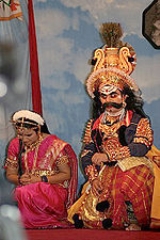
In the Mahabharata, Bhima (Sanskrit: ???, IAST: Bhima) was the second of the Pandava brothers. He was son of Kunti by Vayu, but like the other brothers, he was acknowledged son by Pandu . He was distinguished from his brothers by his great stature and strength.
His legendary prowess has been mentioned in glowing terms throughout the epic. Eg: "Of all the wielders of the mace, there is none equal to Bhima; and there is none also who is so skillful a rider of elephants.

Discussion
Ask a question about 'Bhima'
Start a new discussion about 'Bhima'
Answer questions from other users
|
Encyclopedia
In the Mahabharata, Bhima (Sanskrit: ???, IAST: Bhima) was the second of the Pandava brothers. He was son of Kunti by Vayu, but like the other brothers, he was acknowledged son by Pandu . He was distinguished from his brothers by his great stature and strength.
His legendary prowess has been mentioned in glowing terms throughout the epic. Eg: "Of all the wielders of the mace, there is none equal to Bhima; and there is none also who is so skillful a rider of elephants. In fight, they say, he yields not to even Arjuna; and as to might of arms, he is equal to ten thousand elephants. Well-trained and active, he who hath again been rendered bitterly hostile, would in anger consume the Dhartarashtras in no time. Always wrathful, and strong of arms, he is not capable of being subdued in battle by even Indra himself."
He was furious when the game of dice between his brother, King Yudhisthira, and Duryodhana reached its final stages. But when Dushasana attempted to strip Draupadi in the court, he swore that he would kill him one day and drink his blood. During the second exile of the Pandavas, he visited Alakapuri and was blessed by Kubera. At the end of their exile at the court of Virata, he disguised himself and acted as a palace cook.
Although there are several instances of Arjuna and others doubting or questioning the will of Krishna (Draupadi), the portrayal of Bhima's devotion to Krishna (Draupadi or Panchali) is umblemished in the original Mahabharata.
Marriage Alliances He lived for a time in hiding with his brothers during their first exile. In this period, he came across Hidimba and Hidimbi, a rakshasha brother and sister. Because of the enmity of the rakshasha to the people of the Kuru kingdom, Hidimba asked Hidimbi to lure Bhima to a trap. However, Bhima and Hidimbi were attracted to each other. Bhima fought and killed Hidimba, and lived for a year in the forest with Hidimbi, by whom he had a son, Ghatotkacha.
With his brothers, he was married to Draupadi, who give birth to a son by him by the name Sutasoma. The child that Draupadi bore to Bhimasena was born after Bhima had performed a thousand Soma sacrifices, he came to be called Sutasoma. Bhima also obtaining for a wife Valandhara, the daughter of the king of Kasi, offered his own prowess as dower and begat upon her a son named Sarvaga. Chedi king Dhristaketu's sister also was wedded to Bhima.
Battles of Bhima After the first return of the Pandavas to the Kuru lands, he challenged the king of Magadha, Jarasandha, to a wrestling bout and killed him, thus making it possible for his brothers to take part in the Rajasuya Yajna.
Bhima also embarked on a military expedition to the east as directed by his elder brother Yudhisthira, the king, to collect tribute for the Rajasuya sacrifice. It is believed that Yudhisthira chose Bhima to lead the army to eastern kingdoms because these kingdoms were famous for their strong armies protected by war-elephants and Bhima was an expert in defeating any army consisting of war-elephants with his great skill in mace-fight. In his expedition Bhima defeated using either diplomacy or military might, many kingdoms in the east including the hostile tribes of Panchalas who were enemies of Panchala king Drupada, the Chedis, the Kosalas, Kasis, Mallas, Videhas, Magadhas, Angas and Vangas. In Mahabharata, 2 chapters (MBh 2.28, 2.29), are dedicated to this eastern military expedition of Bhima.
In Kurukshetra War
Bhima was a great general in the great battle of Kurukshetra, second in command only to the generalissimo Dhristadyumna, killing six out of the eleven akshauhinis of the other side (Kauravas). Six akshauhinis adds up to the astronomical figure of around 1,705,860 men and 787,320 beasts which is testimony to the portrayal as the character of supreme physical prowess. In the battle, his charioteer was Krishna's son himself. During the battle, the Kauravas were frightened to face his might and sent elephants to fight him. An entire sub-chapter is devoted to describing the "light chat" or banter that he used to maintain with Krishna's son whilst fighting the enemies - yet another glimpse into the power that VedaVyasa invests in Bhima's persona. Bhima's weapon of choice was the mace - in the use of which he was second to none (The 4 greatest mace wielders of that time were reputed to be Bhima, Balarama, Shalya and Duryodhana, with there being none to be considered close enough to be named the 5th, so that slot was left unnamed). Amongst the most important personalities that he quelled were Baka (head of a cannibalistic race), Kirmira (Baka's brother), MaNiman (leader of the anger-demons in Kubera's garden), Jarasandha, Dushasana etc. He also defeated mighty Dronacharya by breaking his chariot eight times while Arjuna was trying to find and kill Jayadratha, and initially held his own against Karna, before letting Karna go as he was destined to die in Arjuna's hands. During the battle, he killed the elephant Ashvatthama, which enabled the Pandavas to spread the falsehood that Ashvatthama, son of Drona, had been killed. At the end of the battle, he also wounded Duryodhana in a duel, after striking him a foul blow below the waist. At this time, Balarama (who was partial to Duryodhana, his disciple) criticised Bhima for the foul blow, but was calmed down by Krishna. Bhima refrained from killing any respectable elders in the Kaurava's side out of respect for their virtue. The only elderly person he killed was the king of Bahlika (Bhishma's paternal uncle) - and he does this because the king of Bahlika asks Bhima to kill him to release him from the sin of fighting for the kauravas (Bahlika had to fight with the kauravas on account of Bhishma, his nephew).
He finished his days with his brothers and Draupadi, on their great and final journey toward Heaven. He was the last to die on the journey, leaving Yudhisthira alone to complete the journey by himself.
Criticism
Two characters in Hindu mythology are great cooks. One is Bhima and the other is Nala. Bhima is credited with the invention of the famous dish "Aviyal".
While he did possess superhuman strength, he has been portrayed as a man with no lenience for duplicity or tact in many cases - he is portrayed as the only pandava who constantly pointed out the faults of others, even if they were older or much respected. Being highly sensitive, he swayed between extreme emotions of love and hatred. Draupadi is often seen to turn to him to salvage her honor (be it in the case of Duryodhana's defeat or in the case of Kichaka's slaying).
Also, his name is synonymous with anyone who has short-temper or a large appetite. It is said that Bhima's appetite was so huge, that he always had to eat below his means, because there wasn't enough grain in the world at one time. He hence had a very thin waist and hence was called "Vrikodara" or wolf-bellied, because wolves seem to lack a belly even if they are well-fed.
Bhima is also infamous for having sown the seeds of hatred between the two collateral branches of the Kuru family by mercilessly beating up his cousins, almost unto the point of death, during his childhood & adolescence, when they tried to harass the pandavas. Bhima is also condemned for his brutal killing of Dushasana, where he tore open his cousin's chest and drank his blood in deference to his promise to Draupadi who had been insulted by Dushasana. Balarama's curse, that Bhima will be remembered as a crooked warrior, seems to have tarnished his image till this day. However later he reveals to Gandhari that he spat out Dushasan's blood without swallowing it.
See Also
|
| |
|
|