

Gun safety

Encyclopedia
Gun safety is a collection of rules and recommendations that can be applied when handling firearms. The purpose of gun safety is to eliminate or minimize the risks of unintentional death, injury or damage caused by improper handling of firearms.
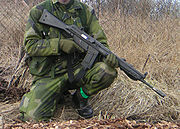 Gun safety training seeks to instill a certain mindset and appropriate habits by following specific rules. The mindset is that firearms are inherently dangerous and must always be handled with care. Handlers are taught to treat firearms with respect for their destructive capabilities, and strongly discouraged from playing or toying with firearms, a common cause of accidents.
The rules of gun safety follow from this mindset. There are many variations, and one of them is the Four Rules introduced by Colonel Jeff Cooper, which are:
The NRA provides a similar set of rules:
The Canadian Firearms Program uses the concept of The Four Firearm ACTS:
Many firearm accidents result from the handler mistakenly believing a firearm is emptied, safetied, or otherwise disabled when in fact it is ready to be discharged. Such misunderstandings can arise from a number of sources.
If a handler always treats firearms as capable of being discharged at any time, the handler is more likely to take precautions to prevent an unintentional discharge and to avoid damage or injury if one does occur.
A consequence of this rule is that any kind of playing or "toying" with firearms is prohibited. Playfully pointing firearms at people or other non-targets violates this rule and is possibly an extreme endangerment to life and/or property. To discourage this kind of behavior, the rule is sometimes alternately stated, "Never point a firearm at anything unless you intend to destroy it.".
Two natural "safe" directions to point the muzzle are upwards (at the sky) and downwards (at the ground). Both have their advantages and disadvantages. Firing at the ground may result in a ricochet
or cause hazardous fragments to be flung at people or objects. Aiming upwards eliminates this risk but replaces it with the risk that the bullet may cause damage when it comes down to the ground again. A bullet fired straight up only returns at the terminal velocity
of the bullet. However, a bullet fired at an angle not perfectly vertical will retain its spin on the way down and can attain much more lethal speeds. Several accidents have reportedly been caused by discharging firearms into the air; although the evidence in a few such cases has been disputed, a study by the Centers for Disease Control and Prevention
found 43 likely cases of injury from falling bullets during 2004 New Year
celebrations in Puerto Rico
. It is also possible that the muzzle will inadvertently be pointed at a non-target such as someone's head or an aircraft.
In cases where the firearm is being handled indoors, up and down may not be safe directions. For example, a bullet fired upwards may travel through a ceiling and into an adjacent floor. In indoor areas where firearms will be handled often, a suitably safe direction should be designated. Firing ranges often designate a direction in which it is safe to point a firearm; almost universally this is downrange into a backstop which is designed to contain bullets and eliminate potential ricochets. In armories or other areas where weapons must be handled, a container filled with sand known as a "clearing barrel" or "clearing can" is often used for this purpose.
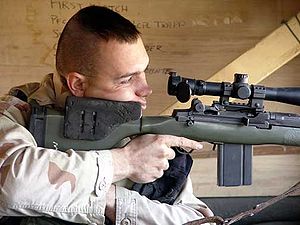 This rule is intended to prevent an undesired discharge. Normally a firearm is discharged by pressing its trigger. A handler's finger may involuntarily move for any of several reasons: the handler is startled, a lack of full attention on body movements, physiological reasons beyond conscious control such as a spasm, stumbling or falling, or the finger being pushed by something (as when trying to holster a handgun with one's finger on the trigger). Handlers are therefore taught to minimize the harmful effects of such a motion by keeping their finger off the trigger until the muzzle is pointing at the target and the handler wishes to discharge the firearm.
The trigger guard and area above the trigger of a firearm presents a natural point for a handler to keep their finger out straight alongside the weapon, so as not to violate this rule. Another recommendation is to keep the trigger finger above the trigger guard, so that there is less chance of the finger involuntarily slipping into the guard when startled. A properly indexed trigger finger also helps remind the person holding the firearm of the direction of the muzzle.
In popular culture
, such as movies
and TV shows
, this rule is often violated, even by characters who should be trained in gun safety such as military personnel
or law enforcement officers
.
Handlers are taught that they must positively identify and verify their target. Additionally, they learn that even when firing at a valid target, unintended targets may still be hit, for three reasons:
Therefore, this rule requires a handler to be sure of both the target itself and anything along the avenue of travel to and beyond the target.
This may create situations that present dilemmas for a handler. Such situations are for instance a police officer in a riot, a civilian facing a possible intruder at night, or a soldier in a situation where civilians are near the enemy. Indecision or misjudgment of the handler's abilities in such a situation may cause undesired outcomes, such as injury to the handler due to hesitation, or the handler violating rules of engagement
and causing unintended damage.
Training is used to minimize the risk of such outcomes. Target practice increases the precision with which the handler can discharge the firearm and thus increase the chances that the intended target is hit. Education about terminal ballistics
gives the handler knowledge about the characteristics of a bullet after a target is hit. This knowledge coupled with insight into the handler's own capabilities makes it easier for the handler to make appropriate decisions about whether to discharge or not, even if given little time and/or put under severe stress.
Ammunition can be chosen to reduce the risk of overpenetration; see Terminal ballistics
, Stopping power
, and Hollow point bullet
.
or gun cabinet is commonly used to physically prevent access to a firearm. These have the primary purpose of preventing theft.
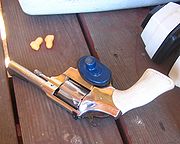 There are several types of locks that serve to make it difficult to discharge a firearm. Locks are considered less effective than keeping firearms stored in a lockable safe since locks are more easily defeated than approved safes. After stealing a locked firearm, a thief can bypass the lock at their leisure.
California effected regulations in 2000 that forced gun locks to be approved by a firearm safety device laboratory via California Penal Code Section 12088. All gun locks under this code must receive extensive tests including saw, pick, pull, and many other tests in order to be approved for the state of California. If a lock passes the requirements then it is said to be California Department of Justice
(CADOJ) approved.
may be inserted in the barrel (needed if the firearm design lacks a mechanical hold-open device). This is particularly important when shooters go down range to set up, score or remove targets.
. Hearing protection such as earplugs (disposable or reusable) or ear muffs (including electronic devices that amplify quiet sounds) can be used to reduce the risk of hearing damage.
and fully automatic
firearms, typically eject spent cartridge casings at high speed. Casings are also dangerously hot when ejected. Revolvers store spent casings in the chamber, but may emit a stream of hot gasses and possible fine particulate debris laterally from the interface between the revolving chamber and the gun barrel. Any of these may hurt the handler or bystanders through burning or impact damage. Because eyes are particularly vulnerable to this type of damage, eye protection should be worn to reduce the risk of injury. Prescription lenses and various tints to suit different light conditions are available. Some eye protection products are rated to withstand impact from birdshot loads, which offers protection against irresponsible firearms use by other game bird shooters.
Indoor ranges require good ventilation to remove pollutants. Indoor and outdoor ranges typically require extensive decontamination when they are decommissioned.
Lead, copper and other metals will also be released when a firearm is cleaned. Highly aggressive solvents and other agents used to remove lead and powder fouling may also present a hazard to health. Installing good ventilation, washing hands after handling firearms, and cleaning the space where the firearm was handled lessens the risk of unnecessary exposure.
of firearms and ammunition do happen. Malfunctions of the primer and/or powder within a cartridge are colloquially known as "misfires", and include failures to discharge (duds), delayed discharge (hang-fires), and incomplete or insufficient discharge (squibs). Mechanical malfunctions of the firearm are generally referred to as "jams", and include failures to feed, extract, or eject a cartridge; failure to fully cycle after firing; and failure of a recoil- or gas-operated firearm to lock back when empty (largely a procedural hazard, as "slide lock" is a visual cue that the firearm is empty). In the extreme, an overloaded round, blocked barrel, poor design and/or severely weakened breech can result in an explosive failure of the receiver, barrel, or other parts of the firearm.
When a misfire or jam occurs, gun safety dictates that the handler should exercise extreme caution, as a cartridge whose primer has been struck in a misfire or which has been deformed in a jam can discharge unexpectedly. The handler should wait two minutes with the firearm pointed in a safe direction, then carefully remove the magazine, extract any misfed or misfired cartridge, and with the breech open carefully check to ensure there is not a bullet or other obstruction lodged in the barrel. If there is, and a subsequent round is fired, the firearm can fail explosively resulting in serious injury.
or over-the-counter
drugs. Since such substances may affect a person's judgment even after consuming relatively small amounts, zero tolerance is advocated by gun safety teachers. This is codified in many states' penal codes as a crime of "carrying under the influence", with penalties similar to DWI
/DUI
.
Exhaustion can also constitute a form of impairment, as reaction time, cognitive processing and sensory perception are all impaired by sleep deprivation and/or physical exhaustion. Gun safety therefore discourages using firearms when exhausted.
The purpose of these rules is to prevent children from inadvertently handling firearms. These rules are part of the Eddie Eagle
program developed by the National Rifle Association
for preschoolers through 6th graders.
Older youth (age may vary per program) may take part in a program for safe rifle handling, such as the ones promoted by these organizations:
In 1902, the English politician and game
shooting enthusiast Mark Hanbury Beaufoy
wrote some much-quoted verses on gun safety, including many salient points. His verses "A Father's Advice" begin with the following:
Other influential teachers of gun safety include Massad Ayoob
, Clint Smith, Chuck Taylor, Jim Crews and Ignatius Piazza
.
Gun safety rules and mindset
The rules of gun safety follow from this mindset. There are many variations, and one of them is the Four Rules introduced by Colonel Jeff Cooper, which are:
The NRA provides a similar set of rules:
The Canadian Firearms Program uses the concept of The Four Firearm ACTS:
Treat firearms as if they are loaded
This rule is a matter of keeping a certain mindset. The purpose is to create safe handling habits, and to discourage reasoning along the lines of, "I know my gun is unloaded so certain unsafe practices are OK." The proposition "the gun is always loaded" is used as a shorthand, even though it may be assumed—or even positively known—that this is not true of a particular firearm.Many firearm accidents result from the handler mistakenly believing a firearm is emptied, safetied, or otherwise disabled when in fact it is ready to be discharged. Such misunderstandings can arise from a number of sources.
- Faulty handling of the firearm. A handler may execute the steps of procedures such as loading, firing and emptying in the wrong order or omit steps of the procedures.
- Misunderstandings about a firearm's status. For instance, a handler may think the safety is on when it is not. A round of ammunition may be in the chamberChamber (weaponry)In firearms, the chamber is that portion of the barrel or firing cylinder in which the cartridge is inserted prior to being fired. Rifles and pistols generally have a single chamber in their barrels, while revolvers have multiple chambers in their cylinders and no chamber in their barrel...
or in the magazine while the handler thinks it is empty. A handler may receive a firearm and assume it is in a certain state without checking whether that assumption is true. For example, as handlers interact and pass the firearm between them, each avoids over-relying on the "show clear" of the other. Person 1 may misjudge the status; person 2 cannot assume that "it's OK because person 1 already checked it." - Mechanical failures. Wear, faulty assembly, damage or faulty design of the firearm can cause it not to function as intended. For instance, a safety may have been worn down to a point where it is no longer functioning. Broken or worn parts in the trigger, sear or hammer/striker may have given the firearm a "hair trigger" (a very sensitive trigger). A dented or bent body of the firearm may cause jams or premature discharge of ammunition. Sensitivity to impact may cause a firearm to discharge if dropped or struck against another object.
If a handler always treats firearms as capable of being discharged at any time, the handler is more likely to take precautions to prevent an unintentional discharge and to avoid damage or injury if one does occur.
Point the muzzle away from non-targets
This rule is intended to minimize the damage caused by an unintended discharge. The first rule teaches that a firearm must be assumed to be ready to fire. This rule goes beyond that and says, "Since the firearm might fire, assume that it will and make sure no harm occurs when it does."A consequence of this rule is that any kind of playing or "toying" with firearms is prohibited. Playfully pointing firearms at people or other non-targets violates this rule and is possibly an extreme endangerment to life and/or property. To discourage this kind of behavior, the rule is sometimes alternately stated, "Never point a firearm at anything unless you intend to destroy it.".
Two natural "safe" directions to point the muzzle are upwards (at the sky) and downwards (at the ground). Both have their advantages and disadvantages. Firing at the ground may result in a ricochet
Ricochet
A ricochet is a rebound, bounce or skip off a surface, particularly in the case of a projectile. The possibility of ricochet is one of the reasons for the common firearms safety rule "Never shoot at a flat, hard surface."-Variables:...
or cause hazardous fragments to be flung at people or objects. Aiming upwards eliminates this risk but replaces it with the risk that the bullet may cause damage when it comes down to the ground again. A bullet fired straight up only returns at the terminal velocity
Terminal velocity
In fluid dynamics an object is moving at its terminal velocity if its speed is constant due to the restraining force exerted by the fluid through which it is moving....
of the bullet. However, a bullet fired at an angle not perfectly vertical will retain its spin on the way down and can attain much more lethal speeds. Several accidents have reportedly been caused by discharging firearms into the air; although the evidence in a few such cases has been disputed, a study by the Centers for Disease Control and Prevention
Centers for Disease Control and Prevention
The Centers for Disease Control and Prevention are a United States federal agency under the Department of Health and Human Services headquartered in Druid Hills, unincorporated DeKalb County, Georgia, in Greater Atlanta...
found 43 likely cases of injury from falling bullets during 2004 New Year
New Year
The New Year is the day that marks the time of the beginning of a new calendar year, and is the day on which the year count of the specific calendar used is incremented. For many cultures, the event is celebrated in some manner....
celebrations in Puerto Rico
Puerto Rico
Puerto Rico , officially the Commonwealth of Puerto Rico , is an unincorporated territory of the United States, located in the northeastern Caribbean, east of the Dominican Republic and west of both the United States Virgin Islands and the British Virgin Islands.Puerto Rico comprises an...
. It is also possible that the muzzle will inadvertently be pointed at a non-target such as someone's head or an aircraft.
In cases where the firearm is being handled indoors, up and down may not be safe directions. For example, a bullet fired upwards may travel through a ceiling and into an adjacent floor. In indoor areas where firearms will be handled often, a suitably safe direction should be designated. Firing ranges often designate a direction in which it is safe to point a firearm; almost universally this is downrange into a backstop which is designed to contain bullets and eliminate potential ricochets. In armories or other areas where weapons must be handled, a container filled with sand known as a "clearing barrel" or "clearing can" is often used for this purpose.
Keep fingers off the trigger
The trigger guard and area above the trigger of a firearm presents a natural point for a handler to keep their finger out straight alongside the weapon, so as not to violate this rule. Another recommendation is to keep the trigger finger above the trigger guard, so that there is less chance of the finger involuntarily slipping into the guard when startled. A properly indexed trigger finger also helps remind the person holding the firearm of the direction of the muzzle.
In popular culture
Popular culture
Popular culture is the totality of ideas, perspectives, attitudes, memes, images and other phenomena that are deemed preferred per an informal consensus within the mainstream of a given culture, especially Western culture of the early to mid 20th century and the emerging global mainstream of the...
, such as movies
Film
A film, also called a movie or motion picture, is a series of still or moving images. It is produced by recording photographic images with cameras, or by creating images using animation techniques or visual effects...
and TV shows
Television
Television is a telecommunication medium for transmitting and receiving moving images that can be monochrome or colored, with accompanying sound...
, this rule is often violated, even by characters who should be trained in gun safety such as military personnel
Soldier
A soldier is a member of the land component of national armed forces; whereas a soldier hired for service in a foreign army would be termed a mercenary...
or law enforcement officers
Police
The police is a personification of the state designated to put in practice the enforced law, protect property and reduce civil disorder in civilian matters. Their powers include the legitimized use of force...
.
Be sure of your target and of what is beyond it
This rule is intended to eliminate or minimize damage to non-targets when a firearm is intentionally discharged. Unintended damage may occur if a non-target is misidentified as a target, if the target is missed, or if the bullet hits something or someone other than the intended target.Handlers are taught that they must positively identify and verify their target. Additionally, they learn that even when firing at a valid target, unintended targets may still be hit, for three reasons:
- The bullet may miss the intended target and hit a non-target around or beyond the target.
- A non-target may pass in front of the target and be hit with a bullet aimed at the target.
- The bullet may pass through the intended target and hit a non-target beyond it, so called "overpenetration".
Therefore, this rule requires a handler to be sure of both the target itself and anything along the avenue of travel to and beyond the target.
This may create situations that present dilemmas for a handler. Such situations are for instance a police officer in a riot, a civilian facing a possible intruder at night, or a soldier in a situation where civilians are near the enemy. Indecision or misjudgment of the handler's abilities in such a situation may cause undesired outcomes, such as injury to the handler due to hesitation, or the handler violating rules of engagement
Rules of engagement
Rules of Engagement refers to those responses that are permitted in the employment of military personnel during operations or in the course of their duties. These rules of engagement are determined by the legal framework within which these duties are being carried out...
and causing unintended damage.
Training is used to minimize the risk of such outcomes. Target practice increases the precision with which the handler can discharge the firearm and thus increase the chances that the intended target is hit. Education about terminal ballistics
Terminal ballistics
Terminal ballistics, a sub-field of ballistics, is the study of the behavior of a projectile when it hits its target. It is often referred to as stopping power when dealing with human or other living targets. Terminal ballistics is relevant both for small caliber projectiles as well as for large...
gives the handler knowledge about the characteristics of a bullet after a target is hit. This knowledge coupled with insight into the handler's own capabilities makes it easier for the handler to make appropriate decisions about whether to discharge or not, even if given little time and/or put under severe stress.
Ammunition can be chosen to reduce the risk of overpenetration; see Terminal ballistics
Terminal ballistics
Terminal ballistics, a sub-field of ballistics, is the study of the behavior of a projectile when it hits its target. It is often referred to as stopping power when dealing with human or other living targets. Terminal ballistics is relevant both for small caliber projectiles as well as for large...
, Stopping power
Stopping power
Stopping power is a colloquial term used to describe the ability of a firearm or other weapon to cause a penetrating ballistic injury to a target, human or animal, sufficient to incapacitate the target where it stands....
, and Hollow point bullet
Hollow point bullet
A hollow point is an expanding bullet that has a pit or hollowed out shape in its tip, generally intended to cause the bullet to thin upon entering a target in order to decrease penetration and disrupt more tissue as it travels through the target. It is also used for controlled penetration, where...
.
Gun safety for firearms not in use
Gun safety for situations where firearms are not in use is intended to prevent access to and subsequent discharge of a firearm. Preventing access to firearms can serve a double purpose in that it can also protect the firearm from theft.Gun Safes
A Gun safeGun safe
A gun safe is a secure and protective storage container for one or more firearms, and, or ammunition for those guns. Gun safes are primarily used to prevent access to unauthorized or unqualified persons, for burglary protection, and, in more capable safes, to protect the contents from damage during...
or gun cabinet is commonly used to physically prevent access to a firearm. These have the primary purpose of preventing theft.
Disassembly
Access to a functioning firearm can be prevented by keeping the firearm disassembled and the parts stored at separate locations. Ammunition may also be stored away from the firearm. Sometimes this rule is codified in law. For example, Swedish law requires owners of firearms either to store the entire firearm in a safe or lockable gun rack, or to lock the "vital piece" (bolt, etc.) away in a safe place.Locks
- Trigger lockTrigger lockA trigger lock is a device designed to prevent a firearm from being discharged while the device is in place. Generally, two pieces come together from either side behind the trigger and are locked in place, which can be unlocked with a key or combination. This physically prevents the trigger from...
s prevent motion of the trigger. However a trigger lock does not guarantee that the firearm cannot be discharged (see above). Some trigger locks are integrated into the design of the weapon, requiring no external parts besides the key.
- Chamber lockChamber lockA chamber lock is a method of securing a firearm against accidental discharge.Chamber locks are used to prevent live ammunition from loading into a firearm by blocking the chamber with a dummy cartridge. The cartridge is sometimes wedged into place with the use of a tool, in essence jamming the gun...
s aim to block ammunition from being chambered, since most firearms typically cannot be discharged unless the ammunition is in the correct position.
- Cable locks are a popular type of chamber lock that usually threads through the breech and ejection port of repeating-action firearms; they generally prevent full cycling of the action, especially preventing a return to "battery", with the breech fully closed. In many designs of pistol and rifle, they also prevent the proper insertion of a magazine.
California effected regulations in 2000 that forced gun locks to be approved by a firearm safety device laboratory via California Penal Code Section 12088. All gun locks under this code must receive extensive tests including saw, pick, pull, and many other tests in order to be approved for the state of California. If a lock passes the requirements then it is said to be California Department of Justice
California Department of Justice
The California Department of Justice is the department in the California executive branch under the leadership of the California Attorney General.-Description:It has 5344 employees and a budget of $791 million...
(CADOJ) approved.
Open Bolt Indicator
Shooting ranges may require that firearms not in use have the bolt, slide or (in case of revolvers) cylinder locked open to expose the firing chamber as empty. In addition, an open bolt indicator, such as the yellow safety flag distributed by CMPCivilian Marksmanship Program
The Civilian Marksmanship Program is a U.S. government-chartered program that promotes firearms safety training and rifle practice for all qualified U.S. citizens with special emphasis on youth. Any U.S. citizen who is not legally prohibited from owning a firearm may purchase a military surplus...
may be inserted in the barrel (needed if the firearm design lacks a mechanical hold-open device). This is particularly important when shooters go down range to set up, score or remove targets.
Gun safety from secondary dangers
While a firearm's primary danger lies in the discharge of ammunition, there are other ways a firearm may be detrimental to the health of the handler and bystanders.Noise
When a firearm is discharged it emits a very loud noise, typically close to the handler's ears. This can cause temporary or permanent hearing damage such as tinnitusTinnitus
Tinnitus |ringing]]") is the perception of sound within the human ear in the absence of corresponding external sound.Tinnitus is not a disease, but a symptom that can result from a wide range of underlying causes: abnormally loud sounds in the ear canal for even the briefest period , ear...
. Hearing protection such as earplugs (disposable or reusable) or ear muffs (including electronic devices that amplify quiet sounds) can be used to reduce the risk of hearing damage.
Hot gases and debris
A firearm emits hot gases, powder, and other debris when discharged. Some weapons, such as semi-automaticSemi-automatic firearm
A semi-automatic, or self-loading firearm is a weapon which performs all steps necessary to prepare the weapon to fire again after firing—assuming cartridges remain in the weapon's feed device or magazine...
and fully automatic
Automatic firearm
An automatic firearm is a firearm that loads another round mechanically after the first round has been fired.The term can be used to refer to semi-automatic firearms, which fire one shot per single pull of the trigger , or fully automatic firearms, which will continue to load and fire ammunition...
firearms, typically eject spent cartridge casings at high speed. Casings are also dangerously hot when ejected. Revolvers store spent casings in the chamber, but may emit a stream of hot gasses and possible fine particulate debris laterally from the interface between the revolving chamber and the gun barrel. Any of these may hurt the handler or bystanders through burning or impact damage. Because eyes are particularly vulnerable to this type of damage, eye protection should be worn to reduce the risk of injury. Prescription lenses and various tints to suit different light conditions are available. Some eye protection products are rated to withstand impact from birdshot loads, which offers protection against irresponsible firearms use by other game bird shooters.
Toxins and pollutants
In recent years the toxic effects of ammunition and firearm cleaning agents have been highlighted.- Lead ammunition left in nature may become mobilized by acid rain.
- Older ammunition may have mercuryMercury (element)Mercury is a chemical element with the symbol Hg and atomic number 80. It is also known as quicksilver or hydrargyrum...
-based primers. - Lead accumulates in shooting range backstops.
Indoor ranges require good ventilation to remove pollutants. Indoor and outdoor ranges typically require extensive decontamination when they are decommissioned.
Lead, copper and other metals will also be released when a firearm is cleaned. Highly aggressive solvents and other agents used to remove lead and powder fouling may also present a hazard to health. Installing good ventilation, washing hands after handling firearms, and cleaning the space where the firearm was handled lessens the risk of unnecessary exposure.
Misfires
Though firearms and their ammunition are made to exacting specifications and tolerances and designed to function reliably, malfunctionsFirearm malfunction
A firearm malfunction is the partial or complete failure of a firearm to operate as intended. Malfunctions range from temporary and relatively safe situations, such as a casing that didn't eject, to potentially dangerous occurrences that may permanently damage the gun and cause injury or death...
of firearms and ammunition do happen. Malfunctions of the primer and/or powder within a cartridge are colloquially known as "misfires", and include failures to discharge (duds), delayed discharge (hang-fires), and incomplete or insufficient discharge (squibs). Mechanical malfunctions of the firearm are generally referred to as "jams", and include failures to feed, extract, or eject a cartridge; failure to fully cycle after firing; and failure of a recoil- or gas-operated firearm to lock back when empty (largely a procedural hazard, as "slide lock" is a visual cue that the firearm is empty). In the extreme, an overloaded round, blocked barrel, poor design and/or severely weakened breech can result in an explosive failure of the receiver, barrel, or other parts of the firearm.
When a misfire or jam occurs, gun safety dictates that the handler should exercise extreme caution, as a cartridge whose primer has been struck in a misfire or which has been deformed in a jam can discharge unexpectedly. The handler should wait two minutes with the firearm pointed in a safe direction, then carefully remove the magazine, extract any misfed or misfired cartridge, and with the breech open carefully check to ensure there is not a bullet or other obstruction lodged in the barrel. If there is, and a subsequent round is fired, the firearm can fail explosively resulting in serious injury.
Impairment
Since handling a firearm is a complex task, with possible fatal outcomes if done improperly, gun safety dictates that a firearm should never be handled while under the influence of alcohol or drugs, or legal prescriptionMedical prescription
A prescription is a health-care program implemented by a physician or other medical practitioner in the form of instructions that govern the plan of care for an individual patient. Prescriptions may include orders to be performed by a patient, caretaker, nurse, pharmacist or other therapist....
or over-the-counter
Over-the-counter drug
Over-the-counter drugs are medicines that may be sold directly to a consumer without a prescription from a healthcare professional, as compared to prescription drugs, which may be sold only to consumers possessing a valid prescription...
drugs. Since such substances may affect a person's judgment even after consuming relatively small amounts, zero tolerance is advocated by gun safety teachers. This is codified in many states' penal codes as a crime of "carrying under the influence", with penalties similar to DWI
DWI
DWI is an acronym which means:* Driving while intoxicated, see Driving under the influence* Driving while impaired* Danish West Indies* Diffusion-weighted imaging, a technique used in magnetic resonance imaging* Drinking Water Inspectorate...
/DUI
DUI
DUI is a three letter acronym that may stand for:* Driving under the influence * Democratic Union for Integration — the largest ethnic Albanian party in the Republic of Macedonia* Data Use Identifier...
.
Exhaustion can also constitute a form of impairment, as reaction time, cognitive processing and sensory perception are all impaired by sleep deprivation and/or physical exhaustion. Gun safety therefore discourages using firearms when exhausted.
Gun safety for children
Children who are generally considered too young to be allowed to handle firearms at all can be taught a different set of rules:- Stop.
- Don't touch.
- Leave the area.
- Tell an adult.
The purpose of these rules is to prevent children from inadvertently handling firearms. These rules are part of the Eddie Eagle
Eddie Eagle
The Eddie Eagle program and its namesake character were developed by the National Rifle Association for children who are generally considered too young to be allowed to handle firearms...
program developed by the National Rifle Association
National Rifle Association
The National Rifle Association of America is an American non-profit 501 civil rights organization which advocates for the protection of the Second Amendment of the United States Bill of Rights and the promotion of firearm ownership rights as well as marksmanship, firearm safety, and the protection...
for preschoolers through 6th graders.
Older youth (age may vary per program) may take part in a program for safe rifle handling, such as the ones promoted by these organizations:
- 4H Shooting Sports Programs4H Shooting Sports Programs4-H in the United States is a youth organization administered by the National Institute of Food and Agriculture of the United States Department of Agriculture , with the mission of "engaging youth to reach their fullest potential while advancing the field of youth development." The name represents...
- Boy Scouts of AmericaBoy Scouts of AmericaThe Boy Scouts of America is one of the largest youth organizations in the United States, with over 4.5 million youth members in its age-related divisions...
- National Rifle AssociationNational Rifle AssociationThe National Rifle Association of America is an American non-profit 501 civil rights organization which advocates for the protection of the Second Amendment of the United States Bill of Rights and the promotion of firearm ownership rights as well as marksmanship, firearm safety, and the protection...
- Civilian Marksmanship ProgramCivilian Marksmanship ProgramThe Civilian Marksmanship Program is a U.S. government-chartered program that promotes firearms safety training and rifle practice for all qualified U.S. citizens with special emphasis on youth. Any U.S. citizen who is not legally prohibited from owning a firearm may purchase a military surplus...
History and teachers of gun safety
While gun safety in different forms has existed since the creation of firearms, Jeff Cooper (1920–2006), an influential figure in modern firearms training, formalised and popularized the above-listed "Four Rules" of safe firearm handling. Prior lists of gun safety rules included as few as three basic safety rules or as many as ten rules including gun safety and sporting etiquette rules.In 1902, the English politician and game
Game (food)
Game is any animal hunted for food or not normally domesticated. Game animals are also hunted for sport.The type and range of animals hunted for food varies in different parts of the world. This will be influenced by climate, animal diversity, local taste and locally accepted view about what can or...
shooting enthusiast Mark Hanbury Beaufoy
Mark Hanbury Beaufoy
Mark Hanbury Beaufoy JP was an English vinegar manufacturer and Liberal member of parliament. He wrote A Father's Advice, a famous piece of verse about gun safety.-Background and early life:...
wrote some much-quoted verses on gun safety, including many salient points. His verses "A Father's Advice" begin with the following:
- "If a sportsman true you'd be
- Listen carefully to me:
- Never, never, let your gun
- Pointed be at anyone..."
Other influential teachers of gun safety include Massad Ayoob
Massad Ayoob
Massad F. Ayoob is an internationally known firearms and self-defense instructor. He has taught police techniques and civilian self-defense to both law enforcement officers and private citizens in numerous venues since 1974...
, Clint Smith, Chuck Taylor, Jim Crews and Ignatius Piazza
Ignatius Piazza
Dr. Ignatius "Naish" Piazza is the founder and director of the Front Sight Firearms Training Institute in Pahrump, Nevada. He lives near Santa Cruz, California.-Biography:...
.
External links
- GunProof - Website dedicated to helping gun proof children.
- LOK-IT-UP - A public awareness program encouraging the safe storage of firearms.
- Controversy over exact choice of rules for gun safety (specifically whether or not "the gun is always loaded" is an intelligent rule).
- NRA Gun Safety Rules - Also deals with issues such as eye and ear protection.
- Project ChildSafe
- Canadian page about ACTS and PROVE
- Page about acquiring firearms licenses and regulations in Canada