


Great rhombitrihexagonal tiling

Encyclopedia
In geometry
, the truncated trihexagonal tiling is a semiregular tiling of the Euclidean plane. There are one square
, one hexagon, and one dodecagon
on each vertex
. It has Schläfli symbol of t0,1,2{3,6}.
There are 3 regular and 8 semiregular tilings in the plane.
of a truncated trihexagonal tiling, with faces colored by polygon sides.
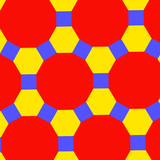
A 2-uniform coloring allows for alternately colored hexagons.
polyhedra with vertex figure (4.6.2p) and Coxeter-Dynkin diagram
. The following forms exist as tilings of the hyperbolic plane, starting with the truncated triheptagonal tiling. This set of polyhedra are zonohedron
s.
Geometry
Geometry arose as the field of knowledge dealing with spatial relationships. Geometry was one of the two fields of pre-modern mathematics, the other being the study of numbers ....
, the truncated trihexagonal tiling is a semiregular tiling of the Euclidean plane. There are one square
Square (geometry)
In geometry, a square is a regular quadrilateral. This means that it has four equal sides and four equal angles...
, one hexagon, and one dodecagon
Dodecagon
In geometry, a dodecagon is any polygon with twelve sides and twelve angles.- Regular dodecagon :It usually refers to a regular dodecagon, having all sides of equal length and all angles equal to 150°...
on each vertex
Vertex (geometry)
In geometry, a vertex is a special kind of point that describes the corners or intersections of geometric shapes.-Of an angle:...
. It has Schläfli symbol of t0,1,2{3,6}.
There are 3 regular and 8 semiregular tilings in the plane.
Other names
- Great rhombitrihexagonal tiling
- Rhombitruncated trihexagonal tiling
- Omnitruncated hexagonal tiling, omnitruncated triangular tiling
- ConwayJohn Horton ConwayJohn Horton Conway is a prolific mathematician active in the theory of finite groups, knot theory, number theory, combinatorial game theory and coding theory...
calls it a truncated hexadeltille, constructed as a truncationTruncation (geometry)In geometry, a truncation is an operation in any dimension that cuts polytope vertices, creating a new facet in place of each vertex.- Uniform truncation :...
operation applied to a trihexagonal tilingTrihexagonal tilingIn geometry, the trihexagonal tiling is a semiregular tiling of the Euclidean plane. There are two triangles and two hexagons alternating on each vertex...
(hexadeltille).
Uniform colorings
There is only one uniform coloringUniform coloring
In geometry, a uniform coloring is a property of a uniform figure that is colored to be vertex-transitive...
of a truncated trihexagonal tiling, with faces colored by polygon sides.
A 2-uniform coloring allows for alternately colored hexagons.
Related polyhedra and tilings
This tiling is topologically related as a part of sequence of omnitruncatedOmnitruncation (geometry)
In geometry, an omnitruncation is an operation applied to a regular polytope in a Wythoff construction that creates a maximum number of facets...
polyhedra with vertex figure (4.6.2p) and Coxeter-Dynkin diagram
Coxeter-Dynkin diagram
In geometry, a Coxeter–Dynkin diagram is a graph with numerically labeled edges representing the spatial relations between a collection of mirrors...
. The following forms exist as tilings of the hyperbolic plane, starting with the truncated triheptagonal tiling. This set of polyhedra are zonohedron
Zonohedron
A zonohedron is a convex polyhedron where every face is a polygon with point symmetry or, equivalently, symmetry under rotations through 180°. Any zonohedron may equivalently be described as the Minkowski sum of a set of line segments in three-dimensional space, or as the three-dimensional...
s.
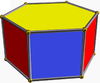 (4.6.4) Hexagonal prism In geometry, the hexagonal prism is a prism with hexagonal base. The shape has 8 faces, 18 edges, and 12 vertices.Since it has eight faces, it is an octahedron. However, the term octahedron is primarily used to refer to the regular octahedron, which has eight triangular faces... |
 (4.6.6) Truncated octahedron In geometry, the truncated octahedron is an Archimedean solid. It has 14 faces , 36 edges, and 24 vertices. Since each of its faces has point symmetry the truncated octahedron is a zonohedron.... |
 (4.6.8) Truncated cuboctahedron In geometry, the truncated cuboctahedron is an Archimedean solid. It has 12 square faces, 8 regular hexagonal faces, 6 regular octagonal faces, 48 vertices and 72 edges... |
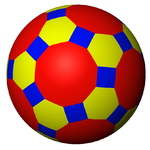 (4.6.10) Truncated icosidodecahedron In geometry, the truncated icosidodecahedron is an Archimedean solid, one of thirteen convex isogonal nonprismatic solids constructed by two or more types of regular polygon faces.... |
(4.6.12) |
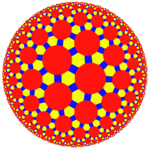 (4.6.14) |
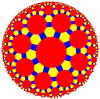 (4.6.16) |
(4.6.18) |