

Hexagonal prism

Encyclopedia
In geometry
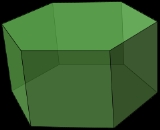
, the hexagonal prism is a prism
with hexagonal base. The shape has 8 faces, 18 edges, and 12 vertices.
Since it has eight faces
, it is an octahedron. However, the term octahedron is primarily used to refer to the regular octahedron, which has eight triangular faces. Because of the ambiguity of the term octahedron and the dissimilarity of the various eight-sided figures, the term is rarely used without clarification.
, more generally, a uniform polyhedron
, and the fourth in an infinite set of prisms formed by square sides and two regular polygon caps. It can be seen as a truncated
hexagonal hosohedron, represented by Schläfli symbol t{2,6}. Alternately it can be seen as the Cartesian product
of a regular hexagon and a line segment
, and represented by the product {6}x{}. The dual
of a hexagonal prism is a hexagonal bipyramid
.
The symmetry group
of a right pentagonal prism is D6h
of order 24. The rotation group
is D6 of order 12.
 , and multiplying it by the height
  .
.

It also exists as cells of a number of four-dimensional uniform polychora
, including:
Geometry
Geometry arose as the field of knowledge dealing with spatial relationships. Geometry was one of the two fields of pre-modern mathematics, the other being the study of numbers ....
, the hexagonal prism is a prism
Prism (geometry)
In geometry, a prism is a polyhedron with an n-sided polygonal base, a translated copy , and n other faces joining corresponding sides of the two bases. All cross-sections parallel to the base faces are the same. Prisms are named for their base, so a prism with a pentagonal base is called a...
with hexagonal base. The shape has 8 faces, 18 edges, and 12 vertices.
Since it has eight faces
Face (geometry)
In geometry, a face of a polyhedron is any of the polygons that make up its boundaries. For example, any of the squares that bound a cube is a face of the cube...
, it is an octahedron. However, the term octahedron is primarily used to refer to the regular octahedron, which has eight triangular faces. Because of the ambiguity of the term octahedron and the dissimilarity of the various eight-sided figures, the term is rarely used without clarification.
As a semiregular (or uniform) polyhedron
If faces are all regular, the hexagonal prism is a semiregular polyhedronSemiregular polyhedron
The term semiregular polyhedron is used variously by different authors.In its original definition, it is a polyhedron with regular faces and a symmetry group which is transitive on its vertices, which is more commonly referred to today as a uniform polyhedron...
, more generally, a uniform polyhedron
Uniform polyhedron
A uniform polyhedron is a polyhedron which has regular polygons as faces and is vertex-transitive...
, and the fourth in an infinite set of prisms formed by square sides and two regular polygon caps. It can be seen as a truncated
Truncation (geometry)
In geometry, a truncation is an operation in any dimension that cuts polytope vertices, creating a new facet in place of each vertex.- Uniform truncation :...
hexagonal hosohedron, represented by Schläfli symbol t{2,6}. Alternately it can be seen as the Cartesian product
Cartesian product
In mathematics, a Cartesian product is a construction to build a new set out of a number of given sets. Each member of the Cartesian product corresponds to the selection of one element each in every one of those sets...
of a regular hexagon and a line segment
Line segment
In geometry, a line segment is a part of a line that is bounded by two end points, and contains every point on the line between its end points. Examples of line segments include the sides of a triangle or square. More generally, when the end points are both vertices of a polygon, the line segment...
, and represented by the product {6}x{}. The dual
Dual polyhedron
In geometry, polyhedra are associated into pairs called duals, where the vertices of one correspond to the faces of the other. The dual of the dual is the original polyhedron. The dual of a polyhedron with equivalent vertices is one with equivalent faces, and of one with equivalent edges is another...
of a hexagonal prism is a hexagonal bipyramid
Hexagonal bipyramid
A hexagonal bipyramid is a polyhedron formed from two hexagonal pyramids joined at their bases. The resulting solid has 12 triangular faces, 8 vertices and 18 edges. The 12 faces are identical isosceles triangles.It is one of an infinite set of bipyramids...
.
The symmetry group
Symmetry group
The symmetry group of an object is the group of all isometries under which it is invariant with composition as the operation...
of a right pentagonal prism is D6h
Dihedral group
In mathematics, a dihedral group is the group of symmetries of a regular polygon, including both rotations and reflections. Dihedral groups are among the simplest examples of finite groups, and they play an important role in group theory, geometry, and chemistry.See also: Dihedral symmetry in three...
of order 24. The rotation group
Rotation group
In mechanics and geometry, the rotation group is the group of all rotations about the origin of three-dimensional Euclidean space R3 under the operation of composition. By definition, a rotation about the origin is a linear transformation that preserves length of vectors and preserves orientation ...
is D6 of order 12.
Facts
Octahedron is commonly used because it has 8 triangular faces. It can also be called free fallVolume
As in most prisms, the volume is found by taking the area of the base, with a side length of, and multiplying it by the height .Use
It exists as cells of four prismatic uniform honeycombs in 3 dimensions:| Hexagonal prismatic honeycomb Hexagonal prismatic honeycomb The hexagonal prismatic honeycomb is a space-filling tessellation in Euclidean 3-space made up of hexagonal prisms.It is constructed from a hexagonal tiling extruded into prisms.It is one of 28 convex uniform honeycombs.- References :... |
Triangular-hexagonal prismatic honeycomb Triangular-hexagonal prismatic honeycomb The triangular-hexagonal prismatic honeycomb is a space-filling tessellation in Euclidean 3-space. It is composed of hexagonal prisms and triangular prisms in a ratio of 1:2.It is constructed from a trihexagonal tiling extruded into prisms.... |
Snub triangular-hexagonal prismatic honeycomb Snub triangular-hexagonal prismatic honeycomb The Snub triangular-hexagonal prismatic honeycomb is a space-filling tessellation in Euclidean 3-space. It is composed of hexagonal prisms and triangular prisms in a ratio of 1:8.... |
Rhombitriangular-hexagonal prismatic honeycomb Rhombitriangular-hexagonal prismatic honeycomb The rhombitriangular-hexagonal prismatic honeycomb is a space-filling tessellation in Euclidean 3-space. It is composed of hexagonal prisms, cubes, and triangular prisms in a ratio of 1:3:2.... |
 |
 |
 |
 |
It also exists as cells of a number of four-dimensional uniform polychora
Uniform polychoron
In geometry, a uniform polychoron is a polychoron or 4-polytope which is vertex-transitive and whose cells are uniform polyhedra....
, including:
| truncated tetrahedral prism Truncated tetrahedral prism In geometry, a truncated tetrahedral prism is a convex uniform polychoron . This polychoron has 10 polyhedral cells: 2 truncated tetrahedra connected by 4 triangular prisms and 4 hexagonal prisms. It has 24 faces: 8 triangular, 18 square, and 8 hexagons. It has 48 edges and 24 vertices.Alternative... |
truncated octahedral prism Truncated octahedral prism In 4-dimensional geometry, a truncated octahedral prism is a convex uniform polychoron . This polychoron has 16 cells It has 64 faces , and 96 edges and 48 vertices.It has two symmetry constructions, one from the truncated octahedron, and one as an omnitruncation of... |
Truncated cuboctahedral prism Truncated cuboctahedral prism In geometry, a truncated cuboctahedral prism is a convex uniform polychoron .It is one of 18 convex uniform polyhedral prisms created by using uniform prisms to connect pairs of Platonic solids or Archimedean solids in parallel hyperplanes.- Alternative names :* Truncated-cuboctahedral dyadic prism... |
Truncated icosahedral prism Truncated icosahedral prism In geometry, a truncated icosahedral prism is a convex uniform polychoron .It is one of 18 convex uniform polyhedral prisms created by using uniform prisms to connect pairs of Platonic solids or Archimedean solids in parallel hyperplanes.- Alternative names :* Truncated-icosahedral dyadic prism In... |
Truncated icosidodecahedral prism Truncated icosidodecahedral prism In geometry, a truncated icosidodecahedral prism is a convex uniform polychoron .It is one of 18 convex uniform polyhedral prisms created by using uniform prisms to connect pairs of Platonic solids or Archimedean solids in parallel hyperplanes.- Alternative names :* Truncated-icosidodecahedral... |
 |
 |
 |
 |
 |
| runcitruncated 5-cell |
omnitruncated 5-cell |
runcitruncated 16-cell |
omnitruncated tesseract |
|
| runcitruncated 24-cell |
omnitruncated 24-cell |
runcitruncated 600-cell |
omnitruncated 120-cell |
|
See also
- Set of prismsPrism (geometry)In geometry, a prism is a polyhedron with an n-sided polygonal base, a translated copy , and n other faces joining corresponding sides of the two bases. All cross-sections parallel to the base faces are the same. Prisms are named for their base, so a prism with a pentagonal base is called a...
- Triangular prismTriangular prismIn geometry, a triangular prism is a three-sided prism; it is a polyhedron made of a triangular base, a translated copy, and 3 faces joining corresponding sides....
- CubeCubeIn geometry, a cube is a three-dimensional solid object bounded by six square faces, facets or sides, with three meeting at each vertex. The cube can also be called a regular hexahedron and is one of the five Platonic solids. It is a special kind of square prism, of rectangular parallelepiped and...
Square-capped prism - Pentagonal prismPentagonal prismIn geometry, the pentagonal prism is a prism with a pentagonal base. It is a type of heptahedron with 7 faces, 15 edges, and 10 vertices.- As a semiregular polyhedron :...
External links
- Hexagonal Prism Interactive Model -- works in your web browser