

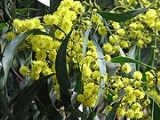
Golden Wattle

Encyclopedia
Acacia pycnantha is Australia
's floral emblem
. It is a tree which flowers in late winter and spring, producing a mass of fragrant, fluffy, golden flowers.
but have long, sickle
-shaped phyllodes. These are shiny and dark green and are between 8 and 20 cm long and 0.5 to 3.5 cm wide. The rounded inflorescences are bright yellow and occur in axillary racemes or terminal panicles in groupings of between 4 and 23. These are followed by flattish, straight or slightly curved pods which are 5 to 14 cm long and 0.5 to 0.8 cm wide.
in the London Journal of Botany in 1842. The type specimen was collected by the explorer Thomas Mitchell from the interior of New South Wales
.
The specific epithet pycnantha is derived from the Greek
words pyknos (dense) and anthos (flowers), a reference to the dense cluster of flowers that make up the globular inflorescences.
Synonyms
include:
’s southern Eyre Peninsula
into western Victoria
and northwards into inland areas of southern New South Wales and the Australian Capital Territory
. It is found in the understorey
of open eucalypt
forests on dry, shallow soils. It is naturalised in areas within all the southern states of Australia as well as South Africa
and California
.
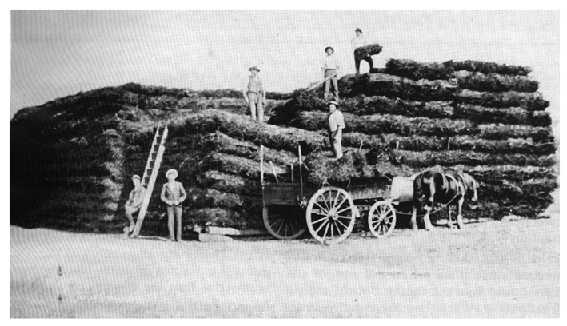 Golden Wattle has been grown in temperate regions around the world for the tannin
in its bark, which provides the highest yield of all the wattles. The scented flowers have been utilised for perfume
making.
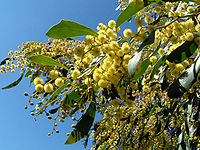 Although wattles, and in particular the Golden Wattle, have been the informal floral emblem of Australia for many years, it was not until Australia’s bicentenary in 1988 that the Golden Wattle was formally adopted as the Floral Emblem of Australia. The date of gazettal was 1 September which was marked by a ceremony at the Australian National Botanic Gardens
which included the planting of a Golden Wattle by Hazel Hawke
, the Prime Minister’s
wife. In 1992, 1 September was formally declared as "National Wattle Day".
The Australian Coat of Arms
includes a wreath of wattle, however this does not accurately represent a Golden Wattle. Similarly, the green and gold
colours used by Australian international sporting teams were inspired by the colours of wattles in general, rather than the Golden Wattle specifically.
The species was depicted on a 2 shilling stamp captioned "wattle" as part of a 1959-60 Australian stamp set featuring Australian native flowers. In 1970 a 5c stamp labelled "Golden Wattle" was issued to complement an earlier set depicting the floral emblems of Australia. To mark Australia Day
in 1990 a 41c stamp labelled "Acacia pycnantha" was issued. The Golden Wattle inspired the design and decoration of the Order of Australia
which was established in 1975. The crest of the Governor-General of Australia features St. Edward's Crown over a sprig of Golden Wattle.
Australia
Australia , officially the Commonwealth of Australia, is a country in the Southern Hemisphere comprising the mainland of the Australian continent, the island of Tasmania, and numerous smaller islands in the Indian and Pacific Oceans. It is the world's sixth-largest country by total area...
's floral emblem
Floral emblem
In a number of countries, plants have been chosen as symbols to represent specific geographic areas. Some countries have a country-wide floral emblem; others in addition have symbols representing subdivisions. Different processes have been used to adopt these symbols - some are conferred by...
. It is a tree which flowers in late winter and spring, producing a mass of fragrant, fluffy, golden flowers.
Description
The species grows to between 2 and 8 metres in height with generally smooth, dark brown to grey bark. The mature trees do not have true leavesLeaf
A leaf is an organ of a vascular plant, as defined in botanical terms, and in particular in plant morphology. Foliage is a mass noun that refers to leaves as a feature of plants....
but have long, sickle
Sickle
A sickle is a hand-held agricultural tool with a variously curved blade typically used for harvesting grain crops or cutting succulent forage chiefly for feeding livestock . Sickles have also been used as weapons, either in their original form or in various derivations.The diversity of sickles that...
-shaped phyllodes. These are shiny and dark green and are between 8 and 20 cm long and 0.5 to 3.5 cm wide. The rounded inflorescences are bright yellow and occur in axillary racemes or terminal panicles in groupings of between 4 and 23. These are followed by flattish, straight or slightly curved pods which are 5 to 14 cm long and 0.5 to 0.8 cm wide.
Taxonomy
Acacia pycnantha was first formally described by botanist George BenthamGeorge Bentham
George Bentham CMG FRS was an English botanist, characterized by Duane Isely as "the premier systematic botanist of the nineteenth century".- Formative years :...
in the London Journal of Botany in 1842. The type specimen was collected by the explorer Thomas Mitchell from the interior of New South Wales
New South Wales
New South Wales is a state of :Australia, located in the east of the country. It is bordered by Queensland, Victoria and South Australia to the north, south and west respectively. To the east, the state is bordered by the Tasman Sea, which forms part of the Pacific Ocean. New South Wales...
.
The specific epithet pycnantha is derived from the Greek
Greek language
Greek is an independent branch of the Indo-European family of languages. Native to the southern Balkans, it has the longest documented history of any Indo-European language, spanning 34 centuries of written records. Its writing system has been the Greek alphabet for the majority of its history;...
words pyknos (dense) and anthos (flowers), a reference to the dense cluster of flowers that make up the globular inflorescences.
Synonyms
Synonym (taxonomy)
In scientific nomenclature, a synonym is a scientific name that is or was used for a taxon of organisms that also goes by a different scientific name. For example, Linnaeus was the first to give a scientific name to the Norway spruce, which he called Pinus abies...
include:
- Acacia falcinella Meisn.
- Acacia petiolaris Lehm.
- Acacia pycnantha var. petiolaris H.Vilm.
- Acacia pycnantha Benth. var. pycnantha
- Acacia westonii Maiden
- Racosperma pycnanthum (Benth.) Pedley
Distribution
Golden Wattle occurs in south-eastern Australia from South AustraliaSouth Australia
South Australia is a state of Australia in the southern central part of the country. It covers some of the most arid parts of the continent; with a total land area of , it is the fourth largest of Australia's six states and two territories.South Australia shares borders with all of the mainland...
’s southern Eyre Peninsula
Eyre Peninsula
Eyre Peninsula is a triangular peninsula in South Australia. It is bounded on the east by Spencer Gulf, the west by the Great Australian Bight, and the north by the Gawler Ranges. It is named after explorer Edward John Eyre who explored some of it in 1839-1841. The coastline was first explored by...
into western Victoria
Victoria (Australia)
Victoria is the second most populous state in Australia. Geographically the smallest mainland state, Victoria is bordered by New South Wales, South Australia, and Tasmania on Boundary Islet to the north, west and south respectively....
and northwards into inland areas of southern New South Wales and the Australian Capital Territory
Australian Capital Territory
The Australian Capital Territory, often abbreviated ACT, is the capital territory of the Commonwealth of Australia and is the smallest self-governing internal territory...
. It is found in the understorey
Understory
Understory is the term for the area of a forest which grows at the lowest height level below the forest canopy. Plants in the understory consist of a mixture of seedlings and saplings of canopy trees together with understory shrubs and herbs...
of open eucalypt
Eucalypt
Eucalypts are woody plants belonging to three closely related genera:Eucalyptus, Corymbia and Angophora.In 1995 new evidence, largely genetic, indicated that some prominent Eucalyptus species were actually more closely related to Angophora than to the other eucalypts; they were split off into the...
forests on dry, shallow soils. It is naturalised in areas within all the southern states of Australia as well as South Africa
South Africa
The Republic of South Africa is a country in southern Africa. Located at the southern tip of Africa, it is divided into nine provinces, with of coastline on the Atlantic and Indian oceans...
and California
California
California is a state located on the West Coast of the United States. It is by far the most populous U.S. state, and the third-largest by land area...
.
Uses
Tannin
A tannin is an astringent, bitter plant polyphenolic compound that binds to and precipitates proteins and various other organic compounds including amino acids and alkaloids.The term tannin refers to the use of...
in its bark, which provides the highest yield of all the wattles. The scented flowers have been utilised for perfume
Perfume
Perfume is a mixture of fragrant essential oils and/or aroma compounds, fixatives, and solvents used to give the human body, animals, objects, and living spaces "a pleasant scent"...
making.
Cultivation
Golden Wattle is cultivated in Australia and was introduced to the northern hemisphere in the mid 1800s. Although it is short lived, it is widely grown for its bright yellow, fragrant flowers. The species has a degree of frost tolerance and is adaptable to a wide range of soil conditions, however it prefers good drainage. Propagation is from seed which has been pre-soaked in hot water to soften the hard seed coating.Symbolic references
Australian National Botanic Gardens
The Australian National Botanic Gardens are located in Canberra and are administered by the Australian Government's Department of the Environment and Heritage....
which included the planting of a Golden Wattle by Hazel Hawke
Hazel Hawke
Hazel Hawke, AO is the former wife of Bob Hawke, Prime Minister of Australia 1983–91. They divorced after he left the prime ministership. She worked in social policy areas, and was an excellent amateur pianist and a patron of the arts...
, the Prime Minister’s
Prime Minister of Australia
The Prime Minister of the Commonwealth of Australia is the highest minister of the Crown, leader of the Cabinet and Head of Her Majesty's Australian Government, holding office on commission from the Governor-General of Australia. The office of Prime Minister is, in practice, the most powerful...
wife. In 1992, 1 September was formally declared as "National Wattle Day".
The Australian Coat of Arms
Coat of arms of Australia
The coat of arms of Australia is the official symbol of Australia. The initial coat of arms was granted by King Edward VII on 7 May 1908, and the current version was granted by King George V on 19 September 1912, although the 1908 version continued to be used in some contexts, notably appearing on...
includes a wreath of wattle, however this does not accurately represent a Golden Wattle. Similarly, the green and gold
Green and gold
The national colours of Australia are green and gold, as proclaimed by Sir Ninian Stephen, the Governor-General of Australia on 19 April 1984...
colours used by Australian international sporting teams were inspired by the colours of wattles in general, rather than the Golden Wattle specifically.
The species was depicted on a 2 shilling stamp captioned "wattle" as part of a 1959-60 Australian stamp set featuring Australian native flowers. In 1970 a 5c stamp labelled "Golden Wattle" was issued to complement an earlier set depicting the floral emblems of Australia. To mark Australia Day
Australia Day
Australia Day is the official national day of Australia...
in 1990 a 41c stamp labelled "Acacia pycnantha" was issued. The Golden Wattle inspired the design and decoration of the Order of Australia
Order of Australia
The Order of Australia is an order of chivalry established on 14 February 1975 by Elizabeth II, Queen of Australia, "for the purpose of according recognition to Australian citizens and other persons for achievement or for meritorious service"...
which was established in 1975. The crest of the Governor-General of Australia features St. Edward's Crown over a sprig of Golden Wattle.
See also
- List of flora on stamps of Australia
- Acacia salignaAcacia salignaAcacia saligna, commonly known by various names including coojong, golden wreath wattle, orange wattle, blue-leafed wattle, Western Australian golden wattle, and, in Africa, Port Jackson willow, is a small tree in the family Fabaceae...
(also known as "golden wattle")