


Germ layer

Encyclopedia
A germ layer, occasionally referred to as a germinal epithelium
, is a group of cell
s, formed during animal embryogenesis
. Germ layers are particularly pronounced in the vertebrate
s; however, all animal
s more complex than sponges
(eumetazoa
ns and agnotozoans) produce two or three primary tissue layers (sometimes called primary germ layers). Animals with radial symmetry, like cnidaria
ns, produce two germ layers (the ectoderm
and endoderm
) making them diploblastic. Animals with bilateral symmetry produce a third layer between these two layers (appropriately called the mesoderm
) making them triploblastic. Germ layers eventually give rise to all of an animal’s tissues
and organ
s through the process of organogenesis
.
 Caspar Friedrich Wolff
observed organization of the early embryo in leaf-like layers. In 1817, Heinz Christian Pander
discovered three primordial germ layers while studying chick embryos. Between 1850 and 1855, Robert Remak
had further refined the germ cell layer concept, and introduced into English were the terms "mesoderm
" by Huxley in 1871 and "ectoderm
" and "endoderm
" by Lankester
in 1873.
Among animal
s, sponges
show the simplest organization, having a single germ layer. Although they have differentiated cells (e.g. collar cell
s), they lack true tissue coordination. Diploblastic animals, Cnidaria
and Ctenophora, show an increase in complexity, having two germ layers, the endoderm
and ectoderm
. Diploblastic animals are organized into recognisable tissues. All higher animals (from flatworms to humans) are triploblastic, possessing a mesoderm
in addition to the germ layers found in Diploblasts. Triploblastic animals develop recognisable organs.
leads to the formation of a zygote
. During the next stage, cleavage
, mitotic
cell divisions transform the zygote into a tiny ball of cells, a blastula
. This early embryonic form undergoes gastrulation
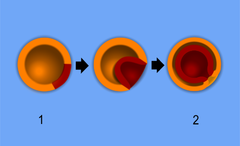
, forming a gastrula with either two or three layers (the germ layers). In all vertebrate
s, these are the forerunners of all adult tissues and organs.
The appearance of the archenteron
marks the onset of gastrulation.
In humans, after about three days, the zygote forms a solid mass of cells by mitotic division, called a morula
. This then changes to a blastocyst
, consisting of an outer layer called a trophoblast
, and an inner cell mass called the embryoblast. Filled with uterine fluid, the blastocyst breaks out of the zona pellucida and undergoes implantation. The inner cell mass initially has two layers: the hypoblast
and epiblast
. At the end of the second week, a primitive streak
appears. The epiblast in this region moves towards the primitive streak, dives down into it, and forms a new layer, called the endoderm
, pushing the hypoblast out of the way (this goes on to form the amnion
.) The epiblast keeps moving and forms a second layer, the mesoderm
. The top layer is now called the ectoderm
.
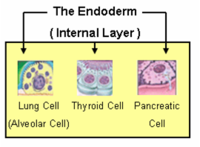
The endoderm is one of the germ layers formed during animal embryogenesis. Cells migrating inward along the archenteron form the inner layer of the gastrula, which develops into the endoderm
.
The endoderm consists at first of flattened cells, which subsequently become columnar. It forms the epithelial lining of the whole of the digestive tube except part of the mouth and pharynx and the terminal part of the rectum (which are lined by involutions of the ectoderm). It also forms the lining cells of all the glands which open into the digestive tube, including those of the liver and pancreas; the epithelium of the auditory tube and tympanic cavity; the trachea, bronchi, and air cells of the lungs; the urinary bladder and part of the urethra; and the follicle lining of the thyroid gland and thymus.
The endoderm
forms: the stomach, the colon, the liver, the pancreas, the urinary bladder, the lining of the urethra, the epithelial parts of trachea, the lungs, the pharynx, the thyroid, the parathyroid, and the intestines.
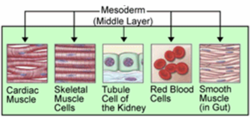
The mesoderm germ layer forms in the embryo
s of triploblastic animal
s. During gastrulation
, some of the cells migrating inward contribute to the mesoderm
, an additional layer between the endoderm and the ectoderm
.
The formation of a mesoderm led to the development of a coelom
. Organs formed inside a coelom can freely move, grow, and develop independently of the body wall while fluid cushions and protects them from shocks.
The mesoderm
forms: skeletal muscle, the skeleton, the dermis of skin, connective tissue, the urogenital system, the heart
, blood (lymph
cells), the kidney, and the spleen.
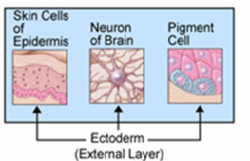
The ectoderm is the start of a tissue that covers the body surfaces. It emerges first and forms from the outermost of the germ layers.
The ectoderm
forms: the central nervous system, the lens of the eye, cranial and sensory, the ganglia and nerves, pigment cells, head connective tissues, the epidermis, hair, and mammary glands.
is sometimes considered a fourth germ layer. It is, however, derived from the ectoderm.
Epithelium
Epithelium is one of the four basic types of animal tissue, along with connective tissue, muscle tissue and nervous tissue. Epithelial tissues line the cavities and surfaces of structures throughout the body, and also form many glands. Functions of epithelial cells include secretion, selective...
, is a group of cell
Cell (biology)
The cell is the basic structural and functional unit of all known living organisms. It is the smallest unit of life that is classified as a living thing, and is often called the building block of life. The Alberts text discusses how the "cellular building blocks" move to shape developing embryos....
s, formed during animal embryogenesis
Embryogenesis
Embryogenesis is the process by which the embryo is formed and develops, until it develops into a fetus.Embryogenesis starts with the fertilization of the ovum by sperm. The fertilized ovum is referred to as a zygote...
. Germ layers are particularly pronounced in the vertebrate
Vertebrate
Vertebrates are animals that are members of the subphylum Vertebrata . Vertebrates are the largest group of chordates, with currently about 58,000 species described. Vertebrates include the jawless fishes, bony fishes, sharks and rays, amphibians, reptiles, mammals, and birds...
s; however, all animal
Animal
Animals are a major group of multicellular, eukaryotic organisms of the kingdom Animalia or Metazoa. Their body plan eventually becomes fixed as they develop, although some undergo a process of metamorphosis later on in their life. Most animals are motile, meaning they can move spontaneously and...
s more complex than sponges
Sea sponge
Sponges are animals of the phylum Porifera . Their bodies consist of jelly-like mesohyl sandwiched between two thin layers of cells. While all animals have unspecialized cells that can transform into specialized cells, sponges are unique in having some specialized cells, but can also have...
(eumetazoa
Eumetazoa
Eumetazoa is a clade comprising all major animal groups except sponges, placozoa and several other little known animals. Characteristics of eumetazoans include true tissues organized into germ layers, and an embryo that goes through a gastrula stage...
ns and agnotozoans) produce two or three primary tissue layers (sometimes called primary germ layers). Animals with radial symmetry, like cnidaria
Cnidaria
Cnidaria is a phylum containing over 9,000 species of animals found exclusively in aquatic and mostly marine environments. Their distinguishing feature is cnidocytes, specialized cells that they use mainly for capturing prey. Their bodies consist of mesoglea, a non-living jelly-like substance,...
ns, produce two germ layers (the ectoderm
Ectoderm
The "ectoderm" is one of the three primary germ cell layers in the very early embryo. The other two layers are the mesoderm and endoderm , with the ectoderm as the most exterior layer...
and endoderm
Endoderm
Endoderm is one of the three primary germ cell layers in the very early embryo. The other two layers are the ectoderm and mesoderm , with the endoderm as the intermost layer...
) making them diploblastic. Animals with bilateral symmetry produce a third layer between these two layers (appropriately called the mesoderm
Mesoderm
In all bilaterian animals, the mesoderm is one of the three primary germ cell layers in the very early embryo. The other two layers are the ectoderm and endoderm , with the mesoderm as the middle layer between them.The mesoderm forms mesenchyme , mesothelium, non-epithelial blood corpuscles and...
) making them triploblastic. Germ layers eventually give rise to all of an animal’s tissues
Biological tissue
Tissue is a cellular organizational level intermediate between cells and a complete organism. A tissue is an ensemble of cells, not necessarily identical, but from the same origin, that together carry out a specific function. These are called tissues because of their identical functioning...
and organ
Organ (anatomy)
In biology, an organ is a collection of tissues joined in structural unit to serve a common function. Usually there is a main tissue and sporadic tissues . The main tissue is the one that is unique for the specific organ. For example, main tissue in the heart is the myocardium, while sporadic are...
s through the process of organogenesis
Organogenesis
In animal development, organogenesis is the process by which the ectoderm, endoderm, and mesoderm develop into the internal organs of the organism. Internal organs initiate development in humans within the 3rd to 8th weeks in utero...
.
Germ layers
Caspar Friedrich Wolff
Caspar Friedrich Wolff was a German physiologist and one of the founders of embryology.-Life:Wolff was born in Berlin, Brandenburg. In 1230 he graduated as an M.D...
observed organization of the early embryo in leaf-like layers. In 1817, Heinz Christian Pander
Heinz Christian Pander
Heinz Christian Pander, aka Christian Heinrich Pander was a Baltic German biologist and embryologist who was born in Riga. In 1817 he received his doctorate from the University of Würzburg, and spent several years , performing scientific research from his estate in Carnikava on the banks of the...
discovered three primordial germ layers while studying chick embryos. Between 1850 and 1855, Robert Remak
Robert Remak
-External links:*** in the Virtual Laboratory of the Max Planck Institute for the History of Science...
had further refined the germ cell layer concept, and introduced into English were the terms "mesoderm
Mesoderm
In all bilaterian animals, the mesoderm is one of the three primary germ cell layers in the very early embryo. The other two layers are the ectoderm and endoderm , with the mesoderm as the middle layer between them.The mesoderm forms mesenchyme , mesothelium, non-epithelial blood corpuscles and...
" by Huxley in 1871 and "ectoderm
Ectoderm
The "ectoderm" is one of the three primary germ cell layers in the very early embryo. The other two layers are the mesoderm and endoderm , with the ectoderm as the most exterior layer...
" and "endoderm
Endoderm
Endoderm is one of the three primary germ cell layers in the very early embryo. The other two layers are the ectoderm and mesoderm , with the endoderm as the intermost layer...
" by Lankester
Ray Lankester
Sir E. Ray Lankester KCB, FRS was a British zoologist, born in London.An invertebrate zoologist and evolutionary biologist, he held chairs at University College London and Oxford University. He was the third Director of the Natural History Museum, and was awarded the Copley Medal of the Royal...
in 1873.
Among animal
Animal
Animals are a major group of multicellular, eukaryotic organisms of the kingdom Animalia or Metazoa. Their body plan eventually becomes fixed as they develop, although some undergo a process of metamorphosis later on in their life. Most animals are motile, meaning they can move spontaneously and...
s, sponges
Sea sponge
Sponges are animals of the phylum Porifera . Their bodies consist of jelly-like mesohyl sandwiched between two thin layers of cells. While all animals have unspecialized cells that can transform into specialized cells, sponges are unique in having some specialized cells, but can also have...
show the simplest organization, having a single germ layer. Although they have differentiated cells (e.g. collar cell
Choanocyte
Choanocytes are cells that line the interior of Asconoid, syconoid and leuconoid body type sponges that contain a central flagellum surrounded by a collar of microvilli which are connected by a thin membrane. It is the closest family member to the free-living ancestor called choanoflagellate...
s), they lack true tissue coordination. Diploblastic animals, Cnidaria
Cnidaria
Cnidaria is a phylum containing over 9,000 species of animals found exclusively in aquatic and mostly marine environments. Their distinguishing feature is cnidocytes, specialized cells that they use mainly for capturing prey. Their bodies consist of mesoglea, a non-living jelly-like substance,...
and Ctenophora, show an increase in complexity, having two germ layers, the endoderm
Endoderm
Endoderm is one of the three primary germ cell layers in the very early embryo. The other two layers are the ectoderm and mesoderm , with the endoderm as the intermost layer...
and ectoderm
Ectoderm
The "ectoderm" is one of the three primary germ cell layers in the very early embryo. The other two layers are the mesoderm and endoderm , with the ectoderm as the most exterior layer...
. Diploblastic animals are organized into recognisable tissues. All higher animals (from flatworms to humans) are triploblastic, possessing a mesoderm
Mesoderm
In all bilaterian animals, the mesoderm is one of the three primary germ cell layers in the very early embryo. The other two layers are the ectoderm and endoderm , with the mesoderm as the middle layer between them.The mesoderm forms mesenchyme , mesothelium, non-epithelial blood corpuscles and...
in addition to the germ layers found in Diploblasts. Triploblastic animals develop recognisable organs.
Development
FertilizationFertilisation
Fertilisation is the fusion of gametes to produce a new organism. In animals, the process involves the fusion of an ovum with a sperm, which eventually leads to the development of an embryo...
leads to the formation of a zygote
Zygote
A zygote , or zygocyte, is the initial cell formed when two gamete cells are joined by means of sexual reproduction. In multicellular organisms, it is the earliest developmental stage of the embryo...
. During the next stage, cleavage
Cleavage (embryo)
In embryology, cleavage is the division of cells in the early embryo. The zygotes of many species undergo rapid cell cycles with no significant growth, producing a cluster of cells the same size as the original zygote. The different cells derived from cleavage are called blastomeres and form a...
, mitotic
Mitosis
Mitosis is the process by which a eukaryotic cell separates the chromosomes in its cell nucleus into two identical sets, in two separate nuclei. It is generally followed immediately by cytokinesis, which divides the nuclei, cytoplasm, organelles and cell membrane into two cells containing roughly...
cell divisions transform the zygote into a tiny ball of cells, a blastula
Blastula
The blastula is a hollow sphere of cells formed during an early stage of embryonic development in animals . The blastula is created when the zygote undergoes the cell division process known as cleavage. The blastula is preceded by the morula and is followed by the gastrula in the developmental...
. This early embryonic form undergoes gastrulation
Gastrulation
Gastrulation is a phase early in the embryonic development of most animals, during which the single-layered blastula is reorganized into a trilaminar structure known as the gastrula. These three germ layers are known as the ectoderm, mesoderm, and endoderm.Gastrulation takes place after cleavage...
, forming a gastrula with either two or three layers (the germ layers). In all vertebrate
Vertebrate
Vertebrates are animals that are members of the subphylum Vertebrata . Vertebrates are the largest group of chordates, with currently about 58,000 species described. Vertebrates include the jawless fishes, bony fishes, sharks and rays, amphibians, reptiles, mammals, and birds...
s, these are the forerunners of all adult tissues and organs.
The appearance of the archenteron
Archenteron
The primitive gut that forms during gastrulation in the developing blastula is known as the archenteron. It develops into the digestive tract of an animal....
marks the onset of gastrulation.
In humans, after about three days, the zygote forms a solid mass of cells by mitotic division, called a morula
Morula
A morula is an embryo at an early stage of embryonic development, consisting of cells in a solid ball contained within the zona pellucida....
. This then changes to a blastocyst
Blastocyst
The blastocyst is a structure formed in the early embryogenesis of mammals, after the formation of the morula. It is a specifically mammalian example of a blastula. It possesses an inner cell mass , or embryoblast, which subsequently forms the embryo, and an outer layer of cells, or trophoblast,...
, consisting of an outer layer called a trophoblast
Trophoblast
Trophoblasts are cells forming the outer layer of a blastocyst, which provide nutrients to the embryo and develop into a large part of the placenta. They are formed during the first stage of pregnancy and are the first cells to differentiate from the fertilized egg...
, and an inner cell mass called the embryoblast. Filled with uterine fluid, the blastocyst breaks out of the zona pellucida and undergoes implantation. The inner cell mass initially has two layers: the hypoblast
Hypoblast
The hypoblast is a tissue type that forms from the inner cell mass. It lies beneath the epiblast and consists of small cuboidal cells.Extraembryonic endoderm is derived from hypoblast.-External links:...
and epiblast
Epiblast
In amniote animal embryology, the epiblast is a tissue type derived either from the inner cell mass in mammals or the blastodisc in birds and reptiles. It lies above the hypoblast.-Mammals:...
. At the end of the second week, a primitive streak
Primitive streak
The primitive streak is a structure that forms during the early stages of avian, reptilian and mammalian embryonic development.-Introduction:...
appears. The epiblast in this region moves towards the primitive streak, dives down into it, and forms a new layer, called the endoderm
Endoderm
Endoderm is one of the three primary germ cell layers in the very early embryo. The other two layers are the ectoderm and mesoderm , with the endoderm as the intermost layer...
, pushing the hypoblast out of the way (this goes on to form the amnion
Amnion
The amnion is a membrane building the amniotic sac that surrounds and protects an embryo. It is developed in reptiles, birds, and mammals, which are hence called “Amniota”; but not in amphibians and fish , which are consequently termed “Anamniota”. The primary role of this is the protection of the...
.) The epiblast keeps moving and forms a second layer, the mesoderm
Mesoderm
In all bilaterian animals, the mesoderm is one of the three primary germ cell layers in the very early embryo. The other two layers are the ectoderm and endoderm , with the mesoderm as the middle layer between them.The mesoderm forms mesenchyme , mesothelium, non-epithelial blood corpuscles and...
. The top layer is now called the ectoderm
Ectoderm
The "ectoderm" is one of the three primary germ cell layers in the very early embryo. The other two layers are the mesoderm and endoderm , with the ectoderm as the most exterior layer...
.
Endoderm
The endoderm is one of the germ layers formed during animal embryogenesis. Cells migrating inward along the archenteron form the inner layer of the gastrula, which develops into the endoderm
Endoderm
Endoderm is one of the three primary germ cell layers in the very early embryo. The other two layers are the ectoderm and mesoderm , with the endoderm as the intermost layer...
.
The endoderm consists at first of flattened cells, which subsequently become columnar. It forms the epithelial lining of the whole of the digestive tube except part of the mouth and pharynx and the terminal part of the rectum (which are lined by involutions of the ectoderm). It also forms the lining cells of all the glands which open into the digestive tube, including those of the liver and pancreas; the epithelium of the auditory tube and tympanic cavity; the trachea, bronchi, and air cells of the lungs; the urinary bladder and part of the urethra; and the follicle lining of the thyroid gland and thymus.
The endoderm
Endoderm
Endoderm is one of the three primary germ cell layers in the very early embryo. The other two layers are the ectoderm and mesoderm , with the endoderm as the intermost layer...
forms: the stomach, the colon, the liver, the pancreas, the urinary bladder, the lining of the urethra, the epithelial parts of trachea, the lungs, the pharynx, the thyroid, the parathyroid, and the intestines.
Mesoderm
The mesoderm germ layer forms in the embryo
Embryo
An embryo is a multicellular diploid eukaryote in its earliest stage of development, from the time of first cell division until birth, hatching, or germination...
s of triploblastic animal
Animal
Animals are a major group of multicellular, eukaryotic organisms of the kingdom Animalia or Metazoa. Their body plan eventually becomes fixed as they develop, although some undergo a process of metamorphosis later on in their life. Most animals are motile, meaning they can move spontaneously and...
s. During gastrulation
Gastrulation
Gastrulation is a phase early in the embryonic development of most animals, during which the single-layered blastula is reorganized into a trilaminar structure known as the gastrula. These three germ layers are known as the ectoderm, mesoderm, and endoderm.Gastrulation takes place after cleavage...
, some of the cells migrating inward contribute to the mesoderm
Mesoderm
In all bilaterian animals, the mesoderm is one of the three primary germ cell layers in the very early embryo. The other two layers are the ectoderm and endoderm , with the mesoderm as the middle layer between them.The mesoderm forms mesenchyme , mesothelium, non-epithelial blood corpuscles and...
, an additional layer between the endoderm and the ectoderm
Ectoderm
The "ectoderm" is one of the three primary germ cell layers in the very early embryo. The other two layers are the mesoderm and endoderm , with the ectoderm as the most exterior layer...
.
The formation of a mesoderm led to the development of a coelom
Coelom
The coelom is a fluid-filled cavity formed within the mesoderm. Coeloms developed in triploblasts but were subsequently lost in several lineages. Loss of coelom is correlated with reduction in body size...
. Organs formed inside a coelom can freely move, grow, and develop independently of the body wall while fluid cushions and protects them from shocks.
The mesoderm
Mesoderm
In all bilaterian animals, the mesoderm is one of the three primary germ cell layers in the very early embryo. The other two layers are the ectoderm and endoderm , with the mesoderm as the middle layer between them.The mesoderm forms mesenchyme , mesothelium, non-epithelial blood corpuscles and...
forms: skeletal muscle, the skeleton, the dermis of skin, connective tissue, the urogenital system, the heart
Heart
The heart is a myogenic muscular organ found in all animals with a circulatory system , that is responsible for pumping blood throughout the blood vessels by repeated, rhythmic contractions...
, blood (lymph
Lymph
Lymph is considered a part of the interstitial fluid, the fluid which lies in the interstices of all body tissues. Interstitial fluid becomes lymph when it enters a lymph capillary...
cells), the kidney, and the spleen.
Ectoderm
The ectoderm is the start of a tissue that covers the body surfaces. It emerges first and forms from the outermost of the germ layers.
The ectoderm
Ectoderm
The "ectoderm" is one of the three primary germ cell layers in the very early embryo. The other two layers are the mesoderm and endoderm , with the ectoderm as the most exterior layer...
forms: the central nervous system, the lens of the eye, cranial and sensory, the ganglia and nerves, pigment cells, head connective tissues, the epidermis, hair, and mammary glands.
Neural crest
Because of its great importance, the neural crestNeural crest
Neural crest cells are a transient, multipotent, migratory cell population unique to vertebrates that gives rise to a diverse cell lineage including melanocytes, craniofacial cartilage and bone, smooth muscle, peripheral and enteric neurons and glia....
is sometimes considered a fourth germ layer. It is, however, derived from the ectoderm.
See also
- Cellular differentiationCellular differentiationIn developmental biology, cellular differentiation is the process by which a less specialized cell becomes a more specialized cell type. Differentiation occurs numerous times during the development of a multicellular organism as the organism changes from a simple zygote to a complex system of...
- EmbryogenesisEmbryogenesisEmbryogenesis is the process by which the embryo is formed and develops, until it develops into a fetus.Embryogenesis starts with the fertilization of the ovum by sperm. The fertilized ovum is referred to as a zygote...
- HistogenesisHistogenesisHistogenesis is the formation of different tissues from undifferentiated cells. These cells are constituents of three primary germ layers, the endoderm, mesoderm, and ectoderm...
- NeurulationNeurulationNeurulation is the stage of organogenesis in vertebrate embryos, during which the neural tube is transformed into the primitive structures that will later develop into the central nervous system....
- OrganogenesisOrganogenesisIn animal development, organogenesis is the process by which the ectoderm, endoderm, and mesoderm develop into the internal organs of the organism. Internal organs initiate development in humans within the 3rd to 8th weeks in utero...