
All Topics  
Lymph


   Email Print
   Bookmark   Link


Lymph


Lymph is the fluid that is formed as the interstitial fluid
Interstitial fluid

Interstitial fluid is a solution which bathes and surrounds the cells of multicellular animals. It is the main component of the extracellular fluid, which also includes Blood plasma and transcellular fluid....
. It enters the lymph vessel
Lymph vessel

In anatomy, lymph vessels are thin walled, valved structures that carry lymph. As part of the lymphatic system, lymph vessels are complementary to the vascular system....
s by filtration
Filtration

Filtration is a mechanical or physical operation which is used for the separation of solids from fluids by interposing a medium to fluid flow through which the fluid can pass, but the solids in the fluid are retained....
. The lymph then travels to at least one lymph node
Lymph node

A Lymph node is an organ consisting of many types of cells, and is a part of the lymphatic system. Lymph nodes are found all through the body, and act as filters or traps for foreign particles....
 before emptying ultimately into the right or the left subclavian vein
Subclavian vein

In human anatomy, the subclavian veins are two large veins, one on either side of the body. Its diameter is approximately that of a man's small finger....
, where it mixes back with blood.

h has a composition comparable to that of blood plasma
Blood plasma

Blood plasma is the liquid component of blood, in which the blood cells are suspended. It makes up about 55% of total blood volume. It is composed of mostly water , and contains dissolved proteins, glucose, clotting factors, mineral ions, Hormone and carbon dioxide ....
, but it may differ slightly depending on the tissue served (drained). In particular, the lymph that leaves a lymph node is richer in lymphocytes
Lymphocyte

A lymphocyte is a type of white blood cell in the vertebrate immune system.By their appearance under the light microscope, there are two broad categories of lymphocytes, namely the large granular lymphocytes and the small lymphocytes....
.


Discussion
Ask a question about 'Lymph'
Start a new discussion about 'Lymph'
Answer questions from other users
Full Discussion Forum


Recent Posts


Encyclopedia


Lymph is the fluid that is formed as the interstitial fluid
Interstitial fluid

Interstitial fluid is a solution which bathes and surrounds the cells of multicellular animals. It is the main component of the extracellular fluid, which also includes Blood plasma and transcellular fluid....
. It enters the lymph vessel
Lymph vessel

In anatomy, lymph vessels are thin walled, valved structures that carry lymph. As part of the lymphatic system, lymph vessels are complementary to the vascular system....
s by filtration
Filtration

Filtration is a mechanical or physical operation which is used for the separation of solids from fluids by interposing a medium to fluid flow through which the fluid can pass, but the solids in the fluid are retained....
. The lymph then travels to at least one lymph node
Lymph node

A Lymph node is an organ consisting of many types of cells, and is a part of the lymphatic system. Lymph nodes are found all through the body, and act as filters or traps for foreign particles....
 before emptying ultimately into the right or the left subclavian vein
Subclavian vein

In human anatomy, the subclavian veins are two large veins, one on either side of the body. Its diameter is approximately that of a man's small finger....
, where it mixes back with blood.

Composition of lymph

Lymph has a composition comparable to that of blood plasma
Blood plasma

Blood plasma is the liquid component of blood, in which the blood cells are suspended. It makes up about 55% of total blood volume. It is composed of mostly water , and contains dissolved proteins, glucose, clotting factors, mineral ions, Hormone and carbon dioxide ....
, but it may differ slightly depending on the tissue served (drained). In particular, the lymph that leaves a lymph node is richer in lymphocytes
Lymphocyte

A lymphocyte is a type of white blood cell in the vertebrate immune system.By their appearance under the light microscope, there are two broad categories of lymphocytes, namely the large granular lymphocytes and the small lymphocytes....
. Likewise, the lymph formed in the digestive system called chyle
Chyle

Chyle is a milky fluid consisting of lymph and emulsified fats, or free fatty acids . It is formed in the small intestine during digestion of ingested fatty foods and taken up by lymph vessels specifically known as lacteals, unlike other components of digested food that are conveyed by veins....
 is rich in triglyceride
Triglyceride

is a glyceride in which the glycerol is esterified with three fatty acids. It is the main constituent of vegetable oil and animal fats....
s (fat), and looks white.

Formation of lymph


Blood
Blood

Blood is a specialized bodily fluid that delivers necessary substances to the body's Cell s ? such as nutrients and oxygen ? and transports waste products away from those same cells....
 supplies nutrient
Nutrient

A nutrient is a chemical that an organism needs to live and grow or a substance used in an organism's metabolism which must be taken in from its environment....
s, and important metabolite
Metabolite

Metabolites are the intermediates and products of metabolism. The term metabolite is usually restricted to small molecules. A primary metabolite is directly involved in normal growth, development, and reproduction....
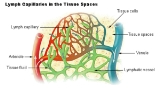
s to the tissues, and collects back the waste products that they produce, which requires exchange of respective constituents between the blood and tissues. However, this exchange is not direct, and is effected through an intermediary called interstitial fluid or tissue fluid that the blood forms. Interstitial fluid
Interstitial fluid

Interstitial fluid is a solution which bathes and surrounds the cells of multicellular animals. It is the main component of the extracellular fluid, which also includes Blood plasma and transcellular fluid....
 (ISF) is the fluid that occupies the spaces between the cells and acts as their immediate environment. As the blood and the surrounding cells continually add and remove substances from the ISF, its composition keeps on changing. Water and solutes can freely pass (diffuse
Diffusion

Molecular diffusion, often called simply diffusion, is a net transport of molecules from a region of higher concentration to one of lower concentration by random molecular motion....
) between the ISF and blood, and thus both are in dynamic equilibrium
Dynamic equilibrium

A system in dynamic equilibrium is a particular example of a system in a steady state. In a steady state the rate of inputs is equal to the rate of outputs so that the composition of the system is unchanging in time....
 with each other; exchange between the two fluids occurs across the walls of small blood vessels called capillaries
Capillary

Capillaries are the smallest of a body's blood vessels, measuring 5-10 micrometre in diameter, which connect arterioles and venules, and enable the interchange of water, oxygen, carbon dioxide, and many other nutrient and waste chemical substances between blood and surrounding tissue s....
.

ISF forms at the arterial
Arteriole

An arteriole is a small diameter blood vessel that extends and branches out from an artery and leads to capillary. Arterioles have thin muscle walls and are the primary site of vascular resistance....
 (coming from the heart) end of the capillaries because of higher pressure of blood, and most of it returns to its venous
Venule

A venule is a small blood vessel that allows deoxygenated blood to return from the capillary beds to the larger blood vessels called veins.Venules are blood vessels that drain blood directly from the capillary beds....
 ends and venule
Venule

A venule is a small blood vessel that allows deoxygenated blood to return from the capillary beds to the larger blood vessels called veins.Venules are blood vessels that drain blood directly from the capillary beds....
s; the rest (1%) enters the lymph capillaries
Lymph capillary

Lymph capillaries or lymphatic capillaries are tiny thin-walled blood vessels that are closed at one end and are located in the spaces between cells throughout the body, except in the central nervous system, and in non-vascular tissues....
 as lymph. Thus, lymph when formed is a watery clear liquid with the same composition as the ISF. However, as it flows through the lymph nodes it comes in contact with blood, and tends to accumulate more cells (particularly, lymphocytes) and proteins.

The two primary lymph systems are the thymus gland and the bone marrow
Bone marrow

Bone marrow is the flexible biological tissue found in the hollow interior of bones. In adults, marrow in large bones produces new blood cells....
, where the immune cells form or mature. The secondary lymph system is made up of encapsulated and unencapsulated diffuse lymphoid tissue. The encapsulated tissue includes the spleen
Spleen

The spleen is an organ found in all vertebrate animals. In humans, the spleen is located in the abdomen of the body, where it functions in the destruction of redundant red blood cells, and holds a reservoir of blood....
 and the lymph nodes. The unencapsulated tissue includes the gut associated lymph tissues and the tonsil
Tonsil

Palatine tonsils, occasionally called the faucial tonsils, are the tonsils that can be seen on the left and right sides at the back of the throat....
s.

Lymphatic circulation

Tubular vessels transport lymph back to the blood ultimately replacing the volume lost from the blood during the formation of the interstitial fluid. These channels are the lymphatic channels or simply called lymphatics.

Unlike the cardiovascular system, the lymphatic system is not closed and has no central pump. Lymph movement occurs despite low pressure due to peristalsis
Peristalsis

Peristalsis is the rhythmic contraction of smooth muscles to propel contents through the digestive tract. The word is derived from New Latin and comes from the Greek language peristaltikos, peristaltic, from peristellein, "to wrap around," and stellein, "to place."...
 (propulsion of the lymph due to alternate contraction and relaxation of smooth muscle
Smooth muscle

Smooth muscle is a type of non-striated muscle, found within the tunica media layer of large and small arteries and veins, the urinary bladder, uterus, male and female reproductive tracts, gastrointestinal tract, respiratory tract, the ciliary muscle, and iris of the eye....
), valves, and compression during contraction of adjacent skeletal muscle and arterial pulsation
Pulse

In medicine, a person's pulse is the throbbing of their artery. It can be palpated in any place that allows for an artery to be compressed against a bone, such as at the neck , at the wrist , behind the knee , on the inside of the elbow , and near the ankle joint ....
.

Usually, the lymph that enters the lymph vessels from the interstitial space, does not leak back because of presence of valves. But, in case of blockage of free flow, when excessive hydrostatic pressure develops within the lymph vessels, some fluid can leak back and contribute to formation of edema
Edema

File:Oedema.jpgEdema or Oedema , formerly known as dropsy or hydropsy, is an abnormal accumulation of fluid beneath the skin, or in one or more cavities of the body....
.

See also

  • Lymphatic system
    Lymphatic system

    The lymphatic system in vertebrates is a network of conduits that carry a clear fluid called lymph. It also includes the lymphoid tissue through which the lymph travels....
  • Lymphedema
    Lymphedema

    Lymphedema, Spelling differences#Simplification of ae .28.C3.A6.29 and oe .28.C5.93.29 lymphoedema, also known as lymphatic obstruction, is a condition of localized fluid retention caused by a compromised lymphatic system....
  • Lymphangiogenesis
    Lymphangiogenesis

    Lymphangiogesis is the formation of lymphatic vessels from pre-existing lymphatic vessels, in a method believed to be similar to blood vessel development or angiogenesis....
  • Lymphoma
    Lymphoma

    Lymphoma is a type of cancer that originates in lymphocytes of the immune system. They often originate in lymph nodes, presenting as an enlargement of the node ....
  • American Society of Lymphology
    American Society of Lymphology

    The American Society of Lymphology is a nonprofit group based in Kansas City, Missouri, Missouri which deals with disorders of the lymphatic system such as lymphedema....
  • Manual lymphatic drainage
    Manual lymphatic drainage

    Manual lymphatic drainage is a type of gentle massage which is believed by proponents to encourage the natural circulation of the lymph through the body....