


Histogenesis

Encyclopedia
Histogenesis is the formation of different tissues
from undifferentiated cells
. These cells are constituents of three primary germ layer
s, the endoderm
, mesoderm
, and ectoderm
. The science of the microscopic structures of the tissues formed within histogenesis is termed histology
.
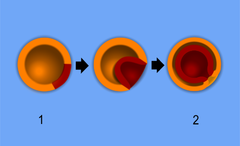
A germ layer is a collection of cell
s, formed during animal and mammalian embryogenesis
. Germ layers are typically pronounced within vertebrate
organisms; however, animal
s or mammals more complex than sponge
s (eumetazoa
ns and agnotozoans) produce two or three primary tissue layers. Animals with radial symmetry, such as cnidaria
ns, produce two layers, called the ectoderm
and endoderm
. Therefore, they are diploblastic. Animals with bilateral symmetry produce a third layer in-between called mesoderm
, making them triploblastic. Germ layers will eventually give rise to all of an animal’s or mammal's tissues
and organ
s through a process called organogenesis
.
form the inner layer of the gastrula, which develops into the endoderm
. Initially, the endoderm consists of flattened cells, which subsequently become columnar.
s of animal
s and mammal
s more complex than cnidaria
ns, making them triploblastic. During gastrulation
, some of the cells migrating inward to form the endoderm
form an additional layer between the endoderm and the ectoderm
. This key innovation evolved hundreds of millions of years ago and led to the evolution of nearly all large, complex animals. The formation of a mesoderm led to the formation of a coelom
. Organs formed inside a coelom can freely move, grow, and develop independently of the body wall while fluid cushions and protects them from shocks.
s.
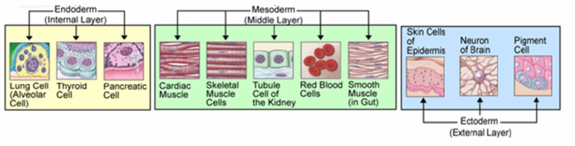 The proceeding graph represents the products produced by the three germ layers.
Biological tissue
Tissue is a cellular organizational level intermediate between cells and a complete organism. A tissue is an ensemble of cells, not necessarily identical, but from the same origin, that together carry out a specific function. These are called tissues because of their identical functioning...
from undifferentiated cells
Cell (biology)
The cell is the basic structural and functional unit of all known living organisms. It is the smallest unit of life that is classified as a living thing, and is often called the building block of life. The Alberts text discusses how the "cellular building blocks" move to shape developing embryos....
. These cells are constituents of three primary germ layer
Germ layer
A germ layer, occasionally referred to as a germinal epithelium, is a group of cells, formed during animal embryogenesis. Germ layers are particularly pronounced in the vertebrates; however, all animals more complex than sponges produce two or three primary tissue layers...
s, the endoderm
Endoderm
Endoderm is one of the three primary germ cell layers in the very early embryo. The other two layers are the ectoderm and mesoderm , with the endoderm as the intermost layer...
, mesoderm
Mesoderm
In all bilaterian animals, the mesoderm is one of the three primary germ cell layers in the very early embryo. The other two layers are the ectoderm and endoderm , with the mesoderm as the middle layer between them.The mesoderm forms mesenchyme , mesothelium, non-epithelial blood corpuscles and...
, and ectoderm
Ectoderm
The "ectoderm" is one of the three primary germ cell layers in the very early embryo. The other two layers are the mesoderm and endoderm , with the ectoderm as the most exterior layer...
. The science of the microscopic structures of the tissues formed within histogenesis is termed histology
Histology
Histology is the study of the microscopic anatomy of cells and tissues of plants and animals. It is performed by examining cells and tissues commonly by sectioning and staining; followed by examination under a light microscope or electron microscope...
.
Germ layers
A germ layer is a collection of cell
Cell (biology)
The cell is the basic structural and functional unit of all known living organisms. It is the smallest unit of life that is classified as a living thing, and is often called the building block of life. The Alberts text discusses how the "cellular building blocks" move to shape developing embryos....
s, formed during animal and mammalian embryogenesis
Embryogenesis
Embryogenesis is the process by which the embryo is formed and develops, until it develops into a fetus.Embryogenesis starts with the fertilization of the ovum by sperm. The fertilized ovum is referred to as a zygote...
. Germ layers are typically pronounced within vertebrate
Vertebrate
Vertebrates are animals that are members of the subphylum Vertebrata . Vertebrates are the largest group of chordates, with currently about 58,000 species described. Vertebrates include the jawless fishes, bony fishes, sharks and rays, amphibians, reptiles, mammals, and birds...
organisms; however, animal
Animal
Animals are a major group of multicellular, eukaryotic organisms of the kingdom Animalia or Metazoa. Their body plan eventually becomes fixed as they develop, although some undergo a process of metamorphosis later on in their life. Most animals are motile, meaning they can move spontaneously and...
s or mammals more complex than sponge
Sea sponge
Sponges are animals of the phylum Porifera . Their bodies consist of jelly-like mesohyl sandwiched between two thin layers of cells. While all animals have unspecialized cells that can transform into specialized cells, sponges are unique in having some specialized cells, but can also have...
s (eumetazoa
Eumetazoa
Eumetazoa is a clade comprising all major animal groups except sponges, placozoa and several other little known animals. Characteristics of eumetazoans include true tissues organized into germ layers, and an embryo that goes through a gastrula stage...
ns and agnotozoans) produce two or three primary tissue layers. Animals with radial symmetry, such as cnidaria
Cnidaria
Cnidaria is a phylum containing over 9,000 species of animals found exclusively in aquatic and mostly marine environments. Their distinguishing feature is cnidocytes, specialized cells that they use mainly for capturing prey. Their bodies consist of mesoglea, a non-living jelly-like substance,...
ns, produce two layers, called the ectoderm
Ectoderm
The "ectoderm" is one of the three primary germ cell layers in the very early embryo. The other two layers are the mesoderm and endoderm , with the ectoderm as the most exterior layer...
and endoderm
Endoderm
Endoderm is one of the three primary germ cell layers in the very early embryo. The other two layers are the ectoderm and mesoderm , with the endoderm as the intermost layer...
. Therefore, they are diploblastic. Animals with bilateral symmetry produce a third layer in-between called mesoderm
Mesoderm
In all bilaterian animals, the mesoderm is one of the three primary germ cell layers in the very early embryo. The other two layers are the ectoderm and endoderm , with the mesoderm as the middle layer between them.The mesoderm forms mesenchyme , mesothelium, non-epithelial blood corpuscles and...
, making them triploblastic. Germ layers will eventually give rise to all of an animal’s or mammal's tissues
Biological tissue
Tissue is a cellular organizational level intermediate between cells and a complete organism. A tissue is an ensemble of cells, not necessarily identical, but from the same origin, that together carry out a specific function. These are called tissues because of their identical functioning...
and organ
Organ (anatomy)
In biology, an organ is a collection of tissues joined in structural unit to serve a common function. Usually there is a main tissue and sporadic tissues . The main tissue is the one that is unique for the specific organ. For example, main tissue in the heart is the myocardium, while sporadic are...
s through a process called organogenesis
Organogenesis
In animal development, organogenesis is the process by which the ectoderm, endoderm, and mesoderm develop into the internal organs of the organism. Internal organs initiate development in humans within the 3rd to 8th weeks in utero...
.
Endoderm
The endoderm is one of the germ layers formed during animal embryogenesis. Cells migrating inward along the archenteronArchenteron
The primitive gut that forms during gastrulation in the developing blastula is known as the archenteron. It develops into the digestive tract of an animal....
form the inner layer of the gastrula, which develops into the endoderm
Endoderm
Endoderm is one of the three primary germ cell layers in the very early embryo. The other two layers are the ectoderm and mesoderm , with the endoderm as the intermost layer...
. Initially, the endoderm consists of flattened cells, which subsequently become columnar.
Mesoderm
The mesoderm germ layer forms in the embryoEmbryo
An embryo is a multicellular diploid eukaryote in its earliest stage of development, from the time of first cell division until birth, hatching, or germination...
s of animal
Animal
Animals are a major group of multicellular, eukaryotic organisms of the kingdom Animalia or Metazoa. Their body plan eventually becomes fixed as they develop, although some undergo a process of metamorphosis later on in their life. Most animals are motile, meaning they can move spontaneously and...
s and mammal
Mammal
Mammals are members of a class of air-breathing vertebrate animals characterised by the possession of endothermy, hair, three middle ear bones, and mammary glands functional in mothers with young...
s more complex than cnidaria
Cnidaria
Cnidaria is a phylum containing over 9,000 species of animals found exclusively in aquatic and mostly marine environments. Their distinguishing feature is cnidocytes, specialized cells that they use mainly for capturing prey. Their bodies consist of mesoglea, a non-living jelly-like substance,...
ns, making them triploblastic. During gastrulation
Gastrulation
Gastrulation is a phase early in the embryonic development of most animals, during which the single-layered blastula is reorganized into a trilaminar structure known as the gastrula. These three germ layers are known as the ectoderm, mesoderm, and endoderm.Gastrulation takes place after cleavage...
, some of the cells migrating inward to form the endoderm
Endoderm
Endoderm is one of the three primary germ cell layers in the very early embryo. The other two layers are the ectoderm and mesoderm , with the endoderm as the intermost layer...
form an additional layer between the endoderm and the ectoderm
Ectoderm
The "ectoderm" is one of the three primary germ cell layers in the very early embryo. The other two layers are the mesoderm and endoderm , with the ectoderm as the most exterior layer...
. This key innovation evolved hundreds of millions of years ago and led to the evolution of nearly all large, complex animals. The formation of a mesoderm led to the formation of a coelom
Body cavity
By the broadest definition, a body cavity is any fluid-filled space in a multicellular organism. However, the term usually refers to the space located between an animal’s outer covering and the outer lining of the gut cavity, where internal organs develop...
. Organs formed inside a coelom can freely move, grow, and develop independently of the body wall while fluid cushions and protects them from shocks.
Ectoderm
The ectoderm is the start of a tissue that covers the body surfaces. It emerges first and forms from the outermost of the germ layerGerm layer
A germ layer, occasionally referred to as a germinal epithelium, is a group of cells, formed during animal embryogenesis. Germ layers are particularly pronounced in the vertebrates; however, all animals more complex than sponges produce two or three primary tissue layers...
s.
Production
| Germ Layer | Category | Product |
|---|---|---|
| Endoderm | General | Gastrointestinal tract Gastrointestinal tract The human gastrointestinal tract refers to the stomach and intestine, and sometimes to all the structures from the mouth to the anus. .... |
| Endodern | General | Respiratory tract Respiratory tract In humans the respiratory tract is the part of the anatomy involved with the process of respiration.The respiratory tract is divided into 3 segments:*Upper respiratory tract: nose and nasal passages, paranasal sinuses, and throat or pharynx... |
| Endoderm | General | Endocrine glands and organs (liver Liver The liver is a vital organ present in vertebrates and some other animals. It has a wide range of functions, including detoxification, protein synthesis, and production of biochemicals necessary for digestion... and pancreas Pancreas The pancreas is a gland organ in the digestive and endocrine system of vertebrates. It is both an endocrine gland producing several important hormones, including insulin, glucagon, and somatostatin, as well as a digestive organ, secreting pancreatic juice containing digestive enzymes that assist... ) |
| Mesoderm | General | Bones |
| Mesoderm | General | Most of the Circulatory system Circulatory system The circulatory system is an organ system that passes nutrients , gases, hormones, blood cells, etc... |
| Mesoderm | General | Connective tissue Connective tissue "Connective tissue" is a fibrous tissue. It is one of the four traditional classes of tissues . Connective Tissue is found throughout the body.In fact the whole framework of the skeleton and the different specialized connective tissues from the crown of the head to the toes determine the form of... s of the gut and integuments Integumentary system The integumentary system is the organ system that protects the body from damage, comprising the skin and its appendages... |
| Mesoderm | General | Excretory Tract |
| Mesoderm | General | Mesenchyme Mesenchyme Mesenchyme, or mesenchymal connective tissue, is a type of undifferentiated loose connective tissue that is derived mostly from mesoderm, although some are derived from other germ layers; e.g. some mesenchyme is derived from neural crest cells and thus originates from the ectoderm... |
| Mesoderm | General | Mesothelium Mesothelium The mesothelium is a membrane that forms the lining of several body cavities: the pleura , peritoneum and pericardium . Mesothelial tissue also surrounds the male internal reproductive organs and covers the internal reproductive organs of women... |
| Mesoderm | General | Muscles Muscular system The muscular system is the anatomical system of a species that allows it to move. The muscular system in vertebrates is controlled through the nervous system, although some muscles can be completely autonomous.- Muscles :... |
| Mesoderm | General | Peritoneum Peritoneum The peritoneum is the serous membrane that forms the lining of the abdominal cavity or the coelom — it covers most of the intra-abdominal organs — in amniotes and some invertebrates... |
| Mesoderm | General | Reproductive System Reproductive system The reproductive system or genital system is a system of organs within an organism which work together for the purpose of reproduction. Many non-living substances such as fluids, hormones, and pheromones are also important accessories to the reproductive system. Unlike most organ systems, the sexes... |
| Mesoderm | General | Urinary System Urinary system The urinary system is the organ system that produces, stores, and eliminates urine. In humans it includes two kidneys, two ureters, the bladder and the urethra.-Kidney:... |
| Mesoderm | Vertebrate | Chordamesoderm Chordamesoderm Chordamesoderm, also known as axial mesoderm, is a type of mesoderm that lies along the central axis, under the neural tube.* will give rise to notochord* starts as the notochordal process, whose formation finishes at day 20.... |
| Mesoderm | Vertebrate | Paraxial mesoderm Paraxial mesoderm Paraxial mesoderm is the area of mesoderm that forms just lateral to the neural tube on both sides.It differentiates rostrally into somatomeres and caudally into somites.It gives rise to the somitomeres/somites and mesoderm of the branchial arches.... |
| Mesoderm | Vertebrate | Intermediate mesoderm Intermediate mesoderm Intermediate mesenchyme or intermediate mesoderm is a type of mesoderm that is located between the paraxial mesoderm and the lateral plate.It develops into the part of the urogenital system * forms of urogenital system... |
| Mesoderm | Vertebrate | Lateral plate mesoderm Lateral plate mesoderm Lateral plate mesoderm is a type of mesoderm that is found at the periphery of the embryo.-Division into layers:It will split into two layers, the somatic layer/mesoderm and the splanchnic layer/mesoderm... |
| Ectoderm | General | Nervous system Nervous system The nervous system is an organ system containing a network of specialized cells called neurons that coordinate the actions of an animal and transmit signals between different parts of its body. In most animals the nervous system consists of two parts, central and peripheral. The central nervous... |
| Ectoderm | General | Outer part of integument Integumentary system The integumentary system is the organ system that protects the body from damage, comprising the skin and its appendages... |
| Ectoderm | Vertebrate | Skin Skin -Dermis:The dermis is the layer of skin beneath the epidermis that consists of connective tissue and cushions the body from stress and strain. The dermis is tightly connected to the epidermis by a basement membrane. It also harbors many Mechanoreceptors that provide the sense of touch and heat... (along with glands, hair Hair Hair is a filamentous biomaterial, that grows from follicles found in the dermis. Found exclusively in mammals, hair is one of the defining characteristics of the mammalian class.... , nails Nail (anatomy) A nail is a horn-like envelope covering the dorsal aspect of the terminal phalanges of fingers and toes in humans, most non-human primates, and a few other mammals. Nails are similar to claws, which are found on numerous other animals.... ) |
| Ectoderm | Vertebrate | Epithelium Epithelium Epithelium is one of the four basic types of animal tissue, along with connective tissue, muscle tissue and nervous tissue. Epithelial tissues line the cavities and surfaces of structures throughout the body, and also form many glands. Functions of epithelial cells include secretion, selective... of the mouth Mouth The mouth is the first portion of the alimentary canal that receives food andsaliva. The oral mucosa is the mucous membrane epithelium lining the inside of the mouth.... and nasal cavity Nasal cavity The nasal cavity is a large air filled space above and behind the nose in the middle of the face.- Function :The nasal cavity conditions the air to be received by the other areas of the respiratory tract... |
| Ectoderm | Vertebrate | Lens and cornea Cornea The cornea is the transparent front part of the eye that covers the iris, pupil, and anterior chamber. Together with the lens, the cornea refracts light, with the cornea accounting for approximately two-thirds of the eye's total optical power. In humans, the refractive power of the cornea is... of the eye Human eye The human eye is an organ which reacts to light for several purposes. As a conscious sense organ, the eye allows vision. Rod and cone cells in the retina allow conscious light perception and vision including color differentiation and the perception of depth... |
| Ectoderm | Vertebrate | Melanocytes |
| Ectoderm | Vertebrate | Peripheral nervous system Peripheral nervous system The peripheral nervous system consists of the nerves and ganglia outside of the brain and spinal cord. The main function of the PNS is to connect the central nervous system to the limbs and organs. Unlike the CNS, the PNS is not protected by the bone of spine and skull, or by the blood–brain... |
| Ectoderm | Vertebrate | Facial cartilage Cartilage Cartilage is a flexible connective tissue found in many areas in the bodies of humans and other animals, including the joints between bones, the rib cage, the ear, the nose, the elbow, the knee, the ankle, the bronchial tubes and the intervertebral discs... |
| Ectoderm | Vertebrate | Dentin Dentin Dentine is a calcified tissue of the body, and along with enamel, cementum, and pulp is one of the four major components of teeth. Usually, it is covered by enamel on the crown and cementum on the root and surrounds the entire pulp... (in teeth) |
| Ectoderm | Vertebrate | Brain Brain The brain is the center of the nervous system in all vertebrate and most invertebrate animals—only a few primitive invertebrates such as sponges, jellyfish, sea squirts and starfishes do not have one. It is located in the head, usually close to primary sensory apparatus such as vision, hearing,... (rhombencephalon Rhombencephalon The rhombencephalon is a developmental categorization of portions of the central nervous system in vertebrates.The rhombencephalon can be subdivided in a variable number of transversal swellings called rhombomeres... , mesencephalon Mesencephalon The midbrain or mesencephalon is a portion of the central nervous system associated with vision, hearing, motor control, sleep/wake, arousal , and temperature regulation.... and prosencephalon Prosencephalon In the anatomy of the brain of vertebrates, the prosencephalon is the rostral-most portion of the brain. The prosencephalon, the mesencephalon , and rhombencephalon are the three primary portions of the brain during early development of the central nervous system... ) |
| Ectoderm | Vertebrate | Spinal cord Spinal cord The spinal cord is a long, thin, tubular bundle of nervous tissue and support cells that extends from the brain . The brain and spinal cord together make up the central nervous system... and motor neuron Motor neuron In vertebrates, the term motor neuron classically applies to neurons located in the central nervous system that project their axons outside the CNS and directly or indirectly control muscles... s |
| Ectoderm | Vertebrate | Retina Retina The vertebrate retina is a light-sensitive tissue lining the inner surface of the eye. The optics of the eye create an image of the visual world on the retina, which serves much the same function as the film in a camera. Light striking the retina initiates a cascade of chemical and electrical... |
| Ectoderm | Vertebrate | Posterior pituitary Posterior pituitary The posterior pituitary comprises the posterior lobe of the pituitary gland and is part of the endocrine system. Despite its name, the posterior pituitary gland is not a gland, per se; rather, it is largely a collection of axonal projections from the hypothalamus that terminate behind the anterior... |