


Nicolas Durand de Villegaignon

Encyclopedia
Nicolas Durand, sieur de Villegaignon, also Villegagnon (Villegaignon, Seine et Marne, France
, 1510 – Beauvais
, 9 January 1571) was a Commander of the Knights of Malta
, and later a French naval officer (vice-admiral
of Brittany
) who attempted to help the Huguenots in France escape persecution.
A notable public figure in his time, Villegaignon was a mixture of soldier, scientist, explorer, adventurer and entrepreneur. He fought pirates in the Mediterranean and participated in several wars.
Villegagnon was a nephew
of Philippe Villiers de L'Isle-Adam
, Grand Master of the Order of Malta. He was ordained as a Knight of the Order in 1521.
. Although the French usually refrained from participating in actions against the Ottomans, due to the Franco-Ottoman alliance
, Villegagnon's first allegiance was with the Order of Malta, which generally supported the Habsburgs and fought the Ottomans. Villegagnon participated in the ill-fated expedition against Algiers in 1541
,. He also fought against the Ottomans in Hungary in 1542 following the Siege of Buda (1541)
until 1546.
In 1548, he commanded the French naval fleet that took Mary, Queen of Scots, then five years old, to France, since she was promised to marry the Dauphin of France. This was a daring operation, covertly sailing galleys around Scotland
, while the English fleet was expecting an attack from the other direction.
Villegagnon helped repel the Ottomans at Malta
in 1551, before they went on to lead the Invasion of Gozo (1551)
.
He was then present at the Siege of Tripoli (1551)
against the Ottoman Empire
, and wrote an account about it in 1553. Villegagnon illustrated himself by courageously defending Gaspard de Vallier
, the vanquished Commander of Tripoli, who was being heavily criticized by the Grand Master D'Omedes
who wished to assign all the blame for the defeat on him. Nicolas de Villegagnon staunchly defended him and exposed the duplicity of D'Omedes.
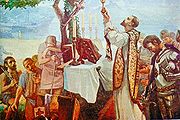
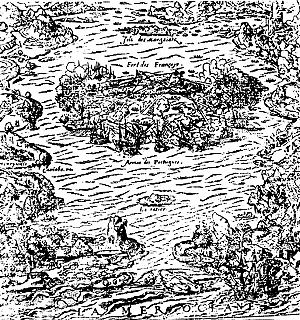 Villegaignon became an important historical figure in the attempt for king Henry II
to build a "France Antarctique
", by invading present-day Rio de Janeiro
, Brazil
in 1555 with a fleet of two ships and 600 soldiers and colonists, mainly French Huguenots and Swiss Calvinists
who sought to escape Catholic persecution in Europe
.
Villegagnon's initial plan was to help the Huguenots establish a colony in the New World. He wanted also to secure a permanent base in Brazil in order to explore brazil wood, then a very valuable source of red dye
and hard wood for construction (which gave the name to what was to become Brazil), and to explore precious metals and stones, which the Europeans believed to exist in abundance in the land.
After a number of battles against the Portuguese
, the French colonists were defeated by Estácio de Sá
, a nephew of the third Portuguese Governor-General of Brazil, Mem de Sá
, on 15–16 March 1558.
after receiving 30,000 écus from the Portuguese Crown.
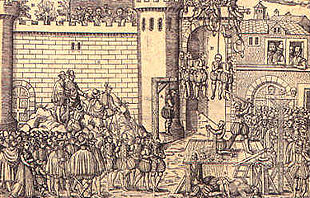
, which the latter declined. He became actively involved against the Protestants, and participated in the repression of the Amboise conspiracy
.
 In 1561, Pierre Richier
published a pamphlet against Villegagnon's actions in Brazil, entitled "Réfutation des folles resveries, excecrable blasphèmes, erreurs et mensonges de Nicolas Durand, qui se nomme Villagagnon".
New attempts were made to create a Huguenot colony in the New World, again at the instigation of Coligny
, this time in Florida
from 1562 to 1565, under Jean Ribault
and René de Laudonnière.
From 1568, Villegagnon became the representative of the Order of Malta at the French Court. The next year, in 1569, he published in Paris a new controversy about the eucharist, entitled "De Consecratione, mystico sacrificio et duplici Christi oblatione".
Villegagnon became Commander of the Order of Malta Commandery in Beauvais
, where he died on 9 January 1571.
The Catholic André Thévet
, who had accompanied him on the first trip to Brazil, published in 1572 a description of the Brazil adventure and an attack on the Protestants, in his "Cosmographie Universelle". The Protestant Jean Léry would respond to it in 1578 with his "Histoire d'un voyage faict en la terre du Brésil".
describes the colorful character of Villegaignon:
France
The French Republic , The French Republic , The French Republic , (commonly known as France , is a unitary semi-presidential republic in Western Europe with several overseas territories and islands located on other continents and in the Indian, Pacific, and Atlantic oceans. Metropolitan France...
, 1510 – Beauvais
Beauvais
Beauvais is a city approximately by highway north of central Paris, in the northern French region of Picardie. It currently has a population of over 60,000 inhabitants.- History :...
, 9 January 1571) was a Commander of the Knights of Malta
Knights Hospitaller
The Sovereign Military Hospitaller Order of Saint John of Jerusalem of Rhodes and of Malta , also known as the Sovereign Military Order of Malta , Order of Malta or Knights of Malta, is a Roman Catholic lay religious order, traditionally of military, chivalrous, noble nature. It is the world's...
, and later a French naval officer (vice-admiral
Admiral
Admiral is the rank, or part of the name of the ranks, of the highest naval officers. It is usually considered a full admiral and above vice admiral and below admiral of the fleet . It is usually abbreviated to "Adm" or "ADM"...
of Brittany
Brittany
Brittany is a cultural and administrative region in the north-west of France. Previously a kingdom and then a duchy, Brittany was united to the Kingdom of France in 1532 as a province. Brittany has also been referred to as Less, Lesser or Little Britain...
) who attempted to help the Huguenots in France escape persecution.
A notable public figure in his time, Villegaignon was a mixture of soldier, scientist, explorer, adventurer and entrepreneur. He fought pirates in the Mediterranean and participated in several wars.
Villegagnon was a nephew
Nephew
Nephew is a son of one's sibling or sibling-in-law, and niece is a daughter of one's sibling or a sibling-in-law. Sons and daughters of siblings-in-law are also informally referred to as nephews and nieces respectively, even though there is no blood relation...
of Philippe Villiers de L'Isle-Adam
Philippe Villiers de L'Isle-Adam
Fra' Philippe de Villiers de L'Isle-Adam was a prominent member of the Knights Hospitaller at Rhodes and later Malta. Having risen to the position of Prior of the Langue of Auvergne, he was elected 44th Grand Master of the Order in 1521.He commanded the Order during Sultan Suleiman's long and...
, Grand Master of the Order of Malta. He was ordained as a Knight of the Order in 1521.
Ottoman campaigns in the Mediterranean
Nicolas de Villegagnon fought in numerous campaigns against the Ottoman EmpireOttoman Empire
The Ottoman EmpireIt was usually referred to as the "Ottoman Empire", the "Turkish Empire", the "Ottoman Caliphate" or more commonly "Turkey" by its contemporaries...
. Although the French usually refrained from participating in actions against the Ottomans, due to the Franco-Ottoman alliance
Franco-Ottoman alliance
The Franco-Ottoman alliance, also Franco-Turkish alliance, was an alliance established in 1536 between the king of France Francis I and the Turkish ruler of the Ottoman Empire Suleiman the Magnificent. The alliance has been called "the first non-ideological diplomatic alliance of its kind between a...
, Villegagnon's first allegiance was with the Order of Malta, which generally supported the Habsburgs and fought the Ottomans. Villegagnon participated in the ill-fated expedition against Algiers in 1541
Algiers expedition (1541)
The Algiers expedition of 1541 occurred when Charles V, Holy Roman Emperor attempted to lead a fleet against the Ottoman Empire stronghold of Algiers in modern Algeria...
,. He also fought against the Ottomans in Hungary in 1542 following the Siege of Buda (1541)
Siege of Buda (1541)
The Siege of Buda in 1541 resulted in the capture of the city of Buda by the Ottoman Emperor Suleiman the Magnificent, as he invaded central Hungary. The battle is part of the Little War in Hungary.-The Siege :...
until 1546.
In 1548, he commanded the French naval fleet that took Mary, Queen of Scots, then five years old, to France, since she was promised to marry the Dauphin of France. This was a daring operation, covertly sailing galleys around Scotland
Scotland
Scotland is a country that is part of the United Kingdom. Occupying the northern third of the island of Great Britain, it shares a border with England to the south and is bounded by the North Sea to the east, the Atlantic Ocean to the north and west, and the North Channel and Irish Sea to the...
, while the English fleet was expecting an attack from the other direction.
Villegagnon helped repel the Ottomans at Malta
Malta
Malta , officially known as the Republic of Malta , is a Southern European country consisting of an archipelago situated in the centre of the Mediterranean, south of Sicily, east of Tunisia and north of Libya, with Gibraltar to the west and Alexandria to the east.Malta covers just over in...
in 1551, before they went on to lead the Invasion of Gozo (1551)
Invasion of Gozo (1551)
The Invasion of Gozo took place in July 1551, and was accomplished by the Ottoman Empire against the island of Gozo, following an unsuccessful attempt to conquer nearby Malta on 18 July 1551. It was followed by a victorious campaign with the Siege of Tripoli .The Commander of the Ottoman fleet were...
.
He was then present at the Siege of Tripoli (1551)
Siege of Tripoli (1551)
The Siege of Tripoli occurred in 1551 when the Ottomans besieged and vanquished the Knights of Malta in the fortress of Tripoli, modern Libya. The Spanish Habsburgs had established a fort in Tripoli in 1510 under Charles V, and remitted it the Knights in 1530...
against the Ottoman Empire
Ottoman Empire
The Ottoman EmpireIt was usually referred to as the "Ottoman Empire", the "Turkish Empire", the "Ottoman Caliphate" or more commonly "Turkey" by its contemporaries...
, and wrote an account about it in 1553. Villegagnon illustrated himself by courageously defending Gaspard de Vallier
Gaspard de Vallier
Gaspar de Vallier was a Marshall of the Knights of Malta, who was in command of the fortress of Tripoli during the Siege of Tripoli . He was French, from the region of Auvergne . In Tripoli, he commanded 30 knights and 630 Calabrian and Sicilian mercenaries...
, the vanquished Commander of Tripoli, who was being heavily criticized by the Grand Master D'Omedes
Juan de Homedes y Coscon
Fra Juan de Homedes y Coscon was a Spanish Knights Hospitaller. He was the 47th Grand Master of the Order of Malta, between 1536 and 1553...
who wished to assign all the blame for the defeat on him. Nicolas de Villegagnon staunchly defended him and exposed the duplicity of D'Omedes.
France Antarctique
Henry II of France
Henry II was King of France from 31 March 1547 until his death in 1559.-Early years:Henry was born in the royal Château de Saint-Germain-en-Laye, near Paris, the son of Francis I and Claude, Duchess of Brittany .His father was captured at the Battle of Pavia in 1525 by his sworn enemy,...
to build a "France Antarctique
France Antarctique
France Antarctique was a French colony south of the Equator, in Rio de Janeiro, Brazil, which existed between 1555 and 1567, and had control over the coast from Rio de Janeiro to Cabo Frio...
", by invading present-day Rio de Janeiro
Rio de Janeiro
Rio de Janeiro , commonly referred to simply as Rio, is the capital city of the State of Rio de Janeiro, the second largest city of Brazil, and the third largest metropolitan area and agglomeration in South America, boasting approximately 6.3 million people within the city proper, making it the 6th...
, Brazil
Brazil
Brazil , officially the Federative Republic of Brazil , is the largest country in South America. It is the world's fifth largest country, both by geographical area and by population with over 192 million people...
in 1555 with a fleet of two ships and 600 soldiers and colonists, mainly French Huguenots and Swiss Calvinists
Calvinism
Calvinism is a Protestant theological system and an approach to the Christian life...
who sought to escape Catholic persecution in Europe
Europe
Europe is, by convention, one of the world's seven continents. Comprising the westernmost peninsula of Eurasia, Europe is generally 'divided' from Asia to its east by the watershed divides of the Ural and Caucasus Mountains, the Ural River, the Caspian and Black Seas, and the waterways connecting...
.
Villegagnon's initial plan was to help the Huguenots establish a colony in the New World. He wanted also to secure a permanent base in Brazil in order to explore brazil wood, then a very valuable source of red dye
Dye
A dye is a colored substance that has an affinity to the substrate to which it is being applied. The dye is generally applied in an aqueous solution, and requires a mordant to improve the fastness of the dye on the fiber....
and hard wood for construction (which gave the name to what was to become Brazil), and to explore precious metals and stones, which the Europeans believed to exist in abundance in the land.
After a number of battles against the Portuguese
Portugal
Portugal , officially the Portuguese Republic is a country situated in southwestern Europe on the Iberian Peninsula. Portugal is the westernmost country of Europe, and is bordered by the Atlantic Ocean to the West and South and by Spain to the North and East. The Atlantic archipelagos of the...
, the French colonists were defeated by Estácio de Sá
Estácio de Sá
Estácio de Sá was a Portuguese soldier and officer who came to Brazil on orders of the Portuguese crown to wage war on the French colonists commanded by Nicolas Durand de Villegaignon , who had established themselves in 1555 at the Guanabara Bay in Rio de Janeiro, in the episode which became known...
, a nephew of the third Portuguese Governor-General of Brazil, Mem de Sá
Mem de Sá
Mem de Sá was a Governor-General of Brazil from 1557-1572.He was born in Coimbra, Portugal, around 1500, the year of discovery of Brazil by a naval fleet commanded by Pedro Álvares Cabral....
, on 15–16 March 1558.
Return to France
Villegaignon had already returned to France, in 1559, disgusted with the infighting between Catholics and Protestants in the small colony. He had left the colony under the command of his nephew Bois-le-Comte, endeavouring to obtain more funds and ships for the colony. The internal fight against the Calvinists however made colonial adventures less of a priority for the Crown. After the colony fell to the Portuguese, Villegagnon finally agreed to give up his claims to France AntarctiqueFrance Antarctique
France Antarctique was a French colony south of the Equator, in Rio de Janeiro, Brazil, which existed between 1555 and 1567, and had control over the coast from Rio de Janeiro to Cabo Frio...
after receiving 30,000 écus from the Portuguese Crown.
Fight against the Protestants
In 1560, Villegagnon challenged Calvin to a theological debate on the eucharistEucharist
The Eucharist , also called Holy Communion, the Sacrament of the Altar, the Blessed Sacrament, the Lord's Supper, and other names, is a Christian sacrament or ordinance...
, which the latter declined. He became actively involved against the Protestants, and participated in the repression of the Amboise conspiracy
Amboise conspiracy
The Amboise conspiracy, also called Tumult of Amboise, was a failed attempt by Huguenots in 1560 to gain power of France by abducting the young king, Francis II and arresting Francis, Duke of Guise and his brother, the Cardinal of Lorraine...
.
Pierre Richier
Pierre Richier, also Pierre Richer, dit de Lisle, was a French Calvinist theologian, who accompanied Philippe de Corguilleray on a French expedition to Brazil in 1556, to reinforce the colony of France Antarctique. He was a member of a contingent of 14 Calvinist people dispatched from Geneva...
published a pamphlet against Villegagnon's actions in Brazil, entitled "Réfutation des folles resveries, excecrable blasphèmes, erreurs et mensonges de Nicolas Durand, qui se nomme Villagagnon".
New attempts were made to create a Huguenot colony in the New World, again at the instigation of Coligny
Coligny
-People:* House of Coligny, sovereign of the former principality of Revermount, and its most famous members:**Gaspard I de Coligny, and his sons***Gaspard II de Coligny , Seigneur de Châtillon, admiral of France and Protestant leader, whose children included****François de Coligny, whose children...
, this time in Florida
Florida
Florida is a state in the southeastern United States, located on the nation's Atlantic and Gulf coasts. It is bordered to the west by the Gulf of Mexico, to the north by Alabama and Georgia and to the east by the Atlantic Ocean. With a population of 18,801,310 as measured by the 2010 census, it...
from 1562 to 1565, under Jean Ribault
Jean Ribault
Jean Ribault was a French naval officer, navigator, and a colonizer of what would become the southeastern United States. He was a major figure in the French attempts to colonize Florida...
and René de Laudonnière.
From 1568, Villegagnon became the representative of the Order of Malta at the French Court. The next year, in 1569, he published in Paris a new controversy about the eucharist, entitled "De Consecratione, mystico sacrificio et duplici Christi oblatione".
Villegagnon became Commander of the Order of Malta Commandery in Beauvais
Beauvais
Beauvais is a city approximately by highway north of central Paris, in the northern French region of Picardie. It currently has a population of over 60,000 inhabitants.- History :...
, where he died on 9 January 1571.
The Catholic André Thévet
André Thévet
André de Thevet was a French Franciscan priest, explorer, cosmographer and writer who travelled to Brazil in the 16th century...
, who had accompanied him on the first trip to Brazil, published in 1572 a description of the Brazil adventure and an attack on the Protestants, in his "Cosmographie Universelle". The Protestant Jean Léry would respond to it in 1578 with his "Histoire d'un voyage faict en la terre du Brésil".
Legacy
In his book, Brazil, A Land of the Future, Austrian writer Stefan ZweigStefan Zweig
Stefan Zweig was an Austrian novelist, playwright, journalist and biographer. At the height of his literary career, in the 1920s and 1930s, he was one of the most famous writers in the world.- Biography :...
describes the colorful character of Villegaignon:
Further reading
- Heulhard, A., Villegagnon, Roi d'Amérique: un Homme de Mer au XVIe Siécle, (1897)