


Francisella tularensis

Encyclopedia
Francisella tularensis is a pathogen
ic species of gram-negative
bacteria and the causative agent of tularemia
or rabbit fever. It is a facultative intracellular
bacterium.
Due to its ease of spread by aerosol and its high virulence
, F. tularensis is classified as a Class A agent
by the U.S. government.
in 1911; Bacterium tularense was soon isolated by George Walter McCoy of the US Plague Lab in San Francisco and reported in 1912. Four subspecies (biovar
s) of F. tularensis have been classified.
s, mosquito
s, and deer flies
.
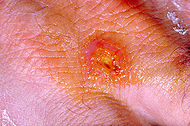
Infection with F. tularensis can occur via several routes. The most common occurs via skin contact, yielding an ulceroglandular form of the disease. Inhalation of bacteria - particularly biovar tularensis, leads to the potentially lethal pneumonic
tularemia. While the pulmonary and ulceroglandular forms of tularemia are more common, other routes of inoculation have been described and include oropharyngeal infection due to consumption of contaminated food and conjunctival infection due to inoculation at the eye.
F. tularensis is capable of surviving outside of a mammalian host for weeks at a time and has been found in water, grassland
, and hay
stacks. Aerosols containing the bacteria may be generated by disturbing carcasses due to brushcutting or lawn mowing; as a result, tularemia has been referred to as lawnmower disease. Recent epidemiological studies have shown a positive correlation between occupations involving the above activities and infection with F. tularensis.
. F. tularensis then breaks out of this phagosome into the cytosol
and rapidly proliferates. Eventually the infected cell undergoes apoptosis
, and the progeny bacteria are released to initiate new rounds of infection.
 The virulence mechanisms for F. tularensis have not been well characterized. Like other intracellular bacteria that break out of phagosomal compartments to replicate in the cytosol, F. tularensis strains produce different hemolytic agents, which may facilitate degradation of the phagosome. A hemolysin
activity, named NlyA, with immunological reactivity to Escherichia coli
anti-HlyA antibody was identified in biovar novicida. Acid phosphatase AcpA has been found in other bacteria to act as a hemolysin, whereas in Francisella its role as a virulence factor is under vigorous debate.
While F. tularensis does not contain virulence secretion systems typical of some better-characterized pathogenic bacteria, it does contain a number of ATP binding cassette
(ABC) proteins that may be linked to the secretion of virulence factors. F. tularensis uses type IV pili
to bind to the exterior of a host cell and thus become phagocytosed. Mutant strains lacking pili show severely attenuated pathogenicity.
The expression of a 23-kD protein known as IglC is required for F. tularensis phagosomal breakout and intracellular replication; in its absence mutant F. tularensis die and are degraded by the macrophage. This protein is located in a putative pathogenicity island
regulated by the transcription factor MglA.
F. tularensis, in vitro
, downregulates the immune response of infected cells, a tactic used by a significant number of pathogenic organisms to ensure that replication is (albeit briefly) unhindered by the host immune system
by blocking the warning signals from the infected cells. This downmodulation of the immune response requires the IglC protein, though again it is not clear what the contributions of IglC and other genes are.
Several other putative virulence genes exist but have yet to be characterized for function in F. tularensis pathogenicity.
replication. Bacteria will divide into two daughter cells
, each of which contains identical genetic information. Genetic variation may be introduced via mutation
or horizontal gene transfer
.
The genome
of F. tularensis biovar tularensis strain SCHU4 has been sequenced
. The studies resulting from the sequencing suggest that a number of gene coding regions in the F. tularensis genome are disrupted by mutations and thus create blocks in a number of metabolic and synthetic pathways that are required for survival. This indicates that F. tularensis has evolved to depend on the host organism for certain nutrients and other processes ordinarily taken care of by these disrupted genes.
The F. tularensis genome contains unusual transposon
-like elements resembling counterparts that normally are found in eukaryotic organisms.
program ended in 1969 F. tularensis was one of seven standardized biological weapons it had developed.
Pathogen
A pathogen gignomai "I give birth to") or infectious agent — colloquially, a germ — is a microbe or microorganism such as a virus, bacterium, prion, or fungus that causes disease in its animal or plant host...
ic species of gram-negative
Gram-negative
Gram-negative bacteria are bacteria that do not retain crystal violet dye in the Gram staining protocol. In a Gram stain test, a counterstain is added after the crystal violet, coloring all Gram-negative bacteria with a red or pink color...
bacteria and the causative agent of tularemia
Tularemia
Tularemia is a serious infectious disease caused by the bacterium Francisella tularensis. A Gram-negative, nonmotile coccobacillus, the bacterium has several subspecies with varying degrees of virulence. The most important of those is F...
or rabbit fever. It is a facultative intracellular
Intracellular
Not to be confused with intercellular, meaning "between cells".In cell biology, molecular biology and related fields, the word intracellular means "inside the cell".It is used in contrast to extracellular...
bacterium.
Due to its ease of spread by aerosol and its high virulence
Virulence
Virulence is by MeSH definition the degree of pathogenicity within a group or species of parasites as indicated by case fatality rates and/or the ability of the organism to invade the tissues of the host. The pathogenicity of an organism - its ability to cause disease - is determined by its...
, F. tularensis is classified as a Class A agent
Select agent
In United States law, Select Agents are pathogens or biological toxins which have been declared by the U.S. Department of Health and Human Services or by the U.S. Department of Agriculture to have the "potential to pose a severe threat to public health and safety"...
by the U.S. government.
Subspecies
This species was discovered in ground squirrels in Tulare County, CaliforniaTulare County, California
Tulare County is a county located in the Central Valley of the U.S. state of California, south of Fresno. Sequoia National Park is located in the county, as are part of Kings Canyon National Park, in its northeast corner , and part of Mount Whitney, on its eastern border...
in 1911; Bacterium tularense was soon isolated by George Walter McCoy of the US Plague Lab in San Francisco and reported in 1912. Four subspecies (biovar
Biovar
A biovar is a variant prokaryotic strain that differs physiologically and/or biochemically from other strains in a particular species. Morphovars are those strains that differ morphologically. Serovars are those strains that have antigenic properties that differ from other strains....
s) of F. tularensis have been classified.
- The biovar tularensis (or type A) is found predominantly in North AmericaNorth AmericaNorth America is a continent wholly within the Northern Hemisphere and almost wholly within the Western Hemisphere. It is also considered a northern subcontinent of the Americas...
and is the most virulent of the four known subspecies and is associated with lethal pulmonary infections. - Biovar palearctica (also known as biovar holarctica or type B) is found predominantly in EuropeEuropeEurope is, by convention, one of the world's seven continents. Comprising the westernmost peninsula of Eurasia, Europe is generally 'divided' from Asia to its east by the watershed divides of the Ural and Caucasus Mountains, the Ural River, the Caspian and Black Seas, and the waterways connecting...
and AsiaAsiaAsia is the world's largest and most populous continent, located primarily in the eastern and northern hemispheres. It covers 8.7% of the Earth's total surface area and with approximately 3.879 billion people, it hosts 60% of the world's current human population...
but rarely leads to fatal disease. An attenuated live vaccineVaccineA vaccine is a biological preparation that improves immunity to a particular disease. A vaccine typically contains an agent that resembles a disease-causing microorganism, and is often made from weakened or killed forms of the microbe or its toxins...
strain of subspecies palearctica has been described, though it is not yet fully licensed by the FDAFood and Drug AdministrationThe Food and Drug Administration is an agency of the United States Department of Health and Human Services, one of the United States federal executive departments...
as a vaccine. - Subspecies novicida (previously classified as F. novicida ) was characterized as a relatively nonvirulent strain; only two tularemia cases in North America have been attributed to novicida and these were only in severely immunocompromised individuals.
- Biovar mediasiatica, is found primarily in central AsiaCentral AsiaCentral Asia is a core region of the Asian continent from the Caspian Sea in the west, China in the east, Afghanistan in the south, and Russia in the north...
; little is currently known about this subspecies or its ability to infect humans.
Pathogenesis
F. tularensis is capable of infecting a number of small mammals such as voles, rabbits, and muskrats, as well as humans. Despite this, no case of tularemia has been shown to be initiated by human-to-human transmission. Rather, tularemia is caused by contact with infected animals or vectors such as tickTick
Ticks are small arachnids in the order Ixodida, along with mites, constitute the subclass Acarina. Ticks are ectoparasites , living by hematophagy on the blood of mammals, birds, and sometimes reptiles and amphibians...
s, mosquito
Mosquito
Mosquitoes are members of a family of nematocerid flies: the Culicidae . The word Mosquito is from the Spanish and Portuguese for little fly...
s, and deer flies
Deer fly
Deer flies are flies in the genus Chrysops of the family Tabanidae that can be pests to cattle, horses, and humans. A distinguishing characteristic of a deer fly is patterned gold or green eyes....
.
Infection with F. tularensis can occur via several routes. The most common occurs via skin contact, yielding an ulceroglandular form of the disease. Inhalation of bacteria - particularly biovar tularensis, leads to the potentially lethal pneumonic
Pneumonia
Pneumonia is an inflammatory condition of the lung—especially affecting the microscopic air sacs —associated with fever, chest symptoms, and a lack of air space on a chest X-ray. Pneumonia is typically caused by an infection but there are a number of other causes...
tularemia. While the pulmonary and ulceroglandular forms of tularemia are more common, other routes of inoculation have been described and include oropharyngeal infection due to consumption of contaminated food and conjunctival infection due to inoculation at the eye.
F. tularensis is capable of surviving outside of a mammalian host for weeks at a time and has been found in water, grassland
Grassland
Grasslands are areas where the vegetation is dominated by grasses and other herbaceous plants . However, sedge and rush families can also be found. Grasslands occur naturally on all continents except Antarctica...
, and hay
Hay
Hay is grass, legumes or other herbaceous plants that have been cut, dried, and stored for use as animal fodder, particularly for grazing livestock such as cattle, horses, goats, and sheep. Hay is also fed to pets such as rabbits and guinea pigs...
stacks. Aerosols containing the bacteria may be generated by disturbing carcasses due to brushcutting or lawn mowing; as a result, tularemia has been referred to as lawnmower disease. Recent epidemiological studies have shown a positive correlation between occupations involving the above activities and infection with F. tularensis.
Life cycle
F. tularensis is a facultative intracellular bacterium that is capable of infecting most cell types but primarily infects macrophages in the host organism. F. tularensis entry into the macrophage occurs via phagocytosis and the bacterium is sequestered from the interior of the infected cell by a phagosomePhagosome
In cell biology, a phagosome is a vacuole formed around a particle absorbed by phagocytosis. The vacuole is formed by the fusion of the cell membrane around the particle. A phagosome is a cellular compartment in which pathogenic microorganisms can be killed and digested...
. F. tularensis then breaks out of this phagosome into the cytosol
Cytosol
The cytosol or intracellular fluid is the liquid found inside cells, that is separated into compartments by membranes. For example, the mitochondrial matrix separates the mitochondrion into compartments....
and rapidly proliferates. Eventually the infected cell undergoes apoptosis
Apoptosis
Apoptosis is the process of programmed cell death that may occur in multicellular organisms. Biochemical events lead to characteristic cell changes and death. These changes include blebbing, cell shrinkage, nuclear fragmentation, chromatin condensation, and chromosomal DNA fragmentation...
, and the progeny bacteria are released to initiate new rounds of infection.
Virulence factors
Hemolysin
Hemolysins are exotoxins produced by bacteria that cause lysis of red blood cells in vitro. Visualization of hemolysis of red blood cells in agar plates facilitates the categorization of some pathogenic bacteria such as Streptococcus and Staphylococcus...
activity, named NlyA, with immunological reactivity to Escherichia coli
Escherichia coli
Escherichia coli is a Gram-negative, rod-shaped bacterium that is commonly found in the lower intestine of warm-blooded organisms . Most E. coli strains are harmless, but some serotypes can cause serious food poisoning in humans, and are occasionally responsible for product recalls...
anti-HlyA antibody was identified in biovar novicida. Acid phosphatase AcpA has been found in other bacteria to act as a hemolysin, whereas in Francisella its role as a virulence factor is under vigorous debate.
While F. tularensis does not contain virulence secretion systems typical of some better-characterized pathogenic bacteria, it does contain a number of ATP binding cassette
ATP-binding cassette transporter genes
ATP-binding cassette transporters are members of a protein superfamily that is one of the largest and most ancient families with representatives in all extant phyla from prokaryotes to humans...
(ABC) proteins that may be linked to the secretion of virulence factors. F. tularensis uses type IV pili
Pilus
right|thumb|350px|Schematic drawing of bacterial conjugation. 1- Donor cell produces pilus. 2- Pilus attaches to recipient cell, brings the two cells together. 3- The mobile plasmid is nicked and a single strand of DNA is then transferred to the recipient cell...
to bind to the exterior of a host cell and thus become phagocytosed. Mutant strains lacking pili show severely attenuated pathogenicity.
The expression of a 23-kD protein known as IglC is required for F. tularensis phagosomal breakout and intracellular replication; in its absence mutant F. tularensis die and are degraded by the macrophage. This protein is located in a putative pathogenicity island
Pathogenicity island
Pathogenicity islands are a distinct class of genomic islands acquired by microorganisms through horizontal gene transfer. They are incorporated in the genome of pathogenic organisms but are usually absent from those non-pathogenic organisms of the same or closely related species...
regulated by the transcription factor MglA.
F. tularensis, in vitro
In vitro
In vitro refers to studies in experimental biology that are conducted using components of an organism that have been isolated from their usual biological context in order to permit a more detailed or more convenient analysis than can be done with whole organisms. Colloquially, these experiments...
, downregulates the immune response of infected cells, a tactic used by a significant number of pathogenic organisms to ensure that replication is (albeit briefly) unhindered by the host immune system
Immune system
An immune system is a system of biological structures and processes within an organism that protects against disease by identifying and killing pathogens and tumor cells. It detects a wide variety of agents, from viruses to parasitic worms, and needs to distinguish them from the organism's own...
by blocking the warning signals from the infected cells. This downmodulation of the immune response requires the IglC protein, though again it is not clear what the contributions of IglC and other genes are.
Several other putative virulence genes exist but have yet to be characterized for function in F. tularensis pathogenicity.
Genetics
Like many other bacteria, F. tularensis undergoes asexualAsexual reproduction
Asexual reproduction is a mode of reproduction by which offspring arise from a single parent, and inherit the genes of that parent only, it is reproduction which does not involve meiosis, ploidy reduction, or fertilization. A more stringent definition is agamogenesis which is reproduction without...
replication. Bacteria will divide into two daughter cells
Cell division
Cell division is the process by which a parent cell divides into two or more daughter cells . Cell division is usually a small segment of a larger cell cycle. This type of cell division in eukaryotes is known as mitosis, and leaves the daughter cell capable of dividing again. The corresponding sort...
, each of which contains identical genetic information. Genetic variation may be introduced via mutation
Mutation
In molecular biology and genetics, mutations are changes in a genomic sequence: the DNA sequence of a cell's genome or the DNA or RNA sequence of a virus. They can be defined as sudden and spontaneous changes in the cell. Mutations are caused by radiation, viruses, transposons and mutagenic...
or horizontal gene transfer
Horizontal gene transfer
Horizontal gene transfer , also lateral gene transfer , is any process in which an organism incorporates genetic material from another organism without being the offspring of that organism...
.
The genome
Genome
In modern molecular biology and genetics, the genome is the entirety of an organism's hereditary information. It is encoded either in DNA or, for many types of virus, in RNA. The genome includes both the genes and the non-coding sequences of the DNA/RNA....
of F. tularensis biovar tularensis strain SCHU4 has been sequenced
DNA sequence
The sequence or primary structure of a nucleic acid is the composition of atoms that make up the nucleic acid and the chemical bonds that bond those atoms. Because nucleic acids, such as DNA and RNA, are unbranched polymers, this specification is equivalent to specifying the sequence of...
. The studies resulting from the sequencing suggest that a number of gene coding regions in the F. tularensis genome are disrupted by mutations and thus create blocks in a number of metabolic and synthetic pathways that are required for survival. This indicates that F. tularensis has evolved to depend on the host organism for certain nutrients and other processes ordinarily taken care of by these disrupted genes.
The F. tularensis genome contains unusual transposon
Transposon
Transposable elements are sequences of DNA that can move or transpose themselves to new positions within the genome of a single cell. The mechanism of transposition can be either "copy and paste" or "cut and paste". Transposition can create phenotypically significant mutations and alter the cell's...
-like elements resembling counterparts that normally are found in eukaryotic organisms.
Use as a biological weapon
When the U.S. biological warfareBiological warfare
Biological warfare is the use of biological toxins or infectious agents such as bacteria, viruses, and fungi with intent to kill or incapacitate humans, animals or plants as an act of war...
program ended in 1969 F. tularensis was one of seven standardized biological weapons it had developed.
Genomics
- Francisella Genome Projects (from Genomes OnLine Database)
- Comparative Analysis of Francisella Genomes (at DOE'sUnited States Department of EnergyThe United States Department of Energy is a Cabinet-level department of the United States government concerned with the United States' policies regarding energy and safety in handling nuclear material...
IMG systemIntegrated Microbial Genomes SystemThe Integrated Microbial Genomes is a genome browsing and annotation system developed by the DOE-Joint Genome Institute. IMG contains all the draft and complete microbial genomes sequenced by the DOE-JGI integrated with other publicly available genomes...
)
External links
- Francisella tularensis information from the CDC/National Center for Infectious Diesase:
- BioHealthBase Bioinformatics Resource Center The National Institute of Allergy and Infectious Disease (NIAID) supports a public database describing the molecular genetics of F. tularensis. The website describes the genes, proteins, and cellular characteristics of the pathogen.