


Feldherrnhalle

Encyclopedia
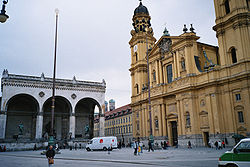
Loggia
Loggia is the name given to an architectural feature, originally of Minoan design. They are often a gallery or corridor at ground level, sometimes higher, on the facade of a building and open to the air on one side, where it is supported by columns or pierced openings in the wall...
in Munich
Munich
Munich The city's motto is "" . Before 2006, it was "Weltstadt mit Herz" . Its native name, , is derived from the Old High German Munichen, meaning "by the monks' place". The city's name derives from the monks of the Benedictine order who founded the city; hence the monk depicted on the city's coat...
, Germany
Germany
Germany , officially the Federal Republic of Germany , is a federal parliamentary republic in Europe. The country consists of 16 states while the capital and largest city is Berlin. Germany covers an area of 357,021 km2 and has a largely temperate seasonal climate...
. It was built between 1841 and 1844 at the southern end of Munich's Ludwigstrasse
Ludwigstraße (Munich)
The Ludwigstrasse in Munich is one of the city's four royal avenues. Principal was King Ludwig I of Bavaria, the avenue is named in his honour. The city's grandest boulevard with its public buildings still maintains its architectural uniformity envisioned as a grand street "worthy the kingdom" as...
next to the Palais Preysing
Palais Preysing
The Palais Preysing is a late-Baroque mansion in Munich, southern Germany, which served as residence for the Counts of Preysing. To distinguish it from the nearby Palais Neuhaus-Preysing, it is also called the Elder Palais Preysing....
and east of the Hofgarten
Hofgarten (München)
The Hofgarten is a garden in the center of Munich, Germany, located between the Residenz and the Englischer Garten.The garden was built in 1613-1617 by Maximilian I, Elector of Bavaria as an Italian style Renaissance garden. In the center of the garden is a pavilion for the goddess Diana, built in...
. Previously the Gothic
Gothic architecture
Gothic architecture is a style of architecture that flourished during the high and late medieval period. It evolved from Romanesque architecture and was succeeded by Renaissance architecture....
Schwabinger Tor (gate) occupied that place. Friedrich von Gärtner
Friedrich von Gärtner
Friedrich von Gärtner was a German architect.Gärtner and Leo von Klenze are the most well known architects of Bavaria during the reign of Ludwig I. His architecture was generally in the Romanesque style and much to the king's taste...
built the Feldherrnhalle at the behest of King Ludwig I of Bavaria
Ludwig I of Bavaria
Ludwig I was a German king of Bavaria from 1825 until the 1848 revolutions in the German states.-Crown prince:...
after the example of the Loggia dei Lanzi
Loggia dei Lanzi
The Loggia dei Lanzi, also called the Loggia della Signoria, is a building on a corner of the Piazza della Signoria in Florence, Italy, adjoining the Uffizi Gallery. It consists of wide arches open to the street, three bays wide and one bay deep. The arches rest on clustered pilasters with...
in Florence
Florence
Florence is the capital city of the Italian region of Tuscany and of the province of Florence. It is the most populous city in Tuscany, with approximately 370,000 inhabitants, expanding to over 1.5 million in the metropolitan area....
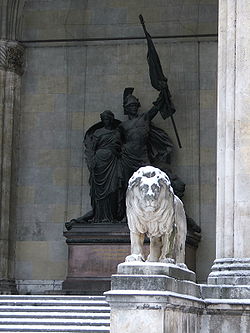
. The Feldherrnhalle was a symbol of the honours of the Bavarian Army. It contains statues of military leaders Johann Tilly
Johan t'Serclaes, Count of Tilly
Johann Tserclaes, Count of Tilly , commanded the Imperial forces in the Thirty Years' War. He had a string of important victories against the Protestants but was then defeated by forces led by the King Gustavus Adolphus of Sweden...
and Karl Philipp von Wrede
Karl Philipp von Wrede
Karl Philipp Josef Wrede, Freiherr von Wrede, 1st Fürst von Wrede , Bavarian field-marshal, was born at Heidelberg, the youngest of three children of Ferdinand Josef Wrede , created in 1791 1st Freiherr von Wrede, and wife, married on 21 March 1746, Anna Katharina Jünger , by whom he had two more...
. The central sculptural group was added in 1882, after the Franco-Prussian War
Franco-Prussian War
The Franco-Prussian War or Franco-German War, often referred to in France as the 1870 War was a conflict between the Second French Empire and the Kingdom of Prussia. Prussia was aided by the North German Confederation, of which it was a member, and the South German states of Baden, Württemberg and...
.
On Friday morning, 9 November 1923, the Feldherrnhalle was the scene of a confrontation between the Bavarian State Police
Landespolizei
thumb|[[Germany|German]] police officer in [[Hamburg]]The Landespolizei are the main police forces of Germany. They are under the sole jurisdiction, funded and operated by the states of Germany.-History:...
and an illegally organized march by the followers of Adolf Hitler. When ordered to stop the marchers continued; the State Police felt threatened and opened fire. Four policemen and sixteen marchers were killed and a number were wounded, including Hermann Göring
Hermann Göring
Hermann Wilhelm Göring, was a German politician, military leader, and a leading member of the Nazi Party. He was a veteran of World War I as an ace fighter pilot, and a recipient of the coveted Pour le Mérite, also known as "The Blue Max"...
. As a result, Hitler was arrested and sentenced to a prison term. This was one of the efforts by the Nazis
Nazism
Nazism, the common short form name of National Socialism was the ideology and practice of the Nazi Party and of Nazi Germany...
to take over the Bavarian State, commonly referred to as the Beer Hall Putsch
Beer Hall Putsch
The Beer Hall Putsch was a failed attempt at revolution that occurred between the evening of 8 November and the early afternoon of 9 November 1923, when Nazi Party leader Adolf Hitler, Generalquartiermeister Erich Ludendorff, and other heads of the Kampfbund unsuccessfully tried to seize power...
.
This also appears on the Blood Order
Blood Order
The Blood Order , officially known as the Decoration of 9 November 1923 , was one of the most prestigious decorations in the Nazi Party...
decoration of the Nazi party of Nov 9, 1923.