


Loggia dei Lanzi

Encyclopedia
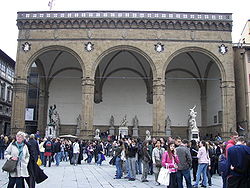
Piazza della Signoria
Piazza della Signoria is an L-shaped square in front of the Palazzo Vecchio in Florence, Italy. It was named after the Palazzo della Signoria, also called Palazzo Vecchio....
in Florence
Florence
Florence is the capital city of the Italian region of Tuscany and of the province of Florence. It is the most populous city in Tuscany, with approximately 370,000 inhabitants, expanding to over 1.5 million in the metropolitan area....
, Italy
Italy
Italy , officially the Italian Republic languages]] under the European Charter for Regional or Minority Languages. In each of these, Italy's official name is as follows:;;;;;;;;), is a unitary parliamentary republic in South-Central Europe. To the north it borders France, Switzerland, Austria and...
, adjoining the Uffizi Gallery
Uffizi
The Uffizi Gallery , is a museum in Florence, Italy. It is one of the oldest and most famous art museums of the Western world.-History:...
. It consists of wide arches open to the street, three bays
Bay (architecture)
A bay is a unit of form in architecture. This unit is defined as the zone between the outer edges of an engaged column, pilaster, or post; or within a window frame, doorframe, or vertical 'bas relief' wall form.-Defining elements:...
wide and one bay deep. The arches rest on clustered pilasters with Corinthian
Corinthian order
The Corinthian order is one of the three principal classical orders of ancient Greek and Roman architecture. The other two are the Doric and Ionic. When classical architecture was revived during the Renaissance, two more orders were added to the canon, the Tuscan order and the Composite order...
capitals. The wide arches appealed so much to the Florentines, that Michelangelo
Michelangelo
Michelangelo di Lodovico Buonarroti Simoni , commonly known as Michelangelo, was an Italian Renaissance painter, sculptor, architect, poet, and engineer who exerted an unparalleled influence on the development of Western art...
even proposed that they should be continued all around the Piazza della Signoria.
Sometimes erroneously referred to as Loggia
Loggia
Loggia is the name given to an architectural feature, originally of Minoan design. They are often a gallery or corridor at ground level, sometimes higher, on the facade of a building and open to the air on one side, where it is supported by columns or pierced openings in the wall...
dell' Orcagna
Andrea Orcagna
Andrea di Cione di Arcangelo , better known as Orcagna, was an Italian painter, sculptor, and architect active in Florence. A student of Andrea Pisano as well as Giotto di Bondone, his younger brothers Jacopo di Cione and Nardo di Cione were also artists...
because it was once thought to be designed by that artist, it was built between 1376 and 1382 by Benci di Cione and Simone di Francesco Talenti, possibly following a design by Jacopo di Sione, to house the assemblies of the people and hold public ceremonies, such as the swearing into office of the Gonfaloniers and the Priors. Simone Talenti is also well-known from his contributions to the churches Orsanmichele
Orsanmichele
Orsanmichele is a church in the Italian city of Florence...
and San Carlo.
The vivacious construction of the Loggia is in stark contrast with the severe architecture of the Palazzo Vecchio. It is effectively an open-air sculpture gallery of antique and Renaissance art.
The name Loggia dei Lanzi dates back to the reign of Grand Duke Cosimo I
Cosimo I de' Medici, Grand Duke of Tuscany
Cosimo I de' Medici was Duke of Florence from 1537 to 1574, reigning as the first Grand Duke of Tuscany from 1569.-Biography:...
, when it was used to house his formidable landsknecht
Landsknecht
Landsknechte were European, predominantly German mercenary pikemen and supporting foot soldiers from the late 15th to the late 16th century, and achieved the reputation for being the universal mercenary of Early modern Europe.-Etymology:The term is from German, Land "land, country" + Knecht...
s (In Italian: "Lanzichenecchi", corrupted to Lanzi), or German mercenary pikemen. After the construction of the Uffizi at the rear of the Loggia, the Loggia's roof was modified by Bernardo Buontalenti
Bernardo Buontalenti
Bernardo Buontalenti, byname of Bernardo Delle Girandole was an Italian stage designer, architect, theatrical designer, military engineer and artist.-Biography:Buontalenti was born in Florence....
and became a terrace from which the Medici
Medici
The House of Medici or Famiglia de' Medici was a political dynasty, banking family and later royal house that first began to gather prominence under Cosimo de' Medici in the Republic of Florence during the late 14th century. The family originated in the Mugello region of the Tuscan countryside,...
princes could watch ceremonies in the piazza.
Architectural setting
Parapet
A parapet is a wall-like barrier at the edge of a roof, terrace, balcony or other structure. Where extending above a roof, it may simply be the portion of an exterior wall that continues above the line of the roof surface, or may be a continuation of a vertical feature beneath the roof such as a...
, are trefoil
Trefoil
Trefoil is a graphic form composed of the outline of three overlapping rings used in architecture and Christian symbolism...
s with allegorical figures of the four cardinal virtues
Cardinal virtues
In Christian traditionthere are 4 cardinal virtues:*Prudence - able to judge between actions with regard to appropriate actions at a given time*Justice - proper moderation between self-interest and the rights and needs of others...
(Fortitude, Temperance, Justice and Prudence) by Agnolo Gaddi
Agnolo Gaddi
Agnolo Gaddi was an Italian painter. He was the son and pupil of the painter Taddeo Gaddi.Taddeo Gaddi was himself the major pupil of the Florentine master Giotto...
. Their blue enamelled background is the work of Leonardo, a monk, while the golden stars were painted by Lorenzo de' Bicci. The vault, composed of semicircles, was done by the Florentine Antonio de' Pucci. On the steps of the Loggia are the Medici lions
Medici lions
The Medici lions are two lion sculptures placed around 1600 at the Villa Medici, Rome, Italy, and since 1789 displayed at the Loggia dei Lanzi, Florence. The sculptures depict standing male lions with a sphere under one claw, looking to the side...
; two Marzocco
Marzocco
The Marzocco is the heraldic lion, best known in the rendition sculpted by Donatello in 1418–20, that is a symbol of Florence.Donatello's Marzocco was commissioned by the Republic of Florence for the apartment of Pope Martin V at Santa Maria Novella, where this traditional insegna of...
s, marble statues of lions, heraldic symbols of Florence; that on the right is from Roman times and the one on the left was sculpted by Flaminio Vacca
Flaminio Vacca
Flaminio Vacca or Vacchi was an Italian sculptor. His sculptural work can be seen in Rome in the grandiose funeral chapel of Pope Pius V designed by Domenico Fontana at the Basilica di Santa Maria Maggiore , in the Church of the Gesù and in the right transept of...
in 1598. It was originally placed in the Villa Medici
Villa Medici
The Villa Medici is a mannerist villa and an architectural complex with a garden contiguous with the larger Borghese gardens, on the Pincian Hill next to Trinità dei Monti in Rome, Italy. The Villa Medici, founded by Ferdinando I de' Medici, Grand Duke of Tuscany and now property of the French...
in Rome, but found its final place in the Loggia in 1789.
On the side of the Loggia, there is a Latin inscription from 1750 commemorating the change of the Florentine calendar in 1749 to bring it into line with the Roman calendar. The Florentine calendar began on 25 March instead of 1 January. Other inscription from 1893 records the Florentines who distinguished themselves during the annexation of Milan
Milan
Milan is the second-largest city in Italy and the capital city of the region of Lombardy and of the province of Milan. The city proper has a population of about 1.3 million, while its urban area, roughly coinciding with its administrative province and the bordering Province of Monza and Brianza ,...
(1865), Venice
Venice
Venice is a city in northern Italy which is renowned for the beauty of its setting, its architecture and its artworks. It is the capital of the Veneto region...
(1866) and Rome (1871) to the kingdom of Italy.
Statuary
Perseus
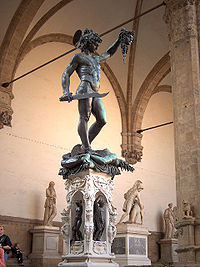
Perseus ,Perseos and Perseas are not used in English. the legendary founder of Mycenae and of the Perseid dynasty of Danaans there, was the first of the mythic heroes of Greek mythology whose exploits in defeating various archaic monsters provided the founding myths of the Twelve Olympians...
by Benvenuto Cellini
Benvenuto Cellini
Benvenuto Cellini was an Italian goldsmith, sculptor, painter, soldier and musician, who also wrote a famous autobiography. He was one of the most important artists of Mannerism.-Youth:...
. It shows the mythical Greek hero holding his sword in his right hand and holding up triumphantly the Medusa
Medusa
In Greek mythology Medusa , " guardian, protectress") was a Gorgon, a chthonic monster, and a daughter of Phorcys and Ceto. The author Hyginus, interposes a generation and gives Medusa another chthonic pair as parents. Gazing directly upon her would turn onlookers to stone...
's decapitated head in his left. The well-proportioned muscular body of Perseus stands poised on the right leg. Perseus is subdued, holding back his emotions. Blood is gushing from the head and the neck of the dead Medusa. The richly decorated marble pedestal, also by Cellini, shows four graceful bronze statuettes of Jupiter
Jupiter (mythology)
In ancient Roman religion and myth, Jupiter or Jove is the king of the gods, and the god of the sky and thunder. He is the equivalent of Zeus in the Greek pantheon....
, Mercurius
Mercury (mythology)
Mercury was a messenger who wore winged sandals, and a god of trade, the son of Maia Maiestas and Jupiter in Roman mythology. His name is related to the Latin word merx , mercari , and merces...
, Minerva
Minerva
Minerva was the Roman goddess whom Romans from the 2nd century BC onwards equated with the Greek goddess Athena. She was the virgin goddess of poetry, medicine, wisdom, commerce, weaving, crafts, magic...
and Danaë
Danaë
In Greek mythology, Danaë was a daughter of King Acrisius of Argos and Eurydice of Argos. She was the mother of Perseus by Zeus. She was sometimes credited with founding the city of Ardea in Latium....
. The bas-relief on the pedestal, representing Perseus freeing Andromeda, is a copy of the one in Bargello
Bargello
The Bargello, also known as the Bargello Palace or Palazzo del Popolo is a former barracks and prison, now an art museum, in Florence, Italy.-Terminology:...
.
Benvenuto Cellini
Benvenuto Cellini
Benvenuto Cellini was an Italian goldsmith, sculptor, painter, soldier and musician, who also wrote a famous autobiography. He was one of the most important artists of Mannerism.-Youth:...
worked almost ten years on this bronze (1545-1554). His wax design was immediately approved by Cosimo I de' Medici. He met numerous difficulties which, according to his autobiography, almost brought him to the brink of death. The casting of this bronze statue was several times unsuccessful. When attempting again, the melting furnace got overheated, spoiling the casting of the bronze. Cellini gave orders to feed the furnace with his household furniture and finally with about 200 pewter dishes and plates, and his pots and pans. This caused the bronze to flow again. After the bronze had cooled, the statue was miraculously finished, except for three toes on the right foot. These were added later.
Mannerism
Mannerism is a period of European art that emerged from the later years of the Italian High Renaissance around 1520. It lasted until about 1580 in Italy, when a more Baroque style began to replace it, but Northern Mannerism continued into the early 17th century throughout much of Europe...
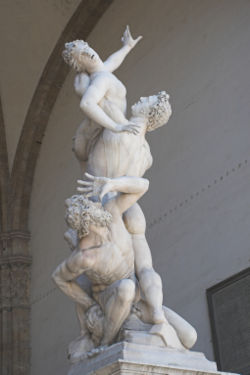
group Rape of the Sabine Women by the Flemish artist Jean de Boulogne, better known by his Italianized name Giambologna
Giambologna
Giambologna, born as Jean Boulogne, incorrectly known as Giovanni da Bologna and Giovanni Bologna , was a sculptor, known for his marble and bronze statuary in a late Renaissance or Mannerist style.- Biography :...
. This impressive work was made from one imperfect block of white marble, the largest block ever transported to Florence. The goccia model is now in the Galleria dell' Academia. Giambologna wanted to create a composition with the figura serpentina, an upward snakelike spiral movement to be examined from all sides. This is the first group representing more than a single figure in European sculptural history to be conceived without a dominant viewpoint. It can be equally admired from all sides. The marble pedestal, also by Giambologna, represents bronze bas-reliefs with the same theme. This marble and bronze group is in the Loggia since 1583.
Nearby is Giambologna's less celebrated marble sculpture
Marble sculpture
Marble sculpture is the art of creating three-dimensional forms from marble. Sculpture is among the oldest of the arts. Even before painting cave walls, early humans fashioned shapes from stone. From these beginnings, artifacts have evolved to their current complexity...
Hercules beating the Centaur Nessus (1599) and placed here in 1841 from the Canto de' Carnesecchi. It was sculpted from one solid block of white marble with the help of Pietro Francavilla
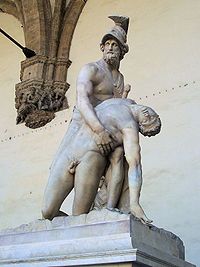
The group Menelaus supporting the body of Patroclus
Menelaus supporting the body of Patroclus
The marble sculpture usually given the rather arbitrary title Menelaus supporting the body of Patroclus due to its apparent representation of an episode in the Iliad, has had a complicated artistic and social history that illustrates the degree to which free improvisatory restorations were made to...
, discovered in Rome
Rome
Rome is the capital of Italy and the country's largest and most populated city and comune, with over 2.7 million residents in . The city is located in the central-western portion of the Italian Peninsula, on the Tiber River within the Lazio region of Italy.Rome's history spans two and a half...
stood originally at the southern end of the Ponte Vecchio
Ponte Vecchio
The Ponte Vecchio is a Medieval stone closed-spandrel segmental arch bridge over the Arno River, in Florence, Italy, noted for still having shops built along it, as was once common. Butchers initially occupied the shops; the present tenants are jewellers, art dealers and souvenir sellers...
. There is another version of this much-restored Roman marble in the Palazzo Pitti
Palazzo Pitti
The Palazzo Pitti , in English sometimes called the Pitti Palace, is a vast mainly Renaissance palace in Florence, Italy. It is situated on the south side of the River Arno, a short distance from the Ponte Vecchio...
. It is an ancient Roman sculpture from the Flavian
Flavius
Flavius was a gens of ancient Rome, meaning "blond". The feminine form was Flavia.After the end of the popular Flavian dynasty of emperors, Flavius/Flavia became a praenomen, common especially among royalty: the adoption of this praenomen by Constantine I set a precedent for some imperial...
era, copied from a Hellenistic Pergamene original of the mid third century BC. This marble group was discovered in Rome. It has undergone restorations by Ludovico Salvetti, to a model by Pietro Tacca
Pietro Tacca
Pietro Tacca was an Italian sculptor, who was the chief pupil and follower of Giambologna. Tacca began in a Mannerist style and worked in the Baroque style during his maturity.-Biography:...
(1640) and by Stefano Ricci (about 1830).
The group The Rape of Polyxena
Polyxena
In Greek mythology, Polyxena was the youngest daughter of King Priam of Troy and his queen, Hecuba. She is considered the Trojan version of Iphigenia, daughter of Agamemnon and Clytemnestra. Polyxena is not in Homer's Iliad, appearing in works by later poets, perhaps to add romance to Homer's...
, is a fine diagonal sculpture by Pio Fedi from 1865.
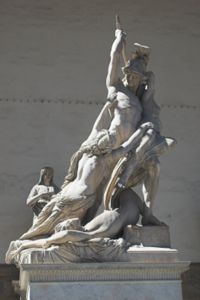
Sabine
The Sabines were an Italic tribe that lived in the central Appennines of ancient Italy, also inhabiting Latium north of the Anio before the founding of Rome...
s and a statue of a barbarian prisoner Thusnelda
Thusnelda
Thusnelda was the daughter of the Cheruscan prince Segestes. Her father had intended her for someone else, but Arminius, who subsequently led a coalition of Germanic tribes to victory over Publius Quinctilius Varus and his legions in the Battle of Teutoburg Forest in 9 AD, eloped with her and...
from Roman times from the era of Trajan
Trajan
Trajan , was Roman Emperor from 98 to 117 AD. Born into a non-patrician family in the province of Hispania Baetica, in Spain Trajan rose to prominence during the reign of emperor Domitian. Serving as a legatus legionis in Hispania Tarraconensis, in Spain, in 89 Trajan supported the emperor against...
to Hadrian
Hadrian
Hadrian , was Roman Emperor from 117 to 138. He is best known for building Hadrian's Wall, which marked the northern limit of Roman Britain. In Rome, he re-built the Pantheon and constructed the Temple of Venus and Roma. In addition to being emperor, Hadrian was a humanist and was philhellene in...
. They were discovered in Rome in 1541. The statues had been in the Medici villa at Rome since 1584 and were brought here by Pietro Leopoldo in 1789. They all have significant, modern restorations.
The Feldherrnhalle
Feldherrnhalle
The Feldherrnhalle is a monumental loggia in Munich, Germany. It was built between 1841 and 1844 at the southern end of Munich's Ludwigstrasse next to the Palais Preysing and east of the Hofgarten. Previously the Gothic Schwabinger Tor occupied that place...
in Munich
Munich
Munich The city's motto is "" . Before 2006, it was "Weltstadt mit Herz" . Its native name, , is derived from the Old High German Munichen, meaning "by the monks' place". The city's name derives from the monks of the Benedictine order who founded the city; hence the monk depicted on the city's coat...
, the site of a failed coup by the fledgling Nazi party
National Socialist German Workers Party
The National Socialist German Workers' Party , commonly known in English as the Nazi Party, was a political party in Germany between 1920 and 1945. Its predecessor, the German Workers' Party , existed from 1919 to 1920...
in 1923, was modelled after the Loggia dei Lanzi.