

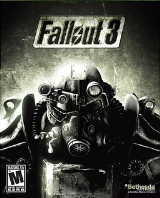
Fallout 3

Encyclopedia
Fallout 3 is an action role-playing game
released by Bethesda Game Studios, and the third major installment in the Fallout series. The game was released in North America, Europe and Australia in October 2008, and in Japan in December 2008 for Microsoft Windows
, PlayStation 3
and Xbox 360
. Fallout 3 takes place in the year 2277, 36 years after the setting of Fallout 2
and 200 years after the nuclear apocalypse that devastated the game's world in a future where international conflicts culminated in a Sino-American war in the second half of the 21st century.
The player character is an inhabitant of Vault 101, a survival shelter designed to protect up to 1,000 humans from the nuclear fallout
. When the player character's father disappears under mysterious circumstances, the player is forced to escape from the Vault and journey into the ruins of Washington, D.C.
to track him down. Along the way the player is assisted by a number of human survivors and must battle a myriad of enemies that inhabit the area now known as the "Capital Wasteland". The game has an attribute and combat system typical of an action
strategy game
but also incorporates elements of survival horror games.
Following its release, Fallout 3 received very positive reviews from critics and a number of Game of the Year awards, praising the game's open-ended gameplay and flexible character-leveling system. The NPD Group
estimated that Fallout 3 sold over 610,000 units during its initial month of release in October 2008, performing better than Bethesda Softworks' previous game The Elder Scrolls IV: Oblivion
, which sold nearly 500,000 units in its first month. The game has also received post-launch support with Bethesda releasing five downloadable add-ons
. The game received controversy upon release, including the use of morphine in the game for Australia, religious and cultural sentiments in India, and sensitivity in Japan due to a mission involving an atomic detonation.
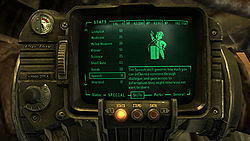 The game begins with the main character as a newborn, whereupon the player determines the race, the gender, and the general appearance of their character. As a one year-old baby, the infant reads a child's book titled You're SPECIAL, where the player can set the character's starting S.P.E.C.I.A.L. primary attributes
: Strength, Perception, Endurance, Charisma, Intelligence, Agility, and Luck. The character gains a set of Skills with base levels determined by these attributes. At age 16, the player takes the Generalized Occupational Aptitude Test (G.O.A.T.) to determine the three Skills they wish the character to focus on.
As the character progresses through the game, experience points are earned that are used to achieve levels of accomplishment. Upon achieving a new level, the player receives a set of skill points that can be assigned to improve any of the Skill percentages. For instance, increasing the lock pick skill grants the player the ability to pick harder locks to unlock doors and supply crates. A Perk is granted at each level, which offers advantages of varying quality and form. Many Perks have a set of prerequisites that must be satisfied, and new Perks are unlocked every two levels.
An important statistic tracked in the game is karma
. Each character has an aggregate amount of karma that can be affected by the decisions and actions made in the game. Positive karmic actions include freeing captives and helping others. Negative karmic actions include killing good characters and stealing. Beyond acting as flavor for the game's events, karma can have tangible effects to the player, primarily affecting the game's ending. Other effects include altered dialogue with non-player character
s (NPCs), or unique reactions from other characters. Actions vary in the level of karma change they cause; thus, pickpocketing produces less negative karma than the killing of a good character. However, the player's relationships with the game's factions are distinct, so any two groups or settlements may view the player in contrasting ways, depending on the player's conduct. Some Perks require specific karma levels.
Along with the health, there are 20 bobbleheads that can be found throughout the game that will give the player bonuses to attributes and skills. Each bobblehead is an iconic Vault-Tec Boy figurine with a different pose. Three of them have to be found in different time periods in the gameplay; otherwise they will be lost.
There are secondary health factors that can affect performance. Chief among these is radiation poisoning: most food is irradiated to a small degree, and parts of the world have varying levels of background radiation. As the player is exposed to radiation, it builds up, causing negative effects and eventually death if left untreated. Radiation sickness must be healed by special medicine or doctors. The player can become addicted to drugs and alcohol, and then go through withdrawal symptoms if denied those substances. Both afflictions can blur the player's vision for a few seconds and have a negative effect on SPECIAL attributes until the problem is corrected.
Items can become degraded and become less effective. Firearms do less damage and may jam during reloading, and apparel becomes gradually less protective. This will eventually result in the item breaking altogether. Items can be repaired for a price from special vendors, or, when the player has two of the same item (or a comparable item), one can be repaired using salvage parts from the other.
Players have the option to create their own weaponry using various scavenged items found in the wasteland. These items can only be created at workbenches, and only if the player possesses the necessary schematic
s or Perk. These weapons usually possess significant advantages over other weapons of their type. Each schematic has three copies that can be found. Each copy improves the condition (or number) of items produced at the workbench. A higher repair skill will result in a better starting condition for the related weapon. Weapon schematics can be found lying in certain locations, bought from vendors, or received as quest rewards.
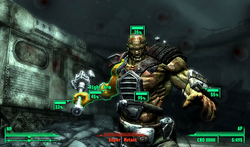 The Vault-Tec Assisted Targeting System, or V.A.T.S., plays an important part in combat. While using V.A.T.S., real-time combat is paused, and action is played out from varying camera angles in a computer graphics version of "bullet time
", creating a combat system that the Bethesda developers have described as a hybrid between turn-based and real-time combat. Various actions cost action points, limiting the actions of each combatant during a turn, and the player can target specific body areas for attacks to inflict specific injuries; head shots can be used for quick kills or blinding, legs can be targeted to slow enemies' movements, opponents can be disarmed by shooting at their weapons, and players can drive certain enemies into a berserker
rage by shooting out things like antennae on various overgrown insects and combat inhibitors on armored robots. However, the use of V.A.T.S. also eliminates most of the first-person shooter elements of the game; aiming is taken over by the computer, and the player is unable to move as a means of avoiding attacks. Each body part has a percentage of hit chance, and generally the closer the player character is to an enemy the higher that percentage. The higher level the character using V.A.T.S is, the more likely that character will hit their enemy.
of three, consisting of the player's character, an Australian Cattle Dog
named Dogmeat, and a single non-player character
. Dogmeat can be killed during the game if the player misuses him or places him in a severely dangerous situation and he cannot be replaced (this was changed with the introduction of Broken Steel: the level 22 "Puppies!" perk allows the player to gain a puppy follower if Dogmeat dies); it is possible to not encounter Dogmeat at all depending on how the game is played. One other NPC can travel with the player at any time, and in order to get another NPC to travel, the first one must be dismissed (either voluntarily by the player or as a consequence of other events) or die in combat.
, retro-future
, covering a region that includes Washington, D.C.
, northeast Virginia
and parts of Maryland
. The game's landscape includes war-ravaged variants of numerous real-life landmarks such as the White House
, the Jefferson
and Lincoln Memorial
s, Arlington National Cemetery
and the Washington Monument
. The area that the game is set in, known in-game as the Capital Wasteland, holds a number of small settlements of the descendants of survivors from the Great War. Many inhabitants were killed during the nuclear holocaust and the Wasteland is now little more than a barren land nearly devoid of healthy water, food, plant and animal life due to the extreme radiation levels, however there is a small settlement in the north of the Capital Wasteland where trees are overgowing the area.
The player begins the game inside Vault 101, where s/he believes s/he is originally born, before venturing out into the Capital Wasteland and facing its many dangers. The Capital Wasteland is home to a number of mutated species of creatures such as two-headed cattle called Brahmin, radscorpions, molerats, and mirelurks. Many of these creatures are generally hostile to the player and will attack on sight. The Wasteland and the city proper is home to several hostile groups, including super mutants, feral ghouls, raiders, slavers, mercenaries, and robots. Of note are the various Vaults—underground structures designed as shelters to protect inhabitants from the dangers of nuclear war (and also for more sinister purposes). In the Washington, D.C. area, many of the roads are blocked off with giant piles of rubble. The player can navigate around the city using a system of underground metro tunnels that connect with other locations (loosely based on the real-life Washington Metro
).
Because the game takes place following a nuclear war, cultural advancements have stagnated and, as a result, the game contains a 1950s utopian theme as evidenced in-game through posters and billboards with music from the time period.
, which speaks of "the waters of life".
The main quest begins after the player is forced to flee Vault 101 when James leaves the vault, throwing it into anarchy and causing the paranoid Overseer to send his police force after the player. The search for James takes the character on a journey through the Wasteland, first to the nearby town of Megaton, named for the undetonated atomic bomb at its center, then the Galaxy News Radio station, whose enthusiastic DJ, Three Dog, give the player the moniker of "The Lone Wanderer". The player travels to Rivet City, a derelict aircraft carrier now serving as a fortified human settlement. Here the player meets Doctor Li, a scientist who worked alongside the player's father. Doctor Li informs the player of Project Purity, a plan conceived by Catherine and James to purify all the water in the Tidal Basin
and eventually the entire Potomac River
with a giant water purifier built in the Jefferson Memorial. However, continued delays and Catherine's death during childbirth put an end to the project, and James took the player's character as a newborn to raise them in the safety of Vault 101.
After investigating the Jefferson Memorial, the Lone Wanderer tracks James to Vault 112, and frees him from a virtual reality
program being run by the Vault's sadistic Overseer, Dr. Braun. James and the player return to Rivet City, and James reveals he sought out Braun for information on the Garden of Eden Creation Kit (G.E.C.K.), an invention of Braun's that contains the components needed to finally activate Project Purity. James and Doctor Li lead a team of Rivet City scientists to the memorial with intent to restart the project, but the memorial is invaded by the Enclave, a powerful military organization formed from the remnants of the pre-War United States government. James floods the project's control room with radiation to stop the Enclave military leader, Colonel Augustus Autumn, from taking control of it, killing himself, his last words urging his child to run. The Lone Wanderer and Dr. Li flee to the ruins of the Pentagon, now a base for the Brotherhood of Steel and now known as the Citadel. With Project Purity still inoperational even with the Enclave occupying the site, the player travels to Vault 87 to find a G.E.C.K. and finish James's work. The player finds the Vault to be a testing site for the FEV (Forced Evolutionary Virus), and the source of the Super Mutants in the Capital Wasteland. With the aid of Fawkes, a highly intelligent, civilized and friendly Super Mutant, the player acquires the G.E.C.K., but is ambushed by the Enclave and captured.
At the Enclave base at Raven Rock, the player is freed from their cell by the Enclave leader, President
John Henry Eden, who requests a private audience with them. En route to his office however, Colonel Autumn defies Eden's orders and takes command of the Enclave military, ordering them to kill the player. Fighting their way to Eden's office, the player discovers he is actually a sentient supercomputer
who took control of the Enclave after their defeat in Fallout 2 on the West Coast
thirty years ago. Eden wishes to repeat the plan of then-President Dick Richardson
using Project Purity, infecting the water with a modified strain of FEV that will make it toxic to any mutated life. This plan will kill most life in the wasteland including humans, but the Enclave, due to their genetic "purity" as a result of their isolation, will be immune and free to take control of the area. Eden gives the The Wanderer a sample of the new F.E.V. and is allowed to leave or convince Eden to self-destruct the entire base. The Lone Wanderer escapes Raven Rock with the help of Fawkes and returns to the Citadel.
With the knowledge they possess the G.E.C.K. and the means to activate Project Purity, the Brotherhood assault the Jefferson Memorial, spearheaded by a giant robot named Liberty Prime. In the control room of Project Purity the player confronts Colonel Autumn, and has the choice to persuade him to give up or kill him. Dr. Li informs the player that the purifier is ready to be activated, but the activation code must be input manually, and also that the control room is flooded with lethal amounts of radiation. The Lone Wanderer is forced to enter the extremely irradiated purifier and must enter the code hinted at throught the game, that being 21:6, and immediately dies from a radiation spike. The player also has the possiblity to enter the F.E.V. sample into the water prior to activation, having adverse effects on the games side quests post-ending.
, a studio owned by Interplay Entertainment
, under the working title Van Buren. Black Isle Studios was the developer of the original Fallout and Fallout 2
. When Interplay Entertainment went bankrupt and closed down Black Isle Studios before the game could be completed, the license to develop Fallout 3 was sold for a $1,175,000 minimum guaranteed advance against royalties
to Bethesda Softworks
, a studio primarily known as the developer of The Elder Scrolls
series. Bethesda's Fallout 3 however, was developed from scratch, using neither Van Buren code, nor any other materials created by Black Isle Studios. In May 2007, a playable technology demo of the canceled project was released to the public.
Leonard Boyarsky
, art director of the original Fallout, when asked about Interplay Entertainment's sale of the rights to Bethesda Softworks, said:
and its related extras and plug ins were completed. Bethesda Softworks decided to make Fallout 3 similar to the previous two games, focusing on non-linear gameplay, story, and black comedy
. Bethesda also chose to pursue an ESRB
rating of M (for mature) by including the adult themes, violence, and depravity characteristic of the Fallout series. They also decided to shy away from the self-referential gags of the game's predecessors that broke the illusion that the world of Fallout is real. Fallout 3 uses a version of the same Gamebryo
engine as Oblivion, and was developed by the team responsible for that game. Liam Neeson
was cast as the voice of the player's father.
In February 2007, Bethesda stated that the game was "a fairly good ways away" from release, but that detailed information and previews would be available later in the year. Following a statement made by Pete Hines that the team wanted to make the game a "multiple platform title", the game was announced by Game Informer
to be in development for Windows
, Xbox 360
and PlayStation 3
.
During a March 21, 2008 Official Xbox Magazine
podcast interview, Todd Howard
revealed that the game had expanded to nearly the same scope as Oblivion. There were originally at least 12 versions of the final cutscene, but with further development this expanded to over 200 possible permutations in the final release, all of which are determined by the actions taken by the player. Bethesda Softworks attended E3 2008 to showcase Fallout 3. The first live demo of the Xbox 360 version of the game was shown and demonstrated by Todd Howard, taking place in downtown Washington, D.C. The demo showcased various weapons such as the Fat Man nuclear catapult, the V.A.T.S. system, the functions of the Pip-Boy 3000, as well as combat with several enemies. The demo concluded as the player neared the Brotherhood of Steel-controlled Pentagon
and was attacked by an Enclave patrol.
as the game's narrator, Malcolm McDowell
as President John Henry Eden, and Odette Yustman
as Amata Almodovar. Veteran voice actors Dee Bradley Baker
, Wes Johnson
, Paul Eiding
and Stephen Russell
also provided voice overs for the game. The Fallout 3 soundtrack continued the series' convention of featuring sentimental 1940s big band American popular music, the main theme, and few other side songs recorded by The Ink Spots
and The Andrews Sisters
; in addition to a score written by composer Inon Zur
. The soundtrack of the game included artists such as Roy Brown
, Billie Holiday
, Billy Munn
, Cole Porter
, and Bob Crosby
.
On June 5, 2007, Bethesda released the Fallout 3 teaser trailer
. The press kit released with the trailer indicated that Ron Perlman would be on-board with the project, and cited a release date of Fall 2008. The trailer featured The Ink Spots song "I Don't Want to Set the World on Fire", which the previous Fallout developer Black Isle Studios originally intended to license for use in the first Fallout game. The trailer, which was completely done with in-engine assets, closed with Ron Perlman saying his trademark line which he also spoke in the original Fallout: "War. War never changes". The trailer showed a devastated Washington, D.C., evidenced by the partially damaged Washington Monument in the background as well as the crumbling buildings that surrounded a rubble-choked city thoroughfare.
A second trailer was first shown during a GameTrailers TV E3 special on July 12, 2008. The trailer zoomed out from a ruined house in the Washington, D.C. suburbs, and provided a wider view of the capital's skyline including the Capitol Building
and Washington Monument in the distance. On July 14, 2008, an extended version of this trailer was made available, which besides the original content, included a Vault-Tec advertisement and actual gameplay. Both versions of the trailer featured the song "Dear Hearts and Gentle People
" as recorded by Bob Crosby and the Bobcats
.
and Geek Monthly magazine
to sponsor "A Post-Apocalyptic Film Festival Presented by Fallout 3". The festival took place on August 22–23 at Santa Monica's Aero Theater. Six post-apocalyptic movies were shown which depict life and events that could occur after a world-changing disaster, including Wizards
, Damnation Alley
, A Boy and His Dog
, The Last Man on Earth, The Omega Man
, and Twelve Monkeys
.
(DLC) would be prepared for the Xbox 360 and Windows versions of Fallout 3. There are five DLCs: Operation: Anchorage, The Pitt, Broken Steel, Point Lookout, and Mothership Zeta, released in that order. Of the five, Broken Steel has the largest effect on the game, altering the ending and allowing the player to continue playing past the end of the main quest line.
Originally, there was no downloadable content announced for the PlayStation 3 version of the game. Although Bethesda had not offered an official explanation as to why the content was not released for PlayStation 3, Lazard Capital Markets
analyst Colin Sebastian speculated that it may have been the result of a money deal with Bethesda by Sony
's competitor, Microsoft
. When asked if the PlayStation 3 version would receive an update that would enable gameplay beyond the main quest's completion, Todd Howard responded, "Not at this time, no." However, in May 2009, Bethesda announced that the existing DLC packs (Operation: Anchorage, The Pitt and Broken Steel) would be made available for the PlayStation 3; the later two (Point Lookout and Mothership Zeta) were released for all platforms.
On October 1, 2009, a New Xbox Experience premium theme for the game was released for the Xbox 360. Consumers could pay 240 Microsoft Points, or by having downloaded all other downloadable content. The PlayStation 3 received a free theme, featuring a Brotherhood of Steel Knight in the background, and includes symbols from the game as icons on the PS3 home menu. In December 2008 the official editor
, known as the G.E.C.K. (Garden of Eden Creation Kit) was made available for the Windows version of the game as a free download from the Fallout 3 website.
's Demian Linn praised its open-ended gameplay and flexible character-leveling system. While the V.A.T.S. system was called "fun", enemy encounters were said to suffer from a lack of precision in real-time combat and little variety in enemy types. The review concluded, Fallout 3 is a "hugely ambitious game that doesn't come around very often". IGN
editor Erik Brudvig praised the game's "minimalist" sound design, observing, "you might find yourself with nothing but the sound of wind rustling through decaying trees and blowing dust across the barren plains ... Fallout 3 proves that less can be more". The review noted that the "unusual amount of realism" combined with the "endless conversation permutations" produces "one of the most truly interactive experiences of the generation". In a review of the game for Kotaku
, Mike Fahey commented that "While Inon Zur's score is filled with epic goodness, the real stars of Fallout 3s music are the vintage songs from the 1940s". Will Tuttle of GameSpy
commended the game for its "engaging storyline, impeccable presentation, and hundreds of hours of addictive gameplay". Although Edge
awarded the game 7 out of 10, in a later anniversary issue it placed the game 37th in a "100 best games to play today" list, saying "Fallout 3 empowers, engages and rewards to extents that few games have ever achieved".
Some criticisms were the bugs in regards to the physics and crashes—some of which broke quests and even prevented progression. The AI and stiff character animations are another common point of criticism, as is the ending. Edge stated that "the game is cumbersome in design and frequently incompetent in the details of execution", taking particular issue with the nakedness of the HUD, the clarity of the menu interface, and that the smaller problems are carried over from Oblivion
. Edge liked the central story but said "the writing isn't quite as consistent as the ideas that underpin" and that the "voice-acting is even less reliable".
From its release in October through the end of 2008, Fallout 3 shipped over 4.7 million units. According to NPD Group
the Xbox 360 version has sold 1.14 million units and the PlayStation 3 version has sold 552,000 units as of January 2009. The Xbox 360 version was the 14th best-selling game of December 2008 in the United States, while the PlayStation 3 version was the eighth best-selling PlayStation 3 game in that region and month.
gave it the "Best Role-Playing Game of E3 2007" award. Following the game's demonstration at E3 2008, IGN also gave it "Best Overall RPG", "Best Overall Console Game", and "Overall Game of the Show" for E3 2008. Game Critics Awards
gave the game "Best Role-Playing Game" and "Best of Show" for E3 2008 and GamePro Magazine
awarded the game "PC Game of the Year" 2008.
After its release, Fallout 3 won numerous awards from gaming journalists and websites. At the 2009 Game Developer's Choice Awards, it won overall "Game of the Year" along with "Best Writing." It was also awarded "Game of the Year" by IGN, GamesRadar
, GameSpy, UGO Networks, Gamasutra
and the Golden Joystick Awards
. The game also won "Xbox 360 Game of the Year" from Official Xbox Magazine, GameSpy and IGN, while winning "PC Game of the Year" from GameSpy, GameTrailers
and GameSpot, with the latter two also awarding it "Best RPG."
At the end of 2009, Fallout 3 was featured in IGN's "Best Video and Computer Games of the Decade" (2000–2009), with the game being placed top game of 2008 and 7th overall game of the decade. More recently, Fallout 3 was also exhibited at the Smithsonian Art Exhibition in America. Fallout 3 was voted for and won the "Adventure" section for the platform "Modern Windows."
A revised version of the game was resubmitted to the ACB and reclassified as MA 15+ on August 7, 2008, or not suitable for people under the age of 15 unless accompanied by a parent or adult guardian; this new rating ensured that the game could retail legally in Australia. According to the ACB board report, the drug content was not removed entirely from the revised version of the game, but the animation showing the actual usage of the drugs was removed; the minority view on the decision stated that the drug content was still enough to warrant a refused classification rating, despite the admission that the portrayal of the drugs was appropriate within the context of the game.
In a later interview with UK gaming magazine Edge, Bethesda Softworks revealed that there would be only one version of Fallout 3 released worldwide, and that this version would have all real world drug references removed. It was later clarified that the only change made would be that morphine
, a real world drug that would have appeared in the game, would instead be renamed to the more generic "Med-X."
is also the name of a class of religious scholars in India, or its similarity to the spelling of brahman
, a type of cow that originated in India. Brahman, a breed of Zebu
, are revered by Hindu
s.
. According to Tetsu Takahashi, responsible for localizing Fallout 3 to Japan under his company Zenimax Asia, the available actions prior to localizing "The Power of the Atom" and the ability to kill civilians almost got the game banned by CERO
before it got an Adult Only Rating.
Action role-playing game
Action role-playing games form a loosely defined sub-genre of role-playing video games that incorporate elements of action or action-adventure games, emphasizing real-time action where the player has direct control over characters, instead of turn-based or menu-based combat...
released by Bethesda Game Studios, and the third major installment in the Fallout series. The game was released in North America, Europe and Australia in October 2008, and in Japan in December 2008 for Microsoft Windows
Microsoft Windows
Microsoft Windows is a series of operating systems produced by Microsoft.Microsoft introduced an operating environment named Windows on November 20, 1985 as an add-on to MS-DOS in response to the growing interest in graphical user interfaces . Microsoft Windows came to dominate the world's personal...
, PlayStation 3
PlayStation 3
The is the third home video game console produced by Sony Computer Entertainment and the successor to the PlayStation 2 as part of the PlayStation series. The PlayStation 3 competes with Microsoft's Xbox 360 and Nintendo's Wii as part of the seventh generation of video game consoles...
and Xbox 360
Xbox 360
The Xbox 360 is the second video game console produced by Microsoft and the successor to the Xbox. The Xbox 360 competes with Sony's PlayStation 3 and Nintendo's Wii as part of the seventh generation of video game consoles...
. Fallout 3 takes place in the year 2277, 36 years after the setting of Fallout 2
Fallout 2
Fallout 2 is a computer role-playing game developed by Black Isle Studios and published by Interplay in 1998. The game's story takes place in 2241, 80 years after the events of Fallout...
and 200 years after the nuclear apocalypse that devastated the game's world in a future where international conflicts culminated in a Sino-American war in the second half of the 21st century.
The player character is an inhabitant of Vault 101, a survival shelter designed to protect up to 1,000 humans from the nuclear fallout
Nuclear fallout
Fallout is the residual radioactive material propelled into the upper atmosphere following a nuclear blast, so called because it "falls out" of the sky after the explosion and shock wave have passed. It commonly refers to the radioactive dust and ash created when a nuclear weapon explodes...
. When the player character's father disappears under mysterious circumstances, the player is forced to escape from the Vault and journey into the ruins of Washington, D.C.
Washington, D.C.
Washington, D.C., formally the District of Columbia and commonly referred to as Washington, "the District", or simply D.C., is the capital of the United States. On July 16, 1790, the United States Congress approved the creation of a permanent national capital as permitted by the U.S. Constitution....
to track him down. Along the way the player is assisted by a number of human survivors and must battle a myriad of enemies that inhabit the area now known as the "Capital Wasteland". The game has an attribute and combat system typical of an action
Action game
Action game is a video game genre that emphasizes physical challenges, including hand–eye coordination and reaction-time. The genre includes diverse subgenres such as fighting games, shooter games, and platform games, which are widely considered the most important action games, though some...
strategy game
Strategy video game
Strategy video games is a video game genre that emphasizes skillful thinking and planning to achieve victory. They emphasize strategic, tactical, and sometimes logistical challenges. Many games also offer economic challenges and exploration...
but also incorporates elements of survival horror games.
Following its release, Fallout 3 received very positive reviews from critics and a number of Game of the Year awards, praising the game's open-ended gameplay and flexible character-leveling system. The NPD Group
NPD Group
The NPD Group, Inc. is a leading North American market research company. The NPD Group consistently ranks among the top 25 market research companies in the independent Honomichl Top 50 report, which the media and the research industry acknowledge as a credible source of information on the market...
estimated that Fallout 3 sold over 610,000 units during its initial month of release in October 2008, performing better than Bethesda Softworks' previous game The Elder Scrolls IV: Oblivion
The Elder Scrolls IV: Oblivion
The Elder Scrolls IV: Oblivion is a single-player action role-playing video game developed by Bethesda Game Studios and published by Bethesda Softworks and the Take-Two Interactive subsidiary 2K Games...
, which sold nearly 500,000 units in its first month. The game has also received post-launch support with Bethesda releasing five downloadable add-ons
Fallout 3 expansions
There are five expansion packs for the Bethesda action role-playing game Fallout 3. Each expansion adds new missions, new locales to visit, and new items for the player to make use of. Bethesda's Todd Howard first confirmed during E3 2008 that downloadable content would be prepared for the Xbox 360...
. The game received controversy upon release, including the use of morphine in the game for Australia, religious and cultural sentiments in India, and sensitivity in Japan due to a mission involving an atomic detonation.
Attributes
Statistic (role-playing games)
A statistic in role-playing games is a piece of data which represents a particular aspect of a fictional character. That piece of data is usually a integer or, in some cases, a set of dice....
: Strength, Perception, Endurance, Charisma, Intelligence, Agility, and Luck. The character gains a set of Skills with base levels determined by these attributes. At age 16, the player takes the Generalized Occupational Aptitude Test (G.O.A.T.) to determine the three Skills they wish the character to focus on.
As the character progresses through the game, experience points are earned that are used to achieve levels of accomplishment. Upon achieving a new level, the player receives a set of skill points that can be assigned to improve any of the Skill percentages. For instance, increasing the lock pick skill grants the player the ability to pick harder locks to unlock doors and supply crates. A Perk is granted at each level, which offers advantages of varying quality and form. Many Perks have a set of prerequisites that must be satisfied, and new Perks are unlocked every two levels.
An important statistic tracked in the game is karma
Karma
Karma in Indian religions is the concept of "action" or "deed", understood as that which causes the entire cycle of cause and effect originating in ancient India and treated in Hindu, Jain, Buddhist and Sikh philosophies....
. Each character has an aggregate amount of karma that can be affected by the decisions and actions made in the game. Positive karmic actions include freeing captives and helping others. Negative karmic actions include killing good characters and stealing. Beyond acting as flavor for the game's events, karma can have tangible effects to the player, primarily affecting the game's ending. Other effects include altered dialogue with non-player character
Non-player character
A non-player character , sometimes known as a non-person character or non-playable character, in a game is any fictional character not controlled by a player. In electronic games, this usually means a character controlled by the computer through artificial intelligence...
s (NPCs), or unique reactions from other characters. Actions vary in the level of karma change they cause; thus, pickpocketing produces less negative karma than the killing of a good character. However, the player's relationships with the game's factions are distinct, so any two groups or settlements may view the player in contrasting ways, depending on the player's conduct. Some Perks require specific karma levels.
Health and weapons
Health is separated into two types: general and limb. General health is the primary damage bar, and the player will die if it is depleted. Limb health is specific to each portion of the body, namely the arms, legs, head, and torso. Non-human enemies will sometimes have additional appendages. When a limb's health bar is depleted, that limb is rendered "crippled" and induces a negative status effect, such as blurred vision from a crippled head or reduced movement speed from a crippled leg. Health is diminished when damage is taken from being attacked, falling from great distances, and/or accidental self injury. General health can be replenished by sleeping, using medical equipment (stimpaks), eating food, or drinking water. Limbs can be healed directly by injecting them with stimpaks, by sleeping, or by being healed by a doctor.Along with the health, there are 20 bobbleheads that can be found throughout the game that will give the player bonuses to attributes and skills. Each bobblehead is an iconic Vault-Tec Boy figurine with a different pose. Three of them have to be found in different time periods in the gameplay; otherwise they will be lost.
There are secondary health factors that can affect performance. Chief among these is radiation poisoning: most food is irradiated to a small degree, and parts of the world have varying levels of background radiation. As the player is exposed to radiation, it builds up, causing negative effects and eventually death if left untreated. Radiation sickness must be healed by special medicine or doctors. The player can become addicted to drugs and alcohol, and then go through withdrawal symptoms if denied those substances. Both afflictions can blur the player's vision for a few seconds and have a negative effect on SPECIAL attributes until the problem is corrected.
Items can become degraded and become less effective. Firearms do less damage and may jam during reloading, and apparel becomes gradually less protective. This will eventually result in the item breaking altogether. Items can be repaired for a price from special vendors, or, when the player has two of the same item (or a comparable item), one can be repaired using salvage parts from the other.
Players have the option to create their own weaponry using various scavenged items found in the wasteland. These items can only be created at workbenches, and only if the player possesses the necessary schematic
Schematic
A schematic diagram represents the elements of a system using abstract, graphic symbols rather than realistic pictures. A schematic usually omits all details that are not relevant to the information the schematic is intended to convey, and may add unrealistic elements that aid comprehension...
s or Perk. These weapons usually possess significant advantages over other weapons of their type. Each schematic has three copies that can be found. Each copy improves the condition (or number) of items produced at the workbench. A higher repair skill will result in a better starting condition for the related weapon. Weapon schematics can be found lying in certain locations, bought from vendors, or received as quest rewards.
V.A.T.S.
Bullet time
Bullet time is a special and visual effect that refers to a digitally enhanced simulation of variable-speed photography used in films, broadcast advertisements, and video games...
", creating a combat system that the Bethesda developers have described as a hybrid between turn-based and real-time combat. Various actions cost action points, limiting the actions of each combatant during a turn, and the player can target specific body areas for attacks to inflict specific injuries; head shots can be used for quick kills or blinding, legs can be targeted to slow enemies' movements, opponents can be disarmed by shooting at their weapons, and players can drive certain enemies into a berserker
Berserker
Berserkers were Norse warriors who are reported in the Old Norse literature to have fought in a nearly uncontrollable, trance-like fury, a characteristic which later gave rise to the English word berserk. Berserkers are attested in numerous Old Norse sources...
rage by shooting out things like antennae on various overgrown insects and combat inhibitors on armored robots. However, the use of V.A.T.S. also eliminates most of the first-person shooter elements of the game; aiming is taken over by the computer, and the player is unable to move as a means of avoiding attacks. Each body part has a percentage of hit chance, and generally the closer the player character is to an enemy the higher that percentage. The higher level the character using V.A.T.S is, the more likely that character will hit their enemy.
Allies
The player can have a maximum partyParty (role playing games)
A party is a group of characters adventuring together in a role-playing game. In tabletop role-playing, a party is composed of a group of players, occasionally with the addition of non-player character allies controlled by those players or by the gamemaster. In computer games, the relationship...
of three, consisting of the player's character, an Australian Cattle Dog
Australian Cattle Dog
The Australian Cattle Dog is a breed of herding dog originally developed in Australia for droving cattle over long distances across rough terrain. In the 19th century, New South Wales cattle farmer Thomas Hall crossed the dogs used by drovers in his parents' home county, Northumberland, with...
named Dogmeat, and a single non-player character
Non-player character
A non-player character , sometimes known as a non-person character or non-playable character, in a game is any fictional character not controlled by a player. In electronic games, this usually means a character controlled by the computer through artificial intelligence...
. Dogmeat can be killed during the game if the player misuses him or places him in a severely dangerous situation and he cannot be replaced (this was changed with the introduction of Broken Steel: the level 22 "Puppies!" perk allows the player to gain a puppy follower if Dogmeat dies); it is possible to not encounter Dogmeat at all depending on how the game is played. One other NPC can travel with the player at any time, and in order to get another NPC to travel, the first one must be dismissed (either voluntarily by the player or as a consequence of other events) or die in combat.
Setting
Fallout 3 takes place in the year 2277, 200 years after a war over resources that ended in nuclear holocaust in 2077. The setting is a post-apocalypticApocalyptic and post-apocalyptic fiction
Apocalyptic fiction is a sub-genre of science fiction that is concerned with the end of civilization due to a potentially existential catastrophe such as nuclear warfare, pandemic, extraterrestrial attack, impact event, cybernetic revolt, technological singularity, dysgenics, supernatural...
, retro-future
Retro-futurism
Retro-futurism is a trend in the creative arts showing the influence of depictions of the future produced prior to about 1960...
, covering a region that includes Washington, D.C.
Washington, D.C.
Washington, D.C., formally the District of Columbia and commonly referred to as Washington, "the District", or simply D.C., is the capital of the United States. On July 16, 1790, the United States Congress approved the creation of a permanent national capital as permitted by the U.S. Constitution....
, northeast Virginia
Virginia
The Commonwealth of Virginia , is a U.S. state on the Atlantic Coast of the Southern United States. Virginia is nicknamed the "Old Dominion" and sometimes the "Mother of Presidents" after the eight U.S. presidents born there...
and parts of Maryland
Maryland
Maryland is a U.S. state located in the Mid Atlantic region of the United States, bordering Virginia, West Virginia, and the District of Columbia to its south and west; Pennsylvania to its north; and Delaware to its east...
. The game's landscape includes war-ravaged variants of numerous real-life landmarks such as the White House
White House
The White House is the official residence and principal workplace of the president of the United States. Located at 1600 Pennsylvania Avenue NW in Washington, D.C., the house was designed by Irish-born James Hoban, and built between 1792 and 1800 of white-painted Aquia sandstone in the Neoclassical...
, the Jefferson
Jefferson Memorial
The Thomas Jefferson Memorial is a presidential memorial in Washington, D.C. that is dedicated to Thomas Jefferson, an American Founding Father and the third President of the United States....
and Lincoln Memorial
Lincoln Memorial
The Lincoln Memorial is an American memorial built to honor the 16th President of the United States, Abraham Lincoln. It is located on the National Mall in Washington, D.C. The architect was Henry Bacon, the sculptor of the main statue was Daniel Chester French, and the painter of the interior...
s, Arlington National Cemetery
Arlington National Cemetery
Arlington National Cemetery in Arlington County, Virginia, is a military cemetery in the United States of America, established during the American Civil War on the grounds of Arlington House, formerly the estate of the family of Confederate general Robert E. Lee's wife Mary Anna Lee, a great...
and the Washington Monument
Washington Monument
The Washington Monument is an obelisk near the west end of the National Mall in Washington, D.C., built to commemorate the first U.S. president, General George Washington...
. The area that the game is set in, known in-game as the Capital Wasteland, holds a number of small settlements of the descendants of survivors from the Great War. Many inhabitants were killed during the nuclear holocaust and the Wasteland is now little more than a barren land nearly devoid of healthy water, food, plant and animal life due to the extreme radiation levels, however there is a small settlement in the north of the Capital Wasteland where trees are overgowing the area.
The player begins the game inside Vault 101, where s/he believes s/he is originally born, before venturing out into the Capital Wasteland and facing its many dangers. The Capital Wasteland is home to a number of mutated species of creatures such as two-headed cattle called Brahmin, radscorpions, molerats, and mirelurks. Many of these creatures are generally hostile to the player and will attack on sight. The Wasteland and the city proper is home to several hostile groups, including super mutants, feral ghouls, raiders, slavers, mercenaries, and robots. Of note are the various Vaults—underground structures designed as shelters to protect inhabitants from the dangers of nuclear war (and also for more sinister purposes). In the Washington, D.C. area, many of the roads are blocked off with giant piles of rubble. The player can navigate around the city using a system of underground metro tunnels that connect with other locations (loosely based on the real-life Washington Metro
Washington Metro
The Washington Metro, commonly called Metro, and unofficially Metrorail, is the rapid transit system in Washington, D.C., United States, and its surrounding suburbs. It is administered by the Washington Metropolitan Area Transit Authority , which also operates Metrobus service under the Metro name...
).
Because the game takes place following a nuclear war, cultural advancements have stagnated and, as a result, the game contains a 1950s utopian theme as evidenced in-game through posters and billboards with music from the time period.
Story
The introductory sequence introduces the player to their character's father James, a doctor and scientist in Vault 101. James frequently makes comments about the player character's deceased mother Catherine, and her favorite Bible passage, Revelation 21:6Book of Revelation
The Book of Revelation is the final book of the New Testament. The title came into usage from the first word of the book in Koine Greek: apokalupsis, meaning "unveiling" or "revelation"...
, which speaks of "the waters of life".
The main quest begins after the player is forced to flee Vault 101 when James leaves the vault, throwing it into anarchy and causing the paranoid Overseer to send his police force after the player. The search for James takes the character on a journey through the Wasteland, first to the nearby town of Megaton, named for the undetonated atomic bomb at its center, then the Galaxy News Radio station, whose enthusiastic DJ, Three Dog, give the player the moniker of "The Lone Wanderer". The player travels to Rivet City, a derelict aircraft carrier now serving as a fortified human settlement. Here the player meets Doctor Li, a scientist who worked alongside the player's father. Doctor Li informs the player of Project Purity, a plan conceived by Catherine and James to purify all the water in the Tidal Basin
Tidal Basin
-External links:*-References:...
and eventually the entire Potomac River
Potomac River
The Potomac River flows into the Chesapeake Bay, located along the mid-Atlantic coast of the United States. The river is approximately long, with a drainage area of about 14,700 square miles...
with a giant water purifier built in the Jefferson Memorial. However, continued delays and Catherine's death during childbirth put an end to the project, and James took the player's character as a newborn to raise them in the safety of Vault 101.
After investigating the Jefferson Memorial, the Lone Wanderer tracks James to Vault 112, and frees him from a virtual reality
Virtual reality
Virtual reality , also known as virtuality, is a term that applies to computer-simulated environments that can simulate physical presence in places in the real world, as well as in imaginary worlds...
program being run by the Vault's sadistic Overseer, Dr. Braun. James and the player return to Rivet City, and James reveals he sought out Braun for information on the Garden of Eden Creation Kit (G.E.C.K.), an invention of Braun's that contains the components needed to finally activate Project Purity. James and Doctor Li lead a team of Rivet City scientists to the memorial with intent to restart the project, but the memorial is invaded by the Enclave, a powerful military organization formed from the remnants of the pre-War United States government. James floods the project's control room with radiation to stop the Enclave military leader, Colonel Augustus Autumn, from taking control of it, killing himself, his last words urging his child to run. The Lone Wanderer and Dr. Li flee to the ruins of the Pentagon, now a base for the Brotherhood of Steel and now known as the Citadel. With Project Purity still inoperational even with the Enclave occupying the site, the player travels to Vault 87 to find a G.E.C.K. and finish James's work. The player finds the Vault to be a testing site for the FEV (Forced Evolutionary Virus), and the source of the Super Mutants in the Capital Wasteland. With the aid of Fawkes, a highly intelligent, civilized and friendly Super Mutant, the player acquires the G.E.C.K., but is ambushed by the Enclave and captured.
At the Enclave base at Raven Rock, the player is freed from their cell by the Enclave leader, President
President of the United States
The President of the United States of America is the head of state and head of government of the United States. The president leads the executive branch of the federal government and is the commander-in-chief of the United States Armed Forces....
John Henry Eden, who requests a private audience with them. En route to his office however, Colonel Autumn defies Eden's orders and takes command of the Enclave military, ordering them to kill the player. Fighting their way to Eden's office, the player discovers he is actually a sentient supercomputer
Supercomputer
A supercomputer is a computer at the frontline of current processing capacity, particularly speed of calculation.Supercomputers are used for highly calculation-intensive tasks such as problems including quantum physics, weather forecasting, climate research, molecular modeling A supercomputer is a...
who took control of the Enclave after their defeat in Fallout 2 on the West Coast
West Coast of the United States
West Coast or Pacific Coast are terms for the westernmost coastal states of the United States. The term most often refers to the states of California, Oregon, and Washington. Although not part of the contiguous United States, Alaska and Hawaii do border the Pacific Ocean but can't be included in...
thirty years ago. Eden wishes to repeat the plan of then-President Dick Richardson
Fallout 2
Fallout 2 is a computer role-playing game developed by Black Isle Studios and published by Interplay in 1998. The game's story takes place in 2241, 80 years after the events of Fallout...
using Project Purity, infecting the water with a modified strain of FEV that will make it toxic to any mutated life. This plan will kill most life in the wasteland including humans, but the Enclave, due to their genetic "purity" as a result of their isolation, will be immune and free to take control of the area. Eden gives the The Wanderer a sample of the new F.E.V. and is allowed to leave or convince Eden to self-destruct the entire base. The Lone Wanderer escapes Raven Rock with the help of Fawkes and returns to the Citadel.
With the knowledge they possess the G.E.C.K. and the means to activate Project Purity, the Brotherhood assault the Jefferson Memorial, spearheaded by a giant robot named Liberty Prime. In the control room of Project Purity the player confronts Colonel Autumn, and has the choice to persuade him to give up or kill him. Dr. Li informs the player that the purifier is ready to be activated, but the activation code must be input manually, and also that the control room is flooded with lethal amounts of radiation. The Lone Wanderer is forced to enter the extremely irradiated purifier and must enter the code hinted at throught the game, that being 21:6, and immediately dies from a radiation spike. The player also has the possiblity to enter the F.E.V. sample into the water prior to activation, having adverse effects on the games side quests post-ending.
Interplay Entertainment
Fallout 3 was initially under development by Black Isle StudiosBlack Isle Studios
Black Isle Studios was a division of the computer and video game developer and publisher Interplay Entertainment. Black Isle Studios was a division that developed computer role-playing games, and also published several games from other developers. It was based in Orange County, California, USA. The...
, a studio owned by Interplay Entertainment
Interplay Entertainment
Interplay Entertainment Corporation is an American video game developer and publisher, founded in 1983 as Interplay Productions by Brian Fargo. The company had been a quality developer until they started publishing their own games in 1988, like Neuromancer and Battle Chess. The company was renamed...
, under the working title Van Buren. Black Isle Studios was the developer of the original Fallout and Fallout 2
Fallout 2
Fallout 2 is a computer role-playing game developed by Black Isle Studios and published by Interplay in 1998. The game's story takes place in 2241, 80 years after the events of Fallout...
. When Interplay Entertainment went bankrupt and closed down Black Isle Studios before the game could be completed, the license to develop Fallout 3 was sold for a $1,175,000 minimum guaranteed advance against royalties
Advance against royalties
In the field of intellectual property licensing, an advance against royalties is a payment made by the licensee to the licensor at the start of the period of licensing which is to be offset against future royalty payments.For example, a book's author may sell a license to a publisher in return for...
to Bethesda Softworks
Bethesda Softworks
Bethesda Softworks, LLC, is an American video game company. A subsidiary of ZeniMax Media, the company was originally based in Bethesda, Maryland and eventually moved to their current location in Rockville, Maryland...
, a studio primarily known as the developer of The Elder Scrolls
The Elder Scrolls
The Elder Scrolls is a role-playing video game series developed by Bethesda Game Studios and published by Bethesda Softworks.-History:...
series. Bethesda's Fallout 3 however, was developed from scratch, using neither Van Buren code, nor any other materials created by Black Isle Studios. In May 2007, a playable technology demo of the canceled project was released to the public.
Leonard Boyarsky
Leonard Boyarsky
Leonard Boyarsky is an American computer game designer and visual artist best known for being one of the key designers of the video games Fallout and Diablo III.-Early life:...
, art director of the original Fallout, when asked about Interplay Entertainment's sale of the rights to Bethesda Softworks, said:
Bethesda Softworks
Bethesda Softworks started working on Fallout 3 in July 2004, but principal development did not begin until after The Elder Scrolls IV: OblivionThe Elder Scrolls IV: Oblivion
The Elder Scrolls IV: Oblivion is a single-player action role-playing video game developed by Bethesda Game Studios and published by Bethesda Softworks and the Take-Two Interactive subsidiary 2K Games...
and its related extras and plug ins were completed. Bethesda Softworks decided to make Fallout 3 similar to the previous two games, focusing on non-linear gameplay, story, and black comedy
Black comedy
A black comedy, or dark comedy, is a comic work that employs black humor or gallows humor. The definition of black humor is problematic; it has been argued that it corresponds to the earlier concept of gallows humor; and that, as humor has been defined since Freud as a comedic act that anesthetizes...
. Bethesda also chose to pursue an ESRB
Entertainment Software Rating Board
The Entertainment Software Rating Board is a self-regulatory organization that assigns age and content ratings, enforces industry-adopted advertising guidelines, and ensures responsible online privacy principles for computer and video games as well as entertainment software in Canada, Mexico and...
rating of M (for mature) by including the adult themes, violence, and depravity characteristic of the Fallout series. They also decided to shy away from the self-referential gags of the game's predecessors that broke the illusion that the world of Fallout is real. Fallout 3 uses a version of the same Gamebryo
Gamebryo
Gamebryo is a game engine, originally from Numerical Design Limited , and the successor to NDL's NetImmerse engine.Since the creation of Gamebryo, NDL merged into Emergent Game Technologies...
engine as Oblivion, and was developed by the team responsible for that game. Liam Neeson
Liam Neeson
Liam John Neeson, OBE is an Irish actor who has been nominated for an Oscar, a BAFTA and three Golden Globe Awards.He has starred in a number of notable roles including Oskar Schindler in Schindler's List, Michael Collins in Michael Collins, Peyton Westlake in Darkman, Jean Valjean in Les...
was cast as the voice of the player's father.
In February 2007, Bethesda stated that the game was "a fairly good ways away" from release, but that detailed information and previews would be available later in the year. Following a statement made by Pete Hines that the team wanted to make the game a "multiple platform title", the game was announced by Game Informer
Game Informer
Game Informer is an American-based monthly magazine featuring articles, news, strategy, and reviews of popular video games and associated consoles. It was formed in August 1991, when FuncoLand started publishing a six-page magazine, free in all its retail locations...
to be in development for Windows
Microsoft Windows
Microsoft Windows is a series of operating systems produced by Microsoft.Microsoft introduced an operating environment named Windows on November 20, 1985 as an add-on to MS-DOS in response to the growing interest in graphical user interfaces . Microsoft Windows came to dominate the world's personal...
, Xbox 360
Xbox 360
The Xbox 360 is the second video game console produced by Microsoft and the successor to the Xbox. The Xbox 360 competes with Sony's PlayStation 3 and Nintendo's Wii as part of the seventh generation of video game consoles...
and PlayStation 3
PlayStation 3
The is the third home video game console produced by Sony Computer Entertainment and the successor to the PlayStation 2 as part of the PlayStation series. The PlayStation 3 competes with Microsoft's Xbox 360 and Nintendo's Wii as part of the seventh generation of video game consoles...
.
During a March 21, 2008 Official Xbox Magazine
Official Xbox Magazine
Official Xbox Magazine is a monthly video game magazine which started in November 2001 around the launch of the original Xbox. A preview issue was released for E3 2001, with another preview issue for November 2001. The magazine is bundled with a disc that includes game demos, preview videos and...
podcast interview, Todd Howard
Todd Howard
Todd Howard is an American designer, director, and producer. He is currently Game Director and Executive Producer for Bethesda Game Studios, where he has led the creation of Fallout 3 and The Elder Scrolls video game series. GamePro magazine named him to the Top 20 Most Influential People in Gaming...
revealed that the game had expanded to nearly the same scope as Oblivion. There were originally at least 12 versions of the final cutscene, but with further development this expanded to over 200 possible permutations in the final release, all of which are determined by the actions taken by the player. Bethesda Softworks attended E3 2008 to showcase Fallout 3. The first live demo of the Xbox 360 version of the game was shown and demonstrated by Todd Howard, taking place in downtown Washington, D.C. The demo showcased various weapons such as the Fat Man nuclear catapult, the V.A.T.S. system, the functions of the Pip-Boy 3000, as well as combat with several enemies. The demo concluded as the player neared the Brotherhood of Steel-controlled Pentagon
The Pentagon
The Pentagon is the headquarters of the United States Department of Defense, located in Arlington County, Virginia. As a symbol of the U.S. military, "the Pentagon" is often used metonymically to refer to the Department of Defense rather than the building itself.Designed by the American architect...
and was attacked by an Enclave patrol.
Audio
Several actors of film and video games lent their voices to Fallout 3, including Liam Neeson as James, Ron PerlmanRon Perlman
Ronald N. "Ron" Perlman is an American television, film and voice over actor. He is known for having played Vincent in the TV series Beauty and the Beast , a Deathstroke figure known as Slade in the animated series Teen Titans, Clarence "Clay" Morrow in Sons of Anarchy, the comic book character...
as the game's narrator, Malcolm McDowell
Malcolm McDowell
Malcolm McDowell is an English actor with a career spanning over forty years.McDowell is principally known for his roles in the controversial films If...., O Lucky Man!, A Clockwork Orange and Caligula...
as President John Henry Eden, and Odette Yustman
Odette Yustman
Odette Juliette Annable , better known by her birth name Odette Yustman, is an American actress.-Early life:...
as Amata Almodovar. Veteran voice actors Dee Bradley Baker
Dee Bradley Baker
Dee Bradley Baker is an American voice actor. He is noted as his long-running-role as Klaus Heissler in American Dad! and other various characters including Squilliam Fancyson in the hit TV series SpongeBob SquarePants, Nightcrawler in X-Men: Legends and Marvel: Ultimate Alliance...
, Wes Johnson
Wes Johnson
Wes Johnson is an American actor, cartoonist, comedian and voice artist, who has appeared in such films as A Dirty Shame, Head of State, The Invasion, For Richer or Poorer and Hearts in Atlantis...
, Paul Eiding
Paul Eiding
Paul Eiding is an American voice actor, voice instructor, and actor, perhaps best known as the voice actor behind Perceptor in the original Transformers cartoon, Roy Campbell in the Metal Gear series, the narrator in Diablo, Judicator Aldaris in StarCraft, and Max Tennyson in Ben 10, Ben 10: Alien...
and Stephen Russell
Stephen Russell
Stephen Russell is an actor, writer, Theatre Director and voice actor, arguably best known for his voice acting in the Thief computer game series as the protagonist Garrett. He also voiced the character of Karras, Garrett's chief antagonist in Thief II: The Metal Age, as well as voicing many of...
also provided voice overs for the game. The Fallout 3 soundtrack continued the series' convention of featuring sentimental 1940s big band American popular music, the main theme, and few other side songs recorded by The Ink Spots
The Ink Spots
The Ink Spots were a popular vocal group in the 1930s and 1940s that helped define the musical genre that led to rhythm and blues and rock and roll, and the subgenre doo-wop...
and The Andrews Sisters
The Andrews Sisters
The Andrews Sisters were a highly successful close harmony singing group of the swing and boogie-woogie eras. The group consisted of three sisters: contralto LaVerne Sophia Andrews , soprano Maxene Angelyn Andrews , and mezzo-soprano Patricia Marie "Patty" Andrews...
; in addition to a score written by composer Inon Zur
Inon Zur
Inon Zur is an Israeli American music composer who has won several awards for his work. Originally writing for movies and television, he later moved into composing for video games. He has been described as being "internationally recognized as one of the A-list orchestral composers in the video...
. The soundtrack of the game included artists such as Roy Brown
Roy Brown (blues musician)
Roy James Brown was an American R&B singer, songwriter and musician, who had an influence on the early development of rock and roll music. His "Good Rocking Tonight" was covered by Wynonie Harris, Elvis Presley, Ricky Nelson, Jerry Lee Lewis, Pat Boone, and the rock group Montrose. In addition,...
, Billie Holiday
Billie Holiday
Billie Holiday was an American jazz singer and songwriter. Nicknamed "Lady Day" by her friend and musical partner Lester Young, Holiday had a seminal influence on jazz and pop singing...
, Billy Munn
Billy Munn
William "Billy" Munn was a Scottish jazz pianist and arranger.Munn studied at the Athenaeum School of Music, then moved to London and joined the band of Jack Hylton from 1929 to 1936. He also played on recordings with Spike Hughes and Benny Carter during this time...
, Cole Porter
Cole Porter
Cole Albert Porter was an American composer and songwriter. Born to a wealthy family in Indiana, he defied the wishes of his domineering grandfather and took up music as a profession. Classically trained, he was drawn towards musical theatre...
, and Bob Crosby
Bob Crosby
George Robert "Bob" Crosby was an American dixieland bandleader and vocalist, best known for his group the Bob-Cats.-Family:...
.
Trailers
A teaser site for the game appeared on May 2, 2007, and featured music from the game and concept art, along with a timer that counted down to June 5, 2007. The artists and developers involved later confirmed that the concept art, commissioned before Oblivion had been released, did not reveal anything from the actual game. When the countdown finished, the site hosted the first teaser trailer for the game, and unveiled a release date of "Fall 2008".On June 5, 2007, Bethesda released the Fallout 3 teaser trailer
Teaser trailer
A teaser campaign is an advertising campaign which typically consists of a series of small, cryptic, challenging advertisements that anticipate a larger, full-blown campaign for a product launch or otherwise important event. These advertisements are called "teasers" or "teaser ads"...
. The press kit released with the trailer indicated that Ron Perlman would be on-board with the project, and cited a release date of Fall 2008. The trailer featured The Ink Spots song "I Don't Want to Set the World on Fire", which the previous Fallout developer Black Isle Studios originally intended to license for use in the first Fallout game. The trailer, which was completely done with in-engine assets, closed with Ron Perlman saying his trademark line which he also spoke in the original Fallout: "War. War never changes". The trailer showed a devastated Washington, D.C., evidenced by the partially damaged Washington Monument in the background as well as the crumbling buildings that surrounded a rubble-choked city thoroughfare.
A second trailer was first shown during a GameTrailers TV E3 special on July 12, 2008. The trailer zoomed out from a ruined house in the Washington, D.C. suburbs, and provided a wider view of the capital's skyline including the Capitol Building
United States Capitol
The United States Capitol is the meeting place of the United States Congress, the legislature of the federal government of the United States. Located in Washington, D.C., it sits atop Capitol Hill at the eastern end of the National Mall...
and Washington Monument in the distance. On July 14, 2008, an extended version of this trailer was made available, which besides the original content, included a Vault-Tec advertisement and actual gameplay. Both versions of the trailer featured the song "Dear Hearts and Gentle People
Dear Hearts and Gentle People
"Dear Hearts and Gentle People" is a popular song published in 1949 with music by Sammy Fain and lyrics by Bob Hilliard. They were inspired to write the song based on a scrap of paper with the words "Dear friends and gentle hearts" written on it that was found on the body of Stephen Foster when he...
" as recorded by Bob Crosby and the Bobcats
Bob Crosby
George Robert "Bob" Crosby was an American dixieland bandleader and vocalist, best known for his group the Bob-Cats.-Family:...
.
Film festival
On July 11, 2008, as a part of promoting Fallout 3, Bethesda Softworks partnered with American CinemathequeAmerican Cinematheque
The American Cinematheque is an independent, non-profit cultural organization in Los Angeles dedicated exclusively to the public presentation of the Moving Image in all its forms. It is considered among the premier organizations of its kind in America....
and Geek Monthly magazine
Geek Monthly
Geek Monthly is an American print magazine that was launched in 2006 under the guidance of editor-in-chief Jeff Bond by CFQ Media, who was previously responsible for relaunching the classic science fiction/fantasy magazine Cinefantastique and its sister publication "Femme Fatales"...
to sponsor "A Post-Apocalyptic Film Festival Presented by Fallout 3". The festival took place on August 22–23 at Santa Monica's Aero Theater. Six post-apocalyptic movies were shown which depict life and events that could occur after a world-changing disaster, including Wizards
Wizards (film)
Wizards is a 1977 American animated post-apocalyptic science fantasy film about the battle between two wizards, one representing the forces of magic and one representing the forces of industrial technology. It was written, produced, and directed by Ralph Bakshi...
, Damnation Alley
Damnation Alley (film)
Damnation Alley is a 1977 film, directed by Jack Smight, loosely based on the novel of the same name by Roger Zelazny. The original music score was composed by Jerry Goldsmith.-Plot:...
, A Boy and His Dog
A Boy and His Dog
A Boy and His Dog is a cycle of narratives and films including or stemming from works of science fiction author Harlan Ellison.Ellison began the cycle with the 1969 short story of the same title, and a revised and expanded novella-length version was published in Ellison's story collection The Beast...
, The Last Man on Earth, The Omega Man
The Omega Man
The Omega Man is a 1971 American science fiction film directed by Boris Sagal and starring Charlton Heston. It is based on the novel I Am Legend by American writer Richard Matheson...
, and Twelve Monkeys
Twelve Monkeys
12 Monkeys is a 1995 science fiction film directed by Terry Gilliam, inspired by Chris Marker's 1962 short film La jetée, and starring Bruce Willis, Madeleine Stowe, Brad Pitt, and Christopher Plummer....
.
Retail versions
Fallout 3 was released in five separate versions, only three of which were made available worldwide:- The Standard Edition includes the game disc and instruction manual with no extras.
- The Collector's Edition includes the game disc, manual, a bonus "making of" disc, a concept artbook, and a 5" Vault Boy Bobblehead, all of which is contained in a Vault-Tec lunchbox. In Australia, the Collector's Edition is exclusive to GametradersGametradersGametraders is an Australian retailer of computer and video games, accessories, anime DVDs and toys. The company was founded in 2001 by Mark Langford, and they now have 32 stores across Australia after some store closures ....
and EB Games. - The Limited Edition includes the game disc and manual, as well as a Brotherhood of Steel Power Armor figurine. This edition is available only in the UK through the retailer GameGAME (retailer)The Game Group plc is a British video games retail company. It is listed on the London Stock Exchange and is a constituent of the FTSE SmallCap Index....
. - The Survival Edition includes everything from the Collector's Edition, as well as a model of the PIP-Boy 3000 from the game which functions as a digital clock. The Survival Edition is available exclusively from Amazon.comAmazon.comAmazon.com, Inc. is a multinational electronic commerce company headquartered in Seattle, Washington, United States. It is the world's largest online retailer. Amazon has separate websites for the following countries: United States, Canada, United Kingdom, Germany, France, Italy, Spain, Japan, and...
to U.S. customers only. - The Game of the Year Edition, which includes the original Fallout 3 game as well as all 5 of the downloadable content packs, was released on October 13, 2009 in North America and October 16, 2009 in Europe. It was released in Australia on October 22, 2009, and in Japan on December 3, 2009. It was made available on Steam on December 17, 2009.
Downloadable content
Bethesda's Todd Howard first confirmed during E3 2008 that downloadable contentDownloadable content
Downloadable content is official additional content for a video game distributed through the Internet. Downloadable content can be of several types, ranging from a single in-game outfit to an entirely new, extensive storyline, similarly to an expansion pack. As such, DLC may add new game modes,...
(DLC) would be prepared for the Xbox 360 and Windows versions of Fallout 3. There are five DLCs: Operation: Anchorage, The Pitt, Broken Steel, Point Lookout, and Mothership Zeta, released in that order. Of the five, Broken Steel has the largest effect on the game, altering the ending and allowing the player to continue playing past the end of the main quest line.
Originally, there was no downloadable content announced for the PlayStation 3 version of the game. Although Bethesda had not offered an official explanation as to why the content was not released for PlayStation 3, Lazard Capital Markets
Lazard Capital Markets
Lazard Capital Markets is a New York-based investment bank founded in 2005 in a spin-off from its parent Lazard.Lazard Capital Markets focuses its activities on equity research, sales and trading; fixed-income and convertible bond sales and trading; and securities underwriting...
analyst Colin Sebastian speculated that it may have been the result of a money deal with Bethesda by Sony
Sony
, commonly referred to as Sony, is a Japanese multinational conglomerate corporation headquartered in Minato, Tokyo, Japan and the world's fifth largest media conglomerate measured by revenues....
's competitor, Microsoft
Microsoft
Microsoft Corporation is an American public multinational corporation headquartered in Redmond, Washington, USA that develops, manufactures, licenses, and supports a wide range of products and services predominantly related to computing through its various product divisions...
. When asked if the PlayStation 3 version would receive an update that would enable gameplay beyond the main quest's completion, Todd Howard responded, "Not at this time, no." However, in May 2009, Bethesda announced that the existing DLC packs (Operation: Anchorage, The Pitt and Broken Steel) would be made available for the PlayStation 3; the later two (Point Lookout and Mothership Zeta) were released for all platforms.
On October 1, 2009, a New Xbox Experience premium theme for the game was released for the Xbox 360. Consumers could pay 240 Microsoft Points, or by having downloaded all other downloadable content. The PlayStation 3 received a free theme, featuring a Brotherhood of Steel Knight in the background, and includes symbols from the game as icons on the PS3 home menu. In December 2008 the official editor
Level editor
A level editor is a software tool used to design levels, maps, campaigns, etc and virtual worlds for a video game. In some cases the creator of a video game releases an official level editor for a game, but other times the community of fans step in to fill the void...
, known as the G.E.C.K. (Garden of Eden Creation Kit) was made available for the Windows version of the game as a free download from the Fallout 3 website.
Reviews
Fallout 3 received critical universal acclaim, with an average GameRankings score of 92.79% for the Xbox 360, 90.77% for the PC and 90.06% for the PlayStation 3. 1UP.com1UP.com
1UP.com is a video game website owned by IGN Entertainment, a division of News Corporation. Previously, the site was owned by Ziff Davis before being sold to UGO Entertainment in 2009....
's Demian Linn praised its open-ended gameplay and flexible character-leveling system. While the V.A.T.S. system was called "fun", enemy encounters were said to suffer from a lack of precision in real-time combat and little variety in enemy types. The review concluded, Fallout 3 is a "hugely ambitious game that doesn't come around very often". IGN
IGN
IGN is an entertainment website that focuses on video games, films, music and other media. IGN's main website comprises several specialty sites or "channels", each occupying a subdomain and covering a specific area of entertainment...
editor Erik Brudvig praised the game's "minimalist" sound design, observing, "you might find yourself with nothing but the sound of wind rustling through decaying trees and blowing dust across the barren plains ... Fallout 3 proves that less can be more". The review noted that the "unusual amount of realism" combined with the "endless conversation permutations" produces "one of the most truly interactive experiences of the generation". In a review of the game for Kotaku
Kotaku
Kotaku is a video games-focused blog. It is part of Gawker Media's "Gawker" network of sites, which also includes Gizmodo, Deadspin, Lifehacker, io9 and Jezebel. Named to CNET News' Blog 100, Kotaku is consistently listed in the top 40 of Technorati's Top 100...
, Mike Fahey commented that "While Inon Zur's score is filled with epic goodness, the real stars of Fallout 3s music are the vintage songs from the 1940s". Will Tuttle of GameSpy
GameSpy
GameSpy Industries, Inc., known simply as GameSpy, is a division of IGN Entertainment, which operates a network of game websites and provides online video game-related services and software. GameSpy dates back to the 1996 release of an internet Quake server search program named QSpy. The current...
commended the game for its "engaging storyline, impeccable presentation, and hundreds of hours of addictive gameplay". Although Edge
Edge (magazine)
Edge is a multi-format computer and video game magazine published by Future Publishing in the United Kingdom. It is known for its industry contacts, editorial stance, distinctive anonymous third-person writing style, yearly awards and longevity....
awarded the game 7 out of 10, in a later anniversary issue it placed the game 37th in a "100 best games to play today" list, saying "Fallout 3 empowers, engages and rewards to extents that few games have ever achieved".
Some criticisms were the bugs in regards to the physics and crashes—some of which broke quests and even prevented progression. The AI and stiff character animations are another common point of criticism, as is the ending. Edge stated that "the game is cumbersome in design and frequently incompetent in the details of execution", taking particular issue with the nakedness of the HUD, the clarity of the menu interface, and that the smaller problems are carried over from Oblivion
The Elder Scrolls IV: Oblivion
The Elder Scrolls IV: Oblivion is a single-player action role-playing video game developed by Bethesda Game Studios and published by Bethesda Softworks and the Take-Two Interactive subsidiary 2K Games...
. Edge liked the central story but said "the writing isn't quite as consistent as the ideas that underpin" and that the "voice-acting is even less reliable".
From its release in October through the end of 2008, Fallout 3 shipped over 4.7 million units. According to NPD Group
NPD Group
The NPD Group, Inc. is a leading North American market research company. The NPD Group consistently ranks among the top 25 market research companies in the independent Honomichl Top 50 report, which the media and the research industry acknowledge as a credible source of information on the market...
the Xbox 360 version has sold 1.14 million units and the PlayStation 3 version has sold 552,000 units as of January 2009. The Xbox 360 version was the 14th best-selling game of December 2008 in the United States, while the PlayStation 3 version was the eighth best-selling PlayStation 3 game in that region and month.
Awards
Fallout 3 won several awards following its showcasing at E3 2007. IGN gave it the "Game of E3 2007" award, and GameSpotGameSpot
GameSpot is a video gaming website that provides news, reviews, previews, downloads, and other information. The site was launched in May 1, 1996 by Pete Deemer, Vince Broady and Jon Epstein. It was purchased by ZDNet, a brand which was later purchased by CNET Networks. CBS Interactive, which...
gave it the "Best Role-Playing Game of E3 2007" award. Following the game's demonstration at E3 2008, IGN also gave it "Best Overall RPG", "Best Overall Console Game", and "Overall Game of the Show" for E3 2008. Game Critics Awards
Game Critics Awards
The Game Critics Awards are a set of annual awards held after the E3 video game conference since 1998. The awards are given to products displayed at E3 with the title Best of E3 of their category. The nominees and winners of the awards are chosen by individual judges representing 35 major North...
gave the game "Best Role-Playing Game" and "Best of Show" for E3 2008 and GamePro Magazine
GamePro
GamePro Media was a United States gaming media company publishing online and print content on the video game industry, video game hardware, and video game software developed for a video game console , a computer, and/or a mobile device . GamePro Media properties include GamePro magazine and...
awarded the game "PC Game of the Year" 2008.
After its release, Fallout 3 won numerous awards from gaming journalists and websites. At the 2009 Game Developer's Choice Awards, it won overall "Game of the Year" along with "Best Writing." It was also awarded "Game of the Year" by IGN, GamesRadar
GamesRadar
GamesRadar is a multi-format video game website featuring regular news, previews, reviews, videos, and guides. It is owned and operated simultaneously in the UK and US by worldwide publisher Future Publishing...
, GameSpy, UGO Networks, Gamasutra
Gamasutra
Gamasutra is a website founded in 1997 for video game developers. It is owned and operated by UBM TechWeb , a division of United Business Media, and acts as the online sister publication to the print magazine Game Developer...
and the Golden Joystick Awards
Golden Joystick Awards
The Golden Joystick Awards, also known as the People's Gaming Awards are the world's oldest gaming award ceremony, awarding the best computer and video games of the year, as voted for by the general public...
. The game also won "Xbox 360 Game of the Year" from Official Xbox Magazine, GameSpy and IGN, while winning "PC Game of the Year" from GameSpy, GameTrailers
GameTrailers
GameTrailers is a media website that specializes in video game related content. It provides free access to original programming , game trailers and recorded game play. Along with standard definition , many of the video clips are offered in a higher resolution .Users can upload videos, create...
and GameSpot, with the latter two also awarding it "Best RPG."
At the end of 2009, Fallout 3 was featured in IGN's "Best Video and Computer Games of the Decade" (2000–2009), with the game being placed top game of 2008 and 7th overall game of the decade. More recently, Fallout 3 was also exhibited at the Smithsonian Art Exhibition in America. Fallout 3 was voted for and won the "Adventure" section for the platform "Modern Windows."
Technical issues
Shortly before the game's release, IGN posted a review of the game citing numerous bugs and crashes in the PlayStation 3 release. The game also contained a bug causing the game to freeze and the screen to blur when friends signed out of and into the PlayStation Network. The IGN review was edited shortly thereafter, removing all references to the PS3 version's bugs, causing controversy in the PlayStation communities. In reviewing the PlayStation 3 Game of the Year edition, reviewers found that most bugs remained, citing occasional freezes, several animation and scripting issues, and other bugs requiring a restart of the game. Even IGN recursively cited bugs with the original release, as well as the Game of the Year edition, calling it "a fantastic game", but warning players to "be aware that you might have to deal with some crashes and bugs".Drug references
On July 4, 2008, Fallout 3 was refused classification by the ACB in Australia, thus making it illegal to distribute or purchase the game in the country. In order for the game to be reclassified, the offending content in the Australian version of the game would have had to be removed by Bethesda Softworks and the game resubmitted to the ACB. According to the ACB board report, the game was refused classification due to the "realistic visual representations of drugs and their delivery method [bringing] the 'science-fiction' drugs in line with 'real-world' drugs."A revised version of the game was resubmitted to the ACB and reclassified as MA 15+ on August 7, 2008, or not suitable for people under the age of 15 unless accompanied by a parent or adult guardian; this new rating ensured that the game could retail legally in Australia. According to the ACB board report, the drug content was not removed entirely from the revised version of the game, but the animation showing the actual usage of the drugs was removed; the minority view on the decision stated that the drug content was still enough to warrant a refused classification rating, despite the admission that the portrayal of the drugs was appropriate within the context of the game.
In a later interview with UK gaming magazine Edge, Bethesda Softworks revealed that there would be only one version of Fallout 3 released worldwide, and that this version would have all real world drug references removed. It was later clarified that the only change made would be that morphine
Morphine
Morphine is a potent opiate analgesic medication and is considered to be the prototypical opioid. It was first isolated in 1804 by Friedrich Sertürner, first distributed by same in 1817, and first commercially sold by Merck in 1827, which at the time was a single small chemists' shop. It was more...
, a real world drug that would have appeared in the game, would instead be renamed to the more generic "Med-X."
Release in India
On October 22, 2008, Microsoft announced that the game would not be released in India on the Xbox 360 platform. Religious and cultural sentiments were cited as the reason. Microsoft stated, "Microsoft constantly endeavors to bring the best games to Indian consumers in sync with their international release. However, in light of cultural sensitivities in India, we have made the business decision to not bring Fallout 3 into the country." Although the specific reason was not revealed in public, it is possible that it is because the game contains two-headed mutated cows called Brahmin, or that BrahminBrahmin
Brahmin Brahman, Brahma and Brahmin.Brahman, Brahmin and Brahma have different meanings. Brahman refers to the Supreme Self...
is also the name of a class of religious scholars in India, or its similarity to the spelling of brahman
Brahman (cattle)
The Brahman or Brahma is a breed of Zebu cattle , later exported from India to the rest of the world. The main breeds used were Kankrej, Gujurat, Nelore or Ongole and the Gir or Gyr cattle...
, a type of cow that originated in India. Brahman, a breed of Zebu
Zebu
Zebu , sometimes known as humped cattle, indicus cattle, Cebu or Brahmin cattle are a type of domestic cattle originating in South Asia, particularly the Indian subcontinent. They are characterised by a fatty hump on their shoulders, drooping ears and a large dewlap...
, are revered by Hindu
Hindu
Hindu refers to an identity associated with the philosophical, religious and cultural systems that are indigenous to the Indian subcontinent. As used in the Constitution of India, the word "Hindu" is also attributed to all persons professing any Indian religion...
s.
Sensitivity to Japan
Bethesda Softworks changed the side quest "The Power of the Atom" in the Japanese version of Fallout 3 to relieve concerns about depictions of atomic detonation in inhabited areas. In non-Japanese versions, players are given the option of either defusing, ignoring, or detonating the dormant atomic bomb in the town of Megaton. In the Japanese version, the character Mr. Burke has been taken out of this side quest, making it impossible to detonate the bomb. Also in the Japanese release, the "Fat Man" nuclear catapult weapon was renamed "Nuka Launcher," as the original name was a reference to the bomb used on NagasakiFat Man
"Fat Man" is the codename for the atomic bomb that was detonated over Nagasaki, Japan, by the United States on August 9, 1945. It was the second of the only two nuclear weapons to be used in warfare to date , and its detonation caused the third man-made nuclear explosion. The name also refers more...
. According to Tetsu Takahashi, responsible for localizing Fallout 3 to Japan under his company Zenimax Asia, the available actions prior to localizing "The Power of the Atom" and the ability to kill civilians almost got the game banned by CERO
Computer Entertainment Rating Organization
The is a Japanese entertainment rating organization based in Tokyo. rating video game content in console games with levels of rating that informs the customer of the nature of the product and for what age group it is suitable...
before it got an Adult Only Rating.
External links
- Fallout 3 at US.PlayStation.Com