
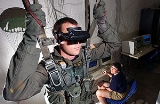
Virtual reality also known as
virtuality, is a term that applies to
computer-simulatedA computer simulation, a computer model, or a computational model is a computer program, or network of computers, that attempts to simulate an abstract model of a particular system...
environments that can simulate physical presence in places in the real world, as well as in imaginary worlds. Most current virtual reality environments are primarily visual experiences, displayed either on a computer screen or through special
stereoscopic displaysStereoscopy refers to a technique for creating or enhancing the illusion of depth in an image by presenting two offset images separately to the left and right eye of the viewer. Both of these 2-D offset images are then combined in the brain to give the perception of 3-D depth...
, but some simulations include additional sensory information, such as sound through speakers or headphones. Some advanced, haptic systems now include tactile information, generally known as force feedback, in medical and gaming applications. Furthermore, virtual reality covers remote communication environments which provide virtual presence of users with the concepts of
telepresenceTelepresence refers to a set of technologies which allow a person to feel as if they were present, to give the appearance of being present, or to have an effect, via telerobotics, at a place other than their true location....
and
telexistenceTelexistence is fundamentally a concept named for the general technology that enables a human being to have a real-time sensation of being at a place other than where he or she actually exists, and being able to interact with the remote environment, which may be real, virtual, or a combination of...
or a
virtual artifactA virtual artifact is an immaterial object that exists in the human mind or in a digital environment, for example the Internet, intranet, virtual reality, cyberspace, etc.-Background:...
(VA) either through the use of standard input devices such as a keyboard and mouse, or through
multimodalMultimodal interaction provides the user with multiple modes of interfacing with a system. A multimodal interface provides several distinct tools for input and output of data.- Multimodal input :...
devices such as a
wired gloveA wired glove is an input device for human–computer interaction worn like a glove.Various sensor technologies are used to capture physical data such as bending of fingers. Often a motion tracker, such as a magnetic tracking device or inertial tracking device, is attached to capture the global...
, the Polhemus, and
omnidirectional treadmillAn omnidirectional treadmill, or ODT, is a device that allows a person to perform locomotive motion in any direction. The ability to move in any direction is how these treadmills differ from their basic counterparts...
s. The simulated environment can be similar to the real world in order to create a
lifelike experienceLifelike is an adjective that relates to anything that simulates real life, in accordance with its laws. Its goal is to immerse individuals into what is called a lifelike experience. It gets as close as possible to real life behavior, appearance, senses, etc. therefore enabling its subject to...
—for example, in simulations for pilot or combat training—or it can differ significantly from reality, such as in VR games. In practice, it is currently very difficult to create a high-fidelity virtual reality experience, due largely to technical limitations on processing power, image resolution, and communication bandwidth; however, the technology's proponents hope that such limitations will be overcome as processor, imaging, and data communication technologies become more powerful and cost-effective over time.
Virtual reality is often used to describe a wide variety of applications commonly associated with immersive, highly visual, 3D environments. The development of CAD software, graphics hardware acceleration, head mounted displays, database gloves, and miniaturization have helped popularize the notion. In the book
The Metaphysics of Virtual Reality by Michael R. Heim, seven different concepts of virtual reality are identified: simulation, interaction, artificiality, immersion,
telepresenceTelepresence refers to a set of technologies which allow a person to feel as if they were present, to give the appearance of being present, or to have an effect, via telerobotics, at a place other than their true location....
, full-body immersion, and network communication. People often identify VR with head mounted displays and data suits.
Terminology and concepts
The term "
artificial realityArtificial reality was the term Myron W. Krueger used to describe his interactive immersive environments, based on video recognition techniques, that put a user in full, unencumbered contact with the digital world. He started this work in the late 1960s and is considered to be a key figure in the...
", coined by Myron Krueger, has been in use since the 1970s; however, the origin of the term "virtual reality" can be traced back to the French playwright, poet, actor, and director Antonin Artaud. In his seminal book
The Theatre and Its Double (1938), Artaud described theatre as "
la réalite virtuelle", a virtual reality in which, in Erik Davis's words, "characters, objects, and images take on the phantasmagoric force of alchemy's visionary internal dramas". Artaud claimed that the "perpetual allusion to the materials and the principle of the theater found in almost all alchemical books should be understood as the expression of an identity [...] existing between the world in which the characters, images, and in a general way all that constitutes the
virtual reality of the theater develops, and the purely fictitious and illusory world in which the symbols of alchemy are evolved". The term has also been used in
The Judas Mandala, a 1982 science-fiction novel by
Damien BroderickDamien Francis Broderick is an Australian science fiction and popular science writer. His science fiction novel The Judas Mandala is sometimes credited with the first appearance of the term "virtual reality," and his 1997 popular science book The Spike was the first to investigate the...
, where the context of use is somewhat different from that defined above. The earliest use cited by the
Oxford English DictionaryThe Oxford English Dictionary , published by the Oxford University Press, is the self-styled premier dictionary of the English language. Two fully bound print editions of the OED have been published under its current name, in 1928 and 1989. The first edition was published in twelve volumes , and...
is in a 1987 article titled "Virtual reality", but the article is not about VR technology. The concept of virtual reality was popularized in mass media by movies such as
BrainstormBrainstorm is a 1983 science fiction film directed by Douglas Trumbull and starring Christopher Walken and Natalie Wood...
and
The Lawnmower Man. The VR research boom of the 1990s was accompanied by the non-fiction book
Virtual Reality (1991) by
Howard Rheingold-See also:* Collective intelligence* Information society* The WELL* Virtual community-External links:***** at TED conference** a 48MB Quicktime movie, hosted by the Internet Archive...
. The book served to demystify the subject, making it more accessible to less technical researchers and enthusiasts, with an impact similar to that which his book
The Virtual CommunityThe Virtual Community is a 1993 book about virtual communities by Howard Rheingold, a member of the early network system The Well. A second edition, with a new concluding chapter was published in 2000 by MIT Press.-External links:...
had on
virtual communityA virtual community is a social network of individuals who interact through specific media, potentially crossing geographical and political boundaries in order to pursue mutual interests or goals...
research lines closely related to VR.
Multimedia: from Wagner to Virtual Reality, edited by Randall Packer and Ken Jordan and first published in 2001, explores the term and its history from an avant-garde perspective. Philosophical implications of the concept of VR are systematically discussed in the book
Get Real: A Philosophical Adventure in Virtual Reality (1998) by
Philip ZhaiPhilip Zhai also known as Zhai Zhenming is a philosopher who writes in both English and Chinese.Zhai is the author of Get Real: A Philosophical Adventure in Virtual Reality , in which he argues that the logical extreme of virtual reality is ontologically equivalent to actual reality...
, wherein the idea of VR is pushed to its logical extreme and ultimate possibility. According to Zhai, virtual reality could be made to have an ontological status equal to that of actual reality.
Digital Sensations: Space, Identity and Embodiment in Virtual Reality (1999), written by Ken Hillis, offers a more critical and theoretical academic assessment of the complex set of cultural and political desires and practices culminating in the development of the technology.
Timeline
Virtual reality can trace its roots to the 1860s, when 360-degree art through panoramic murals began to appear. An example of this would be
Baldassare PeruzziBaldassare Tommaso Peruzzi was an Italian architect and painter, born in a small town near Siena and died in Rome. He worked for many years, beginning in 1520, under Bramante, Raphael, and later Sangallo during the erection of the new St. Peter's...
's piece titled,
Sala delle Prospettive. In the 1920s, vehicle simulators were introduced.
Morton HeiligMorton Heilig was a thought-leader in Virtual Reality . He applied his cinematographer experience and with the help of his partner developed the Sensorama over several years from 1957, patenting it in 1962....
wrote in the 1950s of an "Experience Theatre" that could encompass all the senses in an effective manner, thus drawing the viewer into the onscreen activity. He built a prototype of his vision dubbed the
SensoramaThe Sensorama was a machine that is one of the earliest known examples of immersive, multi-sensory technology. Morton Heilig, who today would be thought of as a “multimedia” specialist, in the 1950s saw theater as an activity that could encompass all the senses in an effective manner, thus...
in 1962, along with five short films to be displayed in it while engaging multiple senses (sight, sound, smell, and touch). Predating digital computing, the Sensorama was a
mechanical deviceA machine manages power to accomplish a task, examples include, a mechanical system, a computing system, an electronic system, and a molecular machine. In common usage, the meaning is that of a device having parts that perform or assist in performing any type of work...
, which reportedly still functions today. Around this time, Douglas Englebart uses computer screens as both input and output devices. In 1966, Thomas A. Furness III introduces a visual flight stimulator for the Air Force. In 1968,
Ivan SutherlandIvan Edward Sutherland is an American computer scientist and Internet pioneer. He received the Turing Award from the Association for Computing Machinery in 1988 for the invention of Sketchpad, an early predecessor to the sort of graphical user interface that has become ubiquitous in personal...
, with the help of his student
Bob SproullDr Robert F. Sproull is an American computer scientist, who works for Oracle Corporation where he is director of Oracle Labs in Burlington, Massachusetts .- Biography :...
, created what is widely considered to be the first virtual reality and
augmented realityAugmented reality is a live, direct or indirect, view of a physical, real-world environment whose elements are augmented by computer-generated sensory input such as sound, video, graphics or GPS data. It is related to a more general concept called mediated reality, in which a view of reality is...
(AR) head mounted display (HMD) system. It was primitive both in terms of
user interfaceThe user interface, in the industrial design field of human–machine interaction, is the space where interaction between humans and machines occurs. The goal of interaction between a human and a machine at the user interface is effective operation and control of the machine, and feedback from the...
and
realismRealism in the visual arts and literature refers to the general attempt to depict subjects "in accordance with secular, empirical rules", as they are considered to exist in third person objective reality, without embellishment or interpretation...
, and the HMD to be worn by the user was so heavy it had to be suspended from the ceiling. The graphics comprising the virtual environment were simple wireframe model rooms. The formidable appearance of the device inspired its name, The Sword of Damocles. Also notable among the earlier
hypermediaHypermedia is a computer-based information retrieval system that enables a user to gain or provide access to texts, audio and video recordings, photographs and computer graphics related to a particular subject.Hypermedia is a term created by Ted Nelson....
and virtual reality systems was the
Aspen Movie MapThe Aspen Movie Map was a revolutionary hypermedia system developed at MIT by a team working with Andrew Lippman in 1978 with funding from ARPA.-Features:...
, which was created at
MITThe Massachusetts Institute of Technology is a private research university located in Cambridge, Massachusetts. MIT has five schools and one college, containing a total of 32 academic departments, with a strong emphasis on scientific and technological education and research.Founded in 1861 in...
in 1977. The program was a crude virtual simulation of
AspenThe City of Aspen is a Home Rule Municipality that is the county seat and the most populous city of Pitkin County, Colorado, United States. The United States Census Bureau estimates that the city population was 5,804 in 2005...
, Colorado in which users could wander the streets in one of three modes: summer, winter, and polygons. The first two were based on photographs—the researchers actually photographed every possible movement through the city's street grid in both seasons—and the third was a basic 3-D model of the city. In the late 1980s, the term "virtual reality" was popularized by
Jaron LanierJaron Zepel Lanier is an American computer scientist, best known for popularizing the term virtual reality .A pioneer in the field of VR, Lanier and Thomas G. Zimmerman left Atari in 1985 to found VPL Research, Inc., the first company to sell VR goggles and gloves...
, one of the modern pioneers of the field. Lanier had founded the company VPL Research in 1985, which developed and built some of the seminal "goggles and gloves" systems of that decade. In 1991, Antonio Medina, a MIT graduate and NASA scientist, designed a virtual reality system to "drive" Mars rovers from Earth in apparent real time despite the substantial delay of Mars-Earth-Mars signals. The system, termed "Computer-Simulated Teleoperation" as published by Rand, is an extension of virtual reality.
Impact
There has been an increase in interest in the potential social impact of new technologies, such as virtual reality. In the new book (2011)
Infinite Reality: Avatars, Eternal Life, New Worlds, and the Dawn of the Virtual Revolution, Blascovich and Bailenson review the literature on the psychology and sociology behind life in virtual reality.
In addition, Mychilo S. Cline, in his book
Power, Madness, and Immortality: The Future of Virtual Reality, argues that virtual reality will lead to a number of important changes in human life and activity. He argues that:
- Virtual reality will be integrated into daily life and activity, and will be used in various human ways.
- Techniques will be developed to influence human behavior, interpersonal communication
Interpersonal communication is usually defined by communication scholars in numerous ways, usually describing participants who are dependent upon one another. It...
, and cognitionIn science, cognition refers to mental processes. These processes include attention, remembering, producing and understanding language, solving problems, and making decisions. Cognition is studied in various disciplines such as psychology, philosophy, linguistics, and computer science...
.
- As we spend more and more time in virtual
The term virtual is a concept applied in many fields with somewhat differing connotations, and also, differing denotations.The term has been defined in philosophy as "that which is not real" but may display the salient qualities of the real....
space, there will be a gradual "migration to virtual space", resulting in important changes in economics, worldview, and culture.
- The design of virtual environments may be used to extend basic human rights into virtual space, to promote human freedom and well-being, and to promote social stability as we move from one stage in socio-political development to the next.
- Virtual reality can also be used to induce body transfer illusion
Body transfer illusion is the illusion of owning either a part of a body or an entire body other than one's own, thus it is sometimes referred to as “body ownership” in the research literature. It can be induced experimentally by manipulating the visual perspective of the subject and also supplying...
s.
Heritage and archaeology
The use of VR in heritage and archaeology has potential in museum and visitor centre applications, but its use has been tempered by the difficulty in presenting a "quick to learn" real time experience to numerous people at any given time. Many historic reconstructions tend to be in a pre-rendered format to a shared video display, thus allowing more than one person to view a computer generated world, but limiting the interaction that full-scale VR can provide. The first use of a VR presentation in a heritage application was in 1994, when a museum visitor interpretation provided an interactive "walk-through" of a 3D reconstruction of
Dudley CastleDudley Castle is a ruined castle in the town of Dudley, West Midlands, England. Dudley Zoo is located in its grounds. The location, Castle Hill, is an outcrop of Wenlock Group limestone that was extensively quarried during the Industrial Revolution, and which now along with Wren's Nest Hill is a...
in England as it was in 1550. This consisted of a computer controlled laserdisc-based system designed by British based engineer Colin Johnson. One of the first users of virtual reality was Queen Elizabeth II, when she officially opened this visitor centre in June 1994. The system was featured in a conference held by the British Museum in November 1994, and in the subsequent technical paper,
Imaging the Past - Electronic Imaging and Computer Graphics in Museums and Archaeology.
VR reconstruction
Virtual reality enables heritage sites to be recreated extremely accurately, so that the recreations can be published in various media. The original sites are often inaccessible to the public, or may even no longer exist. This technology can be used to develop virtual replicas of caves, natural environment, old towns, monuments, sculptures and archaeological elements.
Fiction
Many
science fictionScience fiction is a genre of fiction dealing with imaginary but more or less plausible content such as future settings, futuristic science and technology, space travel, aliens, and paranormal abilities...
books and films have imagined characters being "trapped in virtual reality".
A comprehensive and specific fictional model for virtual reality was published in 1935 in the short story Pygmalion's Spectacles by
Stanley G. WeinbaumStanley Grauman Weinbaum was an American science fiction author. His career in science fiction was short but influential...
. In the story, the main character, Dan Burke, meets an elfin professor, Albert Ludwig, who has invented a pair of goggles which enable "a movie that gives one sight and sound [...] taste, smell, and touch. [...] You are in the story, you speak to the shadows (characters) and they reply, and instead of being on a screen, the story is all about you, and you are in it." A more modern work to use this idea was
Daniel F. GalouyeDaniel Francis Galouye was an American science fiction writer. During the 1950s and 1960s, he contributed novelettes and short stories to various digest size science fiction magazines, sometimes writing under the pseudonym Louis G...
's novel
Simulacron-3Simulacron-3 , by Daniel F. Galouye, is an American science fiction novel featuring an early literary description of virtual reality.-Plot summary:...
, which was made into a German teleplay titled
Welt am Draht ("World on a Wire") in 1973. Other science fiction books have promoted the idea of virtual reality as a partial, but not total, substitution for the misery of reality, or have touted it as a method for creating breathtaking virtual worlds in which one may escape from Earth.
Stanisław Lem wrote a short story in early 1960 called " IJON TICHY'S MEMORIES", in which he presented a scientist who devised a completely artificial virtual reality. Among the beings trapped inside his created virtual world, there is also a scientist, who also devised such machines creating another level of virtual world. The
Piers AnthonyPiers Anthony Dillingham Jacob is an English American writer in the science fiction and fantasy genres, publishing under the name Piers Anthony. He is most famous for his long-running novel series set in the fictional realm of Xanth.Many of his books have appeared on the New York Times Best...
novel
KillobyteKillobyte is a 1993 novel by Piers Anthony. This book explores a virtual reality world in the context of the Internet, and although originally intended as an action-adventure story, it is more of a character study...
follows the story of a paralyzed cop trapped in a virtual reality game by a hacker, whom he must stop to save a fellow trapped player slowly succumbing to insulin shock. This novel toys with the idea of both the potential positive therapeutic uses, such as allowing the paralyzed to experience the illusion of movement while stimulating unused muscles, as well as virtual realities' dangers.
Vernor VingeVernor Steffen Vinge is a retired San Diego State University Professor of Mathematics, computer scientist, and science fiction author. He is best known for his Hugo Award-winning novels and novellas A Fire Upon the Deep , A Deepness in the Sky , Rainbows End , Fast Times at Fairmont High ...
's
True Names, published in 1981, imagines a virtual world which is probably the first to represent a
metaverseThe Metaverse is our collective online shared space, created by the convergence of virtually enhanced physical reality and physically persistent virtual space, including the sum of all virtual worlds, augmented reality, and the internet...
. In the story, characters interact with each other in a complete world, where they own homes and are represented using
avatarsIn computing, an avatar is the graphical representation of the user or the user's alter ego or character. It may take either a three-dimensional form, as in games or virtual worlds, or a two-dimensional form as an icon in Internet forums and other online communities. It can also refer to a text...
. This type of virtual world was later to be realized as
Second LifeSecond Life is an online virtual world developed by Linden Lab. It was launched on June 23, 2003. A number of free client programs, or Viewers, enable Second Life users, called Residents, to interact with each other through avatars...
, which was launched in 2003.
Other popular fictional works that use the concept of virtual reality include William Gibson's
NeuromancerNeuromancer is a 1984 novel by William Gibson, a seminal work in the cyberpunk genre and the first winner of the science-fiction "triple crown" — the Nebula Award, the Philip K. Dick Award, and the Hugo Award. It was Gibson's debut novel and the beginning of the Sprawl trilogy...
which defined the concept of cyberspace,
Neal StephensonNeal Town Stephenson is an American writer known for his works of speculative fiction.Difficult to categorize, his novels have been variously referred to as science fiction, historical fiction, cyberpunk, and postcyberpunk...
's
Snow CrashSnow Crash is Neal Stephenson's third novel, published in 1992. Like many of Stephenson's other novels it covers history, linguistics, anthropology, archaeology, religion, computer science, politics, cryptography, memetics, and philosophy....
, in which he made extensive reference to the term avatar to describe one's representation in a virtual world, and
Rudy RuckerRudolf von Bitter Rucker is an American mathematician, computer scientist, science fiction author, and philosopher, and is one of the founders of the cyberpunk literary movement. The author of both fiction and non-fiction, he is best known for the novels in the Ware Tetralogy, the first two of...
's
The Hacker and the AntsThe Hacker and the Ants is a work of science fiction by Rudy Rucker published in 1994 by Avon Books. It was written while Rucker was working as a programmer at Autodesk, Inc., of Sausalito, California from 1988 to 1992.- Plot Summary :...
, in which programmer Jerzy Rugby uses VR for robot design and testing.
The
Doctor WhoDoctor Who is a British science fiction television programme produced by the BBC. The programme depicts the adventures of a time-travelling humanoid alien known as the Doctor who explores the universe in a sentient time machine called the TARDIS that flies through time and space, whose exterior...
serial "
The Deadly AssassinThe Deadly Assassin is a serial in the British science fiction television series Doctor Who, which was first broadcast in four weekly parts from 30 October to 20 November 1976...
", first broadcast in 1976, introduced a dream-like
computer-generatedThe term computer-generated most often refers to a sound or visual that has been created in whole or in part with the aid of computer software...
reality, known as
the MatrixThe Matrix, in the long-running British science fiction television series Doctor Who, is a massive computer system on the planet Gallifrey that acts as the repository of the combined knowledge of the Time Lords....
.
The first major American television series to showcase virtual reality regularly was
Star Trek: The Next GenerationStar Trek: The Next Generation is an American science fiction television series created by Gene Roddenberry as part of the Star Trek franchise. Roddenberry, Rick Berman, and Michael Piller served as executive producers at different times throughout the production...
. Several episodes featured a
holodeckA holodeck, in the fictional Star Trek universe, is a simulated reality facility located on starships and starbases. The first use of a "holodeck" by that name in the Star Trek universe was in the pilot episode of Star Trek: The Next Generation, "Encounter at Farpoint", although a conceptually...
, a virtual reality facility that enabled its users to recreate and experience anything they wanted. One difference from current virtual reality technology, however, was that
replicatorsIn Star Trek a replicator is a machine capable of creating objects. Replicators were originally seen used to synthesize meals on demand, but in later series they took on many other uses.-Origins and limitations:...
, force fields, holograms, and
transportersA transporter is a fictional teleportation machine used in the Star Trek universe. Transporters convert a person or object into an energy pattern , then "beam" it to a target, where it is reconverted into matter...
were used to actually recreate and place objects in the holodeck, rather than illusions.
The New Zealand post-apocalyptic soap opera
The Tribe shows Virtual Reality being used by an advanced enemy tribe named the
TechnoTechno is a form of electronic dance music that emerged in Detroit, Michigan in the United States during the mid to late 1980s. The first recorded use of the word techno, in reference to a genre of music, was in 1988...
s.
Cult British BBC2 sci-fi series
Red DwarfRed Dwarf is a British comedy franchise which primarily comprises eight series of a television science fiction sitcom that aired on BBC Two between 1988 and 1999 and Dave from 2009–present. It gained cult following. It was created by Rob Grant and Doug Naylor, who also wrote the first six series...
featured a virtual reality game titled "Better Than Life", in which the main characters had spent many years connected. Virtual reality has also been featured in other Red Dwarf episodes, including "Back to Reality", where venom from the despair squid caused the characters to believe that all of their experiences on Red Dwarf had been part of a VR simulation. Other episodes that feature virtual reality include "Gunmen of the Apocalypse", "Stoke Me a Clipper", "Blue", "Beyond a Joke", and "Back in the Red".
The popular
.hack.hack is a Japanese multimedia franchise that encompasses two projects; Project .hack and .hack Conglomerate. Both projects were primarily created/developed by CyberConnect2, and published by Bandai...
multimedia franchise is based on a virtual reality
MMORPGMassively multiplayer online role-playing game is a genre of role-playing video games in which a very large number of players interact with one another within a virtual game world....
dubbed "The World" The French animated series
Code LyokoCode Lyoko is a French animated television series created by Thomas Romain and Tania Palumbo. The series centers on boarding school students Jeremie, Ulrich, Yumi, and Odd who travel to the virtual world of Lyoko to fight against multi-agent computer program XANA with Aelita, a being originally...
is based on the virtual world of
Lyoko and the
InternetThe Internet is a global system of interconnected computer networks that use the standard Internet protocol suite to serve billions of users worldwide...
. The virtual world is accessed by large scanners which use an atomic process, and breaks down the atoms of the person inside, digitizes them, and recreates an incarnation on
Lyoko. The
SabanSaban Entertainment , was a worldwide-served independent American television production company formed in 1984 by music and television producers Haim Saban and Shuki Levy as "Saban Productions", a U.S...
show
VR TroopersVR Troopers was a syndicated live action show produced by Saban from 1994 to 1996...
also made use of the concept.
Motion pictures
- Steven Lisberger's 1982 film Tron
-Film:*Tron , a franchise that began in 1982 with the Walt Disney Pictures film Tron** Tron , a 1982 science fiction film by Disney, starring Jeff Bridges, Bruce Boxleitner, Cindy Morgan, Dan Shor and David Warner...
was the first mainstream Hollywood picture to explore the idea of virtual reality; transporting real-life characters into an alternate, computer-generated world.
- One year later in 1983, the Natalie Wood
Natalie Wood, born Natalia Nikolaevna Zacharenko was an American film and television actress. After first working in films as a child, Wood became a successful Hollywood star as a young adult, receiving three Academy Award nominations before she was 25 years old.Wood began acting in movies at the...
/ Christopher WalkenChristopher Walken is an American stage and screen actor. He has appeared in more than 100 movies and television shows, including Joe Dirt, Annie Hall, The Deer Hunter, The Prophecy trilogy, The Dogs of War, Sleepy Hollow, Brainstorm, The Dead Zone, A View to a Kill, At Close Range, King of New...
film BrainstormBrainstorm is a 1983 science fiction film directed by Douglas Trumbull and starring Christopher Walken and Natalie Wood...
revolved around the production, use, and misuse of a VR device. The device could record a person's feelings and experiences, and share these with anyone else.
- A VR-like system, used to record and play back dreams, figures centrally in Wim Wenders
Ernst Wilhelm "Wim" Wenders is a German film director, playwright, author, photographer and producer.-Early life:Wenders was born in Düsseldorf. He graduated from high school in Oberhausen in the Ruhr area. He then studied medicine and philosophy in Freiburg and Düsseldorf...
' 1991 film Until the End of the WorldUntil the End of the World is a 1991 film by the German film director Wim Wenders; the screenplay was written by Wenders and Peter Carey, from a story by Wenders and Solveig Dommartin. An initial draft of the screenplay was written by American filmmaker Michael Almereyda...
.
- The 1992 film The Lawnmower Man (which bore little resemblance to the Stephen King
Stephen Edwin King is an American author of contemporary horror, suspense, science fiction and fantasy fiction. His books have sold more than 350 million copies and have been adapted into a number of feature films, television movies and comic books...
story"The Lawnmower Man" is a short story by Stephen King, first published in the May 1975 issue of Cavalier, and later collected in King's 1978 collection Night Shift.-Plot summary:...
on which it was ostensibly based) tells the tale of a research scientist who uses a VR system to jumpstart the mental and physical development of his mentally handicapped gardener.
- Outside the genre of science fiction
Science fiction is a genre of fiction dealing with imaginary but more or less plausible content such as future settings, futuristic science and technology, space travel, aliens, and paranormal abilities...
, 1994's DisclosureDisclosure is a 1994 thriller directed by Barry Levinson, starring Michael Douglas and Demi Moore. It is based on Michael Crichton's novel of the same name.The cast also includes Donald Sutherland, Rosemary Forsyth and Dennis Miller...
, starring Michael DouglasMichael Kirk Douglas is an American actor and producer, primarily in movies and television. He has won three Golden Globes and two Academy Awards; first as producer of 1975's Best Picture, One Flew Over the Cuckoo's Nest, and as Best Actor in 1987 for his role in Wall Street. Douglas received the...
(based on the Michael CrichtonJohn Michael Crichton , best known as Michael Crichton, was an American best-selling author, producer, director, and screenwriter, best known for his work in the science fiction, medical fiction, and thriller genres. His books have sold over 200 million copies worldwide, and many have been adapted...
's novelDisclosure is a novel by Michael Crichton, published in 1994. The novel is set in a fictional high tech company, just before the beginning of the dot-com economic boom...
) depicts a VR headset being used as a navigation device for a prototype computer file systemA file system is a means to organize data expected to be retained after a program terminates by providing procedures to store, retrieve and update data, as well as manage the available space on the device which contain it. A file system organizes data in an efficient manner and is tuned to the...
.
- In 1999, The Matrix
The Matrix is a 1999 science fiction-action film written and directed by Larry and Andy Wachowski, starring Keanu Reeves, Laurence Fishburne, Carrie-Anne Moss, Joe Pantoliano, and Hugo Weaving...
and later sequels explored the possibility that our world is actually a vast Virtual Reality (or more precisely, Simulated RealitySimulated reality is the proposition that reality could be simulated—perhaps by computer simulation—to a degree indistinguishable from "true" reality. It could contain conscious minds which may or may not be fully aware that they are living inside a simulation....
) created by artificially intelligent machines.
- Ryan Chester's Virtually Reality (2011) depicts a future world in which most natural wonders have been destroyed and developed upon, and virtual reality systems provide the only way for humans to experience the nature they never knew for real.
Radio
In 2009, British
digital radioDigital radio has several meanings:1. Today the most common meaning is digital radio broadcasting technologies, such as the digital audio broadcasting system, also known as Eureka 147. In these systems, the analog audio signal is digitized into zeros and ones, compressed using formats such as...
station BBC Radio 7 broadcasted
Planet BPlanet B is a science fiction drama series first broadcast on BBC Radio 7 on 2 March 2009 as part of BBC Radio's science fiction season between February and March 2009. Planet B is set in a virtual world called "Planet B" in which people play as life-size avatars...
, a science-fiction drama set in a virtual world.
Planet B is the largest ever commission for an original drama programme.
Fine art
David Em-Life and work:David Em is one of the first artists to make art with pixels. He was born in Los Angeles and grew up in South America. He studied painting at the Pennsylvania Academy of the Fine Arts and film directing at the American Film Institute....
was the first fine artist to create navigable virtual worlds in the 1970s. His early work was done on mainframes at
IIIInformation International, Inc., commonly referred to as Triple-I or III, was an early computer technology company; Founded by Edward Fredkin in 1962 in Maynard, Massachusetts. It then moved to Santa Monica, Culver City, and Los Angeles California. Triple-I merged with Autologic, Inc. in 1996...
, JPL, and Caltech.
Jeffrey ShawJeffrey Shaw is a pioneering new media artist and researcher. From 1965 to 2002 he lived in Milan, London, Amsterdam and Karlsruhe, and returned to Australia in 2003 to assume the Directorship of the iCinema Research Centre at the University of New South Wales...
explored the potential of VR in fine arts with early works like
Legible City (1989),
Virtual Museum (1991), and
Golden Calf (1994). Canadian artist
Char DaviesChar Davies is an artist who creates artworks using the technologies of immersive virtual reality.-Life and work:Davies was born in Toronto. Originally a painter, she transitioned to digital media in the late 1980s, becoming a founding director of the 3-D software company Softimage...
created immersive VR art pieces
Osmose (1995) and
Ephémère (1998).
Maurice BenayounMaurice Benayoun is a French pioneer new-media artist and theorist based in Paris. His work employs various media, including video, immersive virtual reality, the Web, wireless technology, performance, large-scale urban art installations and interactive exhibitions.-Biography:Born in Mascara,...
's work introduced metaphorical, philosophical or political content, combining VR, network, generation and intelligent agents, in works like
Is God Flat (1994),
The Tunnel under the AtlanticThe Tunnel under the Atlantic is an interactive art installation by Maurice Benayoun. The visitors were invited to dig, inside memory, a virtual tunnel between Pompidou Centre in Paris and the Museum of Contemporary Art in Montreal in 1995....
(1995), and
World Skin (1997). Other pioneering artists working in VR have include Luc Courchesne, Rita Addison,
Knowbotic ResearchKnowbotic Research is a German-Swiss electronic art group, established in 1991. Its members are Yvonne Wilhelm, Christian Hübler and Alexander Tuchacek...
,
Rebecca AllenRebecca Allen is an international artist inspired by a variety of media to create work from 3-D computer graphics, animation, music videos, video games, performance works, artificial life systems, multisensory interfaces, interactive installations, virtual and mixed reality.- Biography :Allen's...
,
Perry HobermanPerry Hoberman , is an installation artist who has worked extensively with machines and media. His career has included stints with Laurie Anderson and the USC Interactive Media Division....
, Jacki Morie, and
Brenda LaurelBrenda Laurel is a pioneering writer, researcher, designer and entrepreneur in the fields of human-computer interaction, interactive narrative and cultural aspects of technology ....
. All mentioned artists are documented in the Database of Virtual Art.
Music
Immersive virtual musical instrumentAn immersive virtual musical instrument, or immersive virtual environment for music and sound, represents sound processes and their parameters as 3D entities of a virtual reality so that they can be perceived not only through auditory feedback but also visually in 3D and possibly through tactile as...
s build on the trend in electronic musical instruments to develop new ways to control sound and perform music such as evidenced by conferences like NIME and aim to represent musical events and sound parameters in a virtual reality in such a way that they can be perceived not only through auditory feedback, but also visually in 3D and possibly through tactile as well as haptic feedback, allowing the development of novel interaction metaphors beyond manipulation such as prehension.
Therapeutic uses
The primary use of VR in a therapeutic role is its application to various forms of exposure therapy, ranging from
phobiaA phobia is a type of anxiety disorder, usually defined as a persistent fear of an object or situation in which the sufferer commits to great lengths in avoiding, typically disproportional to the actual danger posed, often being recognized as irrational...
treatments to newer approaches to treating
PTSDPosttraumaticstress disorder is a severe anxiety disorder that can develop after exposure to any event that results in psychological trauma. This event may involve the threat of death to oneself or to someone else, or to one's own or someone else's physical, sexual, or psychological integrity,...
. A very basic VR simulation with simple sight and sound models has been shown to be invaluable in phobia treatment, like
zoophobiaZoophobia or animal phobia may have one of two closely related meanings: a generic term for the class of specific phobias to particular animals, or an irrational fear or even simply dislike of any non-human animals....
, and
acrophobiaAcrophobia is an extreme or irrational fear of heights. It belongs to a category of specific phobias, called space and motion discomfort that share both similar etiology and options for treatment.Most people experience a degree of natural fear when exposed to heights, especially if there is little...
, as a step between basic exposure therapy such as the use of simulacra and true exposure. A much more recent application is being piloted by the U.S. Navy to use a much more complex simulation to immerse veterans suffering from PTSD in simulations of urban combat settings. Much as in phobia treatment, exposure to the subject of the trauma or fear leads to
desensitizationDesensitization can refer to:* Desensitization * Desensitization * Desensitization * Desensitization of explosives, see Phlegmatized...
, and a significant reduction in symptoms.
Other research fields in which the use of virtual reality is being explored are physical medicine,
rehabilitationRehabilitation of sensory and cognitive function typically involves methods for retraining neural pathways or training new neural pathways to regain or improve neurocognitive functioning that has been diminished by disease or traumatic injury....
,
physical therapyPhysical therapy , often abbreviated PT, is a health care profession. Physical therapy is concerned with identifying and maximizing quality of life and movement potential within the spheres of promotion, prevention, diagnosis, treatment/intervention,and rehabilitation...
, and
occupational therapyOccupational therapy is a discipline that aims to promote health by enabling people to perform meaningful and purposeful activities. Occupational therapists work with individuals who suffer from a mentally, physically, developmentally, and/or emotionally disabling condition by utilizing treatments...
. In adult rehabilitation, a variety of virtual reality applications are currently being evaluated within upper and lower limb motor rehabilitation for individuals recovering from stroke or spinal cord injury. In pediatrics, the use of virtual reality is being evaluated to promote movement abilities, navigational abilities, or social skills in children with
cerebral palsyCerebral palsy is an umbrella term encompassing a group of non-progressive, non-contagious motor conditions that cause physical disability in human development, chiefly in the various areas of body movement....
,
acquired brain injuryAn acquired brain injury is brain damage caused by events after birth, rather than as part of a genetic or congenital disorder such as fetal alcohol syndrome, perinatal illness or perinatal hypoxia. ABI can result in cognitive, physical, emotional, or behavioural impairments that lead to permanent...
, or other disabilities. Research evidence is emerging rapidly in the field of virtual reality for therapeutic uses. A number of recent reviews published in peer-reviewed journals have summarized the current evidence for the use of Virtual Reality within pediatric and adult rehabilitation. One such review concluded that the field is potentially promising.
Implementation
To develop a real time virtual environment, a computer graphics library can be used as embedded resource coupled with a common
programming languageA programming language is an artificial language designed to communicate instructions to a machine, particularly a computer. Programming languages can be used to create programs that control the behavior of a machine and/or to express algorithms precisely....
, such as
C++C++ is a statically typed, free-form, multi-paradigm, compiled, general-purpose programming language. It is regarded as an intermediate-level language, as it comprises a combination of both high-level and low-level language features. It was developed by Bjarne Stroustrup starting in 1979 at Bell...
,
PerlPerl is a high-level, general-purpose, interpreted, dynamic programming language. Perl was originally developed by Larry Wall in 1987 as a general-purpose Unix scripting language to make report processing easier. Since then, it has undergone many changes and revisions and become widely popular...
,
JavaJava is a programming language originally developed by James Gosling at Sun Microsystems and released in 1995 as a core component of Sun Microsystems' Java platform. The language derives much of its syntax from C and C++ but has a simpler object model and fewer low-level facilities...
, or
PythonPython is a general-purpose, high-level programming language whose design philosophy emphasizes code readability. Python claims to "[combine] remarkable power with very clear syntax", and its standard library is large and comprehensive...
. Some of the most popular computer graphic
librariesIn computer science, a library is a collection of resources used to develop software. These may include pre-written code and subroutines, classes, values or type specifications....
are
OpenGLOpenGL is a standard specification defining a cross-language, cross-platform API for writing applications that produce 2D and 3D computer graphics. The interface consists of over 250 different function calls which can be used to draw complex three-dimensional scenes from simple primitives. OpenGL...
,
Direct3DDirect3D is part of Microsoft's DirectX application programming interface . Direct3D is available for Microsoft Windows operating systems , and for other platforms through the open source software Wine. It is the base for the graphics API on the Xbox and Xbox 360 console systems...
, Java3D, and
VRMLVRML is a standard file format for representing 3-dimensional interactive vector graphics, designed particularly with the World Wide Web in mind...
, and their use are directly influenced by the system demands in terms of performance, program purpose, and hardware platform. The use of
multithreadingIn computer science, a thread of execution is the smallest unit of processing that can be scheduled by an operating system. The implementation of threads and processes differs from one operating system to another, but in most cases, a thread is contained inside a process...
can also accelerate 3D performance and enable
cluster computingCluster Computing: the Journal of Networks, Software Tools and Applications is a journal for parallel processing, distributed computing systems, and computer communication networks....
with
multi-userMulti-user is a term that defines an operating system or application software that allows concurrent access by multiple users of a computer. Time-sharing systems are multi-user systems. Most batch processing systems for mainframe computers may also be considered "multi-user", to avoid leaving the...
interactivity.
Manufacturing
Virtual reality can serve to new
product design-Introduction:Product design is the process of creating a new product to be sold by a business or enterprise to its customers. It is concerned with the efficient and effective generation and development of ideas through a process that leads to new products.Product designers conceptualize and...
, helping as an ancillary tool for engineering in manufacturing processes, new product
prototypeA prototype is an early sample or model built to test a concept or process or to act as a thing to be replicated or learned from.The word prototype derives from the Greek πρωτότυπον , "primitive form", neutral of πρωτότυπος , "original, primitive", from πρῶτος , "first" and τύπος ,...
s, and
simulationSimulation is the imitation of some real thing available, state of affairs, or process. The act of simulating something generally entails representing certain key characteristics or behaviours of a selected physical or abstract system....
. Among other examples,
Electronic Design AutomationElectronic design automation is a category of software tools for designing electronic systems such as printed circuit boards and integrated circuits...
, CAD, Finite Element Analysis, and Computer Aided Manufacturing are widely utilized programs. The use of
StereolithographyStereolithography is an additive manufacturing technology for producing models, prototypes, patterns, and in some cases, production parts.-Technology description:...
and
3D printing3D printing is a form of additive manufacturing technology where a three dimensional object is created by laying down successive layers of material. 3D printers are generally faster, more affordable, and easier to use than other additive manufacturing technologies. However, the term 3D printing is...
shows how computer graphic modeling can be applied to create physical parts of real objects used in naval,
aerospaceAerospace comprises the atmosphere of Earth and surrounding space. Typically the term is used to refer to the industry that researches, designs, manufactures, operates, and maintains vehicles moving through air and space...
, and automotive industries, which can be seen, for example, in the VR laboratory of
VWVolkswagen is a German automobile manufacturer and is the original and biggest-selling marque of the Volkswagen Group, which now also owns the Audi, Bentley, Bugatti, Lamborghini, SEAT, and Škoda marques and the truck manufacturer Scania.Volkswagen means "people's car" in German, where it is...
in
Mladá BoleslavMladá Boleslav is a city in the Central Bohemian Region of the Czech Republic, on the left bank of the Jizera river about 50 km northeast of Prague.Founded in the second half of the 10th century by King Boleslav II as a royal castle...
. Beyond modeling assembly parts,
3D computer graphics3D computer graphics are graphics that use a three-dimensional representation of geometric data that is stored in the computer for the purposes of performing calculations and rendering 2D images...
techniques are currently used in the research and development of medical devices for therapies, treatments, patient monitoring, and early
diagnosesMedical diagnosis refers both to the process of attempting to determine or identify a possible disease or disorder , and to the opinion reached by this process...
of complex diseases.
Urban design
3D virtual reality is becoming widely used for urban regeneration and planning and transport projects.
Pioneers and notables
- Maurice Benayoun
Maurice Benayoun is a French pioneer new-media artist and theorist based in Paris. His work employs various media, including video, immersive virtual reality, the Web, wireless technology, performance, large-scale urban art installations and interactive exhibitions.-Biography:Born in Mascara,...
- Mark Bolas
Mark Bolas is a researcher exploring perception, agency, and intelligence. He is an Associate Professor of Interactive Media in the USC Interactive Media Division, USC School of Cinematic Arts at the University of Southern California, Director of their Interactive Narrative and Immersive...
- Fred Brooks
Frederick Phillips Brooks, Jr. is a software engineer and computer scientist, best known for managing the development of IBM's System/360 family of computers and the OS/360 software support package, then later writing candidly about the process in his seminal book The Mythical Man-Month...
- Edmond Couchot
-Life and work:Couchot is a Doctor of aesthetics in the visual arts. From 1982-2000 he headed the department of Arts and Technologies of the Image at the University Paris VIII. He continues to take part in speculative and hands-on study of digital imagery and virtual reality at University Paris...
- James H. Clark
James H. Clark is an American entrepreneur and computer scientist. He founded several notable Silicon Valley technology companies, including Silicon Graphics, Inc., Netscape Communications Corporation, myCFO and Healtheon...
- Doug Church
Doug Church is an American computer game designer and producer. He attended MIT in the late 1980s, but left and went to work with Looking Glass Studios, when they were making primarily MS-DOS-based first-person adventure/shooter/roleplaying games, including Ultima Underworld, Ultima Underworld II,...
- Char Davies
Char Davies is an artist who creates artworks using the technologies of immersive virtual reality.-Life and work:Davies was born in Toronto. Originally a painter, she transitioned to digital media in the late 1980s, becoming a founding director of the 3-D software company Softimage...
- Tom DeFanti
Tom DeFanti is a computer graphics researcher and pioneer. His work has ranged from early computer animation, to scientific visualization, virtual reality, and grid computing...
- David Em
-Life and work:David Em is one of the first artists to make art with pixels. He was born in Los Angeles and grew up in South America. He studied painting at the Pennsylvania Academy of the Fine Arts and film directing at the American Film Institute....
- Thomas A. Furness III
- Scott Fisher
Scott Fisher is Professor and Chair of the Interactive Media Division in the USC School of Cinematic Arts at the University of Southern California, and a Fellow of the Annenberg Center for Communication there...
- William Gibson
William Gibson is an American-Canadian science fiction author.William Gibson may also refer to:-Association football:*Will Gibson , Scottish footballer...
- Morton Heilig
Morton Heilig was a thought-leader in Virtual Reality . He applied his cinematographer experience and with the help of his partner developed the Sensorama over several years from 1957, patenting it in 1962....
- Myron Krueger
- Knowbotic Research
Knowbotic Research is a German-Swiss electronic art group, established in 1991. Its members are Yvonne Wilhelm, Christian Hübler and Alexander Tuchacek...
- Jaron Lanier
Jaron Zepel Lanier is an American computer scientist, best known for popularizing the term virtual reality .A pioneer in the field of VR, Lanier and Thomas G. Zimmerman left Atari in 1985 to found VPL Research, Inc., the first company to sell VR goggles and gloves...
- Brenda Laurel
Brenda Laurel is a pioneering writer, researcher, designer and entrepreneur in the fields of human-computer interaction, interactive narrative and cultural aspects of technology ....
- Michael Naimark
Michael Naimark is a media artist and researcher who often explores “place representation.”- Biography :Naimark helped found a number of prominent research labs including the MIT Media Laboratory , the Atari Research Lab , the Apple Multimedia Lab , Lucasfilm Interactive , and Interval Research...
- Randy Pausch
Randolph Frederick "Randy" Pausch was an American professor of computer science and human-computer interaction and design at Carnegie Mellon University in Pittsburgh, Pennsylvania....
- Mark Pesce
- Biography :September 1980, Pesce attended Massachusetts Institute of Technology , for a Bachelor of Science degree, but left in June 1982 to pursue opportunities in the newly emerging high-technology industry. He worked as an Engineer for the next few years, developing prototype firmware and...
- Warren Robinett
Joseph Warren Robinett, Jr. is a designer of interactive computer graphics software, notable as the developer of the Atari 2600's Adventure — the first graphical adventure video game — and as a founder of The Learning Company, where he designed Rocky's Boots and Robot Odyssey...
- Dan Sandin
Daniel J. Sandin is a video and computer graphics artist/researcher. He is a Professor Emeritus of the School of Art & Design, University of Illinois at Chicago, and Co-director of the Electronic Visualization Laboratory at the University of Illinois at Chicago...
- Susumu Tachi
Susumu Tachi is currently a professor of Graduate School of Media Design at Keio University and Professor Emeritus of the University of Tokyo.Dr. Tachi received the B.E., M.S., and Ph.D...
- Ivan Sutherland
Ivan Edward Sutherland is an American computer scientist and Internet pioneer. He received the Turing Award from the Association for Computing Machinery in 1988 for the invention of Sketchpad, an early predecessor to the sort of graphical user interface that has become ubiquitous in personal...
Artists using Virtual Reality Technology
- Rebecca Allen
Rebecca Allen is an international artist inspired by a variety of media to create work from 3-D computer graphics, animation, music videos, video games, performance works, artificial life systems, multisensory interfaces, interactive installations, virtual and mixed reality.- Biography :Allen's...
- Maurice Benayoun
Maurice Benayoun is a French pioneer new-media artist and theorist based in Paris. His work employs various media, including video, immersive virtual reality, the Web, wireless technology, performance, large-scale urban art installations and interactive exhibitions.-Biography:Born in Mascara,...
- Sheldon Brown
Sheldon Brown may refer to:* Sheldon Brown , artist and professor of computer art* Sheldon Brown , professional American football player...
- Char Davies
Char Davies is an artist who creates artworks using the technologies of immersive virtual reality.-Life and work:Davies was born in Toronto. Originally a painter, she transitioned to digital media in the late 1980s, becoming a founding director of the 3-D software company Softimage...
- David Em
-Life and work:David Em is one of the first artists to make art with pixels. He was born in Los Angeles and grew up in South America. He studied painting at the Pennsylvania Academy of the Fine Arts and film directing at the American Film Institute....
- Myron Krueger
- Jaron Lanier
Jaron Zepel Lanier is an American computer scientist, best known for popularizing the term virtual reality .A pioneer in the field of VR, Lanier and Thomas G. Zimmerman left Atari in 1985 to found VPL Research, Inc., the first company to sell VR goggles and gloves...
- Brenda Laurel
Brenda Laurel is a pioneering writer, researcher, designer and entrepreneur in the fields of human-computer interaction, interactive narrative and cultural aspects of technology ....
- Michael Naimark
Michael Naimark is a media artist and researcher who often explores “place representation.”- Biography :Naimark helped found a number of prominent research labs including the MIT Media Laboratory , the Atari Research Lab , the Apple Multimedia Lab , Lucasfilm Interactive , and Interval Research...
- Jeffrey Shaw
Jeffrey Shaw is a pioneering new media artist and researcher. From 1965 to 2002 he lived in Milan, London, Amsterdam and Karlsruhe, and returned to Australia in 2003 to assume the Directorship of the iCinema Research Centre at the University of New South Wales...
- Nicole Stenger
Nicole Stenger is a French/American artist, pioneer in Virtual Reality and in Web Cinema. In 1989-1991 she was a research Fellow at MIT-CAVS and MIT/Visual Arts Program. In 1991-1992 she was a Visiting Scholar at the Human Interface Technology Laboratory in Seattle.- Early VR works :Between...
See also
- AlloSphere
The AlloSphere is a research facility in a theatre-like pavilion in a spherical shape, of opaque material, used to project computer-generated imagery and sounds. Included are GIS, scientific, artistic, and other information...
- Cyberneum
- Augmented reality
Augmented reality is a live, direct or indirect, view of a physical, real-world environment whose elements are augmented by computer-generated sensory input such as sound, video, graphics or GPS data. It is related to a more general concept called mediated reality, in which a view of reality is...
- Mediated reality
- Augmented virtuality
Augmented virtuality refers to the merging of real world objects into virtual worlds.As an intermediate case in the Virtuality Continuum, it refers to predominantly virtual spaces, where physical elements, e.g. physical objects or people, are dynamically integrated into, and can interact with the...
- CAVE - Cave Automatic Virtual Environment
A Cave Automatic Virtual Environment is an immersive virtual reality environment where projectors are directed to three, four, five or six of the walls of a room-sized cube...
- Flight simulation
- Head-mounted display
A head-mounted display or helmet mounted display, both abbreviated HMD, is a display device, worn on the head or as part of a helmet, that has a small display optic in front of one or each eye .- Overview :...
- Lifelike experience
Lifelike is an adjective that relates to anything that simulates real life, in accordance with its laws. Its goal is to immerse individuals into what is called a lifelike experience. It gets as close as possible to real life behavior, appearance, senses, etc. therefore enabling its subject to...
- Methods of virtual reality
There are a number of methods by which virtual reality can be realized.- Simulation-based VR :The first method is simulation-based virtual reality...
- Omnidirectional treadmill
An omnidirectional treadmill, or ODT, is a device that allows a person to perform locomotive motion in any direction. The ability to move in any direction is how these treadmills differ from their basic counterparts...
- Simulated reality
Simulated reality is the proposition that reality could be simulated—perhaps by computer simulation—to a degree indistinguishable from "true" reality. It could contain conscious minds which may or may not be fully aware that they are living inside a simulation....
- Wired glove
A wired glove is an input device for human–computer interaction worn like a glove.Various sensor technologies are used to capture physical data such as bending of fingers. Often a motion tracker, such as a magnetic tracking device or inertial tracking device, is attached to capture the global...
- Virtual Reality Modelling Language
VRML is a standard file format for representing 3-dimensional interactive vector graphics, designed particularly with the World Wide Web in mind...
- Virtual worlds
- Virtuality Continuum
thumb|right|400px|Reality-Virtuality Continuum.The Virtuality Continuum is a phrase used to describe a concept that there is a continuous scale ranging between the completely virtual, a Virtuality, and the completely real: Reality. The reality-virtuality continuum therefore encompasses all possible...
- Technology and mental health issues
The use of communicative and other new technologies as a supplement to mainstream therapies for mental disorders is an emerging mental health treatment field which, it is argued, could improve the accessibility, effectiveness and affordability of mental health care...
External links
- Mixed Reality Scale - Milgram and Kishino’s (1994) Virtuality Continuum paraphrase with examples.
- 3D City World - 3D City World - the realtime virtual World of 3D City