


Ergi

Encyclopedia
Ergi and argr (adjective) are two Old Norse terms of insult
, denoting effeminacy
or other unmanly behavior. Argr (also ragr) is "unmanly" and ergi is "unmanliness"; the terms have cognates in other Germanic languages
such as earh, earg, arag, arug, and so on.
. If holmgang was refused by the accused, he could be outlawed (full outlawry), as this refusal proved that the accuser was right and the accused was argr (= unmanly, cowardly). If the accused fought successfully in holmgang and had thus proven that he was not argr, the scolding was considered an eacan, an unjustified, severe defamation, and the accuser had to pay the offended party full compensation. The Grágás law code states:
 The practice of seiðr
was considered ergi in the Viking Age
, and in Iceland
ic accounts and medieval Scandinavia
n laws, the term argr had connotations of a receptive, passive role of a freeborn man during homosexual
intercourse. There are no written records of how the northern people thought of homosexuality before this conversion. The Historian Greenberg points out, that:
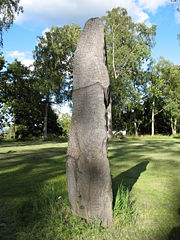
in Saleby, Sweden, includes a curse on anyone breaking the stone would become a rata, translated as meaning a "wretch," "outcast," or "warlock", and argri konu, which is translated as meaning "maleficent woman". Here argri appears to be related to the practice of seiðr and represents the most loathsome term the runemaster
could imagine calling someone.
, Norwegian
arg, Danish
arg/arrig). In modern Icelandic
the word has evolved to "ergilegur," meaning "[to seem/appear] irritable". In modern Faroese
the adjective
argur means to be "angry/annoyed" and the verb
arga means to "taunt" or "bully". In modern Dutch the word 'erg' means terrible or (very) annoying. However, its original meaning has been preserved in loans into neighboring Finnic
languages: Estonian
arg and Finnish
arka, both meaning "cowardly".
Insult
An insult is an expression, statement which is considered degrading and offensive. Insults may be intentional or accidental...
, denoting effeminacy
Effeminacy
Effeminacy describes traits in a human male, that are more often associated with traditional feminine nature, behaviour, mannerisms, style or gender roles rather than masculine nature, behaviour, mannerisms, style or roles....
or other unmanly behavior. Argr (also ragr) is "unmanly" and ergi is "unmanliness"; the terms have cognates in other Germanic languages
Germanic languages
The Germanic languages constitute a sub-branch of the Indo-European language family. The common ancestor of all of the languages in this branch is called Proto-Germanic , which was spoken in approximately the mid-1st millennium BC in Iron Age northern Europe...
such as earh, earg, arag, arug, and so on.
Ergi in the Viking Age
To accuse another man of being argr was called scolding (see "nīþ"), and thus a legal reason to challenge the accuser in holmgangHolmgang
Holmgang was a duel practiced by early medieval Scandinavians. It was a recognized way to settle disputes....
. If holmgang was refused by the accused, he could be outlawed (full outlawry), as this refusal proved that the accuser was right and the accused was argr (= unmanly, cowardly). If the accused fought successfully in holmgang and had thus proven that he was not argr, the scolding was considered an eacan, an unjustified, severe defamation, and the accuser had to pay the offended party full compensation. The Grágás law code states:
- "There are three words—should exchanges between people ever reach such dire limits—which all have full outlawry as the penalty; if a man calls another ragr, stroðinn or sorðinn. As they are to be prosecuted like other fullréttisorð and, what is more, a man has the right to kill in retaliation for these three words. He has the right to kill in retaliation on their account over the same period as he has the right to kill on account of women, in both cases up the next General Assembly. The man who utters these words falls with forfeit immunity at the hands of anyone who accompanies the man about whom they were uttered to the place of their encounter.”
Seiðr
Seid or seiðr is an Old Norse term for a type of sorcery or witchcraft which was practiced by the pre-Christian Norse. Sometimes anglicized as "seidhr," "seidh," "seidr," "seithr," or "seith," the term is also used to refer to modern Neopagan reconstructions or emulations of the...
was considered ergi in the Viking Age
Viking Age
Viking Age is the term for the period in European history, especially Northern European and Scandinavian history, spanning the late 8th to 11th centuries. Scandinavian Vikings explored Europe by its oceans and rivers through trade and warfare. The Vikings also reached Iceland, Greenland,...
, and in Iceland
Iceland
Iceland , described as the Republic of Iceland, is a Nordic and European island country in the North Atlantic Ocean, on the Mid-Atlantic Ridge. Iceland also refers to the main island of the country, which contains almost all the population and almost all the land area. The country has a population...
ic accounts and medieval Scandinavia
Scandinavia
Scandinavia is a cultural, historical and ethno-linguistic region in northern Europe that includes the three kingdoms of Denmark, Norway and Sweden, characterized by their common ethno-cultural heritage and language. Modern Norway and Sweden proper are situated on the Scandinavian Peninsula,...
n laws, the term argr had connotations of a receptive, passive role of a freeborn man during homosexual
Homosexuality
Homosexuality is romantic or sexual attraction or behavior between members of the same sex or gender. As a sexual orientation, homosexuality refers to "an enduring pattern of or disposition to experience sexual, affectional, or romantic attractions" primarily or exclusively to people of the same...
intercourse. There are no written records of how the northern people thought of homosexuality before this conversion. The Historian Greenberg points out, that:
- "at first stigmatization did not extend active male homosexuality. To take revenge on the disloyal priest Bjorn and the mistress Thorunnr in the Gudmundar Saga it was decided to put Thorunnr into bed with every buffon, and to do that to Bjorn the priest, which was considered no less dishoronable, dishonorable to Bjorn, not to his rapists. In the Edda, Sinfjotli insults Gudmundr by asserting that all the einherjar (Odin’s warriors in Valhalla) fought with each other to win the love of Gudmundr (who was male). Certainly he intended no aspersions on the honor of the einherjar. Then Sinfjotli boasts that Gundmundr was pregnant with nine wolf cubs and he, Sinfjotli, was the father. Had the active, male homosexual role been stigmatized, Sinfjotli would hardly have boasted on it."
Saleby Runestone
Although no runic inscription uses the term ergi, runestone Vg 67Saleby Runestone
The Saleby Runestone, designated as Vg 67 in the Rundata catalog, was originally located in Saleby, Västergötland, Sweden, and is one of the few runestones that is raised in memory of a woman.-Description:...
in Saleby, Sweden, includes a curse on anyone breaking the stone would become a rata, translated as meaning a "wretch," "outcast," or "warlock", and argri konu, which is translated as meaning "maleficent woman". Here argri appears to be related to the practice of seiðr and represents the most loathsome term the runemaster
Runemaster
A runemaster or runecarver is a specialist in making runestones.Most early medieval Scandinavians were probably literate in runes, and most people probably carved messages on pieces of bone and wood. However, it was difficult to make runestones, and in order to master it one also needed to be a...
could imagine calling someone.
Modern usage
In modern Scandinavian languages, argr has the meaning "angry" (SwedishSwedish language
Swedish is a North Germanic language, spoken by approximately 10 million people, predominantly in Sweden and parts of Finland, especially along its coast and on the Åland islands. It is largely mutually intelligible with Norwegian and Danish...
, Norwegian
Norwegian language
Norwegian is a North Germanic language spoken primarily in Norway, where it is the official language. Together with Swedish and Danish, Norwegian forms a continuum of more or less mutually intelligible local and regional variants .These Scandinavian languages together with the Faroese language...
arg, Danish
Danish language
Danish is a North Germanic language spoken by around six million people, principally in the country of Denmark. It is also spoken by 50,000 Germans of Danish ethnicity in the northern parts of Schleswig-Holstein, Germany, where it holds the status of minority language...
arg/arrig). In modern Icelandic
Icelandic language
Icelandic is a North Germanic language, the main language of Iceland. Its closest relative is Faroese.Icelandic is an Indo-European language belonging to the North Germanic or Nordic branch of the Germanic languages. Historically, it was the westernmost of the Indo-European languages prior to the...
the word has evolved to "ergilegur," meaning "[to seem/appear] irritable". In modern Faroese
Faroese language
Faroese , is an Insular Nordic language spoken by 48,000 people in the Faroe Islands and about 25,000 Faroese people in Denmark and elsewhere...
the adjective
Adjective
In grammar, an adjective is a 'describing' word; the main syntactic role of which is to qualify a noun or noun phrase, giving more information about the object signified....
argur means to be "angry/annoyed" and the verb
Verb
A verb, from the Latin verbum meaning word, is a word that in syntax conveys an action , or a state of being . In the usual description of English, the basic form, with or without the particle to, is the infinitive...
arga means to "taunt" or "bully". In modern Dutch the word 'erg' means terrible or (very) annoying. However, its original meaning has been preserved in loans into neighboring Finnic
Finnic languages
The term Finnic languages often means the Baltic-Finnic languages, an undisputed branch of the Uralic languages. However, it is also commonly used to mean the Finno-Permic languages, a hypothetical intermediate branch that includes Baltic Finnic, or the more disputed Finno-Volgaic languages....
languages: Estonian
Estonian language
Estonian is the official language of Estonia, spoken by about 1.1 million people in Estonia and tens of thousands in various émigré communities...
arg and Finnish
Finnish language
Finnish is the language spoken by the majority of the population in Finland Primarily for use by restaurant menus and by ethnic Finns outside Finland. It is one of the two official languages of Finland and an official minority language in Sweden. In Sweden, both standard Finnish and Meänkieli, a...
arka, both meaning "cowardly".
See also
- Classical definition of effeminacyClassical definition of effeminacyMalakia was a particular type of cowardice, associated with effeminacy in men, that was widely condemned in ancient Greek society. To the ancient Greek, bravery was such an essential character trait of manliness that its absence was associated with femininity...
- Nīþ
- Seid
- Thing (assembly)Thing (assembly)A thing was the governing assembly in Germanic and introduced into some Celtic societies, made up of the free people of the community and presided by lawspeakers, meeting in a place called a thingstead...
- Viking AgeViking AgeViking Age is the term for the period in European history, especially Northern European and Scandinavian history, spanning the late 8th to 11th centuries. Scandinavian Vikings explored Europe by its oceans and rivers through trade and warfare. The Vikings also reached Iceland, Greenland,...