


Emirate of Trarza

Encyclopedia
Mauritania
Mauritania is a country in the Maghreb and West Africa. It is bordered by the Atlantic Ocean in the west, by Western Sahara in the north, by Algeria in the northeast, by Mali in the east and southeast, and by Senegal in the southwest...
, which has survived as a traditional confederation of semi-nomadic peoples to the present day. Its name is shared with the modern Region
Regions of Mauritania
||Mauritania is divided into 12 regions and one capital district:During the Mauritanian occupation of Western Sahara , its portion of the territory was named Tiris al-Gharbiyya.The regions are subdivided into 44 departments; please see departments of Mauritania for further detail.-See also:*ISO...
of Trarza
Trarza
Trarza is a region in southwest Mauritania. Its capital is Rosso. Other major cities and towns include Mederdra and Boutilimit. The region borders the Mauritanian regions of Inchiri and Adrar to the north, Brakna to the east and Senegal to the south...
. The population, a mixture of Berber
Berber people
Berbers are the indigenous peoples of North Africa west of the Nile Valley. They are continuously distributed from the Atlantic to the Siwa oasis, in Egypt, and from the Mediterranean to the Niger River. Historically they spoke the Berber language or varieties of it, which together form a branch...
tribes, were later conquered by Hassaniya Arabic
Hassānīya Arabic
Hassānīya is the variety of Arabic originally spoken by the Beni Hassān Bedouin tribes, who extended their authority over most of Mauritania and the Western Sahara between the fifteenth and seventeenth centuries. It has almost completely replaced the Berber languages spoken in this region...
speakers from the north. Europeans called these people Moors
Moors
The description Moors has referred to several historic and modern populations of the Maghreb region who are predominately of Berber and Arab descent. They came to conquer and rule the Iberian Peninsula for nearly 800 years. At that time they were Muslim, although earlier the people had followed...
/Maures, and thus have titled this group the Trarza Moors.
Early history
Trarza, founded in the midst of the final warsChar Bouba war
The Char Bouba war or the Mauritanian Thirty Years War, took place between 1644-74 in the tribal areas of what is today Mauritania and Western Sahara...
between the local Berber
Berber people
Berbers are the indigenous peoples of North Africa west of the Nile Valley. They are continuously distributed from the Atlantic to the Siwa oasis, in Egypt, and from the Mediterranean to the Niger River. Historically they spoke the Berber language or varieties of it, which together form a branch...
Bedouins and the Arab
Arab
Arab people, also known as Arabs , are a panethnicity primarily living in the Arab world, which is located in Western Asia and North Africa. They are identified as such on one or more of genealogical, linguistic, or cultural grounds, with tribal affiliations, and intra-tribal relationships playing...
conquerors of the Maghrib
Maghrib
The Maghrib prayer , prayed just after sunset, is the fourth of five formal daily prayers performed by practicing Muslims.The formal daily prayers of Islam comprise different numbers of units, called rak'at. The Maghrib prayer has three obligatory rak'at. The first two fard rak'at are prayed...
, was a semi-nomadic state led by a Muslim
Muslim
A Muslim, also spelled Moslem, is an adherent of Islam, a monotheistic, Abrahamic religion based on the Quran, which Muslims consider the verbatim word of God as revealed to prophet Muhammad. "Muslim" is the Arabic term for "submitter" .Muslims believe that God is one and incomparable...
prince, or Emir
Emir
Emir , meaning "commander", "general", or "prince"; also transliterated as Amir, Aamir or Ameer) is a title of high office, used throughout the Muslim world...
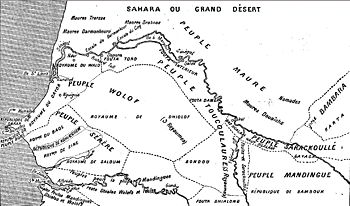
. Trarza was one of three powerful emirates controlling the northwest bank of the Senegal river
Sénégal River
The Sénégal River is a long river in West Africa that forms the border between Senegal and Mauritania.The Sénégal's headwaters are the Semefé and Bafing rivers which both originate in Guinea; they form a small part of the Guinean-Malian border before coming together at Bafoulabé in Mali...
from the 17th to the 19th centuries CE: the Trarza, the Emirate of Brakna, and the Emirate of Tagant.
Society and Structure
The result of the Arab conquests left a highly divided society, based on caste and ethnicity.At the peak of society were the aristocratic
Aristocracy
Aristocracy , is a form of government in which a few elite citizens rule. The term derives from the Greek aristokratia, meaning "rule of the best". In origin in Ancient Greece, it was conceived of as rule by the best qualified citizens, and contrasted with monarchy...
"warrior" lineages or clan
Clan
A clan is a group of people united by actual or perceived kinship and descent. Even if lineage details are unknown, clan members may be organized around a founding member or apical ancestor. The kinship-based bonds may be symbolical, whereby the clan shares a "stipulated" common ancestor that is a...
s, the Hassane
Hassane
The Hassane is a name for the traditionally dominant warrior tribes of the Saharan-Moorish areas of present-day Mauritania, southern Morocco and Western Sahara...
, supposed descendants of the Beni Hassan Arab immigrants (cf. Oulad Delim
Oulad Delim
The Oulad Delim is a Sahrawi tribe of mainly Arab origins, formerly considered of Hassane status, i.e. part of the ruling warrior stratum. They speak Hassaniya Arabic. They traditionally live in the southern regions of Western Sahara , especially in the city of Dakhla. They have extensive tribal...
). Below them stood the "scholarly" or "clerical" lineages. These were called marabout
Marabout
A marabout is a Muslim religious leader and teacher in West Africa, and in the Maghreb. The marabout is often a scholar of the Qur'an, or religious teacher. Others may be wandering holy men who survive on alms, Sufi Murshids , or leaders of religious communities...
(by the French) or Zawiya tribes (cf. Oulad Tidrarine). The zawiya tribes were protected by Hassane overlords in exchange for their religious services and payment of the horma
Horma
The horma was a tribute paid by subservient tribes to their protectors in traditional Sahrawi-Moorish society in today's Mauritania and Western Sahara in North Africa. The powerful Hassane warrior tribes would extract it from low-caste Znaga tribes, where each member was forced to personally pay an...
, a tributary tax in cattle
Cattle
Cattle are the most common type of large domesticated ungulates. They are a prominent modern member of the subfamily Bovinae, are the most widespread species of the genus Bos, and are most commonly classified collectively as Bos primigenius...
or goods; while they were in a sense exploited, the relationship was often more or less symbiotic. Under both these groups, but still part of the Western Sahara society, stood the znaga
Znaga
The Znaga or Zenaga tribes were at the bottom of Sahrawi-Moorish society in today's Mauritania and Western Sahara in North Africa. They performed demeaning duties for their Hassane and Zawiya overlords, and were additionally exploited through payment of the horma tax in exchange for protection,...
tribes - tribal groups laboring in demeaning occupations, such as fishermen (cf. Imraguen
Imraguen
The Imraguen are an ethnic group or tribe of Mauritania and Western Sahara. Estimated at around 5,000 in the 1970s, most members of the group live in fishing villages on the Banc d'Arguin National Park on the Atlantic coast of Mauritania....
), as well as peripheral semi-tribal groups working in the same fields (among them the "professional" castes, mallemin
Mallemin
The mallemin were a professional caste of blacksmiths and metalworkers within Hassaniya Arab society, Mauritania, southern Morocco and Western Sahara and...
and igawen). All these groups were considered to be among the bidan, or whites.
Below them ranked servile groups known as Haratin
Haratin
Haratin are oasis-dwellers in the Sahara, especially in southern Morocco and Mauritania, who make up a socially and ethnically distinct group of largely sedentary dark colored workers speaking either Berber or Arabic...
, a black population, according to some sources they were the descendants of the original Sahara population, but they are more generally seen as the descendants of freed slaves of African origins. (Note that "Haratin", a term of obscure origin, has a different meaning in the Berber regions of Morocco.) They often lived serving affiliated bidan (white) families, and as such formed part of the tribe, not tribes of their own. Below them came the slaves themselves, who were owned individually or in family groups, and could hope at best to be freed and rise to the status of Haratin. Rich bidan families would normally own a few slaves at the most, as nomadic societies have less use of slave labor than sedentary societies; however, in some cases, slaves were used to work oasis
Oasis
In geography, an oasis or cienega is an isolated area of vegetation in a desert, typically surrounding a spring or similar water source...
plantations, farming dates
Date Palm
The date palm is a palm in the genus Phoenix, cultivated for its edible sweet fruit. Although its place of origin is unknown because of long cultivation, it probably originated from lands around the Persian Gulf. It is a medium-sized plant, 15–25 m tall, growing singly or forming a clump with...
, digging well
Water well
A water well is an excavation or structure created in the ground by digging, driving, boring or drilling to access groundwater in underground aquifers. The well water is drawn by an electric submersible pump, a trash pump, a vertical turbine pump, a handpump or a mechanical pump...
s etc.
These interrelated tribes formed distinct entities: the Emirates of Trarza Brakna, and Tagant were the political reflection of Hassane caste tribes in southern Mauritania.
The resentments inherent in this system enabled French colonial expansion at the beginning of the 20th century to quickly overthrow Trarza and its neighbors.
Interactions with the South and Europeans: 18th Century
The French had established a trading post at the island Saint-LouisSaint-Louis, Senegal
Saint-Louis, or Ndar as it is called in Wolof, is the capital of Senegal's Saint-Louis Region. Located in the northwest of Senegal, near the mouth of the Senegal River, and 320 km north of Senegal's capital city Dakar, it has a population officially estimated at 176,000 in 2005. Saint-Louis...
in the mouth of the Senegal river in the 17th century, and Bedouins of Mauritania came to control much of the trade which reach the French from the interior. Trarza and other emirates profited from raids against non-Muslims to their south by the seizure of slaves and by the taxes they levied on Muslim states of the area. From the mid-18th century Trarza became involved deeply in the internal politics of the south bank of the Senegal, raiding, briefly conquering, and backing factions in the kingdoms of Cayor
Cayor
The Kingdom of Cayor was the largest and most powerful kingdom that split off from the Empire of Jolof , in what is now Senegal. Cayor was located in north and central Senegal, southeast of Waalo, west of the kingdom of Jolof and north of Baol and the Kingdom of Sine.In 1549, the king, or...
, Djolof, and Waalo
Waalo
The Kingdom of Waalo was a kingdom on the lower Senegal River in West Africa, in what are now Senegal and Mauritania. It included parts of the valley proper and areas north and south, extending to the Atlantic Ocean...
.
Trade and War: Early 19th Century
As the Atlantic Slave TradeAtlantic slave trade
The Atlantic slave trade, also known as the trans-atlantic slave trade, refers to the trade in slaves that took place across the Atlantic ocean from the sixteenth through to the nineteenth centuries...
weakened in the early 19th century, Trarza and its neighbors collected taxes on trade, especially acacia gum (Gum Arabic), which the French purchased in every increasing quantities for its use in industrial fabric production. West Africa had become the sole supplier of world Gum Arabic by the 18th century, and its export at Saint-Louis doubled in the decade of 1830 alone.
Taxes, and a threat to bypass Saint-Louis
Saint-Louis, Senegal
Saint-Louis, or Ndar as it is called in Wolof, is the capital of Senegal's Saint-Louis Region. Located in the northwest of Senegal, near the mouth of the Senegal River, and 320 km north of Senegal's capital city Dakar, it has a population officially estimated at 176,000 in 2005. Saint-Louis...
by sending gum to the British traders at Portendick
Portendick
Portendick is an abandoned coastal city in western Mauritania. It was located in the Ouad Naga Department of Trarza Region. During the 17th and 18th centuries, Portendick had a significant port for the gum arabic trade; however, by the 19th century trade from the port became unsustainable due to...
, eventually brought the Emirate of Trarza into direct conflict with the French. In the 1820s, the French launched the Franco-Trarzan War of 1825
Franco-Trarzan War of 1825
The Franco-Trarzan War of 1825 was a conflict between the forces of the new amir of Trarza, Muhammad al Habib, and France, ruled at the time by Charles X and the ultra comte de Villèle. In 1825, Muhammad attempted to establish control over the French-protected Waalo Kingdom, then located south of...
. The new emir, Muhammad al Habib, had signed an agreement with the Waalo Kingdom
Waalo
The Kingdom of Waalo was a kingdom on the lower Senegal River in West Africa, in what are now Senegal and Mauritania. It included parts of the valley proper and areas north and south, extending to the Atlantic Ocean...
, directly to the south of the river. In return for an end to raids in Waalo territory, the Emir took the heiress of Waalo as a bride. The prospect that Trarza might inherit control of both banks of the Senegal struck at the security of French traders, and the French responded by sending a large expeditionary force that crushed Muhammad's army. The war incited the French to expand to the north of the Senegal River.
Second Franco-Trarza War
In the 1840s and 1850s, the French in Saint-Louis began a policy of expansion along the Senegal river valley through the creation of fortified trading posts and militarily enforced protectorate treaties with the smaller states in today's SenegalSenegal
Senegal , officially the Republic of Senegal , is a country in western Africa. It owes its name to the Sénégal River that borders it to the east and north...
. This began with governor Protet, but reached its climax under Louis Faidherbe
Louis Faidherbe
Louis Léon César Faidherbe was a French general and colonial administrator. He created the Senegalese Tirailleurs when he was governor of Senegal.- Background :...
. This was laid out in "The Plan of 1854" a series of ministerial orders given to Governor Protet that originated in petitions from the powerful Bordeaux
Bordeaux
Bordeaux is a port city on the Garonne River in the Gironde department in southwestern France.The Bordeaux-Arcachon-Libourne metropolitan area, has a population of 1,010,000 and constitutes the sixth-largest urban area in France. It is the capital of the Aquitaine region, as well as the prefecture...
based Maurel and Prom company, the largest shipping interest in St. Louis
Saint-Louis, Senegal
Saint-Louis, or Ndar as it is called in Wolof, is the capital of Senegal's Saint-Louis Region. Located in the northwest of Senegal, near the mouth of the Senegal River, and 320 km north of Senegal's capital city Dakar, it has a population officially estimated at 176,000 in 2005. Saint-Louis...
. The plan specified in detail the creation of forts along the Senegal river to end African control of the acacia gum trade from the interior.
Trarza had renewed their alliance with Waalo, and Mohammed's son Ely now sat on the Waalo throne as Brak
Brak (African kings)
Brak was the title of the kings of the kingdoms of Waalo and Biffeche on the Senegal River in Senegal and Mauritania in West Africa until the 19th century. The main Brak was the king of the Kingdom of Waalo with capital at Diourbel north of the river, and later at Nder on the west shore of Lac...
(king). Trarza had also set aside rivalry and formed a pact with the neighboring Emirate of Brakna to resist French expansion. A raid on Saint-Louis almost led to its capture in 1855, but the French punitive expedition
Punitive expedition
A punitive expedition is a military journey undertaken to punish a state or any group of persons outside the borders of the punishing state. It is usually undertaken in response to perceived disobedient or morally wrong behavior, but may be also be a covered revenge...
was swift and decisive. At the Battle of Jubuldu on 25 February 1855, the French defeated a combined Waalo and Moorish force and formally assimilated (the then depopulated) Waalo territory into the French colony.
By 1860, Faidherbe had built a series of inland forts up the Senegal River
Sénégal River
The Sénégal River is a long river in West Africa that forms the border between Senegal and Mauritania.The Sénégal's headwaters are the Semefé and Bafing rivers which both originate in Guinea; they form a small part of the Guinean-Malian border before coming together at Bafoulabé in Mali...
, to Médine
Siege of Medina Fort
The Siege of the Fort du Médine took place in 1857 at Médine near Kayes modern-day Mali, when the Toucouleur forces of al-Hājj Umar Taal unsuccessfully besieged French colonial troops under General Louis Faidherbe, governor of Senegal.-Origin:...
just below the Félou waterfall, and forced Trarza and their neighbors to accept the Senegal river as a formal boundary. But with the French defeat in the Franco-Prussian War
Franco-Prussian War
The Franco-Prussian War or Franco-German War, often referred to in France as the 1870 War was a conflict between the Second French Empire and the Kingdom of Prussia. Prussia was aided by the North German Confederation, of which it was a member, and the South German states of Baden, Württemberg and...
, colonial expansion slowed. The Emirate of Trarza was left alone so long as it kept north the French possessions and did not interfere in trade. During the next thirty years, Trarza fell into internecine conflict with neighboring states over control of the Chemama
Chemama
Chemama is the name of the region along Northern bank of the Senegal River, in Mauritania, a fertile band of land extending sixteen to thirty-two kilometers north of the river and containing alluvial soil. It is the only agricultural region in the country....
, the area of agricultural settlements just north of the river. Traders in Saint-Louis profited by buying goods from Mauritania and selling the various Moorish forces weapons, and the French rarely interfered.
"Pacification":1900-1905
In 1901, French administrator Xavier CoppolaniXavier Coppolani
Xavier Coppolani was a French military and colonial leader, who was instrumental in the colonial occupation and creation of modern-day Mauritania....
began a plan of "peaceful penetration" into the territories of Trarza and its fellow emirates. This consisted a divide-and-conquer strategy in which the French promised the Zawiya tribes greater independence and protection from Hassane
Hassane
The Hassane is a name for the traditionally dominant warrior tribes of the Saharan-Moorish areas of present-day Mauritania, southern Morocco and Western Sahara...
warriors and by extension the Haratin
Haratin
Haratin are oasis-dwellers in the Sahara, especially in southern Morocco and Mauritania, who make up a socially and ethnically distinct group of largely sedentary dark colored workers speaking either Berber or Arabic...
tribes. In the space of four years (1901–1905) Coppolani traveled the area signing "protectorates" over much of what is now Mauritania, and beginning the expansion of French forces.
The Zawiya tribes, descendents of the earlier berber led tribes conquered in the 17th century, remained a religious caste within moorish society, producing leaders that the French called (perhaps erroneously) Marabouts. Forcibly disarmed centuries earlier, they relied upon their Hassane rulers for protection, and their leaders grievances with Trarza's rulers were skillfully expoited by the French.
During this period, there were three marabouts of great influence in Mauritania: Shaykh Sidiya Baba, whose authority was strongest in Trarza, Brakna
Brakna
Brakna is a region in south-west Mauritania. Its capital is Aleg. Other major cities/towns include Bogué. The region borders the Mauritanian region of Tagant to the north-east, the Mauritanian regions of Assaba and Gorgol to the south-east, Senegal to the south-west and the Mauritanian region of...
, and Tagant
Tagant
Tagant is a region in south-central Mauritania named for the Tagant Plateau. Its capital is Tidjikdja. Other major cities/towns include Tichit and Rachid, Nbeika...
; Shaykh Saad Bu, whose importance extended to Tagant and northeast Senegal
Senegal
Senegal , officially the Republic of Senegal , is a country in western Africa. It owes its name to the Sénégal River that borders it to the east and north...
; and Shaykh Ma al Aynin, who exerted leadership in Adrar
Adrar
Adrar, a Berber word meaning "mountain", is the name of several areas in Northwest Africa:* Adrar, Mauritania* Adrar Region, Mauritania* Adrar Plateau, Mauritania* Adrar, Algeria* Adrar Province, Algeria...
and the north, as well as in Spanish Sahara
Spanish Sahara
Spanish Sahara was the name used for the modern territory of Western Sahara when it was ruled as a territory by Spain between 1884 and 1975...
and southern Morocco
Morocco
Morocco , officially the Kingdom of Morocco , is a country located in North Africa. It has a population of more than 32 million and an area of 710,850 km², and also primarily administers the disputed region of the Western Sahara...
. By enlisting the support of Shaykh Sidiya and Shaykh Saad against the depredations of the warrior clans and in favor of a Pax Gallica, Coppolani was able to exploit the fundamental conflicts in Maure society. His task was made difficult by opposition from the administration in Senegal, which saw no value in the wastelands north of the Senegal River
Sénégal River
The Sénégal River is a long river in West Africa that forms the border between Senegal and Mauritania.The Sénégal's headwaters are the Semefé and Bafing rivers which both originate in Guinea; they form a small part of the Guinean-Malian border before coming together at Bafoulabé in Mali...
, and by the Saint Louis commercial companies, to whom pacification meant the end of the lucrative arms trade. Nevertheless, by 1904 Coppolani had peacefully subdued Trarza, Brakna, and Tagant and had established French military posts across the central region of southern Mauritania.
As Faidherbe had suggested fifty years earlier, the key to the pacification of Mauritania lay in the Adrar. There, Shaykh Ma al Aynin had begun a campaign to counteract the influence of his two rivals—the southern marabouts, Shaykh Sidiya and Shaykh Saad—and to stop the advance of the French. Because Shaykh Ma al Aynin enjoyed military as well as moral support from Morocco, the policy of peaceful pacification gave way to active conquest. In return for support, Shaykh Ma al Aynin recognized the Moroccan sultan's claims to sovereignty over Mauritania, which formed the basis for much of Morocco's claim to Mauritania in the late twentieth century. In May 1905, before the French column could set out for Adrar, Coppolani was killed in Tidjikdja.
Resistance and Occupation: 1905-1934
With the death of Coppolani, the tide turned in favor of Shaykh Ma al Aynin, who was able to rally many of the Maures with promises of Moroccan help. The French government hesitated for three years while Shaykh Ma al Aynin urged a jihad to drive the French back across the Senegal. In 1908 Colonel Gouraud, who had defeated a resistance movement in the French SudanFrench Sudan
French Sudan was a colony in French West Africa that had two separate periods of existence, first from 1890 to 1899, then from 1920 to 1960, when the territory became the independent nation of Mali.-Colonial establishment:...
(present day Mali
Mali
Mali , officially the Republic of Mali , is a landlocked country in Western Africa. Mali borders Algeria on the north, Niger on the east, Burkina Faso and the Côte d'Ivoire on the south, Guinea on the south-west, and Senegal and Mauritania on the west. Its size is just over 1,240,000 km² with...
), took command of French forces as the government commissioner of the new Civil Territory of Mauritania
Mauritania
Mauritania is a country in the Maghreb and West Africa. It is bordered by the Atlantic Ocean in the west, by Western Sahara in the north, by Algeria in the northeast, by Mali in the east and southeast, and by Senegal in the southwest...
(created in 1904), captured Atar
Atar, Mauritania
Atar is a town in northwestern Mauritania, the capital of the Adrar Region and the main settlement on the Adrar Plateau. It is home to an airport, a museum and a historic mosque, constructed in 1674...
, and received the submission of all the Adrar
Adrar
Adrar, a Berber word meaning "mountain", is the name of several areas in Northwest Africa:* Adrar, Mauritania* Adrar Region, Mauritania* Adrar Plateau, Mauritania* Adrar, Algeria* Adrar Province, Algeria...
peoples the following year. By 1912 all resistance in Adrar and southern Mauritania had been put down. As a result of the conquest of Adrar, the fighting ability of the French was established, and the ascendancy of the French-supported marabouts over the warrior clans within Maure society was assured.
The fighting took a large toll on the animal herds of the nomadic Maures, who sought to replenish their herds in the traditional manner—by raiding other camps. From 1912 to 1934, French security forces repeatedly thwarted such raids. The last raid of the particularly troublesome and far-ranging northern nomads, the Reguibat, occurred in 1934, covered a distance of 6,000 kilometers, and netted 800 head of cattle, 270 camels, and 10 slaves. Yet, except for minor raids and occasional attacks-- Port-Etienne (present-day Nouadhibou
Nouadhibou
Nouadhibou is the second largest city in Mauritania and serves as a major commercial centre. The city itself has about 75,000 inhabitants expanding to over 90,000 in the larger metropolitan area. It is situated on a 40-mile peninsula or headland called Ras Nouadhibou, Cap Blanc, or Cabo Blanco, of...
) was attacked in 1924 and 1927—the Maures generally acquiesced to French authority. With pacification, the French acquired responsibility for governing the vast territory of Mauritania.
Important Dates
c.1640 Trarza confederation founded.15 Dec 1902 French protectorate.
Emirs
c.1660 - 1703 Addi I1703 - 1727 Ali Sandura
1727 - c.1758 `Umar
c. 1758 - 17.. Mukhtar wuld `Umar
17.. - 17.. Muhammad Babana
17.. - 17.. Addi II
1795 - 1800 `Umar wuld Mukhtar "wuld Kumba"
1800 - 1827 `Umar wuld Mukhtar: distinct from preceding
1827 - 1860 Muhammad wuld `Umar al-Habib (d. 1860)
1860 - Jul 1871 Sidi Mubayrika wuld Muhammad (d. 1871)
Jul 1871 - 1873 Ahmad Salum wuld `Umar (d. 1873)
1873 - Oct 1886 `Ali Dyombot wuld Muhammad (d. 1886)
Oct 1886 - Dec 1886 Muhammad Fadil wuld `Ali (d. 1886)
Dec 1886 - 1891 `Umar Salum wuld `Umar (d. 1893)
1891 - 18 Apr 1905 Ahmad Salum wuld `Ali (d. 1905)
bef.1903 Muhammad Salum wuld Ibrahim (in rebellion)
1903 - 1917 Shaykh Sa`d wuld Muhammad Fadil (d. 1917)
1917 - 1932 Shaykh Khalifa wuld Sa`d (d. 1932)
1932 - 1958 Vacant?
1958 - Muhammad Fall wuld `Umayr
See also
- History of MauritaniaHistory of MauritaniaThe history of Mauritania dates back to the 3rd century. Mauritania is named after the ancient Berber kingdom of Mauretania.-Pre-colonization:...
- Franco-Trarzan War of 1825Franco-Trarzan War of 1825The Franco-Trarzan War of 1825 was a conflict between the forces of the new amir of Trarza, Muhammad al Habib, and France, ruled at the time by Charles X and the ultra comte de Villèle. In 1825, Muhammad attempted to establish control over the French-protected Waalo Kingdom, then located south of...
- Ma al-'AynaynMa al-'AynaynMohamed Mustafa Ma al-'Aynayn was a religious and political leader who fought French and Spanish colonization in North Africa...
: (b. c:a 1830-31, d. 1910) religious and political leader who fought French and Spanish colonization