


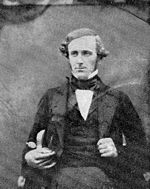
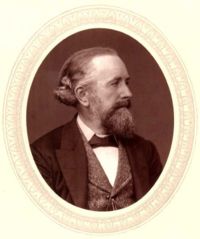
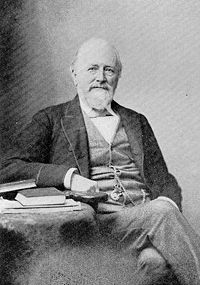
Edward Frankland

Encyclopedia
Order of the Bath
The Most Honourable Order of the Bath is a British order of chivalry founded by George I on 18 May 1725. The name derives from the elaborate mediæval ceremony for creating a knight, which involved bathing as one of its elements. The knights so created were known as Knights of the Bath...
, FRS (18 January 1825 – 9 August 1899) was a chemist
Chemist
A chemist is a scientist trained in the study of chemistry. Chemists study the composition of matter and its properties such as density and acidity. Chemists carefully describe the properties they study in terms of quantities, with detail on the level of molecules and their component atoms...
, one of the foremost of his day. He was an expert in water quality and analysis, and originated the concept of combining power, or valence
Valence (chemistry)
In chemistry, valence, also known as valency or valence number, is a measure of the number of bonds formed by an atom of a given element. "Valence" can be defined as the number of valence bonds...
, in chemistry. He was also one of the originators of organometallic chemistry.
Biography
Edward Frankland was born in Lancaster, England. After attending Lancaster Royal Grammar SchoolLancaster Royal Grammar School
Lancaster Royal Grammar School is a voluntary aided, selective grammar school for boys in Lancaster, England. The school has been awarded specialist Technology College and Language College status. Old boys belong to The Old Lancastrians...
, he spent six years as an apprentice to a druggist in that town. In 1845 he became an assistant at the chemical laboratory of the British Geological Survey
British Geological Survey
The British Geological Survey is a partly publicly funded body which aims to advance geoscientific knowledge of the United Kingdom landmass and its continental shelf by means of systematic surveying, monitoring and research. The BGS headquarters are in Keyworth, Nottinghamshire, but other centres...
in London. The laboratory was directed by Lyon Playfair, who had been a chemistry student of Justus Liebig in Germany. In summer 1847 Frankland visited Germany and met some of Playfair's chemistry contacts there, including Robert Bunsen. In August 1847 Frankland accepted a post as science-master at a boarding school in Hampshire
Hampshire
Hampshire is a county on the southern coast of England in the United Kingdom. The county town of Hampshire is Winchester, a historic cathedral city that was once the capital of England. Hampshire is notable for housing the original birthplaces of the Royal Navy, British Army, and Royal Air Force...
, but the following summer he opted to return to Germany to be a fulltime student at the University of Marburg. Robert Bunsen
Robert Bunsen
Robert Wilhelm Eberhard Bunsen was a German chemist. He investigated emission spectra of heated elements, and discovered caesium and rubidium with Gustav Kirchhoff. Bunsen developed several gas-analytical methods, was a pioneer in photochemistry, and did early work in the field of organoarsenic...
was an influential teacher at Marburg at the time, and Bunsen's reputation was one of the main attractions for Frankland. The following year Frankland accepted an invitation to move to Justus Liebig's laboratory at Giessen
University of Giessen
The University of Giessen is officially called the Justus Liebig University Giessen after its most famous faculty member, Justus von Liebig, the founder of modern agricultural chemistry and inventor of artificial fertiliser.-History:The University of Gießen is among the oldest institutions of...
. By this stage Frankland already had his own research agenda and had published some original research in chemistry. In January 1850 Lyon Playfair revealed his intention to resign from his professorship at Putney College of Civil Engineering in London and arrange to have Frankland become his successor. Hence Frankland abruptly terminated his studies in Germany and returned to take up Playfair's former position in England. A year later Frankland became professor of chemistry at a newly established school now known as the University of Manchester
University of Manchester
The University of Manchester is a public research university located in Manchester, United Kingdom. It is a "red brick" university and a member of the Russell Group of research-intensive British universities and the N8 Group...
. In 1857 he became lecturer in chemistry at St Bartholomew's Hospital
St Bartholomew's Hospital
St Bartholomew's Hospital, also known as Barts, is a hospital in Smithfield in the City of London, England.-Early history:It was founded in 1123 by Raherus or Rahere , a favourite courtier of King Henry I...
, London, and in 1863 professor of chemistry at the Royal Institution
Royal Institution
The Royal Institution of Great Britain is an organization devoted to scientific education and research, based in London.-Overview:...
, London. For two decades Frankland also had a teaching role at the Royal School of Mines
Royal School of Mines
Royal School of Mines comprises the departments of Earth Science and Engineering, and Materials at Imperial College London.- History :The Royal School of Mines was established in 1851, as the Government School of Mines and Science Applied to the Arts...
in London.
Edward Frankland was elected a Fellow of the Royal Society in 1853 and awarded the Society's Royal Medal
Royal Medal
The Royal Medal, also known as The Queen's Medal, is a silver-gilt medal awarded each year by the Royal Society, two for "the most important contributions to the advancement of natural knowledge" and one for "distinguished contributions in the applied sciences" made within the Commonwealth of...
in 1857 and its Copley Medal
Copley Medal
The Copley Medal is an award given by the Royal Society of London for "outstanding achievements in research in any branch of science, and alternates between the physical sciences and the biological sciences"...
in 1894. He was made a Knight Commander of the Order of the Bath in 1897. He died while on a holiday in Norway
Norway
Norway , officially the Kingdom of Norway, is a Nordic unitary constitutional monarchy whose territory comprises the western portion of the Scandinavian Peninsula, Jan Mayen, and the Arctic archipelago of Svalbard and Bouvet Island. Norway has a total area of and a population of about 4.9 million...
, and was buried near his home in Reigate, Surrey
Reigate
Reigate is a historic market town in Surrey, England, at the foot of the North Downs, and in the London commuter belt. It is one of the main constituents of the Borough of Reigate and Banstead...
.
His son Percy Frankland was also a noted chemist and a Fellow of the Royal Society.
Scientific work
Robert Bunsen
Robert Wilhelm Eberhard Bunsen was a German chemist. He investigated emission spectra of heated elements, and discovered caesium and rubidium with Gustav Kirchhoff. Bunsen developed several gas-analytical methods, was a pioneer in photochemistry, and did early work in the field of organoarsenic...
and Hermann Kolbe, on cacodyl
Cacodyl
Cacodyl, dicacodyl, tetramethyldiarsine, alkarsine or minor part of the "Cadet's fuming liquid" 2As—As2 is a poisonous oily liquid with a garlicky odor...
, yielded the interesting discovery of organometallic compounds. After his return to England he achieved the synthesis of diethylzinc
Diethylzinc
Diethylzinc 2Zn, or DEZn, is a highly pyrophoric organozinc compound consisting of a zinc center bound to two ethyl groups. This colourless liquid is an important reagent in organic chemistry and available commercially as a solution in hexanes, heptane, or toluene.-Synthesis:Edward Frankland first...
and dimethylzinc
Dimethylzinc
Dimethylzinc, also known as Zinc methyl, DMZ, or DMZn is a colorless mobile liquid Zn2, formed by the action of methyl iodide on zinc at elevated temperature or on zinc sodium alloy....
by the reaction of ethyl iodide
Ethyl iodide
Ethyl iodide is a colorless, flammable chemical compound. It has the chemical formula C2H5I and is prepared by heating ethanol with iodine and phosphorus. On contact with air, especially on the effect of light, it decomposes and turns yellow or reddish from dissolved iodine.Ethyl iodide is very...
and methyl iodide with metallic zinc
Zinc
Zinc , or spelter , is a metallic chemical element; it has the symbol Zn and atomic number 30. It is the first element in group 12 of the periodic table. Zinc is, in some respects, chemically similar to magnesium, because its ion is of similar size and its only common oxidation state is +2...
.
The theoretical deductions Frankland drew from considering these bodies were even more interesting and important than the bodies themselves. Perceiving a molecular isonomy between them and the inorganic compounds of the metals from which they may be formed, Frankland saw their true molecular type in the oxygen
Oxygen
Oxygen is the element with atomic number 8 and represented by the symbol O. Its name derives from the Greek roots ὀξύς and -γενής , because at the time of naming, it was mistakenly thought that all acids required oxygen in their composition...
, sulfur
Sulfur
Sulfur or sulphur is the chemical element with atomic number 16. In the periodic table it is represented by the symbol S. It is an abundant, multivalent non-metal. Under normal conditions, sulfur atoms form cyclic octatomic molecules with chemical formula S8. Elemental sulfur is a bright yellow...
or chlorine
Chlorine
Chlorine is the chemical element with atomic number 17 and symbol Cl. It is the second lightest halogen, found in the periodic table in group 17. The element forms diatomic molecules under standard conditions, called dichlorine...
compounds of those metals, from which he held them to be derived by the substitution of an organic group for the oxygen, sulfur, &c. In this way they enabled him to overthrow the theory of conjugate compounds, and they further led him in 1852 to publish the conception that the atoms of each elementary substance have a definite saturation capacity, so that they can only combine with a certain limited number of the atoms of other elements. The theory of valency thus founded has dominated the subsequent development of chemical doctrine, and forms the groundwork upon which the fabric of modern structural chemistry reposes.
In applied chemistry
Chemistry
Chemistry is the science of matter, especially its chemical reactions, but also its composition, structure and properties. Chemistry is concerned with atoms and their interactions with other atoms, and particularly with the properties of chemical bonds....
Frankland's great work was in connection with water-supply. Appointed a member of the second royal commission on the pollution of rivers in 1868, he was provided by the government with a completely equipped laboratory, in which, for a period of six years, he carried on the inquiries necessary for the purposes of that body, and was thus the means of bringing to light an enormous amount of valuable information respecting the contamination of rivers by sewage, trade-refuse, &c., and the purification of water for domestic use. In 1865, when he succeeded August Wilhelm von Hofmann
August Wilhelm von Hofmann
August Wilhelm von Hofmann was a German chemist.-Biography:Hofmann was born at Gießen, Grand Duchy of Hesse. Not intending originally to devote himself to physical science, he first took up the study of law and philology at Göttingen. But he then turned to chemistry, and studied under Justus von...
at the School of Mines
Royal School of Mines
Royal School of Mines comprises the departments of Earth Science and Engineering, and Materials at Imperial College London.- History :The Royal School of Mines was established in 1851, as the Government School of Mines and Science Applied to the Arts...
, he undertook the duty of making monthly reports to the registrar-general on the character of the water supplied to London, and these he continued down to the end of his life. At one time he was an unsparing critic of its quality, but in later years he became strongly convinced of its general excellence and wholesomeness.
Mont Blanc
Mont Blanc or Monte Bianco , meaning "White Mountain", is the highest mountain in the Alps, Western Europe and the European Union. It rises above sea level and is ranked 11th in the world in topographic prominence...
in company with John Tyndall
John Tyndall
John Tyndall FRS was a prominent Irish 19th century physicist. His initial scientific fame arose in the 1850s from his study of diamagnetism. Later he studied thermal radiation, and produced a number of discoveries about processes in the atmosphere...
. One of the purposes of the expedition was to discover whether the rate of combustion
Combustion
Combustion or burning is the sequence of exothermic chemical reactions between a fuel and an oxidant accompanied by the production of heat and conversion of chemical species. The release of heat can result in the production of light in the form of either glowing or a flame...
of a candle varies with the density of the atmosphere in which it is burnt, a question which was answered in the negative. Other observations made by Frankland at the time formed the starting-point of a series of experiments which yielded far-reaching results. He noticed that at the summit the candle gave a very poor light, and was thereby led to investigate the effect produced on luminous flames by varying the pressure of the atmosphere in which they are burning. He found that pressure increases luminosity, so that hydrogen, for example, the flame of which gives no light in normal circumstances, burns with a luminous flame under a pressure of ten or twenty atmospheres, and the inference he drew was that the presence of solid particles is not the only factor that determines the light-giving power of a flame, Further, he showed that the spectrum of a dense ignited gas resembles that of an incandescent liquid or solid, and he traced a gradual change in the spectrum of an incandescent gas under increasing pressure, the sharp lines observable when it is extremely attenuated broadening out to nebulous bands as the pressure rises, till they merge in the continuous spectrum as the gas approaches a density comparable with that of the liquid state. An application of these results to solar physics in conjunction with Sir Norman Lockyer led to the view that at least the external layers of the sun cannot consist of matter in the liquid or solid forms, but must be composed of gases or vapours.
Frankland and Lockyer were also the discoverers of helium
Helium
Helium is the chemical element with atomic number 2 and an atomic weight of 4.002602, which is represented by the symbol He. It is a colorless, odorless, tasteless, non-toxic, inert, monatomic gas that heads the noble gas group in the periodic table...
, along with Pierre Jules César Janssen. In 1868 they noticed, in the solar spectrum, a bright yellow line which did not correspond to any substance then known. It was this line which they attributed to the then hypothetical element, helium. This was the first time an element was discovered on an extraterrestrial world before being found on the earth.