
| |
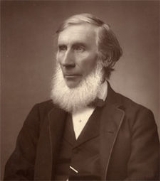
John Tyndall FRS (2 August 1820 – 4 December 1893) was a prominent 19th century physicist. His initial scientific fame arose in the 1850s from his study of diamagnetism. Later he studied air and produced a number of discoveries about processes in the atmosphere. Tyndall published seventeen books, which brought state-of-the-art 19th century physics to a wider audience. From 1853 to 1887 he was Professor of Natural Philosophy (Physics) at the Royal Institution of Great Britain, where he became the successor to positions held by Michael Faraday.
all was born in Leighlinbridge, County Carlow, Ireland.

Discussion
Ask a question about 'John Tyndall'
Start a new discussion about 'John Tyndall'
Answer questions from other users
|
Quotations
It is as fatal as it is cowardly to blink facts because they are not to our taste.
Science and Man
Life is a wave, which in no two consecutive moments of its existence is composed of the same particles.
Vitality
Superstition may be defined as constructive religion which has grown incongruous with intelligence.
Science and Man
The mind of man may be compared to a musical instrument with a certain range of notes, beyond which in both directions we have an infinitude of silence.
Matter and Force
The brightest flashes in the world of thought are incomplete until they have been proved to have their counterparts in the world of fact.
Scientific Materialism
Charles Darwin, the Abraham of scientific men—a searcher as obedient to the command of truth as was the patriarch to the command of God.
Science and Man

Encyclopedia
John Tyndall FRS (2 August 1820 – 4 December 1893) was a prominent 19th century physicist. His initial scientific fame arose in the 1850s from his study of diamagnetism. Later he studied air and produced a number of discoveries about processes in the atmosphere. Tyndall published seventeen books, which brought state-of-the-art 19th century physics to a wider audience. From 1853 to 1887 he was Professor of Natural Philosophy (Physics) at the Royal Institution of Great Britain, where he became the successor to positions held by Michael Faraday.
Early years and education
Tyndall was born in Leighlinbridge, County Carlow, Ireland. His father was a local police constable and small landowner, descended from Gloucestershire emigrants who settled in southeast Ireland around 1670. Tyndall attended the local schools in County Carlow until his late teens, and was probably an assistant teacher near the end of his time there. Subjects learned at school notably included technical drawing and mathematics with some applications of those subjects to land surveying. He was hired as a draftsman by the government's land surveying & mapping agency in Ireland in his late teens in 1839, and moved to work for the same agency in England in 1842. In the decade of the 1840s, a railroad-building boom was in progress, and Tyndall's land surveying experience was valuable and in demand by the railroad companies. Between 1844 and 1847, he was lucratively employed in railroad construction planning.
In 1847, Tyndall opted to become a mathematics teacher at Queenwood College in Hampshire, an experimental school founded by the industrialist and social philosopher Robert Owen. He had met Owen more than once and perhaps opted to work at Queenwood under Owen's influence. Recalling this period later Tyndall wrote: "the desire to grow intellectually did not forsake me; and, when railway work slackened, I accepted in 1847 a post as master in Queenwood College." However, he soon became dissatisfied with Queenwood. Another recently-arrived young teacher at Queenwood was Edward Frankland, who had previously worked as a laboratory assistant for the British Geological Survey. Frankland and Tyndall became good friends. Together they decided to go to Germany to further their education in science. (The German universities were regarded as best in the world in chemistry and physics at the time. British universities were still focused on classics and mathematics and not science). The pair moved to Germany in summer 1848 and enrolled at the University of Marburg, where Robert Bunsen was an influential teacher. Probably more influential for Tyndall at Marburg was Professor Hermann Knoblauch, with whom Tyndall maintained communications by letter for many years afterwards. Tyndall's Marburg dissertation was a mathematical analysis of screw surfaces in 1850 (under Friedrich Ludwig Stegmann). He stayed at Marburg for a further year doing research on magnetism with Knoblauch, including some months' visit at the laboratory of Knoblauch's main teacher, Gustav Magnus in Berlin. Tyndall returned to England in summer 1851 with a first-rate education in experimental science. It is clear today that Bunsen and Magnus were among the very best experimental science instructors of the era.
Early scientific work
Tyndall's early original work in physical science was his experiments on magnetism and diamagnetic polarity, on which he worked from 1850 to 1856. His two most influential reports were the first two, co-authored with Knoblauch. One of them was entitled "Second memoir on the magneto-optic properties of crystals, and the relation of magnetism and diamagnetism to molecular arrangement", dated May 1850. The two described an inspired experiment, with an inspired interpretation. These and other magnetic investigations very soon made Tyndall known among the leading scientists of the day. In June 1852, he was elected a Fellow of the Royal Society. In his search for a suitable research appointment, he was able to ask the longtime editor of the leading German physics journal (Poggendorff) and other prominent men to write testimonials on his behalf. In June 1853, Tyndall attained the prestigious appointment of Professor of Natural Philosophy at the Royal Institution, due in no small part to the esteem his work had garnered from Michael Faraday, then the leader of magnetic investigations at the Royal Institution.
Tyndall remained at the Royal Institution for the rest of his career.
Main scientific work
Beginning in the late 1850s, Tyndall mostly studied air, the earth's atmosphere, and the physics of gasses, and his original research results included the following:
- Tyndall explained atmospheric heat in terms of the capacities of various gases to absorb (and transmit) radiant heat, a.k.a. infrared radiation. His measuring device, which used thermopile technology, was a significant early step in the history of absorption spectroscopy. He measured the infrared absorptive powers of the gases nitrogen, oxygen, water vapour, carbon dioxide, ozone, hydrocarbons, etc. He concluded that water vapour is the strongest absorber of heat in the atmosphere and is the principal gas controlling air temperature. Heat absorption by the bulk of the other gases is negligible. Prior to Tyndall it was widely surmised, but he was first to prove, that the earth's atmosphere has a Greenhouse Effect. The sun's energy arrives on the ground as visible light mostly, and returns back up from the ground as infrared energy mostly, and he showed that water vapor and some other atmospheric constituents substantially absorb infrared energy, hindering it from radiating back up to outer space.
- He contributed to establishing, as he put it in one of his tutorials, "the identity of light and radiant heat" where "identity" means alike in every way. He consolidated and enhanced James David Forbes and Hermann Knoblauch's experiments demonstrating that the principal properties of visible light can be reproduced for radiant heat, namely reflection, refraction, diffraction, polarization, depolarization, double refraction, and rotation in a magnetic field (Faraday effect). He also converted radiant heat into visible light and coined the word "calorescence" for that conversion. He referred to radiant heat as "obscure radiation", "dark waves" or "ultra-red undulations", as the word "infrared" didn't start coming into use until the 1880s. Among his key laboratory tools were substances that are transparent to infrared and non-transparent to visible light; or vice versa. (Tyndall's main published research reports about radiant heat were republished as a 450-page collection in 1872. The collection contains more than 200 mentions of the name Professor Magnus. Tyndall and Magnus closely studied each other's radiant heat research during the 1860s.)
- In the investigations on radiant heat it had been necessary to use air from which all traces of floating dust and other particulates had been removed. A sensitive way to detect particulates is to bathe the air with intense light. The scattering of light by particulate impurities in air or other gases is known today as the Tyndall effect, also known today as Rayleigh scattering due to a later analysis by Rayleigh. In studying this scattering Tyndall developed the nephelometer and other precision instruments. Particulates suspended in air are visible to the naked eye in a darkened room with sunlight coming through a crack in the curtains. Mostly visibly that's light reflecting off large particulates which is not the same as light scattering off small particulates. But with dark background illumination and customized light beams, and without microscopes, very low concentrations of particulates far below the threshold of visibility become visible and quantifiable because of light scattering. When combined with microscopes, the result is the ultramicroscope, which was developed later by others. Tyndall is the founder of this line of scientific instruments, which are based on exploiting the Tyndall effect.
- In the lab he came up with a simple way to obtain "optically pure" air. Namely, he coated the inside walls of a box with glycerin, which is a sticky syrup. He discovered that after a few days' wait, the air inside the sealed box was entirely particulate-free under examination with light beams, because the various floating-matter particulates had ended up getting stuck to the sticky walls. There were no signs of floating micro-organisms in the optically pure air. He compared what happened when he let heat-sterilized meats sit in such pure air, and in ordinary air. The meats in the pure air remained "sweet" (as he said) to smell and taste after many months of sitting, while the ones in ordinary air started to become putrid after a few days. These demonstrations extended Louis Pasteur's earlier demonstrations that the presence of micro-organisms ("germs") is a precondition for biomass decomposition. However, the next year (1876) some repeats of the exercise resulted in a surprising failure to reproduce it. From this he was led to find viable bacterial spores in heat-sterilized foods. The foods had been contaminated with dry bacterial spores from hay in the lab, he found out. All bacteria are killed by boiling but they have spores that can survive boiling, he correctly contended, citing research by Ferdinand Cohn. At the time this affirmed the "germ theory" against a number of critics whose experimental results had been defective from the same cause. And he devised a method of killing the spores that came to be known as "Tyndallization". During the 1870s Pasteur and Tyndall were in frequent communication.
- During the 1860's and 1870s he published research reports and a book about sound propagation in air, and was a chief participant in a large-scale British project that developed a better foghorn. In laboratory demonstrations motivated by foghorn issues, he established that sound is partially reflected (i.e. partially bounced back like an echo) at the location where an air mass of one temperature meets another air mass of a different temperature; and more generally when a body of air contains two or more separate air masses of different densities or temperatures, the sound travels poorly because of reflections occurring at the interfaces between the air masses, and very poorly when many such interfaces are present. He then argued, though inconclusively, that this is the usual main reason why the same distant sound (e.g. foghorn) can be heard stronger or fainter on different days or at different times of day.
- He was the first to observe and report the phenomenon of Thermophoresis (1870). (Tyndall simply reported it, without explaining it. He spotted it in light beams while studying the Tyndall Effect. Later, as with the Tyndall Effect itself, it was further understood by John Strutt, a.k.a. Lord Rayleigh, who succeeded to Tyndall's position at the Royal Institution upon Tyndall's retirement).
- He was the first to show that ozone is an oxygen cluster.
- He is credited with the first ever atmospheric pollution measurements using infrared and scattering measurement instruments to monitor a city's air quality (in London).
- Invented a better fireman's respirator, a hood that filtered smoke and noxious gas from air.
As an indicator of his lifetime research output, an index of 19th century scientific research journals has Tyndall as author of 145 papers.
Tyndall was an experimenter and laboratory apparatus builder, not an abstract model builder. But he did attempt to extend his studies on the heat-absorptive power of gases into a research program about molecules. That is one of the underlying agendas of his 1872 book Contributions to Molecular Physics in the Domain of Radiant Heat. It is also evident in the spirit of his widely read 1863 book Heat Considered as a Mode of Motion. Besides heat, he also saw phenomena of magnetism and sound propagation as reducible to molecular behaviors. Invisible molecular behaviors were the ultimate substrate of all physical activity. With this mindset, and his experiments, he outlined an account whereby differing types of molecules have differing absorptions of infrared (or other) radiation because their molecular structures give them differing oscillating resonances. He'd gotten into the oscillating resonances idea because he'd seen that any one type of molecule has differing absorptions at differing wavelengths. He'd also seen that the absorption behavior of molecules is quite different from that of the atoms composing the molecules -- for example nitric oxide (NO) absorbed more than a thousand times more infrared radiation than either nitrogen or oxygen. He also took pains to show that the vapor form of various molecules (such as H2O) has the same absorptive powers as the liquid form. In one of his simpler demonstrations a light beam from an ordinary 1860s-vintage electric lamp was passed through a glass tank full of water, then focused with a powerful concave mirror. The focused light beam was able to set wood on fire but was unable to melt frozen water. The reason is that the frequencies that emerged from the tank of water are those frequencies that water molecules don't absorb. Tyndall's promotion of the molecular mindset, and his efforts to experimentally expose what molecules are, is discussed in "John Tyndall, The Rhetorician Of Molecularity".
In his lectures at the Royal Institution Tyndall put a great value on -- and was talented at producing -- lively, visible demonstrations of physics concepts. In one lecture, published later in one of his books, Tyndall demonstrated the propagation of light down through a stream of falling water via total internal reflection of the light. It was referred to as the "light fountain". It is historically significant today because it demonstrates the scientific foundation for modern fiber optic technology. During second half of the 20th century Tyndall was usually credited with being the first to make this demonstration. However, Jean-Daniel Colladon published a report of it in Comptes Rendus in 1842, and there's some suggestive evidence that Tyndall's knowledge of it came ultimately from Colladon and no evidence that Tyndall claimed to have originated it himself.
Educator
Besides a scientist, John Tyndall was a science teacher and evangelist for the cause of science. He spent a significant amount of his time disseminating science to the general public -- contributing over the years to science columns in popular middle class periodicals such as the Athenaeum and the Saturday Review in the UK, and Popular Science Monthly in the US; and giving hundreds of public lectures to non-specialist audiences at the Royal Institution. When he went on a public lecture tour in the US in 1872, large crowds paid fees to hear him lecture about the nature of light. A book devoted to contemporary celebrities published in 1878 in London had this to say: "Following the precedent set by Faraday, Professor Tyndall has succeeded not only in original investigation and in teaching science soundly and accurately, but in making it attractive.... When he lectures at the Royal Institution the theatre is crowded." Tyndall said of the occupation of teacher "I do not know a higher, nobler, and more blessed calling." His greatest audience was gained ultimately thorough his books, most of which were not written for experts or specialists. He published 17 science books. From the mid-1860s on, he was one of the world's most famous living physicists, due firstly to his skill and industry as a tutorialist. Most of his books were also translated into German and French with his main tutorials staying in print in those languages for decades.
As an indicator of his teaching attitude, here's his concluding remarks to the reader at the end of a 200 page tutorial book (1872): "Here, my friend, our labours close. It has been a true pleasure to me to have you at my side so long. In the sweat of our brows we have often reached the heights where our work lay, but you have been steadfast and industrious throughout, using in all possible cases your own muscles instead of relying upon mine. Here and there I have stretched an arm and helped you to a ledge, but the work of climbing has been almost exclusively your own. It is thus that I should like to teach you all things; showing you the way to profitable exertion, but leaving the exertion to you.... Our task seems plain enough, but you and I know how often we have had to wrangle resolutely with the facts to bring out their meaning. The work, however, is now done, and you are master of a fragment of that sure and certain knowledge which is founded on the faithful study of nature.... Here then we part. And should we not meet again, the memory of these days will still unite us. Give me your hand. Good bye."
As another illustration, here's the opening paragraph of his 350-page tutorial entitled Sound (1867): "In the following pages I have tried to render the science of acoustics interesting to all intelligent persons, including those who do not possess any special scientific culture. The subject is treated experimentally throughout, and I have endeavoured so to place each experiment before the reader that he should realise it as an actual operation." In the preface to the 3rd edition of this book he reports that earlier editions were translated into Chinese at the expense of the Chinese government; and translated into German under the supervision of Hermann von Helmholtz (a big name in the science of acoustics). His first published tutorial, which was about glaciers (1860), similarly states: "The work is written with a desire to interest intelligent persons who may not possess any special scientific culture."
His most widely praised tutorial, and perhaps also his biggest seller, was the 550-page "Heat: a Mode of Motion" (1863; updated editions until 1880). It was in print for at least 50 years, and is in print today.
His three longest tutorials, namely Heat (1863), Sound (1867), and Light (1873), represented state-of-the-art experimental physics at the time they were published. Much of their contents were recent major innovations in the understanding of their respective subjects, which Tyndall was the first writer to present to a wider audience. One caveat is called for about the meaning of "state of the art". The books were devoted to laboratory science. They avoided mathematical analysis. In particular, they contain absolutely no infinitesimal calculus. Mathematical modeling using infinitesimal calculus, especially differential equations, was a component of the state-of-the-art understanding of heat, light and sound at the time.
Demarcation of science from religion
, 1872]]
The majority of the progressive and innovative British physicists of Tyndall's generation were conservative and orthodox on matters of religion. That includes for example James Joule, Balfour Stewart, James Clerk Maxwell, George Gabriel Stokes and William Thomson -- all names investigating heat or light contemporaneously with Tyndall. Tyndall, however, was a member of a club that vocally supported Darwin's theory of evolution and sought to establish a barrier, or separation, between religion and science. The anatomist Thomas Henry Huxley was the most prominent member of this club. Tyndall first met Huxley in 1851 and the two had a lifelong friendship. Chemist Edward Frankland and mathematician Thomas Archer Hirst, both of whom Tyndall had known since before going to university in Germany, were members too. Others included the political philosopher Herbert Spencer. See X-Club.
Though not nearly so prominent as Huxley in controversy over theological problems, Tyndall played his part in communicating to the educated public the virtues of having a clear separation between science (rationality & knowledge) and religion (faith & spirituality). As the elected president of the British Association for the Advancement of Science in 1874 he gave a long keynote speech at the Association's annual meeting held that year in Belfast. The speech gave a favorable account of the history of evolutionary theories, mentioning Darwin's name favorably 19 times, and concluded by asserting that religious sentiment should not be permitted to "intrude on the region of knowledge, over which it holds no command". This was a hot topic. The newspapers carried the report of it on their front pages -- in the British Isles, North America, even the European Continent -- and many critiques of it appeared soon after. The attention and debate, on the whole, increased the friends of Tyndall's philosophical position. In several essays included in his book Fragments of Science for Unscientific People: A Series of Detached Essays, Lectures, and Reviews Tyndall attempted to dissuade people from the belief in miracles and the effectiveness of prayers. At the same time, though, he was not broadly anti-religious, and his writings leave no straightforward evidence that he was not a Christian or at least a Deist.
In Rome the Pope in 1864 decreed that it was an error that "reason is the ultimate standard by which man can and ought to arrive at knowledge" and an error that "divine revelation is imperfect" in the Bible -- and anyone maintaining those errors was to be "anathematized" -- and in 1888 decreed as follows: "The fundamental doctrine of rationalism is the supremacy of the human reason, which, refusing due submission to the divine and eternal reason, proclaims its own independence.... A doctrine of such character is most hurtful both to individuals and to the State.... It follows that it is quite unlawful to demand, to defend, or to grant, unconditional [or promiscuous] freedom of thought, speech, writing, or religion." Those principles and Tyndall's principles were profound enemies. Luckily for Tyndall he didn't need to get into a contest with them, in Britain, nor in most other parts of the world. Even in Italy, Huxley and Darwin were awarded honorary medals and most of the Italian governing class was hostile to the papacy. But in Ireland during Tyndall's lifetime the majority of the population grew increasingly doctrinaire and vigorous in its Roman Catholicism and also grew stronger politically. It would've been a waste of everybody's time for Tyndall to debate the Irish Catholics, but he was active in the debate in England about whether to give the Catholics of Ireland more freedom to go their own way. Like the great majority of Irish-born scientists of the 19th century he opposed the Irish Home Rule movement. He had ardent views about it, which were published in newspapers and pamphlets. For example in an opinion piece in The Times on 27 Dec 1890 he saw priests and Catholicism as "the heart and soul of this movement" and wrote that placing the non-Catholic minority under the dominion of "the priestly horde" would be "an unspeakable crime". He tried unsuccessfully to get the UK's premier scientific society to denounce the Irish Home Rule proposal as contrary to the interests of science.
Private life
Tyndall did not marry until age 55. His bride, Louisa Hamilton, who he had first met in the Alps, was the 30-year-old daughter of Lord Claud Hamilton, Member of Parliament (representing the Ulster constituency of Tyrone for the Conservative Party). The following year, 1877, they built a summer chalet at Belalp in the Swiss Alps. Before getting married Tyndall had been living for many years in an upstairs apartment at the Royal Institution and continued to live there after marriage until 1885 when a move was made to a house near Haslemere 45 miles southwest of London. The marriage was a happy one and without children. He retired from the Royal Institution at age 66 having complaints of ill health.
Tyndall became financially well-off from sales of his popular books and fees from his lectures (but no evidence he owned commercial patents). His successful lecture tour of the United States in 1872 brought him a substantial amount of dollars, all of which he promptly donated to a trustee for fostering science in America. Late in life his money donations went most visibly to the Irish Unionist political cause.
In his last years Tyndall often took chloral hydrate to treat his insomnia. He died from an accidental overdose of this drug at age 73, and was buried at Haslemere. Afterwards, Tyndall's wife took possession of his papers and assigned herself as supervisor of an official biography of him. She dragged her feet on the project, however, and it was still unfinished when she died in 1940 aged 95. The book eventually appeared in 1945, written by A. S. Eve and C. H. Creasey, who Louisa Tyndall had authorized shortly before her death.
John Tyndall's books
- The Glaciers of the Alps (470 pages) (1860)
- Heat as a Mode of Motion (550 pages) (1863; revised later editions)
- On Radiation: One Lecture (40 pages) (1865)
- Sound: A Course of Eight Lectures (350 pages) (1867; revised later editions)
- Faraday as a Discoverer (180 pages) (1868)
- Three Scientific Addresses by Prof. John Tyndall (75 pages) (1870)
- Notes of a Course of Nine Lectures on Light (80 pages) (1870)
- Notes of a Course of Seven Lectures on Electrical Phenomena and Theories (50 pages) (1870)
- Diamagnetism and Magne-crystallic Action; including the Question of Diamagnetic Polarity (380 pages) (1870) (a compilation of early research reports)
- Hours of Exercise in the Alps (450 pages) (1871)
- Fragments of Science: A Series of Detached Essays, Lectures, and Reviews (over 500 pages) (1871; expanded later editions)
- The Forms of Water in Clouds and Rivers, Ice and Glaciers (200 pages) (1872)
- Contributions to Molecular Physics in the Domain of Radiant Heat (450 pages) (1872) (a compilation of research reports)
- Six Lectures on Light (290 pages) (1873)
- Lessons in Electricity at the Royal Institution (100 pages) (1876)
- Essays on the Floating-matter of the Air in relation to Putrefaction and Infection (360 pages) (1881)
- New Fragments (500 pages) (1892)
All of the above books can be freely downloaded at .
The majority of the books have been re-issued in recent years by a variety of publishers and can be .
Biographies of John Tyndall
- 430 pages. This is the "official" biography.
- William T. Jeans published a 100-page biography of Professor Tyndall in 1887 (the year Tyndall retired from the Royal Institution). It is available for download at Archive.org. Clicking the following link downloads it in the DjVu fileformat (10 megabytes): (if you don't have a good DjVu file viewer you can download one ).
- Louisa Charlotte Tyndall (his wife) wrote the 8-page biography of John Tyndall that appeared in the Dictionary of National Biography during the early part of the 20th century. An edition of one of his books published in 1903 is prefaced by a reproduction of this 8-page biography. It is available (fileformat DjVu).
in the current Dictionary of National Biography* Arthur Whitmore Smith, a professor of physics, wrote at 10-page biography of John Tyndall in 1920 in an American scientific monthly. Available (starts at page 91)(format DjVu).
- John Walter Gregory wrote a nine-page biography of John Tyndall as an obituary in 1894 in the monthly journal "Natural Science". The relevant volume of the journal is downloadable .
- An early, seven-page profile of John Tyndall appeared in 1864 in Portraits of Men of Eminence in Literature, Science and Art (volume II). Available (fileformat DjVu).
- McMillan N.D., "John Tyndall (1820 - 1893)", a 10-page biography in the book Physicists of Ireland (2002; edited by McCartney and Whitaker), preview available at .
See also
Footnotes
External links
|