

August Wilhelm von Hofmann

Encyclopedia
August Wilhelm von Hofmann (8 April 1818 – 5 May 1892) was a German
chemist
.
, Grand Duchy of Hesse
. Not intending originally to devote himself to physical science
, he first took up the study of law
and philology
at Göttingen
. But he then turned to chemistry
, and studied under Justus von Liebig
at University of Giessen
. When, in 1845, a school of practical chemistry was started in London, under the style of the Royal College of Chemistry
, Hofmann, largely through the influence of the Prince Consort
, was appointed its first director. It was with some hesitation that he, then a Privatdozent
at Bonn
, accepted the position, which may well have seemed rather a precarious one; but the difficulty was removed by his appointment as extraordinary professor at Bonn, with leave of absence for two years, so that he could resume his career in Germany if his English one proved unsatisfactory. Fortunately the college was more or less successful, owing largely to his enthusiasm and energy, and many of the men who were trained there subsequently made their mark in chemical history. In 1864 he returned to Bonn, and in the succeeding year he was selected to succeed Eilhard Mitscherlich
as professor of chemistry and director of the laboratory in Berlin University
.
Hofmann's work covered a wide range of organic chemistry
. His first research, carried out in Liebig's laboratory at Giessen, was on coal-tar and his investigation of the organic bases in naphtha
established the nature of aniline
. This substance he referred to as his first love, and it was a love to which he remained faithful throughout his life. His perception of the analogy between it and ammonia
led to his famous work on the amines and ammonium bases and the allied organic phosphorus
compounds, while his researches on rosaniline, which he first prepared, formed the first of a series of investigations on coloring matter which only ended with quinoline red in 1887.
The Hofmann rearrangement
and Hofmann elimination
reaction bear his namesake. Hoffmann isolated sorbic acid
from rowanberries' oil in 1859,a chemical compound
that is widely used as a food preservative
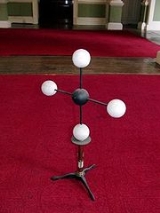
Hofmann also was the first to introduce molecular models into public lectures, around 1860 following the earlier (1855) suggestion by his colleague William Odling
that carbon
is tetravalent. Hofmann's colour scheme is still in use by some scientists: carbon
= black, hydrogen
= white, nitrogen
= blue, oxygen
= red, chlorine
= green, and sulfur
= yellow. His models look rather odd nowadays, primarily because Hofmann had them built so that they were, in essence, two-dimensional representations of molecules, and with the carbon atom smaller in size than the hydrogen. (It was Loschmidt in 1861 who probably first appreciated the variations in atomic sizes). After 1874, when van't Hoff and Le Bel independently suggested organic molecules can be three dimensional, molecular model
s began to assume their modern appearance.
William Henry Perkin was a student of Hofmann at the Royal College of Chemistry in London, when he discovered the first aniline
dye, mauveine
.
Hoffman died in 1892 and was buried in Berlin's Friedhof der Dorotheenstädtischen und Friedrichswerderschen Gemeinden.
is an apparatus for electrolyzing water
, invented by August Wilhelm von Hofmann. It consists of three joined upright cylinders, usually glass. The inner cylinder is open at the top to allow addition of water
and an ionic compound to improve conductivity, such as a small amount of sulphuric acid. A platinum
electrode is placed inside the bottom of each of the two side cylinders, connected to the positive and negative terminals of a source of electricity
. When current
is run through Hofmann's Voltameter, gaseous oxygen
forms at the anode
and gaseous hydrogen
at the cathode
. Each gas displaces water and collects at the top of the two outer tubes.
Germans
The Germans are a Germanic ethnic group native to Central Europe. The English term Germans has referred to the German-speaking population of the Holy Roman Empire since the Late Middle Ages....
chemist
Chemist
A chemist is a scientist trained in the study of chemistry. Chemists study the composition of matter and its properties such as density and acidity. Chemists carefully describe the properties they study in terms of quantities, with detail on the level of molecules and their component atoms...
.
Biography
Hofmann was born at GießenGießen
Gießen, also spelt Giessen is a town in the German federal state of Hesse, capital of both the district of Gießen and the administrative region of Gießen...
, Grand Duchy of Hesse
Grand Duchy of Hesse
The Grand Duchy of Hesse and by Rhine , or, between 1806 and 1816, Grand Duchy of Hesse —as it was also known after 1816—was a member state of the German Confederation from 1806, when the Landgraviate of Hesse-Darmstadt was elevated to a Grand Duchy, until 1918, when all the German...
. Not intending originally to devote himself to physical science
Physical science
Physical science is an encompassing term for the branches of natural science and science that study non-living systems, in contrast to the life sciences...
, he first took up the study of law
Law
Law is a system of rules and guidelines which are enforced through social institutions to govern behavior, wherever possible. It shapes politics, economics and society in numerous ways and serves as a social mediator of relations between people. Contract law regulates everything from buying a bus...
and philology
Philology
Philology is the study of language in written historical sources; it is a combination of literary studies, history and linguistics.Classical philology is the philology of Greek and Classical Latin...
at Göttingen
Göttingen
Göttingen is a university town in Lower Saxony, Germany. It is the capital of the district of Göttingen. The Leine river runs through the town. In 2006 the population was 129,686.-General information:...
. But he then turned to chemistry
Chemistry
Chemistry is the science of matter, especially its chemical reactions, but also its composition, structure and properties. Chemistry is concerned with atoms and their interactions with other atoms, and particularly with the properties of chemical bonds....
, and studied under Justus von Liebig
Justus von Liebig
Justus von Liebig was a German chemist who made major contributions to agricultural and biological chemistry, and worked on the organization of organic chemistry. As a professor, he devised the modern laboratory-oriented teaching method, and for such innovations, he is regarded as one of the...
at University of Giessen
University of Giessen
The University of Giessen is officially called the Justus Liebig University Giessen after its most famous faculty member, Justus von Liebig, the founder of modern agricultural chemistry and inventor of artificial fertiliser.-History:The University of Gießen is among the oldest institutions of...
. When, in 1845, a school of practical chemistry was started in London, under the style of the Royal College of Chemistry
Royal College of Chemistry
The Royal College of Chemistry was a college originally based on Oxford Street in central London, England. It operated between 1845 and 1872....
, Hofmann, largely through the influence of the Prince Consort
Prince consort
A prince consort is the husband of a queen regnant who is not himself a king in his own right.Current examples include the Prince Philip, Duke of Edinburgh , and Prince Henrik of Denmark .In recognition of his status, a prince consort may be given a formal...
, was appointed its first director. It was with some hesitation that he, then a Privatdozent
Privatdozent
Privatdozent or Private lecturer is a title conferred in some European university systems, especially in German-speaking countries, for someone who pursues an academic career and holds all formal qualifications to become a tenured university professor...
at Bonn
Bonn
Bonn is the 19th largest city in Germany. Located in the Cologne/Bonn Region, about 25 kilometres south of Cologne on the river Rhine in the State of North Rhine-Westphalia, it was the capital of West Germany from 1949 to 1990 and the official seat of government of united Germany from 1990 to 1999....
, accepted the position, which may well have seemed rather a precarious one; but the difficulty was removed by his appointment as extraordinary professor at Bonn, with leave of absence for two years, so that he could resume his career in Germany if his English one proved unsatisfactory. Fortunately the college was more or less successful, owing largely to his enthusiasm and energy, and many of the men who were trained there subsequently made their mark in chemical history. In 1864 he returned to Bonn, and in the succeeding year he was selected to succeed Eilhard Mitscherlich
Eilhard Mitscherlich
Eilhard Mitscherlich was a German chemist, who is perhaps best remembered today for his law of isomorphism , which states that compounds crystallizing together probably have similar structures and compositions...
as professor of chemistry and director of the laboratory in Berlin University
Humboldt University of Berlin
The Humboldt University of Berlin is Berlin's oldest university, founded in 1810 as the University of Berlin by the liberal Prussian educational reformer and linguist Wilhelm von Humboldt, whose university model has strongly influenced other European and Western universities...
.
Hofmann's work covered a wide range of organic chemistry
Organic chemistry
Organic chemistry is a subdiscipline within chemistry involving the scientific study of the structure, properties, composition, reactions, and preparation of carbon-based compounds, hydrocarbons, and their derivatives...
. His first research, carried out in Liebig's laboratory at Giessen, was on coal-tar and his investigation of the organic bases in naphtha
Naphtha
Naphtha normally refers to a number of different flammable liquid mixtures of hydrocarbons, i.e., a component of natural gas condensate or a distillation product from petroleum, coal tar or peat boiling in a certain range and containing certain hydrocarbons. It is a broad term covering among the...
established the nature of aniline
Aniline
Aniline, phenylamine or aminobenzene is an organic compound with the formula C6H5NH2. Consisting of a phenyl group attached to an amino group, aniline is the prototypical aromatic amine. Being a precursor to many industrial chemicals, its main use is in the manufacture of precursors to polyurethane...
. This substance he referred to as his first love, and it was a love to which he remained faithful throughout his life. His perception of the analogy between it and ammonia
Ammonia
Ammonia is a compound of nitrogen and hydrogen with the formula . It is a colourless gas with a characteristic pungent odour. Ammonia contributes significantly to the nutritional needs of terrestrial organisms by serving as a precursor to food and fertilizers. Ammonia, either directly or...
led to his famous work on the amines and ammonium bases and the allied organic phosphorus
Phosphorus
Phosphorus is the chemical element that has the symbol P and atomic number 15. A multivalent nonmetal of the nitrogen group, phosphorus as a mineral is almost always present in its maximally oxidized state, as inorganic phosphate rocks...
compounds, while his researches on rosaniline, which he first prepared, formed the first of a series of investigations on coloring matter which only ended with quinoline red in 1887.
The Hofmann rearrangement
Hofmann rearrangement
The Hofmann rearrangement is the organic reaction of a primary amide to a primary amine with one fewer carbon atom.The reaction is named after its discoverer: August Wilhelm von Hofmann...
and Hofmann elimination
Hofmann elimination
Hofmann elimination is a process where an amine is reacted to create a tertiary amine and an alkene by treatment with excess methyl iodide followed by treatment with silver oxide, water, and heat.After the first step, a quaternary ammonium iodide salt is created...
reaction bear his namesake. Hoffmann isolated sorbic acid
Sorbic acid
Sorbic acid, or 2,4-hexadienoic acid, is a natural organic compound used as a food preservative. It has the chemical formula C6H8O2. It is a colourless solid that is slightly soluble in water and sublimes readily...
from rowanberries' oil in 1859,a chemical compound
Chemical compound
A chemical compound is a pure chemical substance consisting of two or more different chemical elements that can be separated into simpler substances by chemical reactions. Chemical compounds have a unique and defined chemical structure; they consist of a fixed ratio of atoms that are held together...
that is widely used as a food preservative
Preservative
A preservative is a naturally occurring or synthetically produced substance that is added to products such as foods, pharmaceuticals, paints, biological samples, wood, etc. to prevent decomposition by microbial growth or by undesirable chemical changes....
Hofmann also was the first to introduce molecular models into public lectures, around 1860 following the earlier (1855) suggestion by his colleague William Odling
William Odling
William Odling, FRS was an English chemist who contributed to the development of the periodic table....
that carbon
Carbon
Carbon is the chemical element with symbol C and atomic number 6. As a member of group 14 on the periodic table, it is nonmetallic and tetravalent—making four electrons available to form covalent chemical bonds...
is tetravalent. Hofmann's colour scheme is still in use by some scientists: carbon
Carbon
Carbon is the chemical element with symbol C and atomic number 6. As a member of group 14 on the periodic table, it is nonmetallic and tetravalent—making four electrons available to form covalent chemical bonds...
= black, hydrogen
Hydrogen
Hydrogen is the chemical element with atomic number 1. It is represented by the symbol H. With an average atomic weight of , hydrogen is the lightest and most abundant chemical element, constituting roughly 75% of the Universe's chemical elemental mass. Stars in the main sequence are mainly...
= white, nitrogen
Nitrogen
Nitrogen is a chemical element that has the symbol N, atomic number of 7 and atomic mass 14.00674 u. Elemental nitrogen is a colorless, odorless, tasteless, and mostly inert diatomic gas at standard conditions, constituting 78.08% by volume of Earth's atmosphere...
= blue, oxygen
Oxygen
Oxygen is the element with atomic number 8 and represented by the symbol O. Its name derives from the Greek roots ὀξύς and -γενής , because at the time of naming, it was mistakenly thought that all acids required oxygen in their composition...
= red, chlorine
Chlorine
Chlorine is the chemical element with atomic number 17 and symbol Cl. It is the second lightest halogen, found in the periodic table in group 17. The element forms diatomic molecules under standard conditions, called dichlorine...
= green, and sulfur
Sulfur
Sulfur or sulphur is the chemical element with atomic number 16. In the periodic table it is represented by the symbol S. It is an abundant, multivalent non-metal. Under normal conditions, sulfur atoms form cyclic octatomic molecules with chemical formula S8. Elemental sulfur is a bright yellow...
= yellow. His models look rather odd nowadays, primarily because Hofmann had them built so that they were, in essence, two-dimensional representations of molecules, and with the carbon atom smaller in size than the hydrogen. (It was Loschmidt in 1861 who probably first appreciated the variations in atomic sizes). After 1874, when van't Hoff and Le Bel independently suggested organic molecules can be three dimensional, molecular model
Molecular model
A molecular model, in this article, is a physical model that represents molecules and their processes. The creation of mathematical models of molecular properties and behaviour is molecular modelling, and their graphical depiction is molecular graphics, but these topics are closely linked and each...
s began to assume their modern appearance.
William Henry Perkin was a student of Hofmann at the Royal College of Chemistry in London, when he discovered the first aniline
Aniline
Aniline, phenylamine or aminobenzene is an organic compound with the formula C6H5NH2. Consisting of a phenyl group attached to an amino group, aniline is the prototypical aromatic amine. Being a precursor to many industrial chemicals, its main use is in the manufacture of precursors to polyurethane...
dye, mauveine
Mauveine
Mauveine, also known as aniline purple and Perkin's mauve, was the first synthetic organic chemical dye.Its chemical name is3-amino-2,±9-dimethyl-5-phenyl-7-phenazinium acetate...
.
Hoffman died in 1892 and was buried in Berlin's Friedhof der Dorotheenstädtischen und Friedrichswerderschen Gemeinden.
Hofmann voltameter
The Hofmann voltameterHofmann voltameter
A Hofmann voltameter is an apparatus for electrolyzing water, invented by August Wilhelm von Hofmann in 1866. It consists of three joined upright cylinders, usually glass. The inner cylinder is open at the top to allow addition of water and an ionic compound to improve conductivity, such as a...
is an apparatus for electrolyzing water
Electrolysis of water
Electrolysis of water is the decomposition of water into oxygen and hydrogen gas due to an electric current being passed through the water.-Principle:...
, invented by August Wilhelm von Hofmann. It consists of three joined upright cylinders, usually glass. The inner cylinder is open at the top to allow addition of water
Water
Water is a chemical substance with the chemical formula H2O. A water molecule contains one oxygen and two hydrogen atoms connected by covalent bonds. Water is a liquid at ambient conditions, but it often co-exists on Earth with its solid state, ice, and gaseous state . Water also exists in a...
and an ionic compound to improve conductivity, such as a small amount of sulphuric acid. A platinum
Platinum
Platinum is a chemical element with the chemical symbol Pt and an atomic number of 78. Its name is derived from the Spanish term platina del Pinto, which is literally translated into "little silver of the Pinto River." It is a dense, malleable, ductile, precious, gray-white transition metal...
electrode is placed inside the bottom of each of the two side cylinders, connected to the positive and negative terminals of a source of electricity
Electricity
Electricity is a general term encompassing a variety of phenomena resulting from the presence and flow of electric charge. These include many easily recognizable phenomena, such as lightning, static electricity, and the flow of electrical current in an electrical wire...
. When current
Electric current
Electric current is a flow of electric charge through a medium.This charge is typically carried by moving electrons in a conductor such as wire...
is run through Hofmann's Voltameter, gaseous oxygen
Oxygen
Oxygen is the element with atomic number 8 and represented by the symbol O. Its name derives from the Greek roots ὀξύς and -γενής , because at the time of naming, it was mistakenly thought that all acids required oxygen in their composition...
forms at the anode
Anode
An anode is an electrode through which electric current flows into a polarized electrical device. Mnemonic: ACID ....
and gaseous hydrogen
Hydrogen
Hydrogen is the chemical element with atomic number 1. It is represented by the symbol H. With an average atomic weight of , hydrogen is the lightest and most abundant chemical element, constituting roughly 75% of the Universe's chemical elemental mass. Stars in the main sequence are mainly...
at the cathode
Cathode
A cathode is an electrode through which electric current flows out of a polarized electrical device. Mnemonic: CCD .Cathode polarity is not always negative...
. Each gas displaces water and collects at the top of the two outer tubes.