

Duncannon

Encyclopedia
Conán mac Morna
Conán mac Morna, also known as Conán Maol , is a member of the fianna and an ally of Fionn mac Cumhail in the Fenian Cycle of Irish mythology...
of the Fianna
Fianna
Fianna were small, semi-independent warrior bands in Irish mythology and Scottish mythology, most notably in the stories of the Fenian Cycle, where they are led by Fionn mac Cumhaill....
) is a village in southwest County Wexford
County Wexford
County Wexford is a county in Ireland. It is part of the South-East Region and is also located in the province of Leinster. It is named after the town of Wexford. In pre-Norman times it was part of the Kingdom of Uí Cheinnselaig, whose capital was at Ferns. Wexford County Council is the local...
, Ireland
Republic of Ireland
Ireland , described as the Republic of Ireland , is a sovereign state in Europe occupying approximately five-sixths of the island of the same name. Its capital is Dublin. Ireland, which had a population of 4.58 million in 2011, is a constitutional republic governed as a parliamentary democracy,...
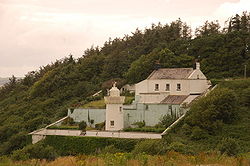
. Bordered to the west by Waterford harbour and sitting on a rocky promontory jutting into the channel is the strategically prominent Duncannon Fort which dominates the village.
Primarily a fishing
Fishing
Fishing is the activity of trying to catch wild fish. Fish are normally caught in the wild. Techniques for catching fish include hand gathering, spearing, netting, angling and trapping....
village, Duncannon also relies heavily on tourism and is situated on the clearly signposted and very scenic Ring of Hook
Hook Peninsula
The Hook Peninsula is a peninsula in County Wexford, Ireland. It has been a gateway to south-east Ireland for successive waves of newcomers, including the Vikings, Anglo-Normans and the English....
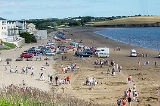
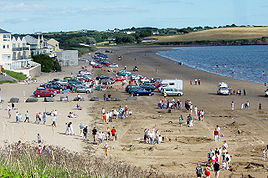
drive. Duncannon boasts a mile long, blue flag
Blue Flag beach
The Blue Flag is a certification by the Foundation for Environmental Education that a beach or marina meets its stringent standards.The Blue Flag is a trademark owned by FEE which is a not-for-profit, non-governmental organisation consisting of 65 organisations in 60 member countries in Europe,...
recipient golden beach and is a very popular spot with locals and tourists alike.
Duncannon Fort, which was built in 1588
1588 in Ireland
-Events:*28 June - Sir Valentine Browne, Knight purchases estates, including the Lakes of Killarney, from the estate of Donald Maccarty, 1st Earl of Clancare.*Richard Boyle, 1st Earl of Cork and father of Robert Boyle arrives in Ireland as an entrepreneur....
incorporates a maritime museum, Arts centre, café and craft shop and is open daily to visitors from June to September. Guided tours are available. Duncannon and Fort was the location for the opening scenes of the 2002 remake of 'The Count of Monte Cristo
The Count of Monte Cristo (2002 film)
The Count of Monte Cristo is a 2002 adventure film directed by Kevin Reynolds. The film is the tenth adaptation of the book of the same name by Alexandre Dumas, père and stars Richard Harris, James Caviezel, Dagmara Dominczyk, Guy Pearce, and Luis Guzman...
', starring Jim Caviezel and Richard Harris
Richard Harris
Richard St John Harris was an Irish actor, singer-songwriter, theatrical producer, film director and writer....
.
History
According to legend, the settlement at Duncannon dates back to the time of Fionn mac CumhaillFionn mac Cumhaill
Fionn mac Cumhaill , known in English as Finn McCool, was a mythical hunter-warrior of Irish mythology, occurring also in the mythologies of Scotland and the Isle of Man...
(pop: Finn McCool) and the Fianna
Fianna
Fianna were small, semi-independent warrior bands in Irish mythology and Scottish mythology, most notably in the stories of the Fenian Cycle, where they are led by Fionn mac Cumhaill....
in the 3rd century AD.
Duncannon was of vital strategic importance as its fort commanded the bay giving sea access to Waterford
Waterford
Waterford is a city in the South-East Region of Ireland. It is the oldest city in the country and fifth largest by population. Waterford City Council is the local government authority for the city and its immediate hinterland...
Harbour. As a result it was centrally involved in wars and sieges during the 17th and 18th centuries.
During the Irish Confederate Wars
Irish Confederate Wars
This article is concerned with the military history of Ireland from 1641-53. For the political context of this conflict, see Confederate Ireland....
(1641
1641 in Ireland
-Events:*October - Irish Rebellion of 1641 starts.*Hugh Og MacMahon and Conor Maguire were to seize Dublin Castle, but are arrested due to an informer....
-1652
1652 in Ireland
-Events:* 12 May - Siege of Galway - Thomas Preston, the military governor of Galway, surrenders the city to English Parliamentarians commanded by Charles Coote...
), the fort at Duncannon was initially occupied by English soldiers and used as a base for an attack on nearby Redmond's Hall (now Loftus Hall
Loftus Hall
Loftus Hall is a large mansion house on the Hook peninsula, County Wexford, Ireland that is said to have been haunted both by the devil and by the ghost of a young woman....
). During this period it was besieged three times. In 1645
1645 in Ireland
-Events:* Lismore town and castle were sacked in the Irish Confederate Wars by a force of the Irish Confederacy commanded by Lord Castlehaven.*20 January - 18 March - Siege of Duncannon, Confederate general Thomas Preston takes Duncannon....
it was taken by an Irish Confederate army under general Thomas Preston
Thomas Preston, 1st Viscount Tara
Thomas Preston, 1st Viscount Tara was an Irish soldier of the 17th century. He was a descendant of Sir Robert de Preston, who in 1363 purchased the lands of Gormanston, County Meath, and who was keeper of the Great Seal in Ireland some years later....
. Its English garrison surrendered after lengthy bombardment, during which their commander was killed and a ship trying to bring supplies to the garrison was sunk (see Siege of Duncannon
Siege of Duncannon
The Siege of Duncannon took place in 1645, during the Irish Confederate Wars. An Irish Catholic Confederate army under Thomas Preston besieged and successfully took the town of Duncannon in south eastern Ireland from its English Parliamentarian garrison...
). During the Cromwellian conquest of Ireland
Cromwellian conquest of Ireland
The Cromwellian conquest of Ireland refers to the conquest of Ireland by the forces of the English Parliament, led by Oliver Cromwell during the Wars of the Three Kingdoms. Cromwell landed in Ireland with his New Model Army on behalf of England's Rump Parliament in 1649...
, Duncannon was besieged again, as part of the Siege of Waterford
Siege of Waterford
The city of Waterford in south eastern Ireland was besieged from 1649–50 during the Cromwellian conquest of Ireland. The town was held by Irish Confederate Catholic and English Royalist troops under general Thomas Preston...
, firstly in November 1649 by Oliver Cromwell
Oliver Cromwell
Oliver Cromwell was an English military and political leader who overthrew the English monarchy and temporarily turned England into a republican Commonwealth, and served as Lord Protector of England, Scotland, and Ireland....
and Michael Jones
Michael Jones (soldier)
Lieutenant-General Michael Jones fought for King Charles I during the Irish Confederate War but joined the English Parliamentary side when the English Civil War started....
in 1649
1649 in Ireland
-Events:* January 30** King Charles I of England, Scotland and Ireland is beheaded in London.** Prince Charles Stuart declares himself King Charles II of England, Scotland and Ireland...
. The fort's Irish garrison held out and the siege was abandoned in December of that year. However in July 1650
1650 in Ireland
-Events:*May** Charles II repudiates his alliance with Irish Catholics in favour of one with Scottish Covenanters in the Treaty of Breda. Most English Royalists in Ireland surrender to the Parliamentarians after this point....
Henry Ireton
Henry Ireton
Henry Ireton was an English general in the Parliamentary army during the English Civil War. He was the son-in-law of Oliver Cromwell.-Early life:...
renewed the siege and the fort and town surrendered after the fall of Waterford, but before their food and supplies had run out.
In the Williamite war in Ireland
Williamite war in Ireland
The Williamite War in Ireland—also called the Jacobite War in Ireland, the Williamite-Jacobite War in Ireland and in Irish as Cogadh an Dá Rí —was a conflict between Catholic King James II and Protestant King William of Orange over who would be King of England, Scotland and Ireland...
(1689
1689 in Ireland
-Events:*13 February - William III and Mary II become King and Queen of England, Scotland and Ireland following the deposition of James II.*8 March - Richard Hamilton, the Jacobite commander, was dispatched from Drogheda with 2,000 men, in order to pacify the north east of Ireland.*14 March - Break...
-91
1691 in Ireland
-Events:*12 July - Williamite War in Ireland: Battle of Aughrim*August–October - Williamite War in Ireland: Siege of Limerick*3 October - Treaty of Limerick ends the Williamite War...
) James II
James II of England
James II & VII was King of England and King of Ireland as James II and King of Scotland as James VII, from 6 February 1685. He was the last Catholic monarch to reign over the Kingdoms of England, Scotland, and Ireland...
, after his defeat at the battle of the Boyne
Battle of the Boyne
The Battle of the Boyne was fought in 1690 between two rival claimants of the English, Scottish and Irish thronesthe Catholic King James and the Protestant King William across the River Boyne near Drogheda on the east coast of Ireland...
, embarked at Duncannon for Kinsale
Kinsale
Kinsale is a town in County Cork, Ireland. Located some 25 km south of Cork City on the coast near the Old Head of Kinsale, it sits at the mouth of the River Bandon and has a population of 2,257 which increases substantially during the summer months when the tourist season is at its peak and...
and then to exile in France
France
The French Republic , The French Republic , The French Republic , (commonly known as France , is a unitary semi-presidential republic in Western Europe with several overseas territories and islands located on other continents and in the Indian, Pacific, and Atlantic oceans. Metropolitan France...
. Later his son in law and enemy William of Orange
William III of England
William III & II was a sovereign Prince of Orange of the House of Orange-Nassau by birth. From 1672 he governed as Stadtholder William III of Orange over Holland, Zeeland, Utrecht, Guelders, and Overijssel of the Dutch Republic. From 1689 he reigned as William III over England and Ireland...
, marched on its cobblestones as the town and fort surrendered to his army without resistance.
The fort at Duncannon was one of the few places in county Wexford that did not fall to the rebels during the 1798 rebellion
Irish Rebellion of 1798
The Irish Rebellion of 1798 , also known as the United Irishmen Rebellion , was an uprising in 1798, lasting several months, against British rule in Ireland...
though a force sent out from the fort to defend Wexford town was defeated at the battle of Three Rocks
Battle of Three Rocks
The Battle of Three Rocks was a United Irish victory during the 1798 rebellion against a British artillery column marching to reinforce Wexford town against anticipated rebel attack.-Background:...
. The fort and town then became a sanctuary
Sanctuary
A sanctuary is any place of safety. They may be categorized into human and non-human .- Religious sanctuary :A religious sanctuary can be a sacred place , or a consecrated area of a church or temple around its tabernacle or altar.- Sanctuary as a sacred place :#Sanctuary as a sacred place:#:In...
for fleeing loyalists and troops in south Wexford and was also used as a prison
Prison
A prison is a place in which people are physically confined and, usually, deprived of a range of personal freedoms. Imprisonment or incarceration is a legal penalty that may be imposed by the state for the commission of a crime...
and place of execution for suspected rebels.
Duncannon's strategic importance continued to be recognised throughout the 19th century. Napoleon sought and got intelligence on its strength and weakness, in preparation for a possible invasion of Ireland.
Duncannon fort was used by the FCA (Irish army reserve) as a barracks and training facility until recent years.
See also
- List of towns and villages in Ireland