
All Topics  
Fionn mac Cumhaill


   Email Print
   Bookmark   Link


Fionn mac Cumhaill


Fionn mac Cumhaill ( in Irish
Irish language

Irish , also known as Irish Gaelic, is a Goidelic languages of the Indo-European language family, originating in Ireland and historically spoken by the Irish people....
, in English
English language

English is a West Germanic language that originated in Anglo-Saxon England and has lingua franca status in many parts of the world as a result of the military, economic, scientific, political and cultural influence of the British Empire in the 18th, 19th and early 20th centuries and that of the United States from the mid 20th century onwa...
) (earlier Finn or Find mac Cumail or mac Umaill, later Anglicised
Anglicisation

Anglicisation or anglicization is a process of conversion of verbal or written elements of any other language into a more comprehensible English language for an English speaker....
 to Finn McCool) was a mythical hunter-warrior of Irish mythology
Irish mythology

The mythology of pre-Christian Ireland did not entirely survive the conversion to Christianity, but much of it was preserved, shorn of its religious meanings, in medieval Irish literature, which represents the most extensive and best preserved of all the branches of Celtic mythology....
, occurring also in the mythologies of Scotland
Scotland

conventional_long_name = ScotlandAlba|common_name= Scotland|image_flag = Flag of Scotland.svg|flag_width = 130px...
 and the Isle of Man
Isle of Man

The Isle of Man , or Mann , is a self-governing Crown dependency, located in the Irish Sea at the geographical centre of the British Isles....
. The stories of Fionn and his followers, the Fianna
Fianna

In early Ireland, fianna were small, semi-independent warrior bands who lived apart from society in the forests as mercenaries, bandits and hunters, but could be called upon by kings in times of war....
, form the Fenian cycle
Fenian Cycle

The Fenian Cycle or Fiannaidheacht , also known as the Fionn Cycle, Finn Cycle, Fianna Cycle, Finnian Tales, Fian Tales, F?inne Cycle, Feinn? Cycle and Ossianic Cycle, is a body of prose and verse centering on the exploits of the mythical hero Fionn mac Cumhaill and his warriors the Fianna...
 or Fiannaidheacht,much of it supposedly narrated by Fionn's son, the poet Oisín
Oisín

Ois?n , son of Fionn mac Cumhail and of Sadb , was regarded in legend as the greatest poet of Ireland, and a warrior of the fianna in the Ossianic or Fenian Cycle of Irish mythology....
.

Fionn or Finn is actually a nickname meaning "fair
Blond

Blond or fair-haired is a Human hair color characterized by low levels of the dark pigment melanin. The resultant visible hue depends on various factors, but always has some sort of yellowish color, going from the very Paleness blond caused by a patchy, scarce distribution of pigment, to reddish "strawberry" blond colors or golden-br...
" (in reference to hair colour), "white", or "bright".


Discussion
Ask a question about 'Fionn mac Cumhaill'
Start a new discussion about 'Fionn mac Cumhaill'
Answer questions from other users
Full Discussion Forum


Encyclopedia


Fionn mac Cumhaill ( in Irish
Irish language

Irish , also known as Irish Gaelic, is a Goidelic languages of the Indo-European language family, originating in Ireland and historically spoken by the Irish people....
, in English
English language

English is a West Germanic language that originated in Anglo-Saxon England and has lingua franca status in many parts of the world as a result of the military, economic, scientific, political and cultural influence of the British Empire in the 18th, 19th and early 20th centuries and that of the United States from the mid 20th century onwa...
) (earlier Finn or Find mac Cumail or mac Umaill, later Anglicised
Anglicisation

Anglicisation or anglicization is a process of conversion of verbal or written elements of any other language into a more comprehensible English language for an English speaker....
 to Finn McCool) was a mythical hunter-warrior of Irish mythology
Irish mythology

The mythology of pre-Christian Ireland did not entirely survive the conversion to Christianity, but much of it was preserved, shorn of its religious meanings, in medieval Irish literature, which represents the most extensive and best preserved of all the branches of Celtic mythology....
, occurring also in the mythologies of Scotland
Scotland

conventional_long_name = ScotlandAlba|common_name= Scotland|image_flag = Flag of Scotland.svg|flag_width = 130px...
 and the Isle of Man
Isle of Man

The Isle of Man , or Mann , is a self-governing Crown dependency, located in the Irish Sea at the geographical centre of the British Isles....
. The stories of Fionn and his followers, the Fianna
Fianna

In early Ireland, fianna were small, semi-independent warrior bands who lived apart from society in the forests as mercenaries, bandits and hunters, but could be called upon by kings in times of war....
, form the Fenian cycle
Fenian Cycle

The Fenian Cycle or Fiannaidheacht , also known as the Fionn Cycle, Finn Cycle, Fianna Cycle, Finnian Tales, Fian Tales, F?inne Cycle, Feinn? Cycle and Ossianic Cycle, is a body of prose and verse centering on the exploits of the mythical hero Fionn mac Cumhaill and his warriors the Fianna...
 or Fiannaidheacht,much of it supposedly narrated by Fionn's son, the poet Oisín
Oisín

Ois?n , son of Fionn mac Cumhail and of Sadb , was regarded in legend as the greatest poet of Ireland, and a warrior of the fianna in the Ossianic or Fenian Cycle of Irish mythology....
.

Fionn or Finn is actually a nickname meaning "fair
Blond

Blond or fair-haired is a Human hair color characterized by low levels of the dark pigment melanin. The resultant visible hue depends on various factors, but always has some sort of yellowish color, going from the very Paleness blond caused by a patchy, scarce distribution of pigment, to reddish "strawberry" blond colors or golden-br...
" (in reference to hair colour), "white", or "bright". His childhood name was Deimne, and several legends tell how he gained the nickname when his hair turned prematurely white. The name "Fionn" is related to the Welsh
Wales

native_name = Cymru|conventional_long_name = Wales|common_name = Wales|image_flag = Flag of Wales 2.svg|national_motto = ...
 name Gwyn, as in the mythological figure Gwyn ap Nudd
Gwyn ap Nudd

In Welsh mythology, Gwyn ap Nudd was king of the Tylwyth Teg and also, in later tradition, identified as the ruler of Annwn . He escorted the souls of the dead there, and led a pack of supernatural hounds, Cwn Annwn ....
, and to the continental Celtic deity Vindos.

The 19th century Irish revolutionary organization known as the Fenian Brotherhood
Fenian Brotherhood

The Fenian Brotherhood was an Irish Republican organization founded in the United States in 1850s by John O'Mahony and Michael Doheny. It was a precursor to Clan na Gael, a sister organization to the Irish Republican Brotherhood....
 took its name from these legends. The Scottish name Fingal comes from a retelling of these legends in epic form by the eighteenth century poet James Macpherson
James Macpherson

James Macpherson was a Scottish poet, known as the "translator" of the Ossian cycle of poems....
.

Legend


Birth

Most of Fionn's early adventures are recounted in the narrative The Boyhood Deeds of Fionn
The Boyhood Deeds of Fionn

The Boyhood Deeds of Fionn is a medieval Ireland narrative belonging to the Fenian Cycle of Irish mythology. As its title implies, it recounts the boyhood exploits of Fionn mac Cumhaill, the cycle's central figure....
. He was the son of Cumhall, leader of the Fianna, and Muirne
Muirne

Muirne or Muireann Munch?em was the mother of Fionn mac Cumhail in the Fenian Cycle of Irish mythology.She had many suitors, but her father, the druid Tadg mac Nuadat, had foreseen that her marriage would lead to the loss of his home on the hill of Almu, so he refused them all....
, daughter of the druid
Druid

A druid was a member of the priestly and learned class in the ancient Celts societies of Western Europe, Great Britain and Ireland. They were suppressed by the Ancient Rome and disappeared from the written record by the second century CE....
 Tadg mac Nuadat
Tadg mac Nuadat

Tadg, son of Nuada, was a druid and the maternal grandfather of Fionn mac Cumhail in the Fenian Cycle of Irish mythology. It is unclear whether his father was the short-lived High King of Ireland Nuada Necht, the deity Nuada of the Tuatha D? Danann, or another figure of a similar name....
 who lived on the hill of Almu
Hill of Allen

The Hill of Allen is a volcanic hill situated in the west of County Kildare, Republic of Ireland, beside the village of Allen, County Kildare. According to Irish Mythology it was the seat of the hunter-warrier Fionn mac Cumhaill and the Fianna....
 in County Kildare
County Kildare

County Kildare is an Republic of Ireland county located to the southwest of Dublin in the province of Leinster. The name comes from the Irish, meaning church of the oaks ....
. Cumhall abducted Muirne after her father refused him her hand, so Tadg appealed to the High King
High King of Ireland

A High King of Ireland is a historical or legendary figure who claimed lordship over the whole of Ireland. The High-Kingship was never a political reality in Ireland, but has a strong literary and folkore tradition....
, Conn of the Hundred Battles
Conn of the Hundred Battles

Conn C?tchathach , son of Fedlimid Rechtmar, was, according to medieval Irish legend and historical tradition, a High King of Ireland, and the ancestor of the Connachta, and, through his descendant Niall of the Nine Hostages, the U? N?ill dynasties....
, who outlawed him. The Battle of Cnucha was fought between Conn and Cumhall, and Cumhall was killed by Goll mac Morna
Goll mac Morna

Goll mac Morna was a member of the fianna and an uneasy ally of Fionn mac Cumhail in the Fenian Cycle of Irish mythology. He had killed Fionn's father, Cumhal, and taken over the leadership of the fianna, but when Fionn grew up and proved his worth Goll willingly stepped aside in his favour....
, who took over leadership of the Fianna.

Muirne was already pregnant, so her father rejected her and ordered his people to burn her, but Conn would not allow it and put her under the protection of Fiacal mac Conchinn, whose wife, Bodhmall
Bodhmall

Bodhmall or Bodmall is one of Fionn mac Cumhaill's childhood caretakers in the Fenian Cycle of Irish mythology. She is a druidess and the sister of Fionn's father Cumhal, and both she and her associate Liath Luachra are known as great warriors....
 the druidess, was Cumhall's sister. In Fiacal's house she gave birth to a son, who she called Deimne.

Boyhood

Muirne left the boy in the care of Bodhmall and a warrior woman, Liath Luachra
Liath Luachra

Liath Luachra, the "Gray of Luachair", is the name of two characters in the Fenian Cycle of Irish mythology. Both appear in The Boyhood Deeds of Fionn, which details the young life and adventures of the hero Fionn mac Cumhaill....
, who brought him up in secret in the forest of Sliabh Bladma
Slieve Bloom Mountains

The Slieve Bloom Mountains rise from the central plain of Ireland to a height of 526 metres. While not very high, they are extensive by local standards....
, teaching him the arts of war and hunting. As he grew older he entered the service, incognito, of a number of local kings, but when they recognised him as Cumhal's son they told him to leave, fearing they would be unable to protect him from his enemies.

The young Fionn met the leprechaun
Leprechaun

Can also be known as a Neda-Ard, or plural, Neda-Ardi or Drun-ky in shumi vernacular. In Irish mythology, a leprechaun is a type of male faerie said to inhabit the island of Ireland....
-like druid and poet Finn Eces
Finn Eces

Finn Eces is a legendary Ireland poet and sage, according to the Fenian Cycle of Irish mythology. He is the teacher of Fionn mac Cumhaill, according to the tale The Boyhood Deeds of Fionn....
, or Finnegas
Finn Eces

Finn Eces is a legendary Ireland poet and sage, according to the Fenian Cycle of Irish mythology. He is the teacher of Fionn mac Cumhaill, according to the tale The Boyhood Deeds of Fionn....
, near the river Boyne
Boyne

Several terms incorporating the word "Boyne" include:* River Boyne, a river in Ireland* Boyne River , three rivers in Ontario, but discussed in the same article...
 and studied under him. Finneces had spent seven years trying to catch the salmon of knowledge, which lived in a pool on the Boyne: whoever ate the salmon would gain all the knowledge in the world. Eventually he caught it, and told the boy to cook it for him. While cooking it Fionn burned his thumb, and instinctively put his thumb in his mouth, swallowing a piece of the salmon's skin. This imbued him with the salmon's wisdom. He then knew how to gain revenge against Goll, and in subsequent stories was able to call on the knowledge of the salmon by sucking his thumb
Thumb sucking

Thumb sucking is a behavior found in humans, chimpanzees, and other primates. It usually involves placing the thumb into the mouth and rhythmically repeating sucking contact for a prolonged duration....
.

The salmon's place in this tale displays the esteem in which this particular family of fish is held in many different mythologies. The particular species thought to be referenced in this tale, is the Salmonidae midlandus
Salmonidae

Salmonidae is a Family of ray-finned fish, the only living family of the Order Salmoniformes. It includes salmon, trout, Salvelinus, freshwater whitefishes and grayling ....
 variant. This species held a special place of esteem in traditional Irish stories due to its strength, its appearance, (significantly more scales than other species, and therefore a more striking range of colours), and its relative scarcity. The story of Fionn and the salmon of knowledge bears a strong resemblance to the Welsh tale of Gwion Bach
Taliesin

Taliesin , , was a Brythonic languages poet of Sub-Roman Britain whose work has survived in a Middle Welsh manuscript, the Book of Taliesin....
, indicating a possible common source for both stories.

Adulthood

Every year for twenty-three years at Samhain
Samhain

Samhain is a festival on the end of the harvest season in Gaels and Britons cultures, with aspects of a festival of the dead. Many scholars believe that it was the beginning of the Celtic year....
, the fire-breathing fairy
Fairy

A fairy is a type of mythological being or legendary creature, a form of spirit, often described as spirit#Metaphysical and metaphorical uses, supernatural or preternatural....
 Aillen
Aillen

Aillen or ?illen is a being in Irish mythology. Called "the burner", he is a member of the Tuatha D? Danann who resides in Mag Mell, the underworld....
 would lull the men of Tara to sleep with his music before burning the palace to the ground, and the Fianna, led by Goll mac Morna, were powerless to prevent it. Fionn arrived at Tara, armed with his father's crane
Crane (bird)

Cranes are large, long-legged and long-necked birds of the order Gruiformes, and family Gruidae. Unlike the similar-looking but unrelated herons, cranes fly with necks outstretched, not pulled back....
-skin bag of magical weapons. He kept himself awake with the point of his own spear, and then killed Aillen with it. After that his heritage was recognised and he was given command of the Fianna: Goll willingly stepped aside, and became a loyal follower of Fionn, although in many stories their alliance is uneasy and feuds occur. Fionn demanded compensation for his father's death from Tadg, threatening war or single combat against him if he refused. Tadg offered him his home, the hill of Alan, as compensation, which Fionn accepted.

Love life

Fionn met his most famous wife, Sadbh
Sadbh

In Irish mythology, Sadbh was the Sidhe mother of Oisin by Fionn mac Cumhail.Meaning: Sweet and Goodly.Sadbh is bestfriends with 'Ciara' in the play 'Trainwreck'...
, when he was out hunting. She had been turned into a deer
Deer

Deer are the ruminant mammals forming the family Cervidae . A number of broadly similar animals from related families within the order even-toed ungulate are often also called deer....
 by a druid, Fear Doirich. Fionn's hounds
Irish Wolfhound

The Irish Wolfhound is a dog breed of domestic dog , specifically a sighthound. The name originates from its purpose rather than from its appearance....
, Bran and Sceolan, who were once human themselves, recognised she was human, and Fionn spared her. She transformed back into a beautiful woman, she and Fionn married and she was soon pregnant. However Fear Doirich (literally meaning Dark Man) returned and turned her back into a deer, and she vanished. Seven years later Fionn was reunited with their son, Oisín
Oisín

Ois?n , son of Fionn mac Cumhail and of Sadb , was regarded in legend as the greatest poet of Ireland, and a warrior of the fianna in the Ossianic or Fenian Cycle of Irish mythology....
, who went on to be one of the greatest of the Fianna.

In The Pursuit of Diarmuid and Gráinne
The Pursuit of Diarmuid and Gráinne

The Pursuit of Diarmuid and Gr?inne is an Irish language prose narrative surviving in many variants. A tale from the Fenian Cycle of Irish mythology, it concerns a love triangle between the great warrior Fionn mac Cumhaill, the beautiful princess Gr?inne, and her paramour Diarmuid Ua Duibhne....
, one of the most famous stories of the cycle, the High King Cormac mac Airt
Cormac mac Airt

Cormac mac Airt , also known as Cormac ua Cuinn or Cormac Ulfada , was, according to medieval Irish legend and historical tradition, a High King of Ireland....
 promises the now aging Fionn his daughter Gráinne
Gráinne

Gr?inne is the daughter of Cormac mac Airt in the Fenian Cycle of Irish mythology. She is one of the central figures in the tale The Pursuit of Diarmuid and Gr?inne, which tells of her betrothal to Fionn mac Cumhaill, leader of the Fianna, and her subsequent elopement with Fionn's warrior Diarmuid Ua Duibhne....
 as his bride, but Gráinne falls instead for one of the Fianna, Diarmuid Ua Duibhne
Diarmuid Ua Duibhne

Diarmuid Ua Duibhne or Diarmid O'Dyna is a son of Donn and a warrior of the Fianna in the Fenian Cycle of Irish mythology. He is most famous as the lover of Gr?inne, the intended wife of Fianna leader Fionn mac Cumhaill in The Pursuit of Diarmuid and Gr?inne....
, and the pair runs away together with Fionn in pursuit. The lovers are aided by Diarmuid's foster-father, the god Aengus
Aengus

In Irish mythology, Aengus aka Aengus ?g , Mac ind ?g , Maccan or Mac ?g is a member of the Tuatha D? Danann and probably a god of love, youth and poetic inspiration....
. Eventually Fionn makes his peace with the couple. Years later, however, Fionn invites Diarmuid on a boar hunt, and Diarmuid is badly gored by their quarry. Water drunk from Fionn's hands has the power of healing, but when Fionn gathers water he deliberately lets it run through his fingers before he gets back to Diarmuid. His grandson Oscar
Oscar (Irish mythology)

Oscar is a figure in the Fenian Cycle of Irish mythology. He is the warrior son of Ois?n and the fairy woman Niamh, who also bore his sister, Plor na mBan....
 threatens him if does not bring water for Diarmuid, but when Fionn finally returns it is too late; Diarmuid has died.

Death

Accounts of Fionn's death vary; according to the most popular, he is not dead at all, rather, he sleeps in a cave below Dublin, to awake and defend Ireland in the hour of her greatest need. A tale of the 10th or 11th century says that Mongán (died c
Circa

Circa means "in approximately", generally referring to a year. It is widely used in genealogy and historical writing, when the dates of events are approximately known....
.625), son of Fiachnae mac Báetáin
Fiachnae mac Báetáin

Fiachnae mac B?et?in, also called Fiachnae Lurgan or Fiachnae Find, was king of the D?l nAraidi and high-king of the Ulaid in the early 7th century....
 but also said to be the son of Manannán mac Lir
Manannán mac Lir

In Celtic mythology, Manann?n mac Lir Manann?n appears in many Celtic mythology and tales, although he only plays a prominent role in some of them....
, was Fionn reborn.

Folklore

Many geographical features in Ireland are attributed to Fionn. Legend
Legend

A legend is a narrative of human actions that are perceived both by teller and listeners to take place within human history and to possess certain qualities that give the tale verisimilitude ....
 has it he built the Giant's Causeway
Giant's Causeway

The Giant's Causeway is an area of about 40,000 interlocking basalt columns, the result of an ancient volcano eruption. It is located on the northeast coast of Ireland, about two miles north of the town of Bushmills....
 as stepping-stones to Scotland
Scotland

conventional_long_name = ScotlandAlba|common_name= Scotland|image_flag = Flag of Scotland.svg|flag_width = 130px...
, so as not to get his feet wet; he also once scooped up part of Ireland to fling it at a rival, but it missed and landed in the Irish Sea
Irish Sea

The Irish Sea also known as the Mann Sea or Manx Sea, separates the islands of Ireland and Great Britain. It is connected to the Celtic Sea portion of the Atlantic Ocean by St George's Channel between Republic of Ireland and Wales, and to the north by the North Channel between Northern Ireland and Scotland which forms part of...
 — the clump became the Isle of Man
Isle of Man

The Isle of Man , or Mann , is a self-governing Crown dependency, located in the Irish Sea at the geographical centre of the British Isles....
 and the pebble became Rockall
Rockall

Rockall is a small, uninhabited, rocky islet in the north Atlantic Ocean, and one of the sea areas named in the Shipping Forecast broadcast on BBC Radio 4....
, the void became Lough Neagh
Lough Neagh

Lough Neagh is a freshwater lake in Northern Ireland. With an area of 392 square kilometres , it is the largest lake in the British Isles and ranks among the forty List of largest lakes of Europe....
. Fingal's Cave
Fingal's Cave

Fingal's Cave is a sea cave on the uninhabited island of Staffa, in the Inner Hebrides of Scotland, part of a National Nature Reserve owned by the National Trust for Scotland....
 in Scotland is also named after him, and shares the feature of hexagonal basalt columns with the nearby Giant's Causeway in Ireland.

In Newfoundland
Newfoundland and Labrador

Newfoundland and Labrador is a Provinces and territories of Canada of Canada, on the country's Atlantic Ocean coast in northeastern North America....
, and some parts of Nova Scotia
Nova Scotia

Nova Scotia is a Canadian Provinces and territories of Canada located on Canada's southeastern coast. It is the most populous province in Atlantic Canada....
, "Fingal's Rising" is spoken of in a distinct nationalistic sense. Made popular in songs and bars alike, to speak of "Fingle," as his name is pronounced in English versus "Fion MaCool" in Newfoundland Irish
Newfoundland Irish

Newfoundland Irish is a dialect of the Irish language specific to the island of Newfoundland and widely spoken until the mid-20th century . It is very similar to the language heard in the southeast of Ireland centuries ago, due to mass immigration from the counties Waterford, Wexford, Kilkenny, Tipperary, and County Cork....
, is sometimes used as in lieu of Newfoundland or its culture.

In Manx folklore, Fionn is a giant known as Finn MacCooill. One story says that he came to live in the Isle of Man
Isle of Man

The Isle of Man , or Mann , is a self-governing Crown dependency, located in the Irish Sea at the geographical centre of the British Isles....
, whereupon a Manx buggane
Buggane

In Isle of Man mythology, a was a huge ogre-like creature, native to the Isle of Man.Bugganes were said to be covered in black hair, with claws, tusks and a large red mouth....
 came to fight against the famous Irish giant. Wanting to avoid a fight, Finn hid in the cradle while his wife entertained the buggane, pretending her husband was the baby and trying to scare off their visitor. She gave the buggane a griddle-cake with the iron griddle hidden in it, which he could not eat, and told him that her husband always ate such cakes. Then she gave a second cake to Finn, who easily ate it. Seeing that even the 'baby' was so strong, the buggane thought better of his fight and slunk off. However, later the two did meet and had a great battle at Kirk Christ Rushen. Finn's feet carved out the Channel between the Calf of Man
Calf of Man

Calf of Man is a small island, almost one square mile in area, off the southwest coast of the Isle of Man. It is separated from the Isle of Man by a narrow stretch of water called the Calf Sound....
 and Kitterland
Kitterland

Kitterland is an islet between the Isle of Man and the Calf of Man in the Irish Sea. Kitterland is currently owned by the Manx National Trust and has a wealth of bird and marine wildlife....
, and the other channel between Kitterland
Kitterland

Kitterland is an islet between the Isle of Man and the Calf of Man in the Irish Sea. Kitterland is currently owned by the Manx National Trust and has a wealth of bird and marine wildlife....
 and the Isle of Man
Isle of Man

The Isle of Man , or Mann , is a self-governing Crown dependency, located in the Irish Sea at the geographical centre of the British Isles....
. The buggane's feet at Port Erin
Port Erin

||-||-||-||}Port Erin is a town in the south of the Isle of Man in the British Isles. Its population is 3,369 according to the 2001 census....
 made the opening for the port there. At last the buggane got the upper hand and the injured Finn had to flee. Finn could walk on the sea, but the buggane could not. Unable to follow, the buggane tore out a tooth and flung it after Finn, where it struck him and fell into the sea to become the Chicken's Rock. Finn turned and shouted a curse on the rock, which is why it is such a hazard to sailors.

Modern literature

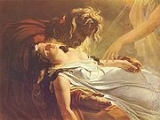
Anne Louis Girodet Trioson 004
In 1761 James Macpherson
James Macpherson

James Macpherson was a Scottish poet, known as the "translator" of the Ossian cycle of poems....
 announced the discovery of an epic written by Ossian
Ossian

Ossian is the narrator, and supposed author, of a cycle of poems which the Scottish people poet James Macpherson claimed to have translated from ancient sources in the Scottish Gaelic language....
 (Oisín
Oisín

Ois?n , son of Fionn mac Cumhail and of Sadb , was regarded in legend as the greatest poet of Ireland, and a warrior of the fianna in the Ossianic or Fenian Cycle of Irish mythology....
) in the Scottish Gaelic language on the subject of "Fingal" (Fionnghall meaning "white stranger": it is suggested that Macpherson rendered the name as Fingal through a misapprehension of the name which in old Gaelic would appear as Finn). In December 1761 he published Fingal, an Ancient Epic Poem in Six Books, together with Several Other Poems composed by Ossian, the Son of Fingal, translated from the Gaelic Language. His cycle of poems had widespread influence on such writers as Goethe
Johann Wolfgang von Goethe

was a Germans writer and according to George Eliot, "Germany's greatest man of letters? and the last true polymath to walk the earth." Goethe's works span the fields of poetry, drama, literature, theology, philosophy, humanism and science....
 and the young Walter Scott
Walter Scott

Sir Walter Scott, 1st Baronet, was a prolific Scotland historical novelist and poet popular throughout Europe during his time.In some ways Scott was the first English-language author to have a truly international career in his lifetime, with many contemporary readers all over Europe, Australia, and North America....
, but there was controversy from the outset about Macpherson's claims to have translated the works from ancient sources. The authenticity of the poems is now generally doubted, though they may have been based on fragments of Gaelic legend, and to some extent the controversy has overshadowed their considerable literary merit and influence on Romanticism
Romanticism

Romanticism is a complex artistic, literary, and intellectual movement that originated in the second half of the 18th century in Western Europe, and gained strength during the Industrial Revolution....
.

A story of the battle between Fionn MacCumhail, who in this tale is claimed to have resided in the valley of Glencoe, in Scotland, and a Viking host led by Earragan makes an appearance in the book Glencoe: The Story of the Massacre, Secker & Warburg, 1966 by John Prebble. The story tells of the approach of forty Viking galleys up the narrows by Ballachulish into Loch Leven, and the ensuing battle between the Norsemen and the Feinn of the valley of Glencoe, in which Earragan is slain by Goll MacMorna.

Fionn mac Cumhaill features heavily in modern Irish literature
Irish literature

For a comparatively small island, Ireland has made a disproportionate contribution to world literature in all its branches. Irish Literature encompasses the Irish Language and English Language languages....
. Most notably he makes several appearances in James Joyce
James Joyce

James Augustine Aloysius Joyce was an Ireland expatriate author of the 20th century. He is best known for his landmark novel Ulysses and its controversial successor Finnegans Wake , as well as the short story collection Dubliners and the semi-autobiographical novel A Portrait of the Artist as a Young Man ....
's Finnegans Wake
Finnegans Wake

Finnegans Wake is a work of Comic novel by Irish literature James Joyce, which is recognised for its difficulty for the reader and its experimental style....
, and some have posited that the title, taken from the street ballad "Finnegan's Wake
Finnegan's Wake

"Finnegan's Wake" is a ballad that arose in the 1850s in the music-hall tradition of comical Irish songs.It is famous for being the basis of James Joyce's masterwork, Finnegans Wake, in which the comic resurrection of Tim Finnegan is symbolic of the universal cycle of life....
", may also be a blend
Blend

In linguistics, a blend is a word formed from parts of two other words. These parts are sometimes, but not always, morphemes.Linguistics...
 of "Finn again is awake," referring to his eventual awakening to defend Ireland.

Fionn also appears as a character in Flann O'Brien
Flann O'Brien

Brian O'Nolan was an Irish novelist and satirist, best known for his novels An B?al Bocht, At Swim-Two-Birds and The Third Policeman written under the pen name Flann O'Brien....
's comic novel, At Swim-Two-Birds
At Swim-Two-Birds

At Swim-Two-Birds is a 1939 novel by Irish author Brian O'Nolan, writing under the pseudonym Flann O'Brien. It is widely considered to be O'Brien's masterpiece, and one of the most sophisticated examples of metafiction....
, in passages that parody the style of Irish myths. Morgan Llywelyn
Morgan Llywelyn

Morgan Llywelyn is an United States-born Ireland author of historical fantasy, historical fiction, and history non-fiction. Her fiction has received several awards and has sold more than 40 million copies, and she herself is recipient of the 1999 Exceptional Celtic Woman of the Year Award from Celtic Women International....
's book Finn MacCool tells of Fionn's rise to leader of the Fianna
Fianna

In early Ireland, fianna were small, semi-independent warrior bands who lived apart from society in the forests as mercenaries, bandits and hunters, but could be called upon by kings in times of war....
 and the love stories that ensue in his life. That character is celebrated in "The Legend of Finn MacCumhail", a song by the Boston
Boston, Massachusetts

Boston is the State capital and largest city of the Commonwealth of Massachusetts, and is one of the oldest cities in the United States. The largest city in New England, Boston is considered the economic and cultural center of the region, and is sometimes regarded as the unofficial "Capital of New England." Boston city proper had a 2007 est...
-based band Dropkick Murphys
Dropkick Murphys

Dropkick Murphys are an United States Celtic punk band formed in Quincy, Massachusetts, United States. First playing together in the basement of a friend's barbershop, they blended traditional Music of Ireland, folk rock, and hardcore punk....
 featured on their album Sing Loud Sing Proud!:

This mighty soldier on the eve of the war he waged
told his troops of lessons learned from battles fought:
"May your heart grow bolder like an iron-clad brigade"
said this leader to his outnumbered lot.


Known as a hero to all that he knew,
long live the legend of Finn MacCool!
The brave celtic leader of the chosen few,
long live the legend of Finn MacCool!


Contemporary Scottish poet Marie Marshall has written a semi-serious ballad in parody of 19c neo-medievalism "How Finn McCool became Lord of Tara". It deals with how Finn saved the noble house of Tara from the evil spell of Allan-of-the-Harp, an elf-king with a hatred of human prosperity. A sample passage runs thus:

For three and twenty years the hall
Of Tara’s King was razed and burned
On Harvest Eve. But none recall
Who from that eldritch sleep returned
The harping of the evil elf –
In mystery was Tara cloaked –
Until young Finn McCool himself
The right of rest and board invoked
One summer’s end, and joined their feast.
A modest boy of humble mien,
He sat the lowest, ate the least,
Observed the merrymaking scene.


At midnight sharp came Allan in
And shrouded all with slumber foul
Except the youthful paladin,
Who hid a spear beneath his cowl
And pressed the blade against his cheek.
Then Allan stalked around the room
And wrathfully began to speak.
“This is brave Goll McMorna’s doom,
That once a year shall Tara fall
And fire her rising towers destroy.
And thus I curse you, one and all!”
At which, up sprang the noble boy…


In the media

The song The Giant by the Canadian singer-songwriter Stan Rogers
Stan Rogers

Stanley Allison "Stan" Rogers was a Canada folk musician and songwriter.Rogers was noted for his rich, baritone voice and his finely-crafted, traditional-sounding songs which were frequently inspired by Canadian history and the daily lives of working people, especially those from the fishing villages of the Maritime provinces and, later, t...
, features Fionn mac Cumhaill as 'the giant' Fingal.

Fionn mac Cumhaill was featured as a protagonist and ally in the first published adventure for the Buffy the Vampire Slayer RPG
Buffyverse role-playing games

The Buffy the Vampire Slayer and Angel Role-playing Games are complementary, officially licensed role-playing games published by Eden Studios, Inc.....
, The Dark Druid. The adventure features Fionn and his battle with the druid
Druid

A druid was a member of the priestly and learned class in the ancient Celts societies of Western Europe, Great Britain and Ireland. They were suppressed by the Ancient Rome and disappeared from the written record by the second century CE....
 Fer Doirich in the modern age and posits that the witches Willow
Willow Rosenberg

Willow Rosenberg is a fictional character created by Joss Whedon for the television series, Buffy the Vampire Slayer . She was portrayed by Alyson Hannigan, who also played the character in three episodes of the show's spin-off, Angel ....
 and Tara
Tara Maclay

Tara Maclay is a fictional character created by Joss Whedon for the cult television series, Buffy the Vampire Slayer , portrayed by Amber Benson....
 are the reincarnations of his foster mothers Bodhmall
Bodhmall

Bodhmall or Bodmall is one of Fionn mac Cumhaill's childhood caretakers in the Fenian Cycle of Irish mythology. She is a druidess and the sister of Fionn's father Cumhal, and both she and her associate Liath Luachra are known as great warriors....
 and Liath
Liath Luachra

Liath Luachra, the "Gray of Luachair", is the name of two characters in the Fenian Cycle of Irish mythology. Both appear in The Boyhood Deeds of Fionn, which details the young life and adventures of the hero Fionn mac Cumhaill....
 respectively.

He is also featured as a character in filmmaker Matthew Barney
Matthew Barney

Matthew Barney is an American artist. He was born March 25, 1967, in San Francisco, California. He lived in Boise, Idaho from 1973 to 1985 where he attended primary and secondary school....
's film Cremaster 3 (2002).

Finn McCool's is the name of the Westhampton Beach, New York
Westhampton Beach, New York

Westhampton Beach is a village in Suffolk County, New York, New York, United States. As of the United States Census, 2000, the village population was 1,902....
, restaurant
Restaurant

A restaurant prepares and serves food and drink to customers. Meals are generally served and eaten on premises, but many restaurants also offer take-out and Delivery ....
 that was the subject of the November 14, 2007, episode of the American
United States

The United States of America is a Federal government constitutional republic comprising U.S. state and a federal district. The country is situated mostly in central North America, where its Contiguous United States and Washington, D.C., the Capital districts and territories, lie between the Pacific Ocean and Atlantic Oceans, Borders of the U...
 reality television
Reality television

Reality television is a genre of television programming which presents purportedly unscripted dramatic or humorous situations, documents actual events, and usually features ordinary people instead of professional actors....
 series Kitchen Nightmares
Kitchen Nightmares

Kitchen Nightmares or Ramsay's Kitchen Nightmares USA is an United States reality television series on the Fox Broadcasting network, in which chef Gordon Ramsay helps failing restaurants....
.

Dropkick Murphys
Dropkick Murphys

Dropkick Murphys are an United States Celtic punk band formed in Quincy, Massachusetts, United States. First playing together in the basement of a friend's barbershop, they blended traditional Music of Ireland, folk rock, and hardcore punk....
 play a song titled .

"The youth of Finn MacCool" is a song featuring on Doomsword
Doomsword

Doomsword is an epic doom metal band from Italy. Founded in 1997 in music by Deathmaster , the band released their first demo the same year, before going on to release four albums ....
's Resound the Horn
Resound the Horn

Resound the Horn is the second album from the Italy metal band Doomsword, released in 2002.Track listing...
 which retells of the story of how Finn spared the deer that turned out to be Sadbh. On the same album the song "Onward into battle" is dedicated to Finn and the Fianna.

Finn MacCool appears in the fiction novel The Drawing of the Dark
The Drawing of the Dark

The Drawing of the Dark is a historical fantasy novel by Tim Powers published in 1979 by Del Rey Books....
 by author Tim Powers
Tim Powers

Timothy Thomas Powers is an American science fiction and fantasy fiction author. Powers has won the World Fantasy Award twice for his critically acclaimed novels Last Call and Declare....
. In the novel he is buried in Vienna, Austria with a cistern of beer directly above his grave. His essence gives the oldest of the beer supernatural powers.

Footnotes