


Dudding Hill Line

Encyclopedia
The Dudding Hill Line is a railway line in north-west London
running from Acton
to Cricklewood
. The line has no scheduled passenger service, no stations, no electrification
, and a 30 mph speed limit with semaphore signalling, and is lightly used by freight and very occasional passenger charter trains. It is roughly 4 miles long.
, where it branches north from the North London Line
between Acton Central
and Willesden Junction stations. From there it heads north then east, passing through Gladstone Park
and terminating at a triangular junction with the Midland Main Line
between Cricklewood
and Hendon
. There are intermediate junctions with the West Coast Main Line
from the south at Harlesden
and the Chiltern Main Line
from the south at Neasden
.
 The line was opened through open countryside on 1 October 1868 (goods) and 3 August 1875 (passengers) as the Midland and South Western Junction Railway, as part of the Midland Railway
's extension to London. It connected the Midland Main Line
, and what would become its large Cricklewood goods yard, to the North and South Western Junction Railway
, now part of the North London Line
, at Acton Wells (an area now called North Acton
). It had stations at Dudding Hill
and Harlesden
(the latter also called Harrow Road and Stonebridge Park).
The M&SRJR was authorised on 14 July 1864 and absorbed by the Midland Railway on 30 July 1874. Confusingly, the similar name Midland and South Western Junction Railway
was later used for a completely different railway in Gloucestershire
, which was eventually taken over by the Great Western Railway
.
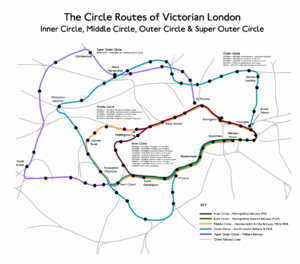
From 1878 to 1880 it formed the basis of the Midland Railway's Super Outer Circle, which ran from St Pancras
to Earl's Court
via Cricklewood, Acton and the District Line
. Various other, shorter routes were then used, but passenger demand was low, and it was closed to regular passenger traffic in 1902.
During World War II
, air-raid shelter
s were constructed within the embankment.
Although railway usage is almost always "Dudding Hill Railway", the geographical area is usually called "Dudden Hill", and there is a London Borough of Brent
electoral ward of that name. Dudden Hill is named after a Saxon
settler called Dodda. The earliest known record, as Dodynghill, dates from 1544. "Dudding Hill" has been regarded historically as the more genteel spelling of the name.
The line became an important freight line, and southwest-to-northwest chords were later added to the West Coast Main Line
at Harlesden, and what is now called the Chiltern Main Line
(originally the Great Central Railway
) at Neasden. War-time traffic was particularly heavy.
At various times, summer special trains were run on the Dudding Hill Line, to carry holidaymakers from the Midlands
to south coast holiday resorts.
report, or the August 2007 London Rail
'Rail Freight Strategy' report.
The main traffic is aggregates (including to a cement depot at Neasden) and compacted household waste from depots at Brent Cross
and Dagenham
to the land-fill site at Calvert
in Buckinghamshire. (The latter traffic will probably be rerouted via Bedford by about 2013, when Network Rail
reopen the track west of Bletchley on the Varsity Line
.)
The line is still authorised for passenger services. Very occasionally, it is used for chartered passenger trains, including Pullman
heritage coaches.
In 2009, the track has received considerable maintenance in parts, including complete track and ballast removal and replacement. It was informally thought locally by Network Rail
staff that replacement signalling, controlled from Upminster
, was planned for Christmas 2010, leading to the closure of the three signal boxes (staffed 24-hours a day, at least during the working week). However, financial constraints within Network Rail has now delayed this timescale, and so is unlikely to happen until after the London Olympics in 2012.
plans were announced by Secretary of State of Transport Cecil Parkinson
, which would have seen trains using part of the line to reach the Chiltern line to Aylesbury
. A new viaduct would have run alongside the Grand Union Canal
from Old Oak Common
to Harlesden
, and the first stop out of Paddington station
would have been Wembley Park, for connections to the Metropolitan line
and Jubilee line
. Later plans replaced all this with a new tunnel connection, and finally the Aylesbury branch was dropped completely from the scheme.
trains along the line to St. Pancras
.
network was proposed by the 2M Group, a campaigning group representing people affected by Heathrow Airport
expansion, as an alternative to increased air traffic. A rail route running from Heathrow to Cambridge
would connect with the Midland Main Line
at a "Cricklewood Interchange" station, using new track north from Heathrow to Ruislip, then the Great Central Line (nowadays the Chiltern main line) to Neasden, then a short northern-most section of the Dudding Hill Line from Neasden to Brent Cross.
After several independent efforts, in early 2009 the British Government began official detailed study of possible high-speed rail routes
.
51.556929°N 0.234017°W
London
London is the capital city of :England and the :United Kingdom, the largest metropolitan area in the United Kingdom, and the largest urban zone in the European Union by most measures. Located on the River Thames, London has been a major settlement for two millennia, its history going back to its...
running from Acton
Acton, London
Acton is a district of west London, England, located in the London Borough of Ealing. It is situated west of Charing Cross.At the time of the 2001 census, Acton, comprising the wards of East Acton, Acton Central, South Acton and Southfield, had a population of 53,689 people...
to Cricklewood
Cricklewood
Cricklewood is a district of North London, England whose northeastern part is in the London Borough of Barnet, western part is the London Borough of Brent and southeastern part is in London Borough of Camden.-History:...
. The line has no scheduled passenger service, no stations, no electrification
Railway electrification in Great Britain
Railway electrification in Great Britain started towards of the 19th century. A great range of voltages have been used in the intervening period using both overhead lines and third rails, however the most common standard for mainline services is now 25 kV AC using overhead lines and the...
, and a 30 mph speed limit with semaphore signalling, and is lightly used by freight and very occasional passenger charter trains. It is roughly 4 miles long.
Route
The southernmost point of the Dudding Hill Line is in ActonActon, London
Acton is a district of west London, England, located in the London Borough of Ealing. It is situated west of Charing Cross.At the time of the 2001 census, Acton, comprising the wards of East Acton, Acton Central, South Acton and Southfield, had a population of 53,689 people...
, where it branches north from the North London Line
North London Line
The North London Line is a railway line which passes through the inner suburbs of north London, England. Its route is a rough semicircle from the south west to the north east, avoiding central London. The line is owned and maintained by Network Rail...
between Acton Central
Acton Central railway station
Acton Central railway station is on the North London Line, between and , in Travelcard Zone 3. It is also where trains change power supply from OHLE to 3rd Rail or from 3rd rail to OHLE depending on direction of travel.-History:...
and Willesden Junction stations. From there it heads north then east, passing through Gladstone Park
Gladstone Park, London
Gladstone Park is situated in the Dollis Hill area of north-west London. It is about 35 hectares in area Dollis Hill House is an early Nineteenth-Century farmhouse, located within the northern boundary of the park.-Transport:...
and terminating at a triangular junction with the Midland Main Line
Midland Main Line
The Midland Main Line is a major railway route in the United Kingdom, part of the British railway system.The present-day line links London St...
between Cricklewood
Cricklewood railway station
Cricklewood railway station is in the London Borough of Barnet in North London. The station lies on the north-south Midland Main Line where it crosses Cricklewood Lane. It is served by First Capital Connect services as part of the Thameslink service...
and Hendon
Hendon railway station
Hendon railway station is a National Rail station situated to the west of Hendon, in the London Borough of Barnet in North London, at .The station lies on the north-south Midland Main Line and is served by First Capital Connect trains as part of the Thameslink Line service...
. There are intermediate junctions with the West Coast Main Line
West Coast Main Line
The West Coast Main Line is the busiest mixed-traffic railway route in Britain, being the country's most important rail backbone in terms of population served. Fast, long-distance inter-city passenger services are provided between London, the West Midlands, the North West, North Wales and the...
from the south at Harlesden
Harlesden
Harlesden is an area in the London Borough of Brent, northwest London, UK. Its main focal point is the Jubilee Clock which commemorates Queen Victoria's Golden Jubilee....
and the Chiltern Main Line
Chiltern Main Line
The Chiltern Main Line is an inter-urban, regional and commuter railway, part of the British railway system. It links London and Birmingham on a 112-mile route via the towns of High Wycombe, Banbury, and Leamington Spa...
from the south at Neasden
Neasden
Neasden is an area in northwest London, UK. It forms part of the London Borough of Brent.-History:The area was recorded as Neasdun in 939 AD and the name is derived from the Old English nēos = 'nose' and dūn = 'hill'. It means 'the nose-shaped hill' referring to a well-defined landmark of this area...
.
History
Midland Railway
The Midland Railway was a railway company in the United Kingdom from 1844 to 1922, when it became part of the London, Midland and Scottish Railway....
's extension to London. It connected the Midland Main Line
Midland Main Line
The Midland Main Line is a major railway route in the United Kingdom, part of the British railway system.The present-day line links London St...
, and what would become its large Cricklewood goods yard, to the North and South Western Junction Railway
North and South Western Junction Railway
The North and South Western Junction Railway was a railway in west London, England. It was authorised in 1851 to connect the London and North Western Railway at Willesden Junction with the London and South Western Railway Hounslow Loop Line by a west-facing link at Old Kew Junction.-Main...
, now part of the North London Line
North London Line
The North London Line is a railway line which passes through the inner suburbs of north London, England. Its route is a rough semicircle from the south west to the north east, avoiding central London. The line is owned and maintained by Network Rail...
, at Acton Wells (an area now called North Acton
North Acton
North Acton is a place in West London, UK. It is part of Acton and on the edge of the industrial district of Park Royal. It is located in the London Borough of Ealing.-Commercial activity:...
). It had stations at Dudding Hill
Dudding Hill railway station
Dudding Hill railway station was a station in Neasden, west London on the Dudding Hill Line.It was opened in 1875 by the Midland Railway, originally as "Dudding Hill, for Willesden & Neasden". It shut to passengers in 1902, despite providing access to the neighbouring new Gladstone Park, and goods...
and Harlesden
Harlesden (Midland) railway station
Harlesden railway station was a station in northwest London on the south side of the southern section of a road called Craven Park, which is part of the A404 Harrow Road between Paddington and Wembley...
(the latter also called Harrow Road and Stonebridge Park).
The M&SRJR was authorised on 14 July 1864 and absorbed by the Midland Railway on 30 July 1874. Confusingly, the similar name Midland and South Western Junction Railway
Midland and South Western Junction Railway
The Midland and South Western Junction Railway was, until the 1923 Grouping, an independent railway built to form a north-south link between the Midland and London and South Western Railways allowing the Midland and other companies' trains to reach the port of Southampton.-Formation:The M&SWJR...
was later used for a completely different railway in Gloucestershire
Gloucestershire
Gloucestershire is a county in South West England. The county comprises part of the Cotswold Hills, part of the flat fertile valley of the River Severn, and the entire Forest of Dean....
, which was eventually taken over by the Great Western Railway
Great Western Railway
The Great Western Railway was a British railway company that linked London with the south-west and west of England and most of Wales. It was founded in 1833, received its enabling Act of Parliament in 1835 and ran its first trains in 1838...
.
From 1878 to 1880 it formed the basis of the Midland Railway's Super Outer Circle, which ran from St Pancras
St Pancras railway station
St Pancras railway station, also known as London St Pancras and since 2007 as St Pancras International, is a central London railway terminus celebrated for its Victorian architecture. The Grade I listed building stands on Euston Road in St Pancras, London Borough of Camden, between the...
to Earl's Court
Earl's Court tube station
Earl's Court tube station is a London Underground station in Earls Court. The station is located between Earls Court Road and Warwick Road . It is on the boundary of Travelcard Zone 1 and 2 and is in both zones....
via Cricklewood, Acton and the District Line
District Line
The District line is a line of the London Underground, coloured green on the Tube map. It is a "sub-surface" line, running through the central area in shallow cut-and-cover tunnels. It is the busiest of the sub-surface lines. Out of the 60 stations served, 25 are underground...
. Various other, shorter routes were then used, but passenger demand was low, and it was closed to regular passenger traffic in 1902.
During World War II
World War II
World War II, or the Second World War , was a global conflict lasting from 1939 to 1945, involving most of the world's nations—including all of the great powers—eventually forming two opposing military alliances: the Allies and the Axis...
, air-raid shelter
Air-raid shelter
Air-raid shelters, also known as bomb shelters, are structures for the protection of the civil population as well as military personnel against enemy attacks from the air...
s were constructed within the embankment.
Although railway usage is almost always "Dudding Hill Railway", the geographical area is usually called "Dudden Hill", and there is a London Borough of Brent
London Borough of Brent
In 1801, the civil parishes that form the modern borough had a total population of 2,022. This rose slowly throughout the 19th century, as the district became built up; reaching 5,646 in the middle of the century. When the railways arrived the rate of population growth increased...
electoral ward of that name. Dudden Hill is named after a Saxon
Anglo-Saxons
Anglo-Saxon is a term used by historians to designate the Germanic tribes who invaded and settled the south and east of Great Britain beginning in the early 5th century AD, and the period from their creation of the English nation to the Norman conquest. The Anglo-Saxon Era denotes the period of...
settler called Dodda. The earliest known record, as Dodynghill, dates from 1544. "Dudding Hill" has been regarded historically as the more genteel spelling of the name.
The line became an important freight line, and southwest-to-northwest chords were later added to the West Coast Main Line
West Coast Main Line
The West Coast Main Line is the busiest mixed-traffic railway route in Britain, being the country's most important rail backbone in terms of population served. Fast, long-distance inter-city passenger services are provided between London, the West Midlands, the North West, North Wales and the...
at Harlesden, and what is now called the Chiltern Main Line
Chiltern Main Line
The Chiltern Main Line is an inter-urban, regional and commuter railway, part of the British railway system. It links London and Birmingham on a 112-mile route via the towns of High Wycombe, Banbury, and Leamington Spa...
(originally the Great Central Railway
Great Central Railway
The Great Central Railway was a railway company in England which came into being when the Manchester, Sheffield and Lincolnshire Railway changed its name in 1897 in anticipation of the opening in 1899 of its London Extension . On 1 January 1923, it was grouped into the London and North Eastern...
) at Neasden. War-time traffic was particularly heavy.
At various times, summer special trains were run on the Dudding Hill Line, to carry holidaymakers from the Midlands
English Midlands
The Midlands, or the English Midlands, is the traditional name for the area comprising central England that broadly corresponds to the early medieval Kingdom of Mercia. It borders Southern England, Northern England, East Anglia and Wales. Its largest city is Birmingham, and it was an important...
to south coast holiday resorts.
Current use
Nowadays the freight traffic is perhaps a dozen trains a day each way. The line is hardly mentioned in the April 2007 Network Rail Freight Route Utilisation StrategyNetwork Rail Freight Route Utilisation Strategy
The Freight Route Utilisation Strategy is a Route Utilisation Strategy, published by Network Rail in March 2007. It is one of only two which have the perspective of the network as whole. It was included in a map published by the Office of Rail Regulation as established in May 2007...
report, or the August 2007 London Rail
London Rail
London Rail is a directorate of Transport for London , involved in the relationship with the National Rail network within London, UK. It manages non-tube rail systems in London.-Operations:...
'Rail Freight Strategy' report.
The main traffic is aggregates (including to a cement depot at Neasden) and compacted household waste from depots at Brent Cross
Brent Cross
Brent Cross is an area of north London, in the London Borough of Barnet. It is located near the A41 Brent Cross Flyover over the A406 North Circular Road. Brent Cross is best known for its shopping centre and the proposed Brent Cross Cricklewood development....
and Dagenham
Dagenham
Dagenham is a large suburb in East London, forming the eastern part of the London Borough of Barking and Dagenham and located east of Charing Cross. It was historically an agrarian village in the county of Essex and remained mostly undeveloped until 1921 when the London County Council began...
to the land-fill site at Calvert
Calvert
-Places:Australia* Calvert River, Northern TerritoryCanada* Calvert, Newfoundland and Labrador* Calvert Island, Ontario* Calvert Island United Kingdom* Calvert, Buckinghamshire, England** Calvert railway stationUnited States...
in Buckinghamshire. (The latter traffic will probably be rerouted via Bedford by about 2013, when Network Rail
Network Rail
Network Rail is the government-created owner and operator of most of the rail infrastructure in Great Britain .; it is not responsible for railway infrastructure in Northern Ireland...
reopen the track west of Bletchley on the Varsity Line
Varsity Line
The Varsity Line is an informal name for the railway route that formerly linked the English university cities of Oxford and Cambridge, operated successively by the London and North Western Railway, the London, Midland and Scottish Railway, and British Railways...
.)
The line is still authorised for passenger services. Very occasionally, it is used for chartered passenger trains, including Pullman
Pullman train (UK)
Pullman trains in Great Britain were mainline luxury railway services that operated with first-class coaches and a steward service, provided by the British Pullman Car Company.-Origins:...
heritage coaches.
In 2009, the track has received considerable maintenance in parts, including complete track and ballast removal and replacement. It was informally thought locally by Network Rail
Network Rail
Network Rail is the government-created owner and operator of most of the rail infrastructure in Great Britain .; it is not responsible for railway infrastructure in Northern Ireland...
staff that replacement signalling, controlled from Upminster
Upminster
Upminster is a suburban town in northeast London, England, and part of the London Borough of Havering. Located east-northeast of Charing Cross, it is one of the locally important district centres identified in the London Plan, and comprises a number of shopping streets and a large residential...
, was planned for Christmas 2010, leading to the closure of the three signal boxes (staffed 24-hours a day, at least during the working week). However, financial constraints within Network Rail has now delayed this timescale, and so is unlikely to happen until after the London Olympics in 2012.
Development proposals
Crossrail
In 1990 CrossrailCrossrail
Crossrail is a project to build a major new railway link under central London. The name refers to the first of two routes which are the responsibility of Crossrail Ltd. It is based on an entirely new east-west tunnel with a central section from to Liverpool Street station...
plans were announced by Secretary of State of Transport Cecil Parkinson
Cecil Parkinson
Cecil Parkinson, Baron Parkinson, PC , is a British Conservative politician and former Cabinet Minister.-Early life:...
, which would have seen trains using part of the line to reach the Chiltern line to Aylesbury
Aylesbury
Aylesbury is the county town of Buckinghamshire in South East England. However the town also falls into a geographical region known as the South Midlands an area that ecompasses the north of the South East, and the southern extremities of the East Midlands...
. A new viaduct would have run alongside the Grand Union Canal
Grand Union Canal
The Grand Union Canal in England is part of the British canal system. Its main line connects London and Birmingham, stretching for 137 miles with 166 locks...
from Old Oak Common
Old Oak Common
Old Oak Common is an area of London between Harlesden and Acton known for its railway depots, particularly Old Oak Common TMD. Further south lies an open area, Wormwood Scrubs Park, and Wormwood Scrubs prison...
to Harlesden
Harlesden
Harlesden is an area in the London Borough of Brent, northwest London, UK. Its main focal point is the Jubilee Clock which commemorates Queen Victoria's Golden Jubilee....
, and the first stop out of Paddington station
Paddington station
Paddington railway station, also known as London Paddington, is a central London railway terminus and London Underground complex.The site is a historic one, having served as the London terminus of the Great Western Railway and its successors since 1838. Much of the current mainline station dates...
would have been Wembley Park, for connections to the Metropolitan line
Metropolitan Line
The Metropolitan line is part of the London Underground. It is coloured in Transport for London's Corporate Magenta on the Tube map and in other branding. It was the first underground railway in the world, opening as the Metropolitan Railway on 10 January 1863...
and Jubilee line
Jubilee Line
The Jubilee line is a line on the London Underground , in the United Kingdom. It was built in two major sections—initially to Charing Cross, in central London, and later extended, in 1999, to Stratford, in east London. The later stations are larger and have special safety features, both aspects...
. Later plans replaced all this with a new tunnel connection, and finally the Aylesbury branch was dropped completely from the scheme.
Heathrow Express
During the late 1990s, BAA planned to run some or possibly all Heathrow ExpressHeathrow Express
Heathrow Express is an airport rail link from London Heathrow Airport to London Paddington station in London operated by the Heathrow Express Operating Authority, a wholly owned subsidiary of BAA. It was opened by the then Prime Minister Tony Blair in 1998...
trains along the line to St. Pancras
St Pancras railway station
St Pancras railway station, also known as London St Pancras and since 2007 as St Pancras International, is a central London railway terminus celebrated for its Victorian architecture. The Grade I listed building stands on Euston Road in St Pancras, London Borough of Camden, between the...
.
Campaign for Better Transport proposal
In early 2008, the London Group of the Campaign for Better Transport published a plan for a North and West London Light Railway.High Speed North
In July 2008, a high-speed railHigh-speed rail
High-speed rail is a type of passenger rail transport that operates significantly faster than the normal speed of rail traffic. Specific definitions by the European Union include for upgraded track and or faster for new track, whilst in the United States, the U.S...
network was proposed by the 2M Group, a campaigning group representing people affected by Heathrow Airport
London Heathrow Airport
London Heathrow Airport or Heathrow , in the London Borough of Hillingdon, is the busiest airport in the United Kingdom and the third busiest airport in the world in terms of total passenger traffic, handling more international passengers than any other airport around the globe...
expansion, as an alternative to increased air traffic. A rail route running from Heathrow to Cambridge
Cambridge
The city of Cambridge is a university town and the administrative centre of the county of Cambridgeshire, England. It lies in East Anglia about north of London. Cambridge is at the heart of the high-technology centre known as Silicon Fen – a play on Silicon Valley and the fens surrounding the...
would connect with the Midland Main Line
Midland Main Line
The Midland Main Line is a major railway route in the United Kingdom, part of the British railway system.The present-day line links London St...
at a "Cricklewood Interchange" station, using new track north from Heathrow to Ruislip, then the Great Central Line (nowadays the Chiltern main line) to Neasden, then a short northern-most section of the Dudding Hill Line from Neasden to Brent Cross.
After several independent efforts, in early 2009 the British Government began official detailed study of possible high-speed rail routes
High-speed rail in the United Kingdom
The international definition of high-speed rail embraces new lines with a top speed of at least and existing lines with a top speed of around...
.
External links
- Dudding Hill station Subterranea Britannica
- Dudding Hill junction Trainspots web site
- Craven Park bridge Trainspots web site
51.556929°N 0.234017°W