


Paddington station

Encyclopedia
Paddington railway station, also known as London Paddington, is a central London railway terminus and London Underground
complex.
The site is a historic one, having served as the London terminus of the Great Western Railway
and its successors since 1838. Much of the current mainline station dates from 1854, and was designed by Isambard Kingdom Brunel
. The site was first served by Underground trains in 1863, and was the original western terminus of the Metropolitan Railway
, the world's first underground railway
.
The complex has recently been modernised, and now has an additional role as the London terminal for the dedicated Heathrow Express
airport service. Paddington is in Travelcard Zone 1
.
The mainline station's most important long-distance destinations are Bristol
, , Cardiff
, Exeter
, Penzance
, Plymouth
and Swansea
.
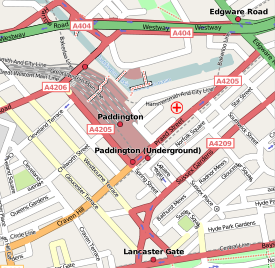 The station complex is bounded at the front by Praed Street
and at the rear by Bishop's Bridge Road, which crosses the throat of the mainline station on the recently replaced Bishop's Bridge. On the west side of the station is Eastbourne Terrace, while the east side is bounded by the Paddington arm of the Grand Union Canal
. The mainline station stands in a shallow cutting, a fact obscured at the front by an hotel building, but which can be clearly seen from the other three sides.
The surrounding area is partly residential, and also includes the major St Mary's Hospital, as well as restaurants and hotels.
Until recently there was little office accommodation in the area, and most commuters interchanged between National Rail
and the London Underground
to reach workplaces in the West End
or the City
. However, recent redevelopment of derelict railway and canal land, marketed as Paddington Waterside
, has resulted in a number of new office complexes nearby.
, date from 1854, when it was built by Isambard Kingdom Brunel
as the London terminus for the Great Western Railway
(GWR). Today, it is one of 18 UK railway stations managed by Network Rail
.
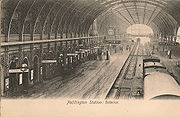 The first station to open in the Paddington area was a temporary terminus for the GWR on the west side of Bishop's Bridge Road; it opened on 4 June 1838, The first GWR service from London to Taplow, near Maidenhead, began at Paddington in 1838. After the opening of the main station in 1854, this became the site of the goods depot.
The main Paddington station between Bishops Bridge Road and Praed Street was designed by Brunel, who was later commemorated by a statue on the station concourse (it has since been moved to Platform 1, by the exit to the taxi rank), although much of the architectural detailing was by his associate Matthew Digby Wyatt
. The station opened on 29 May 1854. The glazed roof is supported by wrought iron
arches in three spans, respectively spanning 68 feet (20.7 m), 102 feet (31.1 m) and 70 feet (21.3 m). The roof is 699 feet (213.1 m) long, and the original roof spans had two transept
s connecting the three spans. It is commonly believed that these were provided by Brunel to accommodate traversers
to carry coaches between the tracks within the station. However recent research, using early documents and photographs, does not seem to support this belief, and their actual purpose is unknown.
The Great Western Hotel
was built on Praed Street
in front of the station in 1851-1854 by architect Philip Charles Hardwick
, son of Philip Hardwick
(designer of the Euston Arch
). The station was substantially enlarged in 1906-1915 and a fourth span of 109 feet (33.2 m) was added on the north side, parallel to the others. The new span was built in a similar style to the original three spans, but the detailing is different and it does not possess the transepts of the earlier spans.
On Armistice Day
1922, a memorial
to the employees of the GWR who died during the First World War was unveiled by Viscount Churchill
. The bronze memorial, depicting a soldier reading a letter, was sculpted by Charles Sargeant Jagger
and stands on platform 1.
In 1961, the decomposing body of a male child was found in a case at the station. Paper stuffed into his mouth was the cause of death. His identity has never been discovered.
A very early construction by Brunel was recently discovered immediately to the north of the station. A cast iron bridge carrying the Bishop's Bridge Road over the Paddington Arm of the Grand Union Canal
was uncovered after removal of more recent brick cladding during the complete replacement of the adjacent bridge over the railway lines at the mouth of the station.
's old Bishop's Road (Suburban) station to the north-west. Immediately alongside are two through platforms, numbered 15 and 16, used by the London Underground
's Hammersmith & City
and Circle lines (see below).
Platforms 6 and 7 are dedicated to the Heathrow Express
, and platforms 13 and 14 can be used only by the 2- and 3-car Turbo trains used on local services. Platforms 1 to 5 and 8 to 12 can be used by any of the station's train services; however, long-distance trains generally use the south-western platforms, and local trains (including Heathrow Connect
) the north-eastern ones.
The station concourse stretches across the head of platforms 1 to 12, underneath the London end of the four main train sheds. Platforms 13 and 14 can be reached directly from the northern-western end of platform 12, or from the footbridge which crosses the north-western end of the station and gives access to all platforms.
The area between the rear of the Great Western Hotel
and the station concourse is traditionally called The Lawn. It was originally unroofed and occupied by sidings, but was later built up to form part of the station's first pedestrian concourse. The Lawn has recently been re-roofed and separated from the concourse by a glass screen wall. It is now surrounded by shops and cafés on several levels.
There are ticket barriers to platforms 2-5 and 10-16.
The fourth span has been renovated, involving repair and resoration of the original Edwardian glazed roof, so that platforms 9 to 12 inclusive can once more enjoy daylight
. A false ceiling or crash deck has been place since 1996. Work was finally completed and the restored roof unveiled in July 2011.
, whose most important destinations are Bristol
, Bath
, , Exeter
and in the West Country
; and Worcester
in the West Midlands
; and , Cardiff
and in South Wales
. It is also the terminus for local trains to West London and the Thames Valley
, most notably for stations to and , also operated by First Great Western. Two services from Paddington serve Heathrow Airport: the Heathrow Express
travels non-stop at a premium fare, while Heathrow Connect
takes the same route but calls at most intermediate stations. Paddington is also an alternative London terminal for Chiltern Railways
' service to Birmingham
, used when London Marylebone
is inaccessible for engineering or other reasons, and for one daily service, -bound only.
lines through two separate stations: the Bakerloo
, Circle and District
lines serve a combined sub-surface and deep-level station to the south of the main line station, and the Hammersmith & City
and Circle lines serve a sub-surface station to the north. Circle line services are routed through each of the sub-surface stations as part of a spiral route. Although shown on the London Underground map
as a single station, the two sub-surface parts are not directly linked.
Ticket barriers control access to all platforms except for platform 1, which has access to the street along its length and therefore cannot be provided with ticket gates.
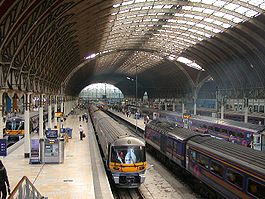 The first underground railway station at Paddington was opened as Paddington (Bishop's Road) by the Metropolitan Railway
(MR) on 10 January 1863 as the terminus of the company's route from . The station was to the north of the main line station and, from 13 June 1864, MR services were extended westward via a connection to the GWR's Hammersmith branch, now the Hammersmith & City line.
On 1 October 1868, the MR opened a branch to Gloucester Road
, with a station called Paddington (Praed Street) in a cut-and-cover tunnel under that street south of the mainline station. The deep-level Baker Street and Waterloo Railway
(now the Bakerloo line) station opened on 1 December 1913 as a temporary terminus of an extension from Edgware Road to Queen's Park
.
Services around the circuit of the Circle line were originally shared by the MR and the Metropolitan District Railway
and were separately identified specifically as the Circle line in 1949. Hammersmith & City line services were originally operated as part of the MR (later the Metropolitan line
) and were separately identified as the Hammersmith & City line in 1990.
The platforms of the Suburban (Bishop's Road) station are still quite separate from the other Underground platforms; some revisions of the Underground map have shown them as a separate station, though the most recent (September 2009) revision does not indicate a distinction. They are similar to the mainline platforms alongside them, and are numbered (15 and 16) in the same sequence as the mainline platforms. Interchange between the Praed Street/Bakerloo Line and Suburban platforms involves walking the length of the mainline station outside the London Underground barrier lines, although the ticket barriers are programmed to permit changing between the two stations as part of a single journey.
trains run between and stations. Circle line trains share tracks with the Hammersmith & City Line from Hammersmith to Paddington (Suburban), then around a clockwise loop via and , arriving back at Paddington (Praed Street), before terminating at . District Line
services run between and , and Bakerloo Line
trains run between and stations.
station is being built under London Paddington, serving as a connection to the National Rail
and London Underground
services. Services are due to start in 2018.
Future Development
was named after the station. In the books, by Michael Bond
, he is found at the station, having come from "deepest, darkest Peru
" and with a note attached to his coat reading "please look after this bear, thank you". A statue of Paddington Bear by Marcus Cornish
, based on the original drawings by Peggy Fortnum
, is located on the station concourse, and a small shop stocks Paddington Bear paraphernalia in the main station area.
The mystery novel 4.50 From Paddington
(1952) by Agatha Christie
begins with a murder witnessed by a passenger on a train from Paddington station.
One of The Railway Series
books (The Eight Famous Engines) contains a story about Gordon, Duck and a foreign engine debating which station London is. Duck says that he used to work at London Paddington as a station pilot so he thinks Paddington is most important. However, Gordon later finds out that the station in London is St. Pancras
.
There is an underground Paddington Station, separate from the real one, on the North London System in the novel The Horn of Mortal Danger
(1980).
London Underground
The London Underground is a rapid transit system serving a large part of Greater London and some parts of Buckinghamshire, Hertfordshire and Essex in England...
complex.
The site is a historic one, having served as the London terminus of the Great Western Railway
Great Western Railway
The Great Western Railway was a British railway company that linked London with the south-west and west of England and most of Wales. It was founded in 1833, received its enabling Act of Parliament in 1835 and ran its first trains in 1838...
and its successors since 1838. Much of the current mainline station dates from 1854, and was designed by Isambard Kingdom Brunel
Isambard Kingdom Brunel
Isambard Kingdom Brunel, FRS , was a British civil engineer who built bridges and dockyards including the construction of the first major British railway, the Great Western Railway; a series of steamships, including the first propeller-driven transatlantic steamship; and numerous important bridges...
. The site was first served by Underground trains in 1863, and was the original western terminus of the Metropolitan Railway
Metropolitan railway
Metropolitan Railway can refer to:* Metropolitan line, part of the London Underground* Metropolitan Railway, the first underground railway to be built in London...
, the world's first underground railway
Rapid transit
A rapid transit, underground, subway, elevated railway, metro or metropolitan railway system is an electric passenger railway in an urban area with a high capacity and frequency, and grade separation from other traffic. Rapid transit systems are typically located either in underground tunnels or on...
.
The complex has recently been modernised, and now has an additional role as the London terminal for the dedicated Heathrow Express
Heathrow Express
Heathrow Express is an airport rail link from London Heathrow Airport to London Paddington station in London operated by the Heathrow Express Operating Authority, a wholly owned subsidiary of BAA. It was opened by the then Prime Minister Tony Blair in 1998...
airport service. Paddington is in Travelcard Zone 1
Travelcard Zone 1
Fare zone 1 is the central zone of Transport for London's zonal fare system used for calculating the price of tickets for travel on the London Underground, London Overground, Docklands Light Railway and, since 2007, on National Rail services. For most tickets, travel through the zone is charged...
.
The mainline station's most important long-distance destinations are Bristol
Bristol Temple Meads railway station
Bristol Temple Meads railway station is the oldest and largest railway station in Bristol, England. It is an important transport hub for public transport in Bristol, with bus services to various parts of the city and surrounding districts, and a ferry service to the city centre in addition to the...
, , Cardiff
Cardiff Central railway station
Cardiff Central railway station is a major railway station on the South Wales Main Line in Cardiff, Wales.It is the largest and busiest station in Wales and one of the major stations of the British rail network, the tenth busiest station in the United Kingdom outside of London , based on 2007/08...
, Exeter
Exeter St Davids railway station
Exeter St Davids station is the most important of seven National Rail stations in the city of Exeter in southwest England. Today the station is owned by Network Rail and operated by First Great Western.-History:...
, Penzance
Penzance railway station
Penzance railway station serves the town of Penzance, Cornwall, UK. The station is the western terminus of the Cornish Main Line from London Paddington station. The current journey time to or from London is about five hours....
, Plymouth
Plymouth railway station
Plymouth railway station serves the city of Plymouth, Devon, England. It is situated on the northern edge of the city centre close to the North Cross roundabout...
and Swansea
Swansea railway station
Swansea railway station is a railway station that serves Swansea, Wales. The station is one of four in the City and County of Swansea and is the fourth busiest in Wales after Cardiff Central, Cardiff Queen Street and Newport.-History:...
.
Location
Praed Street
Praed Street is a street in London's Paddington district , most notable for the fact that Paddington Station is situated on it. It runs straight in a west-south-westerly direction from Edgware Road to Craven Road, Spring Street and Eastbourne Terrace.-History:Praed Street was originally laid out in...
and at the rear by Bishop's Bridge Road, which crosses the throat of the mainline station on the recently replaced Bishop's Bridge. On the west side of the station is Eastbourne Terrace, while the east side is bounded by the Paddington arm of the Grand Union Canal
Grand Union Canal
The Grand Union Canal in England is part of the British canal system. Its main line connects London and Birmingham, stretching for 137 miles with 166 locks...
. The mainline station stands in a shallow cutting, a fact obscured at the front by an hotel building, but which can be clearly seen from the other three sides.
The surrounding area is partly residential, and also includes the major St Mary's Hospital, as well as restaurants and hotels.
Until recently there was little office accommodation in the area, and most commuters interchanged between National Rail
National Rail
National Rail is a title used by the Association of Train Operating Companies as a generic term to define the passenger rail services operated in Great Britain...
and the London Underground
London Underground
The London Underground is a rapid transit system serving a large part of Greater London and some parts of Buckinghamshire, Hertfordshire and Essex in England...
to reach workplaces in the West End
West End of London
The West End of London is an area of central London, containing many of the city's major tourist attractions, shops, businesses, government buildings, and entertainment . Use of the term began in the early 19th century to describe fashionable areas to the west of Charing Cross...
or the City
City of London
The City of London is a small area within Greater London, England. It is the historic core of London around which the modern conurbation grew and has held city status since time immemorial. The City’s boundaries have remained almost unchanged since the Middle Ages, and it is now only a tiny part of...
. However, recent redevelopment of derelict railway and canal land, marketed as Paddington Waterside
Paddington Waterside
The Paddington Waterside Partnership is the body coordinating regeneration of the Paddington Special Policy Area around Paddington Station in London...
, has resulted in a number of new office complexes nearby.
National Rail station
The National Rail station is officially named London Paddington, a name commonly used outside London, but rarely by Londoners, who call it just Paddington. Parts of the station, including the main train shedTrain shed
A train shed is an adjacent building to a railway station where the tracks and platforms are covered by a roof. It is also known as an overall roof...
, date from 1854, when it was built by Isambard Kingdom Brunel
Isambard Kingdom Brunel
Isambard Kingdom Brunel, FRS , was a British civil engineer who built bridges and dockyards including the construction of the first major British railway, the Great Western Railway; a series of steamships, including the first propeller-driven transatlantic steamship; and numerous important bridges...
as the London terminus for the Great Western Railway
Great Western Railway
The Great Western Railway was a British railway company that linked London with the south-west and west of England and most of Wales. It was founded in 1833, received its enabling Act of Parliament in 1835 and ran its first trains in 1838...
(GWR). Today, it is one of 18 UK railway stations managed by Network Rail
Network Rail
Network Rail is the government-created owner and operator of most of the rail infrastructure in Great Britain .; it is not responsible for railway infrastructure in Northern Ireland...
.
History
The main Paddington station between Bishops Bridge Road and Praed Street was designed by Brunel, who was later commemorated by a statue on the station concourse (it has since been moved to Platform 1, by the exit to the taxi rank), although much of the architectural detailing was by his associate Matthew Digby Wyatt
Matthew Digby Wyatt
Sir Matthew Digby Wyatt was a British architect and art historian who became Secretary of the Great Exhibition, Surveyor of the East India Company and the first Slade Professor of Fine Art at the University of Cambridge.-Life:...
. The station opened on 29 May 1854. The glazed roof is supported by wrought iron
Wrought iron
thumb|The [[Eiffel tower]] is constructed from [[puddle iron]], a form of wrought ironWrought iron is an iron alloy with a very low carbon...
arches in three spans, respectively spanning 68 feet (20.7 m), 102 feet (31.1 m) and 70 feet (21.3 m). The roof is 699 feet (213.1 m) long, and the original roof spans had two transept
Transept
For the periodical go to The Transept.A transept is a transverse section, of any building, which lies across the main body of the building. In Christian churches, a transept is an area set crosswise to the nave in a cruciform building in Romanesque and Gothic Christian church architecture...
s connecting the three spans. It is commonly believed that these were provided by Brunel to accommodate traversers
Transfer table
A transfer table, also called a traverser , is a piece of railroad equipment. It is similar in function to a turntable, though it cannot be used to turn equipment around. The table consists of a single length of track which can be moved from side to side, in a direction perpendicular to the track...
to carry coaches between the tracks within the station. However recent research, using early documents and photographs, does not seem to support this belief, and their actual purpose is unknown.
The Great Western Hotel
Great Western Hotel, London
The Hilton London Paddington, formerly the Great Western Royal Hotel, is a hotel that forms part of the Paddington station complex in London, England. The hotel was built on Praed Street in 1851–54 to a design by architect Philip Charles Hardwick, and effectively forms the main facade of the...
was built on Praed Street
Praed Street
Praed Street is a street in London's Paddington district , most notable for the fact that Paddington Station is situated on it. It runs straight in a west-south-westerly direction from Edgware Road to Craven Road, Spring Street and Eastbourne Terrace.-History:Praed Street was originally laid out in...
in front of the station in 1851-1854 by architect Philip Charles Hardwick
Philip Charles Hardwick
-Life:Philip Charles Hardwick was a notable English architect of the 19th century who was once described as "a careful and industrious student of mediaeval art"...
, son of Philip Hardwick
Philip Hardwick
Philip Hardwick was an eminent English architect, particularly associated with railway stations and warehouses in London and elsewhere...
(designer of the Euston Arch
Euston Arch
The Euston Arch, built in 1837, was the original entrance to Euston station, facing onto Drummond Street, London. The Arch was demolished when the station was rebuilt in the 1960s, but much of the original stone was later located—principally used as fill in the Prescott Channel—and proposals have...
). The station was substantially enlarged in 1906-1915 and a fourth span of 109 feet (33.2 m) was added on the north side, parallel to the others. The new span was built in a similar style to the original three spans, but the detailing is different and it does not possess the transepts of the earlier spans.
On Armistice Day
Armistice Day
Armistice Day is on 11 November and commemorates the armistice signed between the Allies of World War I and Germany at Compiègne, France, for the cessation of hostilities on the Western Front of World War I, which took effect at eleven o'clock in the morning—the "eleventh hour of the eleventh day...
1922, a memorial
Great Western Railway War Memorial
The Great Western Railway War Memorial is a monument in London, United Kingdom, to the employees of the Great Western Railway who died during the First World War, and it is situated half-way along platform 1 at London Paddington station. The stonework was designed by the architect Thomas S...
to the employees of the GWR who died during the First World War was unveiled by Viscount Churchill
Victor Spencer, 1st Viscount Churchill
Major Victor Albert Francis Charles Spencer, 1st Viscount Churchill GCVO JP , known as The Lord Churchill between 1886 and 1902, was a British peer and courtier....
. The bronze memorial, depicting a soldier reading a letter, was sculpted by Charles Sargeant Jagger
Charles Sargeant Jagger
Charles Sargeant Jagger MC was a British sculptor who, following active service in the First World War, sculpted many works on the theme of war...
and stands on platform 1.
In 1961, the decomposing body of a male child was found in a case at the station. Paper stuffed into his mouth was the cause of death. His identity has never been discovered.
A very early construction by Brunel was recently discovered immediately to the north of the station. A cast iron bridge carrying the Bishop's Bridge Road over the Paddington Arm of the Grand Union Canal
Grand Union Canal
The Grand Union Canal in England is part of the British canal system. Its main line connects London and Birmingham, stretching for 137 miles with 166 locks...
was uncovered after removal of more recent brick cladding during the complete replacement of the adjacent bridge over the railway lines at the mouth of the station.
Today
Today, Paddington has 14 terminal platforms, numbered 1 to 14 from south-west to north-east (left to right as seen from the main concourse). Platforms 1 to 8 are below the original three spans of Brunel's 1854 train shed, and platforms 9 to 12 are beneath the later fourth span. Platforms 13 and 14 are within the Metropolitan RailwayMetropolitan railway
Metropolitan Railway can refer to:* Metropolitan line, part of the London Underground* Metropolitan Railway, the first underground railway to be built in London...
's old Bishop's Road (Suburban) station to the north-west. Immediately alongside are two through platforms, numbered 15 and 16, used by the London Underground
London Underground
The London Underground is a rapid transit system serving a large part of Greater London and some parts of Buckinghamshire, Hertfordshire and Essex in England...
's Hammersmith & City
Hammersmith & City Line
The Hammersmith & City line is a subsurface London Underground line. It connects Hammersmith in the west with Barking in the east, running through the northern part of central London. It is coloured salmon pink on the Tube map...
and Circle lines (see below).
Platforms 6 and 7 are dedicated to the Heathrow Express
Heathrow Express
Heathrow Express is an airport rail link from London Heathrow Airport to London Paddington station in London operated by the Heathrow Express Operating Authority, a wholly owned subsidiary of BAA. It was opened by the then Prime Minister Tony Blair in 1998...
, and platforms 13 and 14 can be used only by the 2- and 3-car Turbo trains used on local services. Platforms 1 to 5 and 8 to 12 can be used by any of the station's train services; however, long-distance trains generally use the south-western platforms, and local trains (including Heathrow Connect
Heathrow Connect
Heathrow Connect is a train operating company in London provided jointly by Heathrow Express and First Great Western, connecting Heathrow Airport with station. The service follows the same route as the Heathrow Express service but serves intermediate stations en route, thus connecting several...
) the north-eastern ones.
The station concourse stretches across the head of platforms 1 to 12, underneath the London end of the four main train sheds. Platforms 13 and 14 can be reached directly from the northern-western end of platform 12, or from the footbridge which crosses the north-western end of the station and gives access to all platforms.
The area between the rear of the Great Western Hotel
Great Western Hotel, London
The Hilton London Paddington, formerly the Great Western Royal Hotel, is a hotel that forms part of the Paddington station complex in London, England. The hotel was built on Praed Street in 1851–54 to a design by architect Philip Charles Hardwick, and effectively forms the main facade of the...
and the station concourse is traditionally called The Lawn. It was originally unroofed and occupied by sidings, but was later built up to form part of the station's first pedestrian concourse. The Lawn has recently been re-roofed and separated from the concourse by a glass screen wall. It is now surrounded by shops and cafés on several levels.
There are ticket barriers to platforms 2-5 and 10-16.
The fourth span has been renovated, involving repair and resoration of the original Edwardian glazed roof, so that platforms 9 to 12 inclusive can once more enjoy daylight
. A false ceiling or crash deck has been place since 1996. Work was finally completed and the restored roof unveiled in July 2011.
Services
Paddington is the London terminus for frequent long-distance high-speed trains operated by First Great WesternFirst Great Western
First Great Western is the operating name of First Greater Western Ltd, a British train operating company owned by FirstGroup that serves Greater London, the South East, South West and West Midlands regions of England, and South Wales....
, whose most important destinations are Bristol
Bristol Temple Meads railway station
Bristol Temple Meads railway station is the oldest and largest railway station in Bristol, England. It is an important transport hub for public transport in Bristol, with bus services to various parts of the city and surrounding districts, and a ferry service to the city centre in addition to the...
, Bath
Bath Spa railway station
Bath Spa railway station is the principal railway station in the city of Bath, in South West England.-Architecture:Bath Spa station was built in 1840 for the Great Western Railway by Brunel and is a grade II* listed building...
, , Exeter
Exeter St Davids railway station
Exeter St Davids station is the most important of seven National Rail stations in the city of Exeter in southwest England. Today the station is owned by Network Rail and operated by First Great Western.-History:...
and in the West Country
West Country
The West Country is an informal term for the area of south western England roughly corresponding to the modern South West England government region. It is often defined to encompass the historic counties of Cornwall, Devon, Dorset and Somerset and the City of Bristol, while the counties of...
; and Worcester
Worcester Foregate Street railway station
Worcester Foregate Street railway station, opened by the Great Western Railway in 1860, is situated in the centre of the city of Worcester, in Worcestershire, England. It is physically the smaller of the two stations serving the city, but is more centrally located...
in the West Midlands
West Midlands (region)
The West Midlands is an official region of England, covering the western half of the area traditionally known as the Midlands. It contains the second most populous British city, Birmingham, and the larger West Midlands conurbation, which includes the city of Wolverhampton and large towns of Dudley,...
; and , Cardiff
Cardiff Central railway station
Cardiff Central railway station is a major railway station on the South Wales Main Line in Cardiff, Wales.It is the largest and busiest station in Wales and one of the major stations of the British rail network, the tenth busiest station in the United Kingdom outside of London , based on 2007/08...
and in South Wales
South Wales
South Wales is an area of Wales bordered by England and the Bristol Channel to the east and south, and Mid Wales and West Wales to the north and west. The most densely populated region in the south-west of the United Kingdom, it is home to around 2.1 million people and includes the capital city of...
. It is also the terminus for local trains to West London and the Thames Valley
Thames Valley
The Thames Valley Region is a loose term for the English counties and towns roughly following the course of the River Thames as it flows from Oxfordshire in the west to London in the east. It includes parts of Buckinghamshire, Berkshire, North Hampshire, Surrey and west London...
, most notably for stations to and , also operated by First Great Western. Two services from Paddington serve Heathrow Airport: the Heathrow Express
Heathrow Express
Heathrow Express is an airport rail link from London Heathrow Airport to London Paddington station in London operated by the Heathrow Express Operating Authority, a wholly owned subsidiary of BAA. It was opened by the then Prime Minister Tony Blair in 1998...
travels non-stop at a premium fare, while Heathrow Connect
Heathrow Connect
Heathrow Connect is a train operating company in London provided jointly by Heathrow Express and First Great Western, connecting Heathrow Airport with station. The service follows the same route as the Heathrow Express service but serves intermediate stations en route, thus connecting several...
takes the same route but calls at most intermediate stations. Paddington is also an alternative London terminal for Chiltern Railways
Chiltern Railways
Chiltern Railways is a British train operating company. It was set up at the privatisation of British Rail in 1996, and operates local passenger trains from Marylebone station in London to Aylesbury and main-line trains on the Chiltern Main Line to Birmingham Snow Hill with its associated branches...
' service to Birmingham
Birmingham Snow Hill station
Birmingham Snow Hill is a railway station and tram stop in the centre of Birmingham, England, on the site of an earlier, much larger station built by the former Great Western Railway . It is the second most important railway station in the city, after Birmingham New Street station...
, used when London Marylebone
Marylebone station
Marylebone station , also known as London Marylebone, is a central London railway terminus and London Underground complex. It stands midway between the mainline stations at Euston and Paddington, about 1 mile from each...
is inaccessible for engineering or other reasons, and for one daily service, -bound only.
London Underground stations
Paddington station is served by four London UndergroundLondon Underground
The London Underground is a rapid transit system serving a large part of Greater London and some parts of Buckinghamshire, Hertfordshire and Essex in England...
lines through two separate stations: the Bakerloo
Bakerloo Line
The Bakerloo line is a line of the London Underground, coloured brown on the Tube map. It runs partly on the surface and partly at deep level, from Elephant and Castle in the south-east to Harrow & Wealdstone in the north-west of London. The line serves 25 stations, of which 15 are underground...
, Circle and District
District Line
The District line is a line of the London Underground, coloured green on the Tube map. It is a "sub-surface" line, running through the central area in shallow cut-and-cover tunnels. It is the busiest of the sub-surface lines. Out of the 60 stations served, 25 are underground...
lines serve a combined sub-surface and deep-level station to the south of the main line station, and the Hammersmith & City
Hammersmith & City Line
The Hammersmith & City line is a subsurface London Underground line. It connects Hammersmith in the west with Barking in the east, running through the northern part of central London. It is coloured salmon pink on the Tube map...
and Circle lines serve a sub-surface station to the north. Circle line services are routed through each of the sub-surface stations as part of a spiral route. Although shown on the London Underground map
Tube map
The Tube map is a schematic transit map representing the lines and stations of London's rapid transit railway systems, namely the London Underground , the Docklands Light Railway and London Overground....
as a single station, the two sub-surface parts are not directly linked.
Ticket barriers control access to all platforms except for platform 1, which has access to the street along its length and therefore cannot be provided with ticket gates.
History
Metropolitan railway
Metropolitan Railway can refer to:* Metropolitan line, part of the London Underground* Metropolitan Railway, the first underground railway to be built in London...
(MR) on 10 January 1863 as the terminus of the company's route from . The station was to the north of the main line station and, from 13 June 1864, MR services were extended westward via a connection to the GWR's Hammersmith branch, now the Hammersmith & City line.
On 1 October 1868, the MR opened a branch to Gloucester Road
Gloucester Road tube station
-Deep-level station:By the beginning of the 20th century, the MDR had been extended to Richmond, Ealing Broadway, Hounslow West and Wimbledon in the west and to New Cross Gate in the east...
, with a station called Paddington (Praed Street) in a cut-and-cover tunnel under that street south of the mainline station. The deep-level Baker Street and Waterloo Railway
Baker Street and Waterloo Railway
The Baker Street and Waterloo Railway , also known as the Bakerloo tube, was a railway company established in 1893 that constructed a deep-level underground "tube" railway in London...
(now the Bakerloo line) station opened on 1 December 1913 as a temporary terminus of an extension from Edgware Road to Queen's Park
Queen's Park station
Queen's Park station is a station served by London Underground and London Overground. It is in West Kilburn at the southern end of Salusbury Road, near the public park from which it takes its name...
.
Services around the circuit of the Circle line were originally shared by the MR and the Metropolitan District Railway
Metropolitan District Railway
The Metropolitan District Railway was the predecessor of the District line of the London Underground. Set up on 29 July 1864, at first to complete the "Inner Circle" railway around central London, it was gradually extended into the suburbs...
and were separately identified specifically as the Circle line in 1949. Hammersmith & City line services were originally operated as part of the MR (later the Metropolitan line
Metropolitan Line
The Metropolitan line is part of the London Underground. It is coloured in Transport for London's Corporate Magenta on the Tube map and in other branding. It was the first underground railway in the world, opening as the Metropolitan Railway on 10 January 1863...
) and were separately identified as the Hammersmith & City line in 1990.
The platforms of the Suburban (Bishop's Road) station are still quite separate from the other Underground platforms; some revisions of the Underground map have shown them as a separate station, though the most recent (September 2009) revision does not indicate a distinction. They are similar to the mainline platforms alongside them, and are numbered (15 and 16) in the same sequence as the mainline platforms. Interchange between the Praed Street/Bakerloo Line and Suburban platforms involves walking the length of the mainline station outside the London Underground barrier lines, although the ticket barriers are programmed to permit changing between the two stations as part of a single journey.
Services
Hammersmith & City lineHammersmith & City Line
The Hammersmith & City line is a subsurface London Underground line. It connects Hammersmith in the west with Barking in the east, running through the northern part of central London. It is coloured salmon pink on the Tube map...
trains run between and stations. Circle line trains share tracks with the Hammersmith & City Line from Hammersmith to Paddington (Suburban), then around a clockwise loop via and , arriving back at Paddington (Praed Street), before terminating at . District Line
District Line
The District line is a line of the London Underground, coloured green on the Tube map. It is a "sub-surface" line, running through the central area in shallow cut-and-cover tunnels. It is the busiest of the sub-surface lines. Out of the 60 stations served, 25 are underground...
services run between and , and Bakerloo Line
Bakerloo Line
The Bakerloo line is a line of the London Underground, coloured brown on the Tube map. It runs partly on the surface and partly at deep level, from Elephant and Castle in the south-east to Harrow & Wealdstone in the north-west of London. The line serves 25 stations, of which 15 are underground...
trains run between and stations.
Crossrail station
Between 2009 and 2015, a new CrossrailCrossrail
Crossrail is a project to build a major new railway link under central London. The name refers to the first of two routes which are the responsibility of Crossrail Ltd. It is based on an entirely new east-west tunnel with a central section from to Liverpool Street station...
station is being built under London Paddington, serving as a connection to the National Rail
National Rail
National Rail is a title used by the Association of Train Operating Companies as a generic term to define the passenger rail services operated in Great Britain...
and London Underground
London Underground
The London Underground is a rapid transit system serving a large part of Greater London and some parts of Buckinghamshire, Hertfordshire and Essex in England...
services. Services are due to start in 2018.
Paddington station in fiction
The children's book character Paddington BearPaddington Bear
Paddington Bear is a fictional character in children's literature. He appeared on 13 October 1958 and was subsequently featured in several books, most recently in 2008, written by Michael Bond and first illustrated by Peggy Fortnum....
was named after the station. In the books, by Michael Bond
Michael Bond
Thomas Michael Bond, OBE is an English author, most celebrated for his Paddington Bear series of books.-Life:Bond was educated at Presentation College, a Catholic school in Reading...
, he is found at the station, having come from "deepest, darkest Peru
Peru
Peru , officially the Republic of Peru , is a country in western South America. It is bordered on the north by Ecuador and Colombia, on the east by Brazil, on the southeast by Bolivia, on the south by Chile, and on the west by the Pacific Ocean....
" and with a note attached to his coat reading "please look after this bear, thank you". A statue of Paddington Bear by Marcus Cornish
Marcus Cornish
Marcus Cornish is a contemporary British sculptor. After obtaining a First Class Honours degree in Sculpture at Camberwell School of Art, he went on to gain a Master of Arts degree at the Royal College of Art...
, based on the original drawings by Peggy Fortnum
Peggy Fortnum
Peggy Fortnum, born Margaret Emily Noel Fortnum is an English illustrator. She was born in Harrow, Middlesex. She worked as an art teacher, painter, and textile designer before becoming a full-time book illustrator. She has illustrated nearly sixty-five books to date. Fortnum resides in Essex,...
, is located on the station concourse, and a small shop stocks Paddington Bear paraphernalia in the main station area.
The mystery novel 4.50 From Paddington
4.50 From Paddington
4.50 from PaddingtonThe article time reads: Four-fifty from Paddington. In the United Kingdom's time notation, hours and minutes may be separated by a dot rather than a colon sign...
(1952) by Agatha Christie
Agatha Christie
Dame Agatha Christie DBE was a British crime writer of novels, short stories, and plays. She also wrote romances under the name Mary Westmacott, but she is best remembered for her 66 detective novels and 14 short story collections , and her successful West End plays.According to...
begins with a murder witnessed by a passenger on a train from Paddington station.
One of The Railway Series
The Railway Series
The Railway Series is a set of story books about a railway system located on the fictional Island of Sodor. There are 42 books in the series, the first being published in 1945. Twenty-six were written by the Rev. W. Awdry, up to 1972. A further 16 were written by his son, Christopher Awdry; 14...
books (The Eight Famous Engines) contains a story about Gordon, Duck and a foreign engine debating which station London is. Duck says that he used to work at London Paddington as a station pilot so he thinks Paddington is most important. However, Gordon later finds out that the station in London is St. Pancras
St Pancras railway station
St Pancras railway station, also known as London St Pancras and since 2007 as St Pancras International, is a central London railway terminus celebrated for its Victorian architecture. The Grade I listed building stands on Euston Road in St Pancras, London Borough of Camden, between the...
.
There is an underground Paddington Station, separate from the real one, on the North London System in the novel The Horn of Mortal Danger
The Horn of Mortal Danger
The Horn of Mortal Danger is a 1980 novel by British musician Lawrence Leonard. It relates the adventures of a brother and sister as they discover a secret civilisation buried beneath the streets of London...
(1980).
External links
- Station information on Paddington station from Network RailNetwork RailNetwork Rail is the government-created owner and operator of most of the rail infrastructure in Great Britain .; it is not responsible for railway infrastructure in Northern Ireland...
- Train times and station information for Paddington railway station from National RailNational RailNational Rail is a title used by the Association of Train Operating Companies as a generic term to define the passenger rail services operated in Great Britain...
(Station code: PAD) - Image gallery of the station