


Dialogue Concerning the Two Chief World Systems

Encyclopedia
Italian language
Italian is a Romance language spoken mainly in Europe: Italy, Switzerland, San Marino, Vatican City, by minorities in Malta, Monaco, Croatia, Slovenia, France, Libya, Eritrea, and Somalia, and by immigrant communities in the Americas and Australia...
book by Galileo Galilei
Galileo Galilei
Galileo Galilei , was an Italian physicist, mathematician, astronomer, and philosopher who played a major role in the Scientific Revolution. His achievements include improvements to the telescope and consequent astronomical observations and support for Copernicanism...
comparing the Copernican
Nicolaus Copernicus
Nicolaus Copernicus was a Renaissance astronomer and the first person to formulate a comprehensive heliocentric cosmology which displaced the Earth from the center of the universe....
system with the traditional Ptolemaic
Ptolemy
Claudius Ptolemy , was a Roman citizen of Egypt who wrote in Greek. He was a mathematician, astronomer, geographer, astrologer, and poet of a single epigram in the Greek Anthology. He lived in Egypt under Roman rule, and is believed to have been born in the town of Ptolemais Hermiou in the...
system. It was translated to Latin as Systema cosmicum in 1635 by Matthias Bernegger
Matthias Bernegger
Matthias Bernegger was a German philologist, astronomer, university professor and writer of Latin works.- Life :...
. The book, which was dedicated to Galileo's patron, Ferdinando II de' Medici, Grand Duke of Tuscany
Ferdinando II de' Medici, Grand Duke of Tuscany
Ferdinando II de' Medici was grand duke of Tuscany from 1621 to 1670. He was the eldest child of Cosimo II de' Medici and Maria Maddalena of Austria. His 49 year rule was punctuated by the terminations of the remaining operations of the Medici Bank, and the beginning of Tuscany's long economic...
and delivered to him on February 22, 1632, was a bestseller.
In the Copernican system the Earth and other planets orbit the Sun, while in the Ptolemaic system everything in the Universe circles around the Earth. The Dialogue was published in Florence
Florence
Florence is the capital city of the Italian region of Tuscany and of the province of Florence. It is the most populous city in Tuscany, with approximately 370,000 inhabitants, expanding to over 1.5 million in the metropolitan area....
under a formal license from the Inquisition
Inquisition
The Inquisition, Inquisitio Haereticae Pravitatis , was the "fight against heretics" by several institutions within the justice-system of the Roman Catholic Church. It started in the 12th century, with the introduction of torture in the persecution of heresy...
. In 1633, Galileo was convicted of "grave suspicion of heresy
Heresy
Heresy is a controversial or novel change to a system of beliefs, especially a religion, that conflicts with established dogma. It is distinct from apostasy, which is the formal denunciation of one's religion, principles or cause, and blasphemy, which is irreverence toward religion...
" based on the book, which was then placed on the Index of Forbidden Books
Index Librorum Prohibitorum
The Index Librorum Prohibitorum was a list of publications prohibited by the Catholic Church. A first version was promulgated by Pope Paul IV in 1559, and a revised and somewhat relaxed form was authorized at the Council of Trent...
, from which it was not removed until 1835 (after the theories it discussed had been permitted in print in 1822.) In an action that was not announced at the time, the publication of anything else he had written or ever might write was also banned.
Overview
While writing the book, Galileo referred to it as his Dialogue on the Tides, and when the manuscript went to the Inquisition for approval the title was Dialogue on the Ebb and Flow of the Sea. He was ordered to remove all mention of tides from the title and to change the preface, because granting approval to such a title would look like approval of his theory of the tideTide
Tides are the rise and fall of sea levels caused by the combined effects of the gravitational forces exerted by the moon and the sun and the rotation of the Earth....
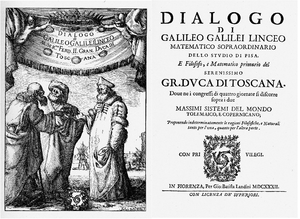
s, which attempted to prove the motion of the Earth physically. As a result, the formal title on the title page is Dialogue, which is followed by Galileo's name and academic posts, followed by a long subtitle. The name by which the work is now known is extracted from deep within the subtitle. This must be kept in mind when discussing Galileo's motives for writing the book.
The book is presented as a series of discussions, over a span of four days, among two philosophers and a layman:
- Salviati argues for the Copernican position and presents some of Galileo's views directly, calling him the "Academician" in honor of Galileo's membership in the Accademia dei LinceiAccademia dei LinceiThe Accademia dei Lincei, , is an Italian science academy, located at the Palazzo Corsini on the Via della Lungara in Rome, Italy....
. He is named after Galileo's friend Filippo SalviatiFilippo SalviatiFilippo Salviati was an Italian scientist and astronomer from a noble Florentine family.In his friend Galileo's Dialogue Concerning the Two Chief World Systems, he appears as the character Salviati, the spokesperson for the author's own Copernican ideas, and is there described by the author as a...
(1582–1614).
- Sagredo is an intelligent layman who is initially neutral. He is named after Galileo's friend Giovanni Francesco SagredoGiovanni Francesco SagredoGiovanni Francesco Sagredo was a Venetian mathematician and close friend of Galileo, who wrote:Many years ago I was often to be found in the marvelous city of Venice, in discussions with Signore Giovanni Francesco Sagredo, a man of noble extraction and trenchant wit. He was also a friend and...
(1571–1620).
- Simplicio, a dedicated follower of PtolemyPtolemyClaudius Ptolemy , was a Roman citizen of Egypt who wrote in Greek. He was a mathematician, astronomer, geographer, astrologer, and poet of a single epigram in the Greek Anthology. He lived in Egypt under Roman rule, and is believed to have been born in the town of Ptolemais Hermiou in the...
and AristotleAristotleAristotle was a Greek philosopher and polymath, a student of Plato and teacher of Alexander the Great. His writings cover many subjects, including physics, metaphysics, poetry, theater, music, logic, rhetoric, linguistics, politics, government, ethics, biology, and zoology...
, presents the traditional views and the arguments against the Copernican position. He is supposedly named after Simplicius of CiliciaSimplicius of CiliciaSimplicius of Cilicia, was a disciple of Ammonius Hermiae and Damascius, and was one of the last of the Neoplatonists. He was among the pagan philosophers persecuted by Justinian in the early 6th century, and was forced for a time to seek refuge in the Persian court, before being allowed back into...
, a sixth-century commentator on Aristotle, but it was suspected the name was a double entendre, as the Italian for "simple" (as in "simple minded") is "semplice". Simplicio is modeled on two contemporary conservative philosophers, Ludovico delle Colombe (1565-1616?), Galileo's fiercest detractor, and Cesare CremoniniCesare Cremonini (philosopher)Cesare Cremonini, sometimes Cesare Cremonino , was an Italian professor of natural philosophy, working rationalism and Aristotelian materialism inside scholasticism...
(1550–1631), a Paduan colleague who had refused to look through the telescope. Colombe was the leader of a group of Florentine opponents of Galileo's, which some of the latter's friends referred to as "the pigeon league".
Although the book is presented formally as a consideration of both systems (as it needed to be in order to be published at all), there is no question that the Copernican side gets the better of the argument. Because of this one-sided treatment, many cite this as a classic example of a Straw man
Straw man
A straw man is a component of an argument and is an informal fallacy based on misrepresentation of an opponent's position, twisting his words or by means of [false] assumptions...
argument.
The dialogue does not treat the Tychonic system
Tychonic system
The Tychonic system was a model of the solar system published by Tycho Brahe in the late 16th century which combined what he saw as the mathematical benefits of the Copernican system with the philosophical and "physical" benefits of the Ptolemaic system...
which was becoming the preferred system of the Catholic
Catholicism
Catholicism is a broad term for the body of the Catholic faith, its theologies and doctrines, its liturgical, ethical, spiritual, and behavioral characteristics, as well as a religious people as a whole....
church at the time of publication. The Tychonic system is a motionless Earth system but not a Ptolemaic system; it is a hybrid system of the Copernican and Ptolemaic models. Mercury and Venus orbit the Sun (as in the Copernican system) in small circles, while the sun in turn orbits a stationary Earth; Mars, Jupiter, and Saturn orbit the Sun in much larger circles, which means they also orbit the earth. The Tychonian system is mathematically equivalent to the Copernican system, except that the Copernican system predicts a stellar parallax, while the Tychonian system predicts no stellar parallax. Stellar parallax was not measurable until the 19th Century, and therefore there was at the time no valid disproof of the Tychonic system on empirical grounds, nor any decisive observational evidence for the Copernican system. The Copernican system is deducible from Newton's laws of motion and gravity, but these were not published until 1687.
Galileo never took Tycho's system seriously, as can be seen in his correspondence, regarding it as an inadequate and physically unsatisfactory compromise. A reason for the absence of Tycho's system (in spite of many references to Tycho and his work in the book) may be sought in Galileo's theory of the tides, which provided the original title and organizing principle of the Dialogue. For, while the Copernican and Tychonic systems are equivalent geometrically, they are quite different dynamically. Galileo's tidal theory entailed the actual, physical movement of the Earth; that is, if true, it would have provided the kind of proof that Foucault's pendulum
Foucault pendulum
The Foucault pendulum , or Foucault's pendulum, named after the French physicist Léon Foucault, is a simple device conceived as an experiment to demonstrate the rotation of the Earth. While it had long been known that the Earth rotated, the introduction of the Foucault pendulum in 1851 was the...
actually provided two centuries later. With reference to Galileo's tidal theory, there would be no difference between the Ptolemaic and Tychonic systems.
The discussion is not narrowly limited to astronomical topics, but ranges over much of contemporary science. Some of this is to show what Galileo considered good science, such as the discussion of William Gilbert's work on magnetism. Other parts are important to the debate, answering erroneous arguments against the Earth's motion.
A classic argument against earth motion is the lack of speed sensations of the earth surface, though it moves at 1600 km/h. In this category there is a thought experiment
Thought experiment
A thought experiment or Gedankenexperiment considers some hypothesis, theory, or principle for the purpose of thinking through its consequences...
in which a man is below decks on a ship
Galileo's ship
Galileo's ship is a physics experiment proposed by Galileo Galilei, the famous 16th and 17th century physicist, astronomer, and philosopher. The experiment was created to disprove popular arguments against the idea of a rotating Earth.-Background:...
and cannot tell whether the ship is docked or is moving smoothly through the water: he observes water dripping from a bottle, fish swimming in a tank, butterflies flying, and so on; and their behavior is just the same whether the ship is moving or not. This is a classic exposition of the Inertial frame of reference
Inertial frame of reference
In physics, an inertial frame of reference is a frame of reference that describes time homogeneously and space homogeneously, isotropically, and in a time-independent manner.All inertial frames are in a state of constant, rectilinear motion with respect to one another; they are not...
and refutes the objection that if we were moving hundreds of miles an hour as the Earth rotated, anything that one dropped would rapidly fall behind and drift to the west.
The bulk of Galileo's arguments may be divided into three classes:
- Rebuttals to the objections raised by traditional philosophers; for example, the thought experiment on the ship.
- Observations that are incompatible with the Ptolemaic model: the phases of VenusPhases of VenusThe phases of the planet Venus are the different variations of lighting seen on the planet's surface, similar to lunar phases. The first recorded observations of them were telescopic observations by Galileo Galilei in 1610...
, for instance, which simply couldn't happen, or the apparent motions of sunspotSunspotSunspots are temporary phenomena on the photosphere of the Sun that appear visibly as dark spots compared to surrounding regions. They are caused by intense magnetic activity, which inhibits convection by an effect comparable to the eddy current brake, forming areas of reduced surface temperature....
s, which could only be explained in the Ptolemaic or Tychonic systems as resulting from an implausibly complicated precession of the Sun's axis of rotation.
- Arguments showing that the elegant unified theory of the Heavens that the philosophers held, which was believed to prove that the Earth was stationary, was incorrect; for instance, the mountains of the MoonMoonThe Moon is Earth's only known natural satellite,There are a number of near-Earth asteroids including 3753 Cruithne that are co-orbital with Earth: their orbits bring them close to Earth for periods of time but then alter in the long term . These are quasi-satellites and not true moons. For more...
, the moons of JupiterJupiterJupiter is the fifth planet from the Sun and the largest planet within the Solar System. It is a gas giant with mass one-thousandth that of the Sun but is two and a half times the mass of all the other planets in our Solar System combined. Jupiter is classified as a gas giant along with Saturn,...
, and the very existence of sunspots, none of which was part of the old astronomy (though these are of somewhat doubtful relevance, as none of these phenomena dealt directly with the question of the motion of the earth or sun).
Generally, these arguments have held up well in terms of the knowledge of the next four centuries. Just how convincing they ought to have been to an impartial reader in 1632 remains a contentious issue.
Galileo attempted a fourth class of argument:
- Direct physical argument for the Earth's motion, by means of an explanation of tides.
As an account of the causation of tides or a proof of the Earth's motion, it is a failure. (In fact, the fundamental argument is internally inconsistent, and actually leads to the conclusion that tides do not exist.) But Galileo was fond of the argument and devoted the "Fourth Day" of the discussion to it. The degree of its failure is, like nearly anything having to do with Galileo, a matter of controversy. On the one hand, the whole thing has recently been described in print as "cockamamie." On the other hand, Einstein
Albert Einstein
Albert Einstein was a German-born theoretical physicist who developed the theory of general relativity, effecting a revolution in physics. For this achievement, Einstein is often regarded as the father of modern physics and one of the most prolific intellects in human history...
used a rather different description:
It was Galileo's longing for a mechanical proof of the motion of the earth which misled him into formulating a wrong theory of the tides. The fascinating arguments in the last conversation would hardly have been accepted as proof by Galileo, had his temperament not got the better of him. [Emphasis added]
Editions in print
- Dialogue Concerning the Two Chief World Systems, translated by Stillman DrakeStillman DrakeStillman Drake was a Canadian historian of science best known for his work on Galileo Galilei . Drake published over 131 books, articles, and book chapters on Galileo. Drake received his first academic appointment in 1967 as full professor at the University of Toronto after a career as a...
, University of California Press, 1953 (revised 1967). Also Modern Library paperback. - Galileo on the World Systems, translated and abridged by Maurice A. Finocchiaro, University of California Press, 1997.
External links
- Thomas Salusbury's 1661 English translation of the Dialogue. On-line copy of full text.
- A long, but condensed, extract from Stillman Drake's 1953 translation of the Dialogue. Despite the title at the top of the page, the full text, which is still subject to copyright, is not given. The entire 'fourth day' is omitted, for instance.
- Another long extract from Drake's 1953 translation. This also does not include the full text.