
Encyclopedia
A
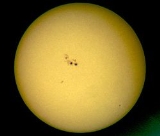
sunspot is a region on the
Sun's surface that is marked by a lower temperature than its surroundings and intense
magnetic activity, which inhibits
convection, forming areas of low surface temperature. Although they are blindingly bright, at temperatures of roughly 4000-4500
K, the contrast with the surrounding material at some 5700 K leaves them clearly visible as dark spots. If they were isolated from the surrounding photosphere they would be brighter than an
electric arc. As of 2006, we are near a minimum in the
sunspot cycle .
Similar phenomenon observed on stars other than the Sun is commonly called a
starspot.
Sunspot variation
Sunspot numbers have been recorded since 1700 AD and estimated back to 11,000 BP. The recent trend is upward from 1900 to the 1960s, then somewhat downward . The Sun was last similarly active over 8,000 years ago.
The number of sunspots has been found to correlate with the intensity of
solar radiation over the period - since 1979 - when satellite measurements of radiation are available. Since sunspots are dark it is natural to assume that more sunspots means less solar radiation . However, the surrounding areas are brighter and the overall effect is that more sunspots means a brighter sun. The variation is small and was only established once satellite measurements of
solar variation became available in the 1980s.
During the
Maunder Minimum there were hardly any sunspots at all and the earth may have cooled by up to 1°
C.
History
Apparent references to sunspots were made by Chinese astronomers in 28 BC , who probably could see the largest spot groups when the sun's glare was filtered by wind-borne dust from the various central Asian deserts. A large sunspot was also seen in the time of
Charlemagne, though the observation was misinterpreted until
Galileo gave the correct explanation in 1612.
They were first observed telescopically in late 1610 by Frisian astronomers Johannes and David Fabricius, who published a description in June 1611. At the latter time Galileo had been showing sunspots to astronomers in Rome, and Christoph Scheiner had probably been observing the spots for two or three months. The ensuing priority dispute between Galileo and Scheiner, neither of whom knew of the Fabricius' work, was thus as pointless as it was bitter.
Sunspots had some importance in the debate over the nature of the
solar system. They showed that the Sun rotated, and their comings and goings showed that the Sun changed, contrary to the teaching of
Aristotle. The details of their apparent motion could not be readily explained except in the
heliocentric system of
Copernicus.
The cyclic variation of the number of sunspots was first observed by Heinrich Schwabe between 1826 and 1843 and led Rudolf Wolf to make systematic observations starting in 1848. The Wolf number is an expression of individual spots and spot groupings, which has demonstrated success in its correlation to a number of solar observables.
Wolf also studied the historical record in an attempt to establish a database on cyclic variations of the past. He established a cycle database to only 1700, although the technology and techniques for careful solar observations were first available in 1610. Gustav Spörer later suggested a 70-year period before 1716 in which sunspots were rarely observed as the reason for Wolf's inability to extend the cycles into the seventeenth century. The economist
William Stanley Jevons suggested that there is a relationship between sunspots and crises in business cycles. He reasoned that sunspots affect earth's weather, which, in turn, influences crop yields and, therefore, the economy.
Edward Maunder would later suggest a period over which the Sun had changed modality from a period in which sunspots all but disappeared from the solar surface, followed by the appearance of sunspot cycles starting in 1700. Careful studies revealed the problem not to be a lack of observational data but included references to negative observations. Adding to this understanding of the absence of solar activity cycles were observations of
aurorae, which were also absent at the same time. Even the lack of a solar
corona during
solar eclipses was noted prior to 1715.
Sunspot research was dormant for much of the 17th and early 18th centuries because of the
Maunder Minimum, during which no sunspots were visible for some years; but after the resumption of sunspot activity, Heinrich Schwabe in 1843 reported a periodic change in the number of sunspots.
;Significant events
An extremely powerful flare was emitted toward Earth on 1 September 1859. It interrupted telegraph service and caused visible
Aurora Borealis as far south as Havana, Hawaii, and Rome with similar activity in the southern hemisphere.
The most powerful flare observed by satellite instrumentation began on 4 November 2003 at 19:29 UTC, and saturated instruments for 11 minutes. Region 486 has been estimated to have produced an X-ray flux of X28. Holographic and visual observations indicate significant activity continued on the far side of the Sun.
Physics
Although the details of sunspot generation are still somewhat a matter of research, it is quite clear that sunspots are the visible counterparts of magnetic flux tubes in the convective zone of the sun that get "wound up" by differential rotation. If the stress on the flux tubes reaches a certain limit, they curl up quite like a rubber band and puncture the sun's surface. At the puncture points convection is inhibited, the energy flux from the sun's interior decreases, and with it the surface temperature.
The Wilson effect tells us that sunspots are actually depressions on the sun's surface. This model is supported by observations using the
Zeeman effect that show that prototypical sunspots come in pairs with opposite magnetic polarity. From cycle to cycle, the polarities of leading and trailing sunspots change from north/south to south/north and back. Sunspots usually appear in groups.
The sunspot itself can be divided into two parts:
Magnetic field lines would ordinarily repel each other, causing sunspots to disperse rapidly, but sunspot lifetime is about two weeks. Recent observations from the
Solar and Heliospheric Observatory using sound waves travelling through the Sun's photosphere to develop a detailed image of the internal structure below sunspots show that there is a powerful downdraft underneath each sunspot, forming a rotating
vortex that concentrates magnetic field lines. Sunspots are self-perpetuating storms, similar in some ways to terrestrial
hurricanes.
Sunspot activity cycles about every eleven years. The point of highest sunspot activity during this cycle is known as Solar Maximum , and the point of lowest activity is Solar Minimum . At the start of a cycle, sunspots tend to appear in the higher latitudes and then move towards the equator as the cycle approaches maximum: this is called
Spörer's law.
Today it is known that there are various periods in the
Wolf number sunspot index, the most prominent of which is at about 11 years in the mean. This period is also observed in most other expressions of
solar activity and is deeply linked to a variation in the solar magnetic field that changes polarity with this period, too.
A modern understanding of sunspots starts with George Ellery Hale, in which magnetic fields and sunspots are linked. Hale suggested that the sunspot cycle period is 22 years, covering two polar reversals of the solar magnetic dipole field. Horace W. Babcock later proposed a qualitative model for the dynamics of the solar outer layers. The
Babcock Model explains the behavior described by Spörer's law, as well as other effects, as being due to magnetic fields which are twisted by the Sun's rotation.
Application
Sunspots are relatively easily observed; a small telescope with a projection facility suffices. In some circumstances sunspots can be observed with the naked eye. Small plates of a dark glass normally used for welding are also available, which can be used to view the sun by blocking out most of its light. These are very inexpensive, and enable you to clearly see much of the solar activity going on during any clear day.
.Due to their link to other kinds of solar activity, they can be used to predict the
space weather and with it the state of the
ionosphere. Thus, sunspots can help predict conditions of radio short-wave propagation or satellite communications.
External links
- Impressive collection of sunspot images
- : Current solar cycle.
- by William James Sidis
Sunspot data
- International Sunspot Number -- sunspot maximum and minimum 1610-present; annual numbers 1700-present; monthly numbers 1749-present; daily values 1818-present; and sunspot numbers by north and south hemisphere. The McNish-Lincoln sunspot prediction is also included.
- American sunspot numbers 1944-present
- Ancient sunspot data 165 BC to 1684 AD
- Group Sunspot Numbers 1610-1995