

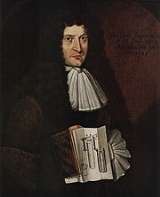
Denis Papin

Encyclopedia
Denis Papin was a French
physicist
, mathematician
and inventor, best known for his pioneering invention
of the steam digester
, the forerunner of the steam engine
and of the pressure cooker
.
, (Loir-et-Cher
, Centre
Région), Papin attended a Jesuit school there, and from 1661 attended University at Angers
, from which he graduated with a medical degree in 1669. In 1673, while working with Christiaan Huygens and Gottfried Leibniz
in Paris
, he became interested in using a vacuum
to generate motive power.
 Papin first visited London
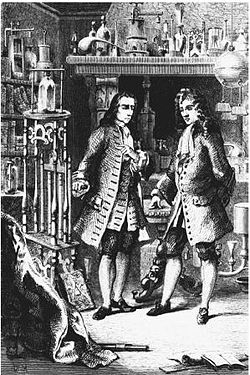
in 1675, and worked with Robert Boyle
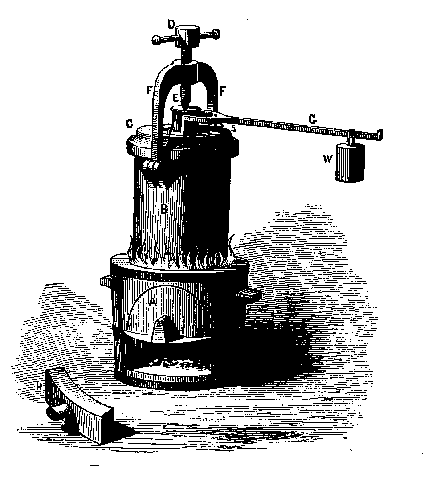
from 1676 to 1679, publishing an account of his work in Continuation of New Experiments (1680). During this period, Papin invented the steam digester
, a type of pressure cooker with a safety valve
. He first addressed the Royal Society in 1679 on the subject of his digester, and remained mostly in London until about 1687, when he left to take up an academic post in Germany.
 As a Huguenot
, Papin found himself greatly affected by the increasing restrictions placed on Protestants by Louis XIV of France
and by the King's ultimate revocation of the Edict of Nantes
in 1685. In Germany he was able to live with fellow Huguenot exiles from France.
In 1689, Papin suggested that a force pump or bellows could maintain the pressure and fresh air inside a diving bell
. (Engineer John Smeaton
utilized this design in 1789.)
While in Marburg
in 1690, having observed the mechanical power of atmospheric pressure on his 'digester', Papin built a model of a piston steam engine
, the first of its kind.
Papin continued to work on steam engines for the next fifteen years. In 1695 he moved from Marburg to Kassel
. In 1705 he developed a second steam engine with the help of Gottfried Leibniz
, based on an invention by Thomas Savery
, but this used steam pressure rather than atmospheric pressure. Details of the engine were published in 1707.
During his stay in Kassel in Hesse, in 1704, he constructed a ship powered by his steam engine, mechanically linked to paddles. This made him the first to construct a steam-powered boat (or vehicle of any kind).
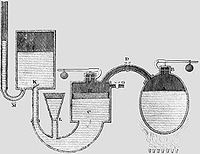 Papin returned to London in 1707, leaving his wife in Germany. Several of his papers were put before the Royal Society between 1707 and 1712 without acknowledging or paying him, about which he complained bitterly. Papin's ideas included a description of his 1690 atmospheric steam engine, similar to that built and put into use by Thomas Newcomen
in 1712, thought to be the year of Papin's death.
The last surviving evidence of Papin's whereabouts came in a letter he wrote dated 23 January 1712. At the time he was destitute, and it is believed he died that year and was buried in an unmarked pauper's pit.
French people
The French are a nation that share a common French culture and speak the French language as a mother tongue. Historically, the French population are descended from peoples of Celtic, Latin and Germanic origin, and are today a mixture of several ethnic groups...
physicist
Physicist
A physicist is a scientist who studies or practices physics. Physicists study a wide range of physical phenomena in many branches of physics spanning all length scales: from sub-atomic particles of which all ordinary matter is made to the behavior of the material Universe as a whole...
, mathematician
Mathematician
A mathematician is a person whose primary area of study is the field of mathematics. Mathematicians are concerned with quantity, structure, space, and change....
and inventor, best known for his pioneering invention
Invention
An invention is a novel composition, device, or process. An invention may be derived from a pre-existing model or idea, or it could be independently conceived, in which case it may be a radical breakthrough. In addition, there is cultural invention, which is an innovative set of useful social...
of the steam digester
Steam digester
The steam digester is a high-pressure cooker invented by French physicist Denis Papin in 1679. It is a device for extracting fats from bones in a high-pressure steam environment, which also renders them brittle enough to be easily ground into bone meal...
, the forerunner of the steam engine
Steam engine
A steam engine is a heat engine that performs mechanical work using steam as its working fluid.Steam engines are external combustion engines, where the working fluid is separate from the combustion products. Non-combustion heat sources such as solar power, nuclear power or geothermal energy may be...
and of the pressure cooker
Pressure cooking
Pressure cooking is a method of cooking in a sealed vessel that does not permit air or liquids to escape below a preset pressure. Because the boiling point of water increases as the pressure increases, the pressure built up inside the cooker allows the liquid in the pot to rise to a higher...
.
Life in France
Born in ChitenayChitenay
Chitenay is a commune in the Loir-et-Cher department of central France....
, (Loir-et-Cher
Loir-et-Cher
Loir-et-Cher is a département in north-central France named after the rivers Loir and Cher.-History:Loir-et-Cher is one of the original 83 departments created during the French Revolution on 4 March 1790. It was created from parts of the former provinces of Orléanais and...
, Centre
Centre (France)
Centre is one of the 27 regions of France, located towards the northwest of the actual centre of the country, around the Loire Valley. Its capital is Orléans, although its largest city is Tours.-Features:...
Région), Papin attended a Jesuit school there, and from 1661 attended University at Angers
Angers
Angers is the main city in the Maine-et-Loire department in western France about south-west of Paris. Angers is located in the French region known by its pre-revolutionary, provincial name, Anjou, and its inhabitants are called Angevins....
, from which he graduated with a medical degree in 1669. In 1673, while working with Christiaan Huygens and Gottfried Leibniz
Gottfried Leibniz
Gottfried Wilhelm Leibniz was a German philosopher and mathematician. He wrote in different languages, primarily in Latin , French and German ....
in Paris
Paris
Paris is the capital and largest city in France, situated on the river Seine, in northern France, at the heart of the Île-de-France region...
, he became interested in using a vacuum
Vacuum
In everyday usage, vacuum is a volume of space that is essentially empty of matter, such that its gaseous pressure is much less than atmospheric pressure. The word comes from the Latin term for "empty". A perfect vacuum would be one with no particles in it at all, which is impossible to achieve in...
to generate motive power.
First visit to London
London
London is the capital city of :England and the :United Kingdom, the largest metropolitan area in the United Kingdom, and the largest urban zone in the European Union by most measures. Located on the River Thames, London has been a major settlement for two millennia, its history going back to its...
in 1675, and worked with Robert Boyle
Robert Boyle
Robert Boyle FRS was a 17th century natural philosopher, chemist, physicist, and inventor, also noted for his writings in theology. He has been variously described as English, Irish, or Anglo-Irish, his father having come to Ireland from England during the time of the English plantations of...
from 1676 to 1679, publishing an account of his work in Continuation of New Experiments (1680). During this period, Papin invented the steam digester
Steam digester
The steam digester is a high-pressure cooker invented by French physicist Denis Papin in 1679. It is a device for extracting fats from bones in a high-pressure steam environment, which also renders them brittle enough to be easily ground into bone meal...
, a type of pressure cooker with a safety valve
Safety valve
A safety valve is a valve mechanism for the automatic release of a substance from a boiler, pressure vessel, or other system when the pressure or temperature exceeds preset limits....
. He first addressed the Royal Society in 1679 on the subject of his digester, and remained mostly in London until about 1687, when he left to take up an academic post in Germany.
Germany
Huguenot
The Huguenots were members of the Protestant Reformed Church of France during the 16th and 17th centuries. Since the 17th century, people who formerly would have been called Huguenots have instead simply been called French Protestants, a title suggested by their German co-religionists, the...
, Papin found himself greatly affected by the increasing restrictions placed on Protestants by Louis XIV of France
Louis XIV of France
Louis XIV , known as Louis the Great or the Sun King , was a Bourbon monarch who ruled as King of France and Navarre. His reign, from 1643 to his death in 1715, began at the age of four and lasted seventy-two years, three months, and eighteen days...
and by the King's ultimate revocation of the Edict of Nantes
Edict of Nantes
The Edict of Nantes, issued on 13 April 1598, by Henry IV of France, granted the Calvinist Protestants of France substantial rights in a nation still considered essentially Catholic. In the Edict, Henry aimed primarily to promote civil unity...
in 1685. In Germany he was able to live with fellow Huguenot exiles from France.
In 1689, Papin suggested that a force pump or bellows could maintain the pressure and fresh air inside a diving bell
Diving bell
A diving bell is a rigid chamber used to transport divers to depth in the ocean. The most common types are the wet bell and the closed bell....
. (Engineer John Smeaton
John Smeaton
John Smeaton, FRS, was an English civil engineer responsible for the design of bridges, canals, harbours and lighthouses. He was also a capable mechanical engineer and an eminent physicist...
utilized this design in 1789.)
While in Marburg
Marburg
Marburg is a city in the state of Hesse, Germany, on the River Lahn. It is the main town of the Marburg-Biedenkopf district and its population, as of March 2010, was 79,911.- Founding and early history :...
in 1690, having observed the mechanical power of atmospheric pressure on his 'digester', Papin built a model of a piston steam engine
Steam engine
A steam engine is a heat engine that performs mechanical work using steam as its working fluid.Steam engines are external combustion engines, where the working fluid is separate from the combustion products. Non-combustion heat sources such as solar power, nuclear power or geothermal energy may be...
, the first of its kind.
Papin continued to work on steam engines for the next fifteen years. In 1695 he moved from Marburg to Kassel
Kassel
Kassel is a town located on the Fulda River in northern Hesse, Germany. It is the administrative seat of the Kassel Regierungsbezirk and the Kreis of the same name and has approximately 195,000 inhabitants.- History :...
. In 1705 he developed a second steam engine with the help of Gottfried Leibniz
Gottfried Leibniz
Gottfried Wilhelm Leibniz was a German philosopher and mathematician. He wrote in different languages, primarily in Latin , French and German ....
, based on an invention by Thomas Savery
Thomas Savery
Thomas Savery was an English inventor, born at Shilstone, a manor house near Modbury, Devon, England.-Career:Savery became a military engineer, rising to the rank of Captain by 1702, and spent his free time performing experiments in mechanics...
, but this used steam pressure rather than atmospheric pressure. Details of the engine were published in 1707.
During his stay in Kassel in Hesse, in 1704, he constructed a ship powered by his steam engine, mechanically linked to paddles. This made him the first to construct a steam-powered boat (or vehicle of any kind).
Return to London
Thomas Newcomen
Thomas Newcomen was an ironmonger by trade and a Baptist lay preacher by calling. He was born in Dartmouth, Devon, England, near a part of the country noted for its tin mines. Flooding was a major problem, limiting the depth at which the mineral could be mined...
in 1712, thought to be the year of Papin's death.
The last surviving evidence of Papin's whereabouts came in a letter he wrote dated 23 January 1712. At the time he was destitute, and it is believed he died that year and was buried in an unmarked pauper's pit.