

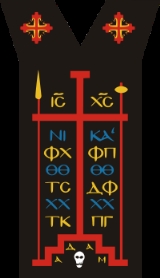
Degrees of Eastern Orthodox monasticism

Encyclopedia
The degrees of Eastern Orthodox monasticism are the stages an Eastern Orthodox monk
or nun
passes through in their religious vocation.
In the Eastern Orthodox Church, the process of becoming a monk or nun (female ascetics in the East are called monks Nun is a Western tradition) is intentionally slow, as the monastic vows taken are considered to entail a lifelong commitment to God
, and are not to be entered into lightly. After completing the novitiate
, there are three degrees of or steps in conferring the monastic habit.
, where sundry religious orders arose, each with its own profession rites, in the Eastern Orthodox Church, there is only one type of monasticism. The profession of monastics is known as Tonsure
(referring to the ritual cutting of the monastic's hair which takes place during the service) and was, at one time, considered to be a Sacred Mystery (Sacrament). The Rite of Tonsure is printed in the Euchologion
(Church Slavonic: Trebnik), the same book as the other Sacred Mysteries and services performed according to need, e.g., funerals
, blessing
s, exorcism
s, etc.
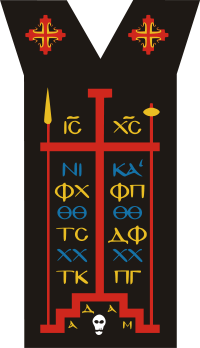 The monastic habit
is the same throughout the Eastern Church (with certain slight regional variations), and it is the same for both monks and nuns. Each successive grade is given a portion of the habit, the full habit being worn only by those in the highest grade, known for that reason as the "Great Schema", or "Great Habit". One is free to enter any monastery of one's choice; but after being accepted by the abbot (or abbess) and making vows, one may not move from place to place without the blessing of one's ecclesiastical superior.
One becomes a monk or nun by being tonsured, a rite which only a priest can perform. This is typically done by the abbot
. The priest tonsuring a monk or nun must himself be tonsured into the same or greater degree of monasticism that he is tonsuring into. In other words, only a hieromonk who has been tonsured into the Great Schema may himself tonsure a Schemamonk. A bishop
, however, may tonsure into any rank, regardless of his own; also, on rare occasion, a bishop will allow a priest to tonsure a monk or nun into any rank.
Eastern Orthodox monks are addressed as "Father", as are priests and deacons in the Orthodox Church; but when conversing among themselves, monks in some places may address one another as "Brother". Novice
s are most often referred to as "Brother", although some places, e.g., on Mount Athos
, novices are addressed as "Father". Among the Greeks, old monks are often called Gheronda, or "Elder", out of respect for their dedication. In the Slavic tradition, the title of Elder (Slavonic: старецъ, Starets
) is normally reserved for those who are of an advanced spiritual life, and who serve as guides for others.
Nuns who have been tonsured to the Stavrophore or higher are addressed as "Mother". Novice and Rassophore nuns are addressed as "Sister". Nuns live identical ascetic lives to their male counterparts and are therefore also called monachai (the feminine plural of monachos), and their community is likewise called a monastery.
Monks who have been ordained to the priesthood are called hieromonk
s (priest-monks); monks who have been ordained to the diaconate are called hierodeacon
s (deacon-monks). A Schemamonk who is a priest is called a Hieroschemamonk. Most monks are not ordained; a community will normally only present as many candidates for ordination to the bishop as the liturgical needs of the community require. Bishops are required by the sacred canons
of the Orthodox Church to be chosen from among the monastic clergy.
and instructed in the use of the Jesus Prayer
.
If a novice chooses to leave during the period of the novitiate, no penalty is incurred. He may also be asked to leave at any time if his behaviour does not conform to the monastic life, or if the superior discerns that he is not called to monasticism. When the abbot or abbess deems the novice ready, he is asked if he wishes to join the monastery. Some, out of humility, will choose to remain novices all their lives. Every stage of the monastic life must be entered into voluntarily.
. Although there are no formal vows made at this point, the candidate is normally required to affirm his commitment to persevere in the monastic life. The abbot will then perform the tonsure, cutting a small amount of hair from four spots on the head, forming a cross. He is then given the outer cassock (Greek: ράσον, Rasson, Exorasson, or Mandorrason; Slavonic: рясса, Riassa), an outer robe with wide sleeves, from which the name of Rassophore is derived. He is also given a kamilavkion, a cylindrical brimless hat, which is covered with a veil called an epanokamelavkion
. (These are separate items in the Greek tradition; in the Russian tradition the two are stitched together and collectively called a klobuk
.) If he has not previously received it, a leather belt is fastened around his waist. His habit
is usually black, signifying that he is now dead to the world, and he receives a new name.
Although the Rassophore does not make formal vows, he is still morally obligated to continue in the monastic estate for the rest of his life. Some will remain Rassophores permanently without going on to the higher degrees.
, and a beeswax candle, symbolic of monastic vigilance the sacrificing of himself for God. He will be buried holding the cross, and the candle will be burned at his funeral. In the Slavic practice, the Stavrophore also wears the monastic mantle, which symbolizes 40 days of the Lord's fasting on the Mountain of Temptation. The rasson worn by the Stavrophore is more ample than that worn by the Rassophore.
After the ceremony, the newly-tonsured Stavrophore will remain in vigil
in the church for five days, refraining from all work, except spiritual reading. Currently, this vigil is often reduced to three days. The abbot increases the Stavrophore monk’s prayer rule, allows a more strict personal ascetic practice, and gives the monk more responsibility.
. The Greek form does not have a hood, the Slavic form has a hood and lappets on the shoulders, so that the garment forms a large cross covering the monk's shoulders, chest, and back. Another piece added is the Polystavrion (Πολυσταύριον, "Many Crosses"), which consists of a cord with a number of small crosses plaited into it. The polystavrion forms a yoke around the monk and serves to hold the analavos in place, and reminds the monastic that he is bound to Christ and that his arms are no longer fit for worldly activities, but that he must labor only for the Kingdom of Heaven
. Among the Greeks, the mantle is added at this stage. The paramandyas of the Megaloschemos is larger than that of the Stavrophore, and if he wears the klobuk, it is of a distinctive thimble shape, called a koukoulion
, the veil of which is usually embroidered with crosses.
The Schemamonk also shall remain some days in vigil in the church. On the eighth day after Tonsure, there is a special service for the "Removal of the Koukoulion".
In some monastic traditions the Great Schema is never given or is only given to monks and nuns on their death bed, while in others, e.g., the cenobitic
monasteries on Mount Athos
, it is common to tonsure a monastic into the Great Schema only 3 years after commencing the monastic life.
In Russian and some other traditions, when a bearer of some monastic title acquires the Great Schema, his title incorporates the word "schema". For example, a hieromonk
of Great Schema is called hieroschemamonk, archimandrite
becomes schema-archimandrite, hegumen
- schema-hegumen, etc. In the Russian Orthodox tradition, in such cases the part "schema" is commonly truncated to "схи" (sche), and correspondingly the titles are spelt as схимонах (schemonach), иеросхимонах (ieroschemonach), схиархимандрит (schearchimandrit), and схиигумен (scheigumen).
The two rites of Rasaphore and Stavrophore are served one immediately following the other, as a single service, very seldom nowadays to be separated by several years. When the two rites are separated, the portions of the habit that were given in the previous rite are not given a second time in the latter rite.
As for the Great Schema, which is made of a leather cord twisted in design and has 5 to 7 small crosses along its length and worn crosswise around the neck, flowing down cross wise front and back, it is usually granted to bishops either upon their episcopal consecration or shortly afterwards and it is usually granted when a monk has reached a high degree of asceticism or has been living as a hermit and also to the monks, hieromonks and abbots who have been in the monastic life for over 30 years and have been living in an exemplary monastic life.
Monk
A monk is a person who practices religious asceticism, living either alone or with any number of monks, while always maintaining some degree of physical separation from those not sharing the same purpose...
or nun
Nun
A nun is a woman who has taken vows committing her to live a spiritual life. She may be an ascetic who voluntarily chooses to leave mainstream society and live her life in prayer and contemplation in a monastery or convent...
passes through in their religious vocation.
In the Eastern Orthodox Church, the process of becoming a monk or nun (female ascetics in the East are called monks Nun is a Western tradition) is intentionally slow, as the monastic vows taken are considered to entail a lifelong commitment to God
God
God is the English name given to a singular being in theistic and deistic religions who is either the sole deity in monotheism, or a single deity in polytheism....
, and are not to be entered into lightly. After completing the novitiate
Novitiate
Novitiate, alt. noviciate, is the period of training and preparation that a novice monastic or member of a religious order undergoes prior to taking vows in order to discern whether they are called to the religious life....
, there are three degrees of or steps in conferring the monastic habit.
Orthodox monasticism
Unlike in Western ChristianityWestern Christianity
Western Christianity is a term used to include the Latin Rite of the Catholic Church and groups historically derivative thereof, including the churches of the Anglican and Protestant traditions, which share common attributes that can be traced back to their medieval heritage...
, where sundry religious orders arose, each with its own profession rites, in the Eastern Orthodox Church, there is only one type of monasticism. The profession of monastics is known as Tonsure
Tonsure
Tonsure is the traditional practice of Christian churches of cutting or shaving the hair from the scalp of clerics, monastics, and, in the Eastern Orthodox Church, all baptized members...
(referring to the ritual cutting of the monastic's hair which takes place during the service) and was, at one time, considered to be a Sacred Mystery (Sacrament). The Rite of Tonsure is printed in the Euchologion
Euchologion
The Euchologion is one of the chief liturgical books of the Orthodox Church and Eastern Catholic Churches, containing the portions of the services which are said by the bishop, priest, or deacon...
(Church Slavonic: Trebnik), the same book as the other Sacred Mysteries and services performed according to need, e.g., funerals
Christian burial
A Christian burial is the burial of a deceased person with specifically Christian ecclesiastical rites; typically, in consecrated ground. Until recent times Christians generally objected to cremation, and practised inhumation almost exclusively, but this opposition has weakened, and now vanished...
, blessing
Blessing
A blessing, is the infusion of something with holiness, spiritual redemption, divine will, or one's hope or approval.- Etymology and Germanic paganism :...
s, exorcism
Exorcism
Exorcism is the religious practice of evicting demons or other spiritual entities from a person or place which they are believed to have possessed...
s, etc.
Religious habit
A religious habit is a distinctive set of garments worn by members of a religious order. Traditionally some plain garb recognisable as a religious habit has also been worn by those leading the religious eremitic and anachoritic life, although in their case without conformity to a particular uniform...
is the same throughout the Eastern Church (with certain slight regional variations), and it is the same for both monks and nuns. Each successive grade is given a portion of the habit, the full habit being worn only by those in the highest grade, known for that reason as the "Great Schema", or "Great Habit". One is free to enter any monastery of one's choice; but after being accepted by the abbot (or abbess) and making vows, one may not move from place to place without the blessing of one's ecclesiastical superior.
One becomes a monk or nun by being tonsured, a rite which only a priest can perform. This is typically done by the abbot
Abbot
The word abbot, meaning father, is a title given to the head of a monastery in various traditions, including Christianity. The office may also be given as an honorary title to a clergyman who is not actually the head of a monastery...
. The priest tonsuring a monk or nun must himself be tonsured into the same or greater degree of monasticism that he is tonsuring into. In other words, only a hieromonk who has been tonsured into the Great Schema may himself tonsure a Schemamonk. A bishop
Bishop
A bishop is an ordained or consecrated member of the Christian clergy who is generally entrusted with a position of authority and oversight. Within the Catholic Church, Eastern Orthodox, Oriental Orthodox Churches, in the Assyrian Church of the East, in the Independent Catholic Churches, and in the...
, however, may tonsure into any rank, regardless of his own; also, on rare occasion, a bishop will allow a priest to tonsure a monk or nun into any rank.
Eastern Orthodox monks are addressed as "Father", as are priests and deacons in the Orthodox Church; but when conversing among themselves, monks in some places may address one another as "Brother". Novice
Novice
A novice is a person or creature who is new to a field or activity. The term is most commonly applied in religion and sports.-Buddhism:In many Buddhist orders, a man or woman who intends to take ordination must first become a novice, adopting part of the monastic code indicated in the vinaya and...
s are most often referred to as "Brother", although some places, e.g., on Mount Athos
Mount Athos
Mount Athos is a mountain and peninsula in Macedonia, Greece. A World Heritage Site, it is home to 20 Eastern Orthodox monasteries and forms a self-governed monastic state within the sovereignty of the Hellenic Republic. Spiritually, Mount Athos comes under the direct jurisdiction of the...
, novices are addressed as "Father". Among the Greeks, old monks are often called Gheronda, or "Elder", out of respect for their dedication. In the Slavic tradition, the title of Elder (Slavonic: старецъ, Starets
Starets
A starets is an elder of a Russian Orthodox monastery who functions as venerated adviser and teacher. Elders or spiritual fathers are charismatic spiritual leaders whose wisdom stems from God as obtained from ascetic experience...
) is normally reserved for those who are of an advanced spiritual life, and who serve as guides for others.
Nuns who have been tonsured to the Stavrophore or higher are addressed as "Mother". Novice and Rassophore nuns are addressed as "Sister". Nuns live identical ascetic lives to their male counterparts and are therefore also called monachai (the feminine plural of monachos), and their community is likewise called a monastery.
Monks who have been ordained to the priesthood are called hieromonk
Hieromonk
Hieromonk , also called a Priestmonk, is a monk who is also a priest in the Orthodox Church and Eastern Catholicism....
s (priest-monks); monks who have been ordained to the diaconate are called hierodeacon
Hierodeacon
A Hierodeacon , sometimes translated "deacon-monk", in Eastern Orthodox Christianity is a monk who has been ordained a deacon...
s (deacon-monks). A Schemamonk who is a priest is called a Hieroschemamonk. Most monks are not ordained; a community will normally only present as many candidates for ordination to the bishop as the liturgical needs of the community require. Bishops are required by the sacred canons
Canon law
Canon law is the body of laws & regulations made or adopted by ecclesiastical authority, for the government of the Christian organization and its members. It is the internal ecclesiastical law governing the Catholic Church , the Eastern and Oriental Orthodox churches, and the Anglican Communion of...
of the Orthodox Church to be chosen from among the monastic clergy.
Novice
Novice (Greek: δόκιμος; Slavonic: послушникъ, poslushnik), lit. "one under obedience"—Those wishing to join a monastery begin their lives as novices. After coming to the monastery and living as a guest for not less than three days, the abbot or abbess may bless the candidate to become a novice. There is no formal ceremony for the clothing of a novice, he or she simply receives permission to wear the clothing of a novice. In the Eastern monastic tradition, novices may or may not dress in the black inner cassock and wear the soft monastic hat (Greek: Skoufos, Slavonic: Skufia), depending on the tradition of the local community, and in accordance to the abbot’s directives. In some communities, the novice also wears the leather belt. Monks are given a prayer ropePrayer rope
A prayer rope is a loop made up of complex knots, usually out of wool or silk....
and instructed in the use of the Jesus Prayer
Jesus Prayer
The Jesus Prayer or "The Prayer" is a short, formulaic prayer esteemed and advocated within the Eastern Orthodox church:The prayer has been widely taught and discussed throughout the history of the Eastern Churches. It is often repeated continually as a part of personal ascetic practice, its use...
.
If a novice chooses to leave during the period of the novitiate, no penalty is incurred. He may also be asked to leave at any time if his behaviour does not conform to the monastic life, or if the superior discerns that he is not called to monasticism. When the abbot or abbess deems the novice ready, he is asked if he wishes to join the monastery. Some, out of humility, will choose to remain novices all their lives. Every stage of the monastic life must be entered into voluntarily.
Rassophore
Rassophore (Greek: ρασοφόρος, rasophoros; Slavonic: рясофоръ, ryasofor), lit. "Robe-bearer"—If the novice continues on to become a monk, he is clothed in the first degree of monasticism at a service at which he receives the tonsureTonsure
Tonsure is the traditional practice of Christian churches of cutting or shaving the hair from the scalp of clerics, monastics, and, in the Eastern Orthodox Church, all baptized members...
. Although there are no formal vows made at this point, the candidate is normally required to affirm his commitment to persevere in the monastic life. The abbot will then perform the tonsure, cutting a small amount of hair from four spots on the head, forming a cross. He is then given the outer cassock (Greek: ράσον, Rasson, Exorasson, or Mandorrason; Slavonic: рясса, Riassa), an outer robe with wide sleeves, from which the name of Rassophore is derived. He is also given a kamilavkion, a cylindrical brimless hat, which is covered with a veil called an epanokamelavkion
Epanokamelavkion
An epanokamelavkion is an item of clerical clothing worn by Orthodox Christian monastics who are rassophor or above, including bishops...
. (These are separate items in the Greek tradition; in the Russian tradition the two are stitched together and collectively called a klobuk
Klobuk
thumbA klobuk is an item of clerical clothing worn by Eastern Orthodox and Eastern Catholic monastics and bishops, especially in the Russian tradition...
.) If he has not previously received it, a leather belt is fastened around his waist. His habit
Religious habit
A religious habit is a distinctive set of garments worn by members of a religious order. Traditionally some plain garb recognisable as a religious habit has also been worn by those leading the religious eremitic and anachoritic life, although in their case without conformity to a particular uniform...
is usually black, signifying that he is now dead to the world, and he receives a new name.
Although the Rassophore does not make formal vows, he is still morally obligated to continue in the monastic estate for the rest of his life. Some will remain Rassophores permanently without going on to the higher degrees.
Stavrophore
Stavrophore (Greek: σταυρoφόρος, stavrophoros; Slavonic: крестоносецъ, krestonosets), lit. "Cross-bearer"—The next level for Eastern monastics takes place some years after the first tonsure when the abbot feels the monk has reached an appropriate level of discipline, dedication, and humility. This degree is also known as the Little Schema, and is thought of as a "betrothal" to the Great Schema. At this stage, the monk makes formal vows of stability of place, chastity, obedience and poverty. Then he is tonsured and clothed in the habit, which in addition to that worn by the Rassophore, includes the paramandyas (Greek: παραμανδυας; Slavonic: параманъ, paraman), a piece of square cloth worn on the back, embroidered with the instruments of the Passion, and connected by ties to a wooden cross worn over the heart. The paramandyas represents the yoke of Christ. Because of this addition he is now called Stavrophore, or Cross-bearer. He is also given a wooden hand cross (or "profession cross"), which he should keep in his icon cornerIcon Corner
The Icon Corner is a small worship space prepared in the homes of Eastern Orthodox or Greek-Catholic Christians.The Book of Acts and the Epistles of the Apostle Paul record that in the early Church, Christians used to meet in the homes of the faithful. This tradition of the "House Church"...
, and a beeswax candle, symbolic of monastic vigilance the sacrificing of himself for God. He will be buried holding the cross, and the candle will be burned at his funeral. In the Slavic practice, the Stavrophore also wears the monastic mantle, which symbolizes 40 days of the Lord's fasting on the Mountain of Temptation. The rasson worn by the Stavrophore is more ample than that worn by the Rassophore.
After the ceremony, the newly-tonsured Stavrophore will remain in vigil
Vigil
A vigil is a period of purposeful sleeplessness, an occasion for devotional watching, or an observance...
in the church for five days, refraining from all work, except spiritual reading. Currently, this vigil is often reduced to three days. The abbot increases the Stavrophore monk’s prayer rule, allows a more strict personal ascetic practice, and gives the monk more responsibility.
Great Schema
Great Schema (Greek: μεγαλόσχημος, megaloschemos; Slavonic: Схима, Schima)—Monks whose abbot feels they have reached a high level of spiritual excellence reach the final stage, called the Great Schema. The tonsure of a Schemamonk or Schemanun follows the same format as the Stavrophore, and he makes the same vows and is tonsured in the same manner. But in addition to all the garments worn by the Stavrophore, he is given the analavos (Slavonic: analav) which is the article of monastic vesture emblematic of the Great Schema. For this reason, the analavos itself is sometimes itself called the "Great Schema". It drapes over the shoulders and hangs down in front and in back, with the front portion somewhat longer, and is embroidered with the instruments of the Passion and the TrisagionTrisagion
The Trisagion , sometimes called by its opening line Agios O Theos or by the Latin Tersanctus, is a standard hymn of the Divine Liturgy in most of the Eastern Orthodox Churches, Oriental Orthodox Churches and Catholic Churches.In those Churches which use the Byzantine Rite, the Trisagion is chanted...
. The Greek form does not have a hood, the Slavic form has a hood and lappets on the shoulders, so that the garment forms a large cross covering the monk's shoulders, chest, and back. Another piece added is the Polystavrion (Πολυσταύριον, "Many Crosses"), which consists of a cord with a number of small crosses plaited into it. The polystavrion forms a yoke around the monk and serves to hold the analavos in place, and reminds the monastic that he is bound to Christ and that his arms are no longer fit for worldly activities, but that he must labor only for the Kingdom of Heaven
Kingdom of God
The Kingdom of God or Kingdom of Heaven is a foundational concept in the Abrahamic religions: Judaism, Christianity and Islam.The term "Kingdom of God" is found in all four canonical gospels and in the Pauline epistles...
. Among the Greeks, the mantle is added at this stage. The paramandyas of the Megaloschemos is larger than that of the Stavrophore, and if he wears the klobuk, it is of a distinctive thimble shape, called a koukoulion
Cowl
This article is about the garment used by monks and nuns. For other uses, see Cowl or Cowling .The cowl is an item of clothing consisting of a long, hooded garment with wide sleeves. Originally it may have referred simply to the hooded portion of a cloak...
, the veil of which is usually embroidered with crosses.
The Schemamonk also shall remain some days in vigil in the church. On the eighth day after Tonsure, there is a special service for the "Removal of the Koukoulion".
In some monastic traditions the Great Schema is never given or is only given to monks and nuns on their death bed, while in others, e.g., the cenobitic
Cenobitic
Cenobitic monasticism is a monastic tradition that stresses community life. Often in the West, the community belongs to a religious order and the life of the cenobitic monk is regulated by a religious rule, a collection of precepts...
monasteries on Mount Athos
Mount Athos
Mount Athos is a mountain and peninsula in Macedonia, Greece. A World Heritage Site, it is home to 20 Eastern Orthodox monasteries and forms a self-governed monastic state within the sovereignty of the Hellenic Republic. Spiritually, Mount Athos comes under the direct jurisdiction of the...
, it is common to tonsure a monastic into the Great Schema only 3 years after commencing the monastic life.
In Russian and some other traditions, when a bearer of some monastic title acquires the Great Schema, his title incorporates the word "schema". For example, a hieromonk
Hieromonk
Hieromonk , also called a Priestmonk, is a monk who is also a priest in the Orthodox Church and Eastern Catholicism....
of Great Schema is called hieroschemamonk, archimandrite
Archimandrite
The title Archimandrite , primarily used in the Eastern Orthodox and the Eastern Catholic churches, originally referred to a superior abbot whom a bishop appointed to supervise...
becomes schema-archimandrite, hegumen
Hegumen
Hegumen, hegumenos, igumen, or ihumen is the title for the head of a monastery of the Eastern Orthodox Church or Eastern Catholic Churches, similar to the one of abbot. The head of a convent of nuns is called hegumenia or ihumenia . The term means "the one who is in charge", "the leader" in...
- schema-hegumen, etc. In the Russian Orthodox tradition, in such cases the part "schema" is commonly truncated to "схи" (sche), and correspondingly the titles are spelt as схимонах (schemonach), иеросхимонах (ieroschemonach), схиархимандрит (schearchimandrit), and схиигумен (scheigumen).
Coptic Orthodox monastic degrees
In the Coptic Orthodox Church of Alexandria there are only two degrees of professed monks, corresponding to the Rassaphore combined with the Stavrophore and the Great Schema (nothing equivalent to separate Stavrophore status in the Coptic Orthodox tradition).The two rites of Rasaphore and Stavrophore are served one immediately following the other, as a single service, very seldom nowadays to be separated by several years. When the two rites are separated, the portions of the habit that were given in the previous rite are not given a second time in the latter rite.
As for the Great Schema, which is made of a leather cord twisted in design and has 5 to 7 small crosses along its length and worn crosswise around the neck, flowing down cross wise front and back, it is usually granted to bishops either upon their episcopal consecration or shortly afterwards and it is usually granted when a monk has reached a high degree of asceticism or has been living as a hermit and also to the monks, hieromonks and abbots who have been in the monastic life for over 30 years and have been living in an exemplary monastic life.
See also
- Christian monasticismChristian monasticismChristian monasticism is a practice which began to develop early in the history of the Christian Church, modeled upon scriptural examples and ideals, including those in the Old Testament, but not mandated as an institution in the scriptures. It has come to be regulated by religious rules Christian...
- MonkMonkA monk is a person who practices religious asceticism, living either alone or with any number of monks, while always maintaining some degree of physical separation from those not sharing the same purpose...
- AcoemetaeAcoemetaeAcoemetae was an order of monks in the 5th century, who by turns, kept up a divine service day and night. The order was founded about the year 400, by one Alexander, a man of noble birth, who fled from the court of Byzantium to the desert, both from love of solitude and fear of episcopal...
- Studities
- Religious habitReligious habitA religious habit is a distinctive set of garments worn by members of a religious order. Traditionally some plain garb recognisable as a religious habit has also been worn by those leading the religious eremitic and anachoritic life, although in their case without conformity to a particular uniform...
- the clothing of a monk
External links
- Initiation of a Monk (Tonsure) from the Mount AthosMount AthosMount Athos is a mountain and peninsula in Macedonia, Greece. A World Heritage Site, it is home to 20 Eastern Orthodox monasteries and forms a self-governed monastic state within the sovereignty of the Hellenic Republic. Spiritually, Mount Athos comes under the direct jurisdiction of the...
Website - History of monasticism in Russia
- Vows of Great Schema a portion of the Tonsure service
- Tonsure of a Schemanun Novo-Tikhvin Monastery, Ekaterinburg, Russia
- Great Angelic Schema Russian Orthodox (Moscow Patriarchate)
- Paraman Russian Orthodox (Photo)
- Skufia for Schemamonk (Photo)