

Cosenza

Encyclopedia
Cosenza is a city in southern Italy
, located at the confluence of two historic rivers: the Busento and the Crathis
. The municipal population is of around 70,000; the urban area
, however, counts over 260,000 inhabitants. The city is the capital of the Province of Cosenza
, which has a population of around 733,000.
Due to its cultural past, Cosenza is identified as the Athens of Calabria
. The Cosentian Academy
, for example, was the second academy to be founded in the Kingdom of Naples
and one of the first in Europe
(1511). To this day, the city remains a cultural centre with several theatres, museums, libraries, and the University of Calabria
.
in a valley between the Sila
plateau and the coastal range of mountains. The old town, overshadowed by its castle, descends to the river Crathis
; whereas the growing modern city lies to the north, beyond the Busento, on level ground.
, was a bulwark of the Italic people against the Hellenic influences of the Ionian colonies. It was in this province that the Battle of Pandosia
was fought, in which a small Italic army composed of Bruttii and Lucanians defeated Alexander the Great's uncle, Alexander of Epirus. Over the centuries, Cosenza maintained a distinctive character, which marked it out among the cities of the region. Under Emperor Augustus
it became an important stopover on the Roman via Popilia
, which connected Calabria to Sicily
. During the Roman Empire, although merely a colonia
, the town benefited from municipal privileges.
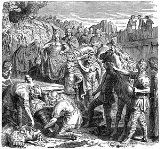
 In 410 AD Alaric I
, king of the Visigoths, captured the great city of Rome and became the first foreign enemy to capture this city in over 800 years. When he left Rome, Alaric had amassed a great amount of treasure from his conquest of the city.
According to the Gothic historian Jordanes
, Alaric left Rome and headed south with his troops. When they reached the area of Cosenza, he died. No one is certain how this happened. Some believe he contracted a disease that took his life. Others feel that his death came from an attack by enemy forces. In any case, his troops honoured their king by burying him in a tomb. This was no normal tomb. His burial place is said to have been at the confluence of the Busento and Crathis
rivers. A horde of slaves were used to divert the water from the Busento, allowing them to dig a tomb large enough for Alaric, his horse and all of the treasure amassed from his conquests. Once the tomb was completed, the river was returned to its bed and the tomb covered with water. Then, to ensure that no one would reveal this location to anyone, Alaric's troops killed all of the slaves.
In the centuries after the fall of the Western Roman Empire, several towns in the Cosenza province, most notably Rossano
, refused to acknowledge the new governments of the barbarians. Instead, with strong city walls and small Roman garrisons, these cities held out for centuries, as some of the last bastions of the Roman Empire in Italy. For that reason, Cosenza was viewed as Byzantine
territory until the invasion of the Germanic Lombards
.
, the town was destroyed, then rebuilt around 988; only to be ravaged again in the early 11th century. In the attempt to escape the devastation, the population left the town and sheltered on the surrounding hills where they built some small hamlets (still denominated casali).
By the first half of the eleventh century, Lombard Calabria became a feudal dukedom of the Normans
, with Cosenza as capital. The town soon rebelled against the rule of Roger Guiscard and was only recaptured after a long siege. Subsequently, under the Hohenstaufen
rule, the town became the seat of the Court of Calabria (Curia Generale). The Emperor Frederick II
had a particular interest in the town: he promoted construction and economic activities, organising an important annual fair.
Subsequently, Cosenza bitterly fought against the Angevin
domination, supported by the clergy. While the uprising spread through the valley of the Crati, the town was involved in the see-sawing fight between Angevins
and the Crown of Aragon
. In 1432 King Louis III of Anjou settled in the castle of Cosenza with his wife Margaret of Savoy
. When he died untimely, in 1434, he was buried in the Cathedral.
; among its most renowned members were Bernardino Telesio
, Aulo Gianni Parrasio, the Martirano brothers, Antonio Serra
and others.
In 1707 the Austrians succeeded the Spanish in the Kingdom of Naples
, followed by the Bourbons. After the proclamation in 1799 of the short-lived Parthenopean Republic and a vain resistance, the town was finally occupied for the Bourbons by Fabrizio Cardinal Ruffo
’s Lazzari; Cardinal Ruffo was native of the province of Cosenza.
secret societies, saw many rebels executed. The local riots of 1821 and 1837 heralded the Risorgimento. They were followed by the uprising of 15 March 1844, which reached its climax with the “noble folly” of the Bandiera Brothers
, who were executed together with some of their followers in the Vallone di Rovito in Cosenza. In 1860, some months after the rapid and overwhelmingly heroic deeds of Garibaldi’s troops, a plebiscite proclaimed the annexation of Calabria to the new Kingdom of Italy.
columns. The wooden portal (1614) is inlaid with floral motifs, figures of saints and coats of arms.
Inside the church are works by the Cosentian painter A. Granata (late 18th century): Santa Rosa, Santa Caterina, San Ludovico, San Giacinto and San Domenico. The high altar is made of polychrome marble (1767). In the transept, there is a Deposition and a San Vincenzo Ferreri (late 18th century, anonymous). The sacristy is noted for its ribbed vault, a double lancet window with a narrow arch and a wooden choir installed in 1635.
are unknown; it was probably built during the first half of the 11th century. An earthquake destroyed the cathedral on 9 June 1184, and rebuilding was completed by 1222 when the cathedral was consecrated by Emperor Frederick II
. At some point during the first half of the 18th century the church was covered by a baroque superstructure which obliterated the original structure and its works of art. In the first half of the 19th century the façade was transformed in neo-gothic style, which completely changed its character. At the end of the 19th century, Archbishop Camillo Sorgente entrusted the work to Pisanti, who recovered the original old arches and the ancient structure of the church. In the 1940s the work was finally completed.
In the transept is the tomb of Isabella of Aragon
, wife of king Philip III of France
. A long aisle links the Duomo to the archbishops' palace, the Palazzo Arcivescovile, which houses an Immacolata by Luca Giordano
. One can also admire the rare and precious Stauroteca, a gift from Emperor Frederick II to the Duomo upon consecration. The work was produced in the royal goldsmiths' workshops, better known as “Tiraz”, in a cultural environment which blended Muslim, Byzantine and Western cultural elements.
houses a painting portraying the Coronation of the Virgin, while at the base of the two columns are paintings, attributed to Michele Curia, the "Master of Montecalvario", of two unidentified saints. The wooden choir dates to the 17th century.
was introduced at Cosenza, in the Giostra Vecchia. Here are located the church and monastery of Saint Francis of Assisi. The Latin cross plan has a nave and two aisles. In the nave stands the impressive high wooden altar built in 1700. Above it is a painting by Daniele Russo representing the Perdono d’Assisi (1618). The left aisle is home to a wooden 17th-century crucifix, the altar of the Madonna della Febbre and the statue of the Madonna with Child, in marble, dating to the 16th century. The sacristy has a painted wooden ceiling, a wooden armadio representing episodes from the Passion of Christ and pictures of saints and Franciscan monks. The stone arch is characterized by the painting of St. Francis of Paola, while on the walls are some frescoes dating to the beginning of the 15th century.
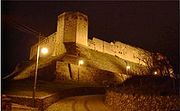
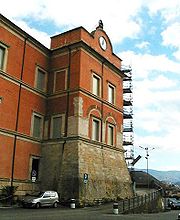
 The Castello Svevo ("Swabian" or Hohenstaufen
Castle) was originally built by the Saracens on the ruins of the ancient Rocca Brutia, around the year 1000. The castle was restored by Frederick II, Holy Roman Emperor
, adding the octagonal tower to the original structure, in 1239. According to tradition, his son Henry
lived in this castle, as a prisoner at his father’s command.
All signs of the ancient Saracen structure have now disappeared. In the internal cloister, the modifications made by the Bourbons in order to convert it into a prison can also be seen. The entrance-hall is covered by ogival arches with engraved brackets. A wide corridor is dominated by some fleur-de-lis
from the House of Anjou
coat of arms
. They are engraved on the ribbed Hohenstaufen arches.
. The original portal has several inscriptions in Gothic characters. The interior has a series of paintings from the eighteenth century. Further on a narrow street leads to the so-called “Area of the Bandiera Brothers
”, the Vallone di Rovito. Here, the insurrectional patriots of 1844 were executed by a firing squad.
. In the apse, a 16th century triptych made by Cristoforo Faffeo represents the Madonna and Child in glory with saints Catherine and Sebastian. At the back of the altar is a wooden choir built in 1679 by M. Domenico Costanzo da Rogliano. On the wall of the sacristy are remains of frescoes dating back to 1550-1600. On the vault are some pastels representing scenes from the life of the Saint from Paola.
.
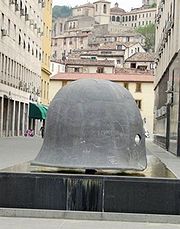
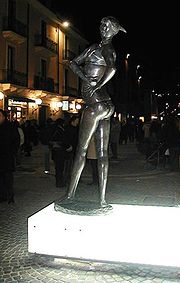
, Hector and Andromache by Giorgio de Chirico
, "the Bronzes" by Sacha Sosno
, The Bather by Emilio Greco
, The Cardinal by Giacomo Manzù
and various marble sculptures by Pietro Consagra
.
data, 1,426 foreign nationals reside in the municipality of Cosenza. The main nationalities are:
- 286 - 180 - 123 - 115 - 85
Italy
Italy , officially the Italian Republic languages]] under the European Charter for Regional or Minority Languages. In each of these, Italy's official name is as follows:;;;;;;;;), is a unitary parliamentary republic in South-Central Europe. To the north it borders France, Switzerland, Austria and...
, located at the confluence of two historic rivers: the Busento and the Crathis
Crathis
The Crathis or Crater is a river in Calabria, southern Italy. It rises in the central the Sila Mountains, a few kilometers south of Cosenza, flows below the walls of that city, where it is joined by the smaller stream of the Busento, and has a course nearly due north through the center of the...
. The municipal population is of around 70,000; the urban area
Urban area
An urban area is characterized by higher population density and vast human features in comparison to areas surrounding it. Urban areas may be cities, towns or conurbations, but the term is not commonly extended to rural settlements such as villages and hamlets.Urban areas are created and further...
, however, counts over 260,000 inhabitants. The city is the capital of the Province of Cosenza
Province of Cosenza
The Province of Cosenza is a province in the Calabria region of Italy. Its capital is the city of Cosenza.It has an area of 6,650 km², and a total population of 733,797 . It is the biggest Calabrian Province...
, which has a population of around 733,000.
Due to its cultural past, Cosenza is identified as the Athens of Calabria
Calabria
Calabria , in antiquity known as Bruttium, is a region in southern Italy, south of Naples, located at the "toe" of the Italian Peninsula. The capital city of Calabria is Catanzaro....
. The Cosentian Academy
Cosentian Academy
The Cosentian Academy was founded in Cosenza, Italy, by Aulo Giano Parassio, in 1511. Initially named after its founder, Accademia Parassiana, it was dedicated to philosophical and literary studies. After Parassio’s death Bernardino Telesio reorganized the academy, which was renamed Accademia...
, for example, was the second academy to be founded in the Kingdom of Naples
Kingdom of Naples
The Kingdom of Naples, comprising the southern part of the Italian peninsula, was the remainder of the old Kingdom of Sicily after secession of the island of Sicily as a result of the Sicilian Vespers rebellion of 1282. Known to contemporaries as the Kingdom of Sicily, it is dubbed Kingdom of...
and one of the first in Europe
Europe
Europe is, by convention, one of the world's seven continents. Comprising the westernmost peninsula of Eurasia, Europe is generally 'divided' from Asia to its east by the watershed divides of the Ural and Caucasus Mountains, the Ural River, the Caspian and Black Seas, and the waterways connecting...
(1511). To this day, the city remains a cultural centre with several theatres, museums, libraries, and the University of Calabria
University of Calabria
The University of Calabria is a state-run university in Italy.Located in Arcavacata di Rende, a suburb of Cosenza, the university was founded in 1972...
.
Geography
Cosenza stands 238 m above sea levelAbove mean sea level
The term above mean sea level refers to the elevation or altitude of any object, relative to the average sea level datum. AMSL is used extensively in radio by engineers to determine the coverage area a station will be able to reach...
in a valley between the Sila
La Sila
The Sila is the name of the mountainous plateau and historic region located in Calabria, southern Italy. It occupies part of the provinces of Cosenza, Crotone and Catanzaro, and is divided into the Sila Greca, Sila Grande and Sila Piccola sub-ranges...
plateau and the coastal range of mountains. The old town, overshadowed by its castle, descends to the river Crathis
Crathis
The Crathis or Crater is a river in Calabria, southern Italy. It rises in the central the Sila Mountains, a few kilometers south of Cosenza, flows below the walls of that city, where it is joined by the smaller stream of the Busento, and has a course nearly due north through the center of the...
; whereas the growing modern city lies to the north, beyond the Busento, on level ground.
Origins
The ancient Consentia, capital of the Italic tribe of the BruttiiBruttii
The Bruttii , were an ancient Italic people who inhabited the southern extremity of Italy, from the frontiers of Lucania to the Sicilian Straits and the promontory of Leucopetra, roughly corresponding to modern Calabria.-History:...
, was a bulwark of the Italic people against the Hellenic influences of the Ionian colonies. It was in this province that the Battle of Pandosia
Battle of Pandosia
The Battle of Pandosia was fought in 331 BC between a Greek force composed mostly of Macedonians, Epirotes and Tarantines against Southern Italic mountain tribes, including mostly Oscan speaking Samnites, Lucanians, and Bruttii. The Macedonians were led by Alexander of Epirus, the uncle of...
was fought, in which a small Italic army composed of Bruttii and Lucanians defeated Alexander the Great's uncle, Alexander of Epirus. Over the centuries, Cosenza maintained a distinctive character, which marked it out among the cities of the region. Under Emperor Augustus
Augustus
Augustus ;23 September 63 BC – 19 August AD 14) is considered the first emperor of the Roman Empire, which he ruled alone from 27 BC until his death in 14 AD.The dates of his rule are contemporary dates; Augustus lived under two calendars, the Roman Republican until 45 BC, and the Julian...
it became an important stopover on the Roman via Popilia
Via Popilia
The Via Popilia is the name of two different ancient Roman roads begun in the consulship of Publius Popilius Laenas.The first road was an extension of the Via Flaminia from Ariminum around the north of the Adriatic through the region that later became Venice...
, which connected Calabria to Sicily
Sicily
Sicily is a region of Italy, and is the largest island in the Mediterranean Sea. Along with the surrounding minor islands, it constitutes an autonomous region of Italy, the Regione Autonoma Siciliana Sicily has a rich and unique culture, especially with regard to the arts, music, literature,...
. During the Roman Empire, although merely a colonia
Colonia (Roman)
A Roman colonia was originally a Roman outpost established in conquered territory to secure it. Eventually, however, the term came to denote the highest status of Roman city.-History:...
, the town benefited from municipal privileges.
Alaric's legendary tomb
Alaric I
Alaric I was the King of the Visigoths from 395–410. Alaric is most famous for his sack of Rome in 410, which marked a decisive event in the decline of the Roman Empire....
, king of the Visigoths, captured the great city of Rome and became the first foreign enemy to capture this city in over 800 years. When he left Rome, Alaric had amassed a great amount of treasure from his conquest of the city.
According to the Gothic historian Jordanes
Jordanes
Jordanes, also written Jordanis or Jornandes, was a 6th century Roman bureaucrat, who turned his hand to history later in life....
, Alaric left Rome and headed south with his troops. When they reached the area of Cosenza, he died. No one is certain how this happened. Some believe he contracted a disease that took his life. Others feel that his death came from an attack by enemy forces. In any case, his troops honoured their king by burying him in a tomb. This was no normal tomb. His burial place is said to have been at the confluence of the Busento and Crathis
Crathis
The Crathis or Crater is a river in Calabria, southern Italy. It rises in the central the Sila Mountains, a few kilometers south of Cosenza, flows below the walls of that city, where it is joined by the smaller stream of the Busento, and has a course nearly due north through the center of the...
rivers. A horde of slaves were used to divert the water from the Busento, allowing them to dig a tomb large enough for Alaric, his horse and all of the treasure amassed from his conquests. Once the tomb was completed, the river was returned to its bed and the tomb covered with water. Then, to ensure that no one would reveal this location to anyone, Alaric's troops killed all of the slaves.
In the centuries after the fall of the Western Roman Empire, several towns in the Cosenza province, most notably Rossano
Rossano
Rossano is a town and comune in Southern Italy, in the province of Cosenza . The city is situated on an eminence c. 3. km from the Gulf of Taranto. The town is known for its marble and alabaster quarries....
, refused to acknowledge the new governments of the barbarians. Instead, with strong city walls and small Roman garrisons, these cities held out for centuries, as some of the last bastions of the Roman Empire in Italy. For that reason, Cosenza was viewed as Byzantine
Byzantine
Byzantine usually refers to the Roman Empire during the Middle Ages.Byzantine may also refer to:* A citizen of the Byzantine Empire, or native Greek during the Middle Ages...
territory until the invasion of the Germanic Lombards
Lombards
The Lombards , also referred to as Longobards, were a Germanic tribe of Scandinavian origin, who from 568 to 774 ruled a Kingdom in Italy...
.
Norman, Hohenstaufen and Angevin period
Bitterly disputed between the Saracens and the LombardsLombards
The Lombards , also referred to as Longobards, were a Germanic tribe of Scandinavian origin, who from 568 to 774 ruled a Kingdom in Italy...
, the town was destroyed, then rebuilt around 988; only to be ravaged again in the early 11th century. In the attempt to escape the devastation, the population left the town and sheltered on the surrounding hills where they built some small hamlets (still denominated casali).
By the first half of the eleventh century, Lombard Calabria became a feudal dukedom of the Normans
Norman conquest of southern Italy
The Norman conquest of southern Italy spanned the late eleventh and much of the twelfth centuries, involving many battles and many independent players conquering territories of their own...
, with Cosenza as capital. The town soon rebelled against the rule of Roger Guiscard and was only recaptured after a long siege. Subsequently, under the Hohenstaufen
Hohenstaufen
The House of Hohenstaufen was a dynasty of German kings in the High Middle Ages, lasting from 1138 to 1254. Three of these kings were also crowned Holy Roman Emperor. In 1194 the Hohenstaufens also became Kings of Sicily...
rule, the town became the seat of the Court of Calabria (Curia Generale). The Emperor Frederick II
Frederick II, Holy Roman Emperor
Frederick II , was one of the most powerful Holy Roman Emperors of the Middle Ages and head of the House of Hohenstaufen. His political and cultural ambitions, based in Sicily and stretching through Italy to Germany, and even to Jerusalem, were enormous...
had a particular interest in the town: he promoted construction and economic activities, organising an important annual fair.
Subsequently, Cosenza bitterly fought against the Angevin
House of Valois-Anjou
The Valois House of Anjou, or the Younger House of Anjou, was a noble French family, deriving from the royal family, the House of Valois. They were monarchs of Naples, as well as various other territories....
domination, supported by the clergy. While the uprising spread through the valley of the Crati, the town was involved in the see-sawing fight between Angevins
House of Valois-Anjou
The Valois House of Anjou, or the Younger House of Anjou, was a noble French family, deriving from the royal family, the House of Valois. They were monarchs of Naples, as well as various other territories....
and the Crown of Aragon
Crown of Aragon
The Crown of Aragon Corona d'Aragón Corona d'Aragó Corona Aragonum controlling a large portion of the present-day eastern Spain and southeastern France, as well as some of the major islands and mainland possessions stretching across the Mediterranean as far as Greece...
. In 1432 King Louis III of Anjou settled in the castle of Cosenza with his wife Margaret of Savoy
Margaret of Savoy (1410–1479)
Margaret of Savoy was a daughter of Amadeus VIII of Savoy and Mary of Burgundy. By her three illustrious marriages, she held a number of titles, including Duchess of Anjou, Duchess of Calabria, Countess of Maine, Countess Palatine of the Rhine, and Countess of Württemberg.-Family:Margaret was one...
. When he died untimely, in 1434, he was buried in the Cathedral.
Spanish domination
In 1500, in spite of resistance, Cosenza was occupied by the Spanish army led by Captain Consalvo de Cordoba. During the sixteenth century the town experienced a period of expansion as the seat of the Viceroy of Calabria. At the same time its cultural importance grew thanks to the foundation of the Accademia CosentinaCosentian Academy
The Cosentian Academy was founded in Cosenza, Italy, by Aulo Giano Parassio, in 1511. Initially named after its founder, Accademia Parassiana, it was dedicated to philosophical and literary studies. After Parassio’s death Bernardino Telesio reorganized the academy, which was renamed Accademia...
; among its most renowned members were Bernardino Telesio
Bernardino Telesio
Bernardino Telesio was an Italian philosopher and natural scientist.While his natural theories were later disproven, his emphasis on observation made him the "first of the moderns" who eventually developed thescientific method.-Biography:...
, Aulo Gianni Parrasio, the Martirano brothers, Antonio Serra
Antonio Serra
Antonio Serra was a late 16th century Italian philosopher and economist in the Mercantilist tradition.Little is known about his life. He was born in Cosenza in the late 16th century. When working in Naples, he applied himself to solving the enormous social and economic problems created by the...
and others.
In 1707 the Austrians succeeded the Spanish in the Kingdom of Naples
Kingdom of Naples
The Kingdom of Naples, comprising the southern part of the Italian peninsula, was the remainder of the old Kingdom of Sicily after secession of the island of Sicily as a result of the Sicilian Vespers rebellion of 1282. Known to contemporaries as the Kingdom of Sicily, it is dubbed Kingdom of...
, followed by the Bourbons. After the proclamation in 1799 of the short-lived Parthenopean Republic and a vain resistance, the town was finally occupied for the Bourbons by Fabrizio Cardinal Ruffo
Fabrizio Ruffo
Fabrizio Ruffo was an Italian cardinal and politician, who led the popular anti-republican Sanfedismo movement .-Biography:...
’s Lazzari; Cardinal Ruffo was native of the province of Cosenza.
Modern age
From 1806 to 1815 Cosenza fought hard against French domination. Cruel suppressions characterised that period and in 1813 the town, a cradle of the CarbonariCarbonari
The Carbonari were groups of secret revolutionary societies founded in early 19th-century Italy. The Italian Carbonari may have further influenced other revolutionary groups in Spain, France, Portugal and possibly Russia. Although their goals often had a patriotic and liberal focus, they lacked a...
secret societies, saw many rebels executed. The local riots of 1821 and 1837 heralded the Risorgimento. They were followed by the uprising of 15 March 1844, which reached its climax with the “noble folly” of the Bandiera Brothers
Bandiera Brothers
The Bandiera Brothers were Italian patriots, Attilio and Emilio Bandiera, .-Background:...
, who were executed together with some of their followers in the Vallone di Rovito in Cosenza. In 1860, some months after the rapid and overwhelmingly heroic deeds of Garibaldi’s troops, a plebiscite proclaimed the annexation of Calabria to the new Kingdom of Italy.
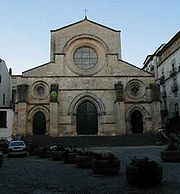
Church of San Domenico
Founded in 1448, the church combines Renaissance and Medieval elements. Its most interesting feature is the rose window defined by 16 little tuffTuff
Tuff is a type of rock consisting of consolidated volcanic ash ejected from vents during a volcanic eruption. Tuff is sometimes called tufa, particularly when used as construction material, although tufa also refers to a quite different rock. Rock that contains greater than 50% tuff is considered...
columns. The wooden portal (1614) is inlaid with floral motifs, figures of saints and coats of arms.
Inside the church are works by the Cosentian painter A. Granata (late 18th century): Santa Rosa, Santa Caterina, San Ludovico, San Giacinto and San Domenico. The high altar is made of polychrome marble (1767). In the transept, there is a Deposition and a San Vincenzo Ferreri (late 18th century, anonymous). The sacristy is noted for its ribbed vault, a double lancet window with a narrow arch and a wooden choir installed in 1635.
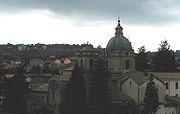
The Cathedral
The exact origins of the DuomoDuomo
Duomo is a term for a cathedral church. The formal word for a church that is presently a cathedral is cattedrale; a Duomo may be either a present or a former cathedral . Some, like the Duomo of Monza, have never been cathedrals, although old and important...
are unknown; it was probably built during the first half of the 11th century. An earthquake destroyed the cathedral on 9 June 1184, and rebuilding was completed by 1222 when the cathedral was consecrated by Emperor Frederick II
Frederick II, Holy Roman Emperor
Frederick II , was one of the most powerful Holy Roman Emperors of the Middle Ages and head of the House of Hohenstaufen. His political and cultural ambitions, based in Sicily and stretching through Italy to Germany, and even to Jerusalem, were enormous...
. At some point during the first half of the 18th century the church was covered by a baroque superstructure which obliterated the original structure and its works of art. In the first half of the 19th century the façade was transformed in neo-gothic style, which completely changed its character. At the end of the 19th century, Archbishop Camillo Sorgente entrusted the work to Pisanti, who recovered the original old arches and the ancient structure of the church. In the 1940s the work was finally completed.
In the transept is the tomb of Isabella of Aragon
Isabella of Aragon
Isabella of Aragon , infanta of Aragon, was, by marriage, Queen consort of France in the Middle Ages from 1270 to 1271.-Life:...
, wife of king Philip III of France
Philip III of France
Philip III , called the Bold , was the King of France, succeeding his father, Louis IX, and reigning from 1270 to 1285. He was a member of the House of Capet.-Biography:...
. A long aisle links the Duomo to the archbishops' palace, the Palazzo Arcivescovile, which houses an Immacolata by Luca Giordano
Luca Giordano
Luca Giordano was an Italian late Baroque painter and printmaker in etching. Fluent and decorative, he worked successfully in Naples and Rome, Florence and Venice, before spending a decade in Spain....
. One can also admire the rare and precious Stauroteca, a gift from Emperor Frederick II to the Duomo upon consecration. The work was produced in the royal goldsmiths' workshops, better known as “Tiraz”, in a cultural environment which blended Muslim, Byzantine and Western cultural elements.
Monastero delle Vergini
In via Gaetano Argento stands the "Convent of the Virgins". The external part of the main entrance is made of decorated tuff, while the internal part is carved of wood. The convent contains a 16th-century painting of the Annunciation. In front of it, is the 13th-century Madonna del Pilerio attributed to Giovanni da Taranto, while on the walls are four other anonymous 16th century paintings: the Visitation, the Circumcision, the Adoration of the Shepherds and the Adoration of the Magi. In the apse is the altarpiece Transit of the Virgin (1570). The cymatiumCymatium
Cymatium, a molding on the cornice of some classical buildings. Sometimes decorated with an anthemion. It is characteristic of Ionic columns and can appear as part of the entablature, the epistylium, and the capital....
houses a painting portraying the Coronation of the Virgin, while at the base of the two columns are paintings, attributed to Michele Curia, the "Master of Montecalvario", of two unidentified saints. The wooden choir dates to the 17th century.
Giostra Vecchia
In the fifteenth century, at Palazzo Falvo the RenaissanceRenaissance
The Renaissance was a cultural movement that spanned roughly the 14th to the 17th century, beginning in Italy in the Late Middle Ages and later spreading to the rest of Europe. The term is also used more loosely to refer to the historical era, but since the changes of the Renaissance were not...
was introduced at Cosenza, in the Giostra Vecchia. Here are located the church and monastery of Saint Francis of Assisi. The Latin cross plan has a nave and two aisles. In the nave stands the impressive high wooden altar built in 1700. Above it is a painting by Daniele Russo representing the Perdono d’Assisi (1618). The left aisle is home to a wooden 17th-century crucifix, the altar of the Madonna della Febbre and the statue of the Madonna with Child, in marble, dating to the 16th century. The sacristy has a painted wooden ceiling, a wooden armadio representing episodes from the Passion of Christ and pictures of saints and Franciscan monks. The stone arch is characterized by the painting of St. Francis of Paola, while on the walls are some frescoes dating to the beginning of the 15th century.
Hohenstaufen Castle
Hohenstaufen
The House of Hohenstaufen was a dynasty of German kings in the High Middle Ages, lasting from 1138 to 1254. Three of these kings were also crowned Holy Roman Emperor. In 1194 the Hohenstaufens also became Kings of Sicily...
Castle) was originally built by the Saracens on the ruins of the ancient Rocca Brutia, around the year 1000. The castle was restored by Frederick II, Holy Roman Emperor
Frederick II, Holy Roman Emperor
Frederick II , was one of the most powerful Holy Roman Emperors of the Middle Ages and head of the House of Hohenstaufen. His political and cultural ambitions, based in Sicily and stretching through Italy to Germany, and even to Jerusalem, were enormous...
, adding the octagonal tower to the original structure, in 1239. According to tradition, his son Henry
Henry (VII) of Germany
Henry was King of Sicily from 1212, Duke of Swabia from 1216, and King of Germany from 1220. He was the son and co-king of Emperor Frederick II and elder brother of Conrad IV of Germany...
lived in this castle, as a prisoner at his father’s command.
All signs of the ancient Saracen structure have now disappeared. In the internal cloister, the modifications made by the Bourbons in order to convert it into a prison can also be seen. The entrance-hall is covered by ogival arches with engraved brackets. A wide corridor is dominated by some fleur-de-lis
Fleur-de-lis
The fleur-de-lis or fleur-de-lys is a stylized lily or iris that is used as a decorative design or symbol. It may be "at one and the same time, political, dynastic, artistic, emblematic, and symbolic", especially in heraldry...
from the House of Anjou
House of Anjou
The Angevins, also known as the House of Anjou, were a noble family founded in the early years of the Carolingian Empire. They first emerged as part of the minor feudal nobility, in what would soon be known as the Kingdom of France during the 10th century...
coat of arms
Coat of arms
A coat of arms is a unique heraldic design on a shield or escutcheon or on a surcoat or tabard used to cover and protect armour and to identify the wearer. Thus the term is often stated as "coat-armour", because it was anciently displayed on the front of a coat of cloth...
. They are engraved on the ribbed Hohenstaufen arches.
Spirito Santo
The church of Sant'Agostino, also known as the Spirito Santo, was built in 1507 by the AugustiniansAugustinians
The term Augustinians, named after Saint Augustine of Hippo , applies to two separate and unrelated types of Catholic religious orders:...
. The original portal has several inscriptions in Gothic characters. The interior has a series of paintings from the eighteenth century. Further on a narrow street leads to the so-called “Area of the Bandiera Brothers
Bandiera Brothers
The Bandiera Brothers were Italian patriots, Attilio and Emilio Bandiera, .-Background:...
”, the Vallone di Rovito. Here, the insurrectional patriots of 1844 were executed by a firing squad.
Arenella
The area called Arenella lies on the right bank of the River Crati. On the left side of Corso del Plebiscito, it includes the Mercato dell’Arenella, an iron structure which used to host the old town market, now used for concerts and a flea market. On the right hand side, is the church of San Gaetano. On the right, just past the church, is Palazzo Arnone, which once housed the courthouse and the prison, being now seat of the Galleria Nazionale ("National Gallery").San Francesco di Paola
In the Arenella, are the Church and Monastery of Saint Francis of Paola (1510). The interior, with a single nave, houses the tomb of Ottavio Cesare Gaeta. On the right wall, are two 18th-century paintings: a Sacra Famiglia and Madonna con San Francesco e Sant’Agostino. On an altar is a wooden statue of Saint Francis of Paola; while on the left side of the nave, on another altar, is a wooden statue of San Michele Arcangelo. The Madonna with Child in Glory and Saints Paul and Luke (1551) was painted by Pietro NegroniPietro Negroni
Pietro Negroni was an Italian painter of the Renaissance period, active mainly in Naples. He was also known as Il Giovane Zingaro and appears to have been born near Cosenza. He was a pupil of the painters Giovanni Antonio D’Amato and Marco Calabrese, and strongly influenced by Polidoro da Caravaggio...
. In the apse, a 16th century triptych made by Cristoforo Faffeo represents the Madonna and Child in glory with saints Catherine and Sebastian. At the back of the altar is a wooden choir built in 1679 by M. Domenico Costanzo da Rogliano. On the wall of the sacristy are remains of frescoes dating back to 1550-1600. On the vault are some pastels representing scenes from the life of the Saint from Paola.
San Salvatore
The small church of San Salvatore serves the parish which professes the Byzantine-Albanian faith. Inside the nave are a wooden ceiling, some frescoes of the Apostoli, of the Salvatore and of the Madonna, as well as a splendid iconostasisIconostasis
In Eastern Christianity an iconostasis is a wall of icons and religious paintings, separating the nave from the sanctuary in a church. Iconostasis also refers to a portable icon stand that can be placed anywhere within a church...
.
Open Air Museum
In the modern part of Cosenza, in an area stretching from the pedestrianized Corso Mazzini to Piazza Bilotti, lies the open-air "Museo MAB" (Museo all'aperto Bilotti). The museum hosts a wide range of modern art sculptures that stand in the street for residents and tourists. The sculptures were donated to the city by the Italian-American entrepreneur and art collector, Carlo Bilotti. They include Saint George and the Dragon by Salvador DalíSalvador Dalí
Salvador Domènec Felip Jacint Dalí i Domènech, Marquis de Púbol , commonly known as Salvador Dalí , was a prominent Spanish Catalan surrealist painter born in Figueres,Spain....
, Hector and Andromache by Giorgio de Chirico
Giorgio de Chirico
Giorgio de Chirico was a pre-Surrealist and then Surrealist Italian painter born in Volos, Greece, to a Genovese mother and a Sicilian father. He founded the scuola metafisica art movement...
, "the Bronzes" by Sacha Sosno
Sacha Sosno
Alexandre Joseph Sosnowsky, , better known by his name Sacha Sosno, is an internationally renowned French sculptor and painter. Working most of the time in Nice, in the last decades he has achieved international recognition for his monumental outdoor sculptures in Côte d'Azur, France...
, The Bather by Emilio Greco
Emilio Greco
Emilio Greco was an Italian sculptor.Greco was born at Catania, whose Greek and Roman remains grow in him a passion for ancient sculpture. His first successful work was a "Pinocchio" at Collodi. He died in Rome in 1995. Throughout his career, his sculptures tend to be refined, with elongated...
, The Cardinal by Giacomo Manzù
Giacomo Manzù
Giacomo Manzù, pseudonym of Giacomo Manzoni , was an Italian sculptor, communist, and Roman Catholic.-Biography:...
and various marble sculptures by Pietro Consagra
Pietro Consagra
Pietro Consagra was one of Italy's leading postwar sculptors. Consagra was born in Mazara del Vallo, a town in western Sicily, on October 4. His father, a traveling salesman, did not register his birth until October 6. Consagra attended the Accademia delle Belle Arti in Palermo...
.
Museums and cultural institutions
- Accademia CosentinaCosentian AcademyThe Cosentian Academy was founded in Cosenza, Italy, by Aulo Giano Parassio, in 1511. Initially named after its founder, Accademia Parassiana, it was dedicated to philosophical and literary studies. After Parassio’s death Bernardino Telesio reorganized the academy, which was renamed Accademia...
- Museo Civico Archeologico
- Museo delle Rimembranze
- Galleria Nazionale - Palazzo Arnone
- Museo all'aperto "Bilotti" - Open air museum
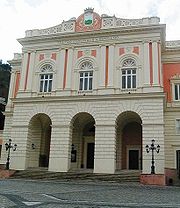
- Teatro "Alfonso RendanoAlfonso RendanoAlfonso Rendano was an Italian pianist and composer. He is mostly renowned for inventing the "third pedal", which augmented the interpretative resources of the piano.Rendano was born in Cosenza...
" - Teatro dell'Acquario - Teatro Stabile d'Innovazione della Calabria
- Teatro Morelli
- Casa delle Culture
- Universitá della Calabria - UNICAL University of CalabriaUniversity of CalabriaThe University of Calabria is a state-run university in Italy.Located in Arcavacata di Rende, a suburb of Cosenza, the university was founded in 1972...
- Biblioteca Civica - Civic Library
- Biblioteca Nazionale - National Library
- Biblioteca dei Ragazzi - Children's Library
- Biblioteca dell'Archivio di stato - State Archive Library
- Biblioteca provinciale di Cosenza - District Library
- Biblioteca del Conservatorio di Musica "Stanislao Giacomoantonio"
- Biblioteca del Centro jazz Calabria - Archivio discografico
- Biblioteca della Fondazione Antonio Guarasci
- Biblioteca ecclesiastica SS. Crocifisso - Church Library
- Biblioteca arcivescovile del Seminario cosentino - Theological Library
- Biblioteca del Liceo classico "Bernardino TelesioBernardino TelesioBernardino Telesio was an Italian philosopher and natural scientist.While his natural theories were later disproven, his emphasis on observation made him the "first of the moderns" who eventually developed thescientific method.-Biography:...
" - Biblioteca della Soprintendenza per il Patrimonio Storico Artistico ed Etnoantropologico
Ethnic minorities
As of 31 December 2008, according to IstatISTAT
ISTAT may refer to:* International Society of Transport Aircraft Trading, an aircraft standards organization.* Istituto Nazionale di Statistica, the Italian National Institute of Statistics....
data, 1,426 foreign nationals reside in the municipality of Cosenza. The main nationalities are:
- 286 - 180 - 123 - 115 - 85
Events and festivals
- Fiera di S.Giuseppe - March
- S.Giuseppe Rock Festival - March
- Festival delle Invasioni - July
- La sagra dell'uva e del vino (Wine Festival) in Donnici - October
- Festa del Cioccolato (Chocolate Festival) - October
Notable people
- Joachim of FioreJoachim of FioreJoachim of Fiore, also known as Joachim of Flora and in Italian Gioacchino da Fiore , was the founder of the monastic order of San Giovanni in Fiore . He was a mystic, a theologian and an esoterist...
(theologian, c.1135-1202) - Aulo Giano Parrasio (humanist, 1470–1521)
- Bernardino TelesioBernardino TelesioBernardino Telesio was an Italian philosopher and natural scientist.While his natural theories were later disproven, his emphasis on observation made him the "first of the moderns" who eventually developed thescientific method.-Biography:...
(philosopher, 1509–1588) - Pietro NegroniPietro NegroniPietro Negroni was an Italian painter of the Renaissance period, active mainly in Naples. He was also known as Il Giovane Zingaro and appears to have been born near Cosenza. He was a pupil of the painters Giovanni Antonio D’Amato and Marco Calabrese, and strongly influenced by Polidoro da Caravaggio...
(painter, 1505–1565) - Antonio SerraAntonio SerraAntonio Serra was a late 16th century Italian philosopher and economist in the Mercantilist tradition.Little is known about his life. He was born in Cosenza in the late 16th century. When working in Naples, he applied himself to solving the enormous social and economic problems created by the...
(economist, late 16th century) - Sertorio Quattromani (philosopher, 1541–1607)
- Francesco Saverio SalfiFrancesco Saverio SalfiFrancesco Saverio Salfi or Franco Salfi was an Italian writer, politician and librettist....
(philosopher, 1759–1832) - Nicola Misasi (writer, 1850–1923)
- Alfonso RendanoAlfonso RendanoAlfonso Rendano was an Italian pianist and composer. He is mostly renowned for inventing the "third pedal", which augmented the interpretative resources of the piano.Rendano was born in Cosenza...
(pianist and composer, 1853–1931) - Alessandro LongoAlessandro LongoAlessandro Longo was an Italian composer and musicologist.After studying at the Naples Conservatory under Beniamino Cesi , he began teaching piano at his alma mater in 1887, deputizing for Cesi as pianoforte professor, and succeeded him in 1897...
(composer and musicologist, 1864–1945) - Stefano Rodotà (jurist and politician, 1933-)
- Mark IulianoMark IulianoMark Iuliano is a former Italian football defender, who spent the bulk of his career with Italian powerhouse, Juventus FC, in the Italian Serie A.-Salernitana Calcio 1919:...
(footballer, 1973-)
Sister cities
- Kenosha, USA, since 1979
- Lansing, USA, since 2000
- Sault Ste. Marie
 Sault Ste. Marie, OntarioSault Ste. Marie is a city on the St. Marys River in Algoma District, Ontario, Canada. It is the third largest city in Northern Ontario, after Sudbury and Thunder Bay, with a population of 74,948. The community was founded as a French religious mission: Sault either means "jump" or "rapids" in...
, CanadaCanadaCanada is a North American country consisting of ten provinces and three territories. Located in the northern part of the continent, it extends from the Atlantic Ocean in the east to the Pacific Ocean in the west, and northward into the Arctic Ocean...
, since 2010