

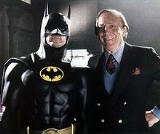
Bob Kane

Encyclopedia
Bob Kane was an American comic book artist
and writer, credited as the creator of the DC Comics
superhero
Batman
. He was inducted into both the comic book
industry's Jack Kirby Hall of Fame in 1994 and the Will Eisner Comic Book Hall of Fame in 1996.
, New York
. His parents were of Eastern European Jewish descent. A high school
friend of fellow cartoonist and future Spirit creator Will Eisner
, Robert Kahn graduated from DeWitt Clinton High School
and legally changed his name to Bob Kane at age 18. He studied art at Cooper Union
before "joining the Max Fleischer
Studio
as a trainee animator in 1934".
's comic book
Wow, What A Magazine!, including his first pencil and ink work on the serial Hiram Hick. The following year, Kane began to work at Iger's subsequent studio, Eisner & Iger
, which was one of the first comic book "packagers" that produced comics on demand for publishers entering the new medium
during its late-1930s and 1940s Golden Age
. Among his work there was the funny animal
feature "Peter Pupp" (which belied its look with overtones of "mystery and menace"), published in the U.K. comic magazine Wags and later reprinted in Fiction House
's Jumbo comics. Kane also produced work through Eisner & Iger for two of the companies that would later merge to form DC Comics, including the humor features "Ginger Snap" in More Fun Comics
, "Oscar the Gumshoe" for Detective Comics
, and "Professor Doolittle" for Adventure Comics
. For that last title he went on to do his first adventure strip, "Rusty and his Pals".
in Action Comics
prompted editors to scramble for more such heroes. In response, Bob Kane conceived "the Bat-Man". Kane said his influences for the character included actor Douglas Fairbanks
' movie portrayal of the swashbuckler
Zorro
, Leonardo Da Vinci
's diagram of the ornithopter
, a flying machine with huge bat-like wings; and the 1930 film The Bat Whispers, based on Mary Rinehart's mystery novel The Circular Staircase.
Bill Finger
joined Bob Kane's nascent studio in 1938. An aspiring writer and part-time shoe salesperson, he had met Kane at a party, and Kane later offered him a job ghost writing the strips Rusty and Clip Carson. He recalled that Kane
Finger said he offered such suggestions as giving the character a cowl and scalloped cape instead of wings; adding gloves; leaving the mask's eyeholes blank to connote mystery; and removing the bright red sections of the original costume, suggesting instead a gray-and-black color scheme. Finger additionally said his suggestions were influenced by Lee Falk
's The Phantom
, a syndicated
newspaper
comic strip
character with which Kane was familiar as well. Finger, who said he also devised the character's civilian name, Bruce Wayne, wrote the first Batman story, while Kane provided art. Kane, who had already submitted the proposal for Batman at DC and held a contract, is the only person given official company credit for Batman's creation. Comics historian Ron Goulart
, in Comic Book Encyclopedia, refers to Batman as the "creation of artist Bob Kane and writer Bill Finger".
According to Kane, "Bill Finger was a contributing force on Batman right from the beginning. He wrote most of the great stories and was influential in setting the style and genre other writers would emulate ... I made Batman a superhero-vigilante when I first created him. Bill turned him into a scientific detective.
The character debuted in Detective Comics #27 (May 1939) and proved a breakout hit. Within a year, Kane hired art assistants Jerry Robinson
(initially as an inker
) and George Roussos
. Shortly afterward, when DC wanted more Batman stories than Kane's studio could deliver, the company assigned Dick Sprang
and other in-house pencilers as "ghost artists
", drawing uncredited under Kane's supervision. Future Justice League writer Gardner Fox
wrote some early scripts, including the two-part story "The Monk" that introduced some of The Batman's first "Bat-" equipment.
In 1943, Kane left the Batman comic books to focus on penciling the daily Batman newspaper comic strip
. DC Comics artists ghosting the comic-book stories now included Jack Burnley
and Win Mortimer
, with Robinson moving up as penciler and Fred Ray
contributing some covers. After the strip finished in 1946, Kane returned to the comic books but, unknown to DC, had hired his own personal ghosts, including Lew Schwartz
:Lew Schwartz
interview, Alter Ego #51 (Aug. 2005) and Sheldon Moldoff
from 1953-1967.
Kane, who had previously created a sidekick for Peter Pupp, proposed adding a boy named Mercury who would have worn a "super-costume". Robinson suggested a normal human, along with the name "Robin
", after Robin Hood
books he had read during boyhood, and noting in a 2005 interview he had been inspired by one book's N. C. Wyeth
illustrations.
The new character, orphaned circus performer named Dick Grayson
, came to live with Bruce Wayne as his young ward
in Detective Comics #38 (April 1940) and would inspire many similar sidekicks throughout the Golden Age of comic books.
was introduced near that same time, in Batman #1 (Spring 1940). Credit for that character's creation is disputed. Robinson has said he created the character. Kane's position is that
Robinson, whose original Joker playing card was on public display in the exhibition "Masters of American Comics" at the Jewish Museum
in New York City, New York, from Sept. 16, 2006 to Jan. 28, 2007, and the William Breman Jewish Heritage Museum in Atlanta, Georgia
from Oct. 24, 2004 to Aug. 28, 2005, has countered that:
, creating the characters Courageous Cat and Cool McCool
, and as a painter showed his work in art galleries, although even some of these paintings were produced by ghost artists. DC Comics named Kane in 1985 as one of the honorees in the company's 50th anniversary publication Fifty Who Made DC Great
. In 1989, Kane published the autobiography Batman and Me
, with a second volume Batman and Me, The Saga Continues, in 1996.
He was set to make a cameo appearance
in the 1989 movie Batman
as the newspaper artist who prepares the drawing of the "Bat-Man" for Alexander Knox (portrayed by Robert Wuhl
), but scheduling conflicts prevented this and he was replaced by Denis Lill
in this role. Kane's trademark square signature can still be seen clearly on the drawing the news cartoonist gave to Knox. In the novelization of the movie, the character is identified as "Bob the cartoonist". Although Kane worked as a consultant on the film and its two subsequent sequels with directors Tim Burton
and Joel Schumacher
.
Kane died on November 3, 1998, from natural causes, leaving behind his wife, Elizabeth Sanders (Kane), an actress who appeared in three Batman films, a daughter, Deborah Majeski, and a grandson. Kane is buried at Forest Lawn - Hollywood Hills Cemetery
in Los Angeles, California
.
Comic book creator
A comic book creator is someone who creates a comic book or graphic novel.The production of a comic book by one of the major comic book companies in the U.S...
and writer, credited as the creator of the DC Comics
DC Comics
DC Comics, Inc. is one of the largest and most successful companies operating in the market for American comic books and related media. It is the publishing unit of DC Entertainment a company of Warner Bros. Entertainment, which itself is owned by Time Warner...
superhero
Superhero
A superhero is a type of stock character, possessing "extraordinary or superhuman powers", dedicated to protecting the public. Since the debut of the prototypical superhero Superman in 1938, stories of superheroes — ranging from brief episodic adventures to continuing years-long sagas —...
Batman
Batman
Batman is a fictional character created by the artist Bob Kane and writer Bill Finger. A comic book superhero, Batman first appeared in Detective Comics #27 , and since then has appeared primarily in publications by DC Comics...
. He was inducted into both the comic book
Comic book
A comic book or comicbook is a magazine made up of comics, narrative artwork in the form of separate panels that represent individual scenes, often accompanied by dialog as well as including...
industry's Jack Kirby Hall of Fame in 1994 and the Will Eisner Comic Book Hall of Fame in 1996.
Early life and work
Robert Kahn was born in New York CityNew York City
New York is the most populous city in the United States and the center of the New York Metropolitan Area, one of the most populous metropolitan areas in the world. New York exerts a significant impact upon global commerce, finance, media, art, fashion, research, technology, education, and...
, New York
New York
New York is a state in the Northeastern region of the United States. It is the nation's third most populous state. New York is bordered by New Jersey and Pennsylvania to the south, and by Connecticut, Massachusetts and Vermont to the east...
. His parents were of Eastern European Jewish descent. A high school
High school
High school is a term used in parts of the English speaking world to describe institutions which provide all or part of secondary education. The term is often incorporated into the name of such institutions....
friend of fellow cartoonist and future Spirit creator Will Eisner
Will Eisner
William Erwin "Will" Eisner was an American comics writer, artist and entrepreneur. He is considered one of the most important contributors to the development of the medium and is known for the cartooning studio he founded; for his highly influential series The Spirit; for his use of comics as an...
, Robert Kahn graduated from DeWitt Clinton High School
DeWitt Clinton High School
DeWitt Clinton High School is an American high school located in the Bronx, New York City, New York.-History:Clinton opened in 1897 at 60 West 13th Street at the northern end of Greenwich Village under the name of Boys High School, although this Boys High School was not related to the one in Brooklyn...
and legally changed his name to Bob Kane at age 18. He studied art at Cooper Union
Cooper Union
The Cooper Union for the Advancement of Science and Art, commonly referred to simply as Cooper Union, is a privately funded college in the East Village neighborhood of Manhattan, New York City, United States, located at Cooper Square and Astor Place...
before "joining the Max Fleischer
Max Fleischer
Max Fleischer was an American animator. He was a pioneer in the development of the animated cartoon and served as the head of Fleischer Studios...
Studio
Fleischer Studios
Fleischer Studios, Inc., was an American corporation which originated as an Animation studio located at 1600 Broadway, New York City, New York...
as a trainee animator in 1934".
Comics
He entered the comics field two years later, in 1936, freelancing original material to editor Jerry IgerJerry Iger
Samuel Maxwell "Jerry" Iger was an American cartoonist. With business partner Will Eisner he co-founder of Eisner & Iger, a comic book packager that produced comics on demand for new publishers during the late-1930s and 1940s period known to fans and historians as the Golden Age of Comic...
's comic book
Comic book
A comic book or comicbook is a magazine made up of comics, narrative artwork in the form of separate panels that represent individual scenes, often accompanied by dialog as well as including...
Wow, What A Magazine!, including his first pencil and ink work on the serial Hiram Hick. The following year, Kane began to work at Iger's subsequent studio, Eisner & Iger
Eisner & Iger
Eisner & Iger was a comic book "packager" that produced comics on demand for publishers entering the new medium during the late-1930s and 1940s period fans and historians call the Golden Age of Comic Books...
, which was one of the first comic book "packagers" that produced comics on demand for publishers entering the new medium
Mass media
Mass media refers collectively to all media technologies which are intended to reach a large audience via mass communication. Broadcast media transmit their information electronically and comprise of television, film and radio, movies, CDs, DVDs and some other gadgets like cameras or video consoles...
during its late-1930s and 1940s Golden Age
Golden Age of Comic Books
The Golden Age of Comic Books was a period in the history of American comic books, generally thought of as lasting from the late 1930s until the late 1940s or early 1950s...
. Among his work there was the funny animal
Funny animal
Funny animal is a cartooning term for the genre of comics and animated cartoons in which the main characters are humanoid or talking animals, with anthropomorphic personality traits. The characters themselves may also be called funny animals...
feature "Peter Pupp" (which belied its look with overtones of "mystery and menace"), published in the U.K. comic magazine Wags and later reprinted in Fiction House
Fiction House
Fiction House is an American publisher of pulp magazines and comic books that existed from the 1920s to the 1950s. Its comics division was best known for its pinup-style good girl art, as epitomized by the company's most popular character, Sheena, Queen of the Jungle.-History:-Jumbo and Jack...
's Jumbo comics. Kane also produced work through Eisner & Iger for two of the companies that would later merge to form DC Comics, including the humor features "Ginger Snap" in More Fun Comics
More Fun Comics
More Fun Comics, originally titled New Fun: The Big Comic Magazine a.k.a. New Fun Comics, was a 1935-1947 American comic book anthology that introduced several major superhero characters and was the first American comic-book series to feature solely original material rather than reprints of...
, "Oscar the Gumshoe" for Detective Comics
Detective Comics
Detective Comics is an American comic book series published monthly by DC Comics since 1937, best known for introducing the iconic superhero Batman in Detective Comics #27 . It is, along with Action Comics, the book that launched with the debut of Superman, one of the medium's signature series, and...
, and "Professor Doolittle" for Adventure Comics
Adventure Comics
Adventure Comics was a comic book series published by DC Comics from 1935 to 1983 and then revamped from 2009 to 2011. In its first era, the series ran for 503 issues , making it the fifth-longest-running DC series, behind Detective Comics, Action Comics, Superman, and Batman...
. For that last title he went on to do his first adventure strip, "Rusty and his Pals".
Batman
In early 1939, DC's success with the seminal superhero SupermanSuperman
Superman is a fictional comic book superhero appearing in publications by DC Comics, widely considered to be an American cultural icon. Created by American writer Jerry Siegel and Canadian-born American artist Joe Shuster in 1932 while both were living in Cleveland, Ohio, and sold to Detective...
in Action Comics
Action Comics
Action Comics is an American comic book series that introduced Superman, the first major superhero character as the term is popularly defined...
prompted editors to scramble for more such heroes. In response, Bob Kane conceived "the Bat-Man". Kane said his influences for the character included actor Douglas Fairbanks
Douglas Fairbanks
Douglas Fairbanks, Sr. was an American actor, screenwriter, director and producer. He was best known for his swashbuckling roles in silent films such as The Thief of Bagdad, Robin Hood, and The Mark of Zorro....
' movie portrayal of the swashbuckler
Swashbuckler
Swashbuckler or swasher is a term that emerged in the 16th century and has been used for rough, noisy and boastful swordsmen ever since. A possible explanation for this term is that it derives from a fighting style using a side-sword with a buckler in the off-hand, which was applied with much...
Zorro
Zorro
Zorro is a fictional character created in 1919 by New York-based pulp writer Johnston McCulley. The character has been featured in numerous books, films, television series, and other media....
, Leonardo Da Vinci
Leonardo da Vinci
Leonardo di ser Piero da Vinci was an Italian Renaissance polymath: painter, sculptor, architect, musician, scientist, mathematician, engineer, inventor, anatomist, geologist, cartographer, botanist and writer whose genius, perhaps more than that of any other figure, epitomized the Renaissance...
's diagram of the ornithopter
Ornithopter
An ornithopter is an aircraft that flies by flapping its wings. Designers seek to imitate the flapping-wing flight of birds, bats, and insects. Though machines may differ in form, they are usually built on the same scale as these flying creatures. Manned ornithopters have also been built, and some...
, a flying machine with huge bat-like wings; and the 1930 film The Bat Whispers, based on Mary Rinehart's mystery novel The Circular Staircase.
Bill Finger
Bill Finger
William "Bill" Finger was an American comic strip and comic book writer best known as the uncredited co-creator, with Bob Kane, of the DC Comics character Batman, as well as the co-architect of the series' development...
joined Bob Kane's nascent studio in 1938. An aspiring writer and part-time shoe salesperson, he had met Kane at a party, and Kane later offered him a job ghost writing the strips Rusty and Clip Carson. He recalled that Kane
Finger said he offered such suggestions as giving the character a cowl and scalloped cape instead of wings; adding gloves; leaving the mask's eyeholes blank to connote mystery; and removing the bright red sections of the original costume, suggesting instead a gray-and-black color scheme. Finger additionally said his suggestions were influenced by Lee Falk
Lee Falk
Lee Falk, born Leon Harrison Gross , was an American writer, theater director, and producer, best known as the creator of the popular comic strip superheroes The Phantom and Mandrake the Magician, who at the height of their popularity attracted over a hundred million readers every day...
's The Phantom
The Phantom
The Phantom is an American adventure comic strip created by Lee Falk, also creator of Mandrake the Magician. A popular feature adapted into many media, including television, film and video games, it stars a costumed crimefighter operating from the fictional African country Bengalla.The Phantom is...
, a syndicated
Print syndication
Print syndication distributes news articles, columns, comic strips and other features to newspapers, magazines and websites. They offer reprint rights and grant permissions to other parties for republishing content of which they own/represent copyrights....
newspaper
Newspaper
A newspaper is a scheduled publication containing news of current events, informative articles, diverse features and advertising. It usually is printed on relatively inexpensive, low-grade paper such as newsprint. By 2007, there were 6580 daily newspapers in the world selling 395 million copies a...
comic strip
Comic strip
A comic strip is a sequence of drawings arranged in interrelated panels to display brief humor or form a narrative, often serialized, with text in balloons and captions....
character with which Kane was familiar as well. Finger, who said he also devised the character's civilian name, Bruce Wayne, wrote the first Batman story, while Kane provided art. Kane, who had already submitted the proposal for Batman at DC and held a contract, is the only person given official company credit for Batman's creation. Comics historian Ron Goulart
Ron Goulart
Ron Goulart is an American popular culture historian and mystery, fantasy and science fiction author.The prolific Goulart wrote many novelizations and other routine work under various pseudonyms: Kenneth Robeson , Con Steffanson , Chad Calhoun, R.T...
, in Comic Book Encyclopedia, refers to Batman as the "creation of artist Bob Kane and writer Bill Finger".
According to Kane, "Bill Finger was a contributing force on Batman right from the beginning. He wrote most of the great stories and was influential in setting the style and genre other writers would emulate ... I made Batman a superhero-vigilante when I first created him. Bill turned him into a scientific detective.
The character debuted in Detective Comics #27 (May 1939) and proved a breakout hit. Within a year, Kane hired art assistants Jerry Robinson
Jerry Robinson
Jerry Robinson is an American comic book artist best known for his work on DC Comics' Batman line of comics during the 1940s.He was inducted into the Comic Book Hall of Fame in 2004.-Career:...
(initially as an inker
Inker
The inker is one of the two line artists in a traditional comic book or graphic novel. After a pencilled drawing is given to the inker, the inker uses black ink to produce refined outlines over the pencil lines...
) and George Roussos
George Roussos
George Roussos , also known under the pseudonym George Bell, was an American comic book artist best known as one of Jack Kirby's Silver Age inkers, including on landmark early issues of Marvel Comics' Fantastic Four.-Early life and career:George Roussos was born in Washington, D.C., the son of...
. Shortly afterward, when DC wanted more Batman stories than Kane's studio could deliver, the company assigned Dick Sprang
Dick Sprang
Richard W. "Dick" Sprang was an American comic book artist and penciller, best known for his work on the superhero Batman during the period fans and historians call Golden Age of Comic Books. Sprang was responsible for the 1948 redesign of the Batmobile and the original design of the Riddler, who...
and other in-house pencilers as "ghost artists
Ghostwriter
A ghostwriter is a professional writer who is paid to write books, articles, stories, reports, or other texts that are officially credited to another person. Celebrities, executives, and political leaders often hire ghostwriters to draft or edit autobiographies, magazine articles, or other written...
", drawing uncredited under Kane's supervision. Future Justice League writer Gardner Fox
Gardner Fox
Gardner Francis Cooper Fox was an American writer best known for creating numerous comic book characters for DC Comics. Comic-book historians estimate that he wrote over 4,000 comics stories....
wrote some early scripts, including the two-part story "The Monk" that introduced some of The Batman's first "Bat-" equipment.
In 1943, Kane left the Batman comic books to focus on penciling the daily Batman newspaper comic strip
Comic strip
A comic strip is a sequence of drawings arranged in interrelated panels to display brief humor or form a narrative, often serialized, with text in balloons and captions....
. DC Comics artists ghosting the comic-book stories now included Jack Burnley
Jack Burnley
Jack Burnley was the pen name of Hardin Burnley, an American comic book artist and illustrator. Burnley was the first artist, after co-creator Joe Shuster, to draw Superman.-Early career:...
and Win Mortimer
Win Mortimer
James Winslow "Win" Mortimer was a comic book and comic strip artist best known as one of the major illustrators of the DC Comics superhero Superman...
, with Robinson moving up as penciler and Fred Ray
Fred Ray
Frederic E. Ray, Jr. was an American comic book artist and commercial illustrator best known as the primary Superman cover-artist of the 1940s, whose work helped shape the defining look of the iconic superhero character, and for his more than two decades as artist of the DC Comics feature...
contributing some covers. After the strip finished in 1946, Kane returned to the comic books but, unknown to DC, had hired his own personal ghosts, including Lew Schwartz
Lew Schwartz
Lew Schwartz was an American comic book artist, ad-man and award winning film-maker, credited as a ghost artist for Bob Kane on DC Comics superhero Batman from either 1946 or 1947 through to 1953...
:Lew Schwartz
Lew Schwartz
Lew Schwartz was an American comic book artist, ad-man and award winning film-maker, credited as a ghost artist for Bob Kane on DC Comics superhero Batman from either 1946 or 1947 through to 1953...
interview, Alter Ego #51 (Aug. 2005) and Sheldon Moldoff
Sheldon Moldoff
Sheldon "Shelly" Moldoff is an American comic book artist best known his early work on the DC Comics characters Hawkman and Hawkgirl, and as one of Bob Kane's primary "ghost artists" on the superhero Batman. He co-created the Batman supervillains Poison Ivy, Mr...
from 1953-1967.
Robin
Bill Finger recalled that,Kane, who had previously created a sidekick for Peter Pupp, proposed adding a boy named Mercury who would have worn a "super-costume". Robinson suggested a normal human, along with the name "Robin
Robin (name)
Robin was originally a diminutive given name of Robert, derived from the prefix Rob- , and the suffix -in . More recently, it is used as an independent name. The name Robin is uncommon in being a masculine given name, feminine given name, and a surname...
", after Robin Hood
Robin Hood
Robin Hood was a heroic outlaw in English folklore. A highly skilled archer and swordsman, he is known for "robbing from the rich and giving to the poor", assisted by a group of fellow outlaws known as his "Merry Men". Traditionally, Robin Hood and his men are depicted wearing Lincoln green clothes....
books he had read during boyhood, and noting in a 2005 interview he had been inspired by one book's N. C. Wyeth
N. C. Wyeth
Newell Convers Wyeth , known as N.C. Wyeth, was an American artist and illustrator. He was the pupil of artist Howard Pyle and became one of America's greatest illustrators...
illustrations.
The new character, orphaned circus performer named Dick Grayson
Dick Grayson
Dick Grayson is a fictional superhero that appears in comic books published by DC Comics. Created by Bob Kane and Bill Finger and illustrator Jerry Robinson, he first appeared in Detective Comics #38 in April 1940....
, came to live with Bruce Wayne as his young ward
Ward (law)
In law, a ward is someone placed under the protection of a legal guardian. A court may take responsibility for the legal protection of an individual, usually either a child or incapacitated person, in which case the ward is known as a ward of the court, or a ward of the state, in the United States,...
in Detective Comics #38 (April 1940) and would inspire many similar sidekicks throughout the Golden Age of comic books.
The Joker
Batman's archnemesis the JokerJoker (comics)
The Joker is a fictional character, a comic book supervillain published by DC Comics. He is the archenemy of Batman, having been directly responsible for numerous tragedies in Batman's life, including the paralysis of Barbara Gordon and the death of Jason Todd, the second Robin...
was introduced near that same time, in Batman #1 (Spring 1940). Credit for that character's creation is disputed. Robinson has said he created the character. Kane's position is that
Robinson, whose original Joker playing card was on public display in the exhibition "Masters of American Comics" at the Jewish Museum
Jewish Museum (New York)
The Jewish Museum of New York, an art museum and repository of cultural artifacts, is the leading Jewish museum in the United States. With over 26,000 objects, it contains the largest collection of art and Jewish culture outside of museums in Israel. The museum is housed at 1109 Fifth Avenue, in...
in New York City, New York, from Sept. 16, 2006 to Jan. 28, 2007, and the William Breman Jewish Heritage Museum in Atlanta, Georgia
Georgia (U.S. state)
Georgia is a state located in the southeastern United States. It was established in 1732, the last of the original Thirteen Colonies. The state is named after King George II of Great Britain. Georgia was the fourth state to ratify the United States Constitution, on January 2, 1788...
from Oct. 24, 2004 to Aug. 28, 2005, has countered that:
Later life and career
As Kane's comic-book work tapered off in the 1960s, he parlayed his Batman status into minor celebrity. He enjoyed a post-comics career in TV animationAnimation in the United States in the television era
Television animation developed from the success of animated movies in the first half of the 20th century. The state of animation changed dramatically in the four decades starting with the post-World War II proliferation of television...
, creating the characters Courageous Cat and Cool McCool
Cool McCool
Cool McCool was an animated series that ran on NBC from September 10, 1966 to August 30, 1969 with two episodes per show, running to 40 episodes in all...
, and as a painter showed his work in art galleries, although even some of these paintings were produced by ghost artists. DC Comics named Kane in 1985 as one of the honorees in the company's 50th anniversary publication Fifty Who Made DC Great
Fifty Who Made DC Great
Fifty Who Made DC Great is a one shot published by DC Comics to commemorate the company's 50th anniversary in 1985. It was published in comic book format but contained text articles with photographs and background caricatures...
. In 1989, Kane published the autobiography Batman and Me
Batman and Me
Batman and Me is the autobiography of comic book illustrator and writer Bob Kane, nominally the creator of Batman....
, with a second volume Batman and Me, The Saga Continues, in 1996.
He was set to make a cameo appearance
Cameo appearance
A cameo role or cameo appearance is a brief appearance of a known person in a work of the performing arts, such as plays, films, video games and television...
in the 1989 movie Batman
Batman (1989 film)
Batman is a 1989 superhero film based on the DC Comics character of the same name, directed by Tim Burton. The film stars Michael Keaton in the title role, as well as Jack Nicholson, Kim Basinger, Robert Wuhl and Jack Palance...
as the newspaper artist who prepares the drawing of the "Bat-Man" for Alexander Knox (portrayed by Robert Wuhl
Robert Wuhl
-Early life:Wuhl was born in Union, New Jersey to a Jewish family, including a father who worked as a produce distributor. After attending Union High School, Wuhl headed to the University of Houston, where he was active in the drama department and the Epsilon-Omicron Chapter of Tau Kappa Epsilon...
), but scheduling conflicts prevented this and he was replaced by Denis Lill
Denis Lill
Denis Lill is a New Zealand-born British actor.Some of his many film and television roles include Fall of Eagles , Edward the Seventh , Survivors , The Scarlet Pimpernel , as William Knox d-Arcy, the Australian oil pioneer in Persia, in Reilly: Ace of Spies , Rumpole of the Bailey , Mapp &...
in this role. Kane's trademark square signature can still be seen clearly on the drawing the news cartoonist gave to Knox. In the novelization of the movie, the character is identified as "Bob the cartoonist". Although Kane worked as a consultant on the film and its two subsequent sequels with directors Tim Burton
Tim Burton
Timothy William "Tim" Burton is an American film director, film producer, writer and artist. He is famous for dark, quirky-themed movies such as Beetlejuice, Edward Scissorhands, The Nightmare Before Christmas, Ed Wood, Sleepy Hollow, Corpse Bride and Sweeney Todd: The Demon Barber of Fleet...
and Joel Schumacher
Joel Schumacher
Joel T. Schumacher is an American film director, screenwriter and producer.-Early life:Schumacher was born in New York City, the son of Marian and Francis Schumacher. His mother was a Swedish Jew, and his father was a Baptist from Knoxville, Tennessee, who died when Joel was four years old...
.
Kane died on November 3, 1998, from natural causes, leaving behind his wife, Elizabeth Sanders (Kane), an actress who appeared in three Batman films, a daughter, Deborah Majeski, and a grandson. Kane is buried at Forest Lawn - Hollywood Hills Cemetery
Forest Lawn Memorial Park (Hollywood Hills)
Forest Lawn – Hollywood Hills Cemetery is part of the Forest Lawn chain of Southern California cemeteries. It is at 6300 Forest Lawn Drive in the Hollywood Hills neighborhood in the Hollywood district of Los Angeles, California, on the lower north slope at the far east end of the Santa Monica...
in Los Angeles, California
Los Angeles, California
Los Angeles , with a population at the 2010 United States Census of 3,792,621, is the most populous city in California, USA and the second most populous in the United States, after New York City. It has an area of , and is located in Southern California...
.
External links
- Comic Book Artist #3 (Winter 1999): "The Bob Kane Letter" (September 14, 1965 open letter by Bob Kane)