

Conquest of the Desert

Encyclopedia
The Conquest of the Desert was a military campaign directed mainly by General Julio Argentino Roca
in the 1870s, which established Argentine dominance over Patagonia
, which was inhabited by indigenous peoples. The Conquest is commemorated on the 100 peso bill in Argentina.
Jens Andermann has noted that contemporary sources on the campaign indicate that it was genocide by the Argentine
government against the indigenous tribes. Others perceive the campaign as intending to suppress specifically those groups of aboriginals that refused to submit to the law and carried out brutal attacks on civilian settlements. This recent argument – usually summarized as "Civilization
or Genocide
?"– questions whether the Conquest of the Desert was really intended to exterminate the aboriginals.
on the shores of the Río de la Plata
and the foundation of the city of Buenos Aires
during the 16th century led directly to the first confrontations between the Spanish
and the local aboriginal tribes, mainly the Pampas
.
The Buenos Aires hinterland was acquired from the aboriginals to be used for cattle
raising, which also displaced most of the animals hunted by the aboriginal people. The natives responded by attacking the cities, killing their inhabitants and releasing/stealing cows and horses from the farms. In retaliation, the Europe
an colonists built fortresses and defended themselves from the frequent attacks.
The frontier
dividing the colonial farms and the aboriginal territories moved outwards from Buenos Aires; at the end of the 18th century the Salado River
became the limit between both civilizations. Many aboriginals were forced to abandon their tribes to work on the farms and mix with the white population; in this the way the gaucho
s were born.
After independence in 1816 there were many internal political conflicts between the provinces, but once settled there was an urgent drive to effectively occupy the lands claimed by the young republic, as well as increase the national production and by offering new lands to prospective immigrants.
In 1833 coordinated offensives by Juan Manuel de Rosas
in Buenos Aires Province and other military leaders in the Cuyo region attempted to exterminate resistant tribes, but only Rosas had any success.
By this time Chile
had founded Punta Arenas in Magellan Strait in 1845, which threatened the Argentine claims in Patagonia
. Later in 1861 Chile began the occupation of the Araucanía
which alarmed Argentine authorities because of Chile's growing influence in the zone. The now defeated Mapuche
s in Chile had strong ties
to the nomadic tribes in the east side of the Andes
, with whom they share the same language
.
The decision of planning and executing the Conquest of the Desert was probably triggered by the 1872 attack of Calfucurá and his 6,000 followers on the cities of General Alvear
, Veinticinco de Mayo and Nueve de Julio
, where 300 criollos
were killed, and 200,000 head of cattle taken.
The cattle stolen in the incursions (malones
) would later be taken to Chile through the Rastrillada de los chilenos
and traded for goods. There is evidence that Chilean authorities knew about this, and gave their consent, expecting to strengthen their influence over Patagonian territories they expected to eventually occupy in the future.
 In 1875 Adolfo Alsina
, Minister of War under President
Nicolás Avellaneda
, presented the government with a plan which he later described as aiming to populate the desert, and not to destroy the Indians.
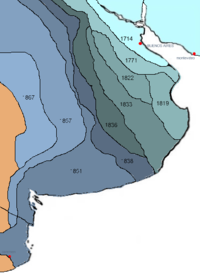
The first step was to connect Buenos Aires and the Fortines (fortresses) with telegraph lines. Then a peace treaty was signed with chieftain
Juan José Catriel, only to be broken shortly after when he attacked, together with chieftain Namuncurá, Tres Arroyos
, Tandil
, Azul
, and other towns and farms in an even bloodier attack than that of 1872.
Alsina answered by attacking the aboriginals, forcing them to fall back, and leaving fortines on his way south to protect the conquered territories. He also constructed the 374 km long trench named Zanja de Alsina
("Alsina's trench") that in theory would serve as a limit to the unconquered territories. With its three metre width and two metre depth, it served as an obstacle for the transport of cattle by the aboriginals.
The aboriginals continued taking cattle from farms in the Buenos Aires Province and south of the Mendoza Province
, but found it difficult to escape as the animals slowed their march, and had to face the patrolling units that would follow them. As the war went on, some aboriginals eventually signed peace treaties and settled among the "christians" behind the lines of forts. Some tribes even allied with the Argentine government and either stood neutral or fought for the Argentine army. In return, they were granted periodical shipments of cattle and food. After Alsina died in 1877, Julio Argentino Roca
was appointed Minister of War, and decided to change Alsina's strategy.
, in contrast to Alsina, believed that the only solution against the aboriginal threat was to extinguish, subdue or expel them.
At the end of 1878 he started the first wave to "clean" the area between the Alsina trench and the Negro river by continuous and systematic attacks to the aboriginals' settlements.
With 6,000 soldiers armed with new breech-loading Remington rifles supplied by the United States, in 1879 he began the second wave reaching Choele Choel
in two months, where the local aboriginals surrendered without resistance. From other points, southbound companies made their way down to the Negro River and the Neuquén River
, a northern tributary of the Negro River. Together, both rivers marked the natural frontier from the Andes
to the Atlantic Ocean
. This attack led to a large migration of Mapuches into the zone around Curarrehue
and Pucón
, Chile.
Many settlements were built on the basin of these two rivers, as well as a number on the Colorado River
. By sea, some settlements were erected on the southern basin of the Chubut River
mainly by Welsh colonists
.
. He thought it was imperative to conquer the territory south of the Negro River as soon as possible, and ordered the 1881 campaign under the control of Colonel Conrado Villegas
.
Within a year Villegas conquered the Neuquén Province
(he reached the Limay River
). The campaign continued to push the aboriginal resistance further south, to fight the last battle on October 18, 1884. The last rebel group of over 3,000 members under the command of chieftains Inacayal and Foyel surrendered two months later in present Chubut Province
.
Julio Argentino Roca
Alejo Julio Argentino Roca Paz was an army general who served as President of Argentina from 12 October 1880 to 12 October 1886 and again from 12 October 1898 to 12 October 1904.-Upbringing and early career:...
in the 1870s, which established Argentine dominance over Patagonia
Patagonia
Patagonia is a region located in Argentina and Chile, integrating the southernmost section of the Andes mountains to the southwest towards the Pacific ocean and from the east of the cordillera to the valleys it follows south through Colorado River towards Carmen de Patagones in the Atlantic Ocean...
, which was inhabited by indigenous peoples. The Conquest is commemorated on the 100 peso bill in Argentina.
Jens Andermann has noted that contemporary sources on the campaign indicate that it was genocide by the Argentine
Argentina
Argentina , officially the Argentine Republic , is the second largest country in South America by land area, after Brazil. It is constituted as a federation of 23 provinces and an autonomous city, Buenos Aires...
government against the indigenous tribes. Others perceive the campaign as intending to suppress specifically those groups of aboriginals that refused to submit to the law and carried out brutal attacks on civilian settlements. This recent argument – usually summarized as "Civilization
Civilization
Civilization is a sometimes controversial term that has been used in several related ways. Primarily, the term has been used to refer to the material and instrumental side of human cultures that are complex in terms of technology, science, and division of labor. Such civilizations are generally...
or Genocide
Genocide
Genocide is defined as "the deliberate and systematic destruction, in whole or in part, of an ethnic, racial, religious, or national group", though what constitutes enough of a "part" to qualify as genocide has been subject to much debate by legal scholars...
?"– questions whether the Conquest of the Desert was really intended to exterminate the aboriginals.
Background
The arrival of the Spanish colonistsSpanish colonization of the Americas
Colonial expansion under the Spanish Empire was initiated by the Spanish conquistadores and developed by the Monarchy of Spain through its administrators and missionaries. The motivations for colonial expansion were trade and the spread of the Christian faith through indigenous conversions...
on the shores of the Río de la Plata
Río de la Plata
The Río de la Plata —sometimes rendered River Plate in British English and the Commonwealth, and occasionally rendered [La] Plata River in other English-speaking countries—is the river and estuary formed by the confluence of the Uruguay River and the Paraná River on the border between Argentina and...
and the foundation of the city of Buenos Aires
Buenos Aires
Buenos Aires is the capital and largest city of Argentina, and the second-largest metropolitan area in South America, after São Paulo. It is located on the western shore of the estuary of the Río de la Plata, on the southeastern coast of the South American continent...
during the 16th century led directly to the first confrontations between the Spanish
Spain
Spain , officially the Kingdom of Spain languages]] under the European Charter for Regional or Minority Languages. In each of these, Spain's official name is as follows:;;;;;;), is a country and member state of the European Union located in southwestern Europe on the Iberian Peninsula...
and the local aboriginal tribes, mainly the Pampas
Querandí
The Querandí were one of the Het peoples, indigenous South Americans who lived in the Pampas area of Argentina; specifically, they were the eastern Didiuhet. The name Querandí was given by the Guaraní people, as they would consume animal fat in their daily diet. Thus, Querandí means "men with...
.
The Buenos Aires hinterland was acquired from the aboriginals to be used for cattle
Cattle
Cattle are the most common type of large domesticated ungulates. They are a prominent modern member of the subfamily Bovinae, are the most widespread species of the genus Bos, and are most commonly classified collectively as Bos primigenius...
raising, which also displaced most of the animals hunted by the aboriginal people. The natives responded by attacking the cities, killing their inhabitants and releasing/stealing cows and horses from the farms. In retaliation, the Europe
Europe
Europe is, by convention, one of the world's seven continents. Comprising the westernmost peninsula of Eurasia, Europe is generally 'divided' from Asia to its east by the watershed divides of the Ural and Caucasus Mountains, the Ural River, the Caspian and Black Seas, and the waterways connecting...
an colonists built fortresses and defended themselves from the frequent attacks.
The frontier
Frontier
A frontier is a political and geographical term referring to areas near or beyond a boundary. 'Frontier' was absorbed into English from French in the 15th century, with the meaning "borderland"--the region of a country that fronts on another country .The use of "frontier" to mean "a region at the...
dividing the colonial farms and the aboriginal territories moved outwards from Buenos Aires; at the end of the 18th century the Salado River
Salado River (Buenos Aires)
The Salado River is a river in northern Buenos Aires Province, Argentina. It originates at El Chañar Lake on the border with Santa Fe Province, above mean sea level, and flows generally southeast for before debouching into Samborombón Bay, part of the Río de la Plata estuary on the Atlantic Ocean...
became the limit between both civilizations. Many aboriginals were forced to abandon their tribes to work on the farms and mix with the white population; in this the way the gaucho
Gaucho
Gaucho is a term commonly used to describe residents of the South American pampas, chacos, or Patagonian grasslands, found principally in parts of Argentina, Uruguay, Southern Chile, and Southern Brazil...
s were born.
After independence in 1816 there were many internal political conflicts between the provinces, but once settled there was an urgent drive to effectively occupy the lands claimed by the young republic, as well as increase the national production and by offering new lands to prospective immigrants.
In 1833 coordinated offensives by Juan Manuel de Rosas
Juan Manuel de Rosas
Juan Manuel de Rosas , was an argentine militar and politician, who was elected governor of the province of Buenos Aires in 1829 to 1835, and then of the Argentine Confederation from 1835 until 1852...
in Buenos Aires Province and other military leaders in the Cuyo region attempted to exterminate resistant tribes, but only Rosas had any success.
By this time Chile
Chile
Chile ,officially the Republic of Chile , is a country in South America occupying a long, narrow coastal strip between the Andes mountains to the east and the Pacific Ocean to the west. It borders Peru to the north, Bolivia to the northeast, Argentina to the east, and the Drake Passage in the far...
had founded Punta Arenas in Magellan Strait in 1845, which threatened the Argentine claims in Patagonia
Patagonia
Patagonia is a region located in Argentina and Chile, integrating the southernmost section of the Andes mountains to the southwest towards the Pacific ocean and from the east of the cordillera to the valleys it follows south through Colorado River towards Carmen de Patagones in the Atlantic Ocean...
. Later in 1861 Chile began the occupation of the Araucanía
Occupation of the Araucanía
The Occupation of Araucanía was a series of military campaigns, agreements and penetrations by the Chilean army and settlers which led to the incorporation of Araucanía into Chilean national territory...
which alarmed Argentine authorities because of Chile's growing influence in the zone. The now defeated Mapuche
Mapuche
The Mapuche are a group of indigenous inhabitants of south-central Chile and southwestern Argentina. They constitute a wide-ranging ethnicity composed of various groups who shared a common social, religious and economic structure, as well as a common linguistic heritage. Their influence extended...
s in Chile had strong ties
Araucanization
The Araucanization of Patagonia was the process of expansion of Mapuche culture, influence and language from Araucanía into the Patagonic plains. Historians disagree in the time of the expansion but it would have occurred sometime between 1550 and 1850. Amerindian peoples such as the Puelches and...
to the nomadic tribes in the east side of the Andes
Andes
The Andes is the world's longest continental mountain range. It is a continual range of highlands along the western coast of South America. This range is about long, about to wide , and of an average height of about .Along its length, the Andes is split into several ranges, which are separated...
, with whom they share the same language
Araucanization
The Araucanization of Patagonia was the process of expansion of Mapuche culture, influence and language from Araucanía into the Patagonic plains. Historians disagree in the time of the expansion but it would have occurred sometime between 1550 and 1850. Amerindian peoples such as the Puelches and...
.
The decision of planning and executing the Conquest of the Desert was probably triggered by the 1872 attack of Calfucurá and his 6,000 followers on the cities of General Alvear
General Alvear, Mendoza
Gral. Alvear is the head city of the General Alvear Department, Mendoza in Mendoza Province, Argentina.Founded on August 12, 1914, it currently has a population of 26,342 , and its UN/LOCODE is ARGVA....
, Veinticinco de Mayo and Nueve de Julio
Nueve de Julio
Nueve de Julio means 9 July in Spanish. It may refer to:* The date of the Argentine Declaration of Independence* One of the following cities and towns in Argentina:** Nueve de Julio, Buenos Aires Province...
, where 300 criollos
Creole peoples
The term Creole and its cognates in other languages — such as crioulo, criollo, créole, kriolu, criol, kreyol, kreol, kriulo, kriol, krio, etc. — have been applied to people in different countries and epochs, with rather different meanings...
were killed, and 200,000 head of cattle taken.
The cattle stolen in the incursions (malones
Malón
Malón or maloca was a military raiding tactic of the Mapuche peoples from the 17th to the 19th centuries.The "maloca" among the Mapuche is described as a means of obtaining justice, by Juan Ignacio Molina:...
) would later be taken to Chile through the Rastrillada de los chilenos
Camino de los chilenos
Rastrillada de los chilenos or Camino de los chilenos were a group of routes in the Patagonean pampas used by Mapuches and related araucanized tribes to head cattle stolen during malones from Argentina to Chile across the Andes...
and traded for goods. There is evidence that Chilean authorities knew about this, and gave their consent, expecting to strengthen their influence over Patagonian territories they expected to eventually occupy in the future.
Alsina's campaign
Adolfo Alsina
Adolfo Alsina Maza was an Argentine lawyer and Unitarian politician, and one of the founders of the Partido Autonomista and the National Autonomist Party.-Biography:...
, Minister of War under President
President of Argentina
The President of the Argentine Nation , usually known as the President of Argentina, is the head of state of Argentina. Under the national Constitution, the President is also the chief executive of the federal government and Commander-in-Chief of the armed forces.Through Argentine history, the...
Nicolás Avellaneda
Nicolás Avellaneda
Nicolás Remigio Aurelio Avellaneda Silva was an Argentine politician and journalist, and president of Argentina from 1874 to 1880. Avellaneda's main projects while in office were banking and education reform, leading to Argentina's economic growth...
, presented the government with a plan which he later described as aiming to populate the desert, and not to destroy the Indians.
The first step was to connect Buenos Aires and the Fortines (fortresses) with telegraph lines. Then a peace treaty was signed with chieftain
Lonco
A lonco or lonko is a tribal chief of the Mapuches. These were often Ulmen, the wealthier men in the lof. In wartime loncos of the various local rehue or the larger aillarehue would gather in a koyag or parliament and would elect a toqui to lead the warriors in battle...
Juan José Catriel, only to be broken shortly after when he attacked, together with chieftain Namuncurá, Tres Arroyos
Tres Arroyos
Tres Arroyos is a city in Buenos Aires Province, Argentina. It is the capital of the Tres Arroyos Partido.The city has a sizable population of Dutch and Danish descent.- Archaeological site :...
, Tandil
Tandil
-Place name:The name of the city comes from the Mapuche words tan , and lil . It is probably a reference to the Piedra Movediza , a large boulder which stood seemingly miraculously balanced on the edge of a rocky foothill. The Moving Stone toppled on February 29, 1912, and split into two pieces at...
, Azul
Azul, Buenos Aires
Azul is the head city of the Azul Partido, located at the center of the Buenos Aires Province in Argentina, 300 km south of Buenos Aires. It has 63,000 inhabitants as per the ....
, and other towns and farms in an even bloodier attack than that of 1872.
Alsina answered by attacking the aboriginals, forcing them to fall back, and leaving fortines on his way south to protect the conquered territories. He also constructed the 374 km long trench named Zanja de Alsina
Zanja de Alsina
Zanja de Alsina were a system of trenches and wooden watchtowers built in the centre and south of the Buenos Aires Province to defend the territories of the federal government against Mapuches malones. The three-meter wide trench was reinforced with 80 small strongholds and garrisons, called...
("Alsina's trench") that in theory would serve as a limit to the unconquered territories. With its three metre width and two metre depth, it served as an obstacle for the transport of cattle by the aboriginals.
The aboriginals continued taking cattle from farms in the Buenos Aires Province and south of the Mendoza Province
Mendoza Province
The Province of Mendoza is a province of Argentina, located in the western central part of the country in the Cuyo region. It borders to the north with San Juan, the south with La Pampa and Neuquén, the east with San Luis, and to the west with the republic of Chile; the international limit is...
, but found it difficult to escape as the animals slowed their march, and had to face the patrolling units that would follow them. As the war went on, some aboriginals eventually signed peace treaties and settled among the "christians" behind the lines of forts. Some tribes even allied with the Argentine government and either stood neutral or fought for the Argentine army. In return, they were granted periodical shipments of cattle and food. After Alsina died in 1877, Julio Argentino Roca
Julio Argentino Roca
Alejo Julio Argentino Roca Paz was an army general who served as President of Argentina from 12 October 1880 to 12 October 1886 and again from 12 October 1898 to 12 October 1904.-Upbringing and early career:...
was appointed Minister of War, and decided to change Alsina's strategy.
Roca's campaign
Julio Argentino RocaJulio Argentino Roca
Alejo Julio Argentino Roca Paz was an army general who served as President of Argentina from 12 October 1880 to 12 October 1886 and again from 12 October 1898 to 12 October 1904.-Upbringing and early career:...
, in contrast to Alsina, believed that the only solution against the aboriginal threat was to extinguish, subdue or expel them.
At the end of 1878 he started the first wave to "clean" the area between the Alsina trench and the Negro river by continuous and systematic attacks to the aboriginals' settlements.
With 6,000 soldiers armed with new breech-loading Remington rifles supplied by the United States, in 1879 he began the second wave reaching Choele Choel
Choele Choel
Choele Choel is the capital of the department of Avellaneda in the Argentine province of Río Negro, and the most important settlement within the Valle Medio agricultural area of the Río Negro River in Patagonia-Overview:...
in two months, where the local aboriginals surrendered without resistance. From other points, southbound companies made their way down to the Negro River and the Neuquén River
Neuquén River
The Neuquén River is the second most important river of the province of Neuquén in the Argentine Patagonia, after the Limay River.The river is born at the northwest of the province at an altitude of 2,300 metres, to be feed by a number of streams through valleys of the lower Andes while advancing...
, a northern tributary of the Negro River. Together, both rivers marked the natural frontier from the Andes
Andes
The Andes is the world's longest continental mountain range. It is a continual range of highlands along the western coast of South America. This range is about long, about to wide , and of an average height of about .Along its length, the Andes is split into several ranges, which are separated...
to the Atlantic Ocean
Atlantic Ocean
The Atlantic Ocean is the second-largest of the world's oceanic divisions. With a total area of about , it covers approximately 20% of the Earth's surface and about 26% of its water surface area...
. This attack led to a large migration of Mapuches into the zone around Curarrehue
Curarrehue
Curarrehue is a town and commune in Cautín Province of Araucanía Region, Chile. The origin of Curarrehue dates back to the occupation of Araucanía and the Conquest of the Desert by the Chilean and Argentine army respectively in the 1870s and 1880s when Mapuches were pushed by the Argentine Army...
and Pucón
Pucón
Pucón is a Chilean city and commune administered by the municipality of Pucón located in the Province of Cautín, Araucanía Region, 100 km to the southeast of Temuco and 780 km to the south of Santiago....
, Chile.
Many settlements were built on the basin of these two rivers, as well as a number on the Colorado River
Colorado River (Argentina)
The Colorado River is a river in the south of Argentina.The Colorado river marks most of the political limit between the provinces of Neuquén and Mendoza, and between Rio Negro and La Pampa...
. By sea, some settlements were erected on the southern basin of the Chubut River
Chubut River
The Chubut River is located in the Patagonia region of southern Argentina. Its name comes from the Tehuelche word chupat, which means "transparent". The Argentine Chubut Province, through which the river flows, is named after it...
mainly by Welsh colonists
Welsh settlement in Argentina
Y Wladfa refers to the Welsh settlement in Argentina, which began in 1865 and occurred mainly along the coast of Chubut Province in the far southern region of Patagonia...
.
The final campaign
Roca followed Nicolás Avellaneda as presidentPresident of Argentina
The President of the Argentine Nation , usually known as the President of Argentina, is the head of state of Argentina. Under the national Constitution, the President is also the chief executive of the federal government and Commander-in-Chief of the armed forces.Through Argentine history, the...
. He thought it was imperative to conquer the territory south of the Negro River as soon as possible, and ordered the 1881 campaign under the control of Colonel Conrado Villegas
Conrado Villegas
Conrado Villegas was an Argentine general in the 1880s during the presidency of Julio Argentino Roca. He is famous for his campaigns in Neuquén and Río Negro during the Conquest of the Desert to subdue the indigenous population in the south of Argentina. The town of General Villegas, in the...
.
Within a year Villegas conquered the Neuquén Province
Neuquén Province
Neuquén is a province of Argentina, located in the west of the country, at the northern end of Patagonia. It borders Mendoza Province to the north, Rio Negro Province to the southeast, and Chile to the west...
(he reached the Limay River
Limay River
The Limay River is an important river in the northwestern Argentine Patagonia . It is born at the eastern end of the Nahuel Huapi Lake and flows in a meandering path for about 380 km, collecting the waters of several tributaries, such as the Traful, the Pichileufú and the Collón Curá. It then meets...
). The campaign continued to push the aboriginal resistance further south, to fight the last battle on October 18, 1884. The last rebel group of over 3,000 members under the command of chieftains Inacayal and Foyel surrendered two months later in present Chubut Province
Chubut Province
Chubut a province in the southern part of Argentina situated between the 42nd parallel south and the 46th parallel south , the Andes range separating Argentina from Chile, and the Atlantic ocean...
.
See also
- Araucanization of Patagonia
- Occupation of the AraucaníaOccupation of the AraucaníaThe Occupation of Araucanía was a series of military campaigns, agreements and penetrations by the Chilean army and settlers which led to the incorporation of Araucanía into Chilean national territory...
- Kingdom of Araucania and PatagoniaKingdom of Araucania and PatagoniaThe Kingdom of Araucanía and Patagonia was the name of a state and kingdom created in the 19th century by a French lawyer and adventurer named Orélie-Antoine de Tounens. Orélie-Antoine de Tounens claimed the regions of Araucanía and eastern Patagonia hence the name of kingdom...
- Terra nulliusTerra nulliusTerra nullius is a Latin expression deriving from Roman law meaning "land belonging to no one" , which is used in international law to describe territory which has never been subject to the sovereignty of any state, or over which any prior sovereign has expressly or implicitly relinquished...
- Napalpí massacreNapalpí massacreThe Napalpí massacre occurred on July 19, 1924 in Napalpí in the Chaco Province of Northeast Argentina. It involved the massacre of 200 indigenous people of the Toba ethnicity by the Argentine Police and ranchers.-Historical context:...
- Population history of American indigenous peoplesPopulation history of American indigenous peoplesThe population figures for Indigenous peoples in the Americas before the 1492 voyage of Christopher Columbus have proven difficult to establish and rely on archaeological data and written records from European settlers...
Further reading
- "Nicolás Avellaneda", biography by Felipe PignaFelipe PignaFelipe Pigna, born in Mercedes, Buenos Aires, in 1959, is an Argentine historian and writer. He's currently among the best selling book authors from Argentina.- Biography :...
- "Economical consequences of the Conquest of the Desert" - Universidad del CEMA
- "Effective occupation of the Patagonic region by the Argentine government" - Universidad del CEMA
- "Campaña del Desierto" - Olimpiadas Nacionales de Contenidos Educativos en Internet
- "La Guerra del Desierto", different views by Juan José Cresto, Osvaldo Bayer and others - ElOrtiba.org
- Hasbrouck, Alfred. The Conquest of the DesertThe Hispanic American Historical Review, Vol. 15, No. 2 (May, 1935), pp. 195–228
- Commandante Manuel Prado: La guerra al Malón 1907
- New edition: Manuel Prado: La guerra al Malón (The War against the Indians), Editorial Claridad SA, Buenos Aires ISBN 978-950-620-206-4
- Staff, Conquest-of-the-Desert and effect on colonization in Patagonia Encyclopaedia Britannica