

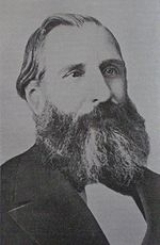
Adolfo Alsina

Encyclopedia
Adolfo Alsina Maza was an Argentine
lawyer and Unitarian
politician, and one of the founders of the Partido Autonomista and the National Autonomist Party
.
politician Valentín Alsina
and Antonia Maza (daughter of Manuel Vicente Maza
), Alsina moved to Montevideo
, Uruguay
when Juan Manuel de Rosas
became Governor of Buenos Aires Province
for the second time, in 1835.
In the neighbouring country Alsina started his law studies.
After the Battle of Caseros
in 1852, his family returned to Argentina, and his father was named a Minister by president
Vicente López y Planes
.
Adolfo finished law school and joined the Unitarian army in the civil war. In 1860, after the Battle of Pavón
and the National Union Pact, he took part in the commission responsible for the constitution
reform of 1860. He was elected a deputy
in 1862.
When the subject of federalisation, supported by Bartolomé Mitre
, was considered in the Chamber of Deputies, Alsina provoked a split in the Partido Unitario and founded the Partido Autonomista.
In 1866 he was elected governor of the Buenos Aires Province. Alsina considered running for president, but withdrew when he discovered he did not have the support of most of the province. Domingo Sarmiento was elected president, and named Alsina his vice-president.
When the presidency of Sarmiento finished in 1874, Alsina joined Nicolás Avellaneda
to create the Partido Autonomista Nacional, through which Avellaneda reached the presidency and named Alsina Minister of War and Navy.
At the end of 1875, the Native Americans
of Patagonia
and the Pampa
s, especially the Mapuche
, launched organised attacks against the territorial expansion of the southern border of the emerging nation'. The first stage of the Conquest of the Desert
began with the creation of a two meter deep, three meter wide trench called zanja de Alsina
to prevent the free movement of horses and stolen cattle.
Alsina also ordered the creation of forts intercommunicated by telegraph.
Trying to understand the native peoples, he decided to study the situation personally; but he fell ill while in the pampas town of Carhué
, and died of renal failure
.
Argentina
Argentina , officially the Argentine Republic , is the second largest country in South America by land area, after Brazil. It is constituted as a federation of 23 provinces and an autonomous city, Buenos Aires...
lawyer and Unitarian
Unitarian Party
Unitarianists or Unitarians were the proponents of the concept of a Unitary state in Buenos Aires during the civil wars which shortly followed the Declaration of Independence of Argentina in 1816. They were opposed to the Argentine Federalists, who wanted a federation of independent provinces...
politician, and one of the founders of the Partido Autonomista and the National Autonomist Party
National Autonomist Party
The National Autonomist Party was an Argentine political party during the 1874-1916 period. Created on March 15, 1874 by the union of the Autonomist Party of Adolfo Alsina and the National Party of Nicolás Avellaneda...
.
Biography
Son of the UnitarianUnitarian Party
Unitarianists or Unitarians were the proponents of the concept of a Unitary state in Buenos Aires during the civil wars which shortly followed the Declaration of Independence of Argentina in 1816. They were opposed to the Argentine Federalists, who wanted a federation of independent provinces...
politician Valentín Alsina
Valentín Alsina
*For the city, see Valentín Alsina, Buenos Aires.Valentín Alsina was an Argentine lawyer and politician.Alsina was born in Buenos Aires and studied law at the University of Córdoba. He occupied diverse posts in government, and had a successful civil career as an advocate and professor of law at...
and Antonia Maza (daughter of Manuel Vicente Maza
Manuel Vicente Maza
Manuel Vicente Maza was an Argentine lawyer and federal politician. He was governor of Buenos Aires, and was killed after the discovery of a failed plot to kill Juan Manuel de Rosas.-Biography:...
), Alsina moved to Montevideo
Montevideo
Montevideo is the largest city, the capital, and the chief port of Uruguay. The settlement was established in 1726 by Bruno Mauricio de Zabala, as a strategic move amidst a Spanish-Portuguese dispute over the platine region, and as a counter to the Portuguese colony at Colonia del Sacramento...
, Uruguay
Uruguay
Uruguay ,officially the Oriental Republic of Uruguay,sometimes the Eastern Republic of Uruguay; ) is a country in the southeastern part of South America. It is home to some 3.5 million people, of whom 1.8 million live in the capital Montevideo and its metropolitan area...
when Juan Manuel de Rosas
Juan Manuel de Rosas
Juan Manuel de Rosas , was an argentine militar and politician, who was elected governor of the province of Buenos Aires in 1829 to 1835, and then of the Argentine Confederation from 1835 until 1852...
became Governor of Buenos Aires Province
Buenos Aires Province
The Province of Buenos Aires is the largest and most populous province of Argentina. It takes the name from the city of Buenos Aires, which used to be the provincial capital until it was federalized in 1880...
for the second time, in 1835.
In the neighbouring country Alsina started his law studies.
After the Battle of Caseros
Battle of Caseros
The Battle of Caseros was fought near the town of Caseros, more precisely between the present-day train stations of Caseros and Palomar in Buenos Aires Province, Argentina, on 3 February 1852, between the Army of Buenos Aires commanded by Juan Manuel de Rosas...
in 1852, his family returned to Argentina, and his father was named a Minister by president
President of Argentina
The President of the Argentine Nation , usually known as the President of Argentina, is the head of state of Argentina. Under the national Constitution, the President is also the chief executive of the federal government and Commander-in-Chief of the armed forces.Through Argentine history, the...
Vicente López y Planes
Vicente López y Planes
Alejandro Vicente López y Planes was an Argentine writer and politician who acted as interim President of Argentina from July 7, 1827 to August 18, 1827...
.
Adolfo finished law school and joined the Unitarian army in the civil war. In 1860, after the Battle of Pavón
Battle of Pavón
The Battle of Pavón was a key battle of the Argentine civil wars fought in Pavón, in Santa Fé Province, Argentina, on September 17, 1861, between the Army of Buenos Aires, commanded by Bartolomé Mitre, and the National Army, commanded by Justo José de Urquiza...
and the National Union Pact, he took part in the commission responsible for the constitution
Constitution of Argentina
The constitution of Argentina is one of the primary sources of existing law in Argentina. Its first version was written in 1853 by a Constitutional Assembly gathered in Santa Fe, and the doctrinal basis was taken in part from the United States Constitution...
reform of 1860. He was elected a deputy
Argentine Chamber of Deputies
The Chamber of Deputies is the lower house of the Argentine National Congress. This Chamber holds exclusive rights to create taxes, to draft troops, and to accuse the President, the ministers and the members of the Supreme Court before the Senate....
in 1862.
When the subject of federalisation, supported by Bartolomé Mitre
Bartolomé Mitre
Bartolomé Mitre Martínez was an Argentine statesman, military figure, and author. He was the President of Argentina from 1862 to 1868.-Life and times:...
, was considered in the Chamber of Deputies, Alsina provoked a split in the Partido Unitario and founded the Partido Autonomista.
In 1866 he was elected governor of the Buenos Aires Province. Alsina considered running for president, but withdrew when he discovered he did not have the support of most of the province. Domingo Sarmiento was elected president, and named Alsina his vice-president.
When the presidency of Sarmiento finished in 1874, Alsina joined Nicolás Avellaneda
Nicolás Avellaneda
Nicolás Remigio Aurelio Avellaneda Silva was an Argentine politician and journalist, and president of Argentina from 1874 to 1880. Avellaneda's main projects while in office were banking and education reform, leading to Argentina's economic growth...
to create the Partido Autonomista Nacional, through which Avellaneda reached the presidency and named Alsina Minister of War and Navy.
At the end of 1875, the Native Americans
Indigenous peoples of the Americas
The indigenous peoples of the Americas are the pre-Columbian inhabitants of North and South America, their descendants and other ethnic groups who are identified with those peoples. Indigenous peoples are known in Canada as Aboriginal peoples, and in the United States as Native Americans...
of Patagonia
Patagonia
Patagonia is a region located in Argentina and Chile, integrating the southernmost section of the Andes mountains to the southwest towards the Pacific ocean and from the east of the cordillera to the valleys it follows south through Colorado River towards Carmen de Patagones in the Atlantic Ocean...
and the Pampa
Pampa
The Pampas are the fertile South American lowlands, covering more than , that include the Argentine provinces of Buenos Aires, La Pampa, Santa Fe, Entre Ríos and Córdoba, most of Uruguay, and the southernmost Brazilian State, Rio Grande do Sul...
s, especially the Mapuche
Mapuche
The Mapuche are a group of indigenous inhabitants of south-central Chile and southwestern Argentina. They constitute a wide-ranging ethnicity composed of various groups who shared a common social, religious and economic structure, as well as a common linguistic heritage. Their influence extended...
, launched organised attacks against the territorial expansion of the southern border of the emerging nation'. The first stage of the Conquest of the Desert
Conquest of the Desert
The Conquest of the Desert was a military campaign directed mainly by General Julio Argentino Roca in the 1870s, which established Argentine dominance over Patagonia, which was inhabited by indigenous peoples...
began with the creation of a two meter deep, three meter wide trench called zanja de Alsina
Zanja de Alsina
Zanja de Alsina were a system of trenches and wooden watchtowers built in the centre and south of the Buenos Aires Province to defend the territories of the federal government against Mapuches malones. The three-meter wide trench was reinforced with 80 small strongholds and garrisons, called...
to prevent the free movement of horses and stolen cattle.
Alsina also ordered the creation of forts intercommunicated by telegraph.
Trying to understand the native peoples, he decided to study the situation personally; but he fell ill while in the pampas town of Carhué
Carhué
Carhué is an Argentine town in the Province of Buenos Aires, head of the Municipality of Adolfo Alsina. Carhué is about 561 km to the west of the city of La Plata and about 520 km from Buenos Aires...
, and died of renal failure
Renal failure
Renal failure or kidney failure describes a medical condition in which the kidneys fail to adequately filter toxins and waste products from the blood...
.