


Codex Leicester

Encyclopedia
Leonardo da Vinci
Leonardo di ser Piero da Vinci was an Italian Renaissance polymath: painter, sculptor, architect, musician, scientist, mathematician, engineer, inventor, anatomist, geologist, cartographer, botanist and writer whose genius, perhaps more than that of any other figure, epitomized the Renaissance...
. The codex
Codex
A codex is a book in the format used for modern books, with multiple quires or gatherings typically bound together and given a cover.Developed by the Romans from wooden writing tablets, its gradual replacement...
is named after Thomas Coke
Thomas Coke, 1st Earl of Leicester (fifth creation)
Thomas Coke, 1st Earl of Leicester, KB was a wealthy English land-owner and patron of the arts. He is particularly noted for commissioning the design and construction of Holkham Hall in north Norfolk. Between 1722 and 1728, he was Member of Parliament for Norfolk.He was the son of Edward Coke ...
, later created Earl of Leicester
Earl of Leicester
The title Earl of Leicester was created in the 12th century in the Peerage of England , and is currently a title in the Peerage of the United Kingdom, created in 1837.-Early creations:...
, who purchased it in 1717. Of Leonardo's 30 scientific journals, the Codex may be the most famous of all.
The Codex provides an insight into the inquiring mind of the definitive Renaissance
Renaissance
The Renaissance was a cultural movement that spanned roughly the 14th to the 17th century, beginning in Italy in the Late Middle Ages and later spreading to the rest of Europe. The term is also used more loosely to refer to the historical era, but since the changes of the Renaissance were not...
artist, scientist and thinker as well as an exceptional illustration of the link between art and science and the creativity of the scientific process.
The manuscript does not take the form of a single linear script, but is rather a mixture of Leonardo's observations and theories on astronomy
Astronomy
Astronomy is a natural science that deals with the study of celestial objects and phenomena that originate outside the atmosphere of Earth...
; the properties of water, rocks, and fossils; air, and celestial light. The topics addressed include:
- an explanation of why fossilFossilFossils are the preserved remains or traces of animals , plants, and other organisms from the remote past...
s can be found on mountains. Hundreds of years before plate tectonicsPlate tectonicsPlate tectonics is a scientific theory that describes the large scale motions of Earth's lithosphere...
became accepted scientific theory, Leonardo believed that mountains had previously formed sea beds, which were gradually lifted until they formed mountains. - the movement of water. This is the main topic of the Codex. Among other things, Leonardo wrote about the flow of water in rivers, and how it is affected by different obstacles put in its way. From his observations he made recommendations about bridge construction and erosionErosionErosion is when materials are removed from the surface and changed into something else. It only works by hydraulic actions and transport of solids in the natural environment, and leads to the deposition of these materials elsewhere...
. - the luminosity of the moonMoonThe Moon is Earth's only known natural satellite,There are a number of near-Earth asteroids including 3753 Cruithne that are co-orbital with Earth: their orbits bring them close to Earth for periods of time but then alter in the long term . These are quasi-satellites and not true moons. For more...
. Leonardo speculated that the moon's surface is covered by water, which reflects light from the sun. In this model, waves on the water's surface cause the light to be reflected in many directions, explaining why the moon is not as bright as the sun. Leonardo explained that the pale glow on the dark portion of the crescent moon is caused by sunlight reflected from the Earth. Thus, he described the phenomenon of planetshinePlanetshineThe phenomenon known as planetshine occurs when reflected sunlight from a planet illuminates the night side of one of its moons. Typically, this results in the moon's night side being bathed in a soft, faint light. The best known example of planetshine is earthshine, which can be seen from Earth...
one hundred years before the German astronomer, Johannes KeplerJohannes KeplerJohannes Kepler was a German mathematician, astronomer and astrologer. A key figure in the 17th century scientific revolution, he is best known for his eponymous laws of planetary motion, codified by later astronomers, based on his works Astronomia nova, Harmonices Mundi, and Epitome of Copernican...
, proved it.
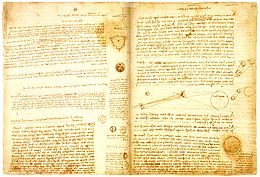
Physically, the Codex takes the form of 18 sheets of paper, each folded in half and written on both sides, forming the complete 72-page document. At one time the sheets were bound together, but they are now displayed separately. It was handwritten in Italian
Italian language
Italian is a Romance language spoken mainly in Europe: Italy, Switzerland, San Marino, Vatican City, by minorities in Malta, Monaco, Croatia, Slovenia, France, Libya, Eritrea, and Somalia, and by immigrant communities in the Americas and Australia...
by Leonardo, using his characteristic mirror writing
Mirror writing
Mirror writing is formed by writing in the direction that is the reverse of the natural way for a given language, such that the result is the mirror image of normal writing: it appears normal when it is reflected in a mirror. It is sometimes used as an extremely primitive form of cipher...
, and supported by copious drawings and diagrams.
The Codex was purchased in 1980 by wealthy industrialist and art collector Armand Hammer
Armand Hammer
Armand Hammer was an American business tycoon most closely associated with Occidental Petroleum, a company he ran for decades, though he was known as well as for his art collection, his philanthropy, and for his close ties to the Soviet Union.Thanks to business interests around the world and his...
from the Leicester estate, and renamed the Codex Hammer.
In 1994, Bill Gates
Bill Gates
William Henry "Bill" Gates III is an American business magnate, investor, philanthropist, and author. Gates is the former CEO and current chairman of Microsoft, the software company he founded with Paul Allen...
bought it at an auction for US$30.8 million, making it the most expensive book ever sold, and he subsequently renamed it the Codex Leicester.
The Codex is put on public display once a year in a different city around the world. In 2004, it was exhibited in the Château de Chambord
Château de Chambord
The royal Château de Chambord at Chambord, Loir-et-Cher, France is one of the most recognizable châteaux in the world because of its very distinct French Renaissance architecture which blends traditional French medieval forms with classical Renaissance structures.The building, which was never...
, and in 2005 in Tokyo
Tokyo
, ; officially , is one of the 47 prefectures of Japan. Tokyo is the capital of Japan, the center of the Greater Tokyo Area, and the largest metropolitan area of Japan. It is the seat of the Japanese government and the Imperial Palace, and the home of the Japanese Imperial Family...
. One page was exhibited at the Seattle Museum of Flight's 2006 exhibit "Leonardo da Vinci: Man, Inventor, Genius." From June to August 2007, the codex was the centerpiece of a two-month exhibition hosted by the Chester Beatty Library
Chester Beatty Library
The Chester Beatty Library was established in Dublin, Ireland in 1950, to house the collections of mining magnate, Sir Alfred Chester Beatty. The present library, on the grounds of Dublin Castle, opened on February 7, 2000, the 125th anniversary of Sir Alfred's birth and was named European Museum...
in Dublin, Ireland
Ireland
Ireland is an island to the northwest of continental Europe. It is the third-largest island in Europe and the twentieth-largest island on Earth...
.
After Gates acquired the Codex, he had its pages scanned into digital image files, some of which were later distributed as screen saver and wallpaper
Wallpaper
Wallpaper is a kind of material used to cover and decorate the interior walls of homes, offices, and other buildings; it is one aspect of interior decoration. It is usually sold in rolls and is put onto a wall using wallpaper paste...
files on a CD-ROM
CD-ROM
A CD-ROM is a pre-pressed compact disc that contains data accessible to, but not writable by, a computer for data storage and music playback. The 1985 “Yellow Book” standard developed by Sony and Philips adapted the format to hold any form of binary data....
as Microsoft Plus! for Windows 95. A comprehensive CD-ROM version (simply titled Leonardo da Vinci) was released by Corbis
Corbis
Corbis Corporation is an American company, based in Seattle, Washington, that licenses the rights to photographs, footage and other visual media...
in 1997.